08/18/15©Lawrence M. Hinman 1
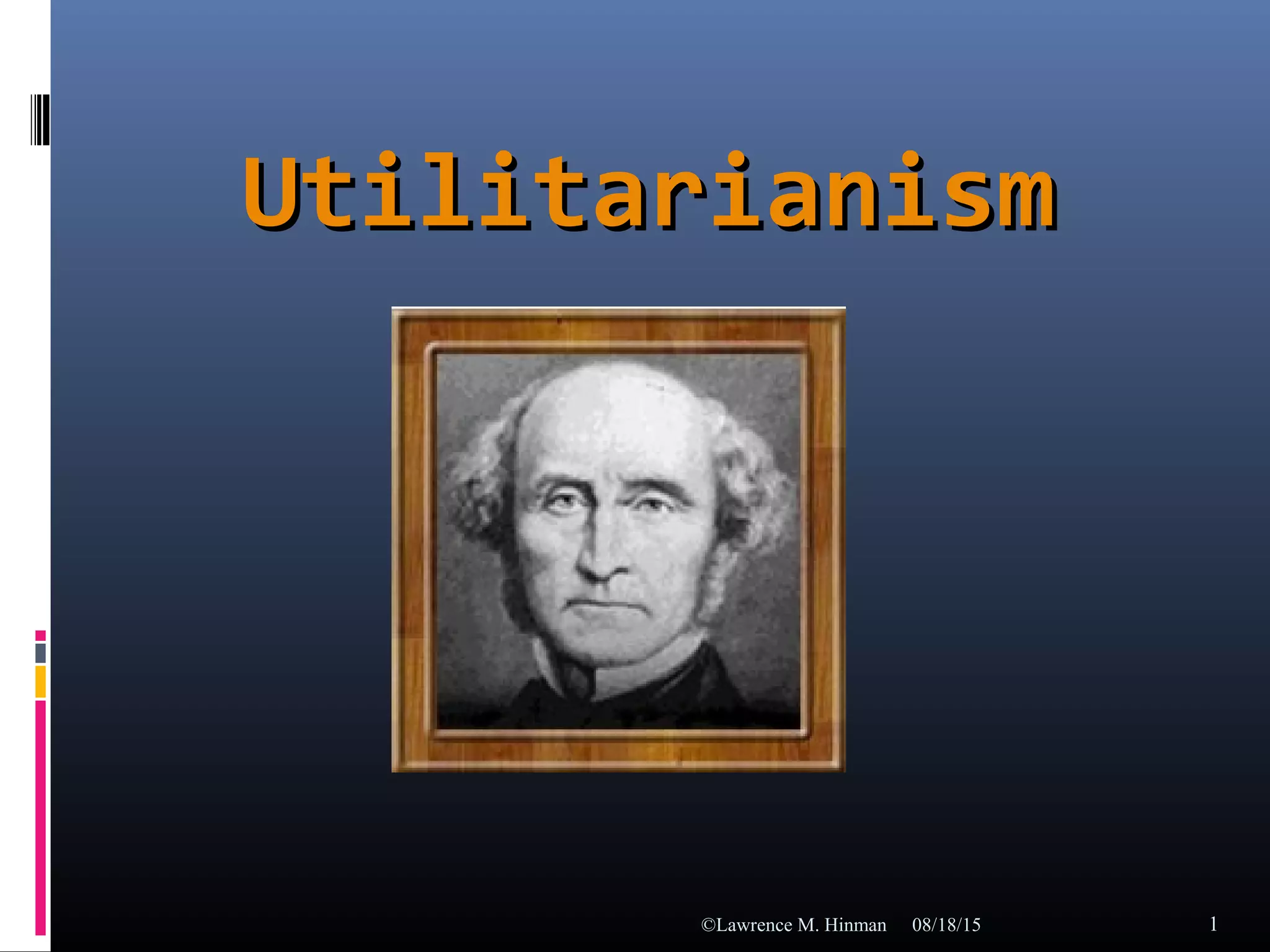
UtilitarianismUtilitarianism
Part One.Part One.
Fundamental TenetsFundamental Tenets
ofof
UtilitarianismUtilitarianism
08/18/15 2
Basic Insights of
Utilitarianism
 The purpose of morality is to make the world
a better place.
 Morality is about producing good
consequences, not having good intentions
 We should do whatever will bring the most
benefit (i.e., intrinsic value) to all of humanity.
08/18/15©Lawrence M. Hinman 3
The Purpose of Morality
 The utilitarian has a very simple answer to the
question of why morality exists at all:
 The purpose of morality is to guide people’s
actions in such a way as to produce a better world.
 Consequently, the emphasis in utilitarianism
is on consequences, not intentions.
08/18/15©Lawrence M. Hinman 4
Fundamental Imperative
 The fundamental imperative of utilitarianism
is:
Always act in the way that will produce the greatest
overall amount of good in the world.
 The emphasis is clearly on consequences, not
intentions.
08/18/15©Lawrence M. Hinman 5
The Emphasis on the Overall Good
 We often speak of “utilitarian” solutions in a
disparaging tone, but in fact utilitarianism is a
demanding moral position that often asks us to
put aside self-interest for the sake of the whole.
 Utilitarianism is a morally demanding position for
two reasons:
 It always asks us to do the most, to maximize utility,
not to do the minimum.
 It asks us to set aside personal interest.
08/18/15©Lawrence M. Hinman 6
The Dream of Utilitarianism:
Bringing Scientific Certainty to
Ethics
 Utilitarianism offers us a powerful vision of the
moral life, one that promises to reduce or
eliminate moral disagreement.
 If we can agree that the purpose of morality is to make
the world a better place; and
 If we can scientifically assess various possible courses
of action to determine which will have the greatest
positive effect on the world; then
 We can provide a scientific answer to the question of
what we ought to do.
08/18/15©Lawrence M. Hinman 7
Part Two.Part Two.
Standards of Utility:Standards of Utility:
A History ofA History of
UtilitarianismUtilitarianism
08/18/15©Lawrence M. Hinman 8
Intrinsic Value
 Many things have instrumental value, that is, they have
value as means to an end.
 However, there must be some things which are not
merely instrumental, but have value in themselves. This
is what we call intrinsic value.
 What has intrinsic value? Four principal candidates:
 Pleasure
 Jeremy Bentham
 Happiness
 John Stuart Mill
 Ideals
 G. E. Moore
 Preferences
 Kenneth Arrow
08/18/15©Lawrence M. Hinman 9
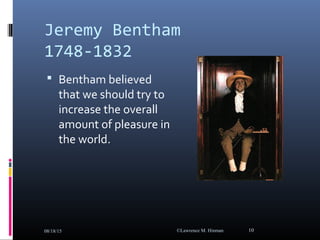
Jeremy Bentham
1748-1832
 Bentham believed
that we should try to
increase the overall
amount of pleasure in
the world.
08/18/15 ©Lawrence M. Hinman 10
Pleasure
 Definition:
 The enjoyable feeling we
experience when a state of
deprivation is replaced by
fulfillment.
 Advantages
 Easy to quantify
 Short duration
 Bodily
 Criticisms
 Came to be known as
“the pig’s philosophy”
 Ignores higher values
 Could justify living on a
pleasure machine
08/18/15©Lawrence M. Hinman 11
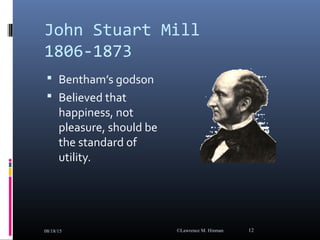
John Stuart Mill
1806-1873
 Bentham’s godson
 Believed that
happiness, not
pleasure, should be
the standard of
utility.
08/18/15 ©Lawrence M. Hinman 12
Happiness
 Advantages
 A higher standard, more
specific to humans
 About realization of
goals
 Disadvantages
 More difficult to
measure
 Competing conceptions
of happiness
08/18/15©Lawrence M. Hinman 13
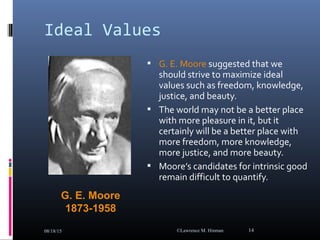
Ideal Values
 G. E. Moore suggested that we
should strive to maximize ideal
values such as freedom, knowledge,
justice, and beauty.
 The world may not be a better place
with more pleasure in it, but it
certainly will be a better place with
more freedom, more knowledge,
more justice, and more beauty.
 Moore’s candidates for intrinsic good
remain difficult to quantify.
08/18/15 ©Lawrence M. Hinman 14
G. E. Moore
1873-1958
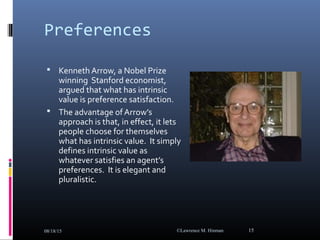
Preferences
 Kenneth Arrow, a Nobel Prize
winning Stanford economist,
argued that what has intrinsic
value is preference satisfaction.
 The advantage of Arrow’s
approach is that, in effect, it lets
people choose for themselves
what has intrinsic value. It simply
defines intrinsic value as
whatever satisfies an agent’s
preferences. It is elegant and
pluralistic.
08/18/15 ©Lawrence M. Hinman 15
Part Three.Part Three.
The UtilitarianThe Utilitarian
CalculusCalculus
08/18/15©Lawrence M. Hinman 16
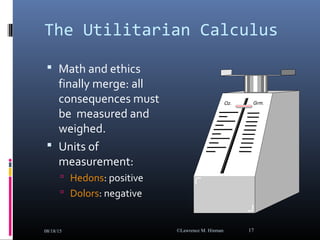
The Utilitarian Calculus
 Math and ethics
finally merge: all
consequences must
be measured and
weighed.
 Units of
measurement:
 Hedons: positive
 Dolors: negative
08/18/15 ©Lawrence M. Hinman 17
What do we calculate?
 Hedons/dolors may be defined in terms of
 Pleasure
 Happiness
 Ideals
 Preferences
 For any given action, we must calculate:
 How many people will be affected, negatively (dolors) as well as
positively (hedons)
 How intensely they will be affected
 Similar calculations for all available alternatives
 Choose the action that produces the greatest overall amount of
utility (hedons minus dolors)
08/18/15©Lawrence M. Hinman 18
Example:
Debating the school lunch program
Utilitarians would have to calculate:
 Benefits
 Increased nutrition for x number of children
 Increased performance, greater long-range chances of success
 Incidental benefits to contractors, etc.
 Costs
 Cost to each taxpayer
 Contrast with other programs that could have been funded and
with lower taxes (no program)
 Multiply each factor by
 Number of individuals affected
 Intensity of effects
08/18/15©Lawrence M. Hinman 19
How much can we quantify?
 Pleasure and preference satisfaction are easier to
quantify than happiness or ideals
 Two distinct issues:
 Can everything be quantified?
 Some would maintain that some of the most important things in life
(love, family, etc.) cannot easily be quantified, while other things
(productivity, material goods) may get emphasized precisely because
they are quantifiable.
 The danger: if it can’t be counted, it doesn’t count.
 Are quantified goods necessarily commensurable?
 Are a fine dinner and a good night’s sleep commensurable? Can one
be traded or substituted for the other?
08/18/15©Lawrence M. Hinman 20
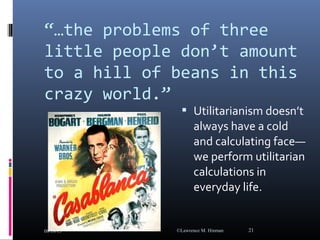
“…the problems of three
little people don’t amount
to a hill of beans in this
crazy world.”
 Utilitarianism doesn’t
always have a cold
and calculating face—
we perform utilitarian
calculations in
everyday life.
08/18/15 ©Lawrence M. Hinman 21
Star Trek: The Wrath of
Khan
 The needs of the many outweigh the
needs of the few—or the one.
08/18/15 ©Lawrence M. Hinman 22
Part Four.Part Four.
Act and RuleAct and Rule
UtilitarianismUtilitarianism
08/18/15©Lawrence M. Hinman 23
Act and Rule Utilitarianism
 Act utilitarianism
 Looks at the consequences of each individual act
and calculate utility each time the act is
performed.
 Rule utilitarianism
 Looks at the consequences of having everyone
follow a particular rule and calculates the overall
utility of accepting or rejecting the rule.
08/18/15©Lawrence M. Hinman 24
An Example
 Imagine the following scenario. A prominent and much-loved leader has
been rushed to the hospital, grievously wounded by an assassin’s bullet. He
needs a heart and lung transplant immediately to survive. No suitable
donors are available, but there is a homeless person in the emergency room
who is being kept alive on a respirator, who probably has only a few days to
live, and who is a perfect donor. Without the transplant, the leader will die;
the homeless person will die in a few days anyway. Security at the hospital
is very well controlled. The transplant team could hasten the death of the
homeless person and carry out the transplant without the public ever
knowing that they killed the homeless person for his organs. What should
they do?
 For rule utilitarians, this is an easy choice. No one could approve a general rule
that lets hospitals kill patients for their organs when they are going to die anyway.
The consequences of adopting such a general rule would be highly negative and
would certainly undermine public trust in the medical establishment.
 For act utilitarians, the situation is more complex. If secrecy were guaranteed, the
overall consequences might be such that in this particular instance greater utility
is produced by hastening the death of the homeless person and using his organs
for the transplant.
08/18/15©Lawrence M. Hinman 25
The Continuing Dispute
 Rule utilitarians claim:
 In particular cases, act utilitarianism can justify disobeying
important moral rules and violating individual rights.
 Act utilitarianism also takes too much time to calculate in each
and every case.
 Act utilitarians respond:
 Following a rule in a particular case when the overall utility
demands that we violate the rule is just rule-worship. If the
consequences demand it, we should violate the rule.
 Furthermore, act utilitarians can follow rules-of-thumb
(accumulated wisdom based on consequences in the past) most
of the time and engage in individual calculation only when there
is some pressing reason for doing so.
08/18/15©Lawrence M. Hinman 26
Part Five.Part Five.
CriticismsCriticisms
of Utilitarianismof Utilitarianism
08/18/15©Lawrence M. Hinman 27
1. Responsibility
2. Integrity
3. Intentions
4. Moral Luck
5. Who does the calculating?
6. Who is included?
1. Responsibility
 Utilitarianism suggests that we are responsible for all the
consequences of our choices.
 The problem is that sometimes we can foresee consequences of
other people’s actions that are taken in response to our own acts.
Are we responsible for those actions, even though we don’t choose
them or approve of them?
 Discuss BernardWilliams’ example of Jim in the village
 Imagine a terrorist situation where the terrorists say that they will kill
their hostages if we do not meet their demands. We refuse to meet their
demands. Are we responsible for what happens to the hostages?
 Imagine someone like Sadam Hussein putting children in targets likely to
be bombed in order to deter bombing by the United States. If we bomb
our original targets, are we responsible if those children are killed by our
bombing?
08/18/15©Lawrence M. Hinman 28
2. Integrity
 Utilitarianism often demands that we put aside self-
interest. Sometimes this means putting aside our own
moral convictions.
 Discuss BernardWilliams on the chemist example.
 Develop a variation on Jim in the village, substituting a
mercenary soldier and then Martin Luther King, Jr. for Jim. Does
this substitution make a difference?
 Integrity may involve certain identity-conferring
commitments, such that the violation of those
commitments entails a violation of who we are at our
core.
08/18/15©Lawrence M. Hinman 29
3. Intentions
 Utilitarianism is concerned almost exclusively
about consequences, not intentions.
 There is a version of utilitarianism called “motive
utilitarianism,” developed by Robert Adams, that
attempts to correct this.
 Intentions may matter is morally assessing an
agent, even if they don’t matter in terms of
guiding action.
08/18/15©Lawrence M. Hinman 30
4. Moral Luck
 By concentrating exclusively on consequences,
utilitarianism makes the moral worth of our actions a
matter of luck. We must await the final consequences
before we find out if our action was good or bad.
 This seems to make the moral life a matter of chance,
which runs counter to our basic moral intuitions.
 We can imagine actions with good intentions that have
unforeseeable and unintended bad consequences
 We can also imagine actions with bad intentions that have
unforeseeable and unintended good conseqeunces.
08/18/15©Lawrence M. Hinman 31
5. Who does the
calculating?
 Historically, this was an issue for the British in
India. The British felt they wanted to do what
was best for India, but that they were the ones to
judge what that was.
 See Ragavan Iyer, Utilitarianism and AllThat
 Typically, the count differs depending on who
does the counting
 InVietnam, Americans could never understand how
much independence counted for theVietnamese.
08/18/15©Lawrence M. Hinman 32
6. Who is included?
 When we consider the issue of consequences, we
must ask who is included within that circle.
 Those in our own group (group egoism)
 Those in our own country (nationalism)
 Those who share our skin color (racism)
 All human beings (humanism or speciesism?)
 All sentient beings
 Classical utilitarianism has often claimed that we
should acknowledge the pain and suffering of
animals and not restrict the calculus just to
human beings.
08/18/15©Lawrence M. Hinman 33
Concluding Assessment
 Utilitarianism is most appropriate for policy
decisions, as long as a strong notion of
fundamental human rights guarantees that it
will not violate rights of small minorities.
08/18/15©Lawrence M. Hinman 34
Find an Ethical Dilemma
 How would a Utilitarian deal with it?
 Example:
08/18/15©Lawrence M. Hinman 35

Utilitarianism 7

  • 1.
    08/18/15©Lawrence M. Hinman1 UtilitarianismUtilitarianism
  • 2.
    Part One.Part One. FundamentalTenetsFundamental Tenets ofof UtilitarianismUtilitarianism 08/18/15 2
  • 3.
    Basic Insights of Utilitarianism The purpose of morality is to make the world a better place.  Morality is about producing good consequences, not having good intentions  We should do whatever will bring the most benefit (i.e., intrinsic value) to all of humanity. 08/18/15©Lawrence M. Hinman 3
  • 4.
    The Purpose ofMorality  The utilitarian has a very simple answer to the question of why morality exists at all:  The purpose of morality is to guide people’s actions in such a way as to produce a better world.  Consequently, the emphasis in utilitarianism is on consequences, not intentions. 08/18/15©Lawrence M. Hinman 4
  • 5.
    Fundamental Imperative  Thefundamental imperative of utilitarianism is: Always act in the way that will produce the greatest overall amount of good in the world.  The emphasis is clearly on consequences, not intentions. 08/18/15©Lawrence M. Hinman 5
  • 6.
    The Emphasis onthe Overall Good  We often speak of “utilitarian” solutions in a disparaging tone, but in fact utilitarianism is a demanding moral position that often asks us to put aside self-interest for the sake of the whole.  Utilitarianism is a morally demanding position for two reasons:  It always asks us to do the most, to maximize utility, not to do the minimum.  It asks us to set aside personal interest. 08/18/15©Lawrence M. Hinman 6
  • 7.
    The Dream ofUtilitarianism: Bringing Scientific Certainty to Ethics  Utilitarianism offers us a powerful vision of the moral life, one that promises to reduce or eliminate moral disagreement.  If we can agree that the purpose of morality is to make the world a better place; and  If we can scientifically assess various possible courses of action to determine which will have the greatest positive effect on the world; then  We can provide a scientific answer to the question of what we ought to do. 08/18/15©Lawrence M. Hinman 7
  • 8.
    Part Two.Part Two. Standardsof Utility:Standards of Utility: A History ofA History of UtilitarianismUtilitarianism 08/18/15©Lawrence M. Hinman 8
  • 9.
    Intrinsic Value  Manythings have instrumental value, that is, they have value as means to an end.  However, there must be some things which are not merely instrumental, but have value in themselves. This is what we call intrinsic value.  What has intrinsic value? Four principal candidates:  Pleasure  Jeremy Bentham  Happiness  John Stuart Mill  Ideals  G. E. Moore  Preferences  Kenneth Arrow 08/18/15©Lawrence M. Hinman 9
  • 10.
    Jeremy Bentham 1748-1832  Benthambelieved that we should try to increase the overall amount of pleasure in the world. 08/18/15 ©Lawrence M. Hinman 10
  • 11.
    Pleasure  Definition:  Theenjoyable feeling we experience when a state of deprivation is replaced by fulfillment.  Advantages  Easy to quantify  Short duration  Bodily  Criticisms  Came to be known as “the pig’s philosophy”  Ignores higher values  Could justify living on a pleasure machine 08/18/15©Lawrence M. Hinman 11
  • 12.
    John Stuart Mill 1806-1873 Bentham’s godson  Believed that happiness, not pleasure, should be the standard of utility. 08/18/15 ©Lawrence M. Hinman 12
  • 13.
    Happiness  Advantages  Ahigher standard, more specific to humans  About realization of goals  Disadvantages  More difficult to measure  Competing conceptions of happiness 08/18/15©Lawrence M. Hinman 13
  • 14.
    Ideal Values  G.E. Moore suggested that we should strive to maximize ideal values such as freedom, knowledge, justice, and beauty.  The world may not be a better place with more pleasure in it, but it certainly will be a better place with more freedom, more knowledge, more justice, and more beauty.  Moore’s candidates for intrinsic good remain difficult to quantify. 08/18/15 ©Lawrence M. Hinman 14 G. E. Moore 1873-1958
  • 15.
    Preferences  Kenneth Arrow,a Nobel Prize winning Stanford economist, argued that what has intrinsic value is preference satisfaction.  The advantage of Arrow’s approach is that, in effect, it lets people choose for themselves what has intrinsic value. It simply defines intrinsic value as whatever satisfies an agent’s preferences. It is elegant and pluralistic. 08/18/15 ©Lawrence M. Hinman 15
  • 16.
    Part Three.Part Three. TheUtilitarianThe Utilitarian CalculusCalculus 08/18/15©Lawrence M. Hinman 16
  • 17.
    The Utilitarian Calculus Math and ethics finally merge: all consequences must be measured and weighed.  Units of measurement:  Hedons: positive  Dolors: negative 08/18/15 ©Lawrence M. Hinman 17
  • 18.
    What do wecalculate?  Hedons/dolors may be defined in terms of  Pleasure  Happiness  Ideals  Preferences  For any given action, we must calculate:  How many people will be affected, negatively (dolors) as well as positively (hedons)  How intensely they will be affected  Similar calculations for all available alternatives  Choose the action that produces the greatest overall amount of utility (hedons minus dolors) 08/18/15©Lawrence M. Hinman 18
  • 19.
    Example: Debating the schoollunch program Utilitarians would have to calculate:  Benefits  Increased nutrition for x number of children  Increased performance, greater long-range chances of success  Incidental benefits to contractors, etc.  Costs  Cost to each taxpayer  Contrast with other programs that could have been funded and with lower taxes (no program)  Multiply each factor by  Number of individuals affected  Intensity of effects 08/18/15©Lawrence M. Hinman 19
  • 20.
    How much canwe quantify?  Pleasure and preference satisfaction are easier to quantify than happiness or ideals  Two distinct issues:  Can everything be quantified?  Some would maintain that some of the most important things in life (love, family, etc.) cannot easily be quantified, while other things (productivity, material goods) may get emphasized precisely because they are quantifiable.  The danger: if it can’t be counted, it doesn’t count.  Are quantified goods necessarily commensurable?  Are a fine dinner and a good night’s sleep commensurable? Can one be traded or substituted for the other? 08/18/15©Lawrence M. Hinman 20
  • 21.
    “…the problems ofthree little people don’t amount to a hill of beans in this crazy world.”  Utilitarianism doesn’t always have a cold and calculating face— we perform utilitarian calculations in everyday life. 08/18/15 ©Lawrence M. Hinman 21
  • 22.
    Star Trek: TheWrath of Khan  The needs of the many outweigh the needs of the few—or the one. 08/18/15 ©Lawrence M. Hinman 22
  • 23.
    Part Four.Part Four. Actand RuleAct and Rule UtilitarianismUtilitarianism 08/18/15©Lawrence M. Hinman 23
  • 24.
    Act and RuleUtilitarianism  Act utilitarianism  Looks at the consequences of each individual act and calculate utility each time the act is performed.  Rule utilitarianism  Looks at the consequences of having everyone follow a particular rule and calculates the overall utility of accepting or rejecting the rule. 08/18/15©Lawrence M. Hinman 24
  • 25.
    An Example  Imaginethe following scenario. A prominent and much-loved leader has been rushed to the hospital, grievously wounded by an assassin’s bullet. He needs a heart and lung transplant immediately to survive. No suitable donors are available, but there is a homeless person in the emergency room who is being kept alive on a respirator, who probably has only a few days to live, and who is a perfect donor. Without the transplant, the leader will die; the homeless person will die in a few days anyway. Security at the hospital is very well controlled. The transplant team could hasten the death of the homeless person and carry out the transplant without the public ever knowing that they killed the homeless person for his organs. What should they do?  For rule utilitarians, this is an easy choice. No one could approve a general rule that lets hospitals kill patients for their organs when they are going to die anyway. The consequences of adopting such a general rule would be highly negative and would certainly undermine public trust in the medical establishment.  For act utilitarians, the situation is more complex. If secrecy were guaranteed, the overall consequences might be such that in this particular instance greater utility is produced by hastening the death of the homeless person and using his organs for the transplant. 08/18/15©Lawrence M. Hinman 25
  • 26.
    The Continuing Dispute Rule utilitarians claim:  In particular cases, act utilitarianism can justify disobeying important moral rules and violating individual rights.  Act utilitarianism also takes too much time to calculate in each and every case.  Act utilitarians respond:  Following a rule in a particular case when the overall utility demands that we violate the rule is just rule-worship. If the consequences demand it, we should violate the rule.  Furthermore, act utilitarians can follow rules-of-thumb (accumulated wisdom based on consequences in the past) most of the time and engage in individual calculation only when there is some pressing reason for doing so. 08/18/15©Lawrence M. Hinman 26
  • 27.
    Part Five.Part Five. CriticismsCriticisms ofUtilitarianismof Utilitarianism 08/18/15©Lawrence M. Hinman 27 1. Responsibility 2. Integrity 3. Intentions 4. Moral Luck 5. Who does the calculating? 6. Who is included?
  • 28.
    1. Responsibility  Utilitarianismsuggests that we are responsible for all the consequences of our choices.  The problem is that sometimes we can foresee consequences of other people’s actions that are taken in response to our own acts. Are we responsible for those actions, even though we don’t choose them or approve of them?  Discuss BernardWilliams’ example of Jim in the village  Imagine a terrorist situation where the terrorists say that they will kill their hostages if we do not meet their demands. We refuse to meet their demands. Are we responsible for what happens to the hostages?  Imagine someone like Sadam Hussein putting children in targets likely to be bombed in order to deter bombing by the United States. If we bomb our original targets, are we responsible if those children are killed by our bombing? 08/18/15©Lawrence M. Hinman 28
  • 29.
    2. Integrity  Utilitarianismoften demands that we put aside self- interest. Sometimes this means putting aside our own moral convictions.  Discuss BernardWilliams on the chemist example.  Develop a variation on Jim in the village, substituting a mercenary soldier and then Martin Luther King, Jr. for Jim. Does this substitution make a difference?  Integrity may involve certain identity-conferring commitments, such that the violation of those commitments entails a violation of who we are at our core. 08/18/15©Lawrence M. Hinman 29
  • 30.
    3. Intentions  Utilitarianismis concerned almost exclusively about consequences, not intentions.  There is a version of utilitarianism called “motive utilitarianism,” developed by Robert Adams, that attempts to correct this.  Intentions may matter is morally assessing an agent, even if they don’t matter in terms of guiding action. 08/18/15©Lawrence M. Hinman 30
  • 31.
    4. Moral Luck By concentrating exclusively on consequences, utilitarianism makes the moral worth of our actions a matter of luck. We must await the final consequences before we find out if our action was good or bad.  This seems to make the moral life a matter of chance, which runs counter to our basic moral intuitions.  We can imagine actions with good intentions that have unforeseeable and unintended bad consequences  We can also imagine actions with bad intentions that have unforeseeable and unintended good conseqeunces. 08/18/15©Lawrence M. Hinman 31
  • 32.
    5. Who doesthe calculating?  Historically, this was an issue for the British in India. The British felt they wanted to do what was best for India, but that they were the ones to judge what that was.  See Ragavan Iyer, Utilitarianism and AllThat  Typically, the count differs depending on who does the counting  InVietnam, Americans could never understand how much independence counted for theVietnamese. 08/18/15©Lawrence M. Hinman 32
  • 33.
    6. Who isincluded?  When we consider the issue of consequences, we must ask who is included within that circle.  Those in our own group (group egoism)  Those in our own country (nationalism)  Those who share our skin color (racism)  All human beings (humanism or speciesism?)  All sentient beings  Classical utilitarianism has often claimed that we should acknowledge the pain and suffering of animals and not restrict the calculus just to human beings. 08/18/15©Lawrence M. Hinman 33
  • 34.
    Concluding Assessment  Utilitarianismis most appropriate for policy decisions, as long as a strong notion of fundamental human rights guarantees that it will not violate rights of small minorities. 08/18/15©Lawrence M. Hinman 34
  • 35.
    Find an EthicalDilemma  How would a Utilitarian deal with it?  Example: 08/18/15©Lawrence M. Hinman 35