What is ethics?
Definition, Scope and Method
of Ethics
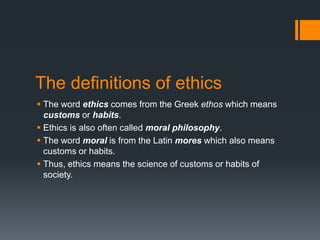
The definitions of ethics
 The word ethics comes from the Greek ethos which means
customs or habits.
 Ethics is also often called moral philosophy.
 The word moral is from the Latin mores which also means
customs or habits.
 Thus, ethics means the science of customs or habits of
society.
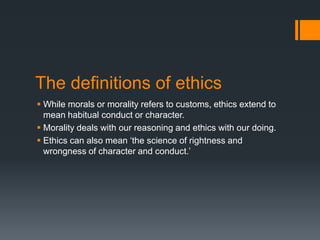
The definitions of ethics
 While morals or morality refers to customs, ethics extend to
mean habitual conduct or character.
 Morality deals with our reasoning and ethics with our doing.
 Ethics can also mean ‘the science of rightness and
wrongness of character and conduct.’
The definitions of ethics
 Ethics is also the ‘science of the highest good.’ It is the
science of morality.
 It is the science of the supreme ideal of human life.
 Ethics is the study of what is right or good in human
conduct or character.
The nature of Ethics
 It is a normative science. Normative sciences seek to
determine norms, ideals or standards, in this case, of human
conduct and character.
 It is not a natural or positive science but a regulative science.
 It is not a practical science nor does it teach us how to live a
moral life, rather, it merely ascertains the moral ideal.
The nature of Ethics
 Ethics is not an art. Art consists in the acquisition of a skill but
morality consists in an attitude of the will when there is no
overt action.
 Ethics is a science because it aims at systematic
explanation of rightness and wrongness.
The Method of Ethics
 The physical and biological method, in which morality is
traced to the conduct of savages and ultimately to the
conduct of animals which seek pleasure and avoid pain.
 The historical or genetic method, in which ethics is thought
to evolve from the crude customs of primitive people.
 The psychological method, in which morality is deemed to
be a phenomenon of human consciousness.
 The metaphysical method, in which morality is deemed to
be a revelation of the divine and is linked with spirituality and
religion.
The Method of Ethics
The true method of ethics is both empirical and transcendental.
It is both scientific and metaphysical.
Ethics accurately observes the moral phenomena, classifies
them according to their similarities and differences and
explains them.
Just as other sciences systematize judgments of common
sense relating to facts, so ethics systematizes judgments of
common sense relating to moral value, though supplemented
by the metaphysical method.
The end of ethics
 The objective of ethics is to define the nature of the highest
good of humans or society.
 It is the basis of moral reasoning and the root of all moral
distinctions.
 Ethics attacks the basis of popular morality, purges it of
errors and inconsistencies, and places on a secure footing all
that is valid and essential in morality.
Doing ethics:
a craft and a skill
 Doing ethics in journalism must be both learned and
developed.
 Doing ethics in journalism is reasoned, principled and
consistently thinking about how journalists can maximize
their truth telling obligations while minimizing harm to
vulnerable sources and audience.
Doing ethics:
a craft and a skill
 Doing ethics in journalism is about individual responsibility.
 Doing ethics in journalism is about accountability and
excellence in journalism
References
Sinha, J. (2009). A Manual of Ethics. Kolkata: New Central
Book Agency (P) Ltd.
Black, J., Steele, B., and Barney, R. (1999). Doing Ethics in
Journalism: A hand book with case studies. Third edition.
Mass.: Allyn & Bacon.
Jimi Kayode
jimikayode@gmail.com
http://facebook.com/jimi.kayode
Adebola Adegunwa School of Communication,
Lagos State University, Lagos, Nigeria

What is ethics

  • 1.
    What is ethics? Definition,Scope and Method of Ethics
  • 2.
    The definitions ofethics  The word ethics comes from the Greek ethos which means customs or habits.  Ethics is also often called moral philosophy.  The word moral is from the Latin mores which also means customs or habits.  Thus, ethics means the science of customs or habits of society.
  • 3.
    The definitions ofethics  While morals or morality refers to customs, ethics extend to mean habitual conduct or character.  Morality deals with our reasoning and ethics with our doing.  Ethics can also mean ‘the science of rightness and wrongness of character and conduct.’
  • 4.
    The definitions ofethics  Ethics is also the ‘science of the highest good.’ It is the science of morality.  It is the science of the supreme ideal of human life.  Ethics is the study of what is right or good in human conduct or character.
  • 5.
    The nature ofEthics  It is a normative science. Normative sciences seek to determine norms, ideals or standards, in this case, of human conduct and character.  It is not a natural or positive science but a regulative science.  It is not a practical science nor does it teach us how to live a moral life, rather, it merely ascertains the moral ideal.
  • 6.
    The nature ofEthics  Ethics is not an art. Art consists in the acquisition of a skill but morality consists in an attitude of the will when there is no overt action.  Ethics is a science because it aims at systematic explanation of rightness and wrongness.
  • 7.
    The Method ofEthics  The physical and biological method, in which morality is traced to the conduct of savages and ultimately to the conduct of animals which seek pleasure and avoid pain.  The historical or genetic method, in which ethics is thought to evolve from the crude customs of primitive people.  The psychological method, in which morality is deemed to be a phenomenon of human consciousness.  The metaphysical method, in which morality is deemed to be a revelation of the divine and is linked with spirituality and religion.
  • 8.
    The Method ofEthics The true method of ethics is both empirical and transcendental. It is both scientific and metaphysical. Ethics accurately observes the moral phenomena, classifies them according to their similarities and differences and explains them. Just as other sciences systematize judgments of common sense relating to facts, so ethics systematizes judgments of common sense relating to moral value, though supplemented by the metaphysical method.
  • 9.
    The end ofethics  The objective of ethics is to define the nature of the highest good of humans or society.  It is the basis of moral reasoning and the root of all moral distinctions.  Ethics attacks the basis of popular morality, purges it of errors and inconsistencies, and places on a secure footing all that is valid and essential in morality.
  • 10.
    Doing ethics: a craftand a skill  Doing ethics in journalism must be both learned and developed.  Doing ethics in journalism is reasoned, principled and consistently thinking about how journalists can maximize their truth telling obligations while minimizing harm to vulnerable sources and audience.
  • 11.
    Doing ethics: a craftand a skill  Doing ethics in journalism is about individual responsibility.  Doing ethics in journalism is about accountability and excellence in journalism References Sinha, J. (2009). A Manual of Ethics. Kolkata: New Central Book Agency (P) Ltd. Black, J., Steele, B., and Barney, R. (1999). Doing Ethics in Journalism: A hand book with case studies. Third edition. Mass.: Allyn & Bacon.
  • 12.
    Jimi Kayode jimikayode@gmail.com http://facebook.com/jimi.kayode Adebola AdegunwaSchool of Communication, Lagos State University, Lagos, Nigeria