Ethics and
social
responsibility
● Sulav Man Singh Taamang
● Nawraj Joshi
● Janis Adhikari
● Aman Lahera
● Ayush Lama
● Bidur Timsina
Presented by:
The literal meaning of
Ethics in Greek is Character
or manner
Ethics
Ethics
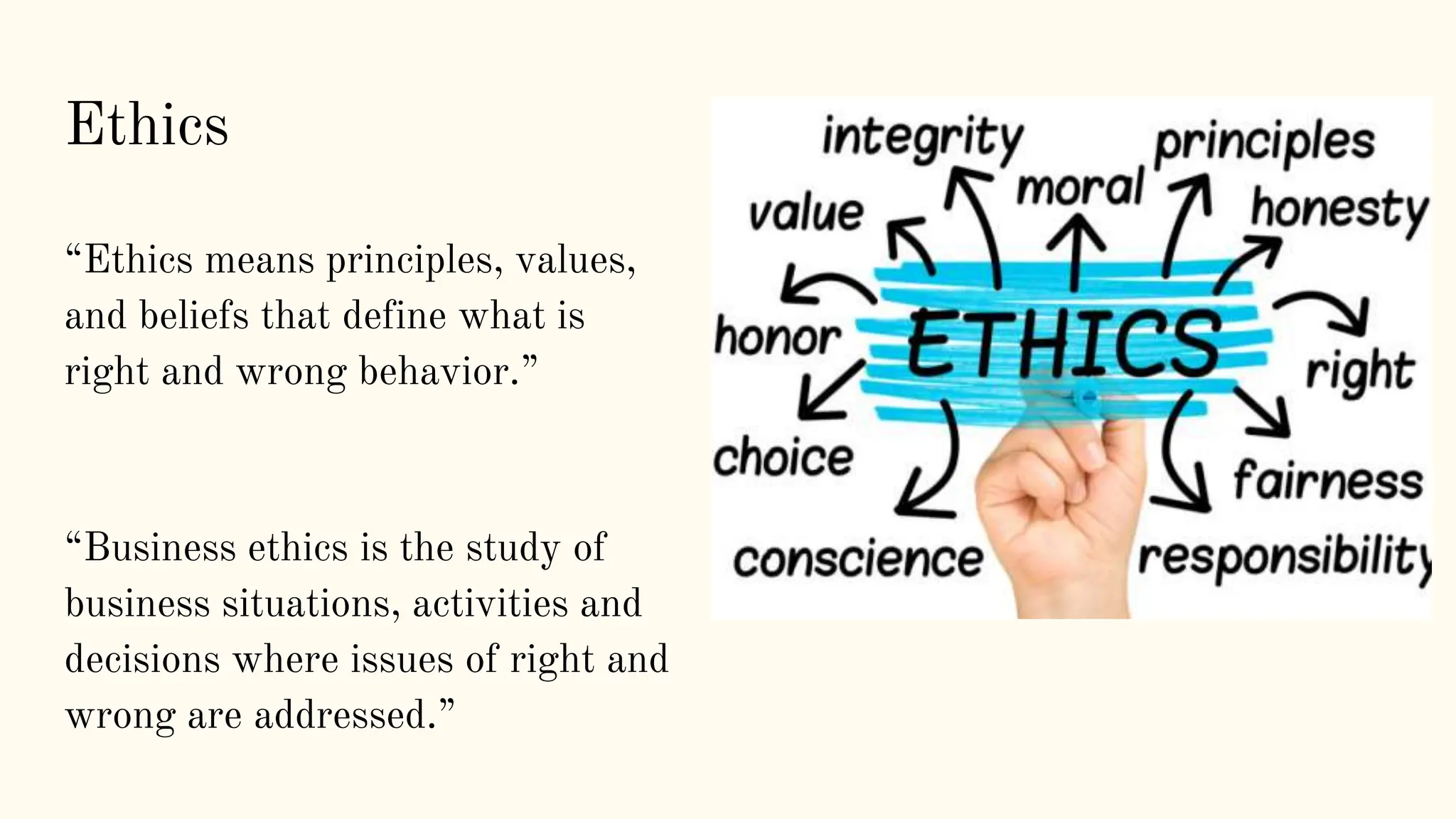
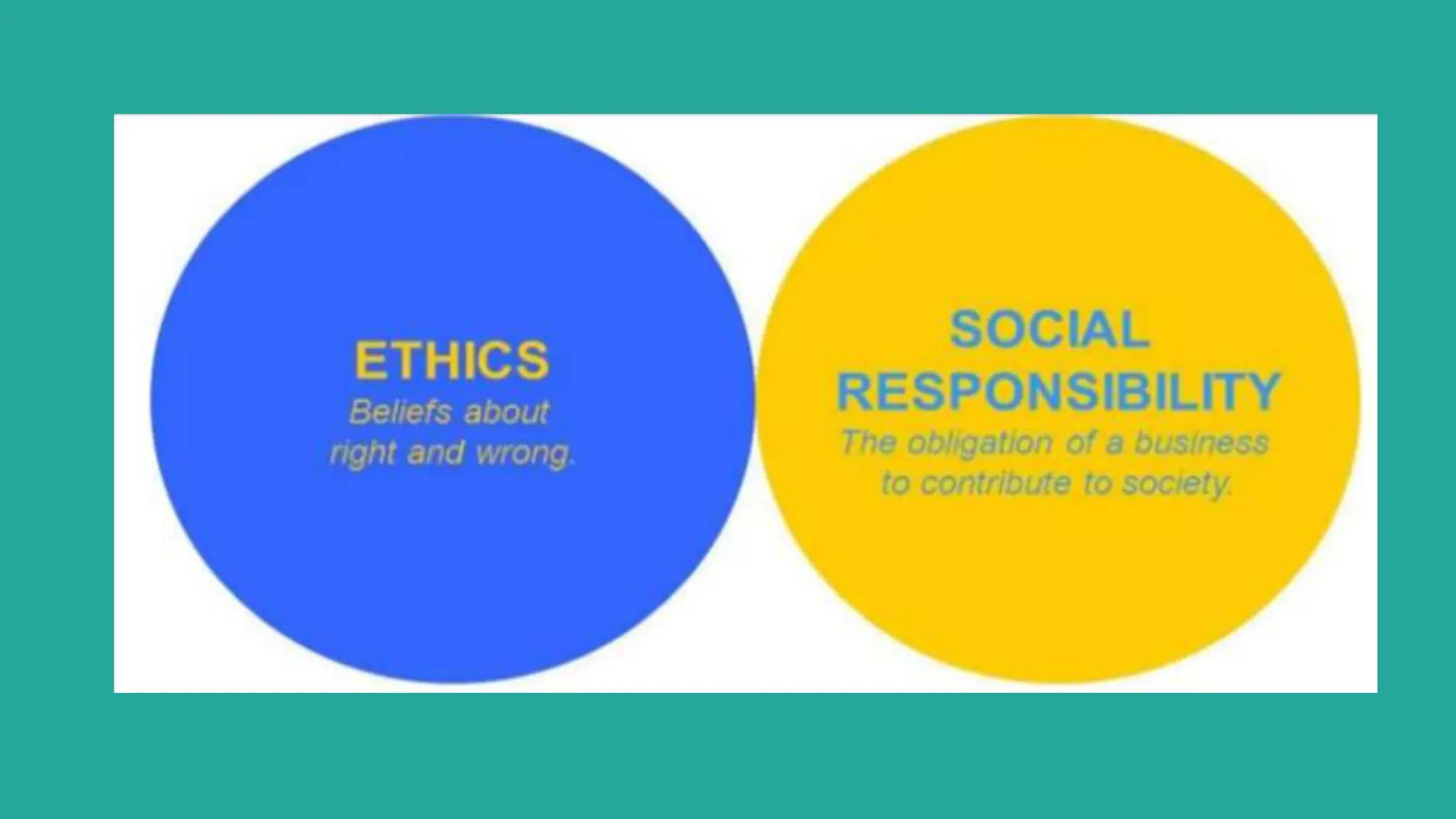
“Ethics means principles, values,
and beliefs that define what is
right and wrong behavior.”
“Business ethics is the study of
business situations, activities and
decisions where issues of right and
wrong are addressed.”
Social Responsibility
The concept of social responsibility describes
that an organization has responsibilities to
society other than making the profits.
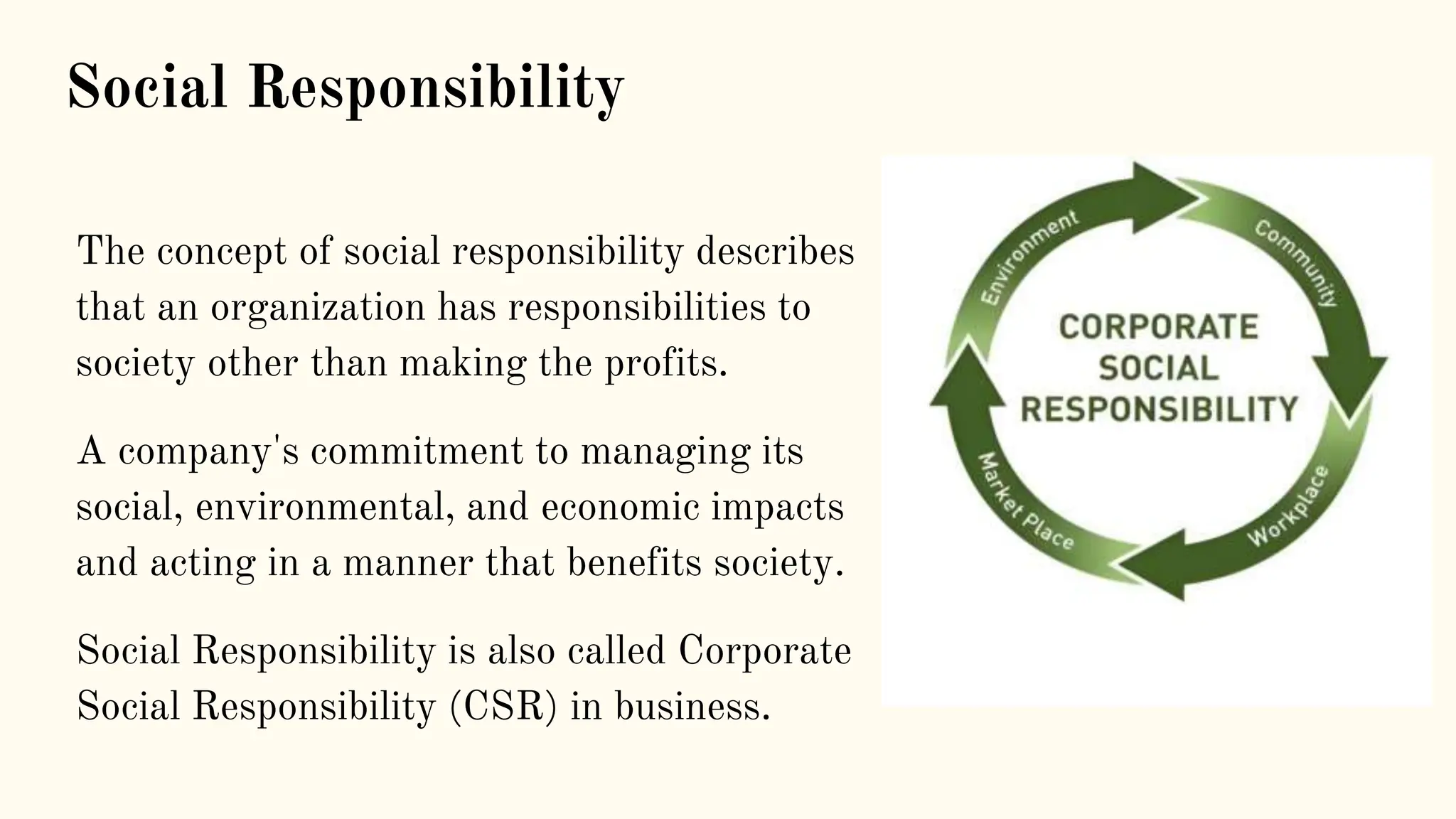
A company's commitment to managing its
social, environmental, and economic impacts
and acting in a manner that benefits society.
Social Responsibility is also called Corporate
Social Responsibility (CSR) in business.
4 main types of Corporate Social Responsibility(CSR)
● Environmental responsibility:
● Ethical responsibility:
● Philanthropic responsibility:
● Financial responsibility:
Environmental responsibility:
Corporate social responsibility is rooted in preserving the environment. A
company can pursue environmental stewardship by reducing pollution and
emissions in manufacturing, recycling materials, replenishing natural
resources like trees, or creating product lines consistent with CSR.
Ethical responsibility:
Corporate social responsibility includes acting fairly and ethically.
Instances of ethical responsibility include fair treatment of all customers
regardless of age, race, culture, or sexual orientation, favorable pay and
benefits for employees, vendor use across demographics, full disclosures,
and transparency for investors.
Philanthropic responsibility:
CSR requires a company to contribute to society, whether a company donates
profit to charities, enters into transactions only with suppliers or vendors that
align with the company philanthropically, supports employee philanthropic
endeavors, or sponsors fundraising events.
Financial responsibility:
A company might make plans to be more environmentally, ethically, and
philanthropically focused, however, it must back these plans through financial
investments in programs, donations, or product research including research
and development for products that encourage sustainability, creating a
diverse workforce, or implementing DEI, social awareness, or environmental
initiatives.
Code Of Ethics:
A code of ethics is a set of principles intended to guide professionals in
conducting business with honesty and integrity
It refers to how an organization expects employees should behave
while on job.
Code of Ethics
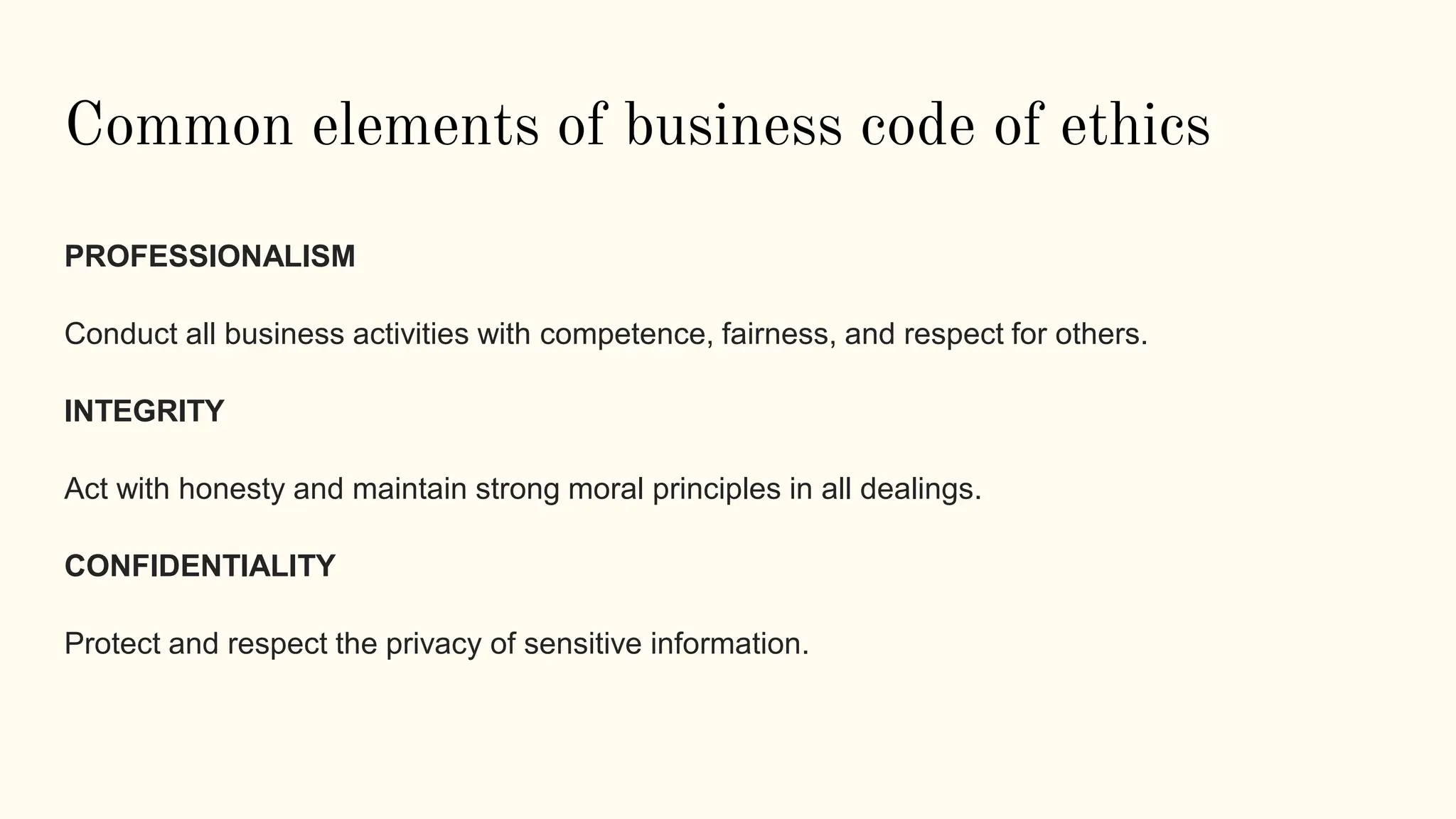
Common elements of business code of ethics
PROFESSIONALISM
Conduct all business activities with competence, fairness, and respect for others.
INTEGRITY
Act with honesty and maintain strong moral principles in all dealings.
CONFIDENTIALITY
Protect and respect the privacy of sensitive information.
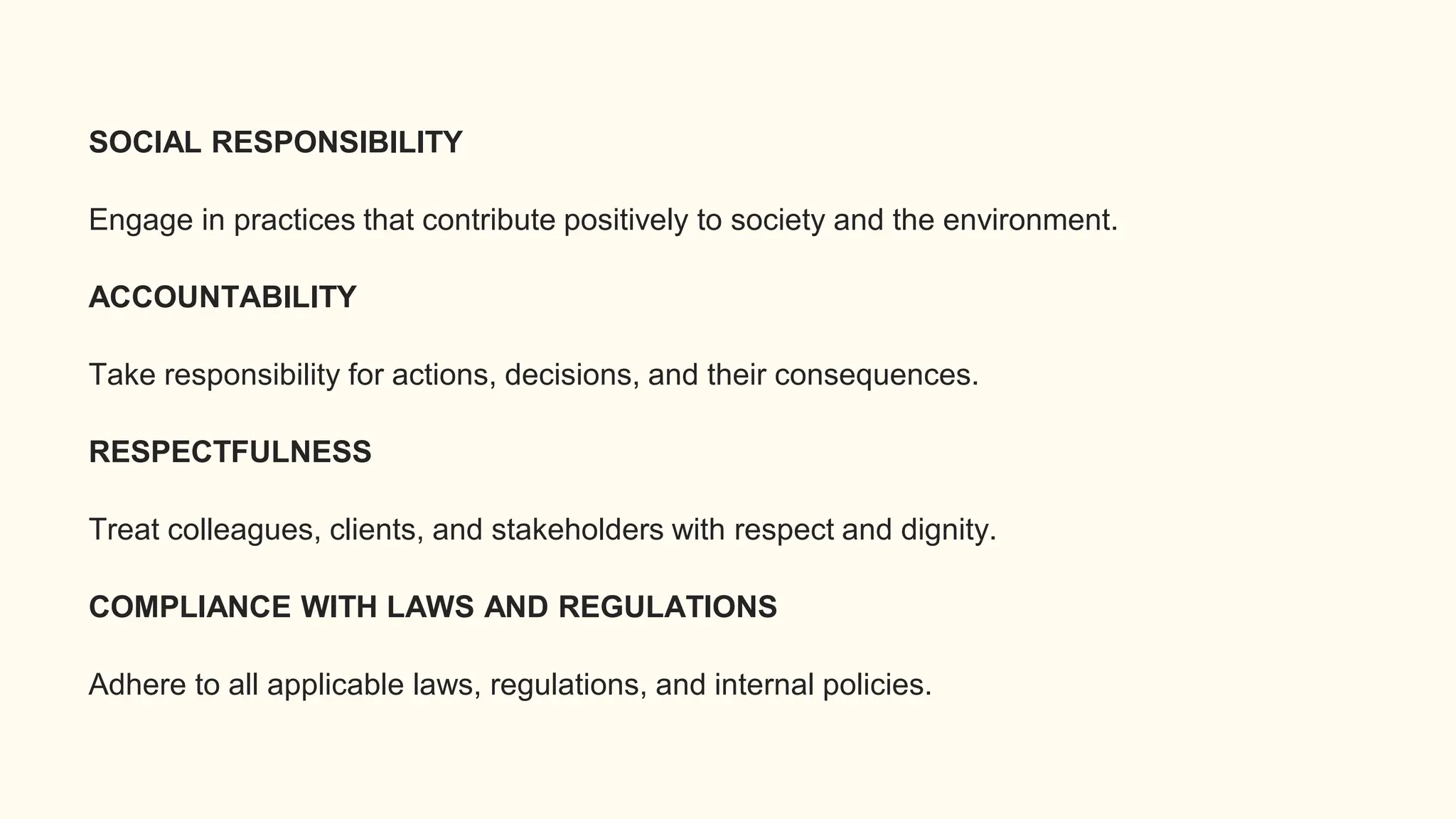
SOCIAL RESPONSIBILITY
Engage in practices that contribute positively to society and the environment.
ACCOUNTABILITY
Take responsibility for actions, decisions, and their consequences.
RESPECTFULNESS
Treat colleagues, clients, and stakeholders with respect and dignity.
COMPLIANCE WITH LAWS AND REGULATIONS
Adhere to all applicable laws, regulations, and internal policies.
Ethical dilemmas
An ethical dilemma is a situation where a person faces a conflict between
two or more morally acceptable or unacceptable options. These scenarios
often involve a difficult choice between competing values, principles, or
duties.
Example:
Medical Field: Choosing between extending a patient's life with aggressive
treatment or respecting their wish for a natural end.
Personal Life: Deciding whether to report a friend's wrongdoing, balancing
loyalty to the friend against a duty to uphold justice.
Ethical frameworks provide systematic approaches to understanding
and addressing ethical dilemmas. They offer different lenses
through which to view ethical issues and guide decision-making
processes.
Theoretical frameworks for ethical analysis
Some key frameworks
1. Utilitarianism
2. Deontology
3. Virtue Ethics
4. Rights-based Ethics
5. Justice and Fairness
6. Care Ethics
1.Utilitarianism
Utilitarianism is a theory of morality that advocates actions that foster
happiness or pleasure and oppose actions that cause unhappiness or harm.
When directed toward making social, economic, or political decisions, a
utilitarian philosophy would aim for thce betterment of society as a whole.
Utilitarianism would say that an action is right if it results in the happiness
of the greatest number of people in a society or a group
Example: Public Transportation
A city decides to invest in an extensive public transportation system, which will require significant funding
and may cause some inconvenience during construction, but will ultimately reduce traffic congestion,
pollution, and commuting time for the majority of its residents.
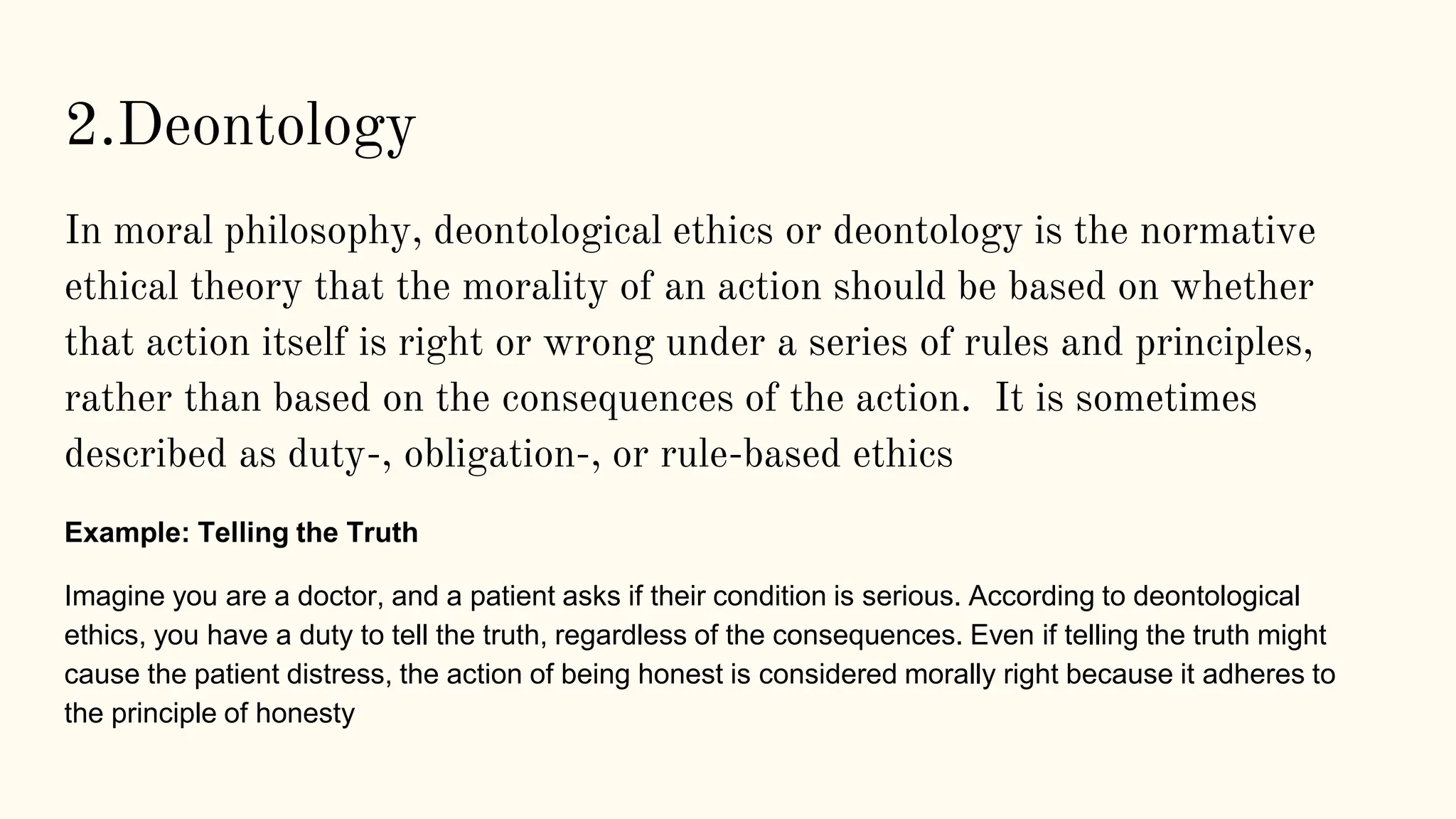
2.Deontology
In moral philosophy, deontological ethics or deontology is the normative
ethical theory that the morality of an action should be based on whether
that action itself is right or wrong under a series of rules and principles,
rather than based on the consequences of the action. It is sometimes
described as duty-, obligation-, or rule-based ethics
Example: Telling the Truth
Imagine you are a doctor, and a patient asks if their condition is serious. According to deontological
ethics, you have a duty to tell the truth, regardless of the consequences. Even if telling the truth might
cause the patient distress, the action of being honest is considered morally right because it adheres to
the principle of honesty
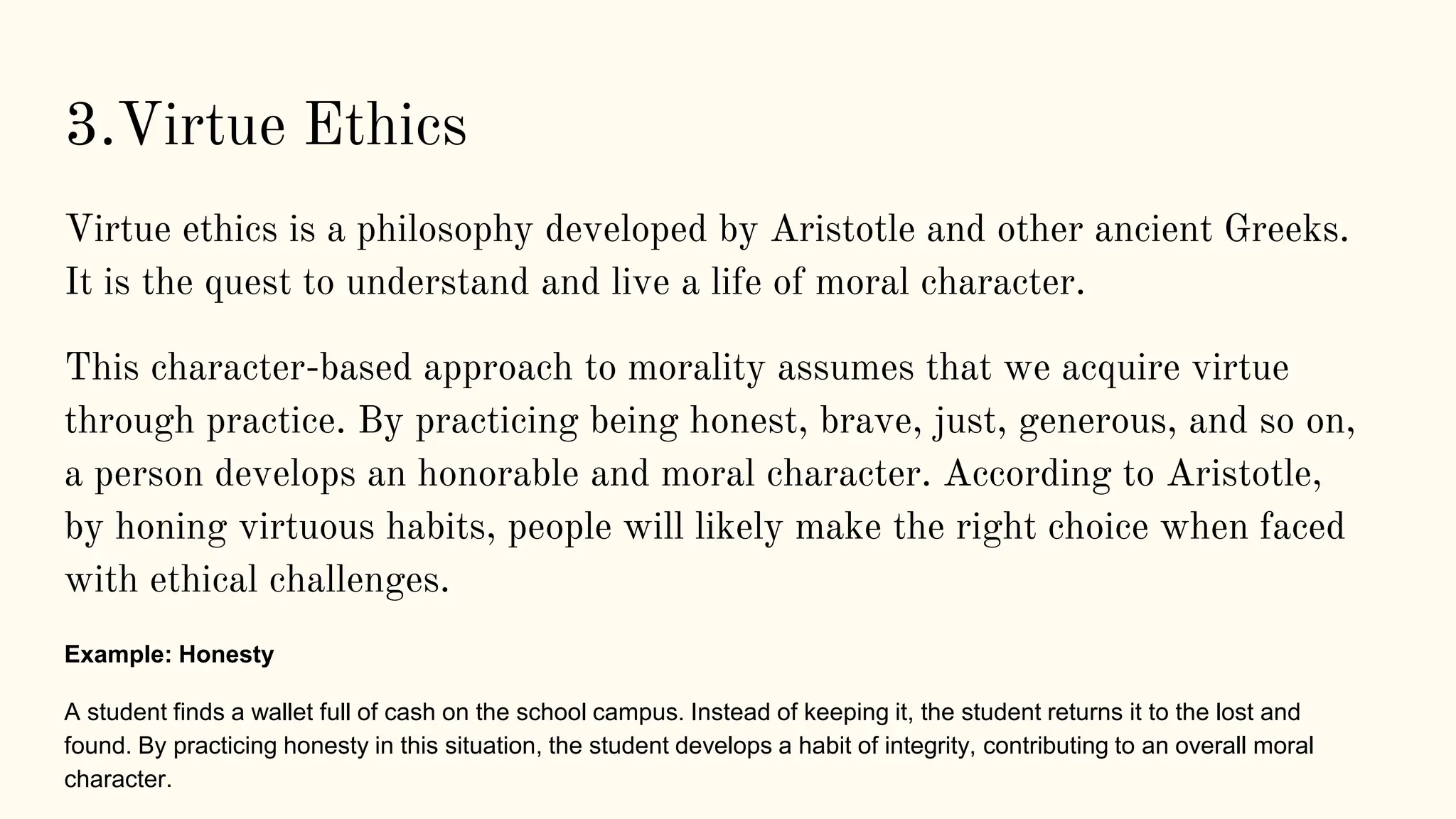
Virtue ethics is a philosophy developed by Aristotle and other ancient Greeks.
It is the quest to understand and live a life of moral character.
This character-based approach to morality assumes that we acquire virtue
through practice. By practicing being honest, brave, just, generous, and so on,
a person develops an honorable and moral character. According to Aristotle,
by honing virtuous habits, people will likely make the right choice when faced
with ethical challenges.
Example: Honesty
A student finds a wallet full of cash on the school campus. Instead of keeping it, the student returns it to the lost and
found. By practicing honesty in this situation, the student develops a habit of integrity, contributing to an overall moral
character.
3.Virtue Ethics
4.Rights-based Ethics
The rights-based approach to ethics is a methodology that emphasizes the
importance of individual rights and freedoms in ethical reasoning. It
recognizes that individuals have certain inherent rights that should be
respected and protected
Example: Freedom of Speech
A journalist publishes an article criticizing the government. Despite the potential backlash or
disagreement, the rights-based approach to ethics supports the journalist's right to freedom of speech,
emphasizing that this inherent right should be respected and protected regardless of the content or
consequences of the article.
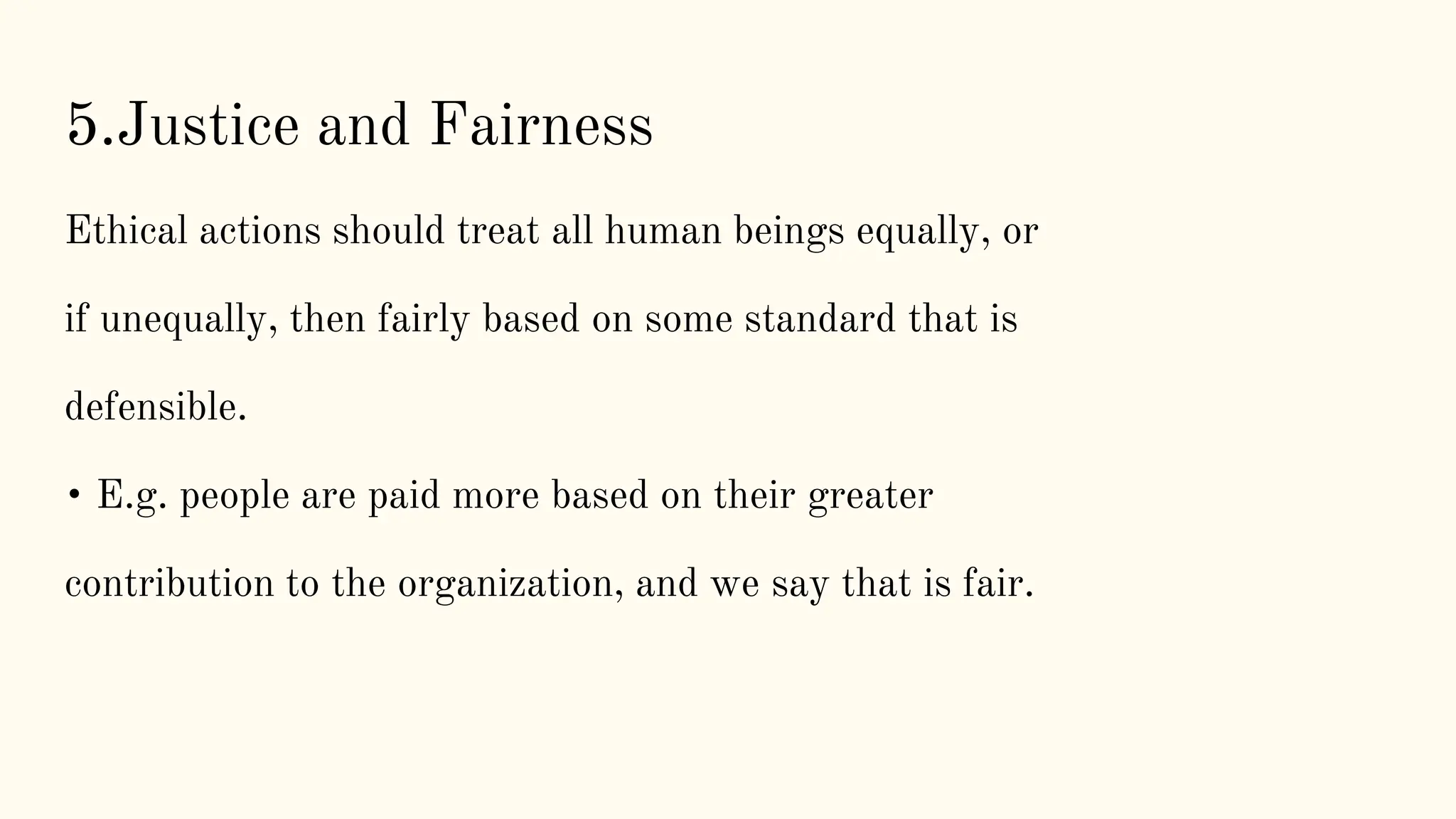
5.Justice and Fairness
Ethical actions should treat all human beings equally, or
if unequally, then fairly based on some standard that is
defensible.
• E.g. people are paid more based on their greater
contribution to the organization, and we say that is fair.
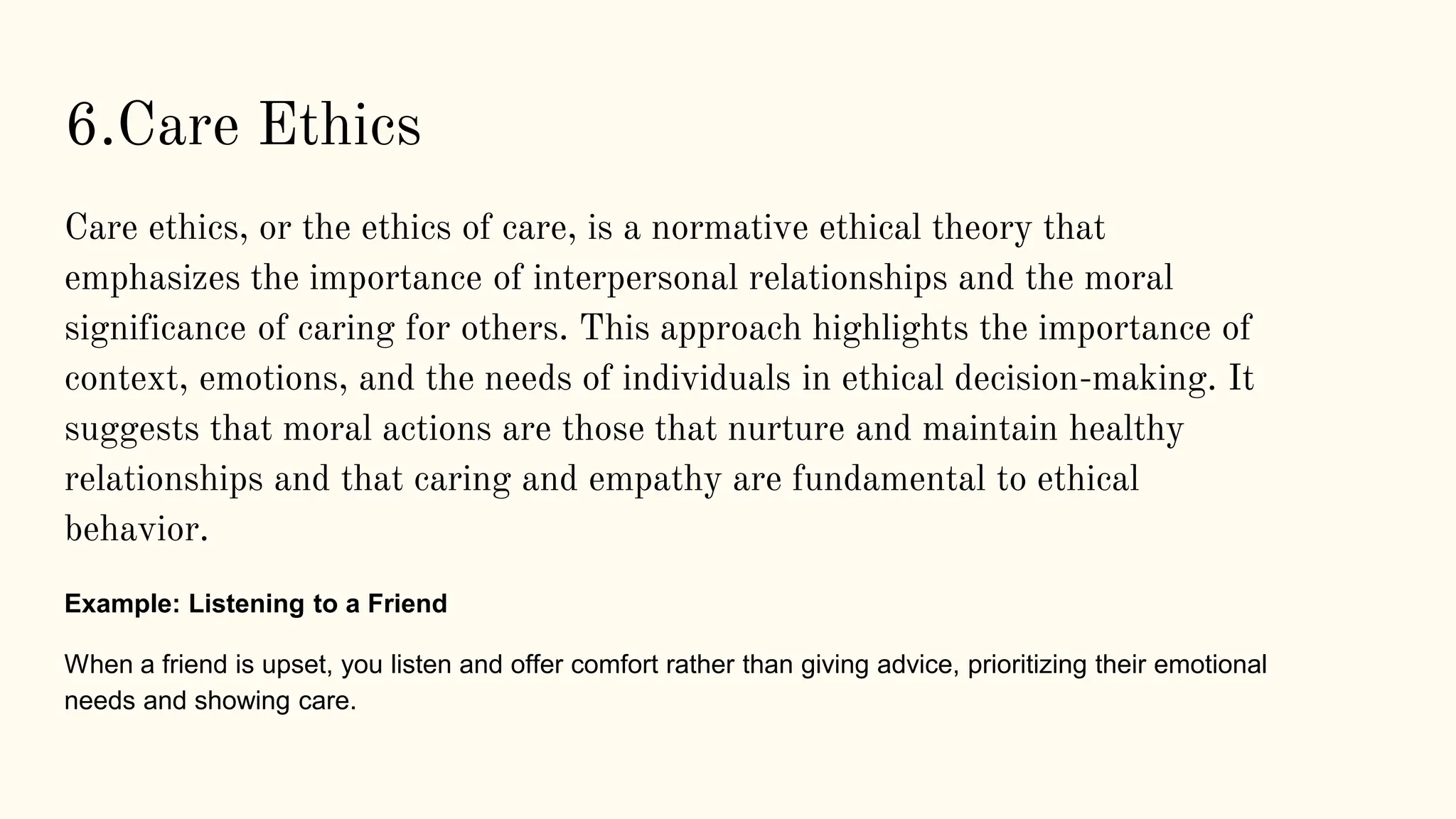
6.Care Ethics
Care ethics, or the ethics of care, is a normative ethical theory that
emphasizes the importance of interpersonal relationships and the moral
significance of caring for others. This approach highlights the importance of
context, emotions, and the needs of individuals in ethical decision-making. It
suggests that moral actions are those that nurture and maintain healthy
relationships and that caring and empathy are fundamental to ethical
behavior.
Example: Listening to a Friend
When a friend is upset, you listen and offer comfort rather than giving advice, prioritizing their emotional
needs and showing care.
Broader Ethical Considerations in Business
● Human Rights
● Stakeholder Theory
● Global Business Ethics
● Environmental Ethics
1.Human Rights
The protection and promotion of fundamental human rights in business
practices.
Key Aspects:
Anti-Discrimination: Ensuring equal opportunities and treatment for all
individuals.
Safe Working Conditions: Protecting workers' health and safety.
Right to Privacy: Respecting individuals' privacy and personal information.
2.Stakeholders Theory
The idea that businesses should consider the interests and well-being of all stakeholders,
not just shareholders.
Key Stakeholders:
Employees: Fair treatment, development opportunities, and a positive work environment.
Customers: Providing quality products and services, and maintaining transparency.
Suppliers: Ensuring fair and ethical sourcing practices.
Communities: Contributing to local development and respecting community interests.
3.Global Business Ethics
Navigating ethical challenges in diverse cultural, legal, and economic
environments.
Key Aspects:
Cultural Sensitivity: Respecting local customs and practices while maintaining
ethical standards.
Legal Compliance: Adhering to international laws and regulations, including anti-
corruption and anti-bribery laws.
Fair Trade: Ensuring fair practices in international trade and avoiding
exploitation.
4.Environmental Ethics
The moral principles guiding businesses in their impact on the environment.
Key Considerations:
Resource Use: Sustainable management of natural resources to prevent
depletion.
Pollution Control: Reducing emissions, waste, and other pollutants.
Biodiversity: Protecting ecosystems and wildlife from harmful business
activities.

Presentation on Ethics and Social responsibilities

  • 1.
    Ethics and social responsibility ● SulavMan Singh Taamang ● Nawraj Joshi ● Janis Adhikari ● Aman Lahera ● Ayush Lama ● Bidur Timsina Presented by:
  • 2.
    The literal meaningof Ethics in Greek is Character or manner Ethics
  • 3.
    Ethics “Ethics means principles,values, and beliefs that define what is right and wrong behavior.” “Business ethics is the study of business situations, activities and decisions where issues of right and wrong are addressed.”
  • 4.
    Social Responsibility The conceptof social responsibility describes that an organization has responsibilities to society other than making the profits. A company's commitment to managing its social, environmental, and economic impacts and acting in a manner that benefits society. Social Responsibility is also called Corporate Social Responsibility (CSR) in business.
  • 6.
    4 main typesof Corporate Social Responsibility(CSR) ● Environmental responsibility: ● Ethical responsibility: ● Philanthropic responsibility: ● Financial responsibility:
  • 7.
    Environmental responsibility: Corporate socialresponsibility is rooted in preserving the environment. A company can pursue environmental stewardship by reducing pollution and emissions in manufacturing, recycling materials, replenishing natural resources like trees, or creating product lines consistent with CSR. Ethical responsibility: Corporate social responsibility includes acting fairly and ethically. Instances of ethical responsibility include fair treatment of all customers regardless of age, race, culture, or sexual orientation, favorable pay and benefits for employees, vendor use across demographics, full disclosures, and transparency for investors.
  • 8.
    Philanthropic responsibility: CSR requiresa company to contribute to society, whether a company donates profit to charities, enters into transactions only with suppliers or vendors that align with the company philanthropically, supports employee philanthropic endeavors, or sponsors fundraising events. Financial responsibility: A company might make plans to be more environmentally, ethically, and philanthropically focused, however, it must back these plans through financial investments in programs, donations, or product research including research and development for products that encourage sustainability, creating a diverse workforce, or implementing DEI, social awareness, or environmental initiatives.
  • 9.
  • 10.
    A code ofethics is a set of principles intended to guide professionals in conducting business with honesty and integrity It refers to how an organization expects employees should behave while on job. Code of Ethics
  • 11.
    Common elements ofbusiness code of ethics PROFESSIONALISM Conduct all business activities with competence, fairness, and respect for others. INTEGRITY Act with honesty and maintain strong moral principles in all dealings. CONFIDENTIALITY Protect and respect the privacy of sensitive information.
  • 12.
    SOCIAL RESPONSIBILITY Engage inpractices that contribute positively to society and the environment. ACCOUNTABILITY Take responsibility for actions, decisions, and their consequences. RESPECTFULNESS Treat colleagues, clients, and stakeholders with respect and dignity. COMPLIANCE WITH LAWS AND REGULATIONS Adhere to all applicable laws, regulations, and internal policies.
  • 13.
    Ethical dilemmas An ethicaldilemma is a situation where a person faces a conflict between two or more morally acceptable or unacceptable options. These scenarios often involve a difficult choice between competing values, principles, or duties. Example: Medical Field: Choosing between extending a patient's life with aggressive treatment or respecting their wish for a natural end. Personal Life: Deciding whether to report a friend's wrongdoing, balancing loyalty to the friend against a duty to uphold justice.
  • 14.
    Ethical frameworks providesystematic approaches to understanding and addressing ethical dilemmas. They offer different lenses through which to view ethical issues and guide decision-making processes. Theoretical frameworks for ethical analysis
  • 15.
    Some key frameworks 1.Utilitarianism 2. Deontology 3. Virtue Ethics 4. Rights-based Ethics 5. Justice and Fairness 6. Care Ethics
  • 16.
    1.Utilitarianism Utilitarianism is atheory of morality that advocates actions that foster happiness or pleasure and oppose actions that cause unhappiness or harm. When directed toward making social, economic, or political decisions, a utilitarian philosophy would aim for thce betterment of society as a whole. Utilitarianism would say that an action is right if it results in the happiness of the greatest number of people in a society or a group Example: Public Transportation A city decides to invest in an extensive public transportation system, which will require significant funding and may cause some inconvenience during construction, but will ultimately reduce traffic congestion, pollution, and commuting time for the majority of its residents.
  • 17.
    2.Deontology In moral philosophy,deontological ethics or deontology is the normative ethical theory that the morality of an action should be based on whether that action itself is right or wrong under a series of rules and principles, rather than based on the consequences of the action. It is sometimes described as duty-, obligation-, or rule-based ethics Example: Telling the Truth Imagine you are a doctor, and a patient asks if their condition is serious. According to deontological ethics, you have a duty to tell the truth, regardless of the consequences. Even if telling the truth might cause the patient distress, the action of being honest is considered morally right because it adheres to the principle of honesty
  • 18.
    Virtue ethics isa philosophy developed by Aristotle and other ancient Greeks. It is the quest to understand and live a life of moral character. This character-based approach to morality assumes that we acquire virtue through practice. By practicing being honest, brave, just, generous, and so on, a person develops an honorable and moral character. According to Aristotle, by honing virtuous habits, people will likely make the right choice when faced with ethical challenges. Example: Honesty A student finds a wallet full of cash on the school campus. Instead of keeping it, the student returns it to the lost and found. By practicing honesty in this situation, the student develops a habit of integrity, contributing to an overall moral character. 3.Virtue Ethics
  • 19.
    4.Rights-based Ethics The rights-basedapproach to ethics is a methodology that emphasizes the importance of individual rights and freedoms in ethical reasoning. It recognizes that individuals have certain inherent rights that should be respected and protected Example: Freedom of Speech A journalist publishes an article criticizing the government. Despite the potential backlash or disagreement, the rights-based approach to ethics supports the journalist's right to freedom of speech, emphasizing that this inherent right should be respected and protected regardless of the content or consequences of the article.
  • 20.
    5.Justice and Fairness Ethicalactions should treat all human beings equally, or if unequally, then fairly based on some standard that is defensible. • E.g. people are paid more based on their greater contribution to the organization, and we say that is fair.
  • 21.
    6.Care Ethics Care ethics,or the ethics of care, is a normative ethical theory that emphasizes the importance of interpersonal relationships and the moral significance of caring for others. This approach highlights the importance of context, emotions, and the needs of individuals in ethical decision-making. It suggests that moral actions are those that nurture and maintain healthy relationships and that caring and empathy are fundamental to ethical behavior. Example: Listening to a Friend When a friend is upset, you listen and offer comfort rather than giving advice, prioritizing their emotional needs and showing care.
  • 22.
    Broader Ethical Considerationsin Business ● Human Rights ● Stakeholder Theory ● Global Business Ethics ● Environmental Ethics
  • 23.
    1.Human Rights The protectionand promotion of fundamental human rights in business practices. Key Aspects: Anti-Discrimination: Ensuring equal opportunities and treatment for all individuals. Safe Working Conditions: Protecting workers' health and safety. Right to Privacy: Respecting individuals' privacy and personal information.
  • 24.
    2.Stakeholders Theory The ideathat businesses should consider the interests and well-being of all stakeholders, not just shareholders. Key Stakeholders: Employees: Fair treatment, development opportunities, and a positive work environment. Customers: Providing quality products and services, and maintaining transparency. Suppliers: Ensuring fair and ethical sourcing practices. Communities: Contributing to local development and respecting community interests.
  • 25.
    3.Global Business Ethics Navigatingethical challenges in diverse cultural, legal, and economic environments. Key Aspects: Cultural Sensitivity: Respecting local customs and practices while maintaining ethical standards. Legal Compliance: Adhering to international laws and regulations, including anti- corruption and anti-bribery laws. Fair Trade: Ensuring fair practices in international trade and avoiding exploitation.
  • 26.
    4.Environmental Ethics The moralprinciples guiding businesses in their impact on the environment. Key Considerations: Resource Use: Sustainable management of natural resources to prevent depletion. Pollution Control: Reducing emissions, waste, and other pollutants. Biodiversity: Protecting ecosystems and wildlife from harmful business activities.