Created by:-
Sandhu Khushbir
Singh
BCA 3 Year
79 A
 A network is a collection of computers,
servers, mainframes, network devices,
peripherals, or other devices connected to
one another to allow the sharing of data. An
excellent example of a network is
the Internet which connects millions of
people all over the world.
 To communicate from one network to
another network the IP Address plays an
important role.
 An Internet Protocol address (IP address) is a
numerical label assigned to each device
connected to a computer network that uses
the Internet Protocol for communication.
 Two version – ipv4 = 32 bit, ipv6= 128 bits.
 ROUTER
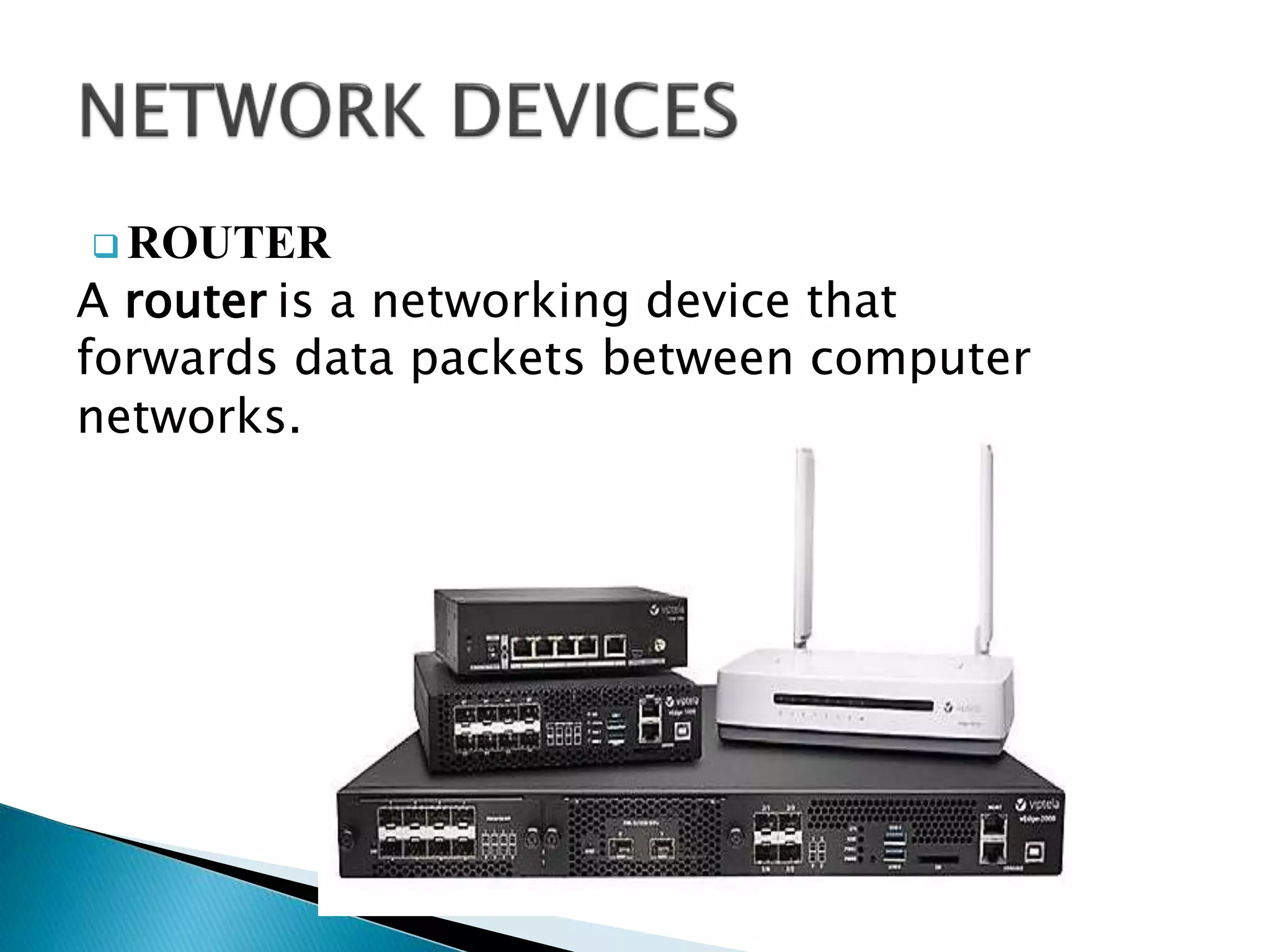
A router is a networking device that
forwards data packets between computer
networks.
 Routing protocols are the set of rules used by
the routers to communicate between source
& destination.
 This protocols finds the best path to send the
packet from source to destination.
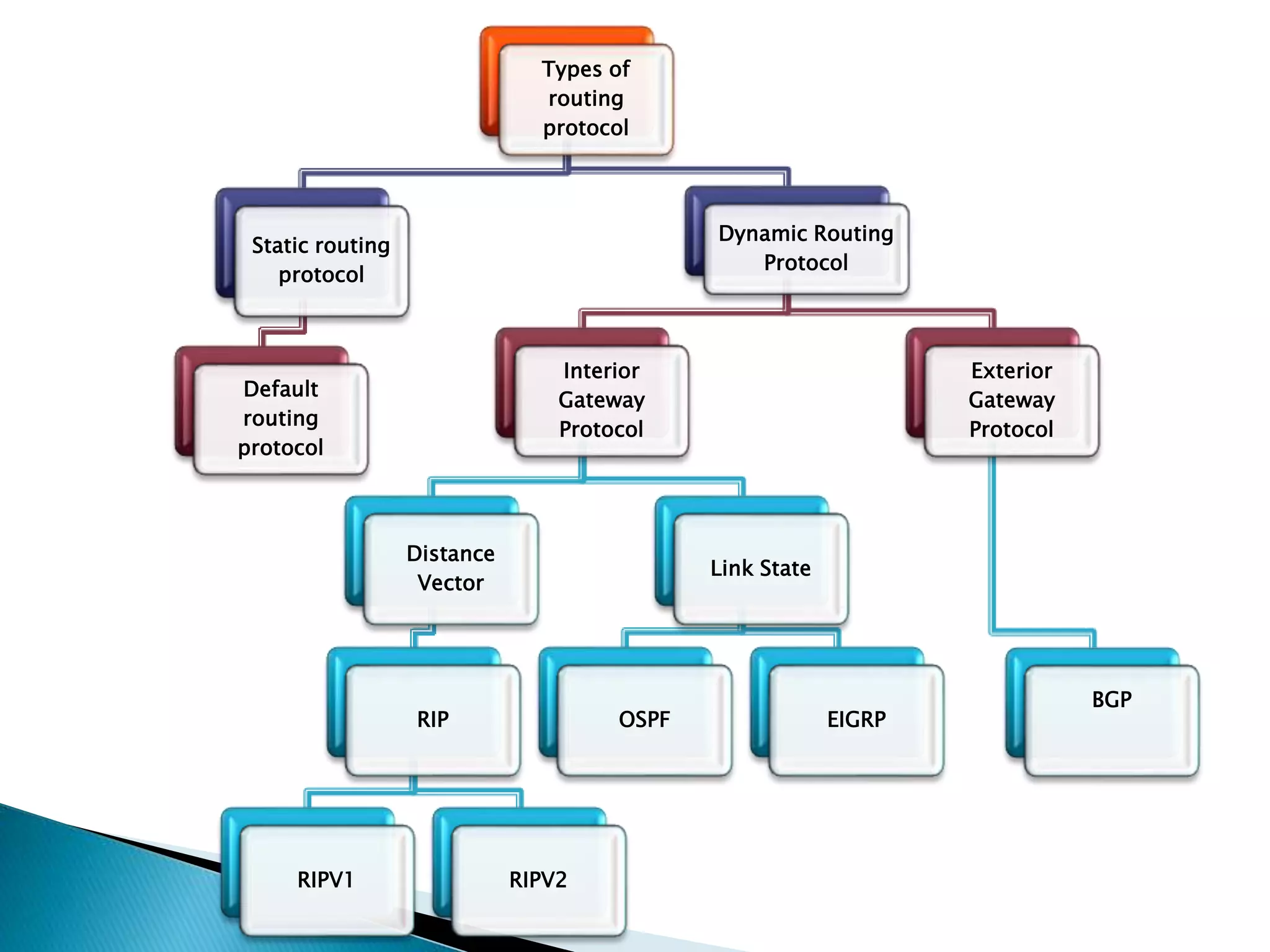
Types of
routing
protocol
Static routing
protocol
Default
routing
protocol
Dynamic Routing
Protocol
Interior
Gateway
Protocol
Distance
Vector
RIP
RIPV1 RIPV2
Link State
OSPF EIGRP
Exterior
Gateway
Protocol
BGP
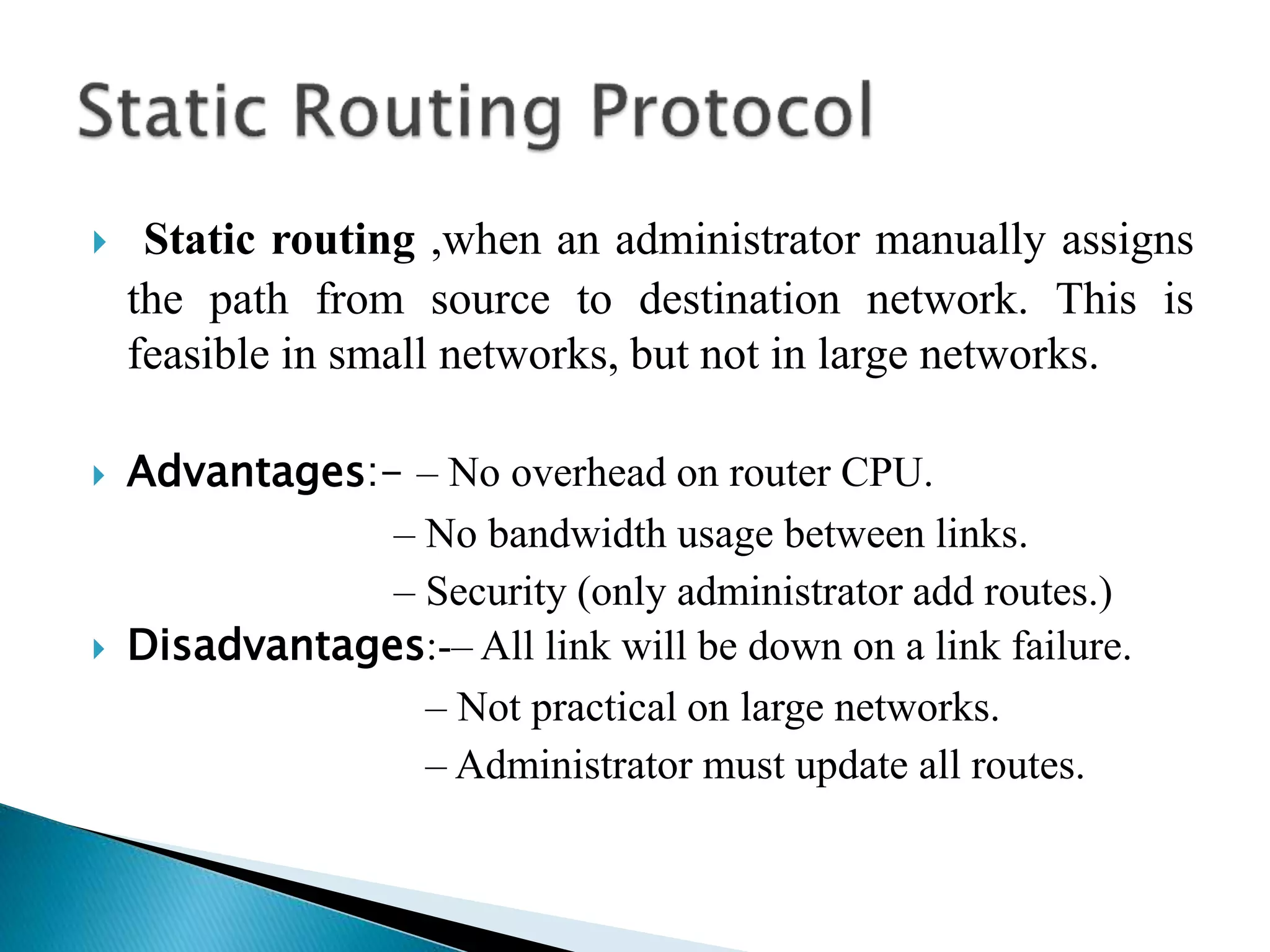
 Static routing ,when an administrator manually assigns
the path from source to destination network. This is
feasible in small networks, but not in large networks.
 Advantages:- – No overhead on router CPU.
– No bandwidth usage between links.
– Security (only administrator add routes.)
 Disadvantages:-– All link will be down on a link failure.
– Not practical on large networks.
– Administrator must update all routes.
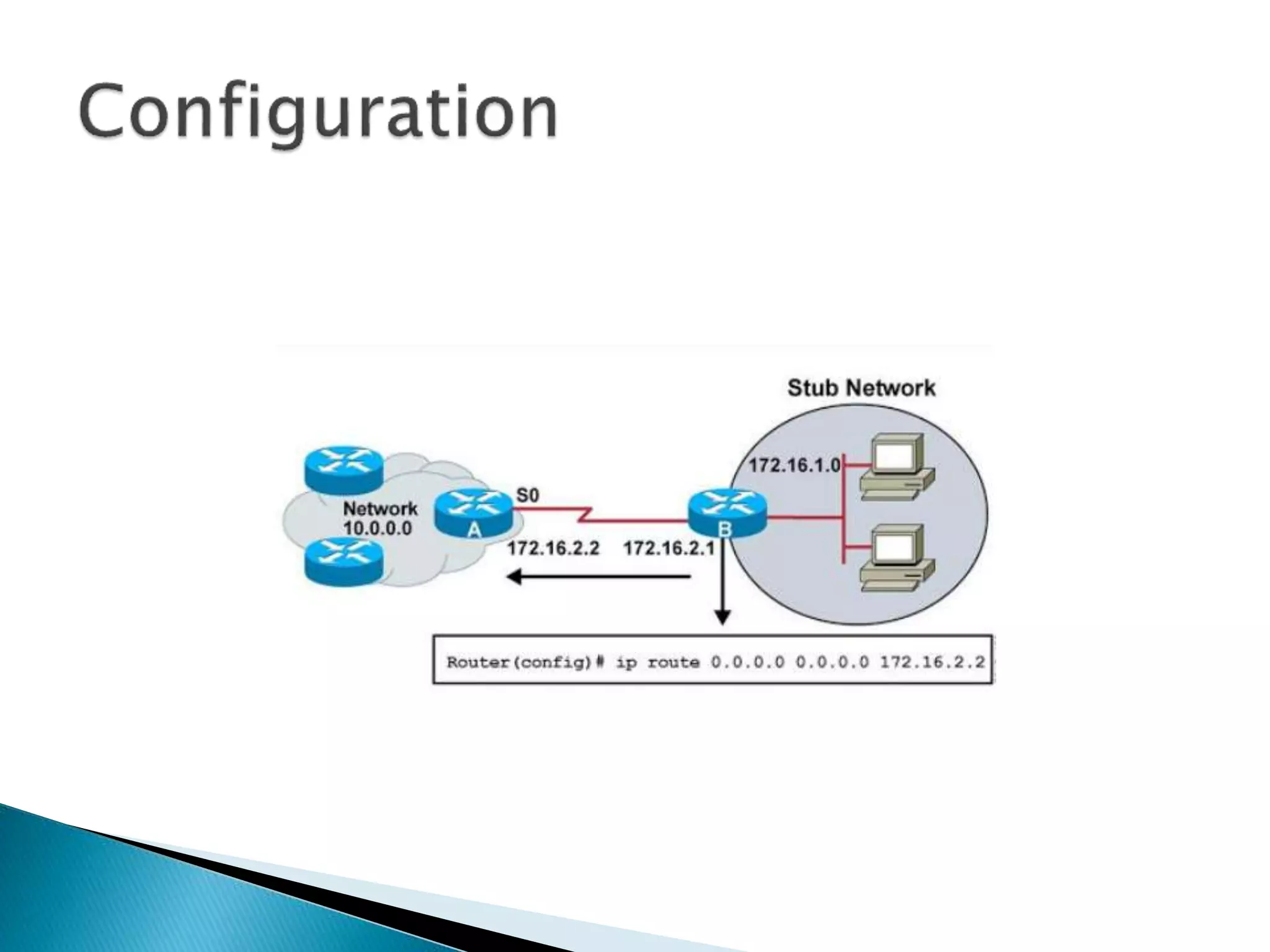
 This is the method where the router is
configured to send all packets towards a single
router (next hop). It doesn’t matter to which
network the packet belongs, it is forwarded out
to router which is configured for default
routing.
 Advantages:- – No overhead on router CPU. –
-No bandwidth usage between links.
– Security (only administrator add routes.)
 Disadvantages:- – All link will be down on a link failure.
– Not practical on large networks.
– Administrator must update all routes.
 Dynamic Routing is the process in which routing tables
are automatically updates by routing table of each
neighbor. – Dynamically discover & maintains routes.-
calculates routes
 Advantages – Less work in maintaining the configuration
when adding & deleting networks.
– Protocols automatically react to the topology changes.
– Configuration is less-prone.
 Disadvantages – Routers resource are used.
– More administrator knowledge is required for configuration
IGP EGP
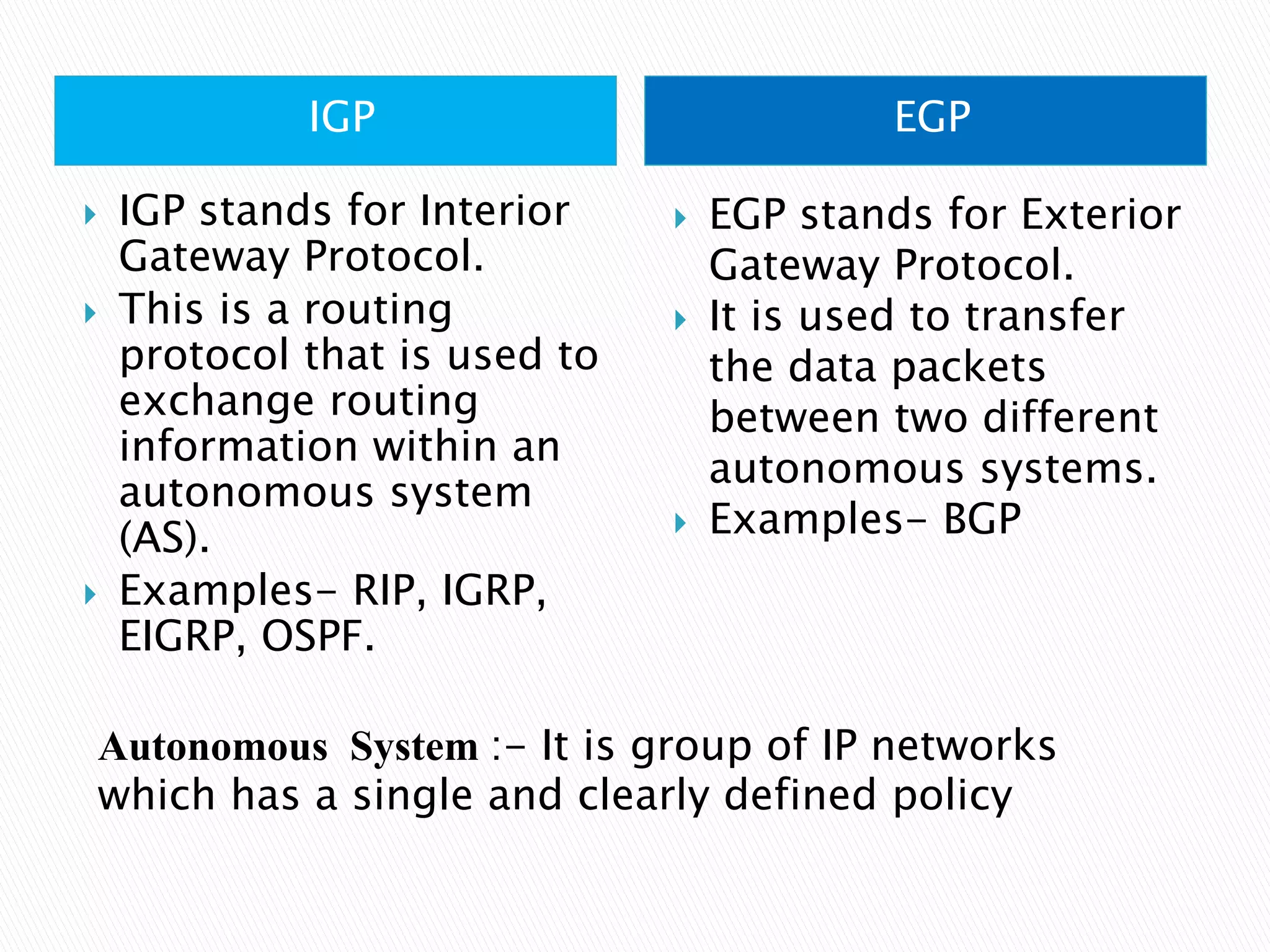
 IGP stands for Interior
Gateway Protocol.
 This is a routing
protocol that is used to
exchange routing
information within an
autonomous system
(AS).
 Examples- RIP, IGRP,
EIGRP, OSPF.
 EGP stands for Exterior
Gateway Protocol.
 It is used to transfer
the data packets
between two different
autonomous systems.
 Examples- BGP
Autonomous System :- It is group of IP networks
which has a single and clearly defined policy
 These protocols selects the best path in the basis
of hop counts to reach a destination network in
the particular direction. Here one router counts as
a one hop .
Characteristics:-
 Updates Frequently
 Each Router is only aware of its immediate neighbors.
 Slow convergence.
 Make create routing loops.
 Easy to configure.
A. RIP is true distance vector routing protocol
B. Uses hop count metric
C. Supports 15 hop-count limit
D. AD value is 120.
E. Supports classful networks and version 2 support classless.
F. Works well in small network.
G. Sends complete routing table at every 30 seconds.
H. It uses Bellman-Ford algorithm to measure hop count
 Disadvantages:-
 Generate Traffic
 As full routing table is exchange it create
security issue.
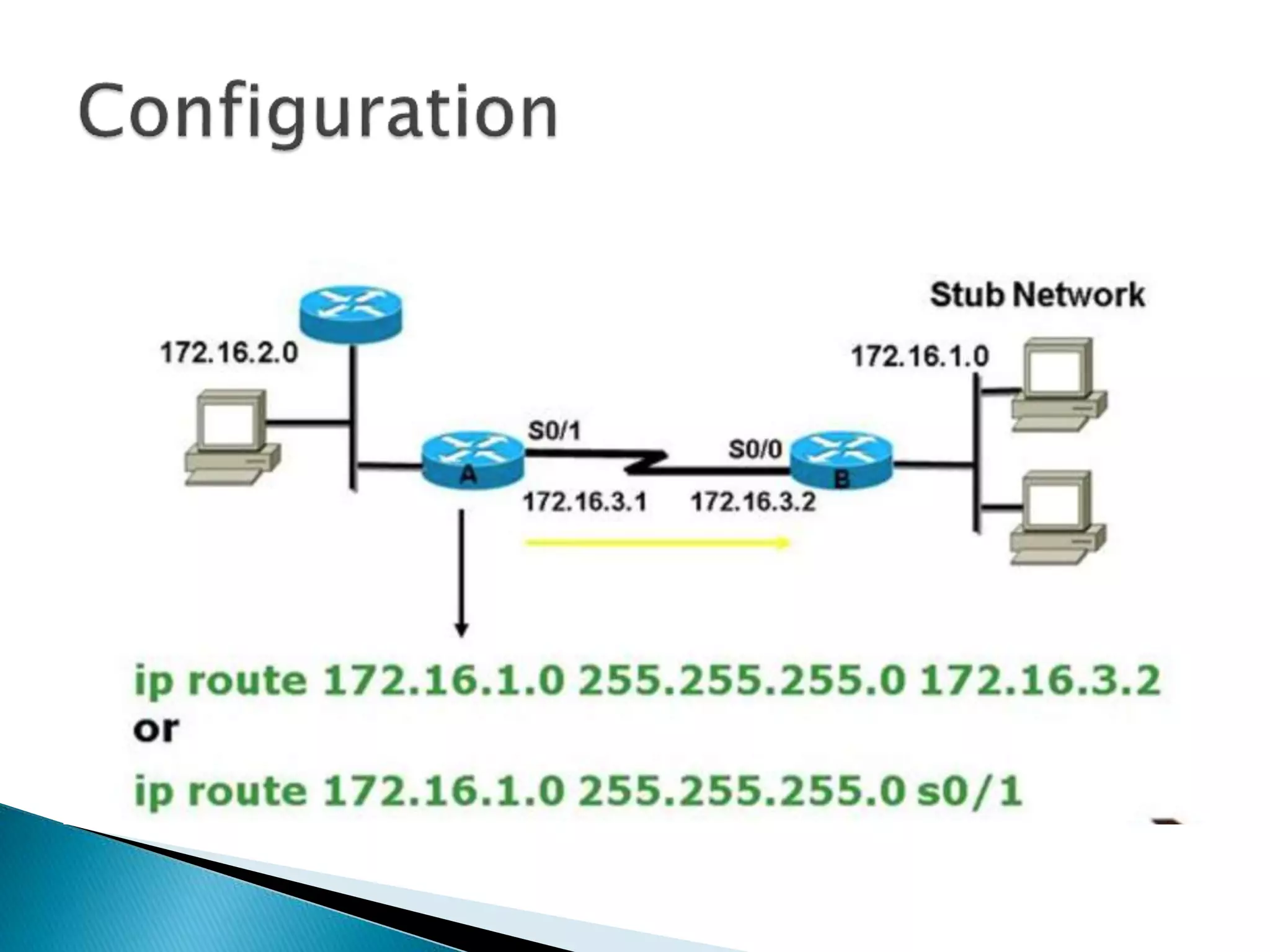
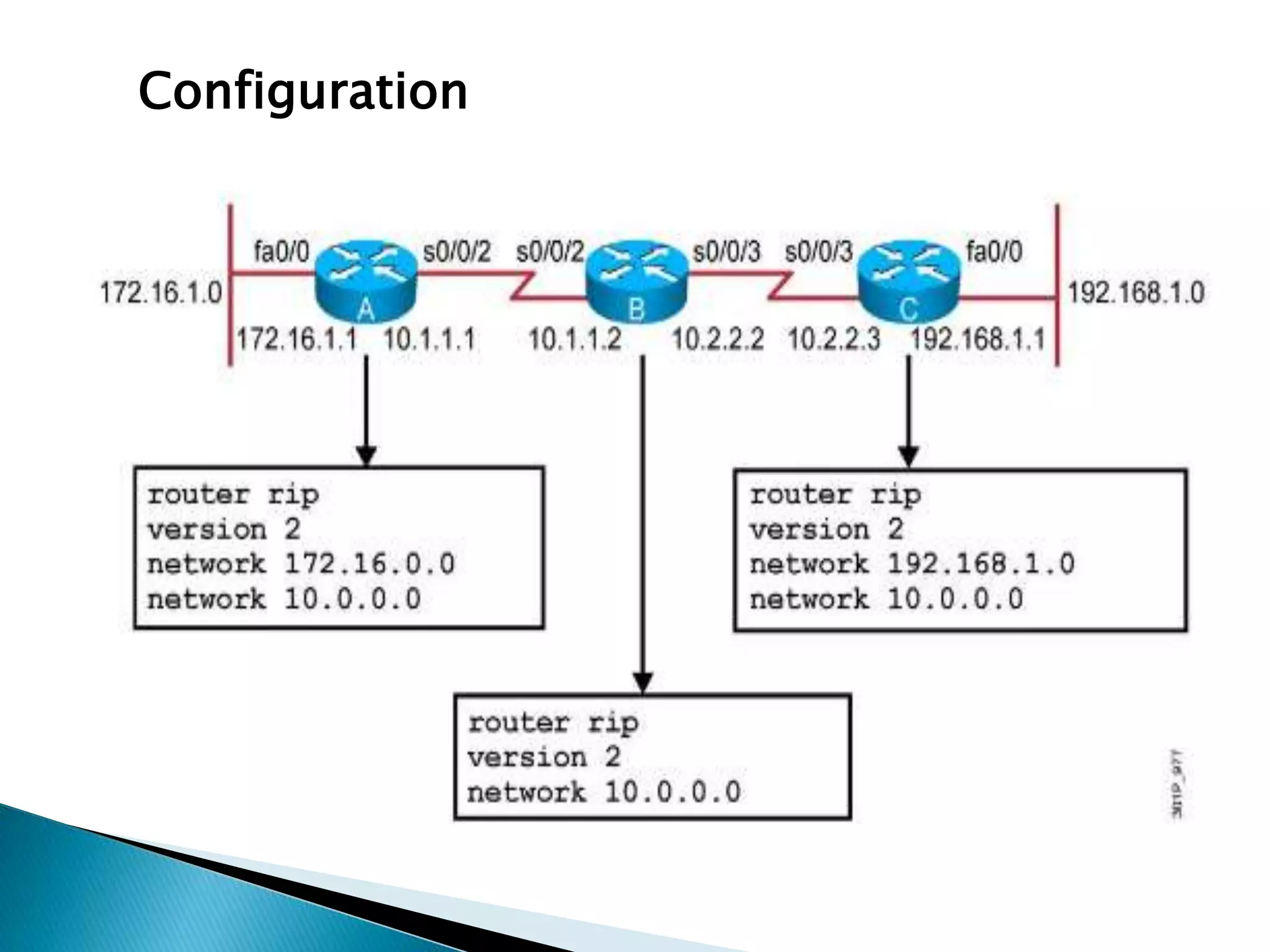
Configuration
Link state routing is a technique in which each router
shares the knowledge of its neighborhood with every
other router in the internetwork.
 Characteristics:-
 Updates are event triggered.
 Each router is aware of all other routers in the area.
 Fast convergence.
 More difficult to configure.
 Updates require less bandwidth.
 Example - OSPF
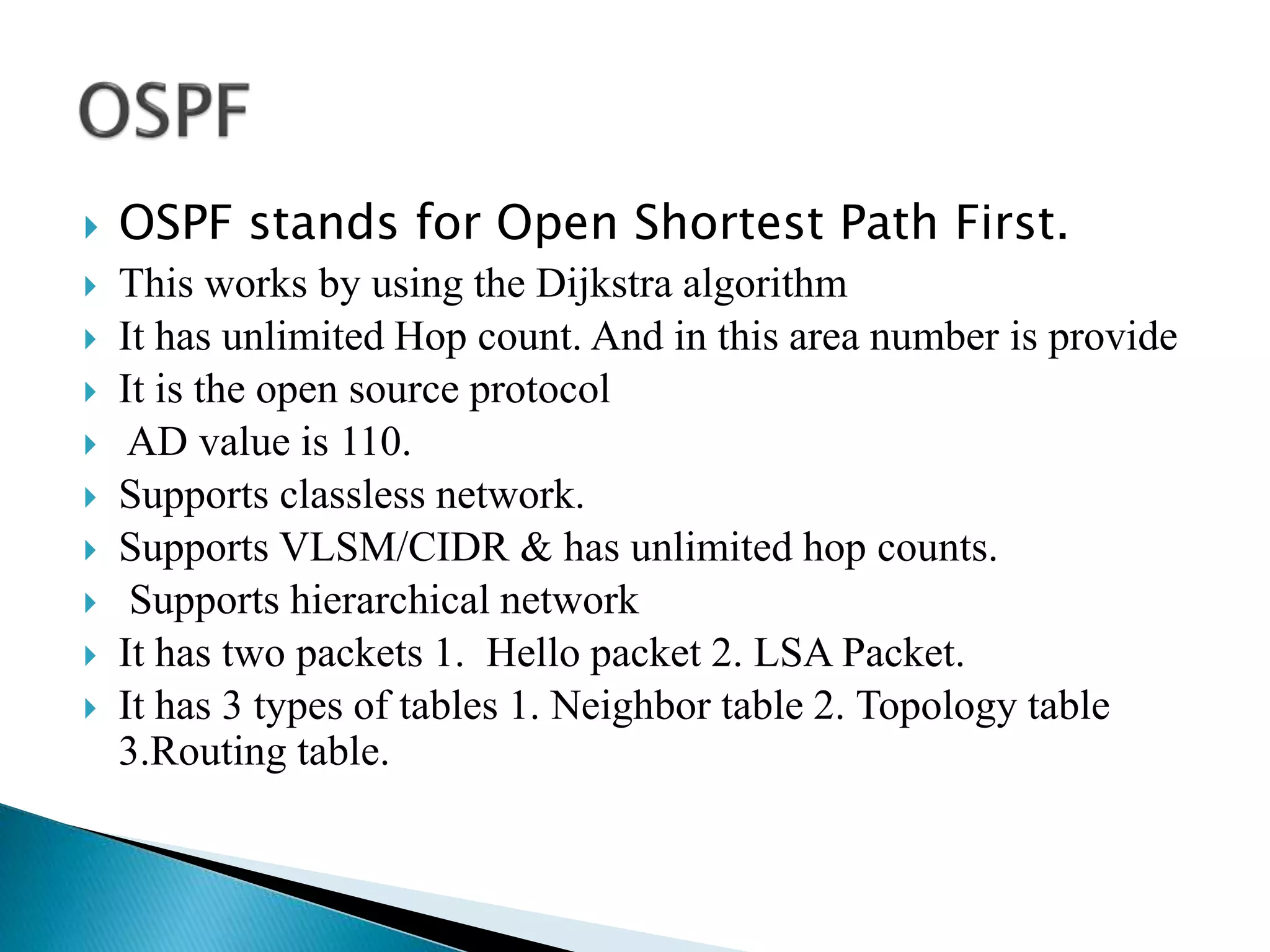
 OSPF stands for Open Shortest Path First.
 This works by using the Dijkstra algorithm
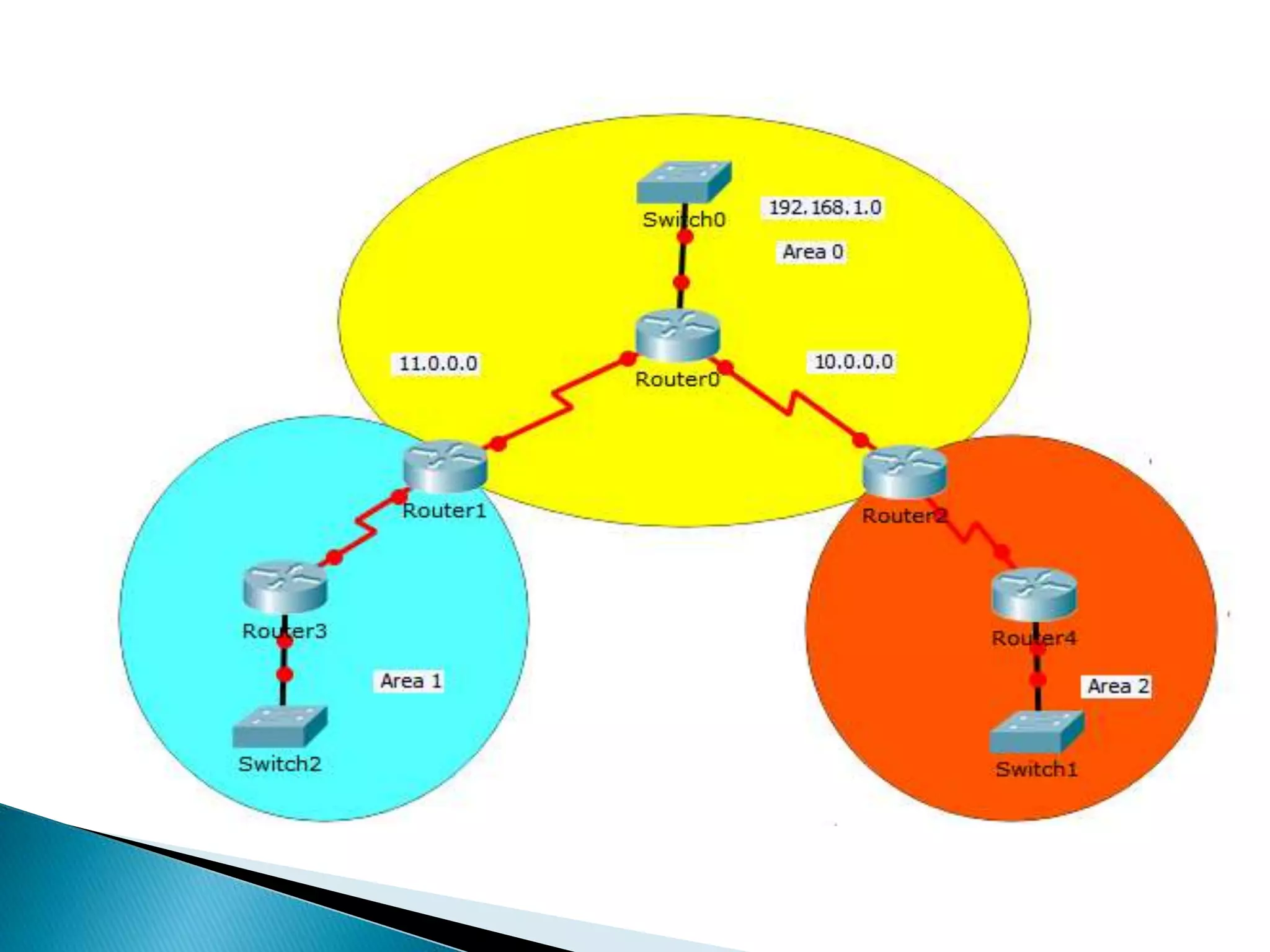
 It has unlimited Hop count. And in this area number is provide
 It is the open source protocol
 AD value is 110.
 Supports classless network.
 Supports VLSM/CIDR & has unlimited hop counts.
 Supports hierarchical network
 It has two packets 1. Hello packet 2. LSA Packet.
 It has 3 types of tables 1. Neighbor table 2. Topology table
3.Routing table.
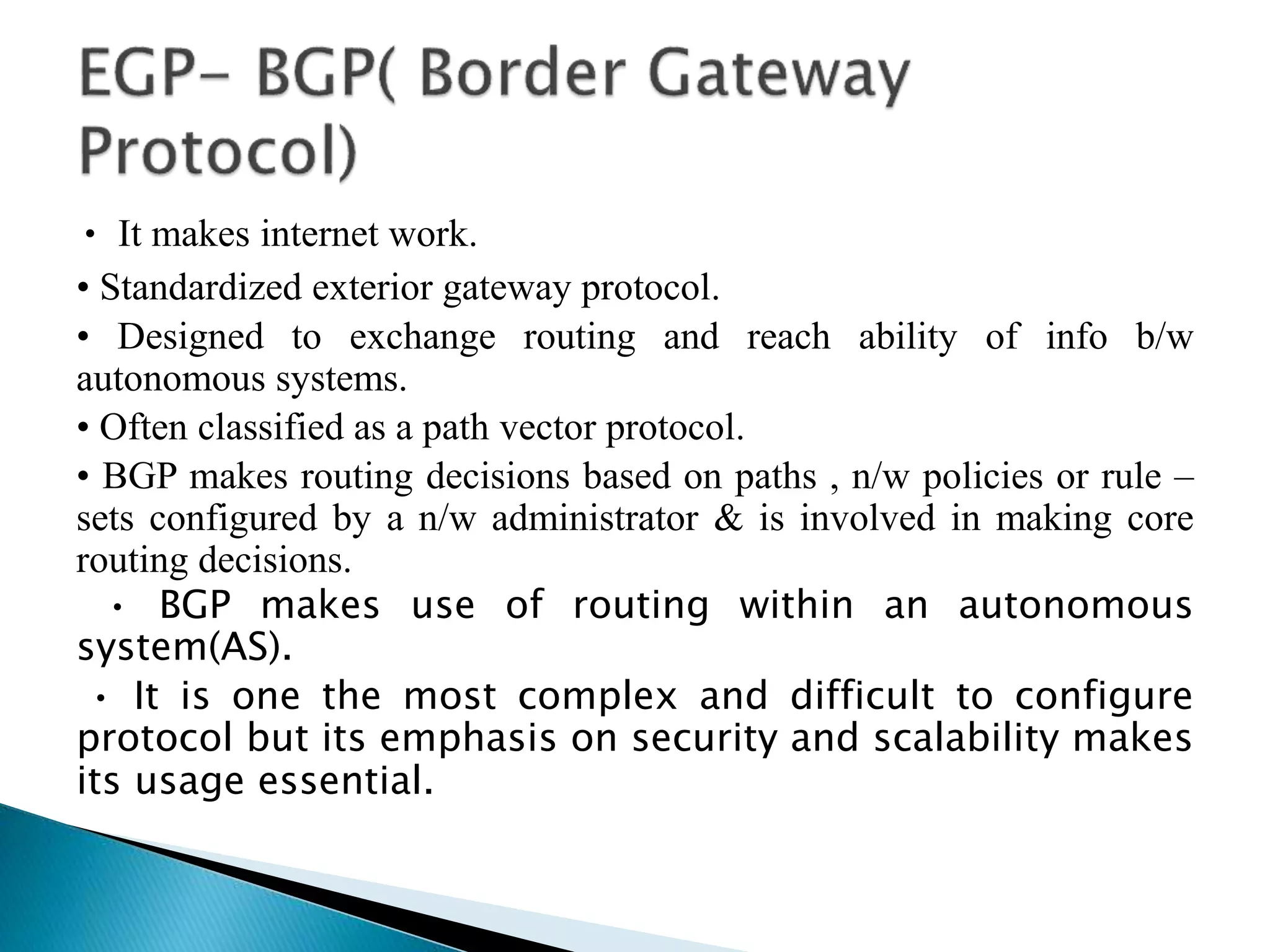
• It makes internet work.
• Standardized exterior gateway protocol.
• Designed to exchange routing and reach ability of info b/w
autonomous systems.
• Often classified as a path vector protocol.
• BGP makes routing decisions based on paths , n/w policies or rule –
sets configured by a n/w administrator & is involved in making core
routing decisions.
• BGP makes use of routing within an autonomous
system(AS).
• It is one the most complex and difficult to configure
protocol but its emphasis on security and scalability makes
its usage essential.
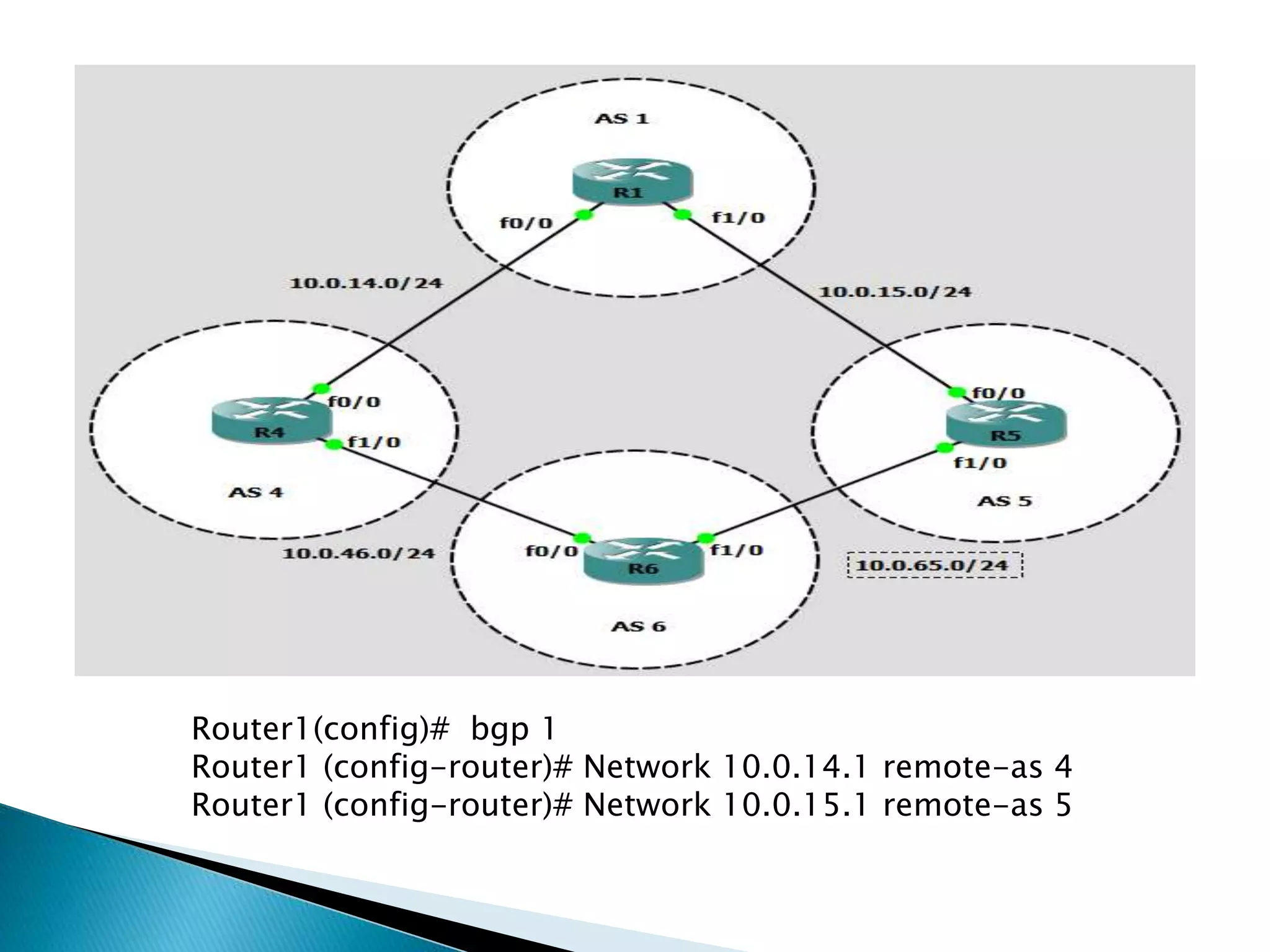
Router1(config)# bgp 1
Router1 (config-router)# Network 10.0.14.1 remote-as 4
Router1 (config-router)# Network 10.0.15.1 remote-as 5
THANK
YOU…….

Routing Protocols

  • 1.
  • 2.
     A networkis a collection of computers, servers, mainframes, network devices, peripherals, or other devices connected to one another to allow the sharing of data. An excellent example of a network is the Internet which connects millions of people all over the world.
  • 4.
     To communicatefrom one network to another network the IP Address plays an important role.  An Internet Protocol address (IP address) is a numerical label assigned to each device connected to a computer network that uses the Internet Protocol for communication.  Two version – ipv4 = 32 bit, ipv6= 128 bits.
  • 5.
     ROUTER A routeris a networking device that forwards data packets between computer networks.
  • 6.
     Routing protocolsare the set of rules used by the routers to communicate between source & destination.  This protocols finds the best path to send the packet from source to destination.
  • 7.
    Types of routing protocol Static routing protocol Default routing protocol DynamicRouting Protocol Interior Gateway Protocol Distance Vector RIP RIPV1 RIPV2 Link State OSPF EIGRP Exterior Gateway Protocol BGP
  • 8.
     Static routing,when an administrator manually assigns the path from source to destination network. This is feasible in small networks, but not in large networks.  Advantages:- – No overhead on router CPU. – No bandwidth usage between links. – Security (only administrator add routes.)  Disadvantages:-– All link will be down on a link failure. – Not practical on large networks. – Administrator must update all routes.
  • 10.
     This isthe method where the router is configured to send all packets towards a single router (next hop). It doesn’t matter to which network the packet belongs, it is forwarded out to router which is configured for default routing.  Advantages:- – No overhead on router CPU. – -No bandwidth usage between links. – Security (only administrator add routes.)  Disadvantages:- – All link will be down on a link failure. – Not practical on large networks. – Administrator must update all routes.
  • 12.
     Dynamic Routingis the process in which routing tables are automatically updates by routing table of each neighbor. – Dynamically discover & maintains routes.- calculates routes  Advantages – Less work in maintaining the configuration when adding & deleting networks. – Protocols automatically react to the topology changes. – Configuration is less-prone.  Disadvantages – Routers resource are used. – More administrator knowledge is required for configuration
  • 13.
    IGP EGP  IGPstands for Interior Gateway Protocol.  This is a routing protocol that is used to exchange routing information within an autonomous system (AS).  Examples- RIP, IGRP, EIGRP, OSPF.  EGP stands for Exterior Gateway Protocol.  It is used to transfer the data packets between two different autonomous systems.  Examples- BGP Autonomous System :- It is group of IP networks which has a single and clearly defined policy
  • 14.
     These protocolsselects the best path in the basis of hop counts to reach a destination network in the particular direction. Here one router counts as a one hop . Characteristics:-  Updates Frequently  Each Router is only aware of its immediate neighbors.  Slow convergence.  Make create routing loops.  Easy to configure.
  • 15.
    A. RIP istrue distance vector routing protocol B. Uses hop count metric C. Supports 15 hop-count limit D. AD value is 120. E. Supports classful networks and version 2 support classless. F. Works well in small network. G. Sends complete routing table at every 30 seconds. H. It uses Bellman-Ford algorithm to measure hop count  Disadvantages:-  Generate Traffic  As full routing table is exchange it create security issue.
  • 16.
  • 17.
    Link state routingis a technique in which each router shares the knowledge of its neighborhood with every other router in the internetwork.  Characteristics:-  Updates are event triggered.  Each router is aware of all other routers in the area.  Fast convergence.  More difficult to configure.  Updates require less bandwidth.  Example - OSPF
  • 18.
     OSPF standsfor Open Shortest Path First.  This works by using the Dijkstra algorithm  It has unlimited Hop count. And in this area number is provide  It is the open source protocol  AD value is 110.  Supports classless network.  Supports VLSM/CIDR & has unlimited hop counts.  Supports hierarchical network  It has two packets 1. Hello packet 2. LSA Packet.  It has 3 types of tables 1. Neighbor table 2. Topology table 3.Routing table.
  • 21.
    • It makesinternet work. • Standardized exterior gateway protocol. • Designed to exchange routing and reach ability of info b/w autonomous systems. • Often classified as a path vector protocol. • BGP makes routing decisions based on paths , n/w policies or rule – sets configured by a n/w administrator & is involved in making core routing decisions. • BGP makes use of routing within an autonomous system(AS). • It is one the most complex and difficult to configure protocol but its emphasis on security and scalability makes its usage essential.
  • 22.
    Router1(config)# bgp 1 Router1(config-router)# Network 10.0.14.1 remote-as 4 Router1 (config-router)# Network 10.0.15.1 remote-as 5
  • 23.