Router Configuration
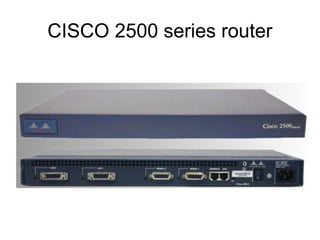
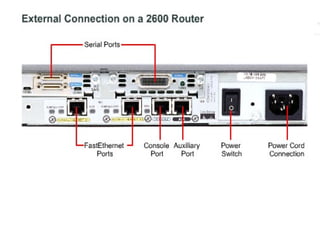
CISCO 2500 series router
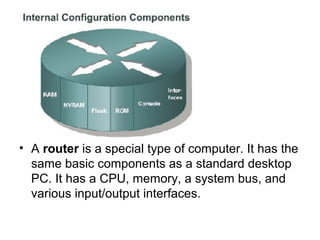
• A router is a special type of computer. It has the
  same basic components as a standard desktop
  PC. It has a CPU, memory, a system bus, and
  various input/output interfaces.
Router Components: RAM
RAM has the following characteristics and functions:
• Stores routing tables
• Holds ARP cache
• Holds fast-switching cache
• Performs packet buffering as shared RAM
• Maintains packet-hold queues
• Provides temporary memory for the configuration file of a
  router while the router is powered on
• Loses content when a router is powered down or
  restarted
Router Components: NVRAM
NVRAM has the following characteristics
  and functions:
• Provides storage for the startup
  configuration file
• Retains content when a router is powered
  down or restarted
Router Components: Flash memory

Flash memory has the following characteristics
  and functions:
• Holds the IOS image
• Allows software to be updated without removing
  and replacing chips on the processor
• Retains content when a router is powered down
  or restarted
• Can store multiple versions of IOS software
• Is a type of electrically erasable programmable
  read-only memory (EEPROM)
Router Components: ROM
ROM has the following characteristics and
  functions:
• Maintains instructions for power-on self
  test (POST) diagnostics
• Stores bootstrap program and basic
  operating system software
• Requires replacing pluggable chips on the
  motherboard for software upgrades
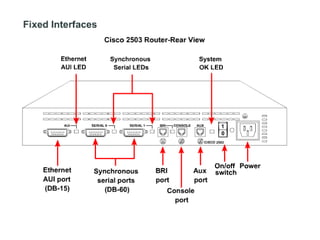
Router Components: Interfaces
Interfaces have the following characteristics
  and functions:
• Connect routers to a network for packet
  entry and exit
• Can be on the motherboard or on a
  separate module
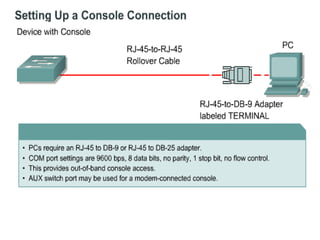
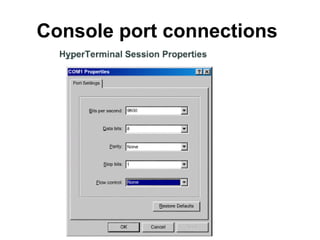
Console port connections
Router Configuration
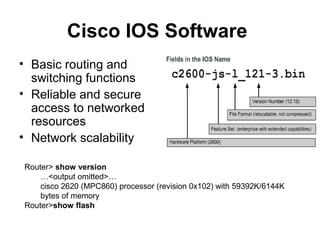
Cisco IOS Software
• Basic routing and
  switching functions
• Reliable and secure
  access to networked
  resources
• Network scalability

Router> show version
    …<output omitted>…
    cisco 2620 (MPC860) processor (revision 0x102) with 59392K/6144K
    bytes of memory
Router>show flash
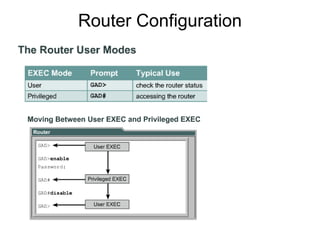
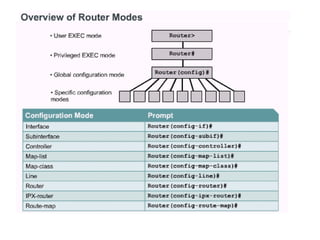
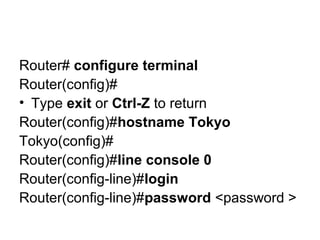
Router# configure terminal
Router(config)#
• Type exit or Ctrl-Z to return
Router(config)#hostname Tokyo
Tokyo(config)#
Router(config)#line console 0
Router(config-line)#login
Router(config-line)#password <password >
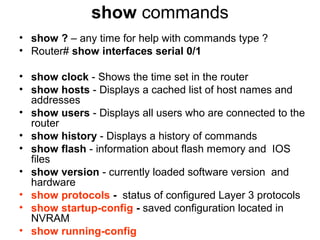
show commands
• show ? – any time for help with commands type ?
• Router# show interfaces serial 0/1

• show clock - Shows the time set in the router
• show hosts - Displays a cached list of host names and
  addresses
• show users - Displays all users who are connected to the
  router
• show history - Displays a history of commands
• show flash - information about flash memory and IOS
  files
• show version - currently loaded software version and
  hardware
• show protocols - status of configured Layer 3 protocols
• show startup-config - saved configuration located in
  NVRAM
• show running-config
Configuring interfaces
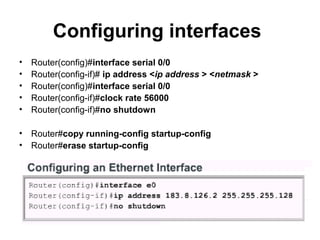
•   Router(config)#interface serial 0/0
•   Router(config-if)# ip address <ip address > <netmask >
•   Router(config)#interface serial 0/0
•   Router(config-if)#clock rate 56000
•   Router(config-if)#no shutdown

• Router#copy running-config startup-config
• Router#erase startup-config
Routing and Routing Protocols

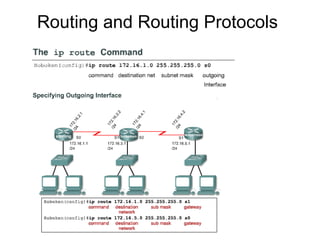
• dynamic routing,
• static routing
  – ip route command to manually configure a static
    route.
  – administrative distance is an optional parameter that
    indicates the reliability of a route.
  – waycross(config)# ip route 172.16.3.0 255.255.255.0
      172.16.4.1 130
  – Route can be configure by outgoing interface or next
    hop ip address.
  – default route is given by ip route 0.0.0.0 0.0.0.0
    [next-hop-address | outgoing interface ]
Routing and Routing Protocols
Dynamic Routing
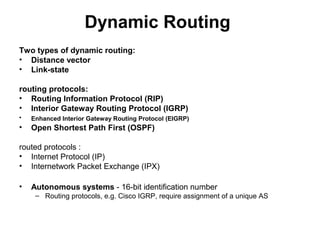
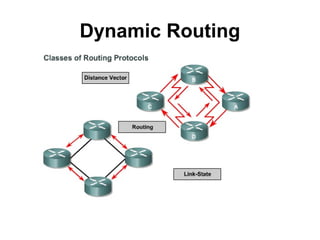
Two types of dynamic routing:
• Distance vector
• Link-state

routing protocols:
• Routing Information Protocol (RIP)
• Interior Gateway Routing Protocol (IGRP)
•   Enhanced Interior Gateway Routing Protocol (EIGRP)
•   Open Shortest Path First (OSPF)

routed protocols :
• Internet Protocol (IP)
• Internetwork Packet Exchange (IPX)

•   Autonomous systems - 16-bit identification number
     – Routing protocols, e.g. Cisco IGRP, require assignment of a unique AS
Dynamic Routing
Configuring Dynamic Routing
• BHM(config) #router rip – Selects RIP as the routing
  protocol
• BHM(config-router) #network 10.0.0.0 – Specifies a
  directly connected network
• BHM(config-router) # network 192.168.13.0 – Specifies
  a directly connected network

• RIP was originally specified in RFC 1058 :
   –   It is a distance vector routing protocol.
   –   Hop count is used as the metric for path selection.
   –   If the hop count is greater than 15, the packet is discarded.
   –   Routing updates are broadcast every 30 seconds, by default.
   –   Load balancing among multiple equidistance path
Troubleshooting
•   ABC#show ip protocols
•   ABC#show ip route
•   ABC#show interface interface
•   ABC#show ip interface interface
•   ABC#show running-config

•   show ip rip database
•   show ip protocols {summary}
•   debug ip rip {events}
•   ip interface brief
IGRP
• IGRP uses the following metrics:
  – Bandwidth – The lowest bandwidth value in
    the path
  – Delay – The cumulative interface delay along
    the path
  – Reliability – The reliability on the link toward
    the destination as determined by the
    exchange of keepalives
  – Load – The load
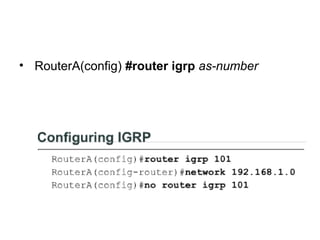
• RouterA(config) #router igrp as-number
More on Routing…
•   OSPF and EIGRP
•   EGP and IGP
•   Switching
•   VLAN
•   Access Control List (ACL)
OSPF
• OSPF is a nonproprietary link-state routing
  protocol.
  – It is a link-state routing protocol.
  – It is an open standard routing protocol described in
    RFC 2328.
  – The SPF algorithm is used to calculate the lowest
    cost to a destination.
  – Routing updates are flooded as topology changes
    occur.
  # router ospf process-id
  # network net-address wildcard-mask area area-id
EIGRP
• EIGRP is a Cisco proprietary enhanced distance vector
  routing protocol.
   – It is an enhanced distance vector routing protocol.
   – It uses unequal cost load balancing.
   – It uses a combination of distance vector and link-state features
     (hybrid).
   – It uses Diffused Update Algorithm (DUAL) to calculate the
     shortest path.
   – Routing updates are multicast using 224.0.0.10 triggered by
     topology changes. Max hop 255
RA(config-router)# router eigrp autonomous-
  system-number
RA(config-router)# network network-number
BGP
• Border Gateway Protocol (BGP) is an
  exterior routing protocol.
  – It is a distance vector exterior routing protocol.
  – It is used between ISPs or ISPs and clients.
  – It is used to route Internet traffic between
    autonomous systems.

Router configuration

  • 1.
  • 3.
  • 5.
    • A routeris a special type of computer. It has the same basic components as a standard desktop PC. It has a CPU, memory, a system bus, and various input/output interfaces.
  • 6.
    Router Components: RAM RAMhas the following characteristics and functions: • Stores routing tables • Holds ARP cache • Holds fast-switching cache • Performs packet buffering as shared RAM • Maintains packet-hold queues • Provides temporary memory for the configuration file of a router while the router is powered on • Loses content when a router is powered down or restarted
  • 7.
    Router Components: NVRAM NVRAMhas the following characteristics and functions: • Provides storage for the startup configuration file • Retains content when a router is powered down or restarted
  • 8.
    Router Components: Flashmemory Flash memory has the following characteristics and functions: • Holds the IOS image • Allows software to be updated without removing and replacing chips on the processor • Retains content when a router is powered down or restarted • Can store multiple versions of IOS software • Is a type of electrically erasable programmable read-only memory (EEPROM)
  • 9.
    Router Components: ROM ROMhas the following characteristics and functions: • Maintains instructions for power-on self test (POST) diagnostics • Stores bootstrap program and basic operating system software • Requires replacing pluggable chips on the motherboard for software upgrades
  • 10.
    Router Components: Interfaces Interfaceshave the following characteristics and functions: • Connect routers to a network for packet entry and exit • Can be on the motherboard or on a separate module
  • 14.
  • 16.
  • 17.
    Cisco IOS Software •Basic routing and switching functions • Reliable and secure access to networked resources • Network scalability Router> show version …<output omitted>… cisco 2620 (MPC860) processor (revision 0x102) with 59392K/6144K bytes of memory Router>show flash
  • 19.
    Router# configure terminal Router(config)# •Type exit or Ctrl-Z to return Router(config)#hostname Tokyo Tokyo(config)# Router(config)#line console 0 Router(config-line)#login Router(config-line)#password <password >
  • 20.
    show commands • show? – any time for help with commands type ? • Router# show interfaces serial 0/1 • show clock - Shows the time set in the router • show hosts - Displays a cached list of host names and addresses • show users - Displays all users who are connected to the router • show history - Displays a history of commands • show flash - information about flash memory and IOS files • show version - currently loaded software version and hardware • show protocols - status of configured Layer 3 protocols • show startup-config - saved configuration located in NVRAM • show running-config
  • 21.
    Configuring interfaces • Router(config)#interface serial 0/0 • Router(config-if)# ip address <ip address > <netmask > • Router(config)#interface serial 0/0 • Router(config-if)#clock rate 56000 • Router(config-if)#no shutdown • Router#copy running-config startup-config • Router#erase startup-config
  • 22.
    Routing and RoutingProtocols • dynamic routing, • static routing – ip route command to manually configure a static route. – administrative distance is an optional parameter that indicates the reliability of a route. – waycross(config)# ip route 172.16.3.0 255.255.255.0 172.16.4.1 130 – Route can be configure by outgoing interface or next hop ip address. – default route is given by ip route 0.0.0.0 0.0.0.0 [next-hop-address | outgoing interface ]
  • 23.
  • 24.
    Dynamic Routing Two typesof dynamic routing: • Distance vector • Link-state routing protocols: • Routing Information Protocol (RIP) • Interior Gateway Routing Protocol (IGRP) • Enhanced Interior Gateway Routing Protocol (EIGRP) • Open Shortest Path First (OSPF) routed protocols : • Internet Protocol (IP) • Internetwork Packet Exchange (IPX) • Autonomous systems - 16-bit identification number – Routing protocols, e.g. Cisco IGRP, require assignment of a unique AS
  • 25.
  • 26.
    Configuring Dynamic Routing •BHM(config) #router rip – Selects RIP as the routing protocol • BHM(config-router) #network 10.0.0.0 – Specifies a directly connected network • BHM(config-router) # network 192.168.13.0 – Specifies a directly connected network • RIP was originally specified in RFC 1058 : – It is a distance vector routing protocol. – Hop count is used as the metric for path selection. – If the hop count is greater than 15, the packet is discarded. – Routing updates are broadcast every 30 seconds, by default. – Load balancing among multiple equidistance path
  • 27.
    Troubleshooting • ABC#show ip protocols • ABC#show ip route • ABC#show interface interface • ABC#show ip interface interface • ABC#show running-config • show ip rip database • show ip protocols {summary} • debug ip rip {events} • ip interface brief
  • 28.
    IGRP • IGRP usesthe following metrics: – Bandwidth – The lowest bandwidth value in the path – Delay – The cumulative interface delay along the path – Reliability – The reliability on the link toward the destination as determined by the exchange of keepalives – Load – The load
  • 29.
  • 30.
    More on Routing… • OSPF and EIGRP • EGP and IGP • Switching • VLAN • Access Control List (ACL)
  • 31.
    OSPF • OSPF isa nonproprietary link-state routing protocol. – It is a link-state routing protocol. – It is an open standard routing protocol described in RFC 2328. – The SPF algorithm is used to calculate the lowest cost to a destination. – Routing updates are flooded as topology changes occur. # router ospf process-id # network net-address wildcard-mask area area-id
  • 32.
    EIGRP • EIGRP isa Cisco proprietary enhanced distance vector routing protocol. – It is an enhanced distance vector routing protocol. – It uses unequal cost load balancing. – It uses a combination of distance vector and link-state features (hybrid). – It uses Diffused Update Algorithm (DUAL) to calculate the shortest path. – Routing updates are multicast using 224.0.0.10 triggered by topology changes. Max hop 255 RA(config-router)# router eigrp autonomous- system-number RA(config-router)# network network-number
  • 33.
    BGP • Border GatewayProtocol (BGP) is an exterior routing protocol. – It is a distance vector exterior routing protocol. – It is used between ISPs or ISPs and clients. – It is used to route Internet traffic between autonomous systems.