Integrated Production Systems I
Lecture 5:
Material Requirements Planning
Learning Objectives
• Describe the inputs and outputs to an MRP system,
and execute the MRP process
• Discuss different lot sizing rules.
Material
Requirements
Planning
A. Master Production Schedule
• Deduced from aggregate planning but for individual products.
• Drives MRP process with a schedule of finished products.
• Quantities represent production not demand
• Quantities may consist of a combination of customer orders and
demand forecasts
• Quantities represent what needs to be produced, not what can be
produced
• Quantities represent end items that may or may not be finished
products
Master Production Schedule
PERIOD
MPS ITEM 1 2 3 4 5
Pencil Case 125 125 125 125 125
Clipboard 85 95 120 100 100
Lapboard 75 120 47 20 17
Lapdesk 0 50 0 50 0
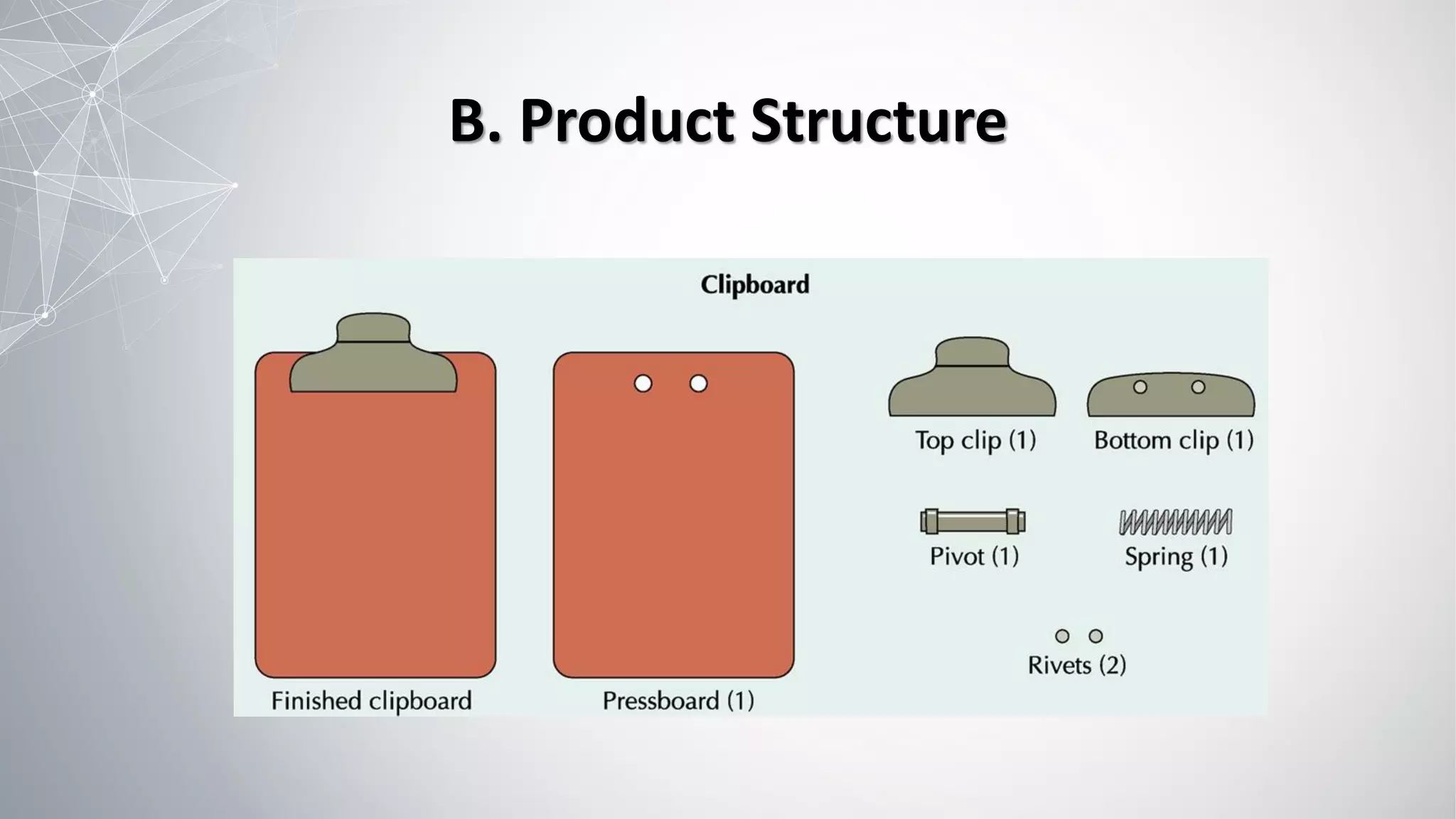
B. Product Structure
Product Structure Tree/diagram
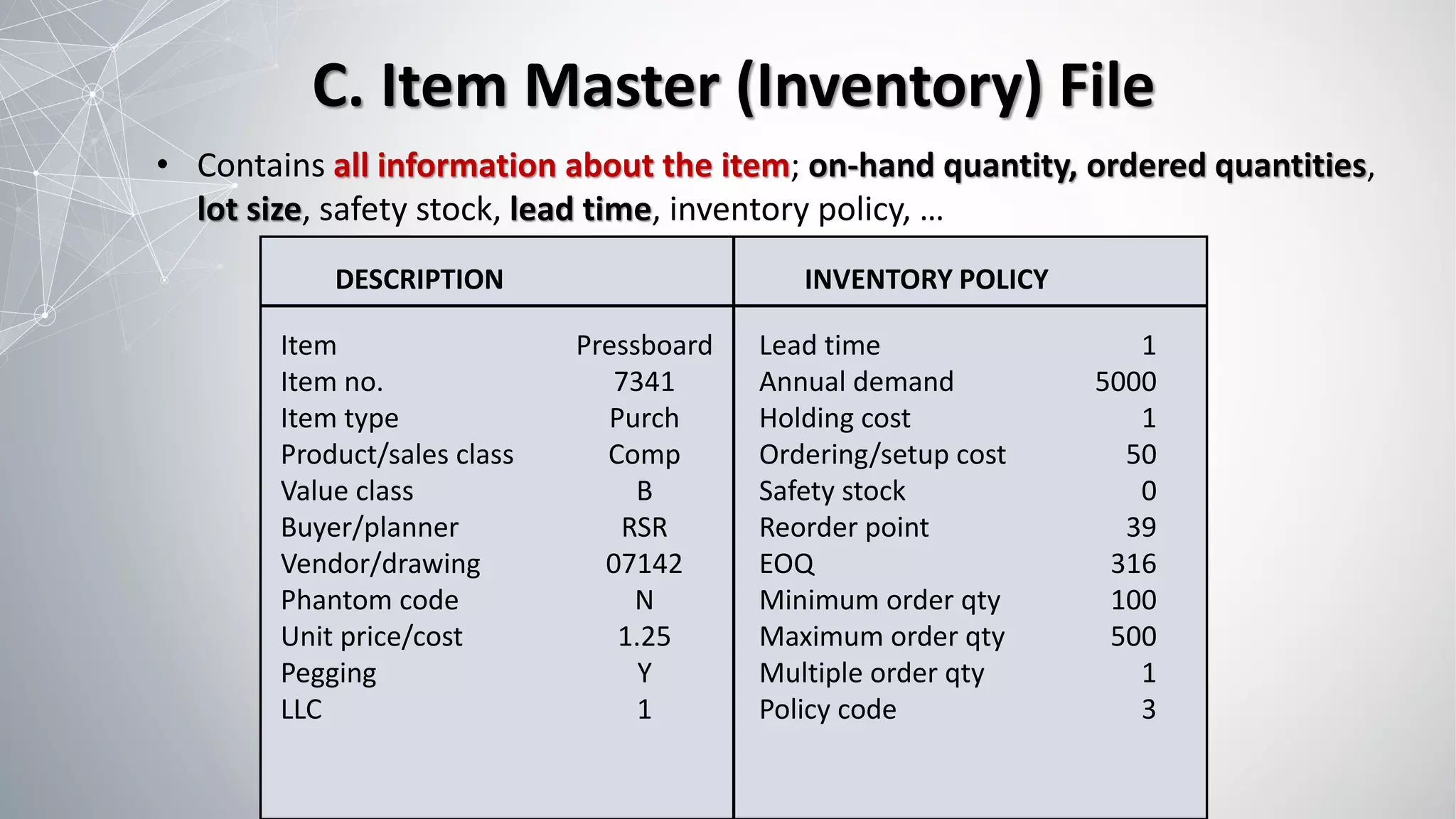
C. Item Master (Inventory) File
DESCRIPTION INVENTORY POLICY
Item Pressboard Lead time 1
Item no. 7341 Annual demand 5000
Item type Purch Holding cost 1
Product/sales class Comp Ordering/setup cost 50
Value class B Safety stock 0
Buyer/planner RSR Reorder point 39
Vendor/drawing 07142 EOQ 316
Phantom code N Minimum order qty 100
Unit price/cost 1.25 Maximum order qty 500
Pegging Y Multiple order qty 1
LLC 1 Policy code 3
• Contains all information about the item; on-hand quantity, ordered quantities,
lot size, safety stock, lead time, inventory policy, …
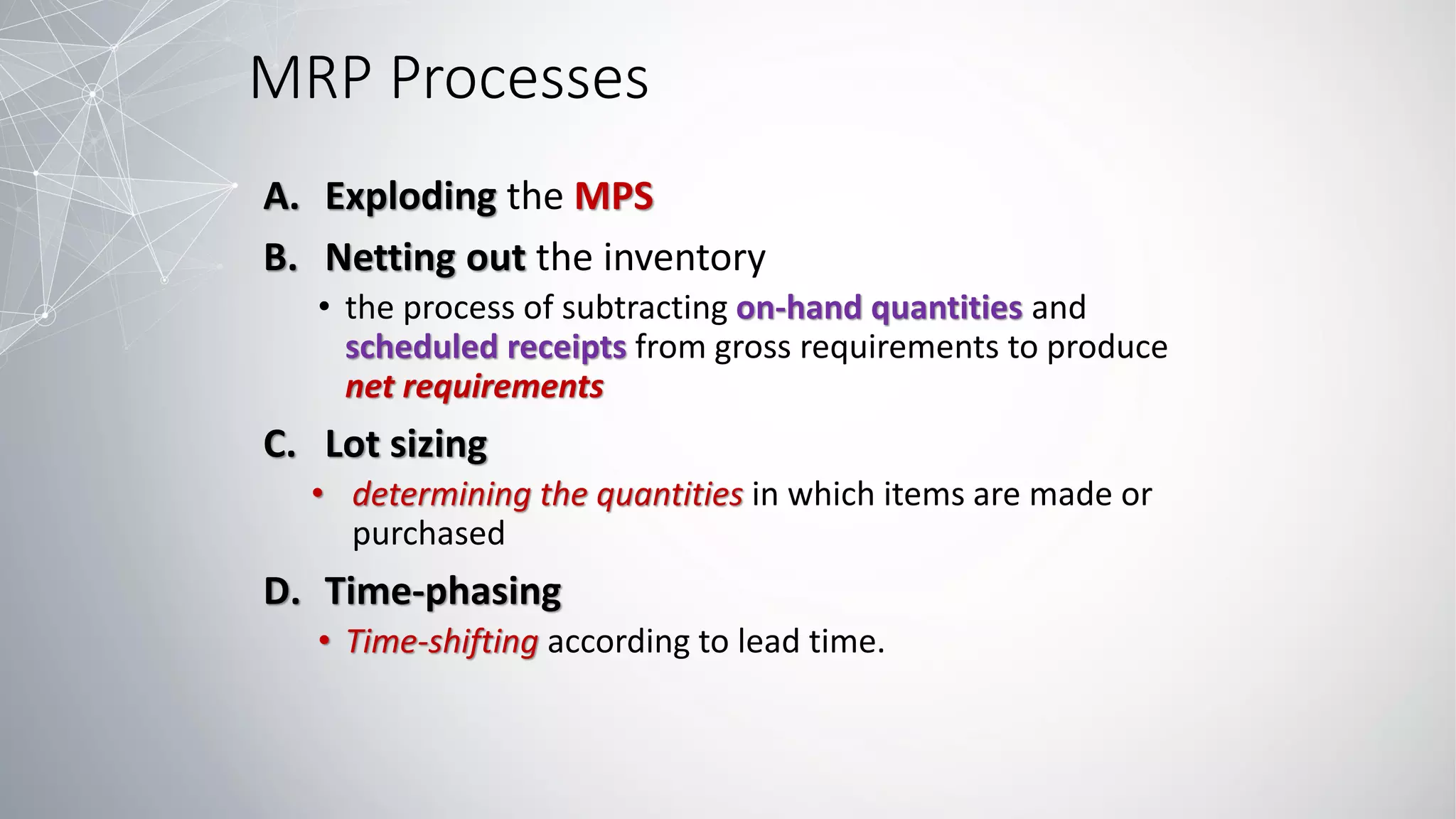
MRP Processes
A. Exploding the MPS
B. Netting out the inventory
• the process of subtracting on-hand quantities and
scheduled receipts from gross requirements to produce
net requirements
C. Lot sizing
• determining the quantities in which items are made or
purchased
D. Time-phasing
• Time-shifting according to lead time.
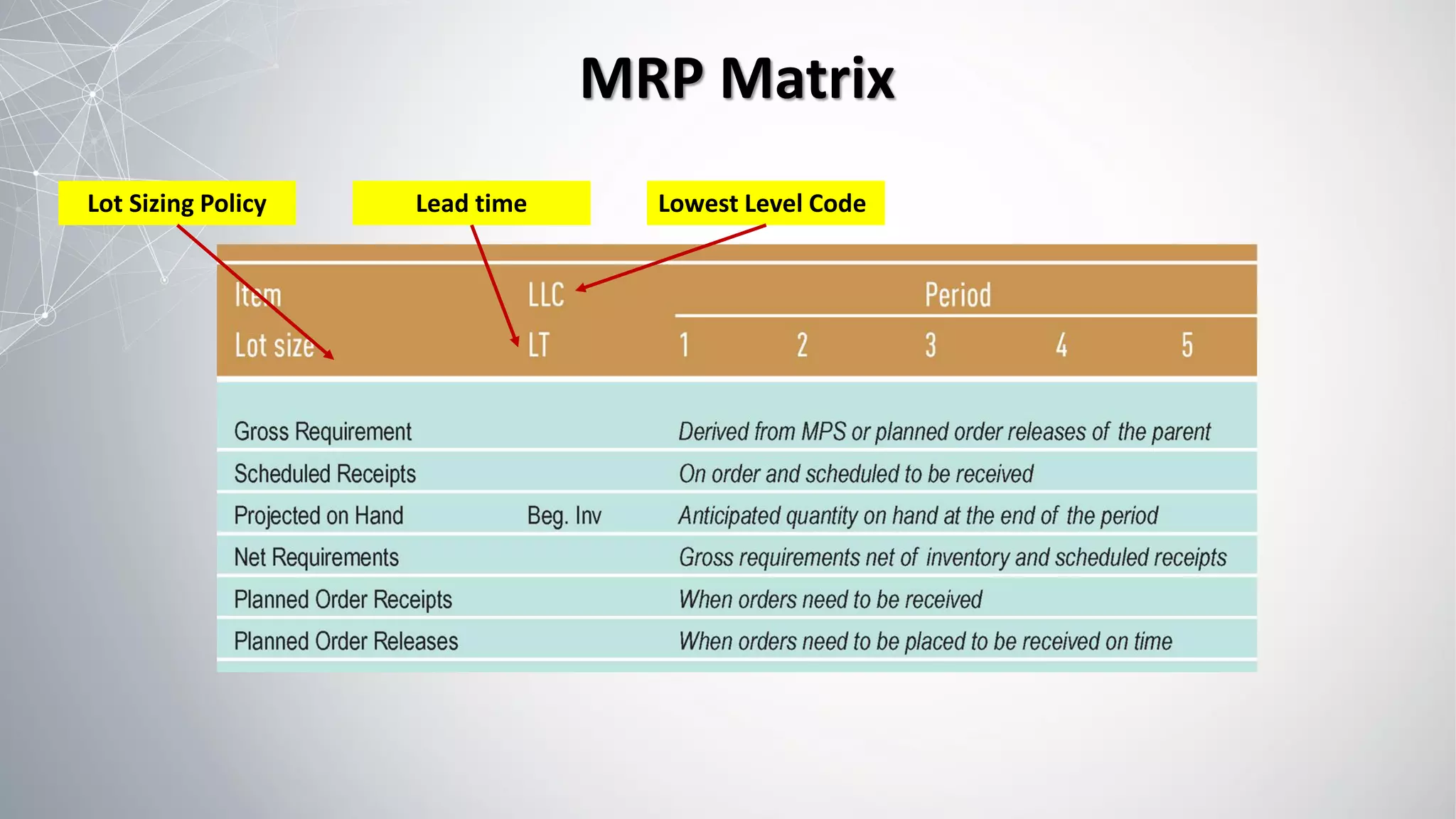
MRP Matrix
Lowest Level Code
Lot Sizing Policy Lead time
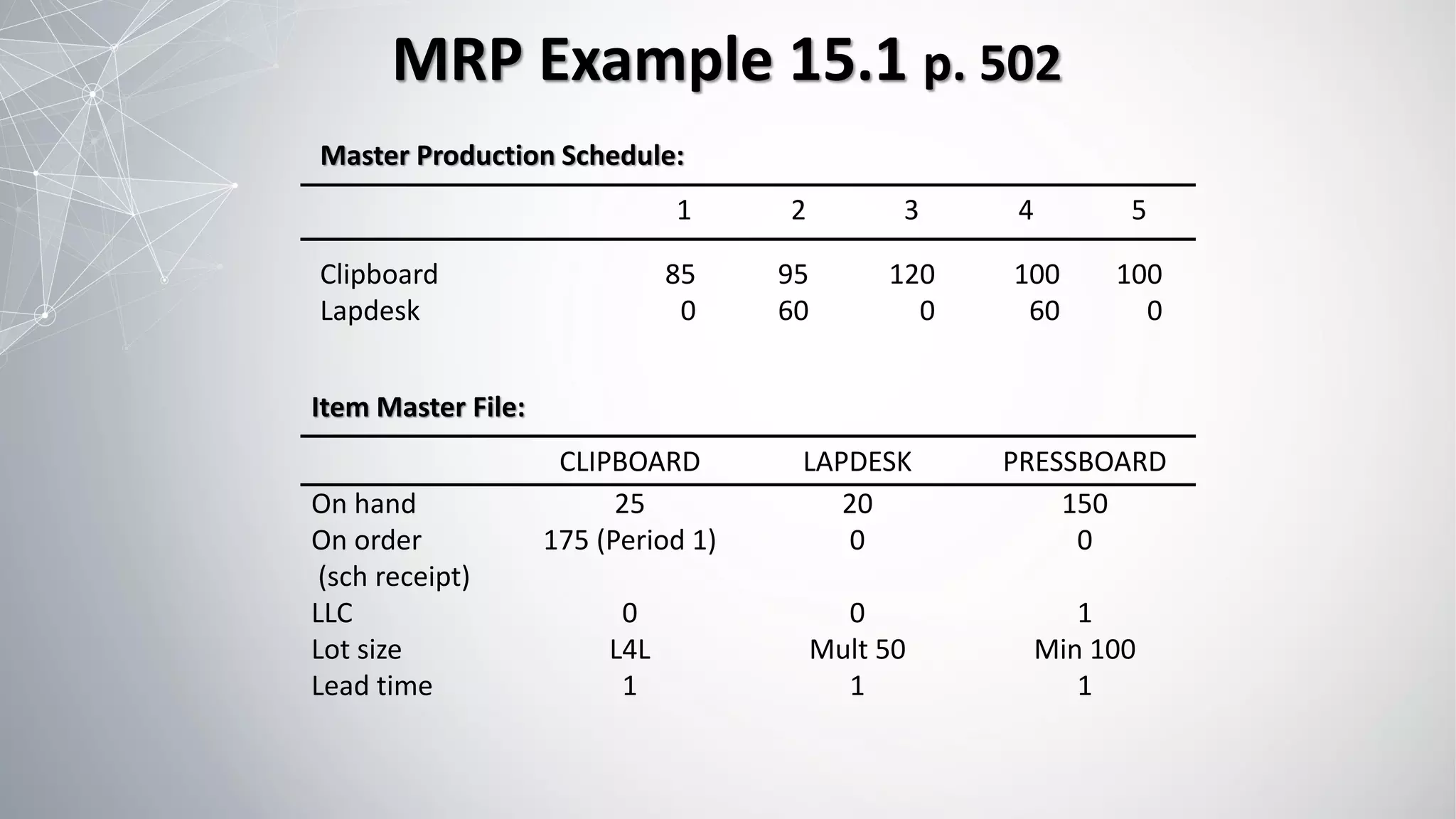
MRP Example 15.1 p. 502
Master Production Schedule:
1 2 3 4 5
Clipboard 85 95 120 100 100
Lapdesk 0 60 0 60 0
Item Master File:
CLIPBOARD LAPDESK PRESSBOARD
On hand 25 20 150
On order 175 (Period 1) 0 0
(sch receipt)
LLC 0 0 1
Lot size L4L Mult 50 Min 100
Lead time 1 1 1
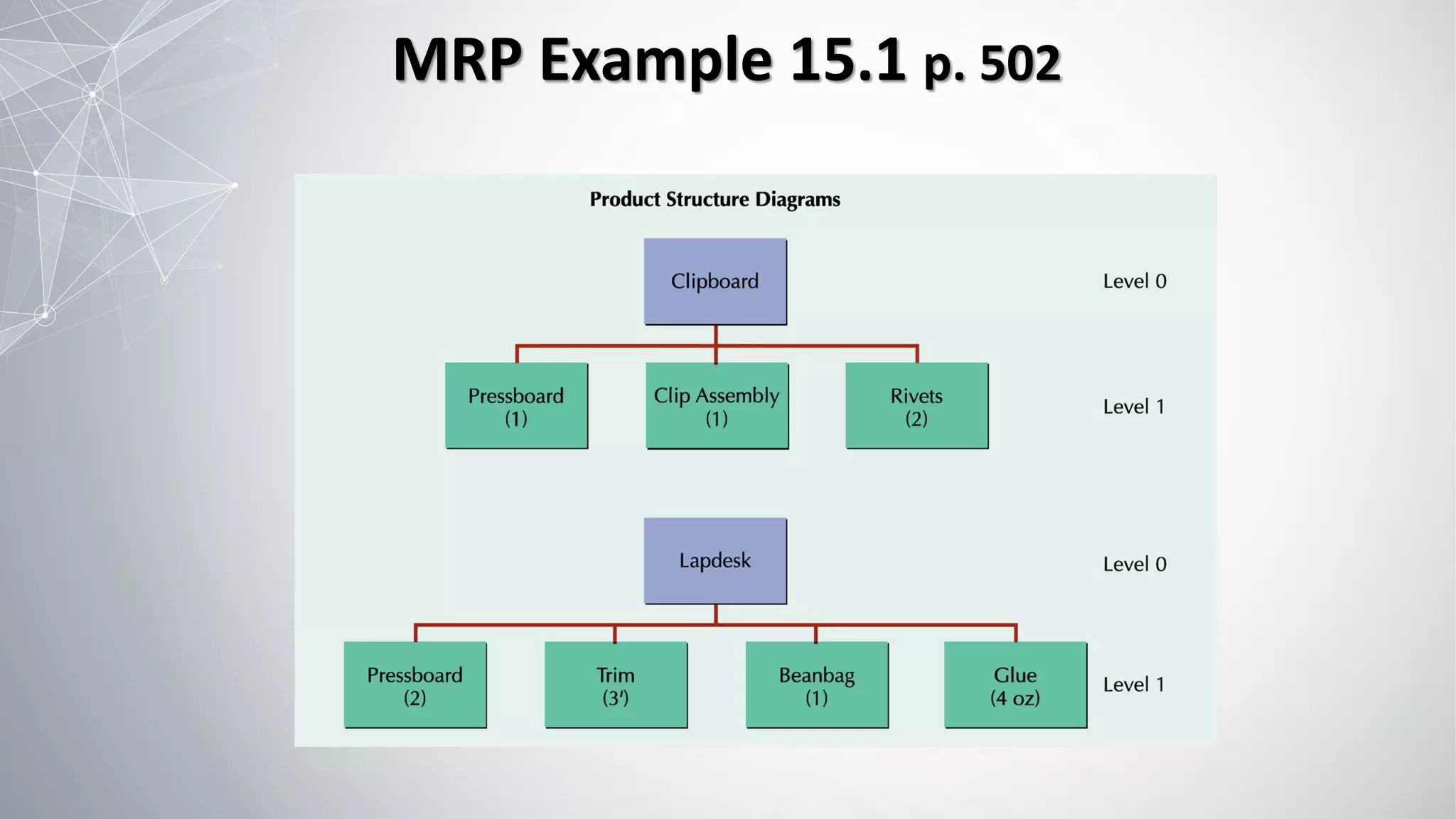
MRP Example 15.1 p. 502
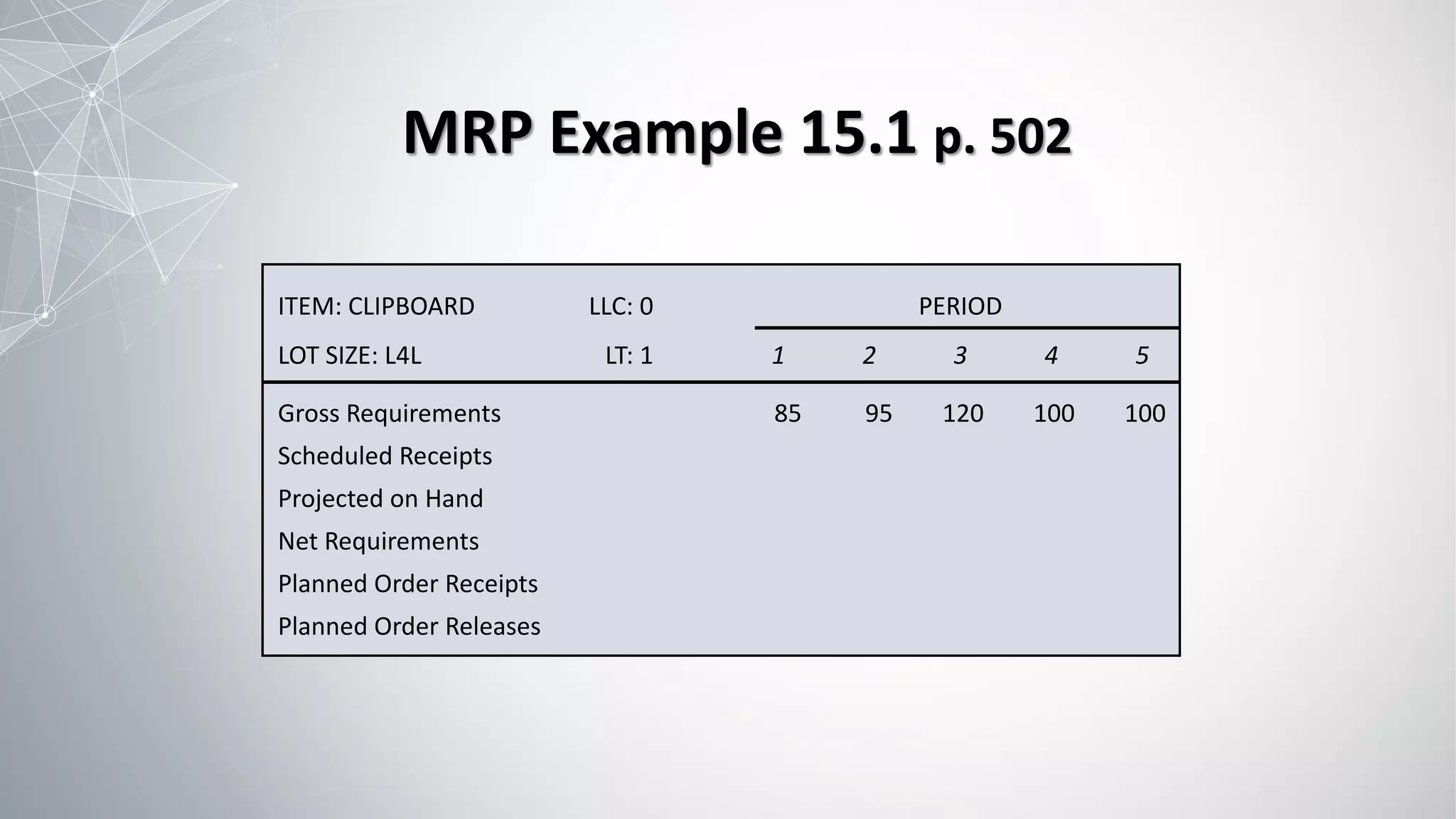
ITEM: CLIPBOARD LLC: 0 PERIOD
LOT SIZE: L4L LT: 1 1 2 3 4 5
Gross Requirements 85 95 120 100 100
Scheduled Receipts
Projected on Hand
Net Requirements
Planned Order Receipts
Planned Order Releases
MRP Example 15.1 p. 502
ITEM: CLIPBOARD LLC: 0 PERIOD
LOT SIZE: L4L LT: 1 1 2 3 4 5
Gross Requirements 85 95 120 100 100
Scheduled Receipts 175
Projected on Hand 25
Net Requirements
Planned Order Receipts
Planned Order Releases
MRP Example 15.1 p. 502
ITEM: CLIPBOARD LLC: 0 PERIOD
LOT SIZE: L4L LT: 1 1 2 3 4 5
Gross Requirements 85 95 120 100 100
Scheduled Receipts 175
Projected on Hand 25 115
Net Requirements 0
Planned Order Receipts
Planned Order Releases
(25 + 175) = 200 units available
(200 - 85) = 115 on hand at the end of Period 1
MRP Example 15.1 p. 502
ITEM: CLIPBOARD LLC: 0 PERIOD
LOT SIZE: L4L LT: 1 1 2 3 4 5
Gross Requirements 85 95 120 100 100
Scheduled Receipts 175
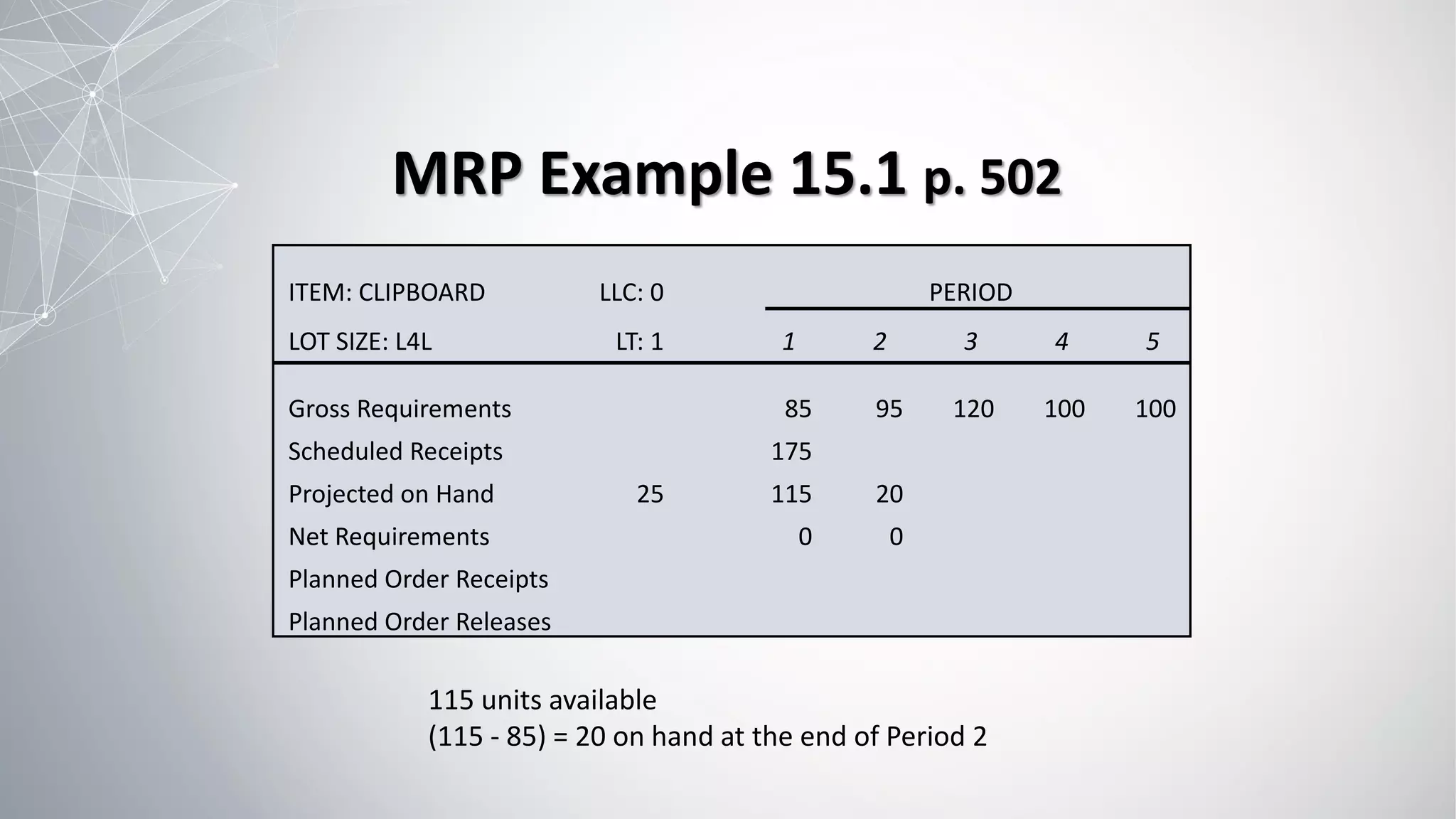
Projected on Hand 25 115 20
Net Requirements 0 0
Planned Order Receipts
Planned Order Releases
115 units available
(115 - 85) = 20 on hand at the end of Period 2
MRP Example 15.1 p. 502
ITEM: CLIPBOARD LLC: 0 PERIOD
LOT SIZE: L4L LT: 1 1 2 3 4 5
Gross Requirements 85 95 120 100 100
Scheduled Receipts 175
Projected on Hand 25 115 20 0
Net Requirements 0 0 100
Planned Order Receipts 100
Planned Order Releases 100
20 units available
(20 - 120) = -100 — 100 additional Clipboards are required
Order must be placed in Period 2 to be received in Period 3
MRP Example 15.1 p. 502
ITEM: CLIPBOARD LLC: 0 PERIOD
LOT SIZE: L4L LT: 1 1 2 3 4 5
Gross Requirements 85 95 120 100 100
Scheduled Receipts 175
Projected on Hand 25 115 20 0 0 0
Net Requirements 0 0 100 100 100
Planned Order Receipts 100 100 100
Planned Order Releases 100 100 100
Following the same logic Gross Requirements in Periods 4 and 5 develop
Net Requirements, Planned Order Receipts, and Planned Order Releases
MRP Example 15.1 p. 502
ITEM: LAPDESK LLC: 0 PERIOD
LOT SIZE: MULT 50 LT: 1 1 2 3 4 5
Gross Requirements 0 60 0 60 0
Scheduled Receipts
Projected on Hand 20
Net Requirements
Planned Order Receipts
Planned Order Releases
MRP Example 15.1 p. 502
ITEM: LAPDESK LLC: 0 PERIOD
LOT SIZE: MULT 50 LT: 1 1 2 3 4 5
Gross Requirements 0 60 0 60 0
Scheduled Receipts
Projected on Hand 20 20 10 10 0 0
Net Requirements 0 40 50
Planned Order Receipts 50 50
Planned Order Releases 50 50
Following the same logic, the Lapdesk MRP matrix is
completed as shown
MRP Example 15.1 p. 502
ITEM: PRESSBOARD LLC: 1 PERIOD
LOT SIZE: MIN 100 LT: 1 1 2 3 4 5
Gross Requirements
Scheduled Receipts
Projected on Hand 150
Net Requirements
Planned Order Receipts
Planned Order Releases
ITEM: CLIPBOARD LLC: 0 PERIOD
LOT SIZE: L4L LT: 1 1 2 3 4 5
Planned Order Releases 100 100 100
ITEM: LAPDESK LLC: 0 PERIOD
LOT SIZE: MULT 50 LT: 1 1 2 3 4 5
Planned Order Releases 50 50
MRP Example 15.1 p. 502
ITEM: PRESSBOARD LLC: 1 PERIOD
LOT SIZE: MIN 100 LT: 1 1 2 3 4 5
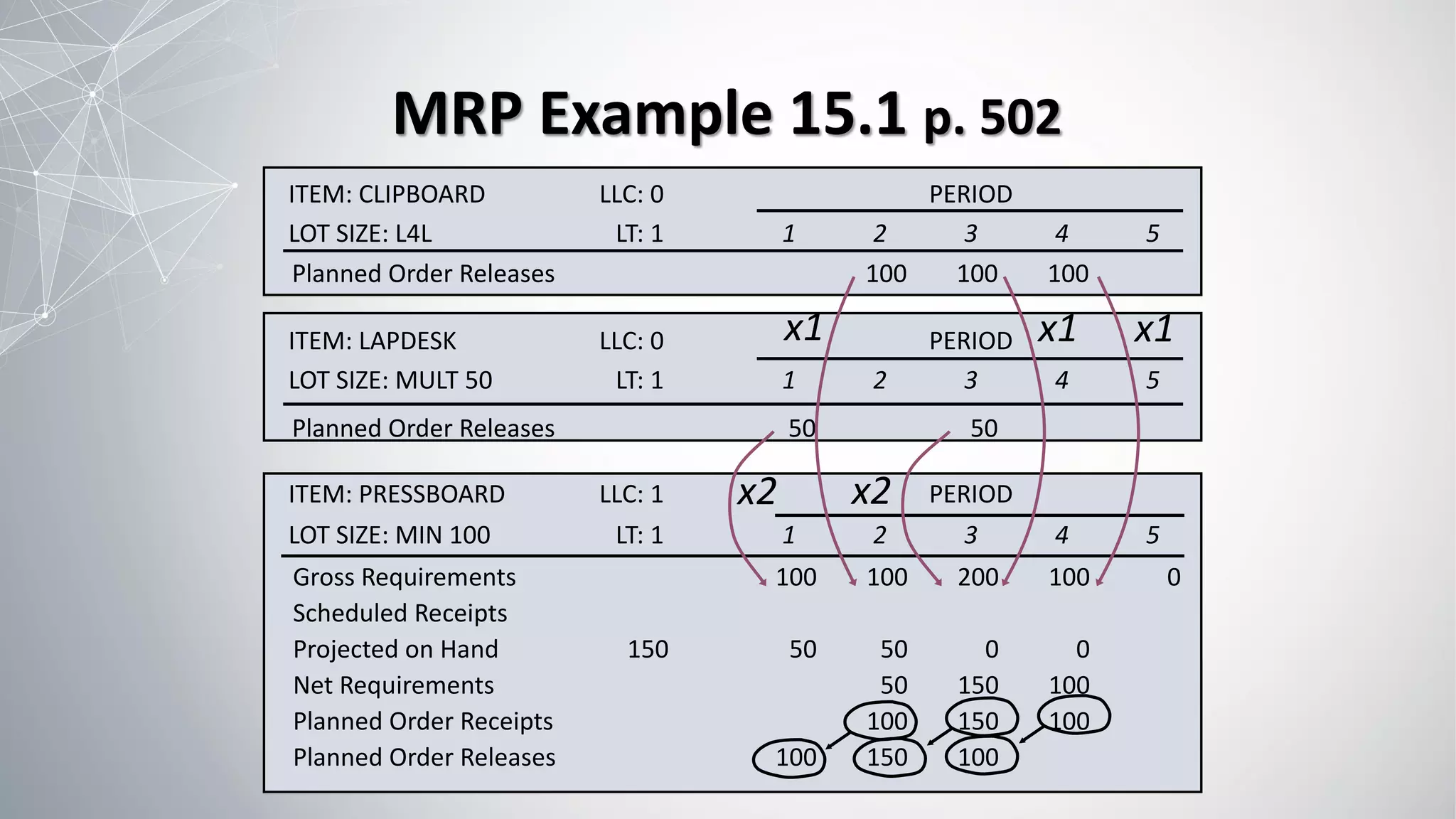
Gross Requirements 100 100 200 100 0
Scheduled Receipts
Projected on Hand 150
Net Requirements
Planned Order Receipts
Planned Order Releases
ITEM: CLIPBOARD LLC: 0 PERIOD
LOT SIZE: L4L LT: 1 1 2 3 4 5
ITEM: LAPDESK LLC: 0 PERIOD
LOT SIZE: MULT 50 LT: 1 1 2 3 4 5
MRP Example 15.1 p. 502
x1 x1
x1
x2 x2
Planned Order Releases 100 100 100
Planned Order Releases 50 50
ITEM: PRESSBOARD LLC: 1 PERIOD
LOT SIZE: MIN 100 LT: 1 1 2 3 4 5
Gross Requirements 100 100 200 100 0
Scheduled Receipts
Projected on Hand 150 50 50 0 0
Net Requirements 50 150 100
Planned Order Receipts 100 150 100
Planned Order Releases 100 150 100
ITEM: CLIPBOARD LLC: 0 PERIOD
LOT SIZE: L4L LT: 1 1 2 3 4 5
Planned Order Releases 100 100 100
ITEM: LAPDESK LLC: 0 PERIOD
LOT SIZE: MULT 50 LT: 1 1 2 3 4 5
Planned Order Releases 50 50
x1 x1
x1
x2 x2
MRP Example 15.1 p. 502
PERIOD
ITEM 1 2 3 4 5
Clipboard 100 100 100
Lapdesk 50 50
Pressboard 100 150 100
Planned Order Report
MRP Example 15.1 p. 502
Lot Sizing in MRP Systems
• Lot-for-lot ordering policy
• Minimum order quantities
• Maximum order quantities
• Multiple order quantities
• Economic order quantity (EOQ)
• Periodic order quantity (POQ)
Best Policy is the Policy with the Minimum Total Cost: Ordering + Holding
Costs
Advanced Lot Sizing Rules: L4L
Example 15.2
p. 506
ITEM: Rod LLC = 0
Lot Size: L4L LT: 1
Period
1 2 3 4 5
Gross Requirements 30 50 20 10 40
Schedule Receipts
Projected on Hand 30
Net Requirements
Planned Order Receipts
Planned Order Releases
Advanced Lot Sizing Rules: L4L
Total cost of L4L = (4 X $60) + (0 X $1) = $240
Example 15.2
p. 506
Advanced Lot Sizing Rules: EOQ
2(30)(60
60
1
EOQ = = minimum order quantity
Example 15.2
p. 506
Advanced Lot Sizing Rules: EOQ
2(30)(60
60
1
EOQ = = minimum order quantity
Example 15.2
p. 506
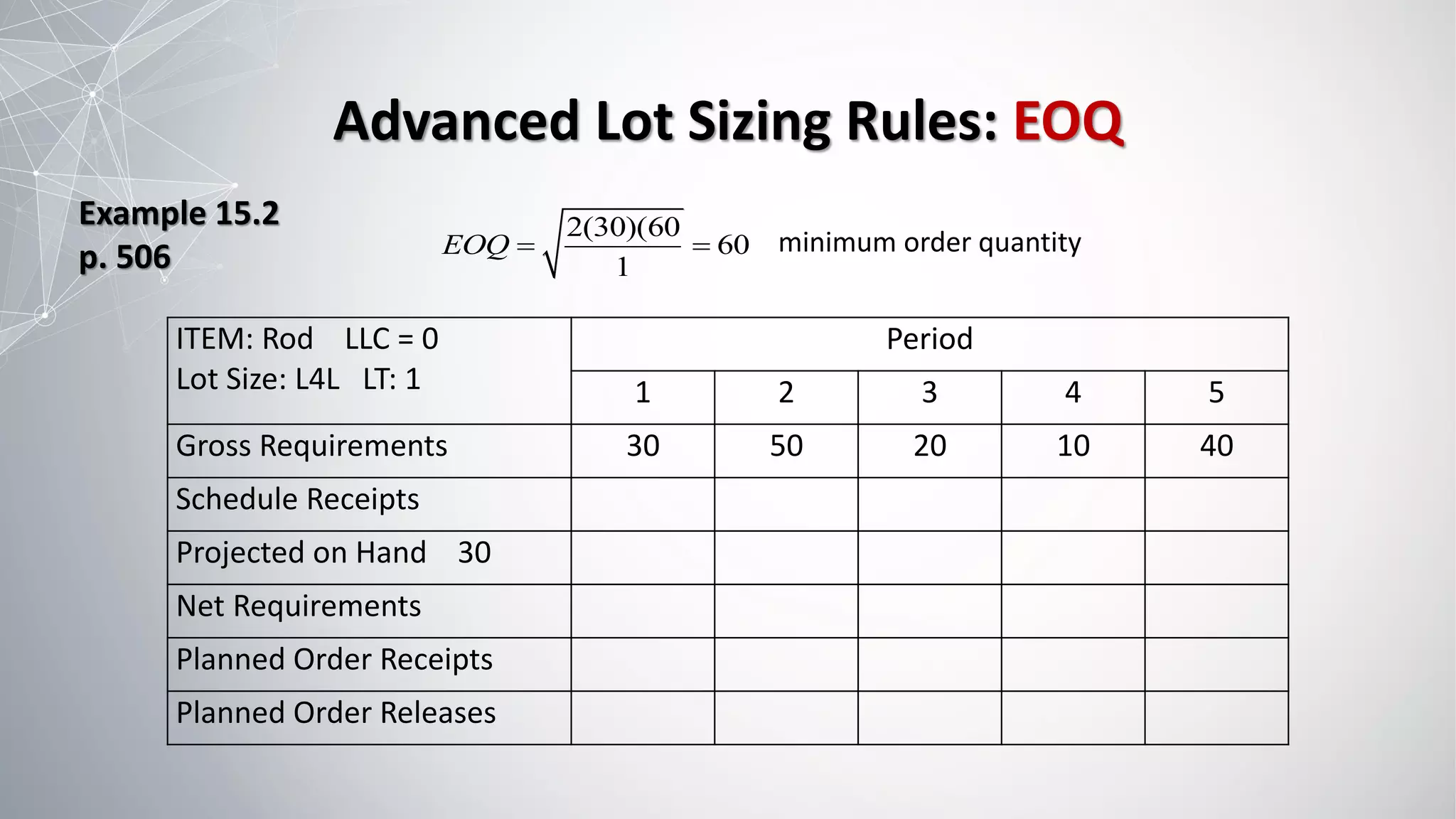
ITEM: Rod LLC = 0
Lot Size: L4L LT: 1
Period
1 2 3 4 5
Gross Requirements 30 50 20 10 40
Schedule Receipts
Projected on Hand 30
Net Requirements
Planned Order Receipts
Planned Order Releases
Advanced Lot Sizing Rules: EOQ
2(30)(60
60
1
EOQ = = minimum order quantity
Total cost of EOQ = (2 X $60) + [(10 + 50 + 40) X $1)] = $220
Example 15.2
p. 506
Advanced Lot Sizing Rules: POQ
/ 60/30 2
POQ Q d
= = = periods worth of requirements
Example 15.2
p. 506
More suitable for variable demand
ITEM: Rod LLC = 0
Lot Size: L4L LT: 1
Period
1 2 3 4 5
Gross Requirements 30 50 20 10 40
Schedule Receipts
Projected on Hand 30
Net Requirements
Planned Order Receipts
Planned Order Releases
Advanced Lot Sizing Rules: POQ
/ 60/30 2
POQ Q d
= = = periods worth of requirements
Total cost of POQ = (2 X $60) + [(20 + 40) X $1] = $180
Example 15.2
p. 506
© 2014 John Wiley & Sons, Inc. - Russell and Taylor 8e
Copyright 2014 John Wiley & Sons, Inc.
All rights reserved. Reproduction or translation of this work
beyond that permitted in section 117 of the 1976 United
States Copyright Act without express permission of the
copyright owner is unlawful. Request for further information
should be addressed to the Permission Department, John
Wiley & Sons, Inc. The purchaser may make back-up copies
for his/her own use only and not for distribution or resale.
The Publisher assumes no responsibility for errors,
omissions, or damages caused by the use of these programs
or from the use of the information herein.
Thank you!!

5. Chapter 15 - MRP.pdf

  • 1.
    Integrated Production SystemsI Lecture 5: Material Requirements Planning
  • 2.
    Learning Objectives • Describethe inputs and outputs to an MRP system, and execute the MRP process • Discuss different lot sizing rules.
  • 3.
  • 4.
    A. Master ProductionSchedule • Deduced from aggregate planning but for individual products. • Drives MRP process with a schedule of finished products. • Quantities represent production not demand • Quantities may consist of a combination of customer orders and demand forecasts • Quantities represent what needs to be produced, not what can be produced • Quantities represent end items that may or may not be finished products
  • 5.
    Master Production Schedule PERIOD MPSITEM 1 2 3 4 5 Pencil Case 125 125 125 125 125 Clipboard 85 95 120 100 100 Lapboard 75 120 47 20 17 Lapdesk 0 50 0 50 0
  • 6.
  • 7.
  • 8.
    C. Item Master(Inventory) File DESCRIPTION INVENTORY POLICY Item Pressboard Lead time 1 Item no. 7341 Annual demand 5000 Item type Purch Holding cost 1 Product/sales class Comp Ordering/setup cost 50 Value class B Safety stock 0 Buyer/planner RSR Reorder point 39 Vendor/drawing 07142 EOQ 316 Phantom code N Minimum order qty 100 Unit price/cost 1.25 Maximum order qty 500 Pegging Y Multiple order qty 1 LLC 1 Policy code 3 • Contains all information about the item; on-hand quantity, ordered quantities, lot size, safety stock, lead time, inventory policy, …
  • 9.
    MRP Processes A. Explodingthe MPS B. Netting out the inventory • the process of subtracting on-hand quantities and scheduled receipts from gross requirements to produce net requirements C. Lot sizing • determining the quantities in which items are made or purchased D. Time-phasing • Time-shifting according to lead time.
  • 10.
    MRP Matrix Lowest LevelCode Lot Sizing Policy Lead time
  • 11.
    MRP Example 15.1p. 502 Master Production Schedule: 1 2 3 4 5 Clipboard 85 95 120 100 100 Lapdesk 0 60 0 60 0 Item Master File: CLIPBOARD LAPDESK PRESSBOARD On hand 25 20 150 On order 175 (Period 1) 0 0 (sch receipt) LLC 0 0 1 Lot size L4L Mult 50 Min 100 Lead time 1 1 1
  • 12.
  • 13.
    ITEM: CLIPBOARD LLC:0 PERIOD LOT SIZE: L4L LT: 1 1 2 3 4 5 Gross Requirements 85 95 120 100 100 Scheduled Receipts Projected on Hand Net Requirements Planned Order Receipts Planned Order Releases MRP Example 15.1 p. 502
  • 14.
    ITEM: CLIPBOARD LLC:0 PERIOD LOT SIZE: L4L LT: 1 1 2 3 4 5 Gross Requirements 85 95 120 100 100 Scheduled Receipts 175 Projected on Hand 25 Net Requirements Planned Order Receipts Planned Order Releases MRP Example 15.1 p. 502
  • 15.
    ITEM: CLIPBOARD LLC:0 PERIOD LOT SIZE: L4L LT: 1 1 2 3 4 5 Gross Requirements 85 95 120 100 100 Scheduled Receipts 175 Projected on Hand 25 115 Net Requirements 0 Planned Order Receipts Planned Order Releases (25 + 175) = 200 units available (200 - 85) = 115 on hand at the end of Period 1 MRP Example 15.1 p. 502
  • 16.
    ITEM: CLIPBOARD LLC:0 PERIOD LOT SIZE: L4L LT: 1 1 2 3 4 5 Gross Requirements 85 95 120 100 100 Scheduled Receipts 175 Projected on Hand 25 115 20 Net Requirements 0 0 Planned Order Receipts Planned Order Releases 115 units available (115 - 85) = 20 on hand at the end of Period 2 MRP Example 15.1 p. 502
  • 17.
    ITEM: CLIPBOARD LLC:0 PERIOD LOT SIZE: L4L LT: 1 1 2 3 4 5 Gross Requirements 85 95 120 100 100 Scheduled Receipts 175 Projected on Hand 25 115 20 0 Net Requirements 0 0 100 Planned Order Receipts 100 Planned Order Releases 100 20 units available (20 - 120) = -100 — 100 additional Clipboards are required Order must be placed in Period 2 to be received in Period 3 MRP Example 15.1 p. 502
  • 18.
    ITEM: CLIPBOARD LLC:0 PERIOD LOT SIZE: L4L LT: 1 1 2 3 4 5 Gross Requirements 85 95 120 100 100 Scheduled Receipts 175 Projected on Hand 25 115 20 0 0 0 Net Requirements 0 0 100 100 100 Planned Order Receipts 100 100 100 Planned Order Releases 100 100 100 Following the same logic Gross Requirements in Periods 4 and 5 develop Net Requirements, Planned Order Receipts, and Planned Order Releases MRP Example 15.1 p. 502
  • 19.
    ITEM: LAPDESK LLC:0 PERIOD LOT SIZE: MULT 50 LT: 1 1 2 3 4 5 Gross Requirements 0 60 0 60 0 Scheduled Receipts Projected on Hand 20 Net Requirements Planned Order Receipts Planned Order Releases MRP Example 15.1 p. 502
  • 20.
    ITEM: LAPDESK LLC:0 PERIOD LOT SIZE: MULT 50 LT: 1 1 2 3 4 5 Gross Requirements 0 60 0 60 0 Scheduled Receipts Projected on Hand 20 20 10 10 0 0 Net Requirements 0 40 50 Planned Order Receipts 50 50 Planned Order Releases 50 50 Following the same logic, the Lapdesk MRP matrix is completed as shown MRP Example 15.1 p. 502
  • 21.
    ITEM: PRESSBOARD LLC:1 PERIOD LOT SIZE: MIN 100 LT: 1 1 2 3 4 5 Gross Requirements Scheduled Receipts Projected on Hand 150 Net Requirements Planned Order Receipts Planned Order Releases ITEM: CLIPBOARD LLC: 0 PERIOD LOT SIZE: L4L LT: 1 1 2 3 4 5 Planned Order Releases 100 100 100 ITEM: LAPDESK LLC: 0 PERIOD LOT SIZE: MULT 50 LT: 1 1 2 3 4 5 Planned Order Releases 50 50 MRP Example 15.1 p. 502
  • 22.
    ITEM: PRESSBOARD LLC:1 PERIOD LOT SIZE: MIN 100 LT: 1 1 2 3 4 5 Gross Requirements 100 100 200 100 0 Scheduled Receipts Projected on Hand 150 Net Requirements Planned Order Receipts Planned Order Releases ITEM: CLIPBOARD LLC: 0 PERIOD LOT SIZE: L4L LT: 1 1 2 3 4 5 ITEM: LAPDESK LLC: 0 PERIOD LOT SIZE: MULT 50 LT: 1 1 2 3 4 5 MRP Example 15.1 p. 502 x1 x1 x1 x2 x2 Planned Order Releases 100 100 100 Planned Order Releases 50 50
  • 23.
    ITEM: PRESSBOARD LLC:1 PERIOD LOT SIZE: MIN 100 LT: 1 1 2 3 4 5 Gross Requirements 100 100 200 100 0 Scheduled Receipts Projected on Hand 150 50 50 0 0 Net Requirements 50 150 100 Planned Order Receipts 100 150 100 Planned Order Releases 100 150 100 ITEM: CLIPBOARD LLC: 0 PERIOD LOT SIZE: L4L LT: 1 1 2 3 4 5 Planned Order Releases 100 100 100 ITEM: LAPDESK LLC: 0 PERIOD LOT SIZE: MULT 50 LT: 1 1 2 3 4 5 Planned Order Releases 50 50 x1 x1 x1 x2 x2 MRP Example 15.1 p. 502
  • 24.
    PERIOD ITEM 1 23 4 5 Clipboard 100 100 100 Lapdesk 50 50 Pressboard 100 150 100 Planned Order Report MRP Example 15.1 p. 502
  • 25.
    Lot Sizing inMRP Systems • Lot-for-lot ordering policy • Minimum order quantities • Maximum order quantities • Multiple order quantities • Economic order quantity (EOQ) • Periodic order quantity (POQ) Best Policy is the Policy with the Minimum Total Cost: Ordering + Holding Costs
  • 26.
    Advanced Lot SizingRules: L4L Example 15.2 p. 506 ITEM: Rod LLC = 0 Lot Size: L4L LT: 1 Period 1 2 3 4 5 Gross Requirements 30 50 20 10 40 Schedule Receipts Projected on Hand 30 Net Requirements Planned Order Receipts Planned Order Releases
  • 27.
    Advanced Lot SizingRules: L4L Total cost of L4L = (4 X $60) + (0 X $1) = $240 Example 15.2 p. 506
  • 28.
    Advanced Lot SizingRules: EOQ 2(30)(60 60 1 EOQ = = minimum order quantity Example 15.2 p. 506
  • 29.
    Advanced Lot SizingRules: EOQ 2(30)(60 60 1 EOQ = = minimum order quantity Example 15.2 p. 506 ITEM: Rod LLC = 0 Lot Size: L4L LT: 1 Period 1 2 3 4 5 Gross Requirements 30 50 20 10 40 Schedule Receipts Projected on Hand 30 Net Requirements Planned Order Receipts Planned Order Releases
  • 30.
    Advanced Lot SizingRules: EOQ 2(30)(60 60 1 EOQ = = minimum order quantity Total cost of EOQ = (2 X $60) + [(10 + 50 + 40) X $1)] = $220 Example 15.2 p. 506
  • 31.
    Advanced Lot SizingRules: POQ / 60/30 2 POQ Q d = = = periods worth of requirements Example 15.2 p. 506 More suitable for variable demand ITEM: Rod LLC = 0 Lot Size: L4L LT: 1 Period 1 2 3 4 5 Gross Requirements 30 50 20 10 40 Schedule Receipts Projected on Hand 30 Net Requirements Planned Order Receipts Planned Order Releases
  • 32.
    Advanced Lot SizingRules: POQ / 60/30 2 POQ Q d = = = periods worth of requirements Total cost of POQ = (2 X $60) + [(20 + 40) X $1] = $180 Example 15.2 p. 506
  • 33.
    © 2014 JohnWiley & Sons, Inc. - Russell and Taylor 8e Copyright 2014 John Wiley & Sons, Inc. All rights reserved. Reproduction or translation of this work beyond that permitted in section 117 of the 1976 United States Copyright Act without express permission of the copyright owner is unlawful. Request for further information should be addressed to the Permission Department, John Wiley & Sons, Inc. The purchaser may make back-up copies for his/her own use only and not for distribution or resale. The Publisher assumes no responsibility for errors, omissions, or damages caused by the use of these programs or from the use of the information herein.
  • 34.