Mechanics of Materials
Stress and Strain – Axial Loading
Chapter II
Contents
 Basic Theory of Axial Deformation
 Statically Determinate Structures
 Statically Indeterminate Structures
 Thermal Effects on Axial Deformation
 Generalized Hooke’s Law
 Shearing Strain
2
- Analysis and design of structures strongly relates to deformations caused by
loads applied to the structure.
- Too large deformations should be avoided, as they may prevent the structure
from fulfilling the purpose for which it was intended.
- Principles of statics may sometimes make it impossible to determine the forces in
a member of a structure , as statics is based on the assumption of undeformable,
rigid structures.
- Considering engineering structures as deformable makes it possible to compute
forces that are statically indeterminate.
Basic Theory of Axial Deformation
3
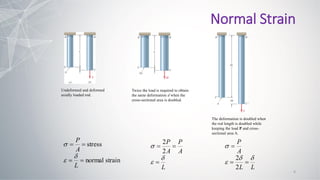
strain
normal
stress




L
A
P



Undeformed and deformed
axially loaded rod.
L
A
P
A
P






2
2
Twice the load is required to obtain
the same deformation d when the
cross-sectional area is doubled.
L
L
A
P







2
2
The deformation is doubled when
the rod length is doubled while
keeping the load P and cross-
sectional area A.
Normal Strain
4
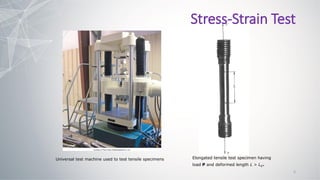
Universal test machine used to test tensile specimens Elongated tensile test specimen having
load P and deformed length L > L0.
Stress-Strain Test
5
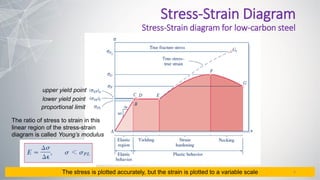
Stress-Strain Diagram
Stress-Strain diagram for low-carbon steel
The stress is plotted accurately, but the strain is plotted to a variable scale
upper yield point
lower yield point
proportional limit
The ratio of stress to strain in this
linear region of the stress-strain
diagram is called Young’s modulus
6
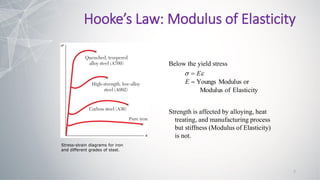
Below the yield stress
Elasticity
of
Modulus
or
Modulus
Youngs


E
E

Strength is affected by alloying, heat
treating, and manufacturing process
but stiffness (Modulus of Elasticity)
is not.
Stress-strain diagrams for iron
and different grades of steel.
Hooke’s Law: Modulus of Elasticity
7
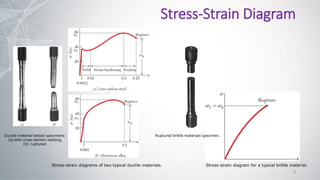
Ductile material tested specimens:
(a) with cross-section necking,
(b) ruptured.
Stress-strain diagrams of two typical ductile materials. Stress-strain diagram for a typical brittle material.
Ruptured brittle materials specimen.
Stress-Strain Diagram
8
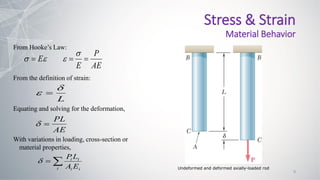
Undeformed and deformed axially-loaded rod
AE
P
E
E 






From Hooke’s Law:
From the definition of strain:
L

 
Equating and solving for the deformation,
AE
PL


With variations in loading, cross-section or
material properties,


i i
i
i
i
E
A
L
P

Stress & Strain
Material Behavior
9
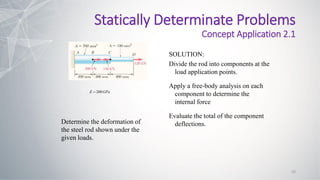
Determine the deformation of
the steel rod shown under the
given loads.
GPa
E 200

SOLUTION:
Divide the rod into components at the
load application points.
Apply a free-body analysis on each
component to determine the
internal force
Evaluate the total of the component
deflections.
Statically Determinate Problems
Concept Application 2.1
10
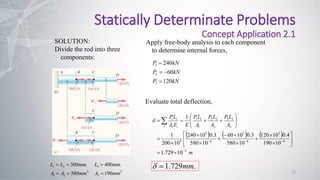
SOLUTION:
Divide the rod into three
components:
2
2
1
2
1
580
.
300
mm
A
A
mm
L
L




2
3
3
190
.
400
mm
A
mm
L


kN
P
kN
P
kN
P
120
60
240
3
2
1




     
m
A
L
P
A
L
P
A
L
P
E
E
A
L
P
i i
i
i
i
3
6
3
6
3
6
3
9
3
3
3
2
2
2
1
1
1
10
729
.
1
10
190
4
.
0
10
120
10
580
3
.
0
10
60
10
580
3
.
0
10
240
10
200
1
1


































 

.
729
.
1 mm


Apply free-body analysis to each component
to determine internal forces,
Evaluate total deflection,
Statically Determinate Problems
Concept Application 2.1
11
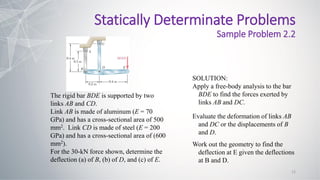
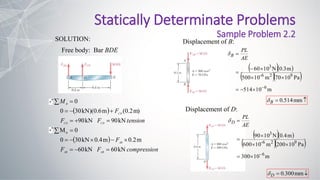
The rigid bar BDE is supported by two
links AB and CD.
Link AB is made of aluminum (E = 70
GPa) and has a cross-sectional area of 500
mm2. Link CD is made of steel (E = 200
GPa) and has a cross-sectional area of (600
mm2).
For the 30-kN force shown, determine the
deflection (a) of B, (b) of D, and (c) of E.
SOLUTION:
Apply a free-body analysis to the bar
BDE to find the forces exerted by
links AB and DC.
Evaluate the deformation of links AB
and DC or the displacements of B
and D.
Work out the geometry to find the
deflection at E given the deflections
at B and D.
Statically Determinate Problems
Sample Problem 2.2
12
Free body: Bar BDE
 
 
n
compressio
F
F
F
tension
F
F
F
M
AB
AB
AB
CD
CD
CD
B
kN
60
kN
60
m
2
.
0
m
4
.
0
kN
30
0
0
M
kN
90
kN
90
m)
2
.
0
(
m
6
.
0
(
kN)
30
0
0
D


















SOLUTION: Displacement of B:
  
  
m
10
514
Pa
10
70
m
10
500
m
3
.
0
N
10
60
6
9
2
6
-
3










AE
PL
B


 mm
514
.
0
B

Displacement of D:
  
  
m
10
300
Pa
10
200
m
10
600
m
4
.
0
N
10
90
6
9
2
6
-
3








AE
PL
D


 mm
300
.
0
D

Statically Determinate Problems
Sample Problem 2.2

 mm
928
.
1
E

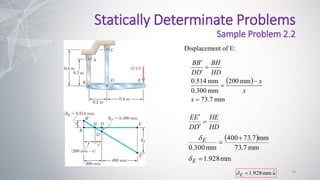
Displacement of E:
 
mm
7
.
73
mm
200
mm
0.300
mm
514
.
0






x
x
x
HD
BH
D
D
B
B
 
mm
928
.
1
mm
7
.
73
mm
7
.
73
400
mm
300
.
0






E
E
HD
HE
D
D
E
E


Statically Determinate Problems
Sample Problem 2.2
14
15
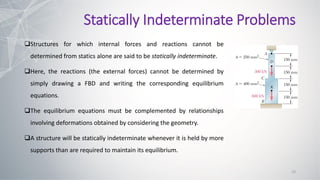
Structures for which internal forces and reactions cannot be
determined from statics alone are said to be statically indeterminate.
Here, the reactions (the external forces) cannot be determined by
simply drawing a FBD and writing the corresponding equilibrium
equations.
The equilibrium equations must be complemented by relationships
involving deformations obtained by considering the geometry.
A structure will be statically indeterminate whenever it is held by more
supports than are required to maintain its equilibrium.
Statically Indeterminate Problems
16
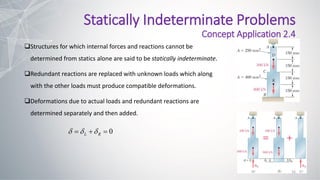
Structures for which internal forces and reactions cannot be
determined from statics alone are said to be statically indeterminate.
Redundant reactions are replaced with unknown loads which along
with the other loads must produce compatible deformations.
Deformations due to actual loads and redundant reactions are
determined separately and then added.
0


 R
L 


Statically Indeterminate Problems
Concept Application 2.4
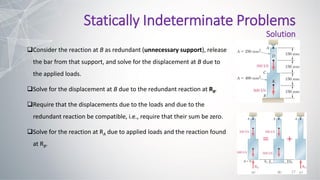
Consider the reaction at B as redundant (unnecessary support), release
the bar from that support, and solve for the displacement at B due to
the applied loads.
Solve for the displacement at B due to the redundant reaction at RB.
Require that the displacements due to the loads and due to the
redundant reaction be compatible, i.e., require that their sum be zero.
Solve for the reaction at RA due to applied loads and the reaction found
at RB.
17
Statically Indeterminate Problems
Solution
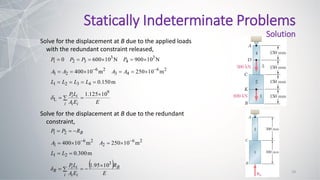
Solve for the displacement at B due to the applied loads
with the redundant constraint released,
E
E
A
L
P
L
L
L
L
A
A
A
A
P
P
P
P
i i
i
i
i
9
L
4
3
2
1
2
6
4
3
2
6
2
1
3
4
3
3
2
1
10
125
.
1
m
150
.
0
m
10
250
m
10
400
N
10
900
N
10
600
0























Solve for the displacement at B due to the redundant
constraint,
 
















i
B
i
i
i
i
R
B
E
R
E
A
L
P
δ
L
L
A
A
R
P
P
3
2
1
2
6
2
2
6
1
2
1
10
95
.
1
m
300
.
0
m
10
250
m
10
400
Statically Indeterminate Problems
Solution
18
 
kN
577
N
10
577
0
10
95
.
1
10
125
.
1
0
3
3
9











B
B
R
L
R
E
R
E




kN
323
kN
577
kN
600
kN
300
0

 




A
A
y
R
R
F
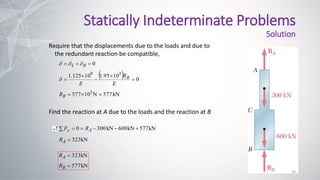
Require that the displacements due to the loads and due to
the redundant reaction be compatible,
Find the reaction at A due to the loads and the reaction at B
kN
577
kN
323


B
A
R
R
Statically Indeterminate Problems
Solution
19
Statically Indeterminate Problems
Exercise
20
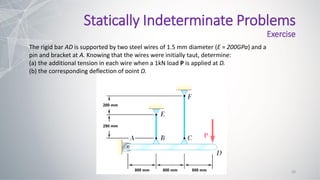
The rigid bar AD is supported by two steel wires of 1.5 mm diameter (E = 200GPa) and a
pin and bracket at A. Knowing that the wires were initially taut, determine:
(a) the additional tension in each wire when a 1kN load P is applied at D.
(b) the corresponding deflection of point D.
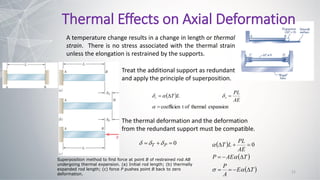
A temperature change results in a change in length or thermal
strain. There is no stress associated with the thermal strain
unless the elongation is restrained by the supports.
 
expansion
thermal
of
t
coefficien








AE
PL
L
T P
T
0


 P
T 

  
 
 
T
E
A
P
T
AE
P
AE
PL
L
T













 0
Superposition method to find force at point B of restrained rod AB
undergoing thermal expansion. (a) Initial rod length; (b) thermally
expanded rod length; (c) force P pushes point B back to zero
deformation.
Treat the additional support as redundant
and apply the principle of superposition.
The thermal deformation and the deformation
from the redundant support must be compatible.
Thermal Effects on Axial Deformation
21
Poisson’s Ratio
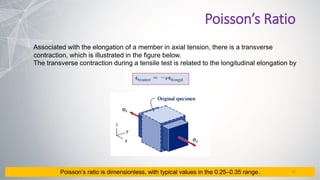
Associated with the elongation of a member in axial tension, there is a transverse
contraction, which is illustrated in the figure below.
The transverse contraction during a tensile test is related to the longitudinal elongation by
Poisson’s ratio is dimensionless, with typical values in the 0.25–0.35 range. 22
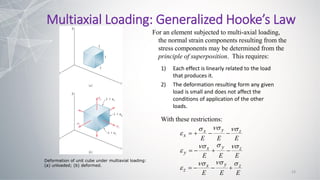
For an element subjected to multi-axial loading,
the normal strain components resulting from the
stress components may be determined from the
principle of superposition. This requires:
E
E
E
E
E
E
E
E
E
z
y
x
z
z
y
x
y
z
y
x
x
























Deformation of unit cube under multiaxial loading:
(a) unloaded; (b) deformed.
1) Each effect is linearly related to the load
that produces it.
2) The deformation resulting form any given
load is small and does not affect the
conditions of application of the other
loads.
With these restrictions:
Multiaxial Loading: Generalized Hooke’s Law
23
2 - 24
 
xy
xy f 
 
zx
zx
yz
yz
xy
xy G
G
G 




 


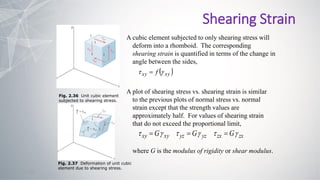
where G is the modulus of rigidity or shear modulus.
Fig. 2.36 Unit cubic element
subjected to shearing stress.
Fig. 2.37 Deformation of unit cubic
element due to shearing stress.
A cubic element subjected to only shearing stress will
deform into a rhomboid. The corresponding
shearing strain is quantified in terms of the change in
angle between the sides,
A plot of shearing stress vs. shearing strain is similar
to the previous plots of normal stress vs. normal
strain except that the strength values are
approximately half. For values of shearing strain
that do not exceed the proportional limit,
Shearing Strain
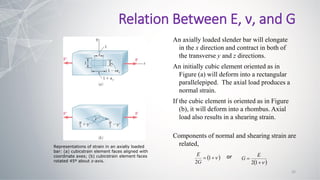
An axially loaded slender bar will elongate
in the x direction and contract in both of
the transverse y and z directions.
 


 1
2G
E
If the cubic element is oriented as in Figure
(b), it will deform into a rhombus. Axial
load also results in a shearing strain.
An initially cubic element oriented as in
Figure (a) will deform into a rectangular
parallelepiped. The axial load produces a
normal strain.
Representations of strain in an axially loaded
bar: (a) cubicstrain element faces aligned with
coordinate axes; (b) cubicstrain element faces
rotated 45º about z-axis.  



1
2
E
G
Components of normal and shearing strain are
related,
or
Relation Between E, ν, and G
25
26

Chapter 02.pdf

  • 1.
    Mechanics of Materials Stressand Strain – Axial Loading Chapter II
  • 2.
    Contents  Basic Theoryof Axial Deformation  Statically Determinate Structures  Statically Indeterminate Structures  Thermal Effects on Axial Deformation  Generalized Hooke’s Law  Shearing Strain 2
  • 3.
    - Analysis anddesign of structures strongly relates to deformations caused by loads applied to the structure. - Too large deformations should be avoided, as they may prevent the structure from fulfilling the purpose for which it was intended. - Principles of statics may sometimes make it impossible to determine the forces in a member of a structure , as statics is based on the assumption of undeformable, rigid structures. - Considering engineering structures as deformable makes it possible to compute forces that are statically indeterminate. Basic Theory of Axial Deformation 3
  • 4.
    strain normal stress     L A P    Undeformed and deformed axiallyloaded rod. L A P A P       2 2 Twice the load is required to obtain the same deformation d when the cross-sectional area is doubled. L L A P        2 2 The deformation is doubled when the rod length is doubled while keeping the load P and cross- sectional area A. Normal Strain 4
  • 5.
    Universal test machineused to test tensile specimens Elongated tensile test specimen having load P and deformed length L > L0. Stress-Strain Test 5
  • 6.
    Stress-Strain Diagram Stress-Strain diagramfor low-carbon steel The stress is plotted accurately, but the strain is plotted to a variable scale upper yield point lower yield point proportional limit The ratio of stress to strain in this linear region of the stress-strain diagram is called Young’s modulus 6
  • 7.
    Below the yieldstress Elasticity of Modulus or Modulus Youngs   E E  Strength is affected by alloying, heat treating, and manufacturing process but stiffness (Modulus of Elasticity) is not. Stress-strain diagrams for iron and different grades of steel. Hooke’s Law: Modulus of Elasticity 7
  • 8.
    Ductile material testedspecimens: (a) with cross-section necking, (b) ruptured. Stress-strain diagrams of two typical ductile materials. Stress-strain diagram for a typical brittle material. Ruptured brittle materials specimen. Stress-Strain Diagram 8
  • 9.
    Undeformed and deformedaxially-loaded rod AE P E E        From Hooke’s Law: From the definition of strain: L    Equating and solving for the deformation, AE PL   With variations in loading, cross-section or material properties,   i i i i i E A L P  Stress & Strain Material Behavior 9
  • 10.
    Determine the deformationof the steel rod shown under the given loads. GPa E 200  SOLUTION: Divide the rod into components at the load application points. Apply a free-body analysis on each component to determine the internal force Evaluate the total of the component deflections. Statically Determinate Problems Concept Application 2.1 10
  • 11.
    SOLUTION: Divide the rodinto three components: 2 2 1 2 1 580 . 300 mm A A mm L L     2 3 3 190 . 400 mm A mm L   kN P kN P kN P 120 60 240 3 2 1           m A L P A L P A L P E E A L P i i i i i 3 6 3 6 3 6 3 9 3 3 3 2 2 2 1 1 1 10 729 . 1 10 190 4 . 0 10 120 10 580 3 . 0 10 60 10 580 3 . 0 10 240 10 200 1 1                                      . 729 . 1 mm   Apply free-body analysis to each component to determine internal forces, Evaluate total deflection, Statically Determinate Problems Concept Application 2.1 11
  • 12.
    The rigid barBDE is supported by two links AB and CD. Link AB is made of aluminum (E = 70 GPa) and has a cross-sectional area of 500 mm2. Link CD is made of steel (E = 200 GPa) and has a cross-sectional area of (600 mm2). For the 30-kN force shown, determine the deflection (a) of B, (b) of D, and (c) of E. SOLUTION: Apply a free-body analysis to the bar BDE to find the forces exerted by links AB and DC. Evaluate the deformation of links AB and DC or the displacements of B and D. Work out the geometry to find the deflection at E given the deflections at B and D. Statically Determinate Problems Sample Problem 2.2 12
  • 13.
    Free body: BarBDE     n compressio F F F tension F F F M AB AB AB CD CD CD B kN 60 kN 60 m 2 . 0 m 4 . 0 kN 30 0 0 M kN 90 kN 90 m) 2 . 0 ( m 6 . 0 ( kN) 30 0 0 D                   SOLUTION: Displacement of B:       m 10 514 Pa 10 70 m 10 500 m 3 . 0 N 10 60 6 9 2 6 - 3           AE PL B    mm 514 . 0 B  Displacement of D:       m 10 300 Pa 10 200 m 10 600 m 4 . 0 N 10 90 6 9 2 6 - 3         AE PL D    mm 300 . 0 D  Statically Determinate Problems Sample Problem 2.2
  • 14.
      mm 928 . 1 E  Displacement ofE:   mm 7 . 73 mm 200 mm 0.300 mm 514 . 0       x x x HD BH D D B B   mm 928 . 1 mm 7 . 73 mm 7 . 73 400 mm 300 . 0       E E HD HE D D E E   Statically Determinate Problems Sample Problem 2.2 14
  • 15.
    15 Structures for whichinternal forces and reactions cannot be determined from statics alone are said to be statically indeterminate. Here, the reactions (the external forces) cannot be determined by simply drawing a FBD and writing the corresponding equilibrium equations. The equilibrium equations must be complemented by relationships involving deformations obtained by considering the geometry. A structure will be statically indeterminate whenever it is held by more supports than are required to maintain its equilibrium. Statically Indeterminate Problems
  • 16.
    16 Structures for whichinternal forces and reactions cannot be determined from statics alone are said to be statically indeterminate. Redundant reactions are replaced with unknown loads which along with the other loads must produce compatible deformations. Deformations due to actual loads and redundant reactions are determined separately and then added. 0    R L    Statically Indeterminate Problems Concept Application 2.4
  • 17.
    Consider the reactionat B as redundant (unnecessary support), release the bar from that support, and solve for the displacement at B due to the applied loads. Solve for the displacement at B due to the redundant reaction at RB. Require that the displacements due to the loads and due to the redundant reaction be compatible, i.e., require that their sum be zero. Solve for the reaction at RA due to applied loads and the reaction found at RB. 17 Statically Indeterminate Problems Solution
  • 18.
    Solve for thedisplacement at B due to the applied loads with the redundant constraint released, E E A L P L L L L A A A A P P P P i i i i i 9 L 4 3 2 1 2 6 4 3 2 6 2 1 3 4 3 3 2 1 10 125 . 1 m 150 . 0 m 10 250 m 10 400 N 10 900 N 10 600 0                        Solve for the displacement at B due to the redundant constraint,                   i B i i i i R B E R E A L P δ L L A A R P P 3 2 1 2 6 2 2 6 1 2 1 10 95 . 1 m 300 . 0 m 10 250 m 10 400 Statically Indeterminate Problems Solution 18
  • 19.
      kN 577 N 10 577 0 10 95 . 1 10 125 . 1 0 3 3 9            B B R L R E R E     kN 323 kN 577 kN 600 kN 300 0        A A y R R F Requirethat the displacements due to the loads and due to the redundant reaction be compatible, Find the reaction at A due to the loads and the reaction at B kN 577 kN 323   B A R R Statically Indeterminate Problems Solution 19
  • 20.
    Statically Indeterminate Problems Exercise 20 Therigid bar AD is supported by two steel wires of 1.5 mm diameter (E = 200GPa) and a pin and bracket at A. Knowing that the wires were initially taut, determine: (a) the additional tension in each wire when a 1kN load P is applied at D. (b) the corresponding deflection of point D.
  • 21.
    A temperature changeresults in a change in length or thermal strain. There is no stress associated with the thermal strain unless the elongation is restrained by the supports.   expansion thermal of t coefficien         AE PL L T P T 0    P T          T E A P T AE P AE PL L T               0 Superposition method to find force at point B of restrained rod AB undergoing thermal expansion. (a) Initial rod length; (b) thermally expanded rod length; (c) force P pushes point B back to zero deformation. Treat the additional support as redundant and apply the principle of superposition. The thermal deformation and the deformation from the redundant support must be compatible. Thermal Effects on Axial Deformation 21
  • 22.
    Poisson’s Ratio Associated withthe elongation of a member in axial tension, there is a transverse contraction, which is illustrated in the figure below. The transverse contraction during a tensile test is related to the longitudinal elongation by Poisson’s ratio is dimensionless, with typical values in the 0.25–0.35 range. 22
  • 23.
    For an elementsubjected to multi-axial loading, the normal strain components resulting from the stress components may be determined from the principle of superposition. This requires: E E E E E E E E E z y x z z y x y z y x x                         Deformation of unit cube under multiaxial loading: (a) unloaded; (b) deformed. 1) Each effect is linearly related to the load that produces it. 2) The deformation resulting form any given load is small and does not affect the conditions of application of the other loads. With these restrictions: Multiaxial Loading: Generalized Hooke’s Law 23
  • 24.
    2 - 24  xy xy f    zx zx yz yz xy xy G G G          where G is the modulus of rigidity or shear modulus. Fig. 2.36 Unit cubic element subjected to shearing stress. Fig. 2.37 Deformation of unit cubic element due to shearing stress. A cubic element subjected to only shearing stress will deform into a rhomboid. The corresponding shearing strain is quantified in terms of the change in angle between the sides, A plot of shearing stress vs. shearing strain is similar to the previous plots of normal stress vs. normal strain except that the strength values are approximately half. For values of shearing strain that do not exceed the proportional limit, Shearing Strain
  • 25.
    An axially loadedslender bar will elongate in the x direction and contract in both of the transverse y and z directions.      1 2G E If the cubic element is oriented as in Figure (b), it will deform into a rhombus. Axial load also results in a shearing strain. An initially cubic element oriented as in Figure (a) will deform into a rectangular parallelepiped. The axial load produces a normal strain. Representations of strain in an axially loaded bar: (a) cubicstrain element faces aligned with coordinate axes; (b) cubicstrain element faces rotated 45º about z-axis.      1 2 E G Components of normal and shearing strain are related, or Relation Between E, ν, and G 25
  • 26.