IMPLEMENTATION OF TQM IN MFG INDUSTRY
REFERENCE TO TOYOTA
“We will strive to meet customers expectations by providing world-class
products and services through total employee commitment and
continuous improvement.”
GROUP NO 2
 IKBAL HASSAN
 SAMEER GAZDAR
 MHD AFFAN
 POOJA GAHINE
 SHERIN JOY
 SANTOSH SINGH
 PRIYA DALVI
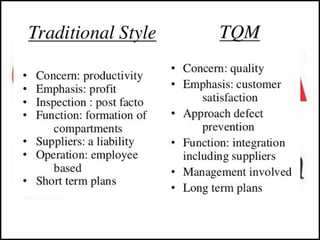
WHAT IS TQM ???
 Total quality implies quality: in all activities by all people in
the organization.
 TQM empowers an entire organization, from the most
junior employee to the CEO, with the responsibility of
ensuring quality in their processes. In particular, TQM
provides management with the ability to ensure quality
through more streamlined and effective process-
improvement channels.
• for all stakeholders
• for all customers
• for all vendors
• at all times
• Quality of design
• Quality of input materials
• Quality of processing
• Quality of performance
• Quality due to product support
Deming Cycle
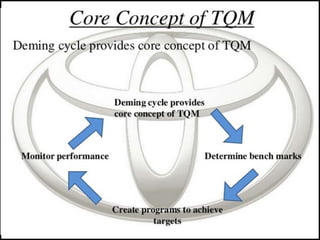
 The philosophy of Deming cycle cut down through theory
and present ideas in a simple way, which could be
meaningful right down the worker level, with an objective
to reduce variations
• Bench marks for standardization
• Programs for implementation
• Monitor for deviations
• Success factors corrective actions
Toyota’s approach to quality
 Toyota has achieved a reputation for the production of
very high quality vehicles in all countries around theworld.
This has been achieved by an approach to quality control
and quality assurance.
 Customer satisfaction is at the heart of all Toyota activities.
In order to satisfy customer needs Toyota includes all
Members in quality control activities.
 Toyota quality relies on the flexibility and teamwork of its
Members. Careful selection and continuous structured
training has resulted in a workforce which is multi-skilled,
flexible and highly motivated; committed to maintaining
and improving the Company performance.
Toyota’s SMED
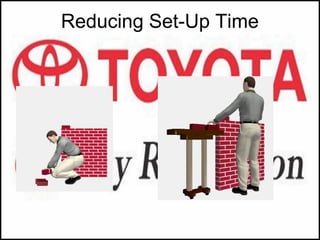
Reducing Set-Up Time
Best example of SMED
TQM IMPLEMENTATION IN TOYOTA
 TQM comprises of four process steps
* Focus on Continuous Process Improvement, to
make processes visible, repeatable and measureable.
* Focus on intangible effects on processes and ways
to optimize and reduce their effects.
* Examining the way the user applies the product,leads
to improvement in the product itself.
* Broaden managements concern beyond the immediate
product.
 TQM requires that the company maintain this quality
standard in all aspects of its business.
 This requires ensuring that things are done right the first
time and that defects and waste are eliminated from
operations.
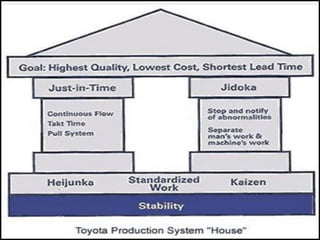
Toyota Production System
 The Toyota Production System is a paradox. On one hand,
every activity, connection, and production flow in a Toyota
factory is rigidly scripted.
 Yet at the same time, Toyotas operations are enormously
flexible and responsive to customer demand.
4 principles of how Toyota sets up all its
operations
 1st rule, governs the way workers do their work.
 2nd rule, the way they interact with one another.
 3rd rule, governs how production lines are constructed.
 4th rule, how people learn to improve.
Toyota
Toyota

Toyota

  • 1.
    IMPLEMENTATION OF TQMIN MFG INDUSTRY REFERENCE TO TOYOTA “We will strive to meet customers expectations by providing world-class products and services through total employee commitment and continuous improvement.” GROUP NO 2  IKBAL HASSAN  SAMEER GAZDAR  MHD AFFAN  POOJA GAHINE  SHERIN JOY  SANTOSH SINGH  PRIYA DALVI
  • 2.
    WHAT IS TQM???  Total quality implies quality: in all activities by all people in the organization.  TQM empowers an entire organization, from the most junior employee to the CEO, with the responsibility of ensuring quality in their processes. In particular, TQM provides management with the ability to ensure quality through more streamlined and effective process- improvement channels. • for all stakeholders • for all customers • for all vendors • at all times • Quality of design • Quality of input materials • Quality of processing • Quality of performance • Quality due to product support
  • 3.
    Deming Cycle  Thephilosophy of Deming cycle cut down through theory and present ideas in a simple way, which could be meaningful right down the worker level, with an objective to reduce variations • Bench marks for standardization • Programs for implementation • Monitor for deviations • Success factors corrective actions
  • 5.
    Toyota’s approach toquality  Toyota has achieved a reputation for the production of very high quality vehicles in all countries around theworld. This has been achieved by an approach to quality control and quality assurance.  Customer satisfaction is at the heart of all Toyota activities. In order to satisfy customer needs Toyota includes all Members in quality control activities.  Toyota quality relies on the flexibility and teamwork of its Members. Careful selection and continuous structured training has resulted in a workforce which is multi-skilled, flexible and highly motivated; committed to maintaining and improving the Company performance.
  • 6.
  • 7.
  • 8.
  • 9.
    TQM IMPLEMENTATION INTOYOTA  TQM comprises of four process steps * Focus on Continuous Process Improvement, to make processes visible, repeatable and measureable. * Focus on intangible effects on processes and ways to optimize and reduce their effects. * Examining the way the user applies the product,leads to improvement in the product itself. * Broaden managements concern beyond the immediate product.  TQM requires that the company maintain this quality standard in all aspects of its business.  This requires ensuring that things are done right the first time and that defects and waste are eliminated from operations.
  • 10.
    Toyota Production System The Toyota Production System is a paradox. On one hand, every activity, connection, and production flow in a Toyota factory is rigidly scripted.  Yet at the same time, Toyotas operations are enormously flexible and responsive to customer demand.
  • 12.
    4 principles ofhow Toyota sets up all its operations  1st rule, governs the way workers do their work.  2nd rule, the way they interact with one another.  3rd rule, governs how production lines are constructed.  4th rule, how people learn to improve.