IE 335
Operations Research-Optimization
Spring 2022
1
Lecture 1: Introduction & Syllabus
Review
2
General Course Information
3
▪ Instructor’s name and title:
▪ Dr. Alperen Bal
• Office Phone Number: 22251400 – Ext: 2724
• Email: Alperen.Bal@aum.edu.kw
▪ Office Hours:
▪ By appointment or on the following:
▪ 15 min extended Q&A session after each class!
Let us meet!
➢ Your name
➢ Your expectations from the course?
➢ What will you do after graduating
the university?
➢ Do you like mathematics and
problem solving?
Sunday Monday Tuesday Wednesday Thursday
16:00-17:00
TUTORING
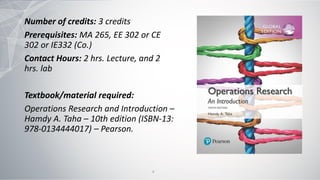
Number of credits: 3 credits
Prerequisites: MA 265, EE 302 or CE
302 or IE332 (Co.)
Contact Hours: 2 hrs. Lecture, and 2
hrs. lab
Textbook/material required:
Operations Research and Introduction –
Hamdy A. Taha – 10th edition (ISBN-13:
978-0134444017) – Pearson.
4
Course Description
• The course introduces the basic concept of deterministic
optimization modeling and algorithms in operations research.
• It is designed to provide students with a sound conceptual
understanding of the role operations research plays in the decision-
making process.
• It emphasizes the application of a wide variety of quantitative
techniques so as to find solution for engineering problems.
5
Course Description
• This course will cover:
➢ Chapter 2: Modelling with Linear Programming
➢ Chapter 3: The Simplex Method and Sensitivity Analysis
➢ Chapter 5: The Transportation Model
➢ Chapter 6: Network Models
➢ Min. spanning tree algorithm
➢ Shortest route algorithm
➢ Maximal flow model
6
Course Objectives
• In this course, you will develop your skills by/at:
• Understanding the deterministic optimization.
• Solving linear programs
• Optimizing deterministic and linear programs
• Understanding of the conceptual framework of quantitative methods in the
decision-making process.
• The basics of OR: Numerical examples are effectively used to explain complex
mathematical concepts, thus avoiding the use of complex notations and
theorems.
• Real-world applications.
• Understanding of linear programming formulation and computer solution
7
Notes about written assignments:
• All assignments, activities, reports are due as hardcopies in class
unless otherwise advised.
• Softcopies(Lab and Project Reports) are required to be uploaded into
Turnit-in in.
8
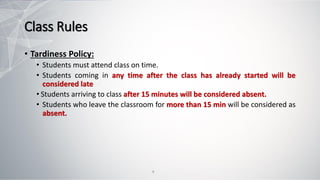
Class Rules
• Tardiness Policy:
• Students must attend class on time.
• Students coming in any time after the class has already started will be
considered late
• Students arriving to class after 15 minutes will be considered absent.
• Students who leave the classroom for more than 15 min will be considered as
absent.
9
The procedure for dealing with cell phones
and smart devices:
Using any format of cell phones and smart devices is considered as a
violation and AUM disciplinary measures will be applied.
• At the beginning of the class, all mobiles to be switched off.
• If the student is expecting any emergency phone call, she/he needs to inform
Student Affairs about her/his case to take special permission which is to be
communicated to the Dean of the College.
• If the student is spotted to use the mobile in any format, she/he will be given
one and only one warning.
• If the student repeats the usage of the mobile, he will be reported
immediately to Student Affairs and the disciplinary measures in the handbook
will be applied which may well mean dismissal from the course.
• AUM non-academic misconduct policy will be strictly applied.
10
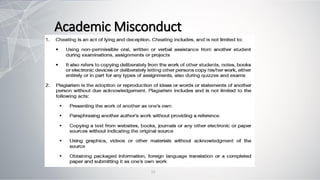
Academic Misconduct
11
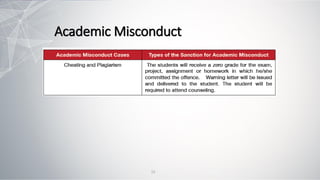
Academic Misconduct
12
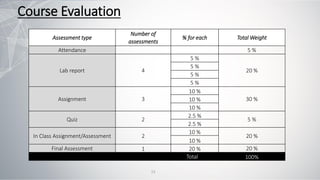
Course Evaluation
13
Assessment type
Number of
assessments
% for each Total Weight
Attendance 5 %
Lab report 4
5 %
20 %
5 %
5 %
5 %
Assignment 3
10 %
30 %
10 %
10 %
Quiz 2
2.5 %
5 %
2.5 %
In Class Assignment/Assessment 2
10 %
20 %
10 %
Final Assessment 1 20 % 20 %
Total 100%
Course Project
• Students, in groups of three, will select a topic. It is expected that
each student will, fully and actively, participate in the project as an
effective team member. The work submitted by the group should be
the group’s own work and not copied from a previous case study or
project.
14
Course Project
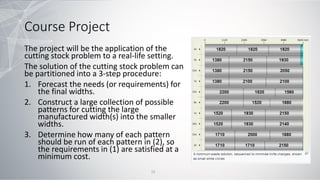
The project will be the application of the
cutting stock problem to a real-life setting.
The solution of the cutting stock problem can
be partitioned into a 3-step procedure:
1. Forecast the needs (or requirements) for
the final widths.
2. Construct a large collection of possible
patterns for cutting the large
manufactured width(s) into the smaller
widths.
3. Determine how many of each pattern
should be run of each pattern in (2), so
the requirements in (1) are satisfied at a
minimum cost.
15
What is Operations Research?
16
Operations Research
• Components of an organization usually become self-driven, each with
own goals, thus loosing sight of the original objectives.
• They may end up working at cross purposes.
• As the complexity and size of an organization increase, it becomes more
and more difficult to allocate the resources efficiently.
17
Operations Research
• Operations Research (OR) is simply a scientific approach that seeks to
best design and operate a system, usually under conditions requiring
the allocation of limited resources.
• OR is mainly concerned with the optimal (best) allocation of available
resources to activities.
• The word operations refers to the activities that have to be
conducted and coordinated, while the word research means that OR
uses an approach that resembles the way research is conducted in
scientific fields.
18
OR Progress
• Origins of OR goes back to WWII:
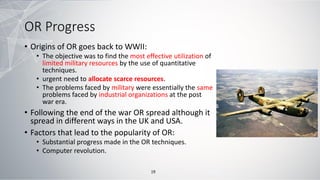
• The objective was to find the most effective utilization of
limited military resources by the use of quantitative
techniques.
• urgent need to allocate scarce resources.
• The problems faced by military were essentially the same
problems faced by industrial organizations at the post
war era.
• Following the end of the war OR spread although it
spread in different ways in the UK and USA.
• Factors that lead to the popularity of OR:
• Substantial progress made in the OR techniques.
• Computer revolution.
19
OR Applications
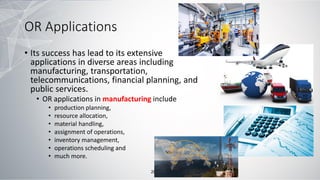
• Its success has lead to its extensive
applications in diverse areas including
manufacturing, transportation,
telecommunications, financial planning, and
public services.
• OR applications in manufacturing include
• production planning,
• resource allocation,
• material handling,
• assignment of operations,
• inventory management,
• operations scheduling and
• much more.
20
Examples of OR Problems
• OR techniques may be used to solve every-day
problems
• What and how much to buy at the market
• Find the best parking on campus
• What classes to register for
• How to allocate studying time for different classes
• Packing your luggage
• How to arrange furniture in a room
• Pick a job from a long list of offers
• etc.
21
Examples of Problems that are Solved using
OR Techniques
• Linear programming
• assignment of personnel
• blending of materials
• distribution and transportation
• investment portfolios
22
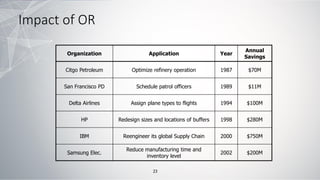
Impact of OR
Organization Application Year
Annual
Savings
Citgo Petroleum Optimize refinery operation 1987 $70M
San Francisco PD Schedule patrol officers 1989 $11M
Delta Airlines Assign plane types to flights 1994 $100M
HP Redesign sizes and locations of buffers 1998 $280M
IBM Reengineer its global Supply Chain 2000 $750M
Samsung Elec.
Reduce manufacturing time and
inventory level
2002 $200M
23
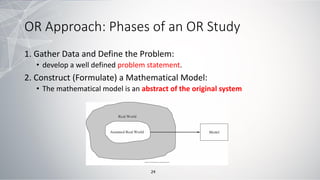
OR Approach: Phases of an OR Study
1. Gather Data and Define the Problem:
• develop a well defined problem statement.
2. Construct (Formulate) a Mathematical Model:
• The mathematical model is an abstract of the original system
24
OR Approach: Phases of an OR Study
3. Solve the Model:
• Use optimization algorithms and test the solution behavior.
4. Validate the model:
• Adequately representing and predicting the behavior of the system.
5. Preparation and Implementation:
• Understandable operational instructions.
25
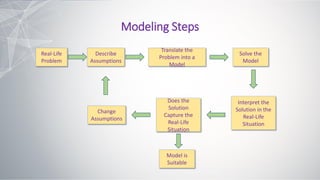
Modeling Steps
Real-Life
Problem
Describe
Assumptions
Translate the
Problem into a
Model
Solve the
Model
Interpret the
Solution in the
Real-Life
Situation
Does the
Solution
Capture the
Real-Life
Situation
Model is
Suitable
Change
Assumptions
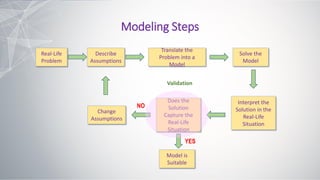
Modeling Steps
YES
Real-Life
Problem
Describe
Assumptions
Translate the
Problem into a
Model
Solve the
Model
Interpret the
Solution in the
Real-Life
Situation
Does the
Solution
Capture the
Real-Life
Situation
Model is
Suitable
Change
Assumptions
NO
Validation
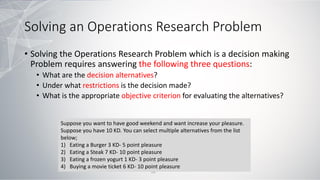
Solving an Operations Research Problem
• Solving the Operations Research Problem which is a decision making
Problem requires answering the following three questions:
• What are the decision alternatives?
• Under what restrictions is the decision made?
• What is the appropriate objective criterion for evaluating the alternatives?
28
Suppose you want to have good weekend and want increase your pleasure.
Suppose you have 10 KD. You can select multiple alternatives from the list
below;
1) Eating a Burger 3 KD- 5 point pleasure
2) Eating a Steak 7 KD- 10 point pleasure
3) Eating a frozen yogurt 1 KD- 3 point pleasure
4) Buying a movie ticket 6 KD- 10 point pleasure
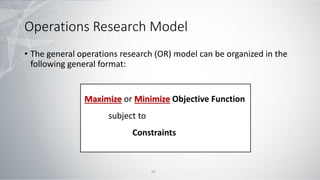
Operations Research Model
• The general operations research (OR) model can be organized in the
following general format:
Maximize or Minimize Objective Function
subject to
Constraints
29
Feasible vs. Optimal
• A solution of the OR model is said to be infeasible if it violates any of
the constraints.
• A solution of the OR model is said to be feasible if it satisfies all the
constraints.
• A feasible solution is optimal if and only if it yields to the best
(minimum or maximum) value of the objective function.
30
Example 1 : Area of a Rectangle
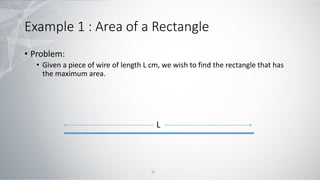
• Problem:
• Given a piece of wire of length L cm, we wish to find the rectangle that has
the maximum area.
L
31
Example 1 : Area of a Rectangle
• Solution:
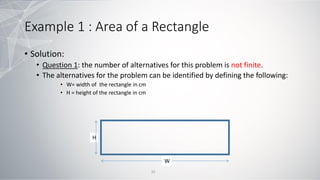
• Question 1: the number of alternatives for this problem is not finite.
• The alternatives for the problem can be identified by defining the following:
• W= width of the rectangle in cm
• H = height of the rectangle in cm
W
H
32
Example 1 : Area of a Rectangle
• Solution:
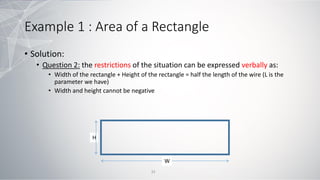
• Question 2: the restrictions of the situation can be expressed verbally as:
• Width of the rectangle + Height of the rectangle = half the length of the wire (L is the
parameter we have)
• Width and height cannot be negative
W
H
33
Example 1 : Area of a Rectangle
• Solution:
• Question 2: the restrictions of the situation can be expressed algebraically as:
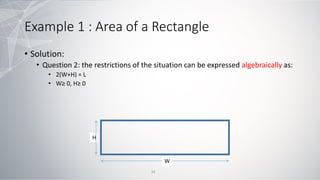
• 2(W+H) = L
• W≥ 0, H≥ 0
W
H
34
Example 1 : Area of a Rectangle
• Solution:
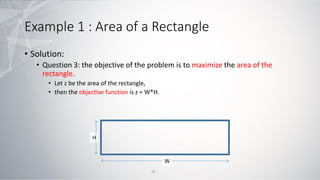
• Question 3: the objective of the problem is to maximize the area of the
rectangle.
• Let z be the area of the rectangle,
• then the objective function is z = W*H.
W
H
35
Example 1 : Area of a Rectangle
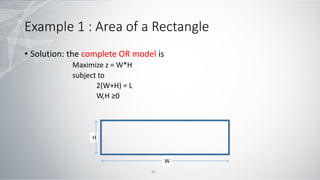
• Solution: the complete OR model is
Maximize z = W*H
subject to
2(W+H) = L
W,H ≥0
W
H
36
Example 1 : Area of a Rectangle
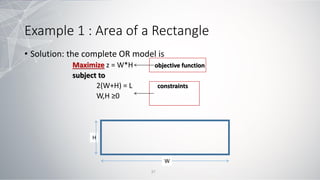
• Solution: the complete OR model is
Maximize z = W*H objective function
subject to
2(W+H) = L constraints
W,H ≥0
W
H
37

Lecture 1 Chapter 1 Introduction to OR.pdf

  • 1.
  • 2.
    Lecture 1: Introduction& Syllabus Review 2
  • 3.
    General Course Information 3 ▪Instructor’s name and title: ▪ Dr. Alperen Bal • Office Phone Number: 22251400 – Ext: 2724 • Email: Alperen.Bal@aum.edu.kw ▪ Office Hours: ▪ By appointment or on the following: ▪ 15 min extended Q&A session after each class! Let us meet! ➢ Your name ➢ Your expectations from the course? ➢ What will you do after graduating the university? ➢ Do you like mathematics and problem solving? Sunday Monday Tuesday Wednesday Thursday 16:00-17:00 TUTORING
  • 4.
    Number of credits:3 credits Prerequisites: MA 265, EE 302 or CE 302 or IE332 (Co.) Contact Hours: 2 hrs. Lecture, and 2 hrs. lab Textbook/material required: Operations Research and Introduction – Hamdy A. Taha – 10th edition (ISBN-13: 978-0134444017) – Pearson. 4
  • 5.
    Course Description • Thecourse introduces the basic concept of deterministic optimization modeling and algorithms in operations research. • It is designed to provide students with a sound conceptual understanding of the role operations research plays in the decision- making process. • It emphasizes the application of a wide variety of quantitative techniques so as to find solution for engineering problems. 5
  • 6.
    Course Description • Thiscourse will cover: ➢ Chapter 2: Modelling with Linear Programming ➢ Chapter 3: The Simplex Method and Sensitivity Analysis ➢ Chapter 5: The Transportation Model ➢ Chapter 6: Network Models ➢ Min. spanning tree algorithm ➢ Shortest route algorithm ➢ Maximal flow model 6
  • 7.
    Course Objectives • Inthis course, you will develop your skills by/at: • Understanding the deterministic optimization. • Solving linear programs • Optimizing deterministic and linear programs • Understanding of the conceptual framework of quantitative methods in the decision-making process. • The basics of OR: Numerical examples are effectively used to explain complex mathematical concepts, thus avoiding the use of complex notations and theorems. • Real-world applications. • Understanding of linear programming formulation and computer solution 7
  • 8.
    Notes about writtenassignments: • All assignments, activities, reports are due as hardcopies in class unless otherwise advised. • Softcopies(Lab and Project Reports) are required to be uploaded into Turnit-in in. 8
  • 9.
    Class Rules • TardinessPolicy: • Students must attend class on time. • Students coming in any time after the class has already started will be considered late • Students arriving to class after 15 minutes will be considered absent. • Students who leave the classroom for more than 15 min will be considered as absent. 9
  • 10.
    The procedure fordealing with cell phones and smart devices: Using any format of cell phones and smart devices is considered as a violation and AUM disciplinary measures will be applied. • At the beginning of the class, all mobiles to be switched off. • If the student is expecting any emergency phone call, she/he needs to inform Student Affairs about her/his case to take special permission which is to be communicated to the Dean of the College. • If the student is spotted to use the mobile in any format, she/he will be given one and only one warning. • If the student repeats the usage of the mobile, he will be reported immediately to Student Affairs and the disciplinary measures in the handbook will be applied which may well mean dismissal from the course. • AUM non-academic misconduct policy will be strictly applied. 10
  • 11.
  • 12.
  • 13.
    Course Evaluation 13 Assessment type Numberof assessments % for each Total Weight Attendance 5 % Lab report 4 5 % 20 % 5 % 5 % 5 % Assignment 3 10 % 30 % 10 % 10 % Quiz 2 2.5 % 5 % 2.5 % In Class Assignment/Assessment 2 10 % 20 % 10 % Final Assessment 1 20 % 20 % Total 100%
  • 14.
    Course Project • Students,in groups of three, will select a topic. It is expected that each student will, fully and actively, participate in the project as an effective team member. The work submitted by the group should be the group’s own work and not copied from a previous case study or project. 14
  • 15.
    Course Project The projectwill be the application of the cutting stock problem to a real-life setting. The solution of the cutting stock problem can be partitioned into a 3-step procedure: 1. Forecast the needs (or requirements) for the final widths. 2. Construct a large collection of possible patterns for cutting the large manufactured width(s) into the smaller widths. 3. Determine how many of each pattern should be run of each pattern in (2), so the requirements in (1) are satisfied at a minimum cost. 15
  • 16.
    What is OperationsResearch? 16
  • 17.
    Operations Research • Componentsof an organization usually become self-driven, each with own goals, thus loosing sight of the original objectives. • They may end up working at cross purposes. • As the complexity and size of an organization increase, it becomes more and more difficult to allocate the resources efficiently. 17
  • 18.
    Operations Research • OperationsResearch (OR) is simply a scientific approach that seeks to best design and operate a system, usually under conditions requiring the allocation of limited resources. • OR is mainly concerned with the optimal (best) allocation of available resources to activities. • The word operations refers to the activities that have to be conducted and coordinated, while the word research means that OR uses an approach that resembles the way research is conducted in scientific fields. 18
  • 19.
    OR Progress • Originsof OR goes back to WWII: • The objective was to find the most effective utilization of limited military resources by the use of quantitative techniques. • urgent need to allocate scarce resources. • The problems faced by military were essentially the same problems faced by industrial organizations at the post war era. • Following the end of the war OR spread although it spread in different ways in the UK and USA. • Factors that lead to the popularity of OR: • Substantial progress made in the OR techniques. • Computer revolution. 19
  • 20.
    OR Applications • Itssuccess has lead to its extensive applications in diverse areas including manufacturing, transportation, telecommunications, financial planning, and public services. • OR applications in manufacturing include • production planning, • resource allocation, • material handling, • assignment of operations, • inventory management, • operations scheduling and • much more. 20
  • 21.
    Examples of ORProblems • OR techniques may be used to solve every-day problems • What and how much to buy at the market • Find the best parking on campus • What classes to register for • How to allocate studying time for different classes • Packing your luggage • How to arrange furniture in a room • Pick a job from a long list of offers • etc. 21
  • 22.
    Examples of Problemsthat are Solved using OR Techniques • Linear programming • assignment of personnel • blending of materials • distribution and transportation • investment portfolios 22
  • 23.
    Impact of OR OrganizationApplication Year Annual Savings Citgo Petroleum Optimize refinery operation 1987 $70M San Francisco PD Schedule patrol officers 1989 $11M Delta Airlines Assign plane types to flights 1994 $100M HP Redesign sizes and locations of buffers 1998 $280M IBM Reengineer its global Supply Chain 2000 $750M Samsung Elec. Reduce manufacturing time and inventory level 2002 $200M 23
  • 24.
    OR Approach: Phasesof an OR Study 1. Gather Data and Define the Problem: • develop a well defined problem statement. 2. Construct (Formulate) a Mathematical Model: • The mathematical model is an abstract of the original system 24
  • 25.
    OR Approach: Phasesof an OR Study 3. Solve the Model: • Use optimization algorithms and test the solution behavior. 4. Validate the model: • Adequately representing and predicting the behavior of the system. 5. Preparation and Implementation: • Understandable operational instructions. 25
  • 26.
    Modeling Steps Real-Life Problem Describe Assumptions Translate the Probleminto a Model Solve the Model Interpret the Solution in the Real-Life Situation Does the Solution Capture the Real-Life Situation Model is Suitable Change Assumptions
  • 27.
    Modeling Steps YES Real-Life Problem Describe Assumptions Translate the Probleminto a Model Solve the Model Interpret the Solution in the Real-Life Situation Does the Solution Capture the Real-Life Situation Model is Suitable Change Assumptions NO Validation
  • 28.
    Solving an OperationsResearch Problem • Solving the Operations Research Problem which is a decision making Problem requires answering the following three questions: • What are the decision alternatives? • Under what restrictions is the decision made? • What is the appropriate objective criterion for evaluating the alternatives? 28 Suppose you want to have good weekend and want increase your pleasure. Suppose you have 10 KD. You can select multiple alternatives from the list below; 1) Eating a Burger 3 KD- 5 point pleasure 2) Eating a Steak 7 KD- 10 point pleasure 3) Eating a frozen yogurt 1 KD- 3 point pleasure 4) Buying a movie ticket 6 KD- 10 point pleasure
  • 29.
    Operations Research Model •The general operations research (OR) model can be organized in the following general format: Maximize or Minimize Objective Function subject to Constraints 29
  • 30.
    Feasible vs. Optimal •A solution of the OR model is said to be infeasible if it violates any of the constraints. • A solution of the OR model is said to be feasible if it satisfies all the constraints. • A feasible solution is optimal if and only if it yields to the best (minimum or maximum) value of the objective function. 30
  • 31.
    Example 1 :Area of a Rectangle • Problem: • Given a piece of wire of length L cm, we wish to find the rectangle that has the maximum area. L 31
  • 32.
    Example 1 :Area of a Rectangle • Solution: • Question 1: the number of alternatives for this problem is not finite. • The alternatives for the problem can be identified by defining the following: • W= width of the rectangle in cm • H = height of the rectangle in cm W H 32
  • 33.
    Example 1 :Area of a Rectangle • Solution: • Question 2: the restrictions of the situation can be expressed verbally as: • Width of the rectangle + Height of the rectangle = half the length of the wire (L is the parameter we have) • Width and height cannot be negative W H 33
  • 34.
    Example 1 :Area of a Rectangle • Solution: • Question 2: the restrictions of the situation can be expressed algebraically as: • 2(W+H) = L • W≥ 0, H≥ 0 W H 34
  • 35.
    Example 1 :Area of a Rectangle • Solution: • Question 3: the objective of the problem is to maximize the area of the rectangle. • Let z be the area of the rectangle, • then the objective function is z = W*H. W H 35
  • 36.
    Example 1 :Area of a Rectangle • Solution: the complete OR model is Maximize z = W*H subject to 2(W+H) = L W,H ≥0 W H 36
  • 37.
    Example 1 :Area of a Rectangle • Solution: the complete OR model is Maximize z = W*H objective function subject to 2(W+H) = L constraints W,H ≥0 W H 37