Hierarchical Planning Process
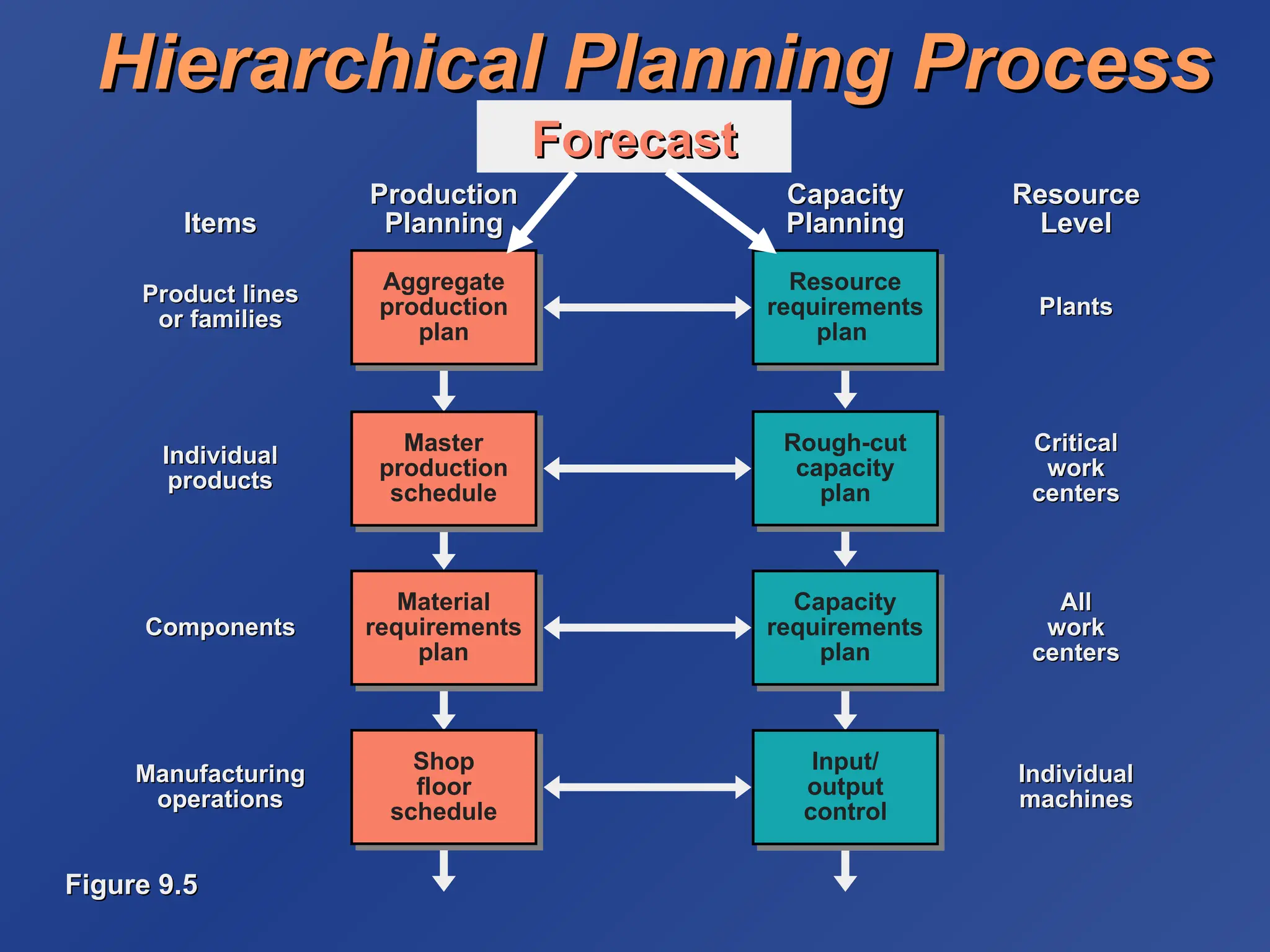
HierarchicalPlanning Process
Items
Items
Product lines
Product lines
or families
or families
Individual
Individual
products
products
Components
Components
Manufacturing
Manufacturing
operations
operations
Resource
Resource
Level
Level
Plants
Plants
Individual
Individual
machines
machines
Critical
Critical
work
work
centers
centers
Production
Production
Planning
Planning
Capacity
Capacity
Planning
Planning
Resource
requirements
plan
Rough-cut
capacity
plan
Capacity
requirements
plan
Input/
output
control
Aggregate
production
plan
Master
production
schedule
Material
requirements
plan
Shop
floor
schedule
All
All
work
work
centers
centers
Figure 9.5
Figure 9.5
Forecast
Forecast
3.
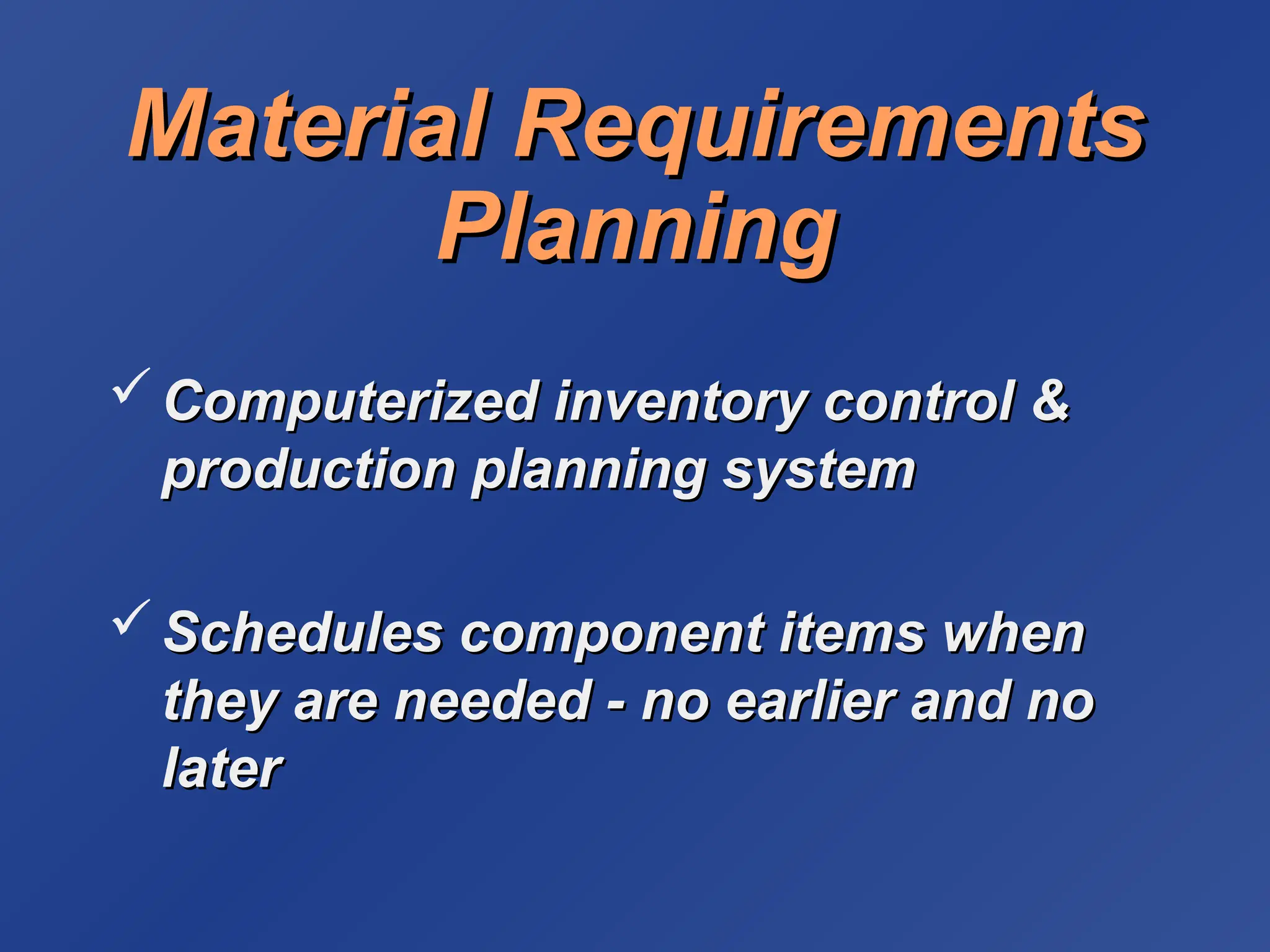
Material Requirements
Material Requirements
Planning
Planning
Computerized inventory control &
Computerized inventory control &
production planning system
production planning system
Schedules component items when
Schedules component items when
they are needed - no earlier and no
they are needed - no earlier and no
later
later
4.
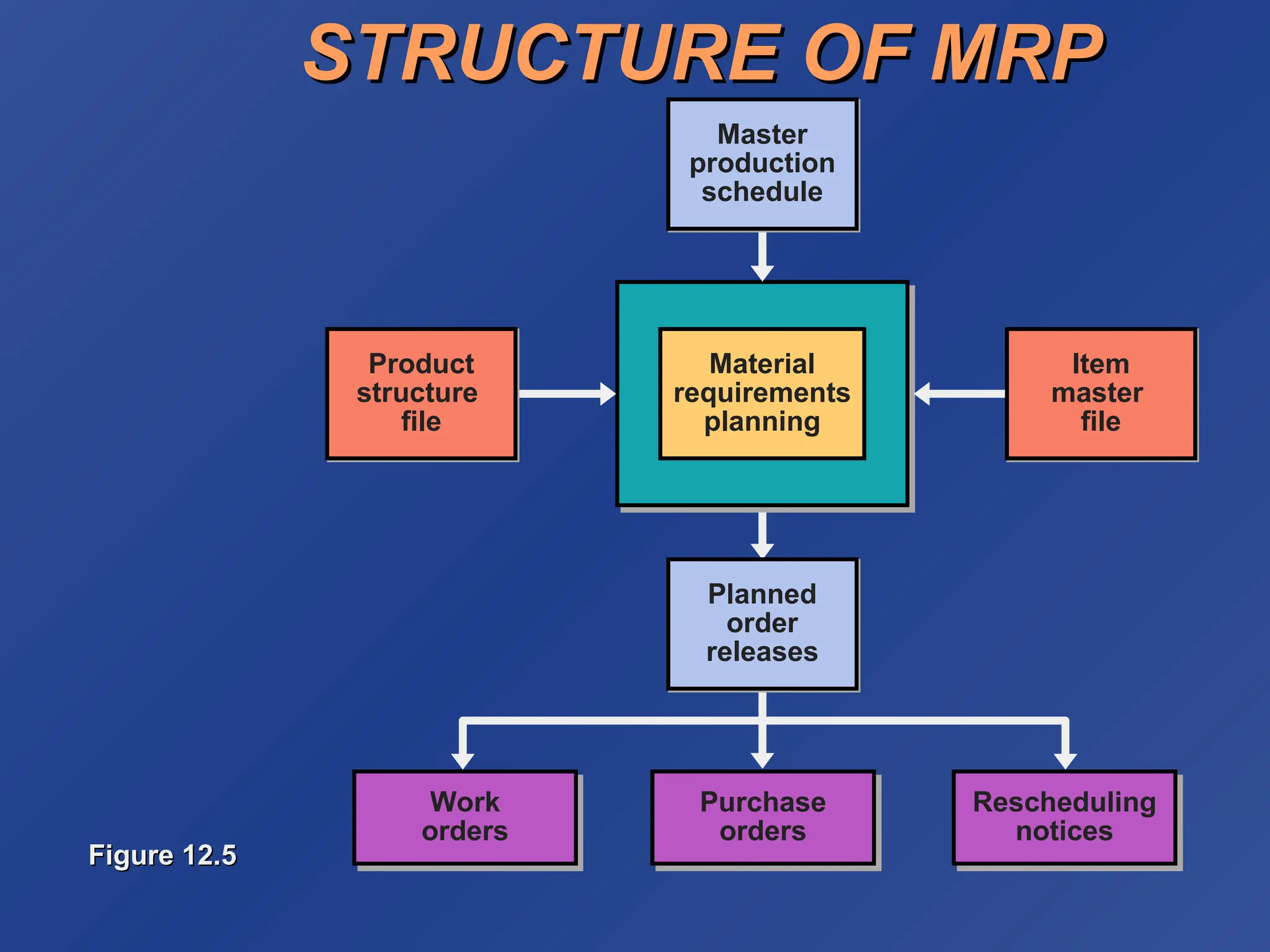
STRUCTURE OF MRP
STRUCTUREOF MRP
Material
requirements
planning
Planned
order
releases
Work
orders
Purchase
orders
Rescheduling
notices
Item
master
file
Product
structure
file
Master
production
schedule
Figure 12.5
Figure 12.5
5.
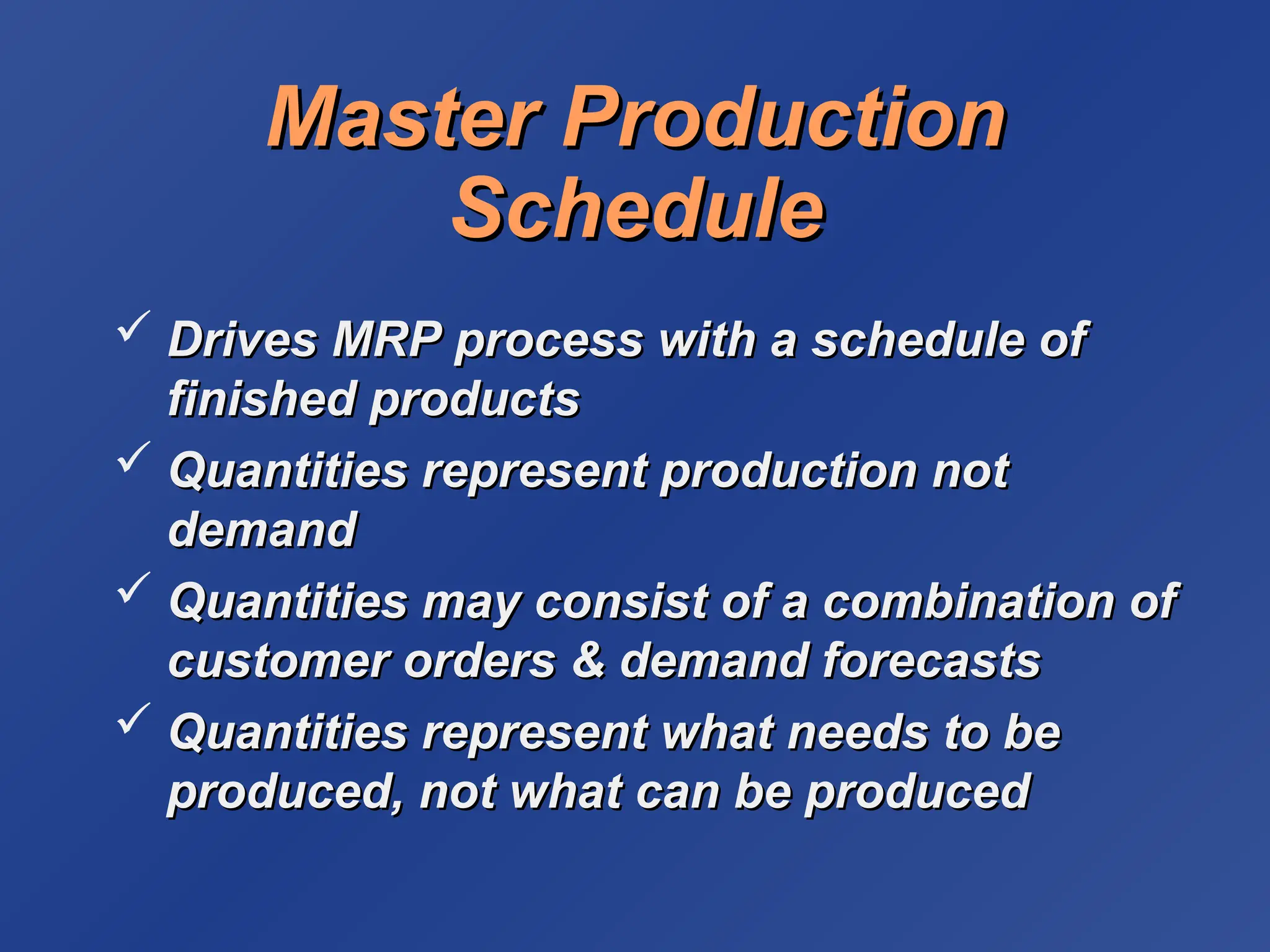
Master Production
Master Production
Schedule
Schedule
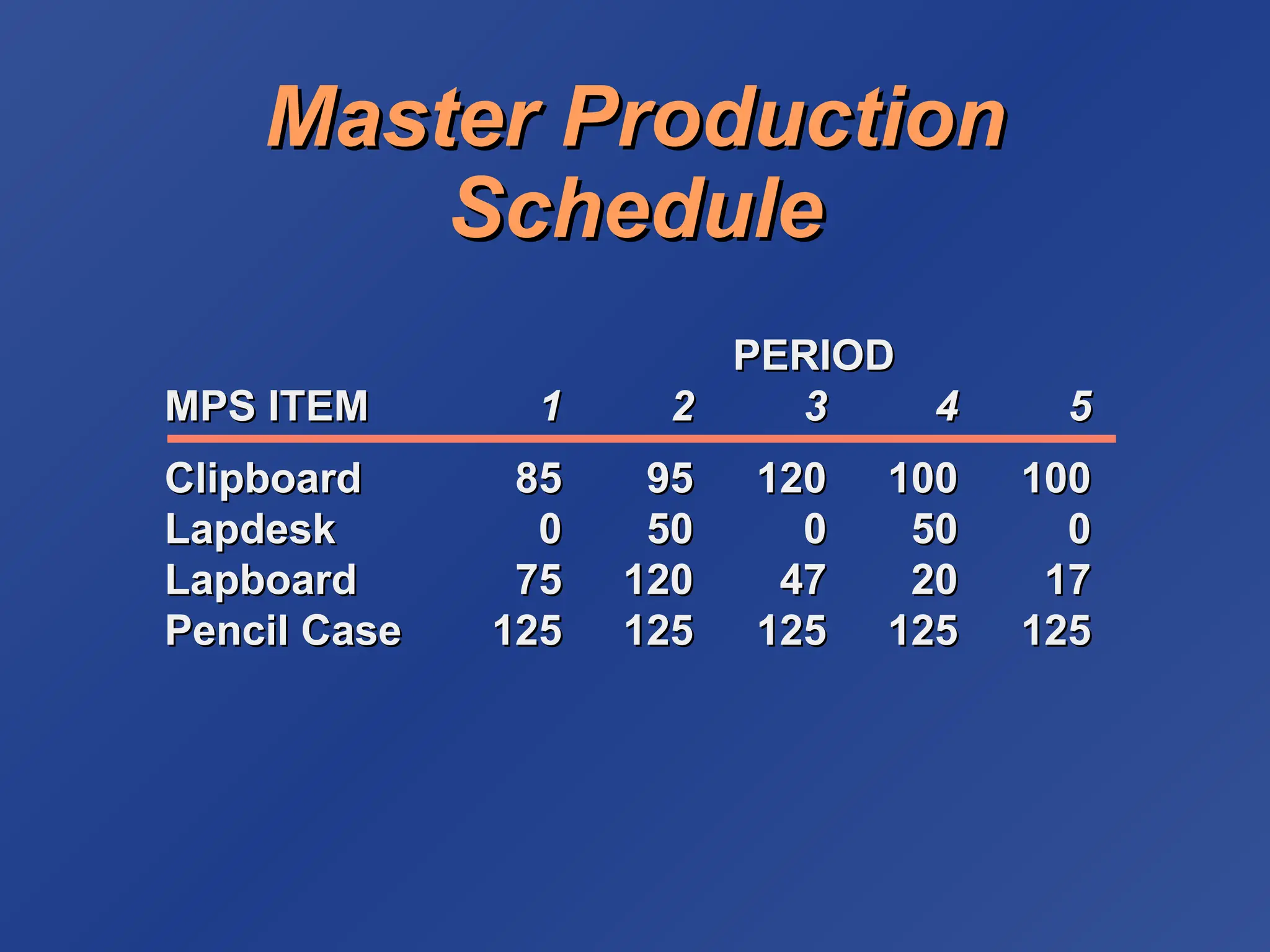
Drives MRP process with a schedule of
Drives MRP process with a schedule of
finished products
finished products
Quantities represent production not
Quantities represent production not
demand
demand
Quantities may consist of a combination of
Quantities may consist of a combination of
customer orders & demand forecasts
customer orders & demand forecasts
Quantities represent what needs to be
Quantities represent what needs to be
produced, not what can be produced
produced, not what can be produced
BILL OF MATERIAL
BILLOF MATERIAL
(BOM)
(BOM)
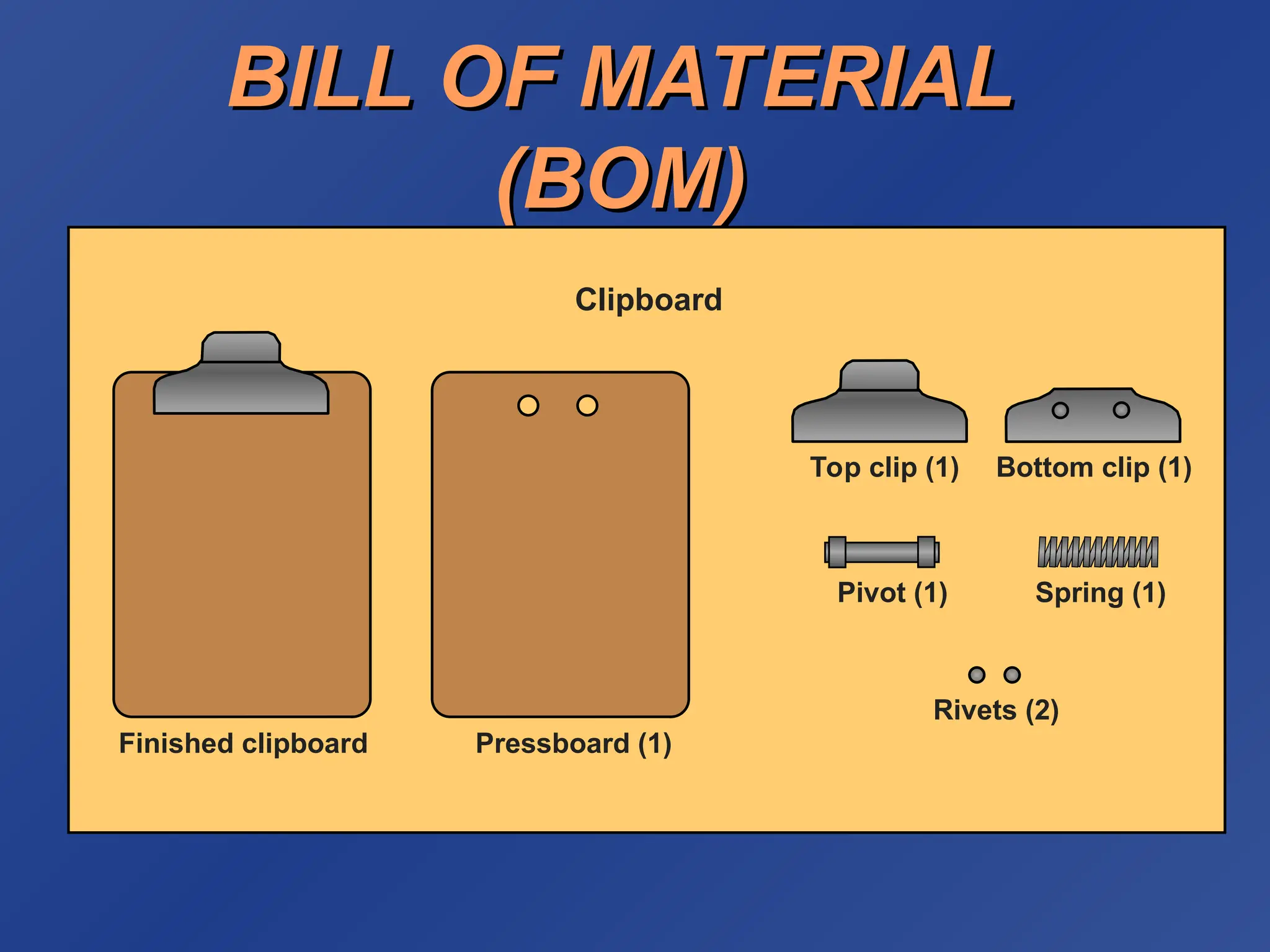
Top clip (1) Bottom clip (1)
Pivot (1) Spring (1)
Rivets (2)
Finished clipboard Pressboard (1)
Clipboard
8.
Product Structure Tree
ProductStructure Tree
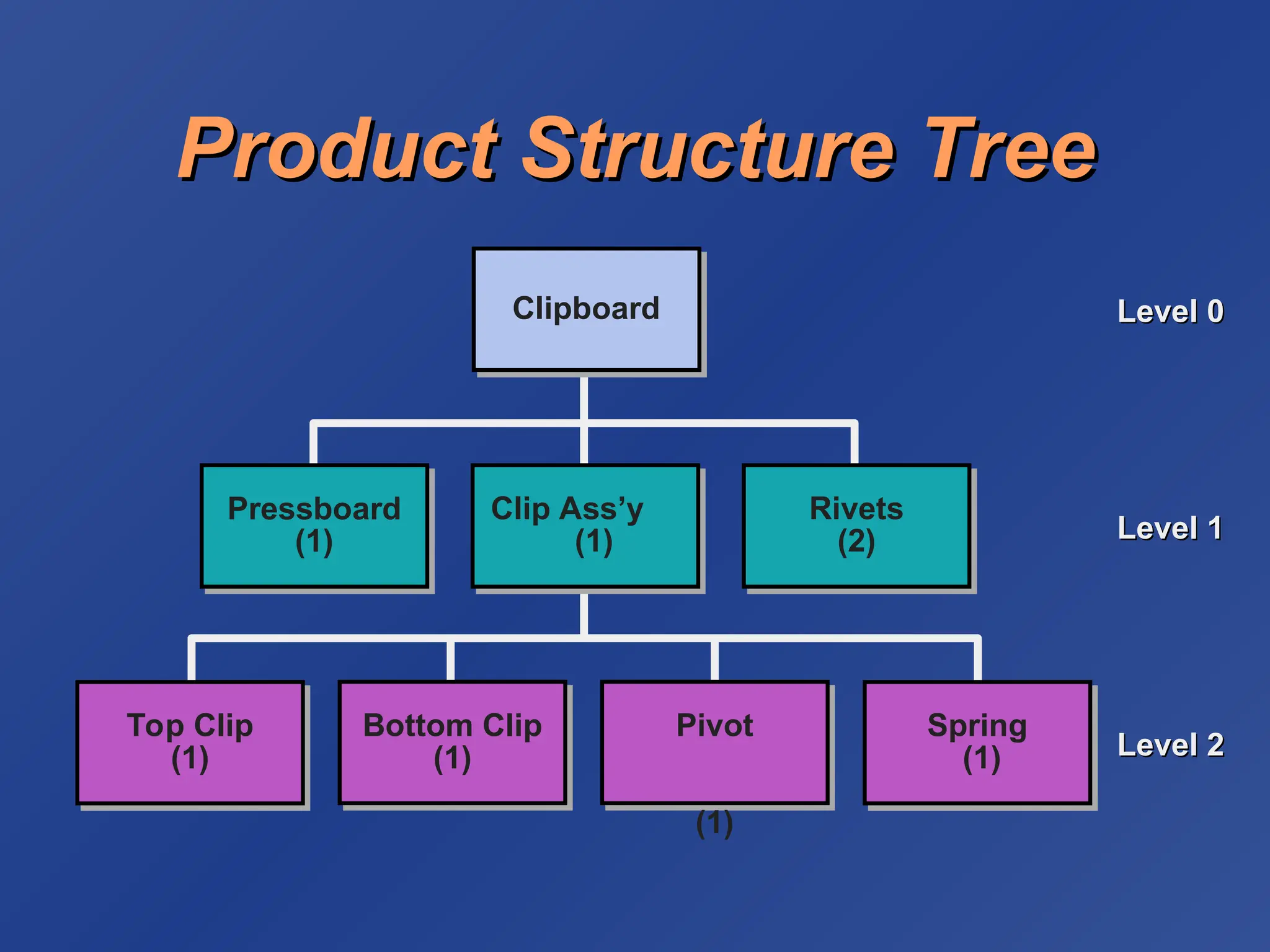
Clipboard Level 0
Level 0
Level 1
Level 1
Level 2
Level 2
Spring
(1)
Bottom Clip
(1)
Top Clip
(1)
Pivot
(1)
Rivets
(2)
Clip Ass’y
(1)
Pressboard
(1)
9.
INVENTORY RECORD FILE
INVENTORYRECORD FILE
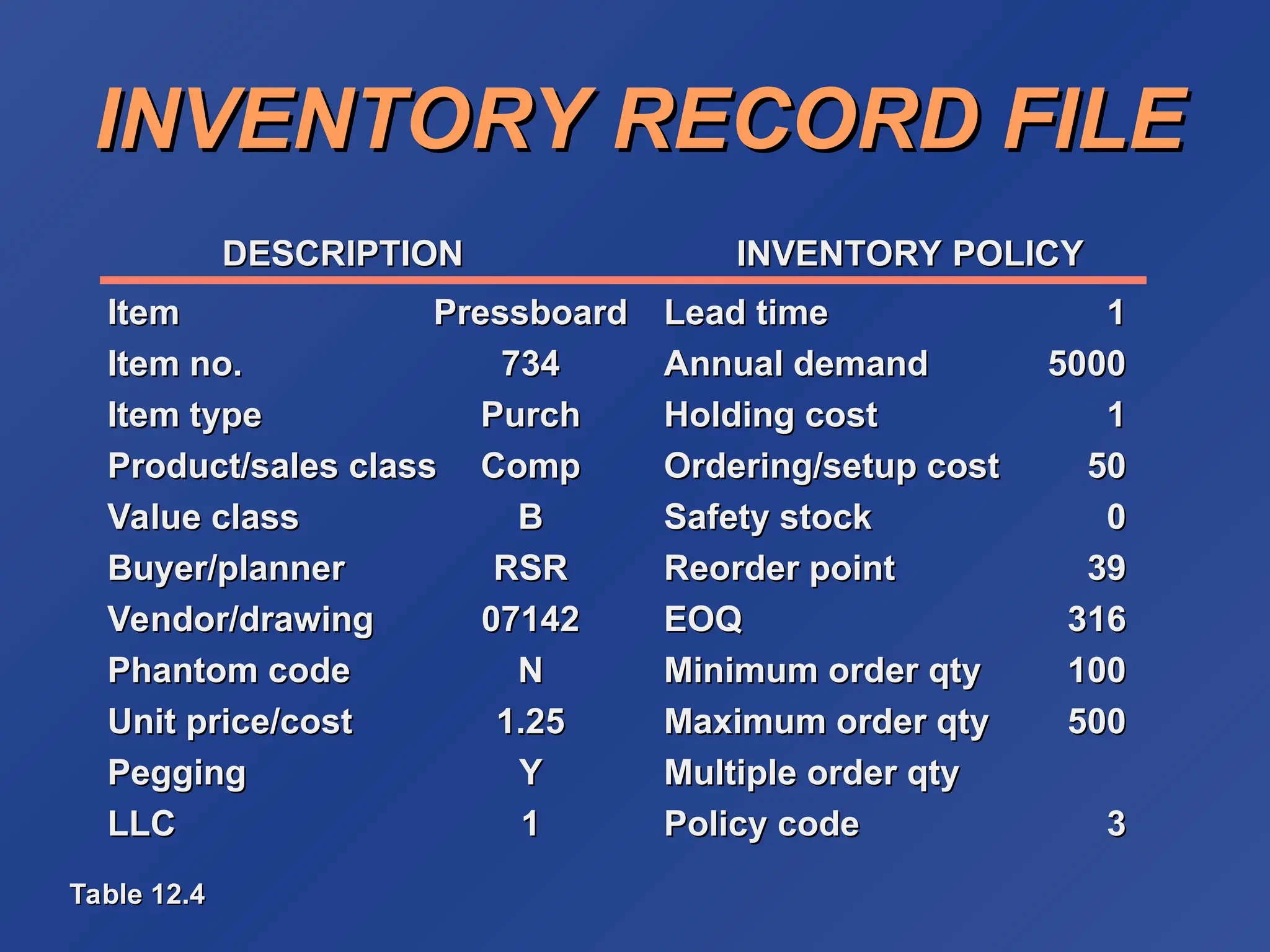
DESCRIPTION
DESCRIPTION INVENTORY POLICY
INVENTORY POLICY
Item
Item Pressboard
Pressboard Lead time
Lead time 1
1
Item no.
Item no. 734
734 Annual demand
Annual demand 5000
5000
Item type
Item type Purch
Purch Holding cost
Holding cost 1
1
Product/sales class
Product/sales class Comp
Comp Ordering/setup cost
Ordering/setup cost 50
50
Value class
Value class B
B Safety stock
Safety stock 0
0
Buyer/planner
Buyer/planner RSR
RSR Reorder point
Reorder point 39
39
Vendor/drawing
Vendor/drawing 07142
07142 EOQ
EOQ 316
316
Phantom code
Phantom code N
N Minimum order qty
Minimum order qty 100
100
Unit price/cost
Unit price/cost 1.25
1.25 Maximum order qty
Maximum order qty 500
500
Pegging
Pegging Y
Y Multiple order qty
Multiple order qty
LLC
LLC 1
1 Policy code
Policy code 3
3
Table 12.4
Table 12.4
10.
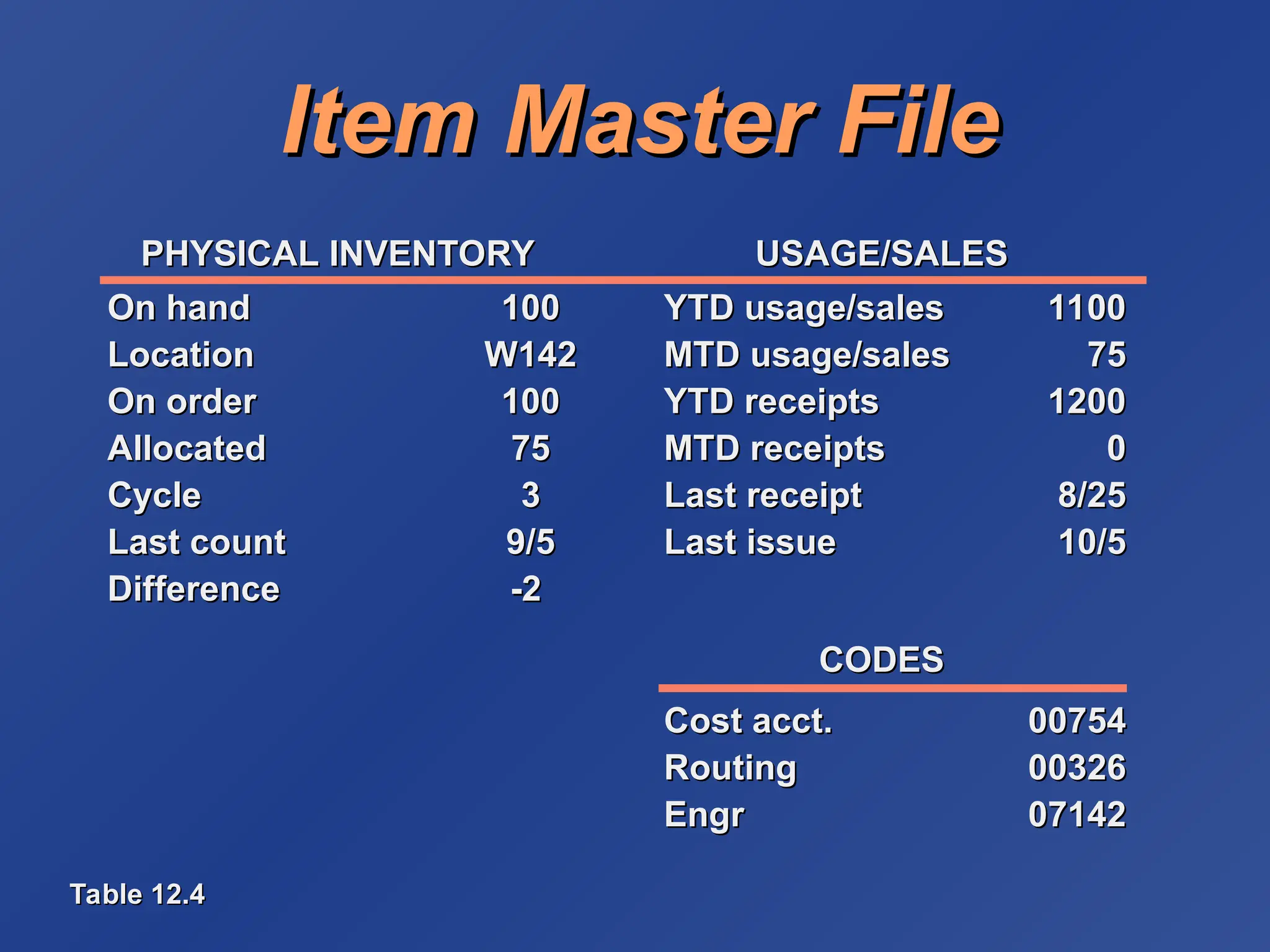
Item Master File
ItemMaster File
PHYSICAL INVENTORY
PHYSICAL INVENTORY USAGE/SALES
USAGE/SALES
CODES
CODES
On hand
On hand 100
100 YTD usage/sales
YTD usage/sales 1100
1100
Location
Location W142
W142 MTD usage/sales
MTD usage/sales 75
75
On order
On order 100
100 YTD receipts
YTD receipts 1200
1200
Allocated
Allocated 75
75 MTD receipts
MTD receipts 0
0
Cycle
Cycle 3
3 Last receipt
Last receipt 8/25
8/25
Last count
Last count 9/5
9/5 Last issue
Last issue 10/5
10/5
Difference
Difference -2
-2
Cost acct.
Cost acct. 00754
00754
Routing
Routing 00326
00326
Engr
Engr 07142
07142
Table 12.4
Table 12.4
11.
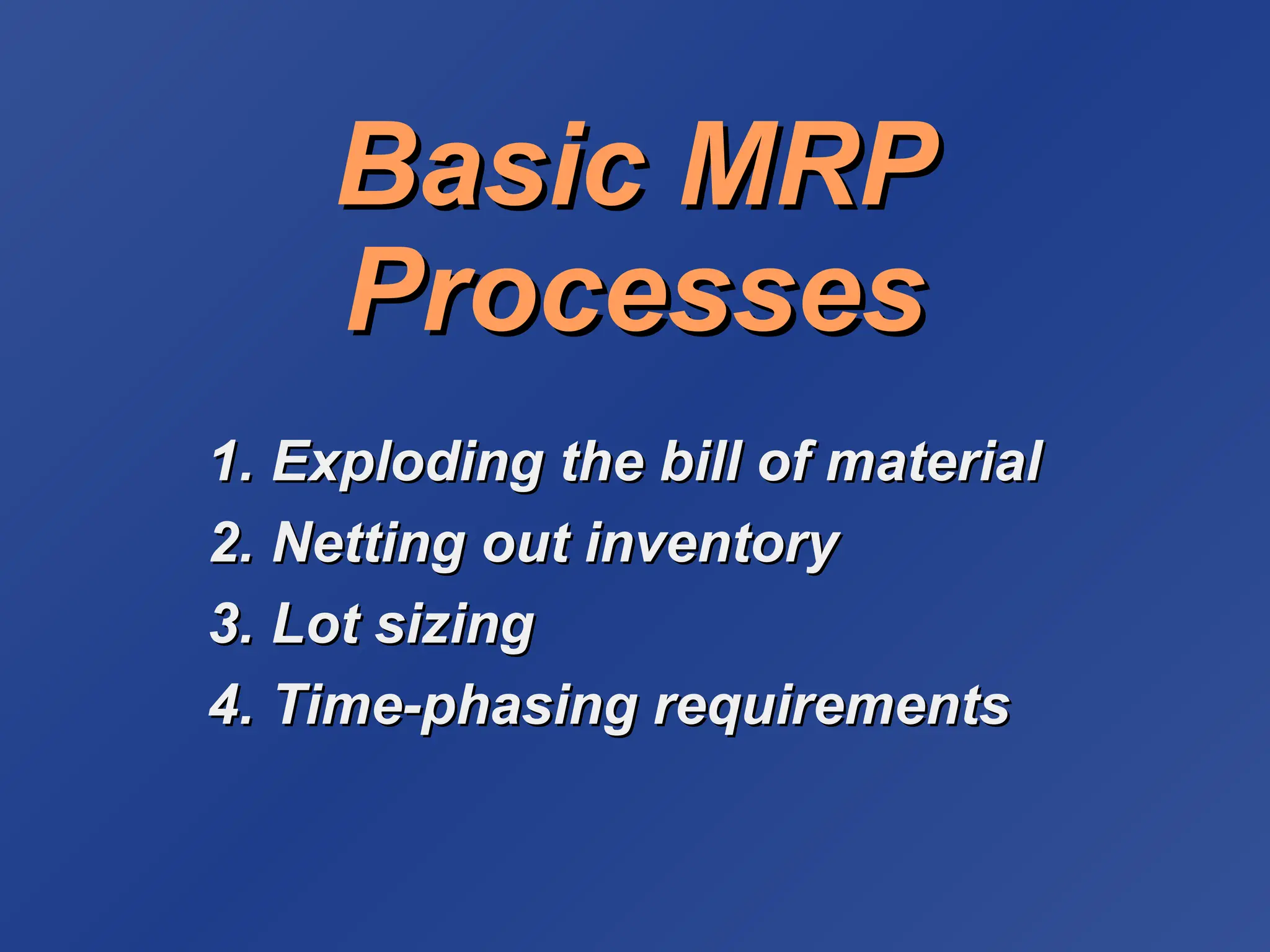
Basic MRP
Basic MRP
Processes
Processes
1.
1.Exploding the bill of material
Exploding the bill of material
2.
2. Netting out inventory
Netting out inventory
3.
3. Lot sizing
Lot sizing
4.
4. Time-phasing requirements
Time-phasing requirements
12.
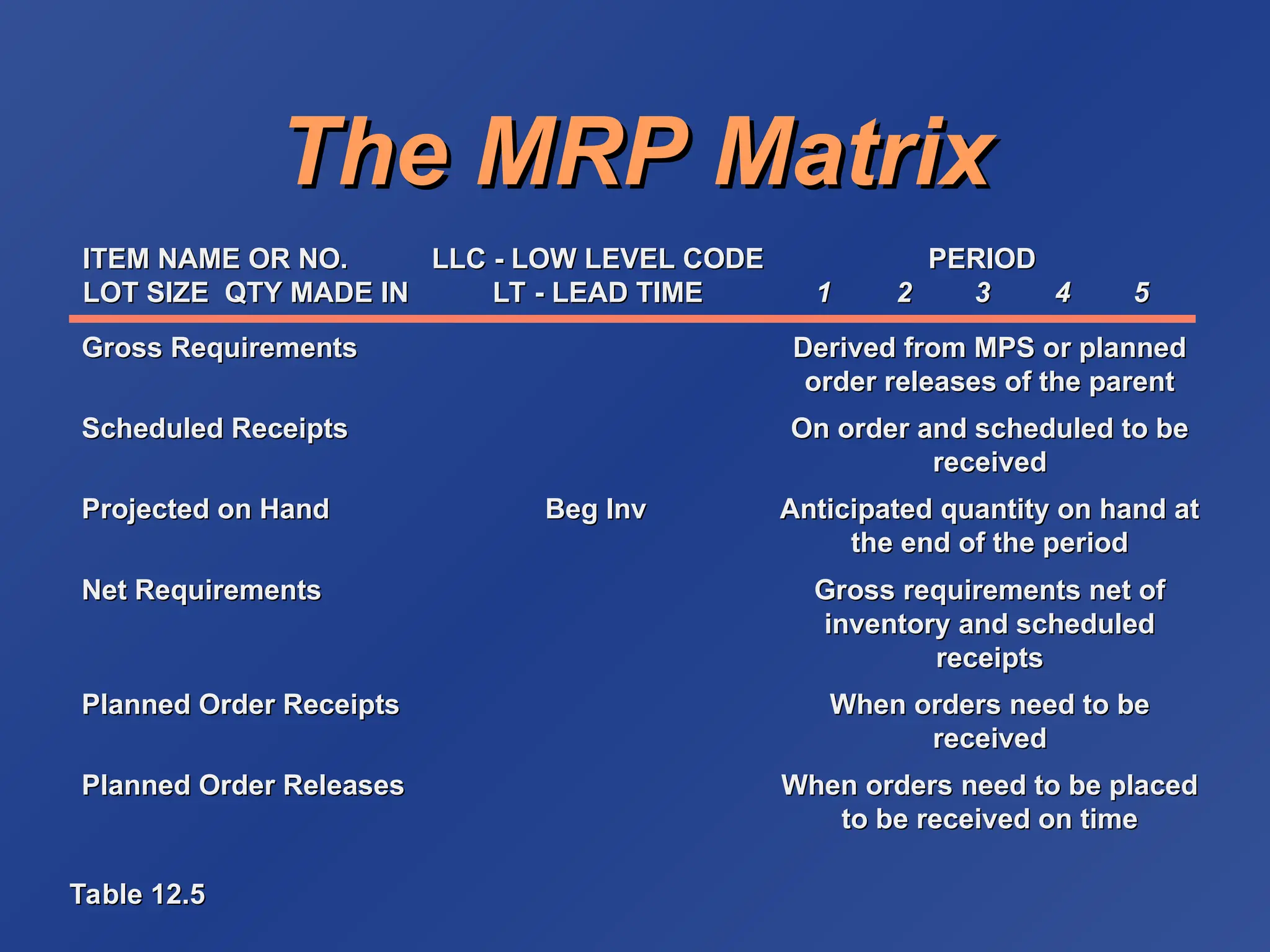
The MRP Matrix
TheMRP Matrix
Gross Requirements
Gross Requirements Derived from MPS or planned
Derived from MPS or planned
order releases of the parent
order releases of the parent
Scheduled Receipts
Scheduled Receipts On order and scheduled to be
On order and scheduled to be
received
received
Projected on Hand
Projected on Hand Beg Inv
Beg Inv Anticipated quantity on hand at
Anticipated quantity on hand at
the end of the period
the end of the period
Net Requirements
Net Requirements Gross requirements net of
Gross requirements net of
inventory and scheduled
inventory and scheduled
receipts
receipts
Planned Order Receipts
Planned Order Receipts When orders need to be
When orders need to be
received
received
Planned Order Releases
Planned Order Releases When orders need to be placed
When orders need to be placed
to be received on time
to be received on time
ITEM NAME OR NO.
ITEM NAME OR NO. LLC - LOW LEVEL CODE
LLC - LOW LEVEL CODE PERIOD
PERIOD
LOT SIZE QTY MADE IN
LOT SIZE QTY MADE IN LT - LEAD TIME
LT - LEAD TIME 1
1 2
2 3
3 4
4 5
5
Table 12.5
Table 12.5
13.
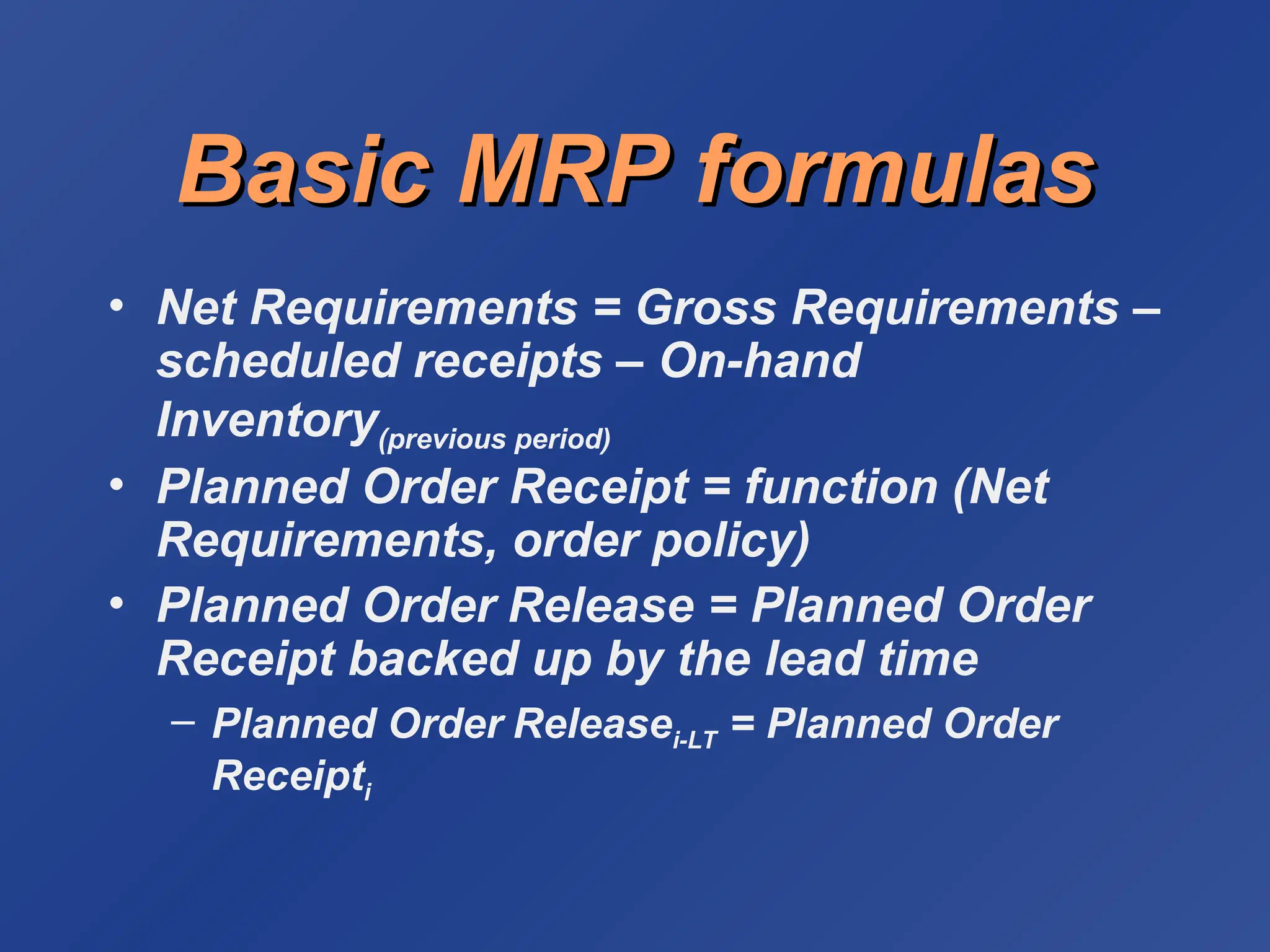
Basic MRP formulas
BasicMRP formulas
• Net Requirements = Gross Requirements –
scheduled receipts – On-hand
Inventory(previous period)
• Planned Order Receipt = function (Net
Requirements, order policy)
• Planned Order Release = Planned Order
Receipt backed up by the lead time
– Planned Order Releasei-LT = Planned Order
Receipti
14.
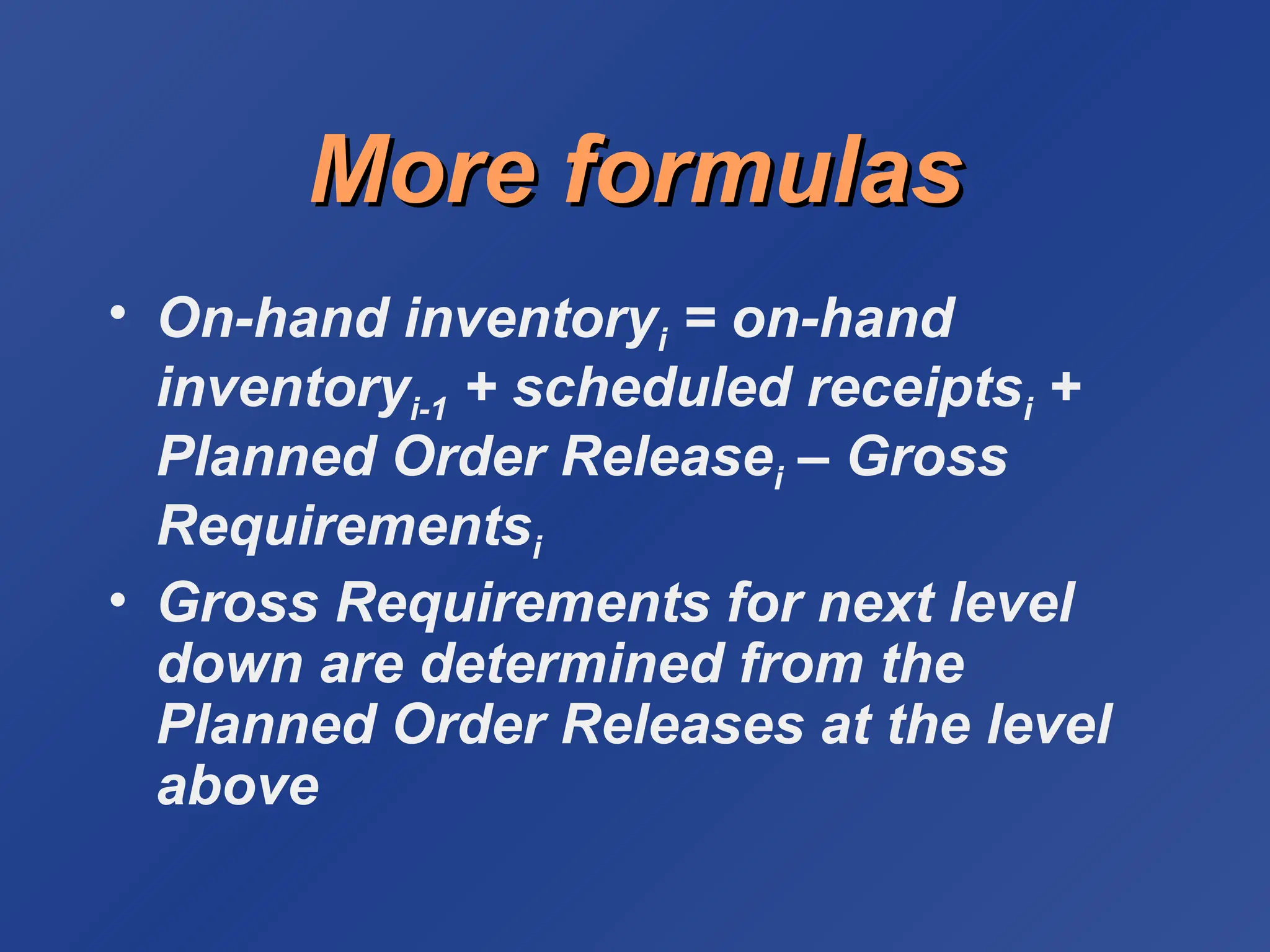
More formulas
More formulas
•On-hand inventoryi = on-hand
inventoryi-1 + scheduled receiptsi +
Planned Order Releasei – Gross
Requirementsi
• Gross Requirements for next level
down are determined from the
Planned Order Releases at the level
above
15.
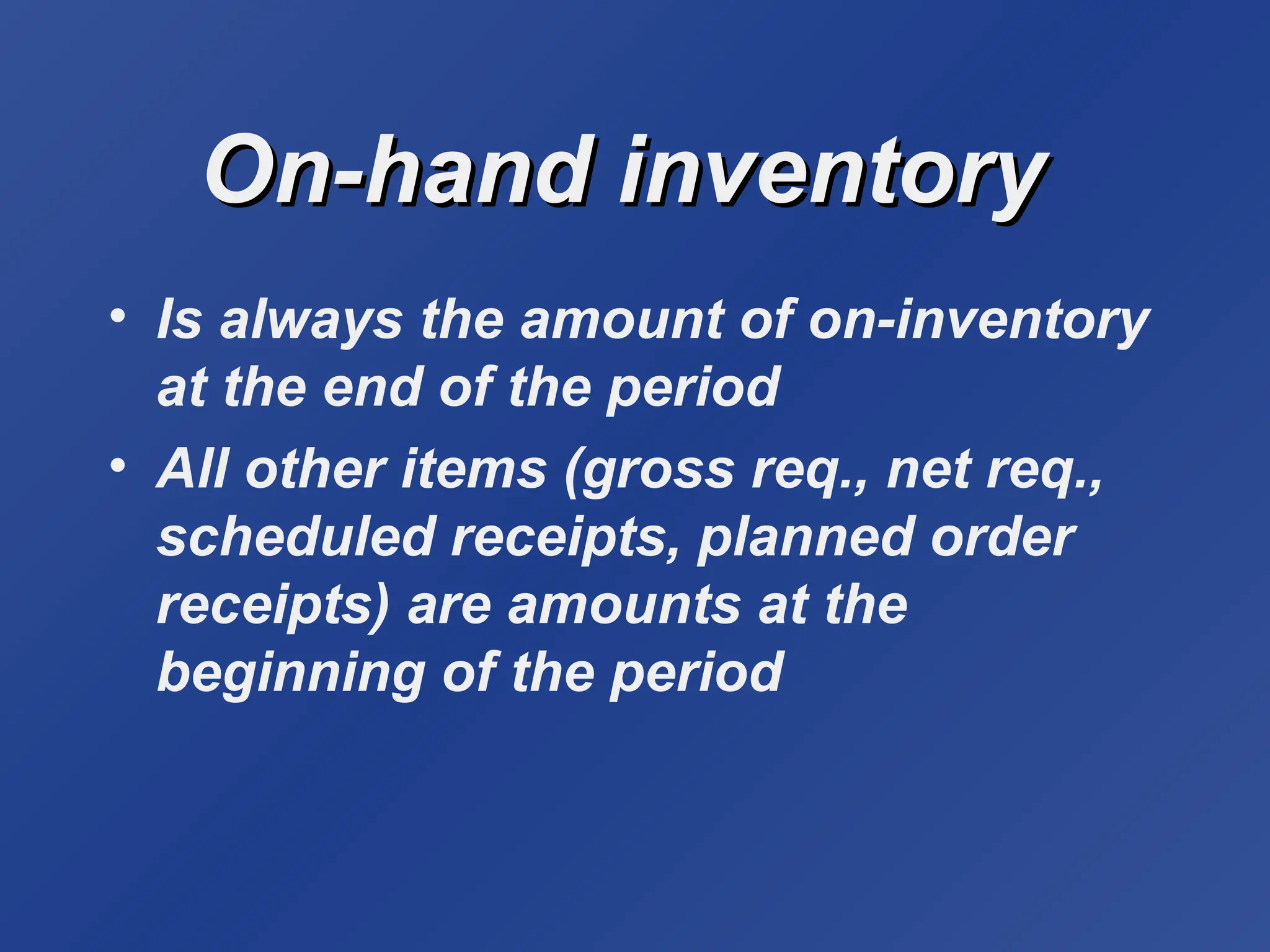
On-hand inventory
On-hand inventory
•Is always the amount of on-inventory
at the end of the period
• All other items (gross req., net req.,
scheduled receipts, planned order
receipts) are amounts at the
beginning of the period
16.
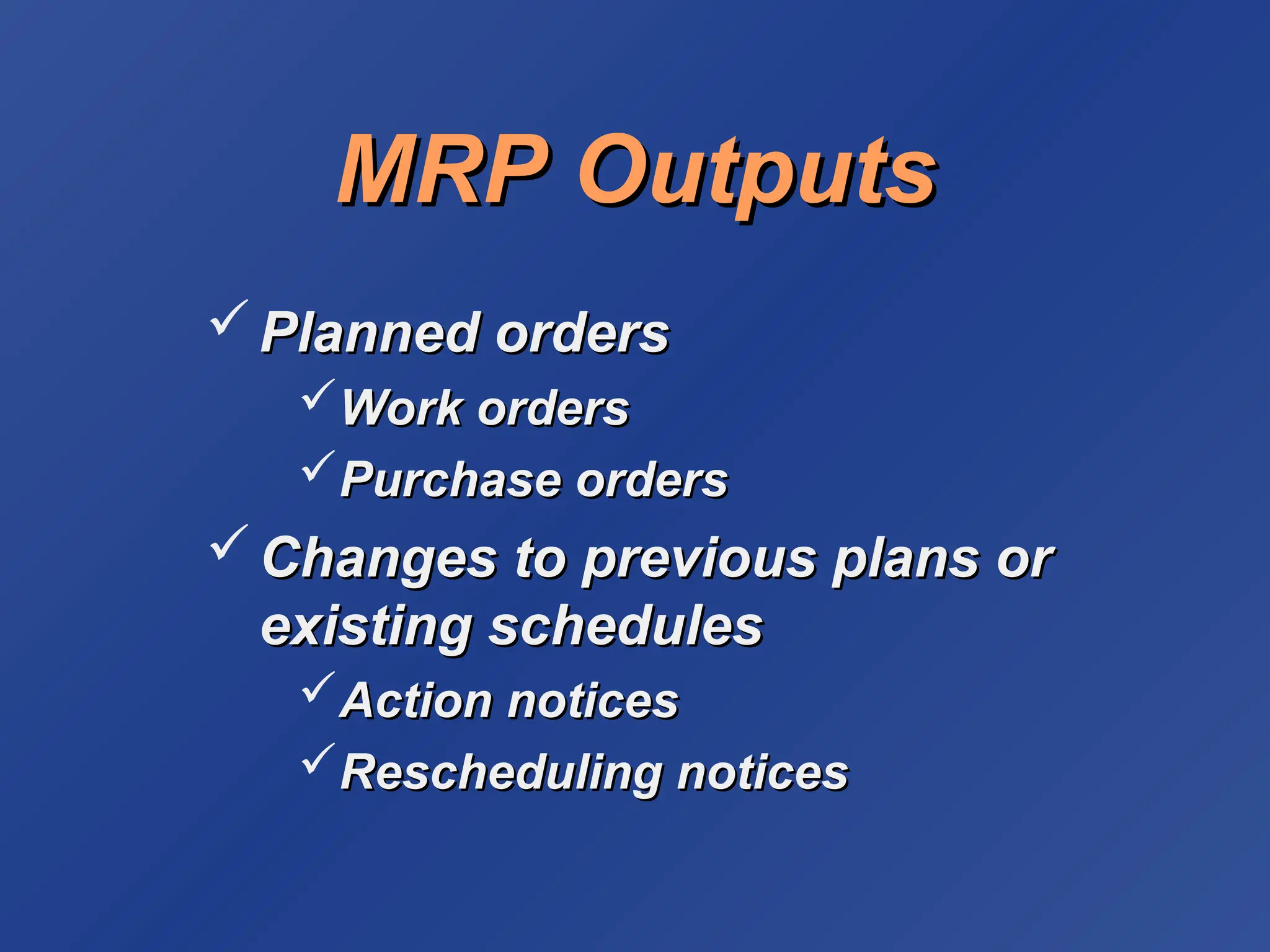
MRP Outputs
MRP Outputs
Planned orders
Planned orders
Work orders
Work orders
Purchase orders
Purchase orders
Changes to previous plans or
Changes to previous plans or
existing schedules
existing schedules
Action notices
Action notices
Rescheduling notices
Rescheduling notices
17.
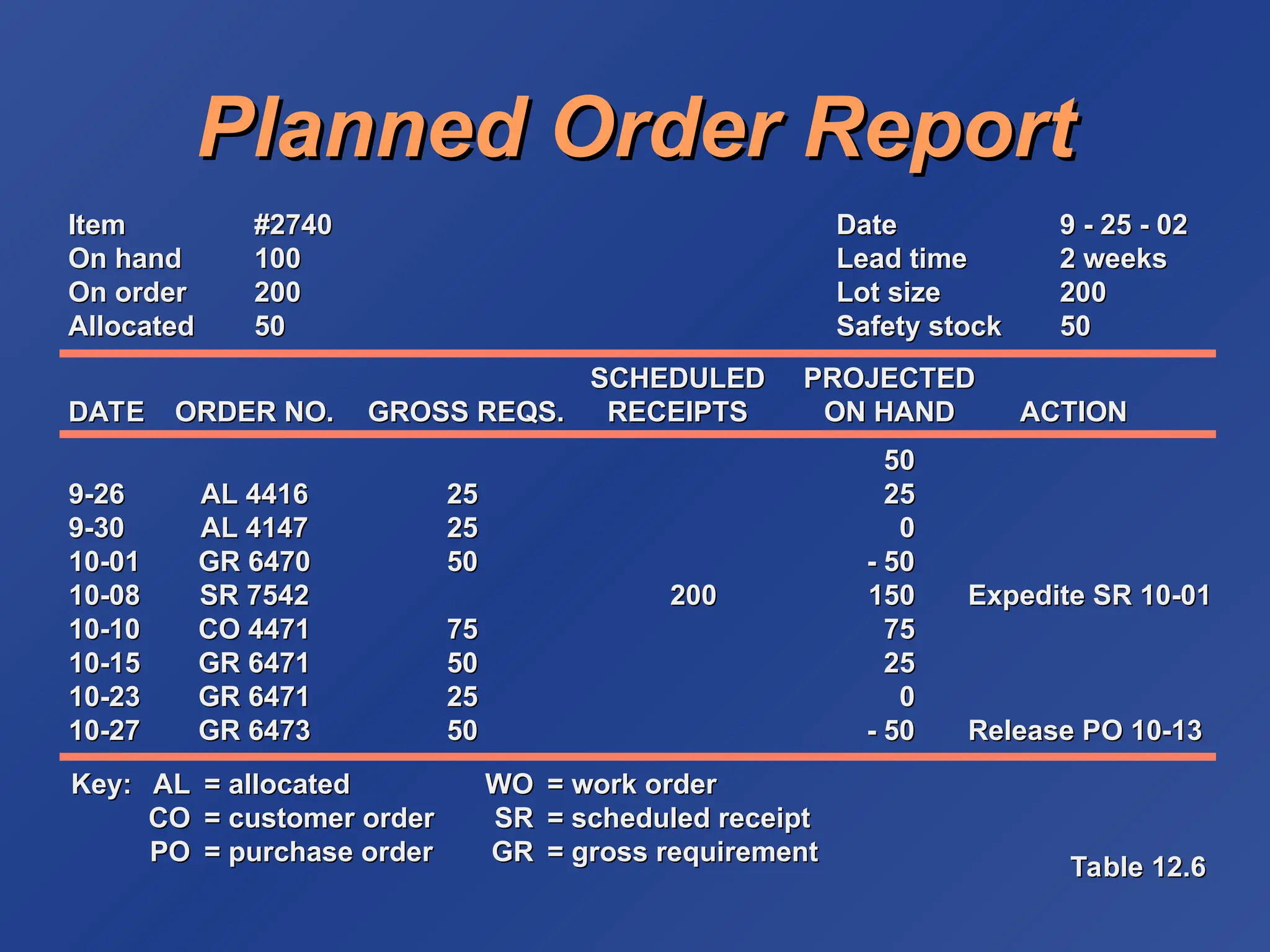
Planned Order Report
PlannedOrder Report
Table 12.6
Table 12.6
Item
Item #2740
#2740 Date
Date 9 - 25 - 02
9 - 25 - 02
On hand
On hand 100
100 Lead time
Lead time 2 weeks
2 weeks
On order
On order 200
200 Lot size
Lot size 200
200
Allocated
Allocated 50
50 Safety stock
Safety stock 50
50
SCHEDULED
SCHEDULED PROJECTED
PROJECTED
DATE
DATE ORDER NO.
ORDER NO. GROSS REQS.
GROSS REQS. RECEIPTS
RECEIPTS ON HAND
ON HAND ACTION
ACTION
50
50
9-26
9-26 AL 4416
AL 4416 25
25 25
25
9-30
9-30 AL 4147
AL 4147 25
25 0
0
10-01
10-01 GR 6470
GR 6470 50
50 - 50
- 50
10-08
10-08 SR 7542
SR 7542 200
200 150
150 Expedite SR 10-01
Expedite SR 10-01
10-10
10-10 CO 4471
CO 4471 75
75 75
75
10-15
10-15 GR 6471
GR 6471 50
50 25
25
10-23
10-23 GR 6471
GR 6471 25
25 0
0
10-27
10-27 GR 6473
GR 6473 50
50 - 50
- 50 Release PO 10-13
Release PO 10-13
Key:
Key: AL
AL = allocated
= allocated WO
WO = work order
= work order
CO
CO = customer order
= customer order SR
SR = scheduled receipt
= scheduled receipt
PO
PO = purchase order
= purchase order GR
GR = gross requirement
= gross requirement
18.
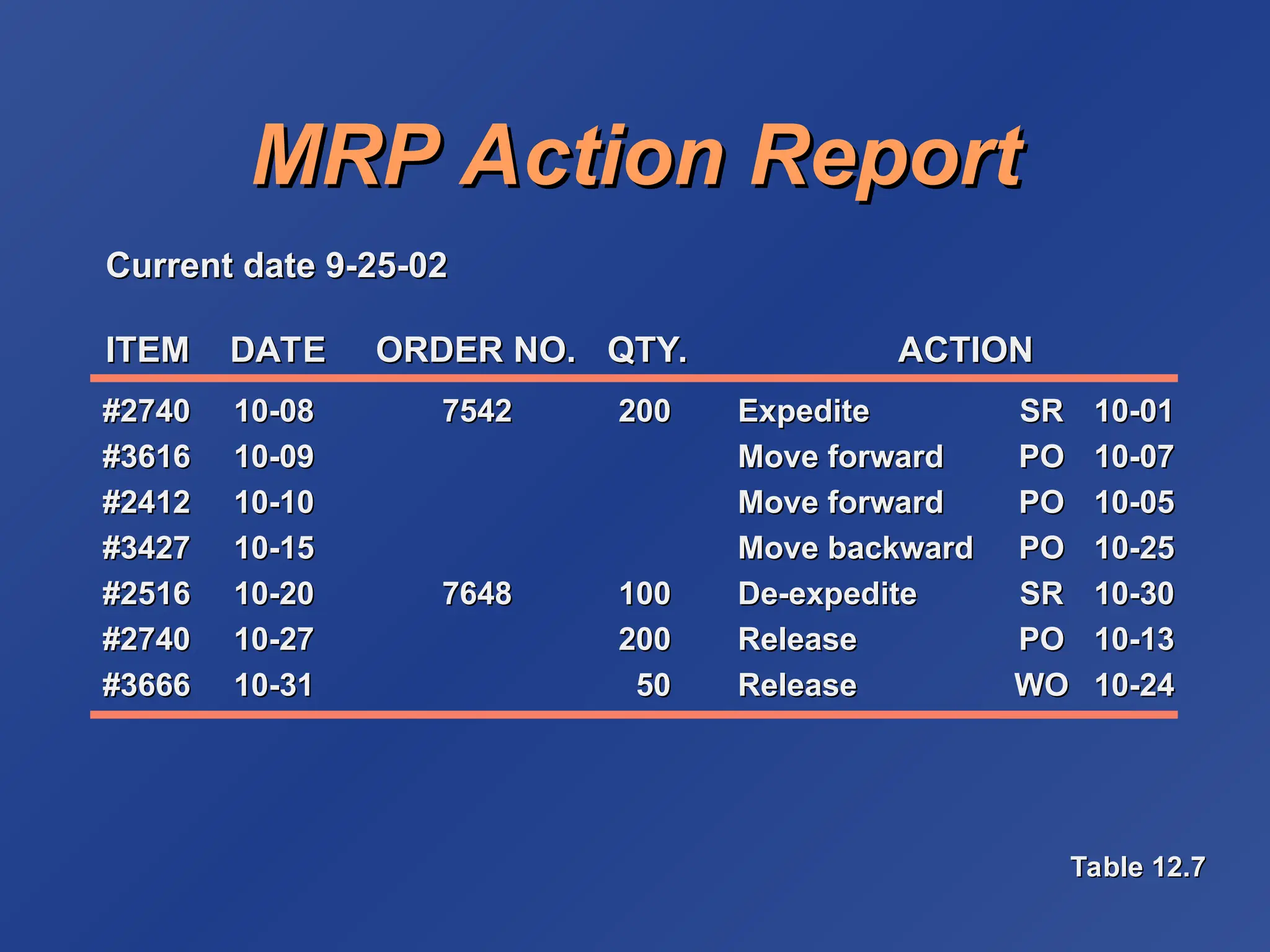
MRP Action Report
MRPAction Report
Table 12.7
Table 12.7
Current date 9-25-02
Current date 9-25-02
ITEM
ITEM DATE
DATE ORDER NO.
ORDER NO. QTY.
QTY. ACTION
ACTION
#2740
#2740 10-08
10-08 7542
7542 200
200 Expedite
Expedite SR
SR 10-01
10-01
#3616
#3616 10-09
10-09 Move forward
Move forward PO
PO 10-07
10-07
#2412
#2412 10-10
10-10 Move forward
Move forward PO
PO 10-05
10-05
#3427
#3427 10-15
10-15 Move backward
Move backward PO
PO 10-25
10-25
#2516
#2516 10-20
10-20 7648
7648 100
100 De-expedite
De-expedite SR
SR 10-30
10-30
#2740
#2740 10-27
10-27 200
200 Release
Release PO
PO 10-13
10-13
#3666
#3666 10-31
10-31 50
50 Release
Release WO
WO 10-24
10-24
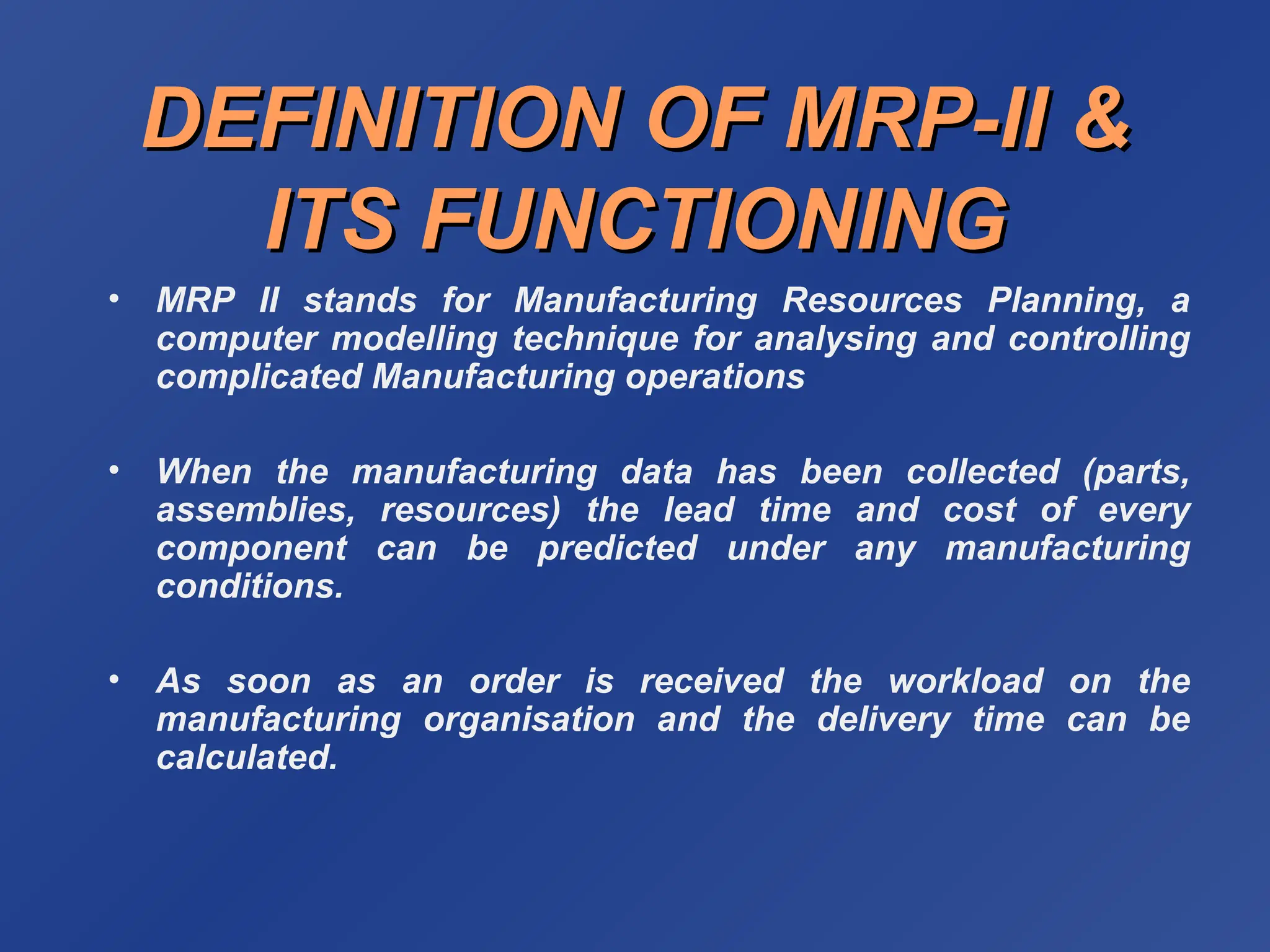
DEFINITION OF MRP-II&
DEFINITION OF MRP-II &
ITS FUNCTIONING
ITS FUNCTIONING
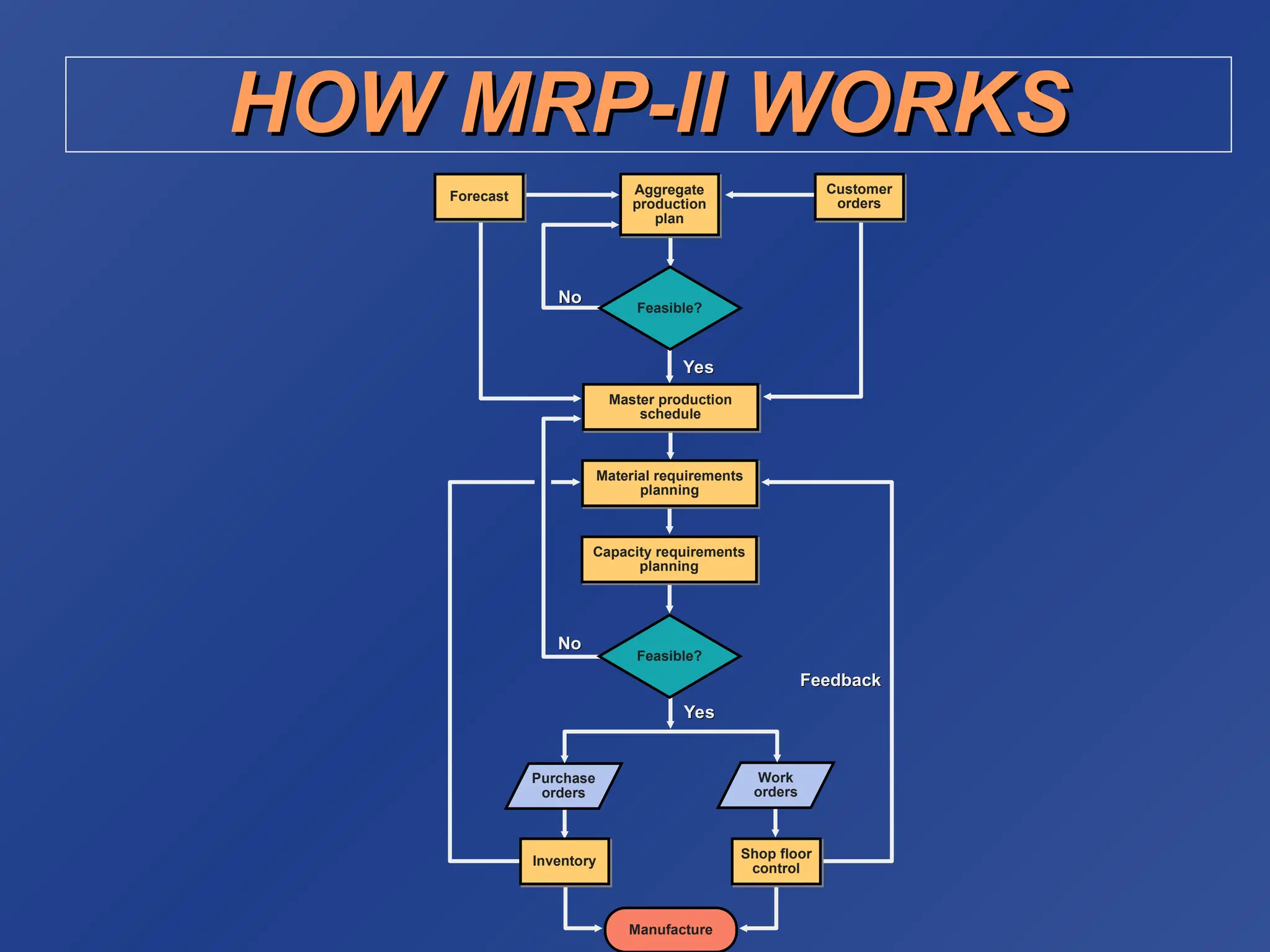
• MRP II stands for Manufacturing Resources Planning, a
computer modelling technique for analysing and controlling
complicated Manufacturing operations
• When the manufacturing data has been collected (parts,
assemblies, resources) the lead time and cost of every
component can be predicted under any manufacturing
conditions.
• As soon as an order is received the workload on the
manufacturing organisation and the delivery time can be
calculated.
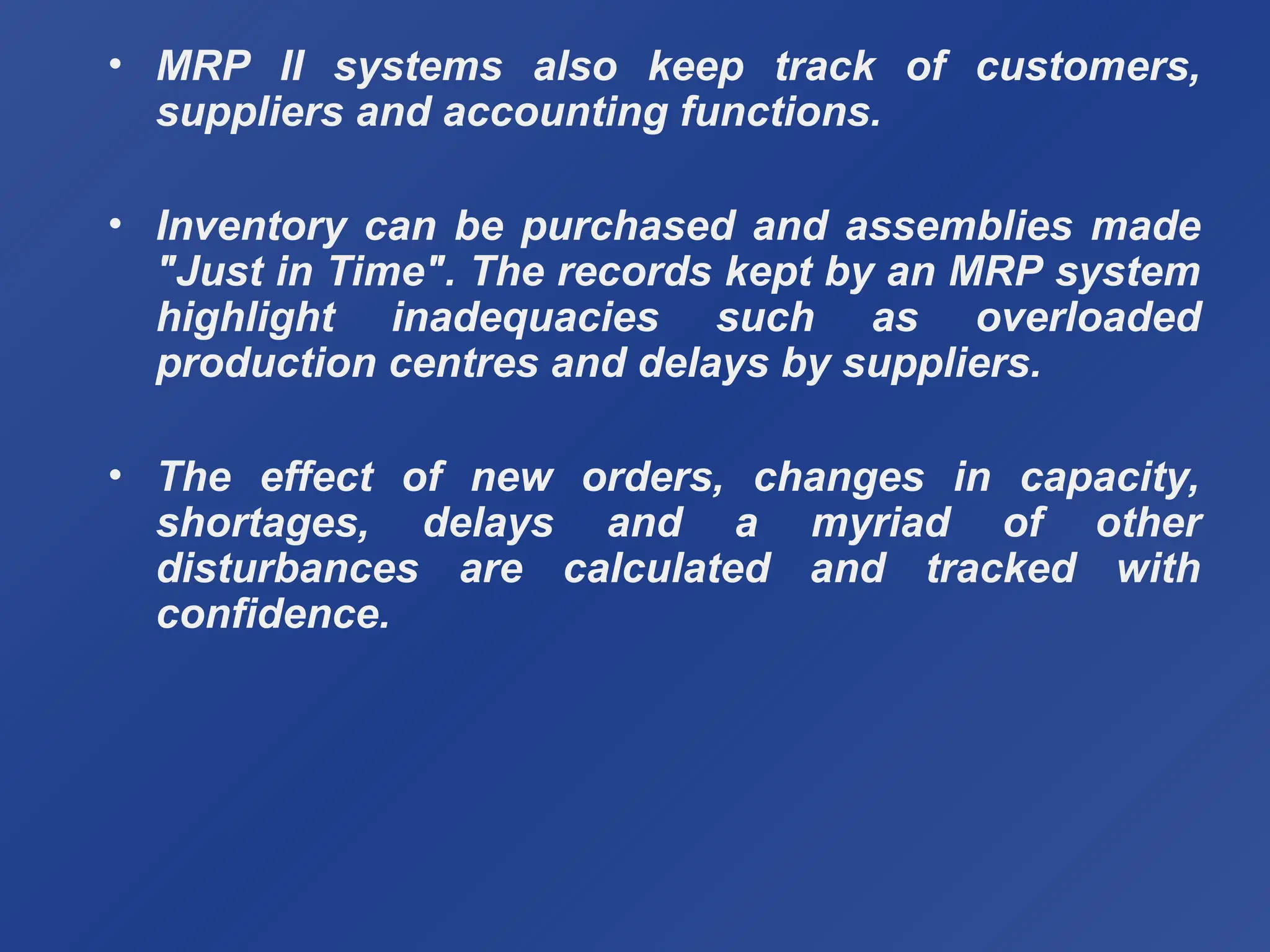
21.
• MRP IIsystems also keep track of customers,
suppliers and accounting functions.
• Inventory can be purchased and assemblies made
"Just in Time". The records kept by an MRP system
highlight inadequacies such as overloaded
production centres and delays by suppliers.
• The effect of new orders, changes in capacity,
shortages, delays and a myriad of other
disturbances are calculated and tracked with
confidence.
22.
HOW MRP-II WORKS
HOWMRP-II WORKS
Forecast Aggregate
production
plan
Customer
orders
Feasible?
Master production
schedule
Material requirements
planning
Capacity requirements
planning
Feasible?
Purchase
orders
Work
orders
Inventory
Shop floor
control
Manufacture
No
No
Yes
Yes
Feedback
Feedback
No
No
Yes
Yes
23.
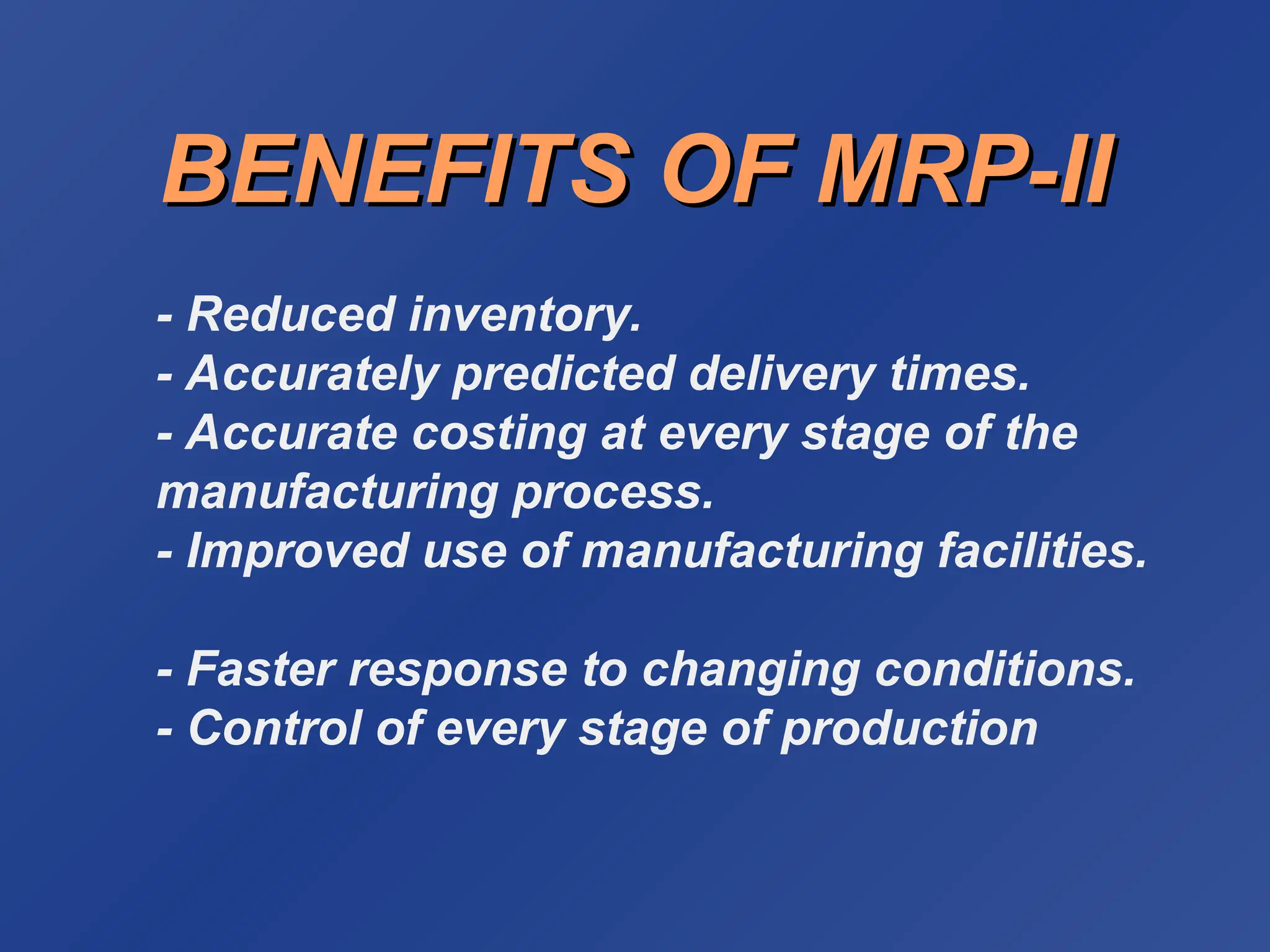
BENEFITS OF MRP-II
BENEFITSOF MRP-II
- Reduced inventory.
- Accurately predicted delivery times.
- Accurate costing at every stage of the
manufacturing process.
- Improved use of manufacturing facilities.
- Faster response to changing conditions.
- Control of every stage of production