Chapter 5, Section 6:
Probability & Odds
Some Definitions to Keep in
Mind
• OUTCOMES…are the possible results of
an action.
• an EVENT is any outcome OR group of
outcomes.
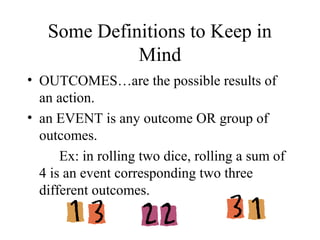
Ex: in rolling two dice, rolling a sum of
4 is an event corresponding two three
different outcomes.
Randomness
• If its random,
if you can’t predict what is going to
happen out of all of the possible
outcomes,
then any outcome is
EQUALLY LIKELY to occur.
Probability of an Event
• When outcomes are equally likely, you can
use a RATIO to find the PROBABILITY
OF AN EVENT.
• Probability of an Event = P(event) =
Number of favorable outcomes/number of
possible outcomes
Here is an Example:
• Find P(rolling an even number) with one
dice.
1st
: how many favorable out comes are there?
2nd
: how many possible outcomes?
3rd
: make a ratio.
P(rolling an even number) = 3/6 or ½.
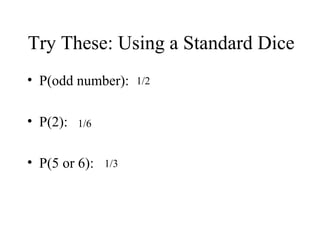
Try These: Using a Standard Dice
• P(odd number):
• P(2):
• P(5 or 6):
1/2
1/6
1/3
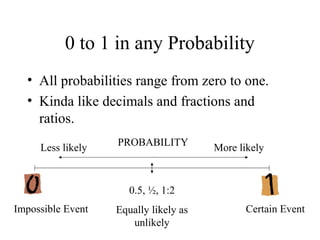
0 to 1 in any Probability
• All probabilities range from zero to one.
• Kinda like decimals and fractions and
ratios.
PROBABILITY
0.5, ½, 1:2
Equally likely as
unlikely
More likelyLess likely
Certain EventImpossible Event
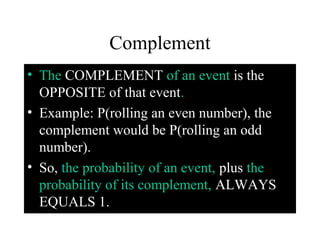
Complement
• The COMPLEMENT of an event is the
OPPOSITE of that event.
• Example: P(rolling an even number), the
complement would be P(rolling an odd
number).
• So, the probability of an event, plus the
probability of its complement, ALWAYS
EQUALS 1.
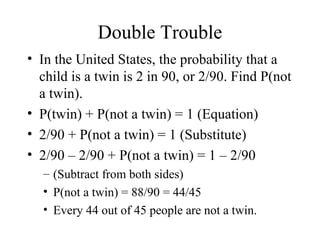
Double Trouble
• In the United States, the probability that a
child is a twin is 2 in 90, or 2/90. Find P(not
a twin).
• P(twin) + P(not a twin) = 1 (Equation)
• 2/90 + P(not a twin) = 1 (Substitute)
• 2/90 – 2/90 + P(not a twin) = 1 – 2/90
– (Subtract from both sides)
• P(not a twin) = 88/90 = 44/45
• Every 44 out of 45 people are not a twin.
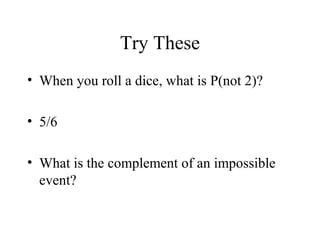
Try These
• When you roll a dice, what is P(not 2)?
• 5/6
• What is the complement of an impossible
event?
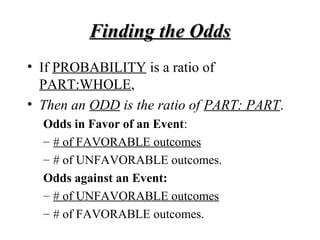
Finding the OddsFinding the Odds
• If PROBABILITY is a ratio of
PART:WHOLE,
• Then an ODD is the ratio of PART: PART.
Odds in Favor of an Event:
– # of FAVORABLE outcomes
– # of UNFAVORABLE outcomes.
Odds against an Event:
– # of UNFAVORABLE outcomes
– # of FAVORABLE outcomes.
Lets Try These
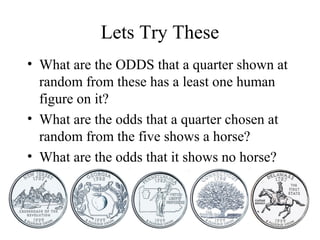
• What are the ODDS that a quarter shown at
random from these has a least one human
figure on it?
• What are the odds that a quarter chosen at
random from the five shows a horse?
• What are the odds that it shows no horse?
And This One
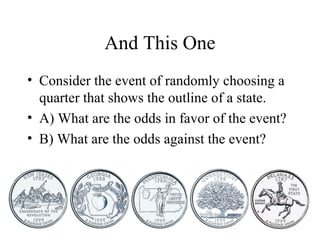
• Consider the event of randomly choosing a
quarter that shows the outline of a state.
• A) What are the odds in favor of the event?
• B) What are the odds against the event?

5 6 probability and odds lesson

  • 1.
    Chapter 5, Section6: Probability & Odds
  • 2.
    Some Definitions toKeep in Mind • OUTCOMES…are the possible results of an action. • an EVENT is any outcome OR group of outcomes. Ex: in rolling two dice, rolling a sum of 4 is an event corresponding two three different outcomes.
  • 3.
    Randomness • If itsrandom, if you can’t predict what is going to happen out of all of the possible outcomes, then any outcome is EQUALLY LIKELY to occur.
  • 4.
    Probability of anEvent • When outcomes are equally likely, you can use a RATIO to find the PROBABILITY OF AN EVENT. • Probability of an Event = P(event) = Number of favorable outcomes/number of possible outcomes
  • 5.
    Here is anExample: • Find P(rolling an even number) with one dice. 1st : how many favorable out comes are there? 2nd : how many possible outcomes? 3rd : make a ratio. P(rolling an even number) = 3/6 or ½.
  • 6.
    Try These: Usinga Standard Dice • P(odd number): • P(2): • P(5 or 6): 1/2 1/6 1/3
  • 7.
    0 to 1in any Probability • All probabilities range from zero to one. • Kinda like decimals and fractions and ratios. PROBABILITY 0.5, ½, 1:2 Equally likely as unlikely More likelyLess likely Certain EventImpossible Event
  • 8.
    Complement • The COMPLEMENTof an event is the OPPOSITE of that event. • Example: P(rolling an even number), the complement would be P(rolling an odd number). • So, the probability of an event, plus the probability of its complement, ALWAYS EQUALS 1.
  • 9.
    Double Trouble • Inthe United States, the probability that a child is a twin is 2 in 90, or 2/90. Find P(not a twin). • P(twin) + P(not a twin) = 1 (Equation) • 2/90 + P(not a twin) = 1 (Substitute) • 2/90 – 2/90 + P(not a twin) = 1 – 2/90 – (Subtract from both sides) • P(not a twin) = 88/90 = 44/45 • Every 44 out of 45 people are not a twin.
  • 10.
    Try These • Whenyou roll a dice, what is P(not 2)? • 5/6 • What is the complement of an impossible event?
  • 11.
    Finding the OddsFindingthe Odds • If PROBABILITY is a ratio of PART:WHOLE, • Then an ODD is the ratio of PART: PART. Odds in Favor of an Event: – # of FAVORABLE outcomes – # of UNFAVORABLE outcomes. Odds against an Event: – # of UNFAVORABLE outcomes – # of FAVORABLE outcomes.
  • 12.
    Lets Try These •What are the ODDS that a quarter shown at random from these has a least one human figure on it? • What are the odds that a quarter chosen at random from the five shows a horse? • What are the odds that it shows no horse?
  • 13.
    And This One •Consider the event of randomly choosing a quarter that shows the outline of a state. • A) What are the odds in favor of the event? • B) What are the odds against the event?