PROBABILITY
DEFINITIONS
 Experiment: When a trial is conducted to obtain some
statistical information.
 Ex: Tossing of a fair coin
 Ex: Rolling of a die
 Event: The possible outcomes of a trial, denoted by capital
letters A,B,C etc.
 Ex: In tossing of a coin, the outcomes – head or tail are
events.
 Equally Likely Events: The events are said to be equally
likely if the chance of happening of each event is equal or
same.
 Ex: In tossing of a coin, the events H or T are equally likely. 2
BirinderSingh,AssistantProfessor,PCTE
Ludhiana
DEFINITIONS
 Favorable Events: The event which we are considering
for study.
 Ex: Getting a head in case of tossing a coin
 Ex: Getting a 6 in case of rolling a die
 Sample Space: The total number of possible outcomes
taken together. These are also called exhaustive events.
 Ex: The set of H,T in tossing a coin
 Ex: The set of 1,2,3,4,5,6 in rolling a die
3
BirinderSingh,AssistantProfessor,PCTE
Ludhiana
DEFINITIONS
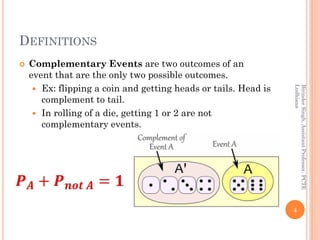
 Complementary Events are two outcomes of an
event that are the only two possible outcomes.
 Ex: flipping a coin and getting heads or tails. Head is
complement to tail.
 In rolling of a die, getting 1 or 2 are not
complementary events.
4
BirinderSingh,AssistantProfessor,PCTE
Ludhiana
DEFINITIONS
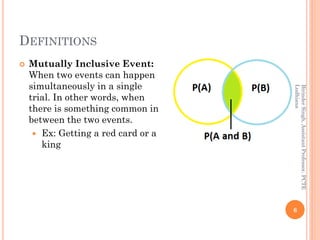
 Mutually Exclusive Event:
When two events can’t
happen simultaneously in a
single trial. In other words,
when the happening of one
excludes the happening of
other.
 Ex: In tossing of a coin,
events head and tail are
MEE.
5
BirinderSingh,AssistantProfessor,PCTE
Ludhiana
DEFINITIONS
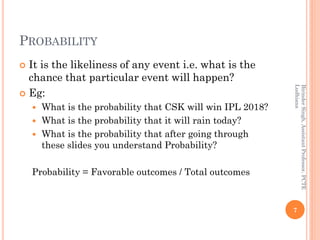
 Mutually Inclusive Event:
When two events can happen
simultaneously in a single
trial. In other words, when
there is something common in
between the two events.
 Ex: Getting a red card or a
king
6
BirinderSingh,AssistantProfessor,PCTE
Ludhiana
PROBABILITY
 It is the likeliness of any event i.e. what is the
chance that particular event will happen?
 Eg:
 What is the probability that CSK will win IPL 2018?
 What is the probability that it will rain today?
 What is the probability that after going through
these slides you understand Probability?
Probability = Favorable outcomes / Total outcomes
7
BirinderSingh,AssistantProfessor,PCTE
Ludhiana
PRACTICE PROBLEMS
Q1: In case of rolling a die, what is the probability
of getting:
a) an even number
b) prime number
c) not even number
d) Number greater than 4
Q2: In a lottery, there are 10 prizes and 90 blanks.
If a person holds one ticket
a) an even number
b) prime number
c) not even number
8
BirinderSingh,AssistantProfessor,PCTE
Ludhiana
PRACTICE PROBLEMS
Q3: In case of drawing a card, what is the
probability of getting:
a) an ace
b) Red card
c) Face card
d) Black king
Q4: What is the probability that a non leap year
selected at random will contain 53 Sundays?
Q5: What is the probability that a leap year
selected at random will contain 53 Sundays? 9
BirinderSingh,AssistantProfessor,PCTE
Ludhiana
PRACTICE PROBLEMS
Q6: Two dice are thrown, what is the probability of
getting:
a) Sum of 11
b) Sum of 10
10
BirinderSingh,AssistantProfessor,PCTE
Ludhiana
THEOREMS OF PROBABILITY
 Addition Theorem (For Mutually Exclusive & not
Mutually Exclusive)
 Multiplication Theorem (For Independent Events
& Dependent Events)
11
BirinderSingh,AssistantProfessor,PCTE
Ludhiana
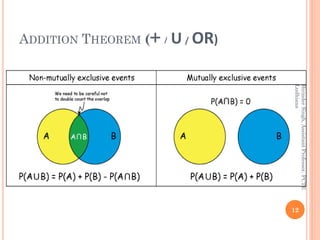
ADDITION THEOREM (+ / U / OR)
12
BirinderSingh,AssistantProfessor,PCTE
Ludhiana
PRACTICE PROBLEMS
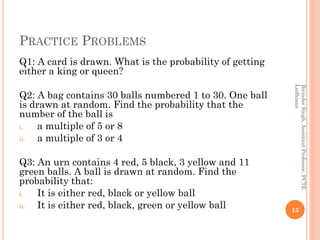
Q1: A card is drawn. What is the probability of getting
either a king or queen?
Q2: A bag contains 30 balls numbered 1 to 30. One ball
is drawn at random. Find the probability that the
number of the ball is
i. a multiple of 5 or 8
ii. a multiple of 3 or 4
Q3: An urn contains 4 red, 5 black, 3 yellow and 11
green balls. A ball is drawn at random. Find the
probability that:
i. It is either red, black or yellow ball
ii. It is either red, black, green or yellow ball 13
BirinderSingh,AssistantProfessor,PCTE
Ludhiana
PRACTICE PROBLEMS
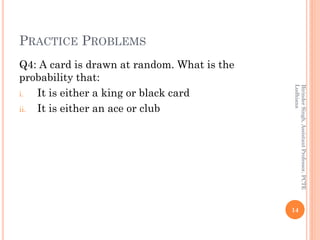
Q4: A card is drawn at random. What is the
probability that:
i. It is either a king or black card
ii. It is either an ace or club
14
BirinderSingh,AssistantProfessor,PCTE
Ludhiana
DEFINITIONS
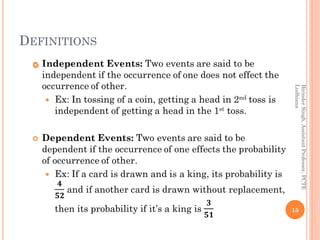

15
BirinderSingh,AssistantProfessor,PCTE
Ludhiana
MULTIPLICATION THEOREM (X / ∩/ AND)
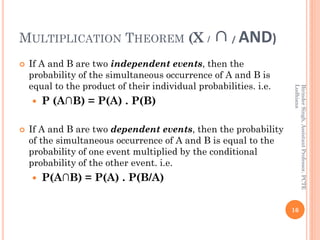
 If A and B are two independent events, then the
probability of the simultaneous occurrence of A and B is
equal to the product of their individual probabilities. i.e.
 P (A∩B) = P(A) . P(B)
 If A and B are two dependent events, then the probability
of the simultaneous occurrence of A and B is equal to the
probability of one event multiplied by the conditional
probability of the other event. i.e.
 P(A∩B) = P(A) . P(B/A)
16
BirinderSingh,AssistantProfessor,PCTE
Ludhiana
PRACTICE PROBLEMS
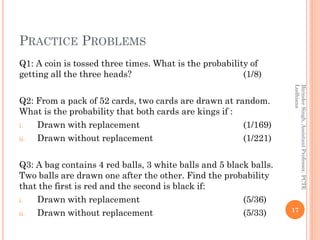
Q1: A coin is tossed three times. What is the probability of
getting all the three heads? (1/8)
Q2: From a pack of 52 cards, two cards are drawn at random.
What is the probability that both cards are kings if :
i. Drawn with replacement (1/169)
ii. Drawn without replacement (1/221)
Q3: A bag contains 4 red balls, 3 white balls and 5 black balls.
Two balls are drawn one after the other. Find the probability
that the first is red and the second is black if:
i. Drawn with replacement (5/36)
ii. Drawn without replacement (5/33) 17
BirinderSingh,AssistantProfessor,PCTE
Ludhiana
PRACTICE PROBLEMS
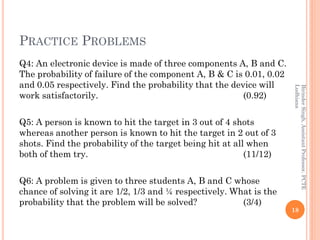
Q4: An electronic device is made of three components A, B and C.
The probability of failure of the component A, B & C is 0.01, 0.02
and 0.05 respectively. Find the probability that the device will
work satisfactorily. (0.92)
Q5: A person is known to hit the target in 3 out of 4 shots
whereas another person is known to hit the target in 2 out of 3
shots. Find the probability of the target being hit at all when
both of them try. (11/12)
Q6: A problem is given to three students A, B and C whose
chance of solving it are 1/2, 1/3 and ¼ respectively. What is the
probability that the problem will be solved? (3/4)
18
BirinderSingh,AssistantProfessor,PCTE
Ludhiana
PRACTICE PROBLEMS
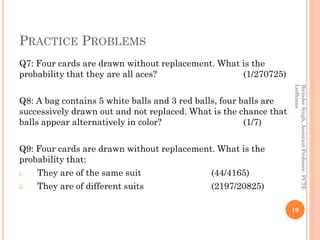
Q7: Four cards are drawn without replacement. What is the
probability that they are all aces? (1/270725)
Q8: A bag contains 5 white balls and 3 red balls, four balls are
successively drawn out and not replaced. What is the chance that
balls appear alternatively in color? (1/7)
Q9: Four cards are drawn without replacement. What is the
probability that:
i. They are of the same suit (44/4165)
ii. They are of different suits (2197/20825)
19
BirinderSingh,AssistantProfessor,PCTE
Ludhiana
PRACTICE PROBLEMS
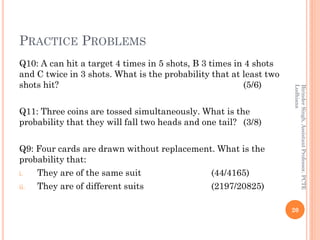
Q10: A can hit a target 4 times in 5 shots, B 3 times in 4 shots
and C twice in 3 shots. What is the probability that at least two
shots hit? (5/6)
Q11: Three coins are tossed simultaneously. What is the
probability that they will fall two heads and one tail? (3/8)
Q9: Four cards are drawn without replacement. What is the
probability that:
i. They are of the same suit (44/4165)
ii. They are of different suits (2197/20825)
20
BirinderSingh,AssistantProfessor,PCTE
Ludhiana
PRACTICE PROBLEMS – BAYES’ THEOREM
 An insurance company insured 2000 scooter drivers, 4000 car
drivers and 6000 truck drivers. The probability of an accident
involving a scooter, a car and a truck are 0.01, 0.03 and 0.15
respectively. One of the insured persons meets with an accident.
What is the probability that he is a scooter driver? (1/52)
 A factory has two machines A and B. Past record shows that
machine A produced 60% of the items of output and machine B
produced 40% of the items. Further, 2% of the items produced by
machine A and 1% produced by machine B were defective. All
the items are put into one stockpile and then one item is chosen
at random from this and is found to be defective. What is the
probability that it was produced by machine B? (1/4)
21
BirinderSingh,AssistantProfessor,PCTE
Ludhiana
 A coin is tossed three times, consider the following
events. A: ‘No head appears’, B: ‘Exactly one head
appears’ and C: ‘Atleast two heads appear’. Find their
probabilities.
 One card is drawn from a well shuffled deck of 52
cards. If each outcome is equally likely, calculate the
probability that the card will be
(i) a diamond (ii) not an ace (iii) a black card (iv) not a
diamond (v) not a black card.
 A bag contains 9 discs of which 4 are red, 3 are blue
and 2 are yellow. The discs are similar in shape and
size. A disc is drawn at random from the bag.
Calculate the probability that it will be (i) red, (ii)
yellow, (iii) blue, (iv) not blue, (v) either red or yellow.
22
BirinderSingh,AssistantProfessor,PCTE
Ludhiana
 Two students Anil and Ashima appeared in an
examination. The probability that Anil will
qualify the examination is 0.05 and that Ashima
will qualify the examination is 0.10. The
probability that both will qualify the examination
is 0.02. Find the probability that
(a) Both Anil and Ashima will not qualify the
examination.
(b) Atleast one of them will not qualify the
examination and
(c) Only one of them will qualify the
examination. 23
BirinderSingh,AssistantProfessor,PCTE
Ludhiana
 A letter is chosen at random from the word
‘ASSASSINATION’. Find the probability that
letter is (i) a vowel (ii) a consonant
 Find the probability that when a hand of 7 cards
is drawn from a well shuffled deck of 52 cards, it
contains (i) all Kings (ii) 3 Kings (iii) atleast 3
Kings.
24
BirinderSingh,AssistantProfessor,PCTE
Ludhiana

Probability - I

  • 1.
  • 2.
    DEFINITIONS  Experiment: Whena trial is conducted to obtain some statistical information.  Ex: Tossing of a fair coin  Ex: Rolling of a die  Event: The possible outcomes of a trial, denoted by capital letters A,B,C etc.  Ex: In tossing of a coin, the outcomes – head or tail are events.  Equally Likely Events: The events are said to be equally likely if the chance of happening of each event is equal or same.  Ex: In tossing of a coin, the events H or T are equally likely. 2 BirinderSingh,AssistantProfessor,PCTE Ludhiana
  • 3.
    DEFINITIONS  Favorable Events:The event which we are considering for study.  Ex: Getting a head in case of tossing a coin  Ex: Getting a 6 in case of rolling a die  Sample Space: The total number of possible outcomes taken together. These are also called exhaustive events.  Ex: The set of H,T in tossing a coin  Ex: The set of 1,2,3,4,5,6 in rolling a die 3 BirinderSingh,AssistantProfessor,PCTE Ludhiana
  • 4.
    DEFINITIONS  Complementary Eventsare two outcomes of an event that are the only two possible outcomes.  Ex: flipping a coin and getting heads or tails. Head is complement to tail.  In rolling of a die, getting 1 or 2 are not complementary events. 4 BirinderSingh,AssistantProfessor,PCTE Ludhiana
  • 5.
    DEFINITIONS  Mutually ExclusiveEvent: When two events can’t happen simultaneously in a single trial. In other words, when the happening of one excludes the happening of other.  Ex: In tossing of a coin, events head and tail are MEE. 5 BirinderSingh,AssistantProfessor,PCTE Ludhiana
  • 6.
    DEFINITIONS  Mutually InclusiveEvent: When two events can happen simultaneously in a single trial. In other words, when there is something common in between the two events.  Ex: Getting a red card or a king 6 BirinderSingh,AssistantProfessor,PCTE Ludhiana
  • 7.
    PROBABILITY  It isthe likeliness of any event i.e. what is the chance that particular event will happen?  Eg:  What is the probability that CSK will win IPL 2018?  What is the probability that it will rain today?  What is the probability that after going through these slides you understand Probability? Probability = Favorable outcomes / Total outcomes 7 BirinderSingh,AssistantProfessor,PCTE Ludhiana
  • 8.
    PRACTICE PROBLEMS Q1: Incase of rolling a die, what is the probability of getting: a) an even number b) prime number c) not even number d) Number greater than 4 Q2: In a lottery, there are 10 prizes and 90 blanks. If a person holds one ticket a) an even number b) prime number c) not even number 8 BirinderSingh,AssistantProfessor,PCTE Ludhiana
  • 9.
    PRACTICE PROBLEMS Q3: Incase of drawing a card, what is the probability of getting: a) an ace b) Red card c) Face card d) Black king Q4: What is the probability that a non leap year selected at random will contain 53 Sundays? Q5: What is the probability that a leap year selected at random will contain 53 Sundays? 9 BirinderSingh,AssistantProfessor,PCTE Ludhiana
  • 10.
    PRACTICE PROBLEMS Q6: Twodice are thrown, what is the probability of getting: a) Sum of 11 b) Sum of 10 10 BirinderSingh,AssistantProfessor,PCTE Ludhiana
  • 11.
    THEOREMS OF PROBABILITY Addition Theorem (For Mutually Exclusive & not Mutually Exclusive)  Multiplication Theorem (For Independent Events & Dependent Events) 11 BirinderSingh,AssistantProfessor,PCTE Ludhiana
  • 12.
    ADDITION THEOREM (+/ U / OR) 12 BirinderSingh,AssistantProfessor,PCTE Ludhiana
  • 13.
    PRACTICE PROBLEMS Q1: Acard is drawn. What is the probability of getting either a king or queen? Q2: A bag contains 30 balls numbered 1 to 30. One ball is drawn at random. Find the probability that the number of the ball is i. a multiple of 5 or 8 ii. a multiple of 3 or 4 Q3: An urn contains 4 red, 5 black, 3 yellow and 11 green balls. A ball is drawn at random. Find the probability that: i. It is either red, black or yellow ball ii. It is either red, black, green or yellow ball 13 BirinderSingh,AssistantProfessor,PCTE Ludhiana
  • 14.
    PRACTICE PROBLEMS Q4: Acard is drawn at random. What is the probability that: i. It is either a king or black card ii. It is either an ace or club 14 BirinderSingh,AssistantProfessor,PCTE Ludhiana
  • 15.
  • 16.
    MULTIPLICATION THEOREM (X/ ∩/ AND)  If A and B are two independent events, then the probability of the simultaneous occurrence of A and B is equal to the product of their individual probabilities. i.e.  P (A∩B) = P(A) . P(B)  If A and B are two dependent events, then the probability of the simultaneous occurrence of A and B is equal to the probability of one event multiplied by the conditional probability of the other event. i.e.  P(A∩B) = P(A) . P(B/A) 16 BirinderSingh,AssistantProfessor,PCTE Ludhiana
  • 17.
    PRACTICE PROBLEMS Q1: Acoin is tossed three times. What is the probability of getting all the three heads? (1/8) Q2: From a pack of 52 cards, two cards are drawn at random. What is the probability that both cards are kings if : i. Drawn with replacement (1/169) ii. Drawn without replacement (1/221) Q3: A bag contains 4 red balls, 3 white balls and 5 black balls. Two balls are drawn one after the other. Find the probability that the first is red and the second is black if: i. Drawn with replacement (5/36) ii. Drawn without replacement (5/33) 17 BirinderSingh,AssistantProfessor,PCTE Ludhiana
  • 18.
    PRACTICE PROBLEMS Q4: Anelectronic device is made of three components A, B and C. The probability of failure of the component A, B & C is 0.01, 0.02 and 0.05 respectively. Find the probability that the device will work satisfactorily. (0.92) Q5: A person is known to hit the target in 3 out of 4 shots whereas another person is known to hit the target in 2 out of 3 shots. Find the probability of the target being hit at all when both of them try. (11/12) Q6: A problem is given to three students A, B and C whose chance of solving it are 1/2, 1/3 and ¼ respectively. What is the probability that the problem will be solved? (3/4) 18 BirinderSingh,AssistantProfessor,PCTE Ludhiana
  • 19.
    PRACTICE PROBLEMS Q7: Fourcards are drawn without replacement. What is the probability that they are all aces? (1/270725) Q8: A bag contains 5 white balls and 3 red balls, four balls are successively drawn out and not replaced. What is the chance that balls appear alternatively in color? (1/7) Q9: Four cards are drawn without replacement. What is the probability that: i. They are of the same suit (44/4165) ii. They are of different suits (2197/20825) 19 BirinderSingh,AssistantProfessor,PCTE Ludhiana
  • 20.
    PRACTICE PROBLEMS Q10: Acan hit a target 4 times in 5 shots, B 3 times in 4 shots and C twice in 3 shots. What is the probability that at least two shots hit? (5/6) Q11: Three coins are tossed simultaneously. What is the probability that they will fall two heads and one tail? (3/8) Q9: Four cards are drawn without replacement. What is the probability that: i. They are of the same suit (44/4165) ii. They are of different suits (2197/20825) 20 BirinderSingh,AssistantProfessor,PCTE Ludhiana
  • 21.
    PRACTICE PROBLEMS –BAYES’ THEOREM  An insurance company insured 2000 scooter drivers, 4000 car drivers and 6000 truck drivers. The probability of an accident involving a scooter, a car and a truck are 0.01, 0.03 and 0.15 respectively. One of the insured persons meets with an accident. What is the probability that he is a scooter driver? (1/52)  A factory has two machines A and B. Past record shows that machine A produced 60% of the items of output and machine B produced 40% of the items. Further, 2% of the items produced by machine A and 1% produced by machine B were defective. All the items are put into one stockpile and then one item is chosen at random from this and is found to be defective. What is the probability that it was produced by machine B? (1/4) 21 BirinderSingh,AssistantProfessor,PCTE Ludhiana
  • 22.
     A coinis tossed three times, consider the following events. A: ‘No head appears’, B: ‘Exactly one head appears’ and C: ‘Atleast two heads appear’. Find their probabilities.  One card is drawn from a well shuffled deck of 52 cards. If each outcome is equally likely, calculate the probability that the card will be (i) a diamond (ii) not an ace (iii) a black card (iv) not a diamond (v) not a black card.  A bag contains 9 discs of which 4 are red, 3 are blue and 2 are yellow. The discs are similar in shape and size. A disc is drawn at random from the bag. Calculate the probability that it will be (i) red, (ii) yellow, (iii) blue, (iv) not blue, (v) either red or yellow. 22 BirinderSingh,AssistantProfessor,PCTE Ludhiana
  • 23.
     Two studentsAnil and Ashima appeared in an examination. The probability that Anil will qualify the examination is 0.05 and that Ashima will qualify the examination is 0.10. The probability that both will qualify the examination is 0.02. Find the probability that (a) Both Anil and Ashima will not qualify the examination. (b) Atleast one of them will not qualify the examination and (c) Only one of them will qualify the examination. 23 BirinderSingh,AssistantProfessor,PCTE Ludhiana
  • 24.
     A letteris chosen at random from the word ‘ASSASSINATION’. Find the probability that letter is (i) a vowel (ii) a consonant  Find the probability that when a hand of 7 cards is drawn from a well shuffled deck of 52 cards, it contains (i) all Kings (ii) 3 Kings (iii) atleast 3 Kings. 24 BirinderSingh,AssistantProfessor,PCTE Ludhiana