By: CHRISTINE P. YNOT
LNHS teacher
This lesson will help you:
• Analyze games and other practical probabilistic events through a
detailed and cooperative problem – solving
• Classify events as mutually exclusive or independent
• Describe probability according to its classification and event
relationships
RECALL
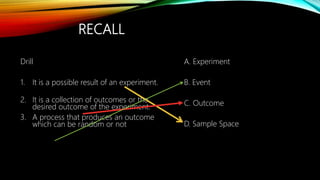
Drill
1. It is a possible result of an experiment.
2. It is a collection of outcomes or the
desired outcome of the experiment.
3. A process that produces an outcome
which can be random or not
A. Experiment
B. Event
C. Outcome
D. Sample Space
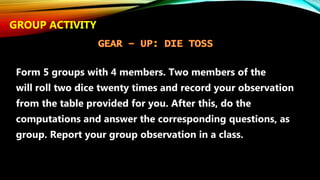
Form 5 groups with 4 members. Two members of the
will roll two dice twenty times and record your observation
from the table provided for you. After this, do the
computations and answer the corresponding questions, as
group. Report your group observation in a class.
GROUP ACTIVITY
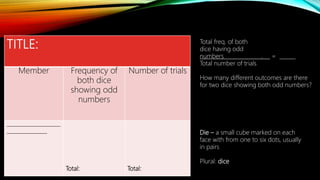
TITLE:
Member Frequency of
both dice
showing odd
numbers
Number of trials
____________________
_______________
Total: Total:
Total freq. of both
dice having odd
numbers . = ______
Total number of trials
How many different outcomes are there
for two dice showing both odd numbers?
Die – a small cube marked on each
face with from one to six dots, usually
in pairs
Plural: dice
How many different outcomes are there
for two dice rolled?
What is the quotient between these two
values?
Are these two quotient values nearly the
same? How can you relate these two
quotients?
REALIZATIONS…
1. There are uncertain situations and conditions in
life.
2. Situations can only be assumed and predicted
but CANNOT BE ASSURED.
WHAT IS PROBABILITY?
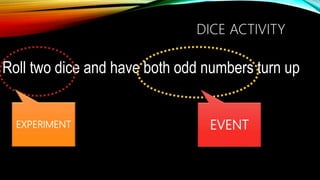
DICE ACTIVITY
Roll two dice and have both odd numbers turn up
EXPERIMENT EVENT
What activities in school or at home
involve uncertainty and randomness
What activities in
school or at home
involve uncertainty
and randomness?
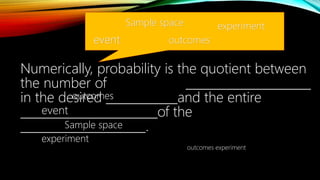
Numerically, probability is the quotient between
the number of _____________________
in the desired ____________and the entire
_______________________of the
_____________________.
outcomes experiment
outcomesevent
Sample space experiment
outcomes
event
experiment
Sample space
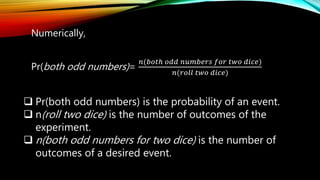
Numerically,
Pr(both odd numbers)=
𝑛(𝑏𝑜𝑡ℎ 𝑜𝑑𝑑 𝑛𝑢𝑚𝑏𝑒𝑟𝑠 𝑓𝑜𝑟 𝑡𝑤𝑜 𝑑𝑖𝑐𝑒)
𝑛(𝑟𝑜𝑙𝑙 𝑡𝑤𝑜 𝑑𝑖𝑐𝑒)
 Pr(both odd numbers) is the probability of an event.
 n(roll two dice) is the number of outcomes of the
experiment.
 n(both odd numbers for two dice) is the number of
outcomes of a desired event.
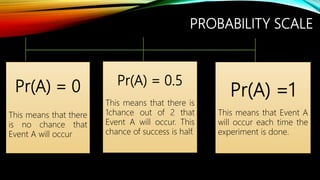
PROBABILITY SCALE
Pr(A) = 0
This means that there
is no chance that
Event A will occur
Pr(A) = 0.5
This means that there is
1chance out of 2 that
Event A will occur. This
chance of success is half.
Pr(A) =1
This means that Event A
will occur each time the
experiment is done.
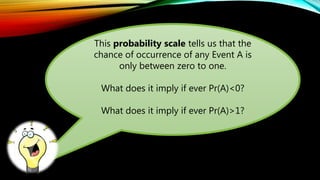
This probability scale tells us that the
chance of occurrence of any Event A is
only between zero to one.
What does it imply if ever Pr(A)<0?
What does it imply if ever Pr(A)>1?
PROBLEM SOLVING
PROBLEM SOLVING
Example 1:
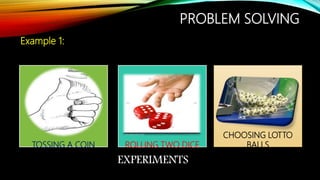
TOSSING A COIN ROLLING TWO DICE
CHOOSING LOTTO
BALLS
EXPERIMENTS
PROBLEM SOLVING
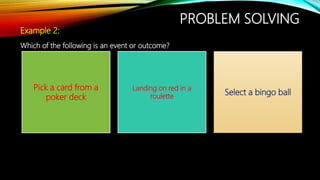
Example 2:
Which of the following is an event or outcome?
Pick a card from a
poker deck
Landing on red in a
roulette
Select a bingo ball
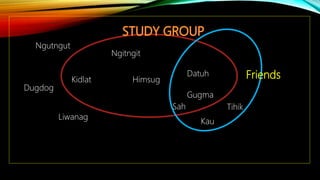
Example #3:
Your class is planning to have Kris Kringle on your
upcoming Christmas party with a theme of
something bright and happy.

Tihik
Kidlat
Dugdog
Ngitngit
Himsug
Liwanag
Datuh
Sah
Gugma
Friends
Ngutngut
Kau
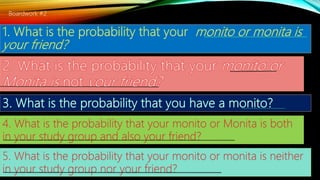
4. What is the probability that your monito or Monita is both
in your study group and also your friend?
5. What is the probability that your monito or monita is neither
in your study group nor your friend?
Boardwork #2
• 1. How can you differentiate intersection from union, in
terms of events?
• 2. How can you describe the illustration of mutually
exclusive events?
A. Manufactuing
B. MANAGEMENT
C. INSURANCE
Choose from this 3 situations wherein
determining the probability of an event is
important.
EXERCISES
DEPENDENT ASSESSEMENT:
10 – item SEATWORK
INDEPENDENT:
11 – item test
1. Probability of getting yellow.
2. Probability of getting 9.
3. Probability of getting even numbers.
4. Probability of getting odd numbers.
5. Probability of getting purple.
6. Probability of getting a no. less than 9 but greater than 7.
7. Probability of getting a negative number.
8. Probability of getting numbers greater than 0 but less than 9.
9. Probability of getting light blue.
10.Probability of getting primary colors.
SEATWORK
(10 MINUTES)
Checking…
15 – MINUTE TEST
11 – ITEM TEST
Refer to the hand – outs)
ASSIGNMENT
•Pierre de Fermat is one of the Pioneers in the
study of modern probability theory. Even if he was
a lawyer by profession, he had enormous
contribution in the field of the probability. Write a
biographical journal about him and focus on his
attitudes that will help you to be a better student.
By: CHRISTINE P. YNOT
What is the probability that you monito or Monita is your friend?

Introduction to probability

  • 1.
    By: CHRISTINE P.YNOT LNHS teacher
  • 2.
    This lesson willhelp you: • Analyze games and other practical probabilistic events through a detailed and cooperative problem – solving • Classify events as mutually exclusive or independent • Describe probability according to its classification and event relationships
  • 3.
    RECALL Drill 1. It isa possible result of an experiment. 2. It is a collection of outcomes or the desired outcome of the experiment. 3. A process that produces an outcome which can be random or not A. Experiment B. Event C. Outcome D. Sample Space
  • 4.
    Form 5 groupswith 4 members. Two members of the will roll two dice twenty times and record your observation from the table provided for you. After this, do the computations and answer the corresponding questions, as group. Report your group observation in a class. GROUP ACTIVITY
  • 5.
    TITLE: Member Frequency of bothdice showing odd numbers Number of trials ____________________ _______________ Total: Total: Total freq. of both dice having odd numbers . = ______ Total number of trials How many different outcomes are there for two dice showing both odd numbers? Die – a small cube marked on each face with from one to six dots, usually in pairs Plural: dice
  • 6.
    How many differentoutcomes are there for two dice rolled? What is the quotient between these two values?
  • 7.
    Are these twoquotient values nearly the same? How can you relate these two quotients?
  • 8.
    REALIZATIONS… 1. There areuncertain situations and conditions in life. 2. Situations can only be assumed and predicted but CANNOT BE ASSURED.
  • 9.
  • 10.
    DICE ACTIVITY Roll twodice and have both odd numbers turn up EXPERIMENT EVENT
  • 11.
    What activities inschool or at home involve uncertainty and randomness
  • 12.
    What activities in schoolor at home involve uncertainty and randomness?
  • 13.
    Numerically, probability isthe quotient between the number of _____________________ in the desired ____________and the entire _______________________of the _____________________. outcomes experiment outcomesevent Sample space experiment outcomes event experiment Sample space
  • 14.
    Numerically, Pr(both odd numbers)= 𝑛(𝑏𝑜𝑡ℎ𝑜𝑑𝑑 𝑛𝑢𝑚𝑏𝑒𝑟𝑠 𝑓𝑜𝑟 𝑡𝑤𝑜 𝑑𝑖𝑐𝑒) 𝑛(𝑟𝑜𝑙𝑙 𝑡𝑤𝑜 𝑑𝑖𝑐𝑒)  Pr(both odd numbers) is the probability of an event.  n(roll two dice) is the number of outcomes of the experiment.  n(both odd numbers for two dice) is the number of outcomes of a desired event.
  • 15.
    PROBABILITY SCALE Pr(A) =0 This means that there is no chance that Event A will occur Pr(A) = 0.5 This means that there is 1chance out of 2 that Event A will occur. This chance of success is half. Pr(A) =1 This means that Event A will occur each time the experiment is done.
  • 16.
    This probability scaletells us that the chance of occurrence of any Event A is only between zero to one. What does it imply if ever Pr(A)<0? What does it imply if ever Pr(A)>1?
  • 17.
  • 18.
    PROBLEM SOLVING Example 1: TOSSINGA COIN ROLLING TWO DICE CHOOSING LOTTO BALLS EXPERIMENTS
  • 19.
    PROBLEM SOLVING Example 2: Whichof the following is an event or outcome? Pick a card from a poker deck Landing on red in a roulette Select a bingo ball
  • 20.
    Example #3: Your classis planning to have Kris Kringle on your upcoming Christmas party with a theme of something bright and happy. 
  • 21.
  • 22.
    4. What isthe probability that your monito or Monita is both in your study group and also your friend? 5. What is the probability that your monito or monita is neither in your study group nor your friend? Boardwork #2
  • 23.
    • 1. Howcan you differentiate intersection from union, in terms of events? • 2. How can you describe the illustration of mutually exclusive events?
  • 24.
    A. Manufactuing B. MANAGEMENT C.INSURANCE Choose from this 3 situations wherein determining the probability of an event is important.
  • 25.
    EXERCISES DEPENDENT ASSESSEMENT: 10 –item SEATWORK INDEPENDENT: 11 – item test
  • 26.
    1. Probability ofgetting yellow. 2. Probability of getting 9. 3. Probability of getting even numbers. 4. Probability of getting odd numbers. 5. Probability of getting purple. 6. Probability of getting a no. less than 9 but greater than 7. 7. Probability of getting a negative number. 8. Probability of getting numbers greater than 0 but less than 9. 9. Probability of getting light blue. 10.Probability of getting primary colors. SEATWORK (10 MINUTES)
  • 27.
  • 28.
    15 – MINUTETEST 11 – ITEM TEST Refer to the hand – outs)
  • 29.
    ASSIGNMENT •Pierre de Fermatis one of the Pioneers in the study of modern probability theory. Even if he was a lawyer by profession, he had enormous contribution in the field of the probability. Write a biographical journal about him and focus on his attitudes that will help you to be a better student.
  • 30.
  • 33.
    What is theprobability that you monito or Monita is your friend?

Editor's Notes

  • #8 ARE YOU CERTAIN THAT YOU CAN GET ODD NUMBERS RIGHT AWAY?
  • #10 It is important in MANUFACTURING,MANAGEMENT, INSURANCE
  • #11 PRESENT ANOTHER 2 EXAMPLES FOR BOARDWORK
  • #14 Solve on the board Pr(both odd numbers)
  • #20 Can you specify an event or outcome from the first and third experiments here?
  • #21 VENN DIAGRAM
  • #22 From the the given digram, what is n(study group) are complementary events. Recall that the sum of complementary events will total outcome of the entire experiment.