Probability and Probability
Distributions
Probability
• Chance of observing a particular outcome
• Likelihood of an event
• Assumes a “stochastic” or “random”
process: i.e.. the outcome is not
predetermined - there is an element of
chance
• An outcome is a specific result of a single
trial of a probability experiment.
• Probability theory developed from the study
of games of chance like dice and cards.
• A process like flipping a coin, rolling a die or
drawing a card from a deck are probability
experiments.
Why Probability in Statistics?
• Results are not certain
• To evaluate how accurate our results are:
– Given how our data were collected, are our
results accurate ?
– Given the level of accuracy needed, how
many observations need to be collected ?
When can we talk about probability ?
• When dealing with a process that has an
uncertain outcome
• Experiment = any process with an uncertain
outcome
• When an experiment is performed, one and
only one outcome is obtained
• Event = something that may happen or not
when the experiment is performed
• An event either occurs or it does not occur
• Events are represented by uppercase
letters such as A, B, and C
• Probability of an Event E
= a number between 0 and 1 representing the
proportion of times that event E is expected to
happen when the experiment is done over and
over again under the same conditions
• Any event can be expressed as a subset
of the set of all possible outcomes (S)
S = set of all possible outcomes
P(S) = 1
Why Probability in Medicine?
• Because medicine is an inexact science,
physicians seldom predict an outcome with
absolute certainty.
• E.g., to formulate a diagnosis, a physician
must rely on available diagnostic information
about a patient
– History and physical examination
– Laboratory investigation, X-ray findings, ECG,
etc
• Although no test result is absolutely accurate, it
does affect the probability of the presence (or
absence) of a disease.
– Sensitivity and specificity
• An understanding of probability is fundamental
for quantifying the uncertainty that is inherent in
the decision-making process
• Probability theory is a foundation for
statistical inference, &
• Allows us to draw conclusions about a
population of patients based on
information obtained from a sample of
patients drawn from that population.
More importantly probability theory is used to
understand:
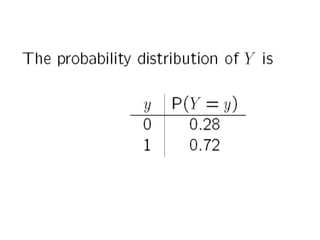
– About probability distributions: Binomial,
Poisson, and Normal Distributions
– Sampling and sampling distributions
– Estimation
– Hypothesis testing
– Advanced statistical analysis
Two Categories of Probability
• Objective and Subjective Probabilities.
• Objective probability
1) Classical probability and
2) Relative frequency probability.
Classical Probability
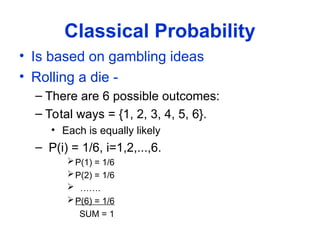
• Is based on gambling ideas
• Rolling a die -
– There are 6 possible outcomes:
– Total ways = {1, 2, 3, 4, 5, 6}.
• Each is equally likely
– P(i) = 1/6, i=1,2,...,6.
P(1) = 1/6
P(2) = 1/6
 …….
P(6) = 1/6
SUM = 1
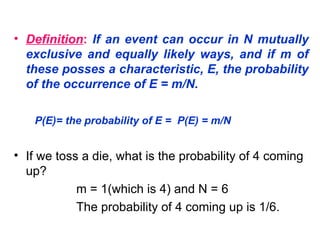
• Definition: If an event can occur in N mutually
exclusive and equally likely ways, and if m of
these posses a characteristic, E, the probability
of the occurrence of E = m/N.
P(E)= the probability of E = P(E) = m/N
• If we toss a die, what is the probability of 4 coming
up?
m = 1(which is 4) and N = 6
The probability of 4 coming up is 1/6.
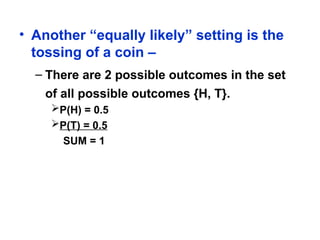
• Another “equally likely” setting is the
tossing of a coin –
– There are 2 possible outcomes in the set
of all possible outcomes {H, T}.
P(H) = 0.5
P(T) = 0.5
SUM = 1
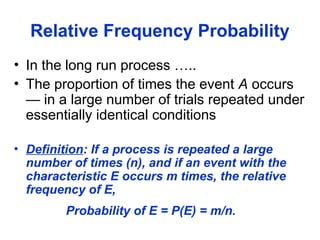
Relative Frequency Probability
• In the long run process …..
• The proportion of times the event A occurs
— in a large number of trials repeated under
essentially identical conditions
• Definition: If a process is repeated a large
number of times (n), and if an event with the
characteristic E occurs m times, the relative
frequency of E,
Probability of E = P(E) = m/n.
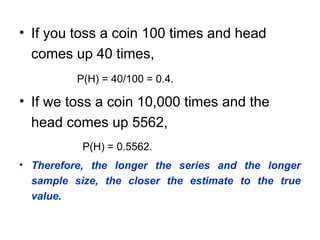
• If you toss a coin 100 times and head
comes up 40 times,
P(H) = 40/100 = 0.4.
• If we toss a coin 10,000 times and the
head comes up 5562,
P(H) = 0.5562.
• Therefore, the longer the series and the longer
sample size, the closer the estimate to the true
value.
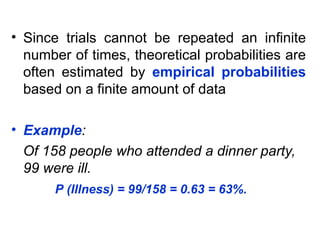
• Since trials cannot be repeated an infinite
number of times, theoretical probabilities are
often estimated by empirical probabilities
based on a finite amount of data
• Example:
Of 158 people who attended a dinner party,
99 were ill.
P (Illness) = 99/158 = 0.63 = 63%.
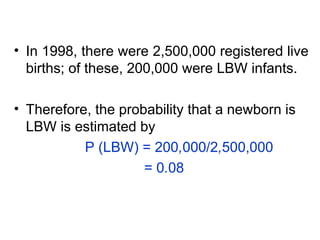
• In 1998, there were 2,500,000 registered live
births; of these, 200,000 were LBW infants.
• Therefore, the probability that a newborn is
LBW is estimated by
P (LBW) = 200,000/2,500,000
= 0.08
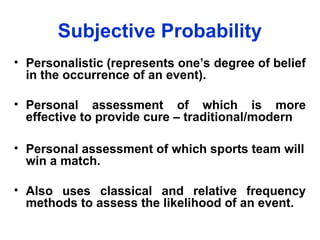
Subjective Probability
• Personalistic (represents one’s degree of belief
in the occurrence of an event).
• Personal assessment of which is more
effective to provide cure – traditional/modern
• Personal assessment of which sports team will
win a match.
• Also uses classical and relative frequency
methods to assess the likelihood of an event.
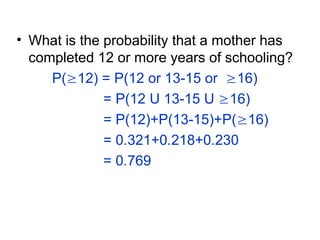
• E.g., If someone says that he is 95% certain
that a cure for AIDS will be discovered
within 5 years, then he means that:
P(discovery of cure for AIDS within 5 years)
= 95% = 0.95
• Although the subjective view of probability has
enjoyed increased attention over the years, it has not
fully accepted by scientists.
Mutually Exclusive Events
 Two events A and B are mutually exclusive if
they cannot both happen at the same time
P (A ∩ B) = 0
• Example:
– A coin toss cannot produce heads and tails
simultaneously.
– Weight of an individual can’t be classified
simultaneously as “underweight”, “normal”,
“overweight”
Independent Events
• Two events A and B are independent if the
probability of the first one happening is the
same no matter how the second one turns
out. OR. The outcome of one event has no effect on the
occurrence or non-occurrence of the other.
P(A∩B) = P(A) x P(B) (Independent events)
P(A∩B) ≠ P(A) x P(B) (Dependent events)
Example:
– The outcomes on the first and second coin
tosses are independent
Intersection, and union
• The intersection of two events A and B, A ∩ B,
is the event that A and B happen simultaneously
P ( A and B ) = P (A ∩ B )
• Let A represent the event that a randomly
selected newborn is LBW, and B the event that
he or she is from a multiple birth
• The intersection of A and B is the event that the
infant is both LBW and from a multiple birth
• The union of A and B, A U B, is the event
that either A happens or B happens or
they both happen simultaneously
P ( A or B ) = P ( A U B )
• In the example above, the union of A and
B is the event that the newborn is either
LBW or from a multiple birth, or both
Properties of Probability
1. The numerical value of a probability always
lies between 0 and 1, inclusive.
0  P(E)  1
 A value 0 means the event can not occur
 A value 1 means the event definitely will occur
 A value of 0.5 means that the probability that
the event will occur is the same as the
probability that it will not occur.
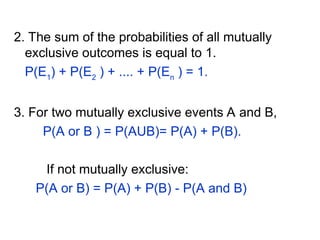
2. The sum of the probabilities of all mutually
exclusive outcomes is equal to 1.
P(E1
) + P(E2
) + .... + P(En
) = 1.
3. For two mutually exclusive events A and B,
P(A or B ) = P(AUB)= P(A) + P(B).
If not mutually exclusive:
P(A or B) = P(A) + P(B) - P(A and B)
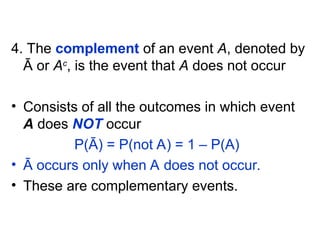
4. The complement of an event A, denoted by
Ā or Ac
, is the event that A does not occur
• Consists of all the outcomes in which event
A does NOT occur
P(Ā) = P(not A) = 1 – P(A)
• Ā occurs only when A does not occur.
• These are complementary events.
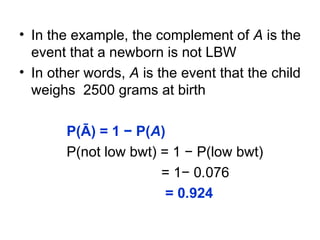
• In the example, the complement of A is the
event that a newborn is not LBW
• In other words, A is the event that the child
weighs 2500 grams at birth
P(Ā) = 1 − P(A)
P(not low bwt) = 1 − P(low bwt)
= 1− 0.076
= 0.924
Basic Probability Rules
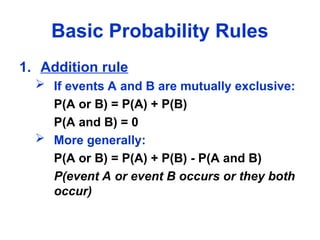
1. Addition rule
 If events A and B are mutually exclusive:
P(A or B) = P(A) + P(B)
P(A and B) = 0
 More generally:
P(A or B) = P(A) + P(B) - P(A and B)
P(event A or event B occurs or they both
occur)
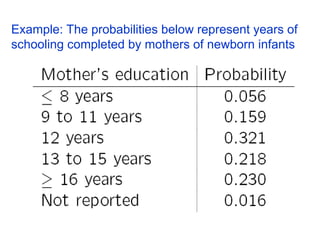
Example: The probabilities below represent years of
schooling completed by mothers of newborn infants
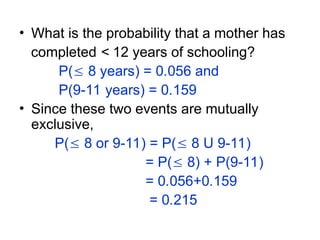
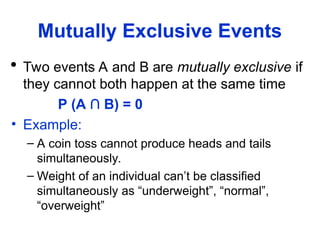
• What is the probability that a mother has
completed < 12 years of schooling?
P( 8 years) = 0.056 and
P(9-11 years) = 0.159
• Since these two events are mutually
exclusive,
P( 8 or 9-11) = P( 8 U 9-11)
= P( 8) + P(9-11)
= 0.056+0.159
= 0.215
• What is the probability that a mother has
completed 12 or more years of schooling?
P(12) = P(12 or 13-15 or 16)
= P(12 U 13-15 U 16)
= P(12)+P(13-15)+P(16)
= 0.321+0.218+0.230
= 0.769
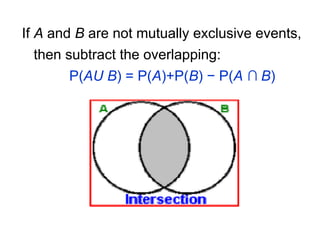
If A and B are not mutually exclusive events,
then subtract the overlapping:
P(AU B) = P(A)+P(B) − P(A ∩ B)
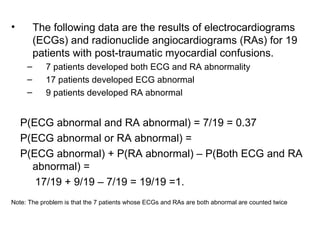
• The following data are the results of electrocardiograms
(ECGs) and radionuclide angiocardiograms (RAs) for 19
patients with post-traumatic myocardial confusions.
– 7 patients developed both ECG and RA abnormality
– 17 patients developed ECG abnormal
– 9 patients developed RA abnormal
P(ECG abnormal and RA abnormal) = 7/19 = 0.37
P(ECG abnormal or RA abnormal) =
P(ECG abnormal) + P(RA abnormal) – P(Both ECG and RA
abnormal) =
17/19 + 9/19 – 7/19 = 19/19 =1.
Note: The problem is that the 7 patients whose ECGs and RAs are both abnormal are counted twice
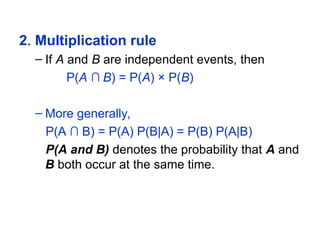
2. Multiplication rule
– If A and B are independent events, then
P(A ∩ B) = P(A) × P(B)
– More generally,
P(A ∩ B) = P(A) P(B|A) = P(B) P(A|B)
P(A and B) denotes the probability that A and
B both occur at the same time.
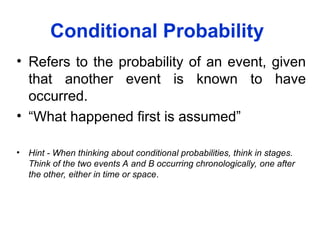
Conditional Probability
• Refers to the probability of an event, given
that another event is known to have
occurred.
• “What happened first is assumed”
• Hint - When thinking about conditional probabilities, think in stages.
Think of the two events A and B occurring chronologically, one after
the other, either in time or space.
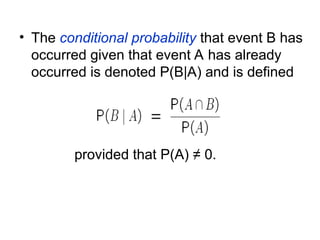
• The conditional probability that event B has
occurred given that event A has already
occurred is denoted P(B|A) and is defined
provided that P(A) ≠ 0.
Example:
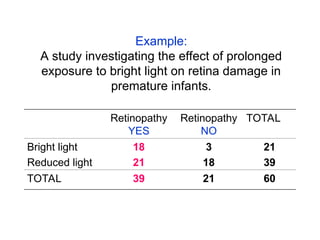
A study investigating the effect of prolonged
exposure to bright light on retina damage in
premature infants.
Retinopathy
YES
Retinopathy
NO
TOTAL
Bright light
Reduced light
18
21
3
18
21
39
TOTAL 39 21 60
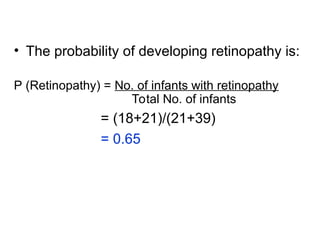
• The probability of developing retinopathy is:
P (Retinopathy) = No. of infants with retinopathy
Total No. of infants
= (18+21)/(21+39)
= 0.65
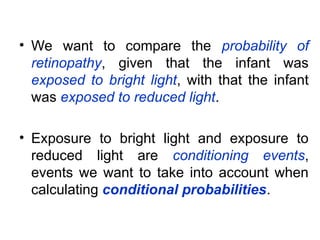
• We want to compare the probability of
retinopathy, given that the infant was
exposed to bright light, with that the infant
was exposed to reduced light.
• Exposure to bright light and exposure to
reduced light are conditioning events,
events we want to take into account when
calculating conditional probabilities.
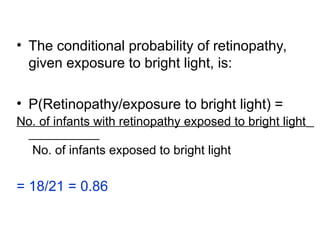
• The conditional probability of retinopathy,
given exposure to bright light, is:
• P(Retinopathy/exposure to bright light) =
No. of infants with retinopathy exposed to bright light
No. of infants exposed to bright light
= 18/21 = 0.86
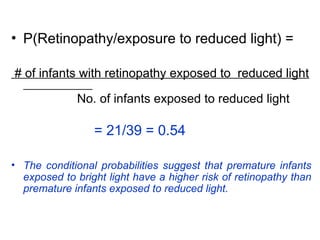
• P(Retinopathy/exposure to reduced light) =
# of infants with retinopathy exposed to reduced light
No. of infants exposed to reduced light
= 21/39 = 0.54
• The conditional probabilities suggest that premature infants
exposed to bright light have a higher risk of retinopathy than
premature infants exposed to reduced light.
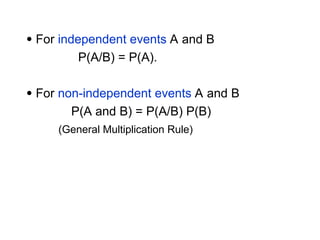
 For independent events A and B
P(A/B) = P(A).
 For non-independent events A and B
P(A and B) = P(A/B) P(B)
(General Multiplication Rule)
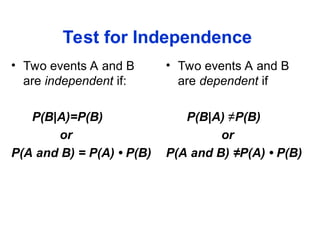
Test for Independence
• Two events A and B
are independent if:
P(B|A)=P(B)
or
P(A and B) = P(A) • P(B)
• Two events A and B
are dependent if
P(B|A) ≠P(B)
or
P(A and B) ≠P(A) • P(B)
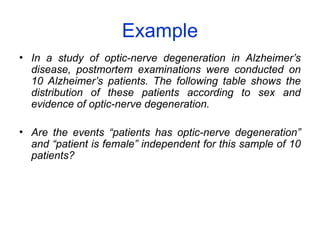
Example
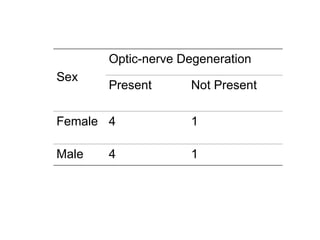
• In a study of optic-nerve degeneration in Alzheimer’s
disease, postmortem examinations were conducted on
10 Alzheimer’s patients. The following table shows the
distribution of these patients according to sex and
evidence of optic-nerve degeneration.
• Are the events “patients has optic-nerve degeneration”
and “patient is female” independent for this sample of 10
patients?
Sex
Optic-nerve Degeneration
Present Not Present
Female 4 1
Male 4 1
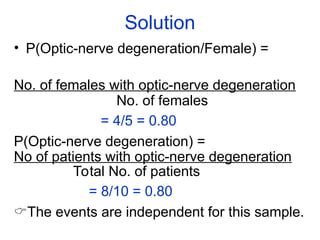
Solution
• P(Optic-nerve degeneration/Female) =
No. of females with optic-nerve degeneration
No. of females
= 4/5 = 0.80
P(Optic-nerve degeneration) =
No of patients with optic-nerve degeneration
Total No. of patients
= 8/10 = 0.80
The events are independent for this sample.
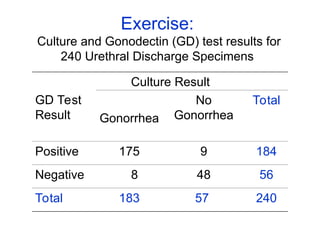
Exercise:
Culture and Gonodectin (GD) test results for
240 Urethral Discharge Specimens
GD Test
Result
Culture Result
Gonorrhea
No
Gonorrhea
Total
Positive 175 9 184
Negative 8 48 56
Total 183 57 240
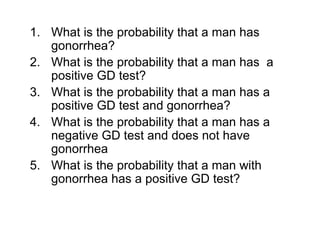
1. What is the probability that a man has
gonorrhea?
2. What is the probability that a man has a
positive GD test?
3. What is the probability that a man has a
positive GD test and gonorrhea?
4. What is the probability that a man has a
negative GD test and does not have
gonorrhea
5. What is the probability that a man with
gonorrhea has a positive GD test?
6. What is the probability that a man does not
have gonorrhea has a negative GD test?
7. What is the probability that a man does not
have gonorrhea has a positive GD test?
8. What is the probability that a man with
positive GD test has gonorrhea?
Probability Distributions
• A probability distribution is a device used to
describe the behaviour that a random variable may
have by applying the theory of probability.
• It is the way data are distributed, in order to draw
conclusions about a set of data
• Random Variable = Any quantity or characteristic
that is able to assume a number of different values
such that any particular outcome is determined by
chance
• Random variables can be either discrete
or continuous
• A discrete random variable is able to
assume only a finite or countable number
of outcomes
• A continuous random variable can take
on any value in a specified interval
• With categorical variables, we obtain the
frequency distribution of each variable
• With numeric variables, the aim is to
determine whether or not normality may be
assumed
– If not we may consider transforming the
variable or categorize it for analysis (eg age
group)
Therefore, the probability distribution of
a random variable is a table, graph, or
mathematical formula that gives the
probabilities with which the random
variable takes different values or ranges
of values.
A. Discrete Probability
Distributions
• For a discrete random variable, the probability
distribution specifies each of the possible
outcomes of the random variable along with the
probability that each will occur
• Examples can be:
– Frequency distribution
– Relative frequency distribution
– Cumulative frequency
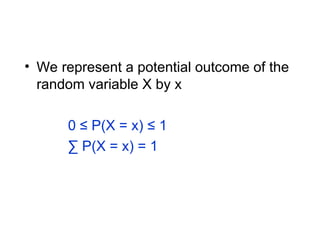
• We represent a potential outcome of the
random variable X by x
0 ≤ P(X = x) ≤ 1
∑ P(X = x) = 1
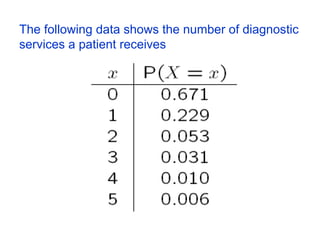
The following data shows the number of diagnostic
services a patient receives
• What is the probability that a patient receives
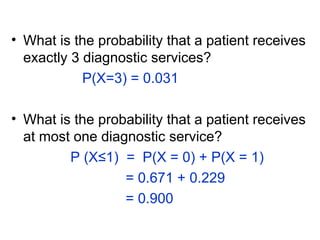
exactly 3 diagnostic services?
P(X=3) = 0.031
• What is the probability that a patient receives
at most one diagnostic service?
P (X≤1) = P(X = 0) + P(X = 1)
= 0.671 + 0.229
= 0.900
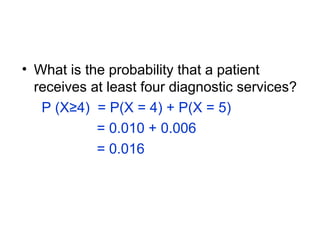
• What is the probability that a patient
receives at least four diagnostic services?
P (X≥4) = P(X = 4) + P(X = 5)
= 0.010 + 0.006
= 0.016
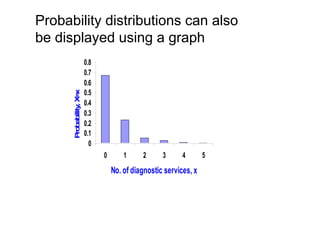
Probability distributions can also
be displayed using a graph
0
0.1
0.2
0.3
0.4
0.5
0.6
0.7
0.8
0 1 2 3 4 5
No. of diagnostic services, x
P
ro
b
a
b
ility
,
X
=
x
The Expected Value of a Discrete
Random variable
• If a random variable is able to take on a
large number of values, then a probability
mass function might not be the most
useful way to summarize its behavior
• Instead, measures of location and
dispersion can be calculated (as long as
the data are not categorical)
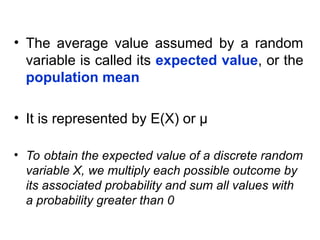
• The average value assumed by a random
variable is called its expected value, or the
population mean
• It is represented by E(X) or µ
• To obtain the expected value of a discrete random
variable X, we multiply each possible outcome by
its associated probability and sum all values with
a probability greater than 0
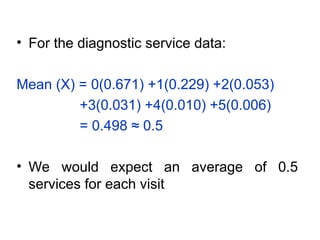
• For the diagnostic service data:
Mean (X) = 0(0.671) +1(0.229) +2(0.053)
+3(0.031) +4(0.010) +5(0.006)
= 0.498 ≈ 0.5
• We would expect an average of 0.5
services for each visit
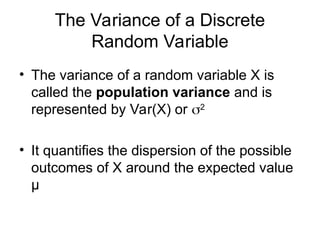
• The variance of a random variable X is
called the population variance and is
represented by Var(X) or 2
• It quantifies the dispersion of the possible
outcomes of X around the expected value
μ
The Variance of a Discrete
Random Variable
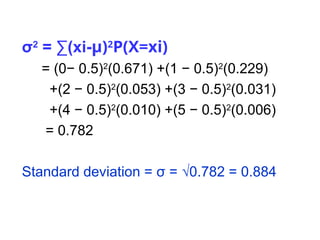
σ2
= ∑(xi-µ)2
P(X=xi)
= (0− 0.5)2
(0.671) +(1 − 0.5)2
(0.229)
+(2 − 0.5)2
(0.053) +(3 − 0.5)2
(0.031)
+(4 − 0.5)2
(0.010) +(5 − 0.5)2
(0.006)
= 0.782
Standard deviation = σ = √0.782 = 0.884
• Examples of discrete probability
distributions are the binomial distribution
and the Poisson distribution.
1. Binomial Distribution
• It is one of the most widely encountered discrete
probability distributions.
• Consider dichotomous (binary) random variable
• Is based on Bernoulli trial
– When a single trial of an experiment can result in only
one of two mutually exclusive outcomes (success or
failure; dead or alive; sick or well, male or female)
Example:
• We are interested in determining whether a
newborn infant will survive until his/her 70th
birthday
• Let Y represent the survival status of the
child at age 70 years
• Y = 1 if the child survives and Y = 0 if
he/she does not
• The outcomes are mutually exclusive and
exhaustive
• Suppose that 72% of infants born survive to
age 70 years
P(Y = 1) = p = 0.72
P(Y = 0) = 1 − p = 0.28
A binomial probability distribution occurs when
the following requirements are met.
1. The procedure has a fixed number of trials.
2. The trials must be independent.
3. Each trial must have all outcomes that fall
into two categories.
4. The probabilities must remain constant for
each trial [P(success) = p].
Characteristics of a Binomial
Distribution
• The experiment consist of n identical trials.
• Only two possible outcomes on each trial.
• The probability of A (success), denoted by p,
remains the same from trial to trial. The
probability of B (failure), denoted by q,
q = 1- p.
• The trials are independent.
• n and  are the parameters of the binomial
distribution.
• The mean is n and the variance is n(1- )
• Suppose an event can have only binary
outcomes A and B.
• Let the probability of A is  and that of B is
1 - .
• The probability  stays the same each
time the event occurs.
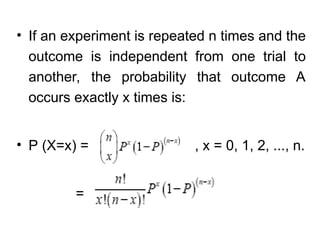
• If an experiment is repeated n times and the
outcome is independent from one trial to
another, the probability that outcome A
occurs exactly x times is:
• P (X=x) = , x = 0, 1, 2, ..., n.
=
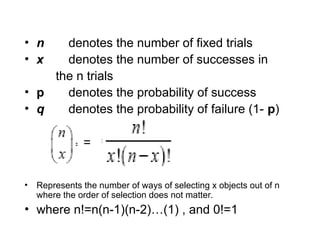
• n denotes the number of fixed trials
• x denotes the number of successes in
the n trials
• p denotes the probability of success
• q denotes the probability of failure (1- p)
=
• Represents the number of ways of selecting x objects out of n
where the order of selection does not matter.
• where n!=n(n-1)(n-2)…(1) , and 0!=1
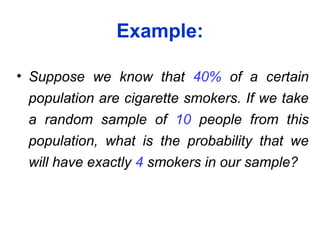
Example:
• Suppose we know that 40% of a certain
population are cigarette smokers. If we take
a random sample of 10 people from this
population, what is the probability that we
will have exactly 4 smokers in our sample?
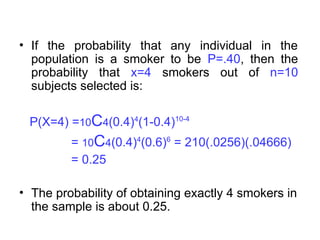
• If the probability that any individual in the
population is a smoker to be P=.40, then the
probability that x=4 smokers out of n=10
subjects selected is:
P(X=4) =10C4(0.4)4
(1-0.4)10-4
= 10C4(0.4)4
(0.6)6
= 210(.0256)(.04666)
= 0.25
• The probability of obtaining exactly 4 smokers in
the sample is about 0.25.
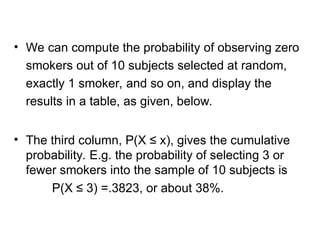
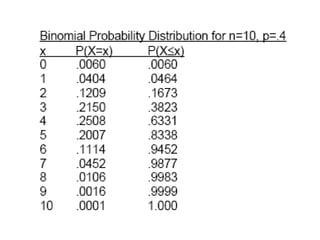
• We can compute the probability of observing zero
smokers out of 10 subjects selected at random,
exactly 1 smoker, and so on, and display the
results in a table, as given, below.
• The third column, P(X ≤ x), gives the cumulative
probability. E.g. the probability of selecting 3 or
fewer smokers into the sample of 10 subjects is
P(X ≤ 3) =.3823, or about 38%.
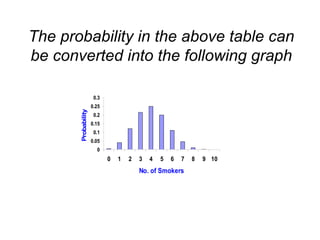
The probability in the above table can
be converted into the following graph
0
0.05
0.1
0.15
0.2
0.25
0.3
0 1 2 3 4 5 6 7 8 9 10
No. of Smokers
Probability
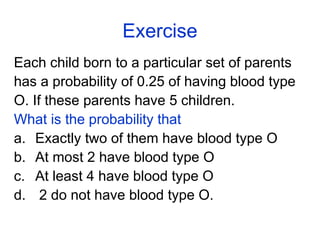
Exercise
Each child born to a particular set of parents
has a probability of 0.25 of having blood type
O. If these parents have 5 children.
What is the probability that
a. Exactly two of them have blood type O
b. At most 2 have blood type O
c. At least 4 have blood type O
d. 2 do not have blood type O.
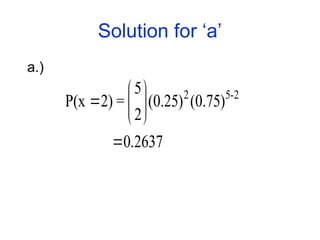
Solution for ‘a’
a.)
2637
.
0
)
75
.
0
(
)
25
.
0
(
2
5
=
2)
P(x 2
-
5
2








The Mean and Variance of a
Binomial Distribution
• Once n and P are specified, we can compute the
proportion of success,
P = x/n
• and the mean and variance of the distribution are
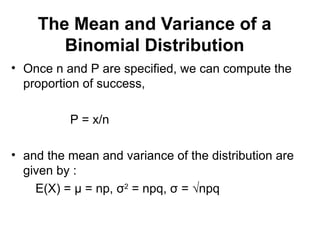
given by :
E(X) = μ = np, σ2
= npq, σ = √npq
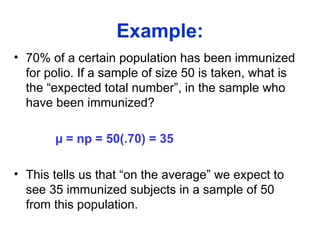
Example:
• 70% of a certain population has been immunized
for polio. If a sample of size 50 is taken, what is
the “expected total number”, in the sample who
have been immunized?
µ = np = 50(.70) = 35
• This tells us that “on the average” we expect to
see 35 immunized subjects in a sample of 50
from this population.
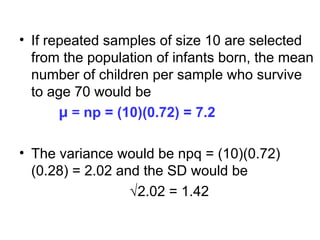
• If repeated samples of size 10 are selected
from the population of infants born, the mean
number of children per sample who survive
to age 70 would be
µ = np = (10)(0.72) = 7.2
• The variance would be npq = (10)(0.72)
(0.28) = 2.02 and the SD would be
√2.02 = 1.42
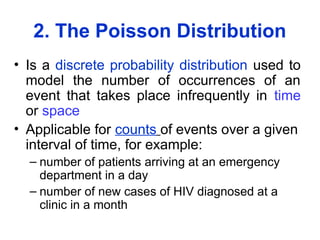
2. The Poisson Distribution
• Is a discrete probability distribution used to
model the number of occurrences of an
event that takes place infrequently in time
or space
• Applicable for counts of events over a given
interval of time, for example:
– number of patients arriving at an emergency
department in a day
– number of new cases of HIV diagnosed at a
clinic in a month
• In such cases, we take a sample of days
and observe the number of patients arriving
at the emergency department on each day,
• or a sample of months and observe the
number of new cases of HIV diagnosed at
the clinic.
• We are observing a count or number of
events, rather than a yes/no or success/
failure outcome for each subject or trial, as
in the binomial.
• In theory, a random variable X is a count
that can assume any integer value
greater than or equal to 0
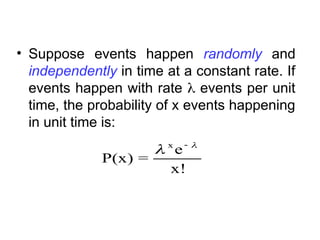
• Suppose events happen randomly and
independently in time at a constant rate. If
events happen with rate  events per unit
time, the probability of x events happening
in unit time is:
P(x) =
e
x!
x
 

• where x = 0, 1, 2, . . .∞
• x is a potential outcome of X
• The constant λ (lambda) represents the
rate at which the event occurs, or the
expected number of events per unit time
• e = 2.71828
• It depends up on just one parameter, which
is the µ number of occurrences (λ).
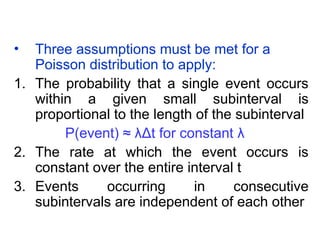
• Three assumptions must be met for a
Poisson distribution to apply:
1. The probability that a single event occurs
within a given small subinterval is
proportional to the length of the subinterval
P(event) ≈ λΔt for constant λ
2. The rate at which the event occurs is
constant over the entire interval t
3. Events occurring in consecutive
subintervals are independent of each other
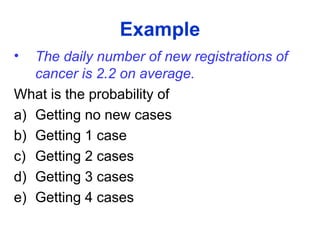
Example
• The daily number of new registrations of
cancer is 2.2 on average.
What is the probability of
a) Getting no new cases
b) Getting 1 case
c) Getting 2 cases
d) Getting 3 cases
e) Getting 4 cases
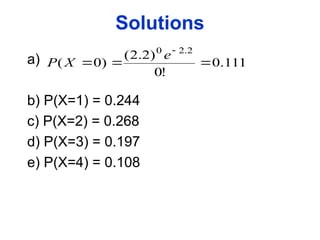
Solutions
a)
b) P(X=1) = 0.244
c) P(X=2) = 0.268
d) P(X=3) = 0.197
e) P(X=4) = 0.108
111
.
0
!
0
)
2
.
2
(
)
0
(
2
.
2
0




e
X
P
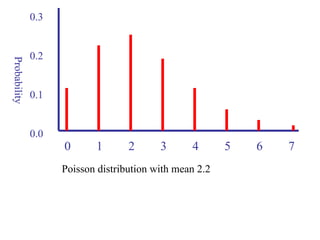
0 1 2 3 4 5 6 7
0.3
0.2
0.1
0.0
Probability
Poisson distribution with mean 2.2
Example:
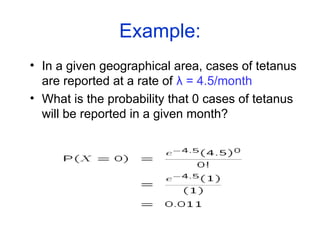
• In a given geographical area, cases of tetanus
are reported at a rate of λ = 4.5/month
• What is the probability that 0 cases of tetanus
will be reported in a given month?
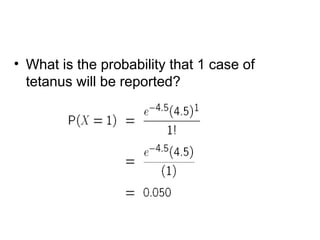
• What is the probability that 1 case of
tetanus will be reported?
Characteristics
• The Poisson distribution is very asymmetric
when its mean is small
• With large means it becomes nearly
symmetric
• It has no theoretical maximum value, but the
probabilities tail off towards zero very quickly
 is the parameter of the Poisson distribution
• The mean is  and the variance is also .
B. Continuous Probability
Distributions
• A continuous random variable X can take on any
value in a specified interval or range
• With a large number of class intervals, the
frequency polygon begins to resemble a smooth
curve.
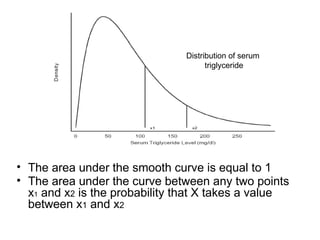
• The probability distribution of X is represented
by a smooth curve called a probability density
function
• The area under the smooth curve is equal to 1
• The area under the curve between any two points
x1 and x2 is the probability that X takes a value
between x1 and x2
Distribution of serum
triglyceride
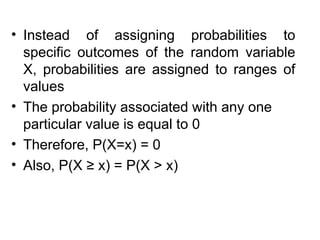
• Instead of assigning probabilities to
specific outcomes of the random variable
X, probabilities are assigned to ranges of
values
• The probability associated with any one
particular value is equal to 0
• Therefore, P(X=x) = 0
• Also, P(X ≥ x) = P(X > x)
• We calculate:
Pr [ a < X < b], the probability of an
interval of values of X.
• For the above reason,
• is also without meaning.
The Normal distribution
• The ND is the most important probability
distribution in statistics
• Frequently called the “Gaussian distribution”
or bell-shape curve.
• Variables such as blood pressure, weight,
height, serum cholesterol level, and IQ
score — are approximately normally
distributed
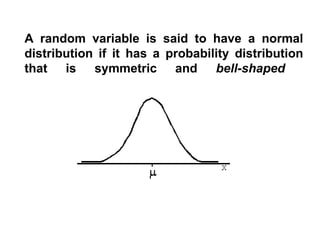
A random variable is said to have a normal
distribution if it has a probability distribution
that is symmetric and bell-shaped
• The ND is vital to statistical work, most
estimation procedures and hypothesis tests
underlie ND
• The concept of “probability of X=x” in the
discrete probability distribution is replaced
by the “probability density function f(x)
• The ND is also an approximating distribution
to other distributions (e.g., binomial)
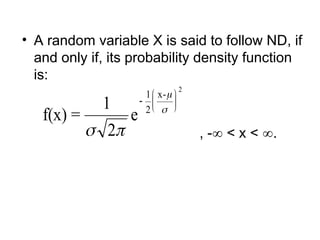
• A random variable X is said to follow ND, if
and only if, its probability density function
is:
, - < x < .
f(x) =
1
2
e
x-
2
 









1
2
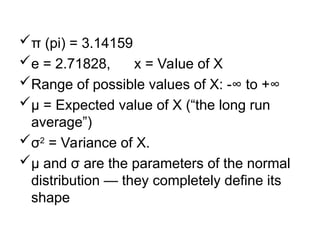
π (pi) = 3.14159
e = 2.71828, x = Value of X
Range of possible values of X: -∞ to +∞
µ = Expected value of X (“the long run
average”)
σ2
= Variance of X.
µ and σ are the parameters of the normal
distribution — they completely define its
shape
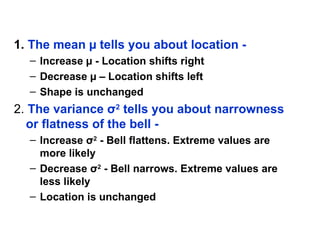
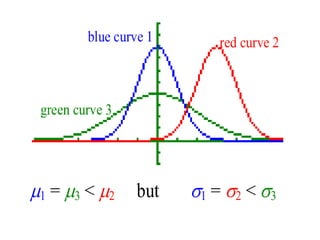
1. The mean µ tells you about location -
– Increase µ - Location shifts right
– Decrease µ – Location shifts left
– Shape is unchanged
2. The variance σ2
tells you about narrowness
or flatness of the bell -
– Increase σ2
- Bell flattens. Extreme values are
more likely
– Decrease σ2
- Bell narrows. Extreme values are
less likely
– Location is unchanged
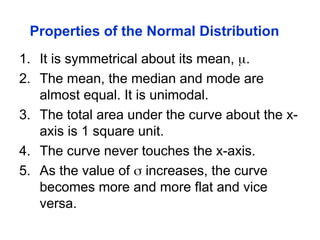
Properties of the Normal Distribution
1. It is symmetrical about its mean, .
2. The mean, the median and mode are
almost equal. It is unimodal.
3. The total area under the curve about the x-
axis is 1 square unit.
4. The curve never touches the x-axis.
5. As the value of  increases, the curve
becomes more and more flat and vice
versa.
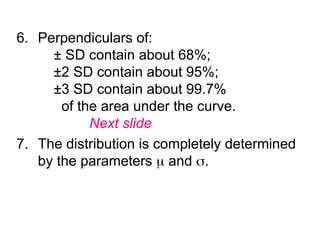
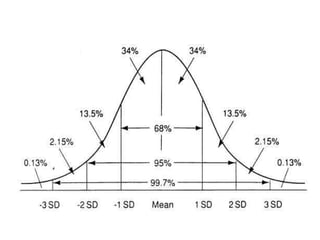
6. Perpendiculars of:
± SD contain about 68%;
±2 SD contain about 95%;
±3 SD contain about 99.7%
of the area under the curve.
Next slide
7. The distribution is completely determined
by the parameters  and .
• We have different normal distributions
depending on the values of μ and σ2
.
• We cannot tabulate every possible
distribution
• Tabulated normal probability calculations
are available only for the ND with µ = 0
and σ2
=1.
Standard Normal Distribution
 It is a normal distribution that has a mean
equal to 0 and a SD equal to 1, and is
denoted by N(0, 1).
 The main idea is to standardize all the
data that is given by using Z-scores.
 These Z-scores can then be used to find
the area (and thus the probability) under
the normal curve.
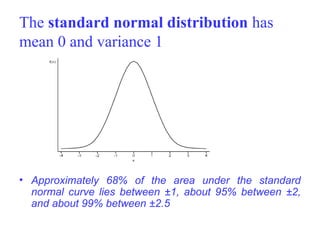
The standard normal distribution has
mean 0 and variance 1
• Approximately 68% of the area under the standard
normal curve lies between ±1, about 95% between ±2,
and about 99% between ±2.5
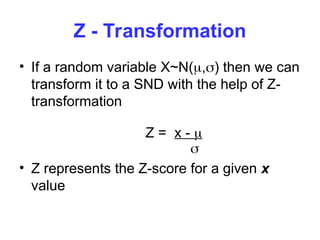
Z - Transformation
• If a random variable X~N(,) then we can
transform it to a SND with the help of Z-
transformation
Z = x - 

• Z represents the Z-score for a given x
value
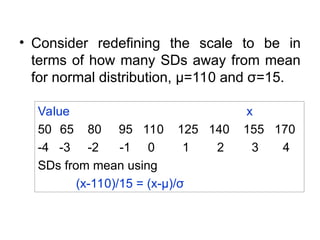
• Consider redefining the scale to be in
terms of how many SDs away from mean
for normal distribution, μ=110 and σ=15.
Value x
50 65 80 95 110 125 140 155 170
-4 -3 -2 -1 0 1 2 3 4
SDs from mean using
(x-110)/15 = (x-μ)/σ
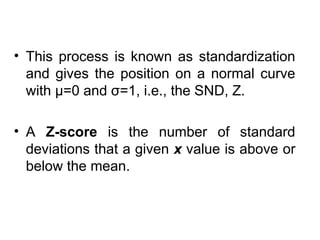
• This process is known as standardization
and gives the position on a normal curve
with μ=0 and σ=1, i.e., the SND, Z.
• A Z-score is the number of standard
deviations that a given x value is above or
below the mean.
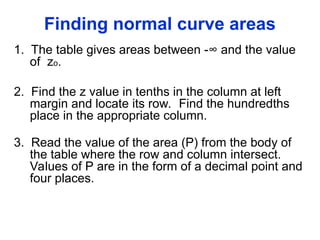
Finding normal curve areas
1. The table gives areas between -∞ and the value
of zo.
2. Find the z value in tenths in the column at left
margin and locate its row. Find the hundredths
place in the appropriate column.
3. Read the value of the area (P) from the body of
the table where the row and column intersect.
Values of P are in the form of a decimal point and
four places.
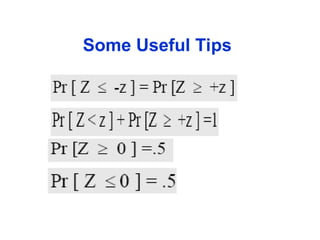
Some Useful Tips
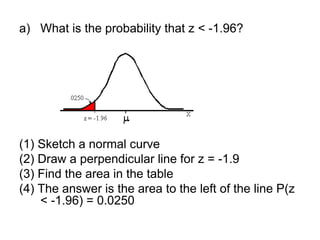
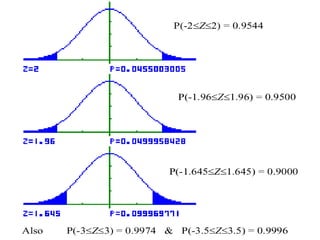
a) What is the probability that z < -1.96?
(1) Sketch a normal curve
(2) Draw a perpendicular line for z = -1.9
(3) Find the area in the table
(4) The answer is the area to the left of the line P(z
< -1.96) = 0.0250
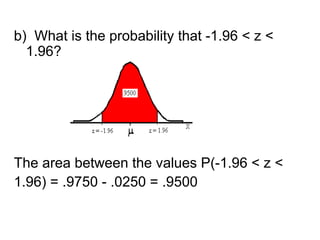
b) What is the probability that -1.96 < z <
1.96?
The area between the values P(-1.96 < z <
1.96) = .9750 - .0250 = .9500
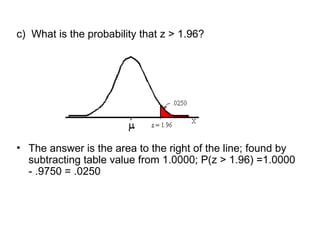
c) What is the probability that z > 1.96?
• The answer is the area to the right of the line; found by
subtracting table value from 1.0000; P(z > 1.96) =1.0000
- .9750 = .0250
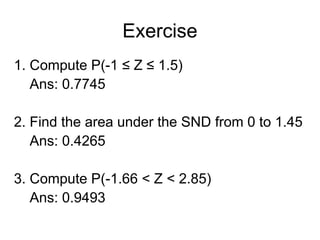
Exercise
1. Compute P(-1 ≤ Z ≤ 1.5)
Ans: 0.7745
2. Find the area under the SND from 0 to 1.45
Ans: 0.4265
3. Compute P(-1.66 < Z < 2.85)
Ans: 0.9493
Applications of the Normal
Distribution
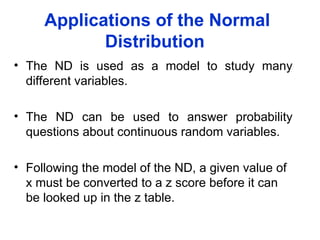
• The ND is used as a model to study many
different variables.
• The ND can be used to answer probability
questions about continuous random variables.
• Following the model of the ND, a given value of
x must be converted to a z score before it can
be looked up in the z table.
Example:
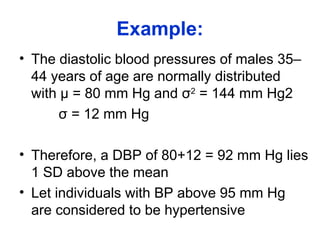
• The diastolic blood pressures of males 35–
44 years of age are normally distributed
with µ = 80 mm Hg and σ2
= 144 mm Hg2
σ = 12 mm Hg
• Therefore, a DBP of 80+12 = 92 mm Hg lies
1 SD above the mean
• Let individuals with BP above 95 mm Hg
are considered to be hypertensive
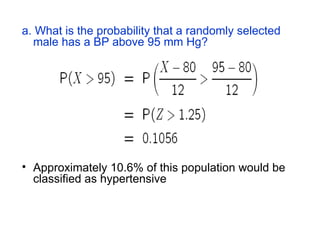
a. What is the probability that a randomly selected
male has a BP above 95 mm Hg?
• Approximately 10.6% of this population would be
classified as hypertensive
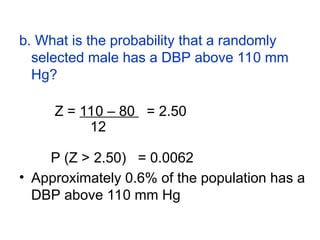
b. What is the probability that a randomly
selected male has a DBP above 110 mm
Hg?
Z = 110 – 80 = 2.50
12
P (Z > 2.50) = 0.0062
• Approximately 0.6% of the population has a
DBP above 110 mm Hg
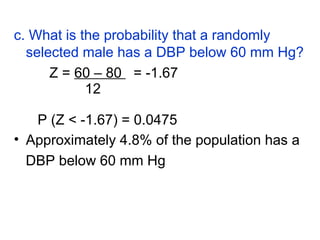
c. What is the probability that a randomly
selected male has a DBP below 60 mm Hg?
Z = 60 – 80 = -1.67
12
P (Z < -1.67) = 0.0475
• Approximately 4.8% of the population has a
DBP below 60 mm Hg
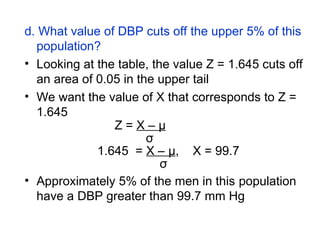
d. What value of DBP cuts off the upper 5% of this
population?
• Looking at the table, the value Z = 1.645 cuts off
an area of 0.05 in the upper tail
• We want the value of X that corresponds to Z =
1.645
Z = X – μ
σ
1.645 = X – μ, X = 99.7
σ
• Approximately 5% of the men in this population
have a DBP greater than 99.7 mm Hg
Other Distributions
1. Student t-distribution
2. F- Distribution
3. 2
-Distribution

Probability and probability distribution.ppt

  • 1.
  • 2.
    Probability • Chance ofobserving a particular outcome • Likelihood of an event • Assumes a “stochastic” or “random” process: i.e.. the outcome is not predetermined - there is an element of chance • An outcome is a specific result of a single trial of a probability experiment.
  • 3.
    • Probability theorydeveloped from the study of games of chance like dice and cards. • A process like flipping a coin, rolling a die or drawing a card from a deck are probability experiments.
  • 4.
    Why Probability inStatistics? • Results are not certain • To evaluate how accurate our results are: – Given how our data were collected, are our results accurate ? – Given the level of accuracy needed, how many observations need to be collected ?
  • 5.
    When can wetalk about probability ? • When dealing with a process that has an uncertain outcome • Experiment = any process with an uncertain outcome • When an experiment is performed, one and only one outcome is obtained
  • 6.
    • Event =something that may happen or not when the experiment is performed • An event either occurs or it does not occur • Events are represented by uppercase letters such as A, B, and C
  • 7.
    • Probability ofan Event E = a number between 0 and 1 representing the proportion of times that event E is expected to happen when the experiment is done over and over again under the same conditions • Any event can be expressed as a subset of the set of all possible outcomes (S) S = set of all possible outcomes P(S) = 1
  • 8.
    Why Probability inMedicine? • Because medicine is an inexact science, physicians seldom predict an outcome with absolute certainty. • E.g., to formulate a diagnosis, a physician must rely on available diagnostic information about a patient – History and physical examination – Laboratory investigation, X-ray findings, ECG, etc
  • 9.
    • Although notest result is absolutely accurate, it does affect the probability of the presence (or absence) of a disease. – Sensitivity and specificity • An understanding of probability is fundamental for quantifying the uncertainty that is inherent in the decision-making process
  • 10.
    • Probability theoryis a foundation for statistical inference, & • Allows us to draw conclusions about a population of patients based on information obtained from a sample of patients drawn from that population.
  • 11.
    More importantly probabilitytheory is used to understand: – About probability distributions: Binomial, Poisson, and Normal Distributions – Sampling and sampling distributions – Estimation – Hypothesis testing – Advanced statistical analysis
  • 12.
    Two Categories ofProbability • Objective and Subjective Probabilities. • Objective probability 1) Classical probability and 2) Relative frequency probability.
  • 13.
    Classical Probability • Isbased on gambling ideas • Rolling a die - – There are 6 possible outcomes: – Total ways = {1, 2, 3, 4, 5, 6}. • Each is equally likely – P(i) = 1/6, i=1,2,...,6. P(1) = 1/6 P(2) = 1/6  ……. P(6) = 1/6 SUM = 1
  • 14.
    • Definition: Ifan event can occur in N mutually exclusive and equally likely ways, and if m of these posses a characteristic, E, the probability of the occurrence of E = m/N. P(E)= the probability of E = P(E) = m/N • If we toss a die, what is the probability of 4 coming up? m = 1(which is 4) and N = 6 The probability of 4 coming up is 1/6.
  • 15.
    • Another “equallylikely” setting is the tossing of a coin – – There are 2 possible outcomes in the set of all possible outcomes {H, T}. P(H) = 0.5 P(T) = 0.5 SUM = 1
  • 16.
    Relative Frequency Probability •In the long run process ….. • The proportion of times the event A occurs — in a large number of trials repeated under essentially identical conditions • Definition: If a process is repeated a large number of times (n), and if an event with the characteristic E occurs m times, the relative frequency of E, Probability of E = P(E) = m/n.
  • 17.
    • If youtoss a coin 100 times and head comes up 40 times, P(H) = 40/100 = 0.4. • If we toss a coin 10,000 times and the head comes up 5562, P(H) = 0.5562. • Therefore, the longer the series and the longer sample size, the closer the estimate to the true value.
  • 18.
    • Since trialscannot be repeated an infinite number of times, theoretical probabilities are often estimated by empirical probabilities based on a finite amount of data • Example: Of 158 people who attended a dinner party, 99 were ill. P (Illness) = 99/158 = 0.63 = 63%.
  • 19.
    • In 1998,there were 2,500,000 registered live births; of these, 200,000 were LBW infants. • Therefore, the probability that a newborn is LBW is estimated by P (LBW) = 200,000/2,500,000 = 0.08
  • 20.
    Subjective Probability • Personalistic(represents one’s degree of belief in the occurrence of an event). • Personal assessment of which is more effective to provide cure – traditional/modern • Personal assessment of which sports team will win a match. • Also uses classical and relative frequency methods to assess the likelihood of an event.
  • 21.
    • E.g., Ifsomeone says that he is 95% certain that a cure for AIDS will be discovered within 5 years, then he means that: P(discovery of cure for AIDS within 5 years) = 95% = 0.95 • Although the subjective view of probability has enjoyed increased attention over the years, it has not fully accepted by scientists.
  • 22.
    Mutually Exclusive Events Two events A and B are mutually exclusive if they cannot both happen at the same time P (A ∩ B) = 0 • Example: – A coin toss cannot produce heads and tails simultaneously. – Weight of an individual can’t be classified simultaneously as “underweight”, “normal”, “overweight”
  • 23.
    Independent Events • Twoevents A and B are independent if the probability of the first one happening is the same no matter how the second one turns out. OR. The outcome of one event has no effect on the occurrence or non-occurrence of the other. P(A∩B) = P(A) x P(B) (Independent events) P(A∩B) ≠ P(A) x P(B) (Dependent events) Example: – The outcomes on the first and second coin tosses are independent
  • 24.
    Intersection, and union •The intersection of two events A and B, A ∩ B, is the event that A and B happen simultaneously P ( A and B ) = P (A ∩ B ) • Let A represent the event that a randomly selected newborn is LBW, and B the event that he or she is from a multiple birth • The intersection of A and B is the event that the infant is both LBW and from a multiple birth
  • 25.
    • The unionof A and B, A U B, is the event that either A happens or B happens or they both happen simultaneously P ( A or B ) = P ( A U B ) • In the example above, the union of A and B is the event that the newborn is either LBW or from a multiple birth, or both
  • 26.
    Properties of Probability 1.The numerical value of a probability always lies between 0 and 1, inclusive. 0  P(E)  1  A value 0 means the event can not occur  A value 1 means the event definitely will occur  A value of 0.5 means that the probability that the event will occur is the same as the probability that it will not occur.
  • 27.
    2. The sumof the probabilities of all mutually exclusive outcomes is equal to 1. P(E1 ) + P(E2 ) + .... + P(En ) = 1. 3. For two mutually exclusive events A and B, P(A or B ) = P(AUB)= P(A) + P(B). If not mutually exclusive: P(A or B) = P(A) + P(B) - P(A and B)
  • 28.
    4. The complementof an event A, denoted by Ā or Ac , is the event that A does not occur • Consists of all the outcomes in which event A does NOT occur P(Ā) = P(not A) = 1 – P(A) • Ā occurs only when A does not occur. • These are complementary events.
  • 29.
    • In theexample, the complement of A is the event that a newborn is not LBW • In other words, A is the event that the child weighs 2500 grams at birth P(Ā) = 1 − P(A) P(not low bwt) = 1 − P(low bwt) = 1− 0.076 = 0.924
  • 30.
    Basic Probability Rules 1.Addition rule  If events A and B are mutually exclusive: P(A or B) = P(A) + P(B) P(A and B) = 0  More generally: P(A or B) = P(A) + P(B) - P(A and B) P(event A or event B occurs or they both occur)
  • 31.
    Example: The probabilitiesbelow represent years of schooling completed by mothers of newborn infants
  • 32.
    • What isthe probability that a mother has completed < 12 years of schooling? P( 8 years) = 0.056 and P(9-11 years) = 0.159 • Since these two events are mutually exclusive, P( 8 or 9-11) = P( 8 U 9-11) = P( 8) + P(9-11) = 0.056+0.159 = 0.215
  • 33.
    • What isthe probability that a mother has completed 12 or more years of schooling? P(12) = P(12 or 13-15 or 16) = P(12 U 13-15 U 16) = P(12)+P(13-15)+P(16) = 0.321+0.218+0.230 = 0.769
  • 34.
    If A andB are not mutually exclusive events, then subtract the overlapping: P(AU B) = P(A)+P(B) − P(A ∩ B)
  • 35.
    • The followingdata are the results of electrocardiograms (ECGs) and radionuclide angiocardiograms (RAs) for 19 patients with post-traumatic myocardial confusions. – 7 patients developed both ECG and RA abnormality – 17 patients developed ECG abnormal – 9 patients developed RA abnormal P(ECG abnormal and RA abnormal) = 7/19 = 0.37 P(ECG abnormal or RA abnormal) = P(ECG abnormal) + P(RA abnormal) – P(Both ECG and RA abnormal) = 17/19 + 9/19 – 7/19 = 19/19 =1. Note: The problem is that the 7 patients whose ECGs and RAs are both abnormal are counted twice
  • 36.
    2. Multiplication rule –If A and B are independent events, then P(A ∩ B) = P(A) × P(B) – More generally, P(A ∩ B) = P(A) P(B|A) = P(B) P(A|B) P(A and B) denotes the probability that A and B both occur at the same time.
  • 37.
    Conditional Probability • Refersto the probability of an event, given that another event is known to have occurred. • “What happened first is assumed” • Hint - When thinking about conditional probabilities, think in stages. Think of the two events A and B occurring chronologically, one after the other, either in time or space.
  • 38.
    • The conditionalprobability that event B has occurred given that event A has already occurred is denoted P(B|A) and is defined provided that P(A) ≠ 0.
  • 39.
    Example: A study investigatingthe effect of prolonged exposure to bright light on retina damage in premature infants. Retinopathy YES Retinopathy NO TOTAL Bright light Reduced light 18 21 3 18 21 39 TOTAL 39 21 60
  • 40.
    • The probabilityof developing retinopathy is: P (Retinopathy) = No. of infants with retinopathy Total No. of infants = (18+21)/(21+39) = 0.65
  • 41.
    • We wantto compare the probability of retinopathy, given that the infant was exposed to bright light, with that the infant was exposed to reduced light. • Exposure to bright light and exposure to reduced light are conditioning events, events we want to take into account when calculating conditional probabilities.
  • 42.
    • The conditionalprobability of retinopathy, given exposure to bright light, is: • P(Retinopathy/exposure to bright light) = No. of infants with retinopathy exposed to bright light No. of infants exposed to bright light = 18/21 = 0.86
  • 43.
    • P(Retinopathy/exposure toreduced light) = # of infants with retinopathy exposed to reduced light No. of infants exposed to reduced light = 21/39 = 0.54 • The conditional probabilities suggest that premature infants exposed to bright light have a higher risk of retinopathy than premature infants exposed to reduced light.
  • 44.
     For independentevents A and B P(A/B) = P(A).  For non-independent events A and B P(A and B) = P(A/B) P(B) (General Multiplication Rule)
  • 45.
    Test for Independence •Two events A and B are independent if: P(B|A)=P(B) or P(A and B) = P(A) • P(B) • Two events A and B are dependent if P(B|A) ≠P(B) or P(A and B) ≠P(A) • P(B)
  • 46.
    Example • In astudy of optic-nerve degeneration in Alzheimer’s disease, postmortem examinations were conducted on 10 Alzheimer’s patients. The following table shows the distribution of these patients according to sex and evidence of optic-nerve degeneration. • Are the events “patients has optic-nerve degeneration” and “patient is female” independent for this sample of 10 patients?
  • 47.
    Sex Optic-nerve Degeneration Present NotPresent Female 4 1 Male 4 1
  • 48.
    Solution • P(Optic-nerve degeneration/Female)= No. of females with optic-nerve degeneration No. of females = 4/5 = 0.80 P(Optic-nerve degeneration) = No of patients with optic-nerve degeneration Total No. of patients = 8/10 = 0.80 The events are independent for this sample.
  • 49.
    Exercise: Culture and Gonodectin(GD) test results for 240 Urethral Discharge Specimens GD Test Result Culture Result Gonorrhea No Gonorrhea Total Positive 175 9 184 Negative 8 48 56 Total 183 57 240
  • 50.
    1. What isthe probability that a man has gonorrhea? 2. What is the probability that a man has a positive GD test? 3. What is the probability that a man has a positive GD test and gonorrhea? 4. What is the probability that a man has a negative GD test and does not have gonorrhea 5. What is the probability that a man with gonorrhea has a positive GD test?
  • 51.
    6. What isthe probability that a man does not have gonorrhea has a negative GD test? 7. What is the probability that a man does not have gonorrhea has a positive GD test? 8. What is the probability that a man with positive GD test has gonorrhea?
  • 52.
    Probability Distributions • Aprobability distribution is a device used to describe the behaviour that a random variable may have by applying the theory of probability. • It is the way data are distributed, in order to draw conclusions about a set of data • Random Variable = Any quantity or characteristic that is able to assume a number of different values such that any particular outcome is determined by chance
  • 53.
    • Random variablescan be either discrete or continuous • A discrete random variable is able to assume only a finite or countable number of outcomes • A continuous random variable can take on any value in a specified interval
  • 54.
    • With categoricalvariables, we obtain the frequency distribution of each variable • With numeric variables, the aim is to determine whether or not normality may be assumed – If not we may consider transforming the variable or categorize it for analysis (eg age group)
  • 55.
    Therefore, the probabilitydistribution of a random variable is a table, graph, or mathematical formula that gives the probabilities with which the random variable takes different values or ranges of values.
  • 56.
    A. Discrete Probability Distributions •For a discrete random variable, the probability distribution specifies each of the possible outcomes of the random variable along with the probability that each will occur • Examples can be: – Frequency distribution – Relative frequency distribution – Cumulative frequency
  • 57.
    • We representa potential outcome of the random variable X by x 0 ≤ P(X = x) ≤ 1 ∑ P(X = x) = 1
  • 58.
    The following datashows the number of diagnostic services a patient receives
  • 59.
    • What isthe probability that a patient receives exactly 3 diagnostic services? P(X=3) = 0.031 • What is the probability that a patient receives at most one diagnostic service? P (X≤1) = P(X = 0) + P(X = 1) = 0.671 + 0.229 = 0.900
  • 60.
    • What isthe probability that a patient receives at least four diagnostic services? P (X≥4) = P(X = 4) + P(X = 5) = 0.010 + 0.006 = 0.016
  • 61.
    Probability distributions canalso be displayed using a graph 0 0.1 0.2 0.3 0.4 0.5 0.6 0.7 0.8 0 1 2 3 4 5 No. of diagnostic services, x P ro b a b ility , X = x
  • 62.
    The Expected Valueof a Discrete Random variable • If a random variable is able to take on a large number of values, then a probability mass function might not be the most useful way to summarize its behavior • Instead, measures of location and dispersion can be calculated (as long as the data are not categorical)
  • 63.
    • The averagevalue assumed by a random variable is called its expected value, or the population mean • It is represented by E(X) or µ • To obtain the expected value of a discrete random variable X, we multiply each possible outcome by its associated probability and sum all values with a probability greater than 0
  • 64.
    • For thediagnostic service data: Mean (X) = 0(0.671) +1(0.229) +2(0.053) +3(0.031) +4(0.010) +5(0.006) = 0.498 ≈ 0.5 • We would expect an average of 0.5 services for each visit
  • 65.
    • The varianceof a random variable X is called the population variance and is represented by Var(X) or 2 • It quantifies the dispersion of the possible outcomes of X around the expected value μ The Variance of a Discrete Random Variable
  • 66.
    σ2 = ∑(xi-µ)2 P(X=xi) = (0−0.5)2 (0.671) +(1 − 0.5)2 (0.229) +(2 − 0.5)2 (0.053) +(3 − 0.5)2 (0.031) +(4 − 0.5)2 (0.010) +(5 − 0.5)2 (0.006) = 0.782 Standard deviation = σ = √0.782 = 0.884
  • 67.
    • Examples ofdiscrete probability distributions are the binomial distribution and the Poisson distribution.
  • 68.
    1. Binomial Distribution •It is one of the most widely encountered discrete probability distributions. • Consider dichotomous (binary) random variable • Is based on Bernoulli trial – When a single trial of an experiment can result in only one of two mutually exclusive outcomes (success or failure; dead or alive; sick or well, male or female)
  • 69.
    Example: • We areinterested in determining whether a newborn infant will survive until his/her 70th birthday • Let Y represent the survival status of the child at age 70 years • Y = 1 if the child survives and Y = 0 if he/she does not
  • 70.
    • The outcomesare mutually exclusive and exhaustive • Suppose that 72% of infants born survive to age 70 years P(Y = 1) = p = 0.72 P(Y = 0) = 1 − p = 0.28
  • 72.
    A binomial probabilitydistribution occurs when the following requirements are met. 1. The procedure has a fixed number of trials. 2. The trials must be independent. 3. Each trial must have all outcomes that fall into two categories. 4. The probabilities must remain constant for each trial [P(success) = p].
  • 73.
    Characteristics of aBinomial Distribution • The experiment consist of n identical trials. • Only two possible outcomes on each trial. • The probability of A (success), denoted by p, remains the same from trial to trial. The probability of B (failure), denoted by q, q = 1- p. • The trials are independent. • n and  are the parameters of the binomial distribution. • The mean is n and the variance is n(1- )
  • 74.
    • Suppose anevent can have only binary outcomes A and B. • Let the probability of A is  and that of B is 1 - . • The probability  stays the same each time the event occurs.
  • 75.
    • If anexperiment is repeated n times and the outcome is independent from one trial to another, the probability that outcome A occurs exactly x times is: • P (X=x) = , x = 0, 1, 2, ..., n. =
  • 76.
    • n denotesthe number of fixed trials • x denotes the number of successes in the n trials • p denotes the probability of success • q denotes the probability of failure (1- p) = • Represents the number of ways of selecting x objects out of n where the order of selection does not matter. • where n!=n(n-1)(n-2)…(1) , and 0!=1
  • 77.
    Example: • Suppose weknow that 40% of a certain population are cigarette smokers. If we take a random sample of 10 people from this population, what is the probability that we will have exactly 4 smokers in our sample?
  • 78.
    • If theprobability that any individual in the population is a smoker to be P=.40, then the probability that x=4 smokers out of n=10 subjects selected is: P(X=4) =10C4(0.4)4 (1-0.4)10-4 = 10C4(0.4)4 (0.6)6 = 210(.0256)(.04666) = 0.25 • The probability of obtaining exactly 4 smokers in the sample is about 0.25.
  • 79.
    • We cancompute the probability of observing zero smokers out of 10 subjects selected at random, exactly 1 smoker, and so on, and display the results in a table, as given, below. • The third column, P(X ≤ x), gives the cumulative probability. E.g. the probability of selecting 3 or fewer smokers into the sample of 10 subjects is P(X ≤ 3) =.3823, or about 38%.
  • 81.
    The probability inthe above table can be converted into the following graph 0 0.05 0.1 0.15 0.2 0.25 0.3 0 1 2 3 4 5 6 7 8 9 10 No. of Smokers Probability
  • 82.
    Exercise Each child bornto a particular set of parents has a probability of 0.25 of having blood type O. If these parents have 5 children. What is the probability that a. Exactly two of them have blood type O b. At most 2 have blood type O c. At least 4 have blood type O d. 2 do not have blood type O.
  • 83.
  • 84.
    The Mean andVariance of a Binomial Distribution • Once n and P are specified, we can compute the proportion of success, P = x/n • and the mean and variance of the distribution are given by : E(X) = μ = np, σ2 = npq, σ = √npq
  • 85.
    Example: • 70% ofa certain population has been immunized for polio. If a sample of size 50 is taken, what is the “expected total number”, in the sample who have been immunized? µ = np = 50(.70) = 35 • This tells us that “on the average” we expect to see 35 immunized subjects in a sample of 50 from this population.
  • 86.
    • If repeatedsamples of size 10 are selected from the population of infants born, the mean number of children per sample who survive to age 70 would be µ = np = (10)(0.72) = 7.2 • The variance would be npq = (10)(0.72) (0.28) = 2.02 and the SD would be √2.02 = 1.42
  • 87.
    2. The PoissonDistribution • Is a discrete probability distribution used to model the number of occurrences of an event that takes place infrequently in time or space • Applicable for counts of events over a given interval of time, for example: – number of patients arriving at an emergency department in a day – number of new cases of HIV diagnosed at a clinic in a month
  • 88.
    • In suchcases, we take a sample of days and observe the number of patients arriving at the emergency department on each day, • or a sample of months and observe the number of new cases of HIV diagnosed at the clinic. • We are observing a count or number of events, rather than a yes/no or success/ failure outcome for each subject or trial, as in the binomial.
  • 89.
    • In theory,a random variable X is a count that can assume any integer value greater than or equal to 0
  • 90.
    • Suppose eventshappen randomly and independently in time at a constant rate. If events happen with rate  events per unit time, the probability of x events happening in unit time is: P(x) = e x! x   
  • 91.
    • where x= 0, 1, 2, . . .∞ • x is a potential outcome of X • The constant λ (lambda) represents the rate at which the event occurs, or the expected number of events per unit time • e = 2.71828 • It depends up on just one parameter, which is the µ number of occurrences (λ).
  • 92.
    • Three assumptionsmust be met for a Poisson distribution to apply: 1. The probability that a single event occurs within a given small subinterval is proportional to the length of the subinterval P(event) ≈ λΔt for constant λ 2. The rate at which the event occurs is constant over the entire interval t 3. Events occurring in consecutive subintervals are independent of each other
  • 93.
    Example • The dailynumber of new registrations of cancer is 2.2 on average. What is the probability of a) Getting no new cases b) Getting 1 case c) Getting 2 cases d) Getting 3 cases e) Getting 4 cases
  • 94.
    Solutions a) b) P(X=1) =0.244 c) P(X=2) = 0.268 d) P(X=3) = 0.197 e) P(X=4) = 0.108 111 . 0 ! 0 ) 2 . 2 ( ) 0 ( 2 . 2 0     e X P
  • 95.
    0 1 23 4 5 6 7 0.3 0.2 0.1 0.0 Probability Poisson distribution with mean 2.2
  • 96.
    Example: • In agiven geographical area, cases of tetanus are reported at a rate of λ = 4.5/month • What is the probability that 0 cases of tetanus will be reported in a given month?
  • 97.
    • What isthe probability that 1 case of tetanus will be reported?
  • 98.
    Characteristics • The Poissondistribution is very asymmetric when its mean is small • With large means it becomes nearly symmetric • It has no theoretical maximum value, but the probabilities tail off towards zero very quickly  is the parameter of the Poisson distribution • The mean is  and the variance is also .
  • 99.
    B. Continuous Probability Distributions •A continuous random variable X can take on any value in a specified interval or range • With a large number of class intervals, the frequency polygon begins to resemble a smooth curve. • The probability distribution of X is represented by a smooth curve called a probability density function
  • 100.
    • The areaunder the smooth curve is equal to 1 • The area under the curve between any two points x1 and x2 is the probability that X takes a value between x1 and x2 Distribution of serum triglyceride
  • 101.
    • Instead ofassigning probabilities to specific outcomes of the random variable X, probabilities are assigned to ranges of values • The probability associated with any one particular value is equal to 0 • Therefore, P(X=x) = 0 • Also, P(X ≥ x) = P(X > x)
  • 102.
    • We calculate: Pr[ a < X < b], the probability of an interval of values of X. • For the above reason, • is also without meaning.
  • 103.
    The Normal distribution •The ND is the most important probability distribution in statistics • Frequently called the “Gaussian distribution” or bell-shape curve. • Variables such as blood pressure, weight, height, serum cholesterol level, and IQ score — are approximately normally distributed
  • 104.
    A random variableis said to have a normal distribution if it has a probability distribution that is symmetric and bell-shaped
  • 105.
    • The NDis vital to statistical work, most estimation procedures and hypothesis tests underlie ND • The concept of “probability of X=x” in the discrete probability distribution is replaced by the “probability density function f(x) • The ND is also an approximating distribution to other distributions (e.g., binomial)
  • 106.
    • A randomvariable X is said to follow ND, if and only if, its probability density function is: , - < x < . f(x) = 1 2 e x- 2            1 2
  • 107.
    π (pi) =3.14159 e = 2.71828, x = Value of X Range of possible values of X: -∞ to +∞ µ = Expected value of X (“the long run average”) σ2 = Variance of X. µ and σ are the parameters of the normal distribution — they completely define its shape
  • 109.
    1. The meanµ tells you about location - – Increase µ - Location shifts right – Decrease µ – Location shifts left – Shape is unchanged 2. The variance σ2 tells you about narrowness or flatness of the bell - – Increase σ2 - Bell flattens. Extreme values are more likely – Decrease σ2 - Bell narrows. Extreme values are less likely – Location is unchanged
  • 111.
    Properties of theNormal Distribution 1. It is symmetrical about its mean, . 2. The mean, the median and mode are almost equal. It is unimodal. 3. The total area under the curve about the x- axis is 1 square unit. 4. The curve never touches the x-axis. 5. As the value of  increases, the curve becomes more and more flat and vice versa.
  • 112.
    6. Perpendiculars of: ±SD contain about 68%; ±2 SD contain about 95%; ±3 SD contain about 99.7% of the area under the curve. Next slide 7. The distribution is completely determined by the parameters  and .
  • 114.
    • We havedifferent normal distributions depending on the values of μ and σ2 . • We cannot tabulate every possible distribution • Tabulated normal probability calculations are available only for the ND with µ = 0 and σ2 =1.
  • 115.
    Standard Normal Distribution It is a normal distribution that has a mean equal to 0 and a SD equal to 1, and is denoted by N(0, 1).  The main idea is to standardize all the data that is given by using Z-scores.  These Z-scores can then be used to find the area (and thus the probability) under the normal curve.
  • 116.
    The standard normaldistribution has mean 0 and variance 1 • Approximately 68% of the area under the standard normal curve lies between ±1, about 95% between ±2, and about 99% between ±2.5
  • 117.
    Z - Transformation •If a random variable X~N(,) then we can transform it to a SND with the help of Z- transformation Z = x -   • Z represents the Z-score for a given x value
  • 118.
    • Consider redefiningthe scale to be in terms of how many SDs away from mean for normal distribution, μ=110 and σ=15. Value x 50 65 80 95 110 125 140 155 170 -4 -3 -2 -1 0 1 2 3 4 SDs from mean using (x-110)/15 = (x-μ)/σ
  • 119.
    • This processis known as standardization and gives the position on a normal curve with μ=0 and σ=1, i.e., the SND, Z. • A Z-score is the number of standard deviations that a given x value is above or below the mean.
  • 120.
    Finding normal curveareas 1. The table gives areas between -∞ and the value of zo. 2. Find the z value in tenths in the column at left margin and locate its row. Find the hundredths place in the appropriate column. 3. Read the value of the area (P) from the body of the table where the row and column intersect. Values of P are in the form of a decimal point and four places.
  • 121.
  • 122.
    a) What isthe probability that z < -1.96? (1) Sketch a normal curve (2) Draw a perpendicular line for z = -1.9 (3) Find the area in the table (4) The answer is the area to the left of the line P(z < -1.96) = 0.0250
  • 123.
    b) What isthe probability that -1.96 < z < 1.96? The area between the values P(-1.96 < z < 1.96) = .9750 - .0250 = .9500
  • 124.
    c) What isthe probability that z > 1.96? • The answer is the area to the right of the line; found by subtracting table value from 1.0000; P(z > 1.96) =1.0000 - .9750 = .0250
  • 126.
    Exercise 1. Compute P(-1≤ Z ≤ 1.5) Ans: 0.7745 2. Find the area under the SND from 0 to 1.45 Ans: 0.4265 3. Compute P(-1.66 < Z < 2.85) Ans: 0.9493
  • 127.
    Applications of theNormal Distribution • The ND is used as a model to study many different variables. • The ND can be used to answer probability questions about continuous random variables. • Following the model of the ND, a given value of x must be converted to a z score before it can be looked up in the z table.
  • 128.
    Example: • The diastolicblood pressures of males 35– 44 years of age are normally distributed with µ = 80 mm Hg and σ2 = 144 mm Hg2 σ = 12 mm Hg • Therefore, a DBP of 80+12 = 92 mm Hg lies 1 SD above the mean • Let individuals with BP above 95 mm Hg are considered to be hypertensive
  • 129.
    a. What isthe probability that a randomly selected male has a BP above 95 mm Hg? • Approximately 10.6% of this population would be classified as hypertensive
  • 130.
    b. What isthe probability that a randomly selected male has a DBP above 110 mm Hg? Z = 110 – 80 = 2.50 12 P (Z > 2.50) = 0.0062 • Approximately 0.6% of the population has a DBP above 110 mm Hg
  • 131.
    c. What isthe probability that a randomly selected male has a DBP below 60 mm Hg? Z = 60 – 80 = -1.67 12 P (Z < -1.67) = 0.0475 • Approximately 4.8% of the population has a DBP below 60 mm Hg
  • 132.
    d. What valueof DBP cuts off the upper 5% of this population? • Looking at the table, the value Z = 1.645 cuts off an area of 0.05 in the upper tail • We want the value of X that corresponds to Z = 1.645 Z = X – μ σ 1.645 = X – μ, X = 99.7 σ • Approximately 5% of the men in this population have a DBP greater than 99.7 mm Hg
  • 133.
    Other Distributions 1. Studentt-distribution 2. F- Distribution 3. 2 -Distribution

Editor's Notes

  • #53 A random variable is a numeric function that assigns probabilities to different events in a sample space. A random variable for which there exists a discrete set of values with specified probabilities is a discrete random variable. Let X be the random variable that represents the number of episodes of diarrhoea per child per year. Then X is a discrete random variable, which takes on the values o, 1, 2,… A random variable whose possible values can’t be enumerated is a continuous random variable. For example: the cumulative lifetime exposure of workers to low levels of radiation over long periods of time.
  • #56 The probability distribution of a discrete random variable is a table, graph, formula, or other device used to specify all possible values of a discrete random variable along with their respective probabilities. The relationship between the values and their associated probabilities is called a probability mass function.
  • #59 Many random variables are displayed in tables or figures in terms of a cumulative distribution function rather than a distribution of probabilities of individual values. The basic concept is to assign to each individual value the sum of probabilities of all values that are no larger than the value being considered. Thus, the cumulative distribution function of a random variable X is denoted by F(X) and, for a specific value x of X, is defined by P(X≤ x) and denoted by F(x).
  • #62 If a random variable has a large number of values with positive (that is, nonzero) probability, then the probability mass function is not a useful summary measure. Indeed, we are faced with the same problems in trying to summarize a sample by enumerating each data value. Measures of location and spread can be developed for a random variable in much the same way as they were developed for samples. The analogue to the arithmetic sample mean is referred to as the expected value of a random variable, or population mean, and is denoted by E(X) or µ.
  • #63 E(X) ≡ µ = ∑ xi P(X=xi), where xi’s are the values the random variable assumes with positive probability. The sign (≡) is identical sign.
  • #65 The analogue to the sample variance (s2) for a random variable is called the variance of the random variable, or population variance, and is denoted by Var(X). The variance represents the spread, relative to the expected value, of all values that have positive probability. In particular, the variance is obtained by multiplying the squared distance of each possible value from the expected value by its respective probability and summing over all the values that have positive probability.
  • #66 σ2 = ∑(xi-µ)2P(X=xi) Where the xi’s are the values for which the random variable takes on positive probability. The standard deviation of a random variable X, denoted by sd(X) or σ, is defined by the square root of its variance.
  • #68 In a sample of n independent trials, each of which can have only two possible outcomes. denoted as “success” and “failure”.
  • #75 We can use this distribution to model the probability distribution of the number of successes (x) among n trials where each trial has probability of success = p, and probability of failure = q = 1-p and the trials are independent.
  • #81 Note that, although p is a fraction, its sampling distribution is discrete and not continuous, since it may take only a limited number of values for any given sample size. As the sample size n increases the binomial distribution becomes very close to a normal distribution, and this can be used to calculate confidence intervals and carry out hypothesis tests. In fact the normal distribution can be used as a reasonable approximation to the binomial distribution if both np and n-np are 10 or more. This approximating normal distribution has the same mean and standard error as the binomial distribution.
  • #83 For small n (n≤20) and selected values of p, refer to Binomial Tables. In this case, the number of trials (n) is provided in the first column, the number of successes (x) out of the n trials is given in the second column, and the probability of success for an individual trial (p) is given in the first row. Binomial probabilities are provided for n = 2, 3, …., 20; p=0.05, 0.1, …, 0.5. One problem that arises is how to use the binomial tables if p>0.05. There is an alternative. In other words, the probability of obtaining x successes for a binomial random variable X with parameters n and p is the same as the probability of obtaining n-x successes for a binomial random variable Y with parameters n and q. If p>0.05, q=1-p with sample size n and n-x successes. For example, n=5, p=0.6 and x=1 P(X=1) = P(Y=4) = 0.0768 on referring to the 4 row and 0.4 column under n=5. (Rosner, 5th edition, Page 95).
  • #84 In much the same way that we use the sample mean as a measure of location for a sample, we use the “population mean” or expected value (denoted by E(X) or µ as a measure of location for a random variable.
  • #86 The variance represents the average squared distance of each possible value from the mean, weighted by its probability of occurrence. It gives us a sense of the spread of the possible values relative to the mean (or expected value). If n = 100, p = 0.01, V(X) = 0.99 =1 n = 100, p=0.5, V(X) = 25. For a given n, the binomial distribution is most variable for p=0.5 and least variable as p approaches 0 or 1.
  • #87 The Poisson distribution is perhaps the second most frequently used discrete distribution after the binomial distribution. This distribution is usually associated with rare events. It is named after the French mathematician, Simeon Denis Poisson (1781-1840), for publishing its derivation in 1837.
  • #88 The Poisson distribution is appropriate for describing the number of occurrences of an event during a period of time, provided that these events occur independently of each other and at random. It is also appropriate the number of particles found in a unit of space, such as the number of malaria parasites seen in a microscope field of a blood slide, provided that the particles are distributed randomly and independently over the total space.
  • #90 The Poisson distribution describes the sampling distribution of the number of occurrences, x, of an event during a period of time (or region of space).
  • #91 The Poisson distribution depends on one parameter µ = λt. Note that the parameter λ represents the expected number of events per unit time, where as the parameter µ represents the expected number of events over the time period t.
  • #99 For distributions that take on a few discrete values, we could describe probabilities of specific events; P(X=0), P(X=1), …., P(X=x). For continuous distributions, there are an effectively infinite number of possibilities, which can’t be enumerated. We describe such distributions using a probability density function.
  • #103 The ND is the most widely used continuous distribution. It is also frequently referred to as the Gaussian distribution, after the well-known mathematician Karl Friedrich Gauss (1777-1855).
  • #106 Many random variables can only take on positive values but are well approximated by a ND.
  • #113 (i) 68% of the distribution of X lies in an interval of ± (1)(σ n ) about its mean value μ. (ii) 95% of the distribution of X lies in an interval of ± (1.96)(σ n ) about its mean value μ. (iii) 99% of the distribution of X lies in an interval of ± (2.576)(σ n ) about its mean value μ.