How Amazon Business Works
ID: s1200017
Reference:
http://computer.howstuffworks.com/amazon.htm
Amazon.com sells lots and lots of stuff. The direct Amazon-to-buyer sales
approach is really no different from what happens at most other large, online
retailers except for its range of products. You can find beauty supplies, clothing,
jewelry, gourmet food, sporting goods, pet supplies, books, CDs, DVDs,
computers, furniture, toys, garden supplies, bedding and almost anything else
you might want to buy. What makes Amazon a giant is in the details. Besides
its tremendous product range, Amazon makes every possible attempt to
customize the buyer experience.
Amazon.com Basics
When you arrive at the homepage, you'll find not only special offers and
featured products, but if you've been to Amazon.com before, you'll also find
some recommendations just for you. Amazon knows you by name and tries to
be your personal shopper.
he embedded marketing techniques that Amazon employs to personalize your
experience are probably the best example of the company's overall approach to
sales: Know your customer very, very well. Customer tracking is an Amazon
stronghold. If you let the Web site stick a cookie on your hard drive, you'll find
yourself on the receiving end of all sorts of useful features that make your
shopping experience pretty cool, like recommendations based on past
purchases and lists of reviews and guides written by users who purchased the
products you're looking at.
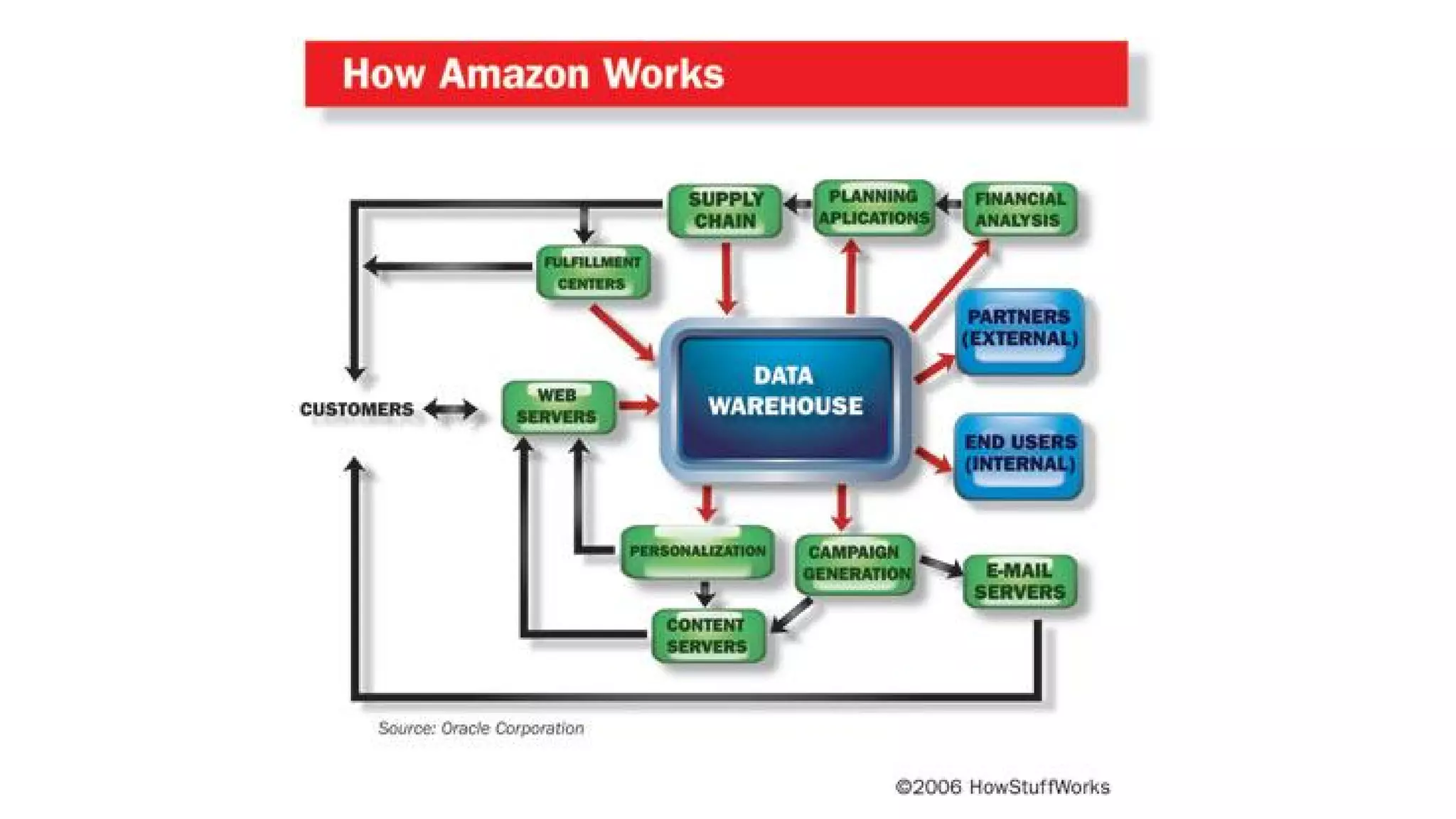
Amazon Technology
he massive technology core that keeps Amazon running is entirely Linux-
based. As of 2005, Amazon has the world's three largest Linux databases, with
a total capacity of 7.8 terabytes (TB), 18.5 TB and 24.7 TB respectively. The
central Amazon data warehouse is made up of 28 Hewlett Packard servers,
with four CPUs per node, running Oracle 9i database software.
Amazon E-commerce
Amazon.com has always sold goods out of its own warehouses. It started as a
bookseller, pure and simple, and over the last decade has branched out into
additional product areas and the third-party sales that now represent a good
chunk of its revenue (some estimates put it at 25 percent).
Both retailers and individual sellers utilize the Amazon.com platform to sell
goods. Large retailers like Nordstrom, Land's End and Target use Amazon.
com to sell their products in addition to selling them through their own Web
sites. The sales go through Amazon.com and end up at Nordstrom.com, Land's
End.com or Target.com for processing and order fulfillment. Amazon essentially
leases space to these retailers, who use Amazon.com as a supplemental outlet
for their online sales.
Small sellers of used and new goods go to Amazon Marketplace, Amazon
zShops or Amazon Auctions. At Marketplace, sellers offer goods at a fixed
price, and at Auctions they sell their stuff to the highest bidder. Amazon zShops
features only used goods at fixed prices. If an item listed on zShops,
Marketplace or Auctions is also sold on the main Amazon.com, it appears in a
box beside the Amazon.com item so buyers can see if someone else is selling
the product for less in one of the other sales channels.
Amazon Tools, Marketing and Community
The goal is pretty straightforward: "To be Earth's most customer-centric
company where people can find and discover anything they want to buy
online." The implementation is complex, massive and dynamic. Amazon's
marketing structure is a lesson in cost-efficiency and brilliant self-promotion.
Amazon's associates link to Amazon products in order to add value to their own
Web sites, sending people to Amazon to make their purchases. It costs
Amazon practically nothing. Some associates create mini-Amazons -- satellite
sites that do new things with Amazon data and send people to the mothership
when they're ready to buy. Amazon Light, built and maintained by software
developer Alan Taylor, is one of those satellite sites.

無題プレゼンテーション2

  • 1.
    How Amazon BusinessWorks ID: s1200017 Reference: http://computer.howstuffworks.com/amazon.htm
  • 2.
    Amazon.com sells lotsand lots of stuff. The direct Amazon-to-buyer sales approach is really no different from what happens at most other large, online retailers except for its range of products. You can find beauty supplies, clothing, jewelry, gourmet food, sporting goods, pet supplies, books, CDs, DVDs, computers, furniture, toys, garden supplies, bedding and almost anything else you might want to buy. What makes Amazon a giant is in the details. Besides its tremendous product range, Amazon makes every possible attempt to customize the buyer experience. Amazon.com Basics
  • 3.
    When you arriveat the homepage, you'll find not only special offers and featured products, but if you've been to Amazon.com before, you'll also find some recommendations just for you. Amazon knows you by name and tries to be your personal shopper. he embedded marketing techniques that Amazon employs to personalize your experience are probably the best example of the company's overall approach to sales: Know your customer very, very well. Customer tracking is an Amazon stronghold. If you let the Web site stick a cookie on your hard drive, you'll find yourself on the receiving end of all sorts of useful features that make your shopping experience pretty cool, like recommendations based on past purchases and lists of reviews and guides written by users who purchased the products you're looking at.
  • 4.
    Amazon Technology he massivetechnology core that keeps Amazon running is entirely Linux- based. As of 2005, Amazon has the world's three largest Linux databases, with a total capacity of 7.8 terabytes (TB), 18.5 TB and 24.7 TB respectively. The central Amazon data warehouse is made up of 28 Hewlett Packard servers, with four CPUs per node, running Oracle 9i database software.
  • 6.
    Amazon E-commerce Amazon.com hasalways sold goods out of its own warehouses. It started as a bookseller, pure and simple, and over the last decade has branched out into additional product areas and the third-party sales that now represent a good chunk of its revenue (some estimates put it at 25 percent).
  • 7.
    Both retailers andindividual sellers utilize the Amazon.com platform to sell goods. Large retailers like Nordstrom, Land's End and Target use Amazon. com to sell their products in addition to selling them through their own Web sites. The sales go through Amazon.com and end up at Nordstrom.com, Land's End.com or Target.com for processing and order fulfillment. Amazon essentially leases space to these retailers, who use Amazon.com as a supplemental outlet for their online sales. Small sellers of used and new goods go to Amazon Marketplace, Amazon zShops or Amazon Auctions. At Marketplace, sellers offer goods at a fixed price, and at Auctions they sell their stuff to the highest bidder. Amazon zShops features only used goods at fixed prices. If an item listed on zShops, Marketplace or Auctions is also sold on the main Amazon.com, it appears in a box beside the Amazon.com item so buyers can see if someone else is selling the product for less in one of the other sales channels.
  • 8.
    Amazon Tools, Marketingand Community The goal is pretty straightforward: "To be Earth's most customer-centric company where people can find and discover anything they want to buy online." The implementation is complex, massive and dynamic. Amazon's marketing structure is a lesson in cost-efficiency and brilliant self-promotion. Amazon's associates link to Amazon products in order to add value to their own Web sites, sending people to Amazon to make their purchases. It costs Amazon practically nothing. Some associates create mini-Amazons -- satellite sites that do new things with Amazon data and send people to the mothership when they're ready to buy. Amazon Light, built and maintained by software developer Alan Taylor, is one of those satellite sites.