* GB785368 (A)
Description: GB785368 (A) ? 1957-10-30
Improvements in or relating to metal structures
Description of GB785368 (A)
PATENT SPECIFICATION
Date of filing Complete Specification: Dec 14, 1955.
Application Date: Sept14, 1954 No 26539/54.
Complete Specification Published: Oct 30, 1957.
Index at acceptance:-Class 20 ( 1), A( 1: 8).
International Classification:-E 04 h.
COMPLETE SPECIFICATION
Improvements, in or relating to Metal Structures I, SAMUEL HAYWARD, a
British Subject, of 66 Woolmore Road, Erdington, Birmingham, do hereby
declare the invention for which I pray that a patent may be granted to
me, and the method by which it is to be performed, to be particularly
described in and by the following statement:-
This invention relates to metal buildings and provides a new and
convenient mode of construction The invention is applicable to
buildings of various sizes and the smaller structures such as cubicles
or cupboards.
According to the present invention the framework of a metal structure
comprises tubular members interconnected by junction members having
portions to fit into the ends of the bores of the tubular members to
be joined and is held together by metal sheet or the like forming the
skin of the structure.
An embodiment of the invention will now be described with reference to
the accompanying drawings which illustrate a typical structure for a
ridged portable building according to the invention.
Figure 1 is a perspective view of the complete framework with the
outer sheet metal skin panelling partly broken away.
Figure 2 is an enlarged perspective view of a detail.
Figure 3 illustrates a further constructional detail.
The framework of the building comprises spaced horizontal longitudinal
tube members 3 for the side walls, 4 for the lower part of the roof
and 5 at the ridge At each end of the building these tubes fit over
the stem part of T-shaped junction members 6 the cross bars of which
fit into the bores of the aligned ends of tubes forming the end
frames.
Each end frame comprises inclined rafter tubes 7 between and joining
the T-shaped junction members 6 at the ends of the longitudinal tube
members 4 and 5 At the ridge the junction members at the ends of the
longitudinal ridge tubes 5 are each joined by 785368 short coupling
tubes 8 to junction member bends 9 Similar coupling tubes 8 join the
T-shaped junction members 6 at the ends of the longitudinal roof tubes
4 to specially 50 shaped junction members 10 (see Figure 2) having
three arms two of which are formed by a length of tube bent to an
angle to suit the required inclination of the roof and the third by a
short piece of tube welded to the 55 inside of the curve of the bent
tube and at right angles to one of its ends.
This third arm is fitted to a cross-member 11 forming with the rafter
tubes 7 the principal elements of a roof truss The arm to 60 which the
third arm is at right angles is joined by a coupling tube 8 to a
T-shaped junction member 6 at the end of the upper side tube 3.
At the front end of the building the T 65 shaped junction members at
the ends of the upper and lower side tubes 3 are joined by coupling
tubes 8 to T-shaped junction members 12 similar to the junction
members 6 and angularly movable in the coupling tubes 70 8 to form
hinges for subsidiary swingable frames 13 for doors The junction
members 12 of each door frame are spaced apart by upright tubes 14
which also form part of the main framework 75 Each door frame
comprises upper and lower tubes 15 joined at the free ends of the
frames by T-shaped junction members 16 to upright members 17 The
T-shaped junction members 16 are similar to the junction 80 members 6
with the addition of fastening bolts 18 for the doors, the casings of
which bolts are welded directly to the free arms of the junction
members 16 Similarly a lock is welded directly to a T shaped junction
85 member 19 inserted in one of the upright members 17.
The construction of the rear end frame is similar except that
provision is made for hinges for only a single door 20 in one side 90
of the building.
An intermediate transverse frame 21 is similar to the end frames
except that instead of T-shaped junction members 6 cruciform junction
members 22 are employed to enable the intermediate frame to be joined
to axially aligned portions of the longitudinal tubes 3, 4 and 5
extending to front and rear of the intermediate frame.
To complete the end and intermediate ransverse frames a bottom tubular
member 26 is employed with 1 angle junction members 27 to ioiin it to
the lowvrmost unction members 6 or 22.
Al Ser assembly o the framework the sheet rmetal panelling 23 is
applied and secured to the tubular frame members for ensample by dia
Letral bolts or rivets or by U or hook bolts In Figure 2 hook bolts 24
are illustrated Tne panelling is shown as an outer s 51 in but may be
a lining The panels may be single large sheets or smaller sheets
riveted, bolted or otherwise joined together to form panels large
enough to overlap the frame work members to which thiey are secured by
the hook bolts In this way the tubular members are held firmly engaged
wvid the junction members when the hook bolts 24 have been tightened
up.
Care must be taken to ensure that all joints are locked by the
panelling At the ridge a ridge piece (cappinig) 25 is used with hook
bolts 24 engaging the longitudinal tubes on each side of the ridge At
the eaves the side panelling 23 is continued upwards as shown in
Figure 3 and secured by a hook bolt 20 fitted with its hookl between
the fork of the two adjacent arms of the junction member 10 thus tying
the roof framework to the wall structure All the joints in the
frameworks illustrated may be locked by the panelling with the
exception of the crosstube 11 of the intermediate frame which is
preferably bolted or riveted to the third arm of the junction members
10.
To avoid an excessive number of short lengths oif tube adjacent
junction members may be directly welded together to form a unit For
example, the junction members 22 and 10 seen in Figure 2 may be welded
directly together, with or without the intermediate coupling tubes 8,
to form a single unit Alternatively complex junction members may be
specially formed as a unit from suitably shaped lengths of tube welded
together.
In these ways the number of components required for the assembly of a
structure of set design can be reduced Such relatively complex
junction members may be easily manufactured and packed for transport
with the few tubular frame members required ready for assembly on the
site Nevertheless the framework illustrated in the drawings has
considerable advantage in flexibility and a relatively small range of
components can be used to build a varietv of structures 65 and
buildings The junction pieces may conveniienltly be made of standard
iron pipe and the tubular frame members from metal tubing such as that
used fc, electrical conduit 70 Altiiough the i,-nvention has been
specificallv described in connection with the conStrilci Oi of
ortabl-e buildings it is obvious that the invention may readily be
applied to other structures such as partitioning, 75 cubicles and
cupboards By the method of construction according to the invention
metal framed structures can be simply and inexpensively made and
readily assembled.
* Sitemap
* Accessibility
* Legal notice
* Terms of use
* Last updated: 08.04.2015
* Worldwide Database
* 5.8.23.4; 93p
* GB785369 (A)
Description: GB785369 (A) ? 1957-10-30
Improvements in or relating to machines for mixing granular materials such
as concrete
Description of GB785369 (A)
PATENT SPECIFICATION
785,369 Date of filing Complete Specification: Sept 28, 1955.
No 28074/54.
Complete Specification Published: Oct 30, 1957.
Index at acceptance:-Class 86, C 18 G 4 B. International
Classification:-BO 2 g.
COMPLETE SPECIFICATION
Improvements in or relating to Machines for Mixing Granular Materials
such as Concrete We, THE LINER CONCRETE MACHINERY COMPANY LIMITED, a
British Company, of Park Road Works, Park Road, Gateshead 8, and
CHARLES BA Rw Ic K ABBEY, a British SubS ject, of 119, Church Road,
Low Fell, Gateshead 9, both in the County of Durham, England, do
hereby declare the invention, for which we pray that a patent may be
granted to us, and the method by which it is to be performed, to be
particularly described in and by the following statement: -
This invention relates to machines for mixing granular materials such
as concrete, of the kind in which the mixing pan is stationary and the
mixing means, such as axially rotatable mixing blades, scraper blades,
and, if desired, rollers are rotatable.
The form of mixer of the kind above referred to has the drawback that
owing to the space occupied by the mixing means, and the frame on
which they are mounted, a relatively narrow annular space only is
available for feeding the materials to be mixed into the stationary
pan; while there is the further disadvantage that owing to the
material being located adjacent the periphery of the pan, it takes
several revolutions of the, mixing means before it is evenly
distributed over the surface of the pan, so that a longer time is
required to obtain a thorough mix The object of the present invention
is to provide improved feeding means whereby this drawback may be
overcome.
According to the invention the material is fed to the mixing pan
through a vertical passage which is co-axial with the axis of rotation
of the mixing means, so that it arrives in the centre of the pan.
Not onlv does this axial feeding overcome the above objection, but as
the material is fed into the centre of the pan the mixing means are
alwavs in contact with it and so spread it quickly and evenly over the
pan in a thoroughly mixed condition; whereas when the material is fed
into the side of the pan the mixing means come into contact with it
only lPrice 3 s 6 d) intermittently, so that the spreading and mixing
take longer to obtain the same intimate mix.
The invention will now be described by 50 way of example with
reference to the accompanying semi-diagrammatic drawings which show
its application to a concrete mixing machine.
In the drawings: SS Fig 1 is a sectional elevation of the mixing
portion of the machine.
Fig 2 is a plan of Fig 1, with the hopper omitted.
Referring more particularly to the draw 60 ings, the mixing machine
comprises a vertical frame A consisting of two uprights 1, 2, a base
3, and a transverse twin beam 4 On the base 3 there is mounted a
stationary mixing pan B The mixing means comprise 65 scraper blades 5
and 6, and a rotary threebladed star C whose blades 7 are adapted to
sweep over the radius of the pan B, while the one scraper blade 5 has
its edge arranged adjacent the wall of the pan B and the other TO
scraper blade 6 has its edge adjacent the base of the pan The
direction of rotation of the mixing assembly and the pivotal rotation
of the star C is the same and is indicated by the arrows x, y is On
the under side of the beam 4 there is rigidly secured an inverted
circular flanged disc 8 through whcih projects upwards and downwards a
vertical bearing 9 of relatively large diameter which is coaxial with
the axis 8 s of the mixing pan B On the underside and outside of the
bearing 9 there is rigidly mounted a spur wheel 10 with which meshes a
pinion 11 mounted at the upper end of a vertical shaft 12 on the lower
end of which is 85 rigidly mounted the star C The shaft 12 is mounted
in bearings in a casing 13 passing through a bore formed near the
periphery of a carrier member in the form of a dished housing 14
having a vertical peripheral flange 9 ej which is a rotating fit
inside the flange of the stationary inverted disc 8 and to which
Application Date: Sept 29, 1954.
flange 15 the blades 5 and 6 are secured, the is co-axial with the
axis of rotation of the drive of the shaft 12 thus being entirely en
mixing means, so that it arrives in the centre closed At the central
portion of the hous of the pan.
* Sitemap
* Accessibility
* Legal notice
* Terms of use
* Last updated: 08.04.2015
* Worldwide Database
* 5.8.23.4; 93p
* GB785370 (A)
Description: GB785370 (A) ? 1957-10-30
Improvements in or relating to liquid fuel fired boilers
Description of GB785370 (A)
PATENT SPECIFICATION
Date of Application and filing Complete Specification: Oct 6, 1954.
785,370 No 28741154.
 1/ Complete Specification Published: Oct30, 1957.
Index at acceptance:-Classes 51 ( 1), B 18 B, BA 8 (B 7:W:J:L:54); 75
( 1), TA 2 C, TC( 11:22)> and 75 ( 3), F 7 (F:J).
International Classification:-F 21 g, F 23 d, g.
COMPLETE SPECIFICATION
Improvements in or relating to Liquid Fuel Fired Boilers We, Luis CRI
Cc A and Luis MARIA ZAMBRINI, Argentine Citizens of Entre Rios 637,
Martinez, Buenos Aires, Argentina, do hereby declare the invention,
for which we pray that a patent may be granted to us, and the method
by which it is to be performed, to be particularly described in and by
the following statement:-
The present invention relates to a liquid fuel-fired boiler for use
with medium weight liquid fuels, and it has for its object to provide
a simple and inexpensive arrangement of such boiler which is capable
of automatic control and which possesses substantial advantages over
the known boilers, in that due to its characteristics it is capable of
working effectively without the provision of chimney draught and it
can be incorporated with hot water installations in which the
temperature is likely to vary to meet differing heating requirements.
These two fundamental characteristics are of primary importance, as
first they allow of the installation of the boiler where tall chimneys
with correspondingly strong draught cannot be provided and, secondly,
no working attention is required so that, when started, this boiler
provides the required hot water.
The boiler can readily be applied in the most varied manner, such as
that of central heating, or for providing hot water for kitchens
and/or bathrooms and other uses.
According to the present invention there is provided a boiler equipped
with an automatically operated liquid fuel burner wherein the boiler
is a hollow, bell-like structure in the form of an annular cylinder
which is closed at its top and base, said cylinder having an inlet and
an outlet respectively for cold and hot water, a liquid fuel burner
arranged below said boiler, a tubular member disposed above the burner
and extending into the bore of said boiler and forming between the
exterior of said member and the lPrice 3 ce 4 S 6 bore of said boiler
a combustion chamber having an exit for combustion products, liquid
fuel feed regulating means for said burner, and a thermostat on said
boiler responsive to the water temperature therein 50 for controlling
said regulating means.
According to another aspect of the invention there is provided a
boiler equipped with an automatically operated liquid fuel burner,
wherein the boiler is a hollow, bell-like 55 structure in the form of
an annular cylinder which is closed at its top and base, said cylinder
having an inlet and an outlet respectively for cold and hot water, a
liquid fuel burner arranged below said boiler and having 60 a liquid
fuel tray, regulating means for supplying fuel to said tray to a
constant level, a vaporising tube disposed above said burner and said
tube extending into the bore of said boiler and adapted to be heated
thereby, 65 the lower part of said tube being situated below the upper
edge of said liquid fuel tray but above a predetermined fuel level of
said tray, said tube being adapted to draw in atmospheric air which
can be preheated by 70 the hot gases of the burner.
According to a further aspect of the in; vention there is provided a
boiler equipped with an automatically operated liquid fuel burner
wherein the boiler is a hollow bell 75 like structure in the form of
an annular cylinder which is closed at its top and base and having an
inlet and an outlet respectively for cold and hot water, a tubular
deflector arranged within and spaced from the inner 80 wall of the
boiler and forming a combustion chamber, a liquid fuel burner arranged
at the lower end of the deflector, means for removing spent gases from
the combustion chamber and thermostatically controlled means 85 for
regulating the fuel feed in response to the temperature of the water.
A liquid fuel-fired boiler according to the invention is illustrated
by way of example on the accompanying drawings, in which: -90 2
785,370 Fig 1 shows a vertical section in elevation of the boiler
which achieves complete combustion of a vaporized fuel by means of an
additional supply of air; Fig 2 illustrates the thermostat, seen in
Fig 1, on a larger scale; Fig 3 illustrates a boiler which achieves
complete combustion by means of an additional jet of steam; and Fig 4
illustrates the injector nozzle of the fuel mixture used in the
embodiment of Fig.
3, in section and on a larger scale.
In Fig 1 combustion is achieved by the oxidation of the molecules of
carbon monoxide produced in the primary, incomplete combustion, with
atmospheric oxygen, said oxidation taking place within a vertical iron
tube, which is heated by the self-same combustion, and, in the
embodiment shown in Fig 3, combustion of the fuel is achieved by the
oxygen contained in a jet of superheated steam, which in turn draws a
quantity of air into contact with a spray of hydrocarbon droplets at
high temperatures, the oxygen causing the combustion of a portion
thereof, whilst the remainder are dissociated into carbon and
hydrogen.
The hydrogen produced, due to its greater affinity for oxygen,
instantly combines to form high temperature steam, thereby assisting
the reaction of the free particles of carbon and the steam to form
carbon monoxide and a fresh amount of hydrogen These two combustion
gases then combine with more oxygen to form carbon dioxide and steam
thereby producing complete combustion with total yield of the calories
available and without any smoke.
The boiler shown in Fig 1 contains a flame deflector 1 in the form of
a cylindrical metal tube situated inside the combustion chamber 2 The
deflector 1 is fixed vertically above a circular tray 3, so that its
lower edge is spaced at a certain distance from the bottom of said
tray 3 and also from a constant level 4 of the fuel contained therein.
A feed pipe 5 leads form a fuel feed tank 6 to the bottom of the tray
3 This feed pipe 5 has an extension 7, closed by a screw plug 8,
whereby and wherein any impurity contained in the fuel collects and
can readily be removed.
A float 9 is provided within the fuel tank 556 and is connected to a
needle valve 10, whereby a constant level of liquid fuel is maintained
in the feed tank 6, and consequently in the tray 3 This valve 10 is
connected to the fuel storage tank (not shown) by a pipe 11.
The flow of liquid fuel entering the tray 3, by gravity from the feed
tank 6, is regulated by a needle valve 12, provided within the pipe 5,
adjustable by a screw thread and hand wheel 13, extending beyond the
fuel feed tank 6.
Another needle valve 14, is provided to control the opening leading
from the fuel feed tank 6 to the feed pipe 5, and is adapted to be
controlled automatically by means of 70 the thermostat 15, with which
it is combined by mechanical means.
A wick 16 is provided at the edge of the tray 3 and constitutes a
pilot flame When the fuel feed is closed, this wick 16 is fed 75
directly from the fuel feed tank 6 by means of the pipe 17, controlled
by another needle valve 18, adjustable by means of the hand wheel 19.
The boiler comprises a bell-shaped hous 80 ing 20, surrounding and
defining the combustion chamber 2, and provided at its base with an
outlet 21 for the spent gases This housing 20 is surrounded by another
similar bell-shaped housing 22, of greater volume, 85 forming an
annular space between the two housings 20, 22 and constituting the
boiler.
The whole installation may be enclosed in yet another casing 23, which
may be insulated so as to prevent heat dissipation 90 In this
embodiment, where the outlet of spent gases 21 is situated at the
lower part of the boiler, a chimney of no great height is necessary to
carry away the gases In those cases where a chimney is undesirable and
95 when it is not sought to utilize the total amount of heat
generated, the spent gas outlet can be situated at the upper part of
the boiler (not shown in the drawings), whereby sufficient draught
will be produced to enable 100 the chimney to be eliminated
completely, but causing the loss of a portion of the heat generated,
as the spent gases will not have time to cool before their exit.
A recess is provided in the side of the 105 exterior housing 22,
wherein the thermostat is situated so as to receive the calories
corresponding to the heat of the liquid in the boiler by conduction
and by radiation.
This thermostat 15, which is shown in 110 greater detail in Fig 2,
consists of a thermal bellows 24 preferably of copper, containing a
certain amount of sulphuric ether Upon expanding, the bellows 24,
actuates the lever 25, regulated by the screw dial 26, which in 115
turn, moves the rod 27, the lower end of which is operatively
connected to the needle valve 14 and controls the movement thereof.
A handwheel 28, having an eccentric attachment 29, is adapted to raise
the lever 25, 120 independently of the expansion of the bellows 24, so
as to lower the needle of the valve 14, closing same and thereby
shutting off the fuel feed pipe 5, leaving only the pilot flame
alight, which latter, as already stated, 125 has its own independent
fuel feed 17.
To give greater stability and to prevent any deformation of the boiler
by the pressure existing in the space defined bv the walls 20, 22, the
said walls can be co-operatively 130 785,370 785,370 strengthened by
means of one or more tension tie-rods 30.
The boiler is started up by pouring a small quantity of volatile fuel
upon the surface of the medium weight fuel in the tray 3 and lighting
same thus forming a secondary flame The heat produced by this
secondary flame heats the deflector 1 and establishes a current of air
that passes over the surface of the burning fuel in the tray 3 and
ascends through the deflector 1 The air supply assists the combustion
of the primary flame generated in the tray 3, by volatilizing the
heavier hydrocarbons and thereby completing their combustion, and the
natural draught of the chimney removes the hot gases of the flame
chamber, consisting of the space between the inner housing 20 and the
deflector 1, so that the said hot gases, coming into contact with the
housing 20, which forms one of the walls of the boiler, transmit their
heat to the water contained in same, becoming heavier on cooling and
descending to the outlet 21.
The boiler will absorb the heat generated both by radiation and by
convection from the deflector tube 1 As soon as the water reaches the
predetermined temperature the thermostat 15, which has been pre-set,
moves the lever 25 and the rod 27 then operates to close the needle
valve 14, shutting off the fuel feed, putting out the main flame and
leaving only the wick 16 alight.
When the temperature of the water falls below a predetermined degree,
the needle valve 14 controlled by the thermostat 15 again opens and
allows fresh fuel to flow into the tray 3, where it is set alight by
the pilot flame and the heating cycle is restored.
Cold water enters the boiler through the pipe 31, situated at the
lowest point of same and hot water leaves the boiler by the pipe 32,
provided at the uppermost part.
In the embodiment shown in Fig 3, the construction of the boiler and
its accessories, the feed system for the liquid fuel and the
thermostatic control of said system are all identical with the
corresponding parts of the former embodiment shown in Fig 1, the
method of combustion and the apparatus therefor being the only
differences.
This embodiment, as shown in Fig 3, consists of a boiler defined by
two bellshaped walls 20, 22, joined at their base and having the
deflector 33 centrally positioned, but in this case the deflector need
not extend upwardly to the ceiling of the boiler, as it need be only
of a height sufficient to reach above the spent gas outlet 21.
6 ( The burner consists of a tray 34, smaller in size than that of the
former embodiment, having a raised central portion 35, provided with
an opening 36 ' which is preferably circular.
A small annular chamber of iron sheet 36 is fixed above the fuel tray
34, having a central passage for the combustion flame from the tray 34
This chamber contains a certain amount of water which is maintained at
a constant level and replaced as it boils 70 away, from a storage tank
(not illustrated).
The water feed tank, controlled by means of a float valve 37,
communicates with the water chamber 36 by two pipes 38, 39 One of
these said pipes 39 is the feed water con 75 duit and the other 38 is
provided in order to equalize the pressure in both the water chamber
and the feed tank.
The water chamber 36 has a steam filter at its upper part, the object
of same being 80 that of preventing particles of incrustation from
entering an ejector nozzle 42.
A pipe 41 leads from water chamber 36 and filter 40 to the ejector 42
situated below the opening 36 ' in the tray 34 85 The ejector 42,
which is illustrated on a larger scale in Fig 4, consists of two
concentric tubes 43, 44, the inner tube 43 conducting steam and the
outer tube 44 conducting liquid fuel The outer tube 44 is connected 90
to the pipe 5, which leads the fuel from the feed tank 6 This pipe 5
extends beyond the ejector 42 and is connected to the tray 34 by a
vertical portion 45, a screw plug 8 being provided for the removal of
accumu 95 lated impurities in the fuel.
A pilot flame 16 ' is provided in this embodiment, with identical feed
means as already described.
This boiler functions as follows: A small 100 quantity of volatile
fuel is poured on the surface of the liquid fuel in the tray 34 and
this is set alight as between described.
The flame of the fuel in the tray 34 passes through the chamber 36 and
heats the water 105 therein contained, producing steam which passes
the filter 40 and emerges through the ejector 42 where it generates a
suction in the pipe 5 and automatically draws fuel through same 110
The pressure in the water chamber 36 should always be less than that
of the column of water above its feed tank, so that the requisite
amount of feed water can enter the chamber 36 to maintain the level
115 there.
The steam leaving the ejector 42 through the interior tube 43 causes a
suction in the exterior tube 44 and thereby moves the fuel along the
pipe 5 and atomizes same into fine 120 droplets mixed with steam,
which are set alight by the primary flame and burn above the tray 34.
Complete combustion of the fuel from the ejector 42 takes place in the
flame chamber 125 2 as described above and the heat generated is
transmitted to the water in the boiler in the manner described in the
former embodiment.
When the atomized fuel commences to 130 at 785,370 leave the ejector
42 the pipe 5 ceases to feed the tray 34, where the flame goes out as
soon the the fuel in same has been consumed.
The pilot flame 16 ' remains alight having an independent feed.
As soon as the water in the boiler reaches the desired temperature,
the pre-set thermostat 15, by means of the lever 27 and the needle
valve 14 shuts off the fuel feed from the tank 6, whereupon the
ejector flame goes out and the water chamber 36 ceases to generate
steam.
When the temperature of the water in the boiler falls to a
predetermined degree the thermostat 15 again opens, the fuel feed
valve 14 and the tray 34 again fills with liquid fuel which is set
alight by the pilot flame 16 ', whereby a cycle for steam raising is
repeated as above described for the heating of water.
In this embodiment of the invention one or more ejectors may be
installed according to the requirements of the particular case.
Additional ejectors may be fixed either alongside the main ejector, or
at other effective positions.
* Sitemap
* Accessibility
* Legal notice
* Terms of use
* Last updated: 08.04.2015
* Worldwide Database
* 5.8.23.4; 93p
* GB785371 (A)
Description: GB785371 (A) ? 1957-10-30
Improvements in and relating to breathing apparatus and pressure control
valves therefor
Description of GB785371 (A)
COMPLETE SPECIFICATION
Improvements in and relating to Breathing Apparatus and
Pressure Control Valves therefor
We, NORMALAIR LIMITED, of West Hendford, Yeovil, in the County of
Somerset, a
British Company, do hereby declare the invention, for which we pray
that a patent may be granted to us, and the method by which it is to
be performed, to be particularly described in and by the following
statement:
The present invention relates to pressure control valves incorporated
with or associated with breathing apparatus. Such types of pressure
control valve or demand regulator, as they are sometimes known, are
supplied from a reservoir of pressurised oxygen or air or other
breathable gas via a pressure reducing valve and in turn deliver the
breathable gas to a face-mask or helmet or other suitable unit through
which a user breathes.
The pressure control valve forming the subject of this invention is
intended for use in breathing apparatus for use in an irrespirable
atmosphere, noxious atmospheres or for use under water and for example
may form part of a diving apparatus, mine rescue or mine survey
apparatus, fire service equipment, apparatus used by occupants of
aircraft at high altitudes, apparatus used by the occupant of an
aircraft who may be forced to make a parachute jump from an aircraft,
resuscitators or apparatus for administering an sthetic gases or
vapours.
With the customary lung-operated pressure control valve or demand
regulator, it has up to the present time been necessary to provide a
relatively large flexible diaphragm of a diameter normally in excess
of three inches, the use of such a large diaphragm being necessitated
by the demands of the user, which may vary from zero up to 200 litres
per minute, and to prevent undue breathing strain on the user. In
other words, to maintain a stable control of the opening of the
pressure control valve, the small changes of mask pressure resulting
from the varying demands of the user, must be magnified to a
satisfactory operating force by the use of a large diaphragm.
It is obvious that with known types the larger the diameter of the
diaphragm the smaller will be the depression required to operate it,
and therefore the operational strain will also be reduced.
One of the many adverse effects of the large diaphragm is the size and
weight of its casing which in many cases has caused additional harness
to be worn by the user, which again adversely affects the weight of
equipment to be carried. The size and weight factors of known pressure
control or demand regulators has made them generally unsuitable for
incorporation in or attachment to a face-type mask and such known
types accordingly of necessity have been attached to a part of the
body of the user or to a part of the user's apparatus other than the
facemask.
One of the objects of the present invention is to provide a pressure
control valve or demand regulator of relatively small dimensions,
preferably of the order of a maximum of 2" diameter, so that it can be
conveniently mounted or incorporated in a face mask or carried at any
position by the user without being unduly bulky or necessitating
special or additional harness or equipment.
The invention consists in a pressure control demand regulator valve
for breathing apparatus which valve is operated by suction on a small
elastic diaphragm to transmit a servo pressure to a second diaphragm
in such a manner that a main demand valve operates to deliver a
required flow of breathable gas at a pressure exceeding that of the
surrounding atmosphere to a mask associated with the breathing
apparatus.
The invention also consists in a pressure control demand regulator
valve as set forth in the preceding paragraph, in which pressure
supplied to the said valve may be in the region of 50 p.s.i. and which
may vary approximately 15 p.s.i. up or down without a substantially
noticeable change of suction characteristic in the mask.
The invention also consists in a pressure control demand regulator as
set forth in either of the two preceding paragraphs installed remotely
from a face mask and in which arrangement a suction tube operating the
valve is independent from a flow delivery tube so that the control
valve is always sensitive to mask pressure and is not affected by
pressure drop or variation along the delivery tube.
The invention also consists in a demand regulator substantially as
hereinafter described and as illustrated in Figure 1 or
Figure 2 or Figures 3 to 6 of the drawings.
Referring to the diagrammatic drawings accompanying the Provisional
Specification:
Figure 1 is a sectional view of one form of demand regulator embodying
the present invention, and
Figure 2 is a sectional view through the centre of an alternative form
of demand regulator.
Referring to the diagrammatic drawings accompanying this specification
:
Figure 3 is a plan view of a further modified construction,
Figure 4 is a vertical section on the line A-A of Figure 3, and
Figures 5 and 6 are sectional views on the line B-B and CK
respectively of Figure 3.
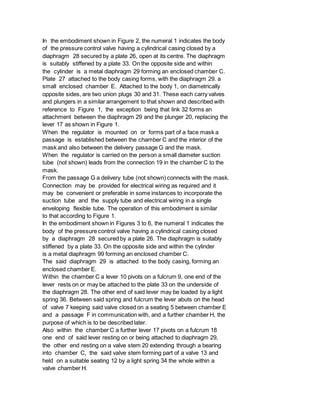
In the embodiment shown in Figure 1, the numeral 1 indicates the body
of a pressure control valve having a cylindrical casing closed by a
flexible diaphragm 2 protected by a perforated screen 21, to form an
enclosed chamber C, the diaphragm 2 being suitably stiffened by a
plate 33. On the opposite side of the chamber C is formed a recess
closed by a metal diaphragm 3 forming chamber E. Leading into one side
of the body 1 is a duct 4 reduced in the body to form a valve seating
5 and thereafter enlarged to form a pocket F, which is connected to
chamber E by a passage 16. A bearing 6 supports a valve 7 designed to
seat on 5 and protrude into the chamber C and beyond this is a
spring-loaded plunger 8. A lever 10 pivoted on a fulcrum 9 rests on
the head of the valve 7 and on the plunger 8 and at its other end
rests on or may be attached to the underside of diaphragm 2. At the
opposite side of the body 1 is a duct 11 reduced to form a valve
seating at 12, this being closed by a spring-loaded valve 13 which
valve has a stem or extension 20 extending through a bearing into the
chamber C and resting an a lever 17 resting on or attached to the
diaphragm 3 and pivoted on a fulcrum 18.
Adjacent to the valve seating 12 is a passageway G through which
passes an adjusting pin 14 extending into an orifice 15 leading from
the chamber E.
In operation, the valve is supplied with breathable gas at both ducts
4 and 11, via a first stage reducing valve (not shown), at
approximately 50 p.s.i., which may vary by 15 p.s.i. up or down
without noticeable change of suction characteristic in the mask. On
the wearer inhaling a depression is created in the chamber C by way of
the connection 19 to the mask (not shown) and it may here be mentioned
that by using a small diameter tube for suction only the regulator is
sensitive to mask suction and not to the suction upstream of a
delivery tube.
The depression set up in the chamber C causes the diaphragm 2 to
collapse inwards and press the lever 10 towards the opposite wall of
the body 1. The lever 10, swivelling on the fulcrum 9 compresses the
plunger 8 and releases the valve 7, thus allowing compressed gas to
enter the pocket F whence it travels via a duct 16 into the chamber E.
This high pressure forces the servo diaphragm 3 inwards taking the end
of the lever 17 with it. This lever, pivoting on fulcrum 18 presses
the main supply valve 13 open to deliver the required flow to the mask
via passage G.
On exhaling, pressure balance is restored across the diaphragm 2 which
is pressed outwards by means of the plunger 8 acting through the lever
10 which in turn closes the valve 7 to pressure. The pressure supply
from the duct 4 being now shut off, pressure in the chamber E will be
released via orifice 15, thus allowing the diaphragm 3 and valve 13 to
return to their original positions and cut off supply of gas to the
mask.
In the embodiment shown in Figure 2, the numeral 1 indicates the body
of the pressure control valve having a cylindrical casing closed by a
diaphragm 28 secured by a plate 26, open at its centre. The diaphragm
is suitably stiffened by a plate 33. On the opposite side and within
the cylinder is a metal diaphragm 29 forming an enclosed chamber C.
Plate 27 attached to the body casing forms, with the diaphragm 29. a
small enclosed chamber E. Attached to the body 1, on diametrically
opposite sides, are two union plugs 30 and 31. These each carry valves
and plungers in a similar arrangement to that shown and described with
reference to Figure 1, the exception being that link 32 forms an
attachment between the diaphragm 29 and the plunger 20, replacing the
lever 17 as shown in Figure 1.
When the regulator is mounted on or forms part of a face mask a
passage is established between the chamber C and the interior of the
mask and also between the delivery passage G and the mask.
When the regulator is carried on the person a small diameter suction
tube (not shown) leads from the connection 19 in the chamber C to the
mask.
From the passage G a delivery tube (not shown) connects with the mask.
Connection may be provided for electrical wiring as required and it
may be convenient or preferable in some instances to incorporate the
suction tube and the supply tube and electrical wiring in a single
enveloping flexible tube. The operation of this embodiment is similar
to that according to Figure 1.
In the embodiment shown in Figures 3 to 6, the numeral 1 indicates the
body of the pressure control valve having a cylindrical casing closed
by a diaphragm 28 secured by a plate 26. The diaphragm is suitably
stiffened by a plate 33. On the opposite side and within the cylinder
is a metal diaphragm 99 forming an enclosed chamber C.
The said diaphragm 29 is attached to the body casing, forming an
enclosed chamber E.
Within the chamber C a lever 10 pivots on a fulcrum 9, one end of the
lever rests on or may be attached to the plate 33 on the underside of
the diaphragm 28. The other end of said lever may be loaded by a light
spring 36. Between said spring and fulcrum the lever abuts on the head
of valve 7 keeping said valve closed on a seating 5 between chamber E
and a passage F in communication with, and a further chamber H, the
purpose of which is to be described later.
Also within the chamber C a further lever 17 pivots on a fulcrum 18
one end of said lever resting on or being attached to diaphragm 29,
the other end resting on a valve stem 20 extending through a bearing
into chamber C, the said valve stem forming part of a valve 13 and
held on a suitable seating 12 by a light spring 34 the whole within a
valve chamber H.
Leading into one side of the body 1 is a duct 31 which may be
connected by suitable means (not shown) to a supply of breathable gas,
the said duct 31 in communication with chamber H.
On the opposite side of the body 1 is a further duct 19 entering into
the chamber C (not shown). This duct may be connected by suitable
means (not shown) to the breathing mask.
Following after the valve seating 12 is a passageway G leading to the
breathing mask, a further passageway is provided (not shown) between
the chamber E and the passageway
G through an orifice 15 adjusted by a pin 14.
In operation, the valve is supplied with breathable -gas under
pressure at duct 31 via a first stage reducing valve (not shown).
The pressure may vary substantially up or down without noticeable
change of suction characteristic in the mask. On the wearer inhaling,
a depression is created in the chamber C by way of the connection 19
to the mask (not shown) and it may here be mentioned that by using a
small diameter tube for suction only the regulator is sensitive to
mask suction and not to the suction upstream of a delivery tube.
The depression set-up in chamber C causes diaphragnn 28 to collapse
inwards pressing the lever LO towards the opposite wall of the body 1.
The lever 10 pivoting on fulcrum 9 allows the valve 7 to rise, thus
allowing gas to enter the chamber E by way of chamber H and passages F
and 16. This high pressure forces the servo diaphragm 29 upwards
carrying lever 17 with it. This lever pivoting on fulcrum 18 presses
the main supply valve 13 open to deliver the required flow to the mask
via passage G.
On exhaling, pressure balance is restored across the diaphragm 28
which is pressed upwards by means of the spring 36 acting through the
lever 10 which in turn closes valve 7. The pressure supply from duct
31 being now shut off, pressure in chamber E is released via orifice
15, thus allowing diaphragm 29 and valve 13 to return to their
original positions, cutting off the supply of gas to the mask, as they
do so.
What we claim is: -
1. A pressure control demand regulator valve for breathing apparatus
which valve is operated by suction on a small elastic diaphragm to
transmit a servo pressure to a second diaphragm in such a manner that
a main demand valve operates to deliver a required flow of breathable
gas at a pressure exceeding that of the surrounding atmosphere to a
mask associated with the breathing apparatus.
2. A pressure control demand regulator valve as claimed in Claim 1 in
which pressure supplied to the said valve may be in the region of 50
p.s.i. and which may vary approximately 15 p.s.i. up or down without a
substantially noticeable change of suction characteristic in the masks
3. A pressure control demand regulator as claimed in Claim 1 or Claim
2 installed remotely from a face mask and in which arrangement a
suction tube operating the valve is independent from a flow delivery
tube so that the control valve is always sensitive to mask pressure
and is not affected by pressure drop or variation along the delivery
tube.
4. A demand regulator substantially as hereinbefore described and as
illustrated in
Figure 1 or Figure 2 or Figures 3 to 6 of the drawings.
* GB785372 (A)
Description: GB785372 (A) ? 1957-10-30
Machines for assisting manual wrapping operations
Description of GB785372 (A)
COMPLETE SPEXICAEON Macbines for Assisting Wtanua Wrag:piing
Operations
We, PORSTERS MACHINE COMPANY
LIMITED a British company, of 17, Yeading
Lane, Hayes, Middlesex, do hereby declare the invention, for which we
pray tliat a patent may be granted to us, and the method by which it
is to be performed, to be particularly described in and by the
following statement: -
This invention relates to wrapping machines having means for assisting
manual operations during file wrapping of an article.
The invention is applicable in connection with the wrapping of a
limited number of articles of the same shape during a comparatively
short run, the number of articles being such as not to justify the
employment of an automatic wrapping machine.
In the present invention the operation is essentially manual, but the
operator is provided with certain mechanical and electrical aids. Such
aids may include an electrically actuated cutter for cutting o " a
measured length of material from a roll and means for carrying out
certain or the tucking and folding operations when a partially wrapped
article is pushed through said means by the operator.
The operator stands or sits in front of a machine, which includes a
framework supporting a roll of wrapping paper so mounted as to be
freely rotatable. The paper is led upwardly over direction controlling
rollers and towards the operator, who may pull a measured or pre
determined length of paper forwardly over the wrapping table and may
then, preferably by a pedal operated switch, actuate transverse
cutting mechanism. The uncut paper is prevented from moving backwardly
by frictional or other ratchet mechanism.
The operator then places the article in position and encircles the
packet with the wrapping material, bringing the ends together so that
they overlap after which the said ends are sealed together by heating
or other means conveniently located on the wrapping table.
For completing the side tucking and final folding operations the
partially wrapped packet is pushed by the operator through a tucking
and folding assembly having associated therewith heat or other final
sealing means for the wrapped packet.
The invention comprises a wrapping machine having means for assisting
manual operation during the wrapping of an article comprising; means
for supporting a roll of wrapping material; a wrapping table over
which an operator pulls forward a length of material from the roll; a
transverse cutter for severing a measured length of material; means
for sealing the ends of the wrapping material after it has been
wrapped round the article by the operator; and mechanism by which the
side tucking and folding operations are carried out when the packet is
pushed through the mechanism by the operator.
The invention also comprises a wrapping machine having means for
assisting manual operation during the wrapping of an article
comprising; a frame work having a wrapping table before which the
operator stands, means for supporting a roll of wrapping material; a
transversely movable cutter for cutting off a length of wrapping
material; heating or other sealing means for securing the wrapping
material after it has first been wrapped round the article by the
operator, and means for com pleting the wrapping operation at the two
sides while the article is pushed through said means
by the operator.
In the embodiments of the invention shawn by way of example in the
accompanying drawmgs:-
Figure 1 shows a front elevation of the apparatus with the front panel
removed;
Figure 2 shows a vertical side elevation in section;
Figure 3 shows a vertical section of a cutting device; and
Figure 4 shows a further vertical section of the cutting device taken
on a plane at right angles to the plane of Figure 3.
The frame work of the wrapping apparatus includes four vertical bars 1
of light angle or other section and a number of horizontal bars 2
running both transversely and longitudinally, these bars being
preferably welded at their anglers.
The upper front part, before which the operator stands, is arranged at
a convenient level and is provided preferably with a wood or other
non-metallic member 3 to form a table. A rearward extension is
arranged at a slightly higher level to constitute a further table or
support for the final tucking and folding mechanism. The vertical step
between the upper and lower tables and the supports is partly closed
by a vertical panel not shown sufficient opening being left for the
passage of the strip 16 of covering material and to leave room for the
operator's hands to grasp the edges of the strip of covering material
and pull it forward over the lower table. All four sides are
preferably closed by wooden or other nonmetallic panels 5, the front
panel having therein an opening or recess to protect a foot operated
switch 6 and allow operation thereof.
In the form illustrated a single roll 7 of thin covering machine is
shown mounted on two side bars 8, welded or otherwise rigidly secured
to the vertical frame members and providing additional strength and
rigidity.
These bars are of angle or other section with an inner upwardly
projecting flange 9 adapted to support the ends of a transverse shaft
12 carrying the roll 7. To prevent rolling movement of the shaft along
the bars 8, the reduced ends 14 of the shaft rest in a segment shaped
notch cut in the upper edge of the vertical flange 9 of each angle
member. Endwise movement of the shaft is prevented by shoulders
bearinT against the flanges 9.
The roll of material is mounted centrally on the bar by means which
facilitate rapid mount- ing or removal. These means comprise two
readily adjustable conical centralising members 15 engaging the centre
opening in the roll and clamped to the shaft 12 by any simple means.
Preferably the centralising members are split radially on one side and
provided with a bolt which clamps them on to the bar, the material
from which the said members are made being sufficiently elastic and
the members being so shaped that this method of clamping becomes
practicable.
The flexible strip 16 is led upwards from the rearmost side of the
roll 7 over one or more freely rctatable guide rollers 17. From the
last of these rollers, the strip 16 passes forward through the opening
in the vertical cover plate interposed between the operating table and
the upper support fcr the tucking and folding mechanism. The cutting
apparatus to be here- inafter described is located substantially in
the plane of fil cover plate. Friction ratchet or like mechanism 18 is
provided to prevent return movement of the strip of covering material
after it has been drawn forward by the operator.
It will be obvious that two or more rolls 7 of covering material may
be similarly supported on the said bars 8 and the material delivered
from said rolls may be superimposed and brought upwardly and forwardly
towards the cutting position as previously described. The rolls are
preferably of different widths so that the operator may select
material from that roll which is of the most suitable quality or width
for a given packet
The cutting apparatus consists of a transversely movable knife or
razor-like cutting element 19. This knife projects upwardly through a
transverse slot 22 in a cutting o.s plate 23 over which the wrapping
material is pulled by the operator, the wrapping material resting upon
this plate. The knife projects upwards suifficiently to cut the
material cleanly when it is moved transversely. A guard bar or shield
24 is brought above and in front of the knife 19 so as to avoid the
possibility of injury to the fingers of the operator. The end 25 of
the shield may enter the slot 22 to a point just below the upper end
of the cutting edge of the knife so as to depress the wrapping
material into the slot to facilitate cutting. The knife may however
project slightly above the level of the cutting plate 23. The slotted
cutting off plate may be replaced by a single cutting off plate, the
cutter being moved while in contact with or adjacent the edge of said
plate.
An endless chain 26 supported on cross bars 27 below the slotted plate
23 by means of brackets 31 has secured thereto an upwardly extending
block 28 which carries the cutting knife. The upper run of the chain
bears upon the edge of a horizontal guide plate, not shown, so as to
ensure correct rectilinear movement d the knife. The chain passes at
its end over sprockets 29, one of which is connected through reduction
gear 30 to an electric motor 31 mounted on the cross bars 27. The
sprocket at the nonZriven end may be replaced by a roller.
The motor 31 is started when the switch 6 is depressed by the foot of
the operator and it is stopped automatically after tile chain 26 has
made one complete rotation which includes movement of the knife 19
during the cutting operation. During the return movement, the knife
extends downwardly below the lower run of the chain. This cycle of
operations may be terminated by an additional switch operated by a
projection on or movable with the chain or by other means.
The operator, when wrapping an article, reaches forward with
preferably both hands so as to grasp the edges of the strip 16 of
covering material and draws it forward a certain amount, depending
upon the size of the article to be wrapped. For convenience the end of
the wrapping material may be drawn as far as a certain mark on the
table. The switch is then operated to effect the cutting operation.
The article is then placed in a suitable position on the cut oS
length, said position being preferably indicated by marks on the
table. The use of such marks is particularly advantageous with
transparent covering material. The cut off length may, however, first
be moved forwardly towards the operator clear of the cutting plate 26,
this position being also preferably indicated by marks on the table.
In the example shown, the article is placed towards the rearward edge
of the cut off piece of wrapping material so that the final overlap
will take place on the rearmost side of a rectangular article 32. The
operator first turns over the longer forwardly extending part of the
wrapping material by hand and then tilts the article as indicated at
321 so that the short end of the wrapping material overlaps the end of
the longer part. The article is then drawn forwardly with the
overlapping end bearing on the table until this end contacts a heater
33 as shown at 3211, thus sealing the covered ends.
The heater 33 is conveniently arranged on the chamfered or inclined
end of the table. The preceding operations complete the initial wrap
ping process and leave the wrapping material extending outwardly at
the two sides of the article. The succeeding wrapping operations
include the utilisation of apparatus which tucks the material in on
the vertical ends of the article and then folds downwardly and
upwardly the wings of covering material still extending outwardly
sideways.
This tucking and folding apparatus comprises a fixed part 34 and a
slideable part 35 hereinafter referred to as the front tucking plate,
the fixed part being secured to the case 36, which is supported from
the main frame by brackets 50, 51. The fixed part includes two sets of
tucking and side folding plates spaced transversely a distance equal
to the width of the packet Each set of side plates comprises a first
tucking plate 37, and further side plates 38, 39, so shaped as to
provide a first downwardly inclined folding slot 40 and a second
upwardly inclined folding slot 41. The three plates of each side are
rigidly secured by brackets to a suporting plate, which may be bolted
to the base 36, but is preferably so mounted thereon by screw
mechanism 42 that it may be adjusted transversely. The two sets of
side folding plates are right and left handed but otherwise identical
and may be readily removed and replaced by another set of different
dimensions when it is desired to effect a change in the dimensions of
the packets which are being wrapped. The two sets of side plates may
be mounted independently on the base 36 or may be mounted on a common
base member, which is readily removable from base 36.
Located in front of the fixed tucking and folding unit 34 is the front
tucking plate 35 which is slidable lengthwise of said unt. This
tucking plate is carried by a bracket 20 from a longitudinal bar 43
supported in bearings such as the double conical V-shaped roller
bearings 44 which provide a practically frictionless, but exact
rectilinear guiding movement. The plate is bent backwardly and
outwardly at its two ends. The bracket 20 moves in a slot 13 in the
base 36.
The front tucking plate is movable rearwardly until it meets the fixed
side tucking plates 37. The corresponding meeting surfaces are shaped
as indicated, that on the fixed tucking plate having a convex
projecting part 45 which enters a correspondingly shaped concave part
46 on the front tucking plate 35.
These corresponding surfaces are so placed as to facilitate lengthwise
movement of the article during the tucking and folding operations
while avoiding risk of the forward side tuck being lifted by the fixed
tucker as the package is moved rearwardly during the final folding
operations.
The package after the first previously described hand folding
operation is placed by the operator on the base plate 36 between the
fixed tucking and folding part 34 and the movable front tucking plate
35 and is drawn forwardly towards the operator between the doubly bent
folding plates 351 of the ends of the back plate 3511 into engagement
with the said back plate. During this movement the tucking operation
at the front end of the article is carried out. The movable tucking
plate is then moved forward with the article by the operator who
carries out this movement conveniently by grasping the bail or handle
47.
The packet is thus moved between the fixed side tucking plates 45
before further movement of the movable tucking plate is prevented by
engagement with the fixed tucking plates.
The front tucking plate is then withdrawn into such a position that a
second partially wrapped article can be inserted, after the pr
liminary wrapping operations have been carried out, between the end of
the movable tucking plate 35 and the first article. The second packet
is then moved forwardly into engagement with the movable tucking
plate, whereby the first side tucking operation is carried out on the
second article. The movable tucking plate and the second packet are
then moved rearwardly by the operator grasping the bail or bar 47
until the second article engages the first article and further side
folding operations on the first packet are thus carried out.
The second packet is similarly moved between the folding and sealing
elements by a third packet; in some cases the operation may require
three or more steps for completion. A succession of packets is thus
dealt with in steps, the tucked and folded sides of each packet in
turn being moved finally between heaters 381 on the end plates 39
thereby sealing and completing the wrapping of the article.
What we claim is:-
1. A wrapping machine having means for assisting manual operation
during the wrap- ping of an article comprising; means for supporting a
roll of wrapping material; a wrapping table over which an operator
pulls forward a length of material from the roll; a transverse cutter
for severing a measured length of material; means for sealing the ends
of the wrapping material after it has been wrapped round the article
by the operator; and machanism by which the side tucking and folding
operations are carried out when the packet is pushed through the
mechanism by the operator.
2. A wrapping machine having means for assisting manual operation
during the wrapping of an article comprising; a frame work having a
wrapping table before which the operator stands; means for supporting
a roll of wrapping material; a transversely movable cutter for cutting
off a length of wrapping material; heating or other sealing means for
securing the wrapping material after it has first been wrapped round
the article by the operator, and means for completing the wrap ping
operation at the two sides while the article is pushed through said
means by the operator.
3. A wrapping machine as claimed in Claim 1 or 2, in which the roll of
material is mounted within the apparatus at a lower level than the
wrapping table, the material being led upwards over rollers and into a
position adjacent the wrapping table whereby the operator may pull the
material forwardly as required.
4. A wrapping machine as claimed in Claim 1 or 2, in which the roll of
material is mounted centrally on a shaft by conical devices encircling
the shaft and adapted to be clamped thereto, the ends of the shaft
engaging a segment cut from a vertical flange of a horizontal frame
member, the ends of the shaft having flanges or washers to prevent
endwise movement
5. A wrapping machine as claimed in any of
Claims l to 4, provided with frictional or other ratchet like means
for preventing return movement of the wrapping material after it has
been pulled from the roll.
6. A wrapping machine as claimed in Claim 1 or 2, in which a
transversely movable cutter for the material comprises a knife secured
to the outer periphery of an endless chain and movable in a slot in a
cutting off plate, the knife projecting sufficiently to cut the
material which has been previously pulled over said plate into
position for cutting by the operator.
7. A wrapping machine as claimed in Claim 6, in which a projecting
guard bar or shield or the like is arranged above the upper part of
the cutter and is movable transversely therewith.
8. A wrapping machine as claimed in Claim 6, in which the upper run of
the said endless chain is supported by the upper edge of a plate or
bar to prevent sagging.
9. A wrapping machine as claimed in Claim 6 or 8, in which the endless
chain is led over a spracket at one end and a sprocl:et or roller at
the other end, and is actuated by an electric motor driving a sprocket
through a cycle at each operation, said cycle including one complete
rotation of the chain.
10. A wrapping machine as claimed in Claim 9, in which said motor is
actuated to complete the said cycle by a switch placed towards the
front of the machine conveniently for actuation by the foot of the
operator.
11. A wrapping machine as claimed in any of the preceding claims, in
which means for completing the side tucking and folding operations is
located rearwardly of an at a higher level than the wrapping table and
is adapted to receive the partially wrapped packet which is pushed
through the said means by the operator.
12. A wrapping machine as claimed in Claim 11, in which the said
tucking and folding means includes a movable first tucking plate
element and a fixed unit comprising on each side thereof a second
tucking plate and two side folding plates providing with the second
tucking plates, upwardly and downwardly inclined side folding slots.
13. A wrapping machine as claimed in Claim 12, in which the movable
tucking plate moves in a direction parallel to the planes of the
second tucking and side folding plates in the fixed unit.
14. A wrapping machine as claimed in
Claim 12, in which the end side folding plates are extended
sufficiently to carry sealing heaters or other sealing means b7 which
the sides of the wrapped packet are finally sealed.
15. A wrapping machine as claimed in Claim 3, in which a plurality of
rolls of wrapping material, preferably of di+erent widths, are
supported within the machine at a lower level than the wrapping tablet
th ends of the several strips of material being led over independent
sets of pulleys so as to be superimposed upon one another.
16. A wrapping machine as claimed in Claim 6, in which the slotted
cutting off plate is replaced by a single cutting off plate, the
cutter moving adjacent the edge of said plate.
17. A wrapping machine having means for assisting manual operation
during the wrapping of an article, substantially as described herein
with reference to the accompanying drawings.

4961 4965.output

  • 1.
    * GB785368 (A) Description:GB785368 (A) ? 1957-10-30 Improvements in or relating to metal structures Description of GB785368 (A) PATENT SPECIFICATION Date of filing Complete Specification: Dec 14, 1955. Application Date: Sept14, 1954 No 26539/54. Complete Specification Published: Oct 30, 1957. Index at acceptance:-Class 20 ( 1), A( 1: 8). International Classification:-E 04 h. COMPLETE SPECIFICATION Improvements, in or relating to Metal Structures I, SAMUEL HAYWARD, a British Subject, of 66 Woolmore Road, Erdington, Birmingham, do hereby declare the invention for which I pray that a patent may be granted to me, and the method by which it is to be performed, to be particularly described in and by the following statement:- This invention relates to metal buildings and provides a new and convenient mode of construction The invention is applicable to buildings of various sizes and the smaller structures such as cubicles or cupboards. According to the present invention the framework of a metal structure comprises tubular members interconnected by junction members having portions to fit into the ends of the bores of the tubular members to be joined and is held together by metal sheet or the like forming the skin of the structure. An embodiment of the invention will now be described with reference to the accompanying drawings which illustrate a typical structure for a ridged portable building according to the invention. Figure 1 is a perspective view of the complete framework with the outer sheet metal skin panelling partly broken away. Figure 2 is an enlarged perspective view of a detail. Figure 3 illustrates a further constructional detail. The framework of the building comprises spaced horizontal longitudinal tube members 3 for the side walls, 4 for the lower part of the roof
  • 2.
    and 5 atthe ridge At each end of the building these tubes fit over the stem part of T-shaped junction members 6 the cross bars of which fit into the bores of the aligned ends of tubes forming the end frames. Each end frame comprises inclined rafter tubes 7 between and joining the T-shaped junction members 6 at the ends of the longitudinal tube members 4 and 5 At the ridge the junction members at the ends of the longitudinal ridge tubes 5 are each joined by 785368 short coupling tubes 8 to junction member bends 9 Similar coupling tubes 8 join the T-shaped junction members 6 at the ends of the longitudinal roof tubes 4 to specially 50 shaped junction members 10 (see Figure 2) having three arms two of which are formed by a length of tube bent to an angle to suit the required inclination of the roof and the third by a short piece of tube welded to the 55 inside of the curve of the bent tube and at right angles to one of its ends. This third arm is fitted to a cross-member 11 forming with the rafter tubes 7 the principal elements of a roof truss The arm to 60 which the third arm is at right angles is joined by a coupling tube 8 to a T-shaped junction member 6 at the end of the upper side tube 3. At the front end of the building the T 65 shaped junction members at the ends of the upper and lower side tubes 3 are joined by coupling tubes 8 to T-shaped junction members 12 similar to the junction members 6 and angularly movable in the coupling tubes 70 8 to form hinges for subsidiary swingable frames 13 for doors The junction members 12 of each door frame are spaced apart by upright tubes 14 which also form part of the main framework 75 Each door frame comprises upper and lower tubes 15 joined at the free ends of the frames by T-shaped junction members 16 to upright members 17 The T-shaped junction members 16 are similar to the junction 80 members 6 with the addition of fastening bolts 18 for the doors, the casings of which bolts are welded directly to the free arms of the junction members 16 Similarly a lock is welded directly to a T shaped junction 85 member 19 inserted in one of the upright members 17. The construction of the rear end frame is similar except that provision is made for hinges for only a single door 20 in one side 90 of the building. An intermediate transverse frame 21 is similar to the end frames except that instead of T-shaped junction members 6 cruciform junction members 22 are employed to enable the intermediate frame to be joined to axially aligned portions of the longitudinal tubes 3, 4 and 5 extending to front and rear of the intermediate frame. To complete the end and intermediate ransverse frames a bottom tubular member 26 is employed with 1 angle junction members 27 to ioiin it to the lowvrmost unction members 6 or 22.
  • 3.
    Al Ser assemblyo the framework the sheet rmetal panelling 23 is applied and secured to the tubular frame members for ensample by dia Letral bolts or rivets or by U or hook bolts In Figure 2 hook bolts 24 are illustrated Tne panelling is shown as an outer s 51 in but may be a lining The panels may be single large sheets or smaller sheets riveted, bolted or otherwise joined together to form panels large enough to overlap the frame work members to which thiey are secured by the hook bolts In this way the tubular members are held firmly engaged wvid the junction members when the hook bolts 24 have been tightened up. Care must be taken to ensure that all joints are locked by the panelling At the ridge a ridge piece (cappinig) 25 is used with hook bolts 24 engaging the longitudinal tubes on each side of the ridge At the eaves the side panelling 23 is continued upwards as shown in Figure 3 and secured by a hook bolt 20 fitted with its hookl between the fork of the two adjacent arms of the junction member 10 thus tying the roof framework to the wall structure All the joints in the frameworks illustrated may be locked by the panelling with the exception of the crosstube 11 of the intermediate frame which is preferably bolted or riveted to the third arm of the junction members 10. To avoid an excessive number of short lengths oif tube adjacent junction members may be directly welded together to form a unit For example, the junction members 22 and 10 seen in Figure 2 may be welded directly together, with or without the intermediate coupling tubes 8, to form a single unit Alternatively complex junction members may be specially formed as a unit from suitably shaped lengths of tube welded together. In these ways the number of components required for the assembly of a structure of set design can be reduced Such relatively complex junction members may be easily manufactured and packed for transport with the few tubular frame members required ready for assembly on the site Nevertheless the framework illustrated in the drawings has considerable advantage in flexibility and a relatively small range of components can be used to build a varietv of structures 65 and buildings The junction pieces may conveniienltly be made of standard iron pipe and the tubular frame members from metal tubing such as that used fc, electrical conduit 70 Altiiough the i,-nvention has been specificallv described in connection with the conStrilci Oi of ortabl-e buildings it is obvious that the invention may readily be applied to other structures such as partitioning, 75 cubicles and cupboards By the method of construction according to the invention metal framed structures can be simply and inexpensively made and readily assembled.
  • 4.
    * Sitemap * Accessibility *Legal notice * Terms of use * Last updated: 08.04.2015 * Worldwide Database * 5.8.23.4; 93p * GB785369 (A) Description: GB785369 (A) ? 1957-10-30 Improvements in or relating to machines for mixing granular materials such as concrete Description of GB785369 (A) PATENT SPECIFICATION 785,369 Date of filing Complete Specification: Sept 28, 1955. No 28074/54. Complete Specification Published: Oct 30, 1957. Index at acceptance:-Class 86, C 18 G 4 B. International Classification:-BO 2 g. COMPLETE SPECIFICATION Improvements in or relating to Machines for Mixing Granular Materials such as Concrete We, THE LINER CONCRETE MACHINERY COMPANY LIMITED, a British Company, of Park Road Works, Park Road, Gateshead 8, and CHARLES BA Rw Ic K ABBEY, a British SubS ject, of 119, Church Road, Low Fell, Gateshead 9, both in the County of Durham, England, do hereby declare the invention, for which we pray that a patent may be granted to us, and the method by which it is to be performed, to be particularly described in and by the following statement: - This invention relates to machines for mixing granular materials such as concrete, of the kind in which the mixing pan is stationary and the mixing means, such as axially rotatable mixing blades, scraper blades, and, if desired, rollers are rotatable. The form of mixer of the kind above referred to has the drawback that owing to the space occupied by the mixing means, and the frame on
  • 5.
    which they aremounted, a relatively narrow annular space only is available for feeding the materials to be mixed into the stationary pan; while there is the further disadvantage that owing to the material being located adjacent the periphery of the pan, it takes several revolutions of the, mixing means before it is evenly distributed over the surface of the pan, so that a longer time is required to obtain a thorough mix The object of the present invention is to provide improved feeding means whereby this drawback may be overcome. According to the invention the material is fed to the mixing pan through a vertical passage which is co-axial with the axis of rotation of the mixing means, so that it arrives in the centre of the pan. Not onlv does this axial feeding overcome the above objection, but as the material is fed into the centre of the pan the mixing means are alwavs in contact with it and so spread it quickly and evenly over the pan in a thoroughly mixed condition; whereas when the material is fed into the side of the pan the mixing means come into contact with it only lPrice 3 s 6 d) intermittently, so that the spreading and mixing take longer to obtain the same intimate mix. The invention will now be described by 50 way of example with reference to the accompanying semi-diagrammatic drawings which show its application to a concrete mixing machine. In the drawings: SS Fig 1 is a sectional elevation of the mixing portion of the machine. Fig 2 is a plan of Fig 1, with the hopper omitted. Referring more particularly to the draw 60 ings, the mixing machine comprises a vertical frame A consisting of two uprights 1, 2, a base 3, and a transverse twin beam 4 On the base 3 there is mounted a stationary mixing pan B The mixing means comprise 65 scraper blades 5 and 6, and a rotary threebladed star C whose blades 7 are adapted to sweep over the radius of the pan B, while the one scraper blade 5 has its edge arranged adjacent the wall of the pan B and the other TO scraper blade 6 has its edge adjacent the base of the pan The direction of rotation of the mixing assembly and the pivotal rotation of the star C is the same and is indicated by the arrows x, y is On the under side of the beam 4 there is rigidly secured an inverted circular flanged disc 8 through whcih projects upwards and downwards a vertical bearing 9 of relatively large diameter which is coaxial with the axis 8 s of the mixing pan B On the underside and outside of the bearing 9 there is rigidly mounted a spur wheel 10 with which meshes a pinion 11 mounted at the upper end of a vertical shaft 12 on the lower end of which is 85 rigidly mounted the star C The shaft 12 is mounted in bearings in a casing 13 passing through a bore formed near the periphery of a carrier member in the form of a dished housing 14
  • 6.
    having a verticalperipheral flange 9 ej which is a rotating fit inside the flange of the stationary inverted disc 8 and to which Application Date: Sept 29, 1954. flange 15 the blades 5 and 6 are secured, the is co-axial with the axis of rotation of the drive of the shaft 12 thus being entirely en mixing means, so that it arrives in the centre closed At the central portion of the hous of the pan. * Sitemap * Accessibility * Legal notice * Terms of use * Last updated: 08.04.2015 * Worldwide Database * 5.8.23.4; 93p * GB785370 (A) Description: GB785370 (A) ? 1957-10-30 Improvements in or relating to liquid fuel fired boilers Description of GB785370 (A) PATENT SPECIFICATION Date of Application and filing Complete Specification: Oct 6, 1954. 785,370 No 28741154. 1/ Complete Specification Published: Oct30, 1957. Index at acceptance:-Classes 51 ( 1), B 18 B, BA 8 (B 7:W:J:L:54); 75 ( 1), TA 2 C, TC( 11:22)> and 75 ( 3), F 7 (F:J). International Classification:-F 21 g, F 23 d, g. COMPLETE SPECIFICATION Improvements in or relating to Liquid Fuel Fired Boilers We, Luis CRI Cc A and Luis MARIA ZAMBRINI, Argentine Citizens of Entre Rios 637, Martinez, Buenos Aires, Argentina, do hereby declare the invention, for which we pray that a patent may be granted to us, and the method by which it is to be performed, to be particularly described in and by the following statement:- The present invention relates to a liquid fuel-fired boiler for use
  • 7.
    with medium weightliquid fuels, and it has for its object to provide a simple and inexpensive arrangement of such boiler which is capable of automatic control and which possesses substantial advantages over the known boilers, in that due to its characteristics it is capable of working effectively without the provision of chimney draught and it can be incorporated with hot water installations in which the temperature is likely to vary to meet differing heating requirements. These two fundamental characteristics are of primary importance, as first they allow of the installation of the boiler where tall chimneys with correspondingly strong draught cannot be provided and, secondly, no working attention is required so that, when started, this boiler provides the required hot water. The boiler can readily be applied in the most varied manner, such as that of central heating, or for providing hot water for kitchens and/or bathrooms and other uses. According to the present invention there is provided a boiler equipped with an automatically operated liquid fuel burner wherein the boiler is a hollow, bell-like structure in the form of an annular cylinder which is closed at its top and base, said cylinder having an inlet and an outlet respectively for cold and hot water, a liquid fuel burner arranged below said boiler, a tubular member disposed above the burner and extending into the bore of said boiler and forming between the exterior of said member and the lPrice 3 ce 4 S 6 bore of said boiler a combustion chamber having an exit for combustion products, liquid fuel feed regulating means for said burner, and a thermostat on said boiler responsive to the water temperature therein 50 for controlling said regulating means. According to another aspect of the invention there is provided a boiler equipped with an automatically operated liquid fuel burner, wherein the boiler is a hollow, bell-like 55 structure in the form of an annular cylinder which is closed at its top and base, said cylinder having an inlet and an outlet respectively for cold and hot water, a liquid fuel burner arranged below said boiler and having 60 a liquid fuel tray, regulating means for supplying fuel to said tray to a constant level, a vaporising tube disposed above said burner and said tube extending into the bore of said boiler and adapted to be heated thereby, 65 the lower part of said tube being situated below the upper edge of said liquid fuel tray but above a predetermined fuel level of said tray, said tube being adapted to draw in atmospheric air which can be preheated by 70 the hot gases of the burner. According to a further aspect of the in; vention there is provided a boiler equipped with an automatically operated liquid fuel burner wherein the boiler is a hollow bell 75 like structure in the form of an annular cylinder which is closed at its top and base and having an
  • 8.
    inlet and anoutlet respectively for cold and hot water, a tubular deflector arranged within and spaced from the inner 80 wall of the boiler and forming a combustion chamber, a liquid fuel burner arranged at the lower end of the deflector, means for removing spent gases from the combustion chamber and thermostatically controlled means 85 for regulating the fuel feed in response to the temperature of the water. A liquid fuel-fired boiler according to the invention is illustrated by way of example on the accompanying drawings, in which: -90 2 785,370 Fig 1 shows a vertical section in elevation of the boiler which achieves complete combustion of a vaporized fuel by means of an additional supply of air; Fig 2 illustrates the thermostat, seen in Fig 1, on a larger scale; Fig 3 illustrates a boiler which achieves complete combustion by means of an additional jet of steam; and Fig 4 illustrates the injector nozzle of the fuel mixture used in the embodiment of Fig. 3, in section and on a larger scale. In Fig 1 combustion is achieved by the oxidation of the molecules of carbon monoxide produced in the primary, incomplete combustion, with atmospheric oxygen, said oxidation taking place within a vertical iron tube, which is heated by the self-same combustion, and, in the embodiment shown in Fig 3, combustion of the fuel is achieved by the oxygen contained in a jet of superheated steam, which in turn draws a quantity of air into contact with a spray of hydrocarbon droplets at high temperatures, the oxygen causing the combustion of a portion thereof, whilst the remainder are dissociated into carbon and hydrogen. The hydrogen produced, due to its greater affinity for oxygen, instantly combines to form high temperature steam, thereby assisting the reaction of the free particles of carbon and the steam to form carbon monoxide and a fresh amount of hydrogen These two combustion gases then combine with more oxygen to form carbon dioxide and steam thereby producing complete combustion with total yield of the calories available and without any smoke. The boiler shown in Fig 1 contains a flame deflector 1 in the form of a cylindrical metal tube situated inside the combustion chamber 2 The deflector 1 is fixed vertically above a circular tray 3, so that its lower edge is spaced at a certain distance from the bottom of said tray 3 and also from a constant level 4 of the fuel contained therein. A feed pipe 5 leads form a fuel feed tank 6 to the bottom of the tray 3 This feed pipe 5 has an extension 7, closed by a screw plug 8, whereby and wherein any impurity contained in the fuel collects and can readily be removed. A float 9 is provided within the fuel tank 556 and is connected to a needle valve 10, whereby a constant level of liquid fuel is maintained
  • 9.
    in the feedtank 6, and consequently in the tray 3 This valve 10 is connected to the fuel storage tank (not shown) by a pipe 11. The flow of liquid fuel entering the tray 3, by gravity from the feed tank 6, is regulated by a needle valve 12, provided within the pipe 5, adjustable by a screw thread and hand wheel 13, extending beyond the fuel feed tank 6. Another needle valve 14, is provided to control the opening leading from the fuel feed tank 6 to the feed pipe 5, and is adapted to be controlled automatically by means of 70 the thermostat 15, with which it is combined by mechanical means. A wick 16 is provided at the edge of the tray 3 and constitutes a pilot flame When the fuel feed is closed, this wick 16 is fed 75 directly from the fuel feed tank 6 by means of the pipe 17, controlled by another needle valve 18, adjustable by means of the hand wheel 19. The boiler comprises a bell-shaped hous 80 ing 20, surrounding and defining the combustion chamber 2, and provided at its base with an outlet 21 for the spent gases This housing 20 is surrounded by another similar bell-shaped housing 22, of greater volume, 85 forming an annular space between the two housings 20, 22 and constituting the boiler. The whole installation may be enclosed in yet another casing 23, which may be insulated so as to prevent heat dissipation 90 In this embodiment, where the outlet of spent gases 21 is situated at the lower part of the boiler, a chimney of no great height is necessary to carry away the gases In those cases where a chimney is undesirable and 95 when it is not sought to utilize the total amount of heat generated, the spent gas outlet can be situated at the upper part of the boiler (not shown in the drawings), whereby sufficient draught will be produced to enable 100 the chimney to be eliminated completely, but causing the loss of a portion of the heat generated, as the spent gases will not have time to cool before their exit. A recess is provided in the side of the 105 exterior housing 22, wherein the thermostat is situated so as to receive the calories corresponding to the heat of the liquid in the boiler by conduction and by radiation. This thermostat 15, which is shown in 110 greater detail in Fig 2, consists of a thermal bellows 24 preferably of copper, containing a certain amount of sulphuric ether Upon expanding, the bellows 24, actuates the lever 25, regulated by the screw dial 26, which in 115 turn, moves the rod 27, the lower end of which is operatively connected to the needle valve 14 and controls the movement thereof. A handwheel 28, having an eccentric attachment 29, is adapted to raise the lever 25, 120 independently of the expansion of the bellows 24, so as to lower the needle of the valve 14, closing same and thereby
  • 10.
    shutting off thefuel feed pipe 5, leaving only the pilot flame alight, which latter, as already stated, 125 has its own independent fuel feed 17. To give greater stability and to prevent any deformation of the boiler by the pressure existing in the space defined bv the walls 20, 22, the said walls can be co-operatively 130 785,370 785,370 strengthened by means of one or more tension tie-rods 30. The boiler is started up by pouring a small quantity of volatile fuel upon the surface of the medium weight fuel in the tray 3 and lighting same thus forming a secondary flame The heat produced by this secondary flame heats the deflector 1 and establishes a current of air that passes over the surface of the burning fuel in the tray 3 and ascends through the deflector 1 The air supply assists the combustion of the primary flame generated in the tray 3, by volatilizing the heavier hydrocarbons and thereby completing their combustion, and the natural draught of the chimney removes the hot gases of the flame chamber, consisting of the space between the inner housing 20 and the deflector 1, so that the said hot gases, coming into contact with the housing 20, which forms one of the walls of the boiler, transmit their heat to the water contained in same, becoming heavier on cooling and descending to the outlet 21. The boiler will absorb the heat generated both by radiation and by convection from the deflector tube 1 As soon as the water reaches the predetermined temperature the thermostat 15, which has been pre-set, moves the lever 25 and the rod 27 then operates to close the needle valve 14, shutting off the fuel feed, putting out the main flame and leaving only the wick 16 alight. When the temperature of the water falls below a predetermined degree, the needle valve 14 controlled by the thermostat 15 again opens and allows fresh fuel to flow into the tray 3, where it is set alight by the pilot flame and the heating cycle is restored. Cold water enters the boiler through the pipe 31, situated at the lowest point of same and hot water leaves the boiler by the pipe 32, provided at the uppermost part. In the embodiment shown in Fig 3, the construction of the boiler and its accessories, the feed system for the liquid fuel and the thermostatic control of said system are all identical with the corresponding parts of the former embodiment shown in Fig 1, the method of combustion and the apparatus therefor being the only differences. This embodiment, as shown in Fig 3, consists of a boiler defined by two bellshaped walls 20, 22, joined at their base and having the deflector 33 centrally positioned, but in this case the deflector need not extend upwardly to the ceiling of the boiler, as it need be only
  • 11.
    of a heightsufficient to reach above the spent gas outlet 21. 6 ( The burner consists of a tray 34, smaller in size than that of the former embodiment, having a raised central portion 35, provided with an opening 36 ' which is preferably circular. A small annular chamber of iron sheet 36 is fixed above the fuel tray 34, having a central passage for the combustion flame from the tray 34 This chamber contains a certain amount of water which is maintained at a constant level and replaced as it boils 70 away, from a storage tank (not illustrated). The water feed tank, controlled by means of a float valve 37, communicates with the water chamber 36 by two pipes 38, 39 One of these said pipes 39 is the feed water con 75 duit and the other 38 is provided in order to equalize the pressure in both the water chamber and the feed tank. The water chamber 36 has a steam filter at its upper part, the object of same being 80 that of preventing particles of incrustation from entering an ejector nozzle 42. A pipe 41 leads from water chamber 36 and filter 40 to the ejector 42 situated below the opening 36 ' in the tray 34 85 The ejector 42, which is illustrated on a larger scale in Fig 4, consists of two concentric tubes 43, 44, the inner tube 43 conducting steam and the outer tube 44 conducting liquid fuel The outer tube 44 is connected 90 to the pipe 5, which leads the fuel from the feed tank 6 This pipe 5 extends beyond the ejector 42 and is connected to the tray 34 by a vertical portion 45, a screw plug 8 being provided for the removal of accumu 95 lated impurities in the fuel. A pilot flame 16 ' is provided in this embodiment, with identical feed means as already described. This boiler functions as follows: A small 100 quantity of volatile fuel is poured on the surface of the liquid fuel in the tray 34 and this is set alight as between described. The flame of the fuel in the tray 34 passes through the chamber 36 and heats the water 105 therein contained, producing steam which passes the filter 40 and emerges through the ejector 42 where it generates a suction in the pipe 5 and automatically draws fuel through same 110 The pressure in the water chamber 36 should always be less than that of the column of water above its feed tank, so that the requisite amount of feed water can enter the chamber 36 to maintain the level 115 there. The steam leaving the ejector 42 through the interior tube 43 causes a suction in the exterior tube 44 and thereby moves the fuel along the pipe 5 and atomizes same into fine 120 droplets mixed with steam, which are set alight by the primary flame and burn above the tray 34. Complete combustion of the fuel from the ejector 42 takes place in the
  • 12.
    flame chamber 1252 as described above and the heat generated is transmitted to the water in the boiler in the manner described in the former embodiment. When the atomized fuel commences to 130 at 785,370 leave the ejector 42 the pipe 5 ceases to feed the tray 34, where the flame goes out as soon the the fuel in same has been consumed. The pilot flame 16 ' remains alight having an independent feed. As soon as the water in the boiler reaches the desired temperature, the pre-set thermostat 15, by means of the lever 27 and the needle valve 14 shuts off the fuel feed from the tank 6, whereupon the ejector flame goes out and the water chamber 36 ceases to generate steam. When the temperature of the water in the boiler falls to a predetermined degree the thermostat 15 again opens, the fuel feed valve 14 and the tray 34 again fills with liquid fuel which is set alight by the pilot flame 16 ', whereby a cycle for steam raising is repeated as above described for the heating of water. In this embodiment of the invention one or more ejectors may be installed according to the requirements of the particular case. Additional ejectors may be fixed either alongside the main ejector, or at other effective positions. * Sitemap * Accessibility * Legal notice * Terms of use * Last updated: 08.04.2015 * Worldwide Database * 5.8.23.4; 93p * GB785371 (A) Description: GB785371 (A) ? 1957-10-30 Improvements in and relating to breathing apparatus and pressure control valves therefor Description of GB785371 (A)
  • 13.
    COMPLETE SPECIFICATION Improvements inand relating to Breathing Apparatus and Pressure Control Valves therefor We, NORMALAIR LIMITED, of West Hendford, Yeovil, in the County of Somerset, a British Company, do hereby declare the invention, for which we pray that a patent may be granted to us, and the method by which it is to be performed, to be particularly described in and by the following statement: The present invention relates to pressure control valves incorporated with or associated with breathing apparatus. Such types of pressure control valve or demand regulator, as they are sometimes known, are supplied from a reservoir of pressurised oxygen or air or other breathable gas via a pressure reducing valve and in turn deliver the breathable gas to a face-mask or helmet or other suitable unit through which a user breathes. The pressure control valve forming the subject of this invention is intended for use in breathing apparatus for use in an irrespirable atmosphere, noxious atmospheres or for use under water and for example may form part of a diving apparatus, mine rescue or mine survey apparatus, fire service equipment, apparatus used by occupants of aircraft at high altitudes, apparatus used by the occupant of an aircraft who may be forced to make a parachute jump from an aircraft, resuscitators or apparatus for administering an sthetic gases or vapours. With the customary lung-operated pressure control valve or demand regulator, it has up to the present time been necessary to provide a relatively large flexible diaphragm of a diameter normally in excess of three inches, the use of such a large diaphragm being necessitated by the demands of the user, which may vary from zero up to 200 litres per minute, and to prevent undue breathing strain on the user. In other words, to maintain a stable control of the opening of the pressure control valve, the small changes of mask pressure resulting from the varying demands of the user, must be magnified to a satisfactory operating force by the use of a large diaphragm. It is obvious that with known types the larger the diameter of the diaphragm the smaller will be the depression required to operate it, and therefore the operational strain will also be reduced. One of the many adverse effects of the large diaphragm is the size and weight of its casing which in many cases has caused additional harness to be worn by the user, which again adversely affects the weight of equipment to be carried. The size and weight factors of known pressure control or demand regulators has made them generally unsuitable for incorporation in or attachment to a face-type mask and such known
  • 14.
    types accordingly ofnecessity have been attached to a part of the body of the user or to a part of the user's apparatus other than the facemask. One of the objects of the present invention is to provide a pressure control valve or demand regulator of relatively small dimensions, preferably of the order of a maximum of 2" diameter, so that it can be conveniently mounted or incorporated in a face mask or carried at any position by the user without being unduly bulky or necessitating special or additional harness or equipment. The invention consists in a pressure control demand regulator valve for breathing apparatus which valve is operated by suction on a small elastic diaphragm to transmit a servo pressure to a second diaphragm in such a manner that a main demand valve operates to deliver a required flow of breathable gas at a pressure exceeding that of the surrounding atmosphere to a mask associated with the breathing apparatus. The invention also consists in a pressure control demand regulator valve as set forth in the preceding paragraph, in which pressure supplied to the said valve may be in the region of 50 p.s.i. and which may vary approximately 15 p.s.i. up or down without a substantially noticeable change of suction characteristic in the mask. The invention also consists in a pressure control demand regulator as set forth in either of the two preceding paragraphs installed remotely from a face mask and in which arrangement a suction tube operating the valve is independent from a flow delivery tube so that the control valve is always sensitive to mask pressure and is not affected by pressure drop or variation along the delivery tube. The invention also consists in a demand regulator substantially as hereinafter described and as illustrated in Figure 1 or Figure 2 or Figures 3 to 6 of the drawings. Referring to the diagrammatic drawings accompanying the Provisional Specification: Figure 1 is a sectional view of one form of demand regulator embodying the present invention, and Figure 2 is a sectional view through the centre of an alternative form of demand regulator. Referring to the diagrammatic drawings accompanying this specification : Figure 3 is a plan view of a further modified construction, Figure 4 is a vertical section on the line A-A of Figure 3, and Figures 5 and 6 are sectional views on the line B-B and CK respectively of Figure 3. In the embodiment shown in Figure 1, the numeral 1 indicates the body of a pressure control valve having a cylindrical casing closed by a
  • 15.
    flexible diaphragm 2protected by a perforated screen 21, to form an enclosed chamber C, the diaphragm 2 being suitably stiffened by a plate 33. On the opposite side of the chamber C is formed a recess closed by a metal diaphragm 3 forming chamber E. Leading into one side of the body 1 is a duct 4 reduced in the body to form a valve seating 5 and thereafter enlarged to form a pocket F, which is connected to chamber E by a passage 16. A bearing 6 supports a valve 7 designed to seat on 5 and protrude into the chamber C and beyond this is a spring-loaded plunger 8. A lever 10 pivoted on a fulcrum 9 rests on the head of the valve 7 and on the plunger 8 and at its other end rests on or may be attached to the underside of diaphragm 2. At the opposite side of the body 1 is a duct 11 reduced to form a valve seating at 12, this being closed by a spring-loaded valve 13 which valve has a stem or extension 20 extending through a bearing into the chamber C and resting an a lever 17 resting on or attached to the diaphragm 3 and pivoted on a fulcrum 18. Adjacent to the valve seating 12 is a passageway G through which passes an adjusting pin 14 extending into an orifice 15 leading from the chamber E. In operation, the valve is supplied with breathable gas at both ducts 4 and 11, via a first stage reducing valve (not shown), at approximately 50 p.s.i., which may vary by 15 p.s.i. up or down without noticeable change of suction characteristic in the mask. On the wearer inhaling a depression is created in the chamber C by way of the connection 19 to the mask (not shown) and it may here be mentioned that by using a small diameter tube for suction only the regulator is sensitive to mask suction and not to the suction upstream of a delivery tube. The depression set up in the chamber C causes the diaphragm 2 to collapse inwards and press the lever 10 towards the opposite wall of the body 1. The lever 10, swivelling on the fulcrum 9 compresses the plunger 8 and releases the valve 7, thus allowing compressed gas to enter the pocket F whence it travels via a duct 16 into the chamber E. This high pressure forces the servo diaphragm 3 inwards taking the end of the lever 17 with it. This lever, pivoting on fulcrum 18 presses the main supply valve 13 open to deliver the required flow to the mask via passage G. On exhaling, pressure balance is restored across the diaphragm 2 which is pressed outwards by means of the plunger 8 acting through the lever 10 which in turn closes the valve 7 to pressure. The pressure supply from the duct 4 being now shut off, pressure in the chamber E will be released via orifice 15, thus allowing the diaphragm 3 and valve 13 to return to their original positions and cut off supply of gas to the mask.
  • 16.
    In the embodimentshown in Figure 2, the numeral 1 indicates the body of the pressure control valve having a cylindrical casing closed by a diaphragm 28 secured by a plate 26, open at its centre. The diaphragm is suitably stiffened by a plate 33. On the opposite side and within the cylinder is a metal diaphragm 29 forming an enclosed chamber C. Plate 27 attached to the body casing forms, with the diaphragm 29. a small enclosed chamber E. Attached to the body 1, on diametrically opposite sides, are two union plugs 30 and 31. These each carry valves and plungers in a similar arrangement to that shown and described with reference to Figure 1, the exception being that link 32 forms an attachment between the diaphragm 29 and the plunger 20, replacing the lever 17 as shown in Figure 1. When the regulator is mounted on or forms part of a face mask a passage is established between the chamber C and the interior of the mask and also between the delivery passage G and the mask. When the regulator is carried on the person a small diameter suction tube (not shown) leads from the connection 19 in the chamber C to the mask. From the passage G a delivery tube (not shown) connects with the mask. Connection may be provided for electrical wiring as required and it may be convenient or preferable in some instances to incorporate the suction tube and the supply tube and electrical wiring in a single enveloping flexible tube. The operation of this embodiment is similar to that according to Figure 1. In the embodiment shown in Figures 3 to 6, the numeral 1 indicates the body of the pressure control valve having a cylindrical casing closed by a diaphragm 28 secured by a plate 26. The diaphragm is suitably stiffened by a plate 33. On the opposite side and within the cylinder is a metal diaphragm 99 forming an enclosed chamber C. The said diaphragm 29 is attached to the body casing, forming an enclosed chamber E. Within the chamber C a lever 10 pivots on a fulcrum 9, one end of the lever rests on or may be attached to the plate 33 on the underside of the diaphragm 28. The other end of said lever may be loaded by a light spring 36. Between said spring and fulcrum the lever abuts on the head of valve 7 keeping said valve closed on a seating 5 between chamber E and a passage F in communication with, and a further chamber H, the purpose of which is to be described later. Also within the chamber C a further lever 17 pivots on a fulcrum 18 one end of said lever resting on or being attached to diaphragm 29, the other end resting on a valve stem 20 extending through a bearing into chamber C, the said valve stem forming part of a valve 13 and held on a suitable seating 12 by a light spring 34 the whole within a valve chamber H.
  • 17.
    Leading into oneside of the body 1 is a duct 31 which may be connected by suitable means (not shown) to a supply of breathable gas, the said duct 31 in communication with chamber H. On the opposite side of the body 1 is a further duct 19 entering into the chamber C (not shown). This duct may be connected by suitable means (not shown) to the breathing mask. Following after the valve seating 12 is a passageway G leading to the breathing mask, a further passageway is provided (not shown) between the chamber E and the passageway G through an orifice 15 adjusted by a pin 14. In operation, the valve is supplied with breathable -gas under pressure at duct 31 via a first stage reducing valve (not shown). The pressure may vary substantially up or down without noticeable change of suction characteristic in the mask. On the wearer inhaling, a depression is created in the chamber C by way of the connection 19 to the mask (not shown) and it may here be mentioned that by using a small diameter tube for suction only the regulator is sensitive to mask suction and not to the suction upstream of a delivery tube. The depression set-up in chamber C causes diaphragnn 28 to collapse inwards pressing the lever LO towards the opposite wall of the body 1. The lever 10 pivoting on fulcrum 9 allows the valve 7 to rise, thus allowing gas to enter the chamber E by way of chamber H and passages F and 16. This high pressure forces the servo diaphragm 29 upwards carrying lever 17 with it. This lever pivoting on fulcrum 18 presses the main supply valve 13 open to deliver the required flow to the mask via passage G. On exhaling, pressure balance is restored across the diaphragm 28 which is pressed upwards by means of the spring 36 acting through the lever 10 which in turn closes valve 7. The pressure supply from duct 31 being now shut off, pressure in chamber E is released via orifice 15, thus allowing diaphragm 29 and valve 13 to return to their original positions, cutting off the supply of gas to the mask, as they do so. What we claim is: - 1. A pressure control demand regulator valve for breathing apparatus which valve is operated by suction on a small elastic diaphragm to transmit a servo pressure to a second diaphragm in such a manner that a main demand valve operates to deliver a required flow of breathable gas at a pressure exceeding that of the surrounding atmosphere to a mask associated with the breathing apparatus. 2. A pressure control demand regulator valve as claimed in Claim 1 in which pressure supplied to the said valve may be in the region of 50 p.s.i. and which may vary approximately 15 p.s.i. up or down without a substantially noticeable change of suction characteristic in the masks
  • 18.
    3. A pressurecontrol demand regulator as claimed in Claim 1 or Claim 2 installed remotely from a face mask and in which arrangement a suction tube operating the valve is independent from a flow delivery tube so that the control valve is always sensitive to mask pressure and is not affected by pressure drop or variation along the delivery tube. 4. A demand regulator substantially as hereinbefore described and as illustrated in Figure 1 or Figure 2 or Figures 3 to 6 of the drawings. * GB785372 (A) Description: GB785372 (A) ? 1957-10-30 Machines for assisting manual wrapping operations Description of GB785372 (A) COMPLETE SPEXICAEON Macbines for Assisting Wtanua Wrag:piing Operations We, PORSTERS MACHINE COMPANY LIMITED a British company, of 17, Yeading Lane, Hayes, Middlesex, do hereby declare the invention, for which we pray tliat a patent may be granted to us, and the method by which it is to be performed, to be particularly described in and by the following statement: - This invention relates to wrapping machines having means for assisting manual operations during file wrapping of an article. The invention is applicable in connection with the wrapping of a limited number of articles of the same shape during a comparatively short run, the number of articles being such as not to justify the employment of an automatic wrapping machine. In the present invention the operation is essentially manual, but the operator is provided with certain mechanical and electrical aids. Such aids may include an electrically actuated cutter for cutting o " a measured length of material from a roll and means for carrying out certain or the tucking and folding operations when a partially wrapped article is pushed through said means by the operator.
  • 19.
    The operator standsor sits in front of a machine, which includes a framework supporting a roll of wrapping paper so mounted as to be freely rotatable. The paper is led upwardly over direction controlling rollers and towards the operator, who may pull a measured or pre determined length of paper forwardly over the wrapping table and may then, preferably by a pedal operated switch, actuate transverse cutting mechanism. The uncut paper is prevented from moving backwardly by frictional or other ratchet mechanism. The operator then places the article in position and encircles the packet with the wrapping material, bringing the ends together so that they overlap after which the said ends are sealed together by heating or other means conveniently located on the wrapping table. For completing the side tucking and final folding operations the partially wrapped packet is pushed by the operator through a tucking and folding assembly having associated therewith heat or other final sealing means for the wrapped packet. The invention comprises a wrapping machine having means for assisting manual operation during the wrapping of an article comprising; means for supporting a roll of wrapping material; a wrapping table over which an operator pulls forward a length of material from the roll; a transverse cutter for severing a measured length of material; means for sealing the ends of the wrapping material after it has been wrapped round the article by the operator; and mechanism by which the side tucking and folding operations are carried out when the packet is pushed through the mechanism by the operator. The invention also comprises a wrapping machine having means for assisting manual operation during the wrapping of an article comprising; a frame work having a wrapping table before which the operator stands, means for supporting a roll of wrapping material; a transversely movable cutter for cutting off a length of wrapping material; heating or other sealing means for securing the wrapping material after it has first been wrapped round the article by the operator, and means for com pleting the wrapping operation at the two sides while the article is pushed through said means by the operator. In the embodiments of the invention shawn by way of example in the accompanying drawmgs:- Figure 1 shows a front elevation of the apparatus with the front panel removed; Figure 2 shows a vertical side elevation in section; Figure 3 shows a vertical section of a cutting device; and Figure 4 shows a further vertical section of the cutting device taken on a plane at right angles to the plane of Figure 3. The frame work of the wrapping apparatus includes four vertical bars 1
  • 20.
    of light angleor other section and a number of horizontal bars 2 running both transversely and longitudinally, these bars being preferably welded at their anglers. The upper front part, before which the operator stands, is arranged at a convenient level and is provided preferably with a wood or other non-metallic member 3 to form a table. A rearward extension is arranged at a slightly higher level to constitute a further table or support for the final tucking and folding mechanism. The vertical step between the upper and lower tables and the supports is partly closed by a vertical panel not shown sufficient opening being left for the passage of the strip 16 of covering material and to leave room for the operator's hands to grasp the edges of the strip of covering material and pull it forward over the lower table. All four sides are preferably closed by wooden or other nonmetallic panels 5, the front panel having therein an opening or recess to protect a foot operated switch 6 and allow operation thereof. In the form illustrated a single roll 7 of thin covering machine is shown mounted on two side bars 8, welded or otherwise rigidly secured to the vertical frame members and providing additional strength and rigidity. These bars are of angle or other section with an inner upwardly projecting flange 9 adapted to support the ends of a transverse shaft 12 carrying the roll 7. To prevent rolling movement of the shaft along the bars 8, the reduced ends 14 of the shaft rest in a segment shaped notch cut in the upper edge of the vertical flange 9 of each angle member. Endwise movement of the shaft is prevented by shoulders bearinT against the flanges 9. The roll of material is mounted centrally on the bar by means which facilitate rapid mount- ing or removal. These means comprise two readily adjustable conical centralising members 15 engaging the centre opening in the roll and clamped to the shaft 12 by any simple means. Preferably the centralising members are split radially on one side and provided with a bolt which clamps them on to the bar, the material from which the said members are made being sufficiently elastic and the members being so shaped that this method of clamping becomes practicable. The flexible strip 16 is led upwards from the rearmost side of the roll 7 over one or more freely rctatable guide rollers 17. From the last of these rollers, the strip 16 passes forward through the opening in the vertical cover plate interposed between the operating table and the upper support fcr the tucking and folding mechanism. The cutting apparatus to be here- inafter described is located substantially in the plane of fil cover plate. Friction ratchet or like mechanism 18 is provided to prevent return movement of the strip of covering material
  • 21.
    after it hasbeen drawn forward by the operator. It will be obvious that two or more rolls 7 of covering material may be similarly supported on the said bars 8 and the material delivered from said rolls may be superimposed and brought upwardly and forwardly towards the cutting position as previously described. The rolls are preferably of different widths so that the operator may select material from that roll which is of the most suitable quality or width for a given packet The cutting apparatus consists of a transversely movable knife or razor-like cutting element 19. This knife projects upwardly through a transverse slot 22 in a cutting o.s plate 23 over which the wrapping material is pulled by the operator, the wrapping material resting upon this plate. The knife projects upwards suifficiently to cut the material cleanly when it is moved transversely. A guard bar or shield 24 is brought above and in front of the knife 19 so as to avoid the possibility of injury to the fingers of the operator. The end 25 of the shield may enter the slot 22 to a point just below the upper end of the cutting edge of the knife so as to depress the wrapping material into the slot to facilitate cutting. The knife may however project slightly above the level of the cutting plate 23. The slotted cutting off plate may be replaced by a single cutting off plate, the cutter being moved while in contact with or adjacent the edge of said plate. An endless chain 26 supported on cross bars 27 below the slotted plate 23 by means of brackets 31 has secured thereto an upwardly extending block 28 which carries the cutting knife. The upper run of the chain bears upon the edge of a horizontal guide plate, not shown, so as to ensure correct rectilinear movement d the knife. The chain passes at its end over sprockets 29, one of which is connected through reduction gear 30 to an electric motor 31 mounted on the cross bars 27. The sprocket at the nonZriven end may be replaced by a roller. The motor 31 is started when the switch 6 is depressed by the foot of the operator and it is stopped automatically after tile chain 26 has made one complete rotation which includes movement of the knife 19 during the cutting operation. During the return movement, the knife extends downwardly below the lower run of the chain. This cycle of operations may be terminated by an additional switch operated by a projection on or movable with the chain or by other means. The operator, when wrapping an article, reaches forward with preferably both hands so as to grasp the edges of the strip 16 of covering material and draws it forward a certain amount, depending upon the size of the article to be wrapped. For convenience the end of the wrapping material may be drawn as far as a certain mark on the table. The switch is then operated to effect the cutting operation.
  • 22.
    The article isthen placed in a suitable position on the cut oS length, said position being preferably indicated by marks on the table. The use of such marks is particularly advantageous with transparent covering material. The cut off length may, however, first be moved forwardly towards the operator clear of the cutting plate 26, this position being also preferably indicated by marks on the table. In the example shown, the article is placed towards the rearward edge of the cut off piece of wrapping material so that the final overlap will take place on the rearmost side of a rectangular article 32. The operator first turns over the longer forwardly extending part of the wrapping material by hand and then tilts the article as indicated at 321 so that the short end of the wrapping material overlaps the end of the longer part. The article is then drawn forwardly with the overlapping end bearing on the table until this end contacts a heater 33 as shown at 3211, thus sealing the covered ends. The heater 33 is conveniently arranged on the chamfered or inclined end of the table. The preceding operations complete the initial wrap ping process and leave the wrapping material extending outwardly at the two sides of the article. The succeeding wrapping operations include the utilisation of apparatus which tucks the material in on the vertical ends of the article and then folds downwardly and upwardly the wings of covering material still extending outwardly sideways. This tucking and folding apparatus comprises a fixed part 34 and a slideable part 35 hereinafter referred to as the front tucking plate, the fixed part being secured to the case 36, which is supported from the main frame by brackets 50, 51. The fixed part includes two sets of tucking and side folding plates spaced transversely a distance equal to the width of the packet Each set of side plates comprises a first tucking plate 37, and further side plates 38, 39, so shaped as to provide a first downwardly inclined folding slot 40 and a second upwardly inclined folding slot 41. The three plates of each side are rigidly secured by brackets to a suporting plate, which may be bolted to the base 36, but is preferably so mounted thereon by screw mechanism 42 that it may be adjusted transversely. The two sets of side folding plates are right and left handed but otherwise identical and may be readily removed and replaced by another set of different dimensions when it is desired to effect a change in the dimensions of the packets which are being wrapped. The two sets of side plates may be mounted independently on the base 36 or may be mounted on a common base member, which is readily removable from base 36. Located in front of the fixed tucking and folding unit 34 is the front tucking plate 35 which is slidable lengthwise of said unt. This tucking plate is carried by a bracket 20 from a longitudinal bar 43
  • 23.
    supported in bearingssuch as the double conical V-shaped roller bearings 44 which provide a practically frictionless, but exact rectilinear guiding movement. The plate is bent backwardly and outwardly at its two ends. The bracket 20 moves in a slot 13 in the base 36. The front tucking plate is movable rearwardly until it meets the fixed side tucking plates 37. The corresponding meeting surfaces are shaped as indicated, that on the fixed tucking plate having a convex projecting part 45 which enters a correspondingly shaped concave part 46 on the front tucking plate 35. These corresponding surfaces are so placed as to facilitate lengthwise movement of the article during the tucking and folding operations while avoiding risk of the forward side tuck being lifted by the fixed tucker as the package is moved rearwardly during the final folding operations. The package after the first previously described hand folding operation is placed by the operator on the base plate 36 between the fixed tucking and folding part 34 and the movable front tucking plate 35 and is drawn forwardly towards the operator between the doubly bent folding plates 351 of the ends of the back plate 3511 into engagement with the said back plate. During this movement the tucking operation at the front end of the article is carried out. The movable tucking plate is then moved forward with the article by the operator who carries out this movement conveniently by grasping the bail or handle 47. The packet is thus moved between the fixed side tucking plates 45 before further movement of the movable tucking plate is prevented by engagement with the fixed tucking plates. The front tucking plate is then withdrawn into such a position that a second partially wrapped article can be inserted, after the pr liminary wrapping operations have been carried out, between the end of the movable tucking plate 35 and the first article. The second packet is then moved forwardly into engagement with the movable tucking plate, whereby the first side tucking operation is carried out on the second article. The movable tucking plate and the second packet are then moved rearwardly by the operator grasping the bail or bar 47 until the second article engages the first article and further side folding operations on the first packet are thus carried out. The second packet is similarly moved between the folding and sealing elements by a third packet; in some cases the operation may require three or more steps for completion. A succession of packets is thus dealt with in steps, the tucked and folded sides of each packet in turn being moved finally between heaters 381 on the end plates 39 thereby sealing and completing the wrapping of the article.
  • 24.
    What we claimis:- 1. A wrapping machine having means for assisting manual operation during the wrap- ping of an article comprising; means for supporting a roll of wrapping material; a wrapping table over which an operator pulls forward a length of material from the roll; a transverse cutter for severing a measured length of material; means for sealing the ends of the wrapping material after it has been wrapped round the article by the operator; and machanism by which the side tucking and folding operations are carried out when the packet is pushed through the mechanism by the operator. 2. A wrapping machine having means for assisting manual operation during the wrapping of an article comprising; a frame work having a wrapping table before which the operator stands; means for supporting a roll of wrapping material; a transversely movable cutter for cutting off a length of wrapping material; heating or other sealing means for securing the wrapping material after it has first been wrapped round the article by the operator, and means for completing the wrap ping operation at the two sides while the article is pushed through said means by the operator. 3. A wrapping machine as claimed in Claim 1 or 2, in which the roll of material is mounted within the apparatus at a lower level than the wrapping table, the material being led upwards over rollers and into a position adjacent the wrapping table whereby the operator may pull the material forwardly as required. 4. A wrapping machine as claimed in Claim 1 or 2, in which the roll of material is mounted centrally on a shaft by conical devices encircling the shaft and adapted to be clamped thereto, the ends of the shaft engaging a segment cut from a vertical flange of a horizontal frame member, the ends of the shaft having flanges or washers to prevent endwise movement 5. A wrapping machine as claimed in any of Claims l to 4, provided with frictional or other ratchet like means for preventing return movement of the wrapping material after it has been pulled from the roll. 6. A wrapping machine as claimed in Claim 1 or 2, in which a transversely movable cutter for the material comprises a knife secured to the outer periphery of an endless chain and movable in a slot in a cutting off plate, the knife projecting sufficiently to cut the material which has been previously pulled over said plate into position for cutting by the operator. 7. A wrapping machine as claimed in Claim 6, in which a projecting guard bar or shield or the like is arranged above the upper part of the cutter and is movable transversely therewith. 8. A wrapping machine as claimed in Claim 6, in which the upper run of
  • 25.
    the said endlesschain is supported by the upper edge of a plate or bar to prevent sagging. 9. A wrapping machine as claimed in Claim 6 or 8, in which the endless chain is led over a spracket at one end and a sprocl:et or roller at the other end, and is actuated by an electric motor driving a sprocket through a cycle at each operation, said cycle including one complete rotation of the chain. 10. A wrapping machine as claimed in Claim 9, in which said motor is actuated to complete the said cycle by a switch placed towards the front of the machine conveniently for actuation by the foot of the operator. 11. A wrapping machine as claimed in any of the preceding claims, in which means for completing the side tucking and folding operations is located rearwardly of an at a higher level than the wrapping table and is adapted to receive the partially wrapped packet which is pushed through the said means by the operator. 12. A wrapping machine as claimed in Claim 11, in which the said tucking and folding means includes a movable first tucking plate element and a fixed unit comprising on each side thereof a second tucking plate and two side folding plates providing with the second tucking plates, upwardly and downwardly inclined side folding slots. 13. A wrapping machine as claimed in Claim 12, in which the movable tucking plate moves in a direction parallel to the planes of the second tucking and side folding plates in the fixed unit. 14. A wrapping machine as claimed in Claim 12, in which the end side folding plates are extended sufficiently to carry sealing heaters or other sealing means b7 which the sides of the wrapped packet are finally sealed. 15. A wrapping machine as claimed in Claim 3, in which a plurality of rolls of wrapping material, preferably of di+erent widths, are supported within the machine at a lower level than the wrapping tablet th ends of the several strips of material being led over independent sets of pulleys so as to be superimposed upon one another. 16. A wrapping machine as claimed in Claim 6, in which the slotted cutting off plate is replaced by a single cutting off plate, the cutter moving adjacent the edge of said plate. 17. A wrapping machine having means for assisting manual operation during the wrapping of an article, substantially as described herein with reference to the accompanying drawings.