Copyright © 2005 Pearson Education, Inc. publishing as Benjamin Cummings
Overview: Command and Control Center
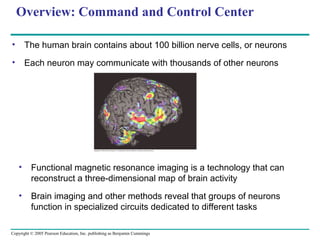
• The human brain contains about 100 billion nerve cells, or neurons
• Each neuron may communicate with thousands of other neurons
• Functional magnetic resonance imaging is a technology that can
reconstruct a three-dimensional map of brain activity
• Brain imaging and other methods reveal that groups of neurons
function in specialized circuits dedicated to different tasks
Copyright © 2005 Pearson Education, Inc. publishing as Benjamin Cummings
Brainbow mouse section of brain
http://www.conncad.com/gallery/brainbow.html
Copyright © 2005 Pearson Education, Inc. publishing as Benjamin Cummings
Concept 48.1: Nervous systems consist of circuits
of neurons and supporting cells
• All animals except sponges have a nervous
system
• What distinguishes nervous systems of different
animal groups is how neurons are organized into
circuits
Nerve net
Hydra (cnidarian)
Radial
nerve
Nerve
ring
Sea star (echinoderm)
The simplest animals with
nervous systems, the cnidarians,
have neurons arranged in nerve
nets
Sea stars have a nerve net in
each arm connected by radial
nerves to a central nerve ring
Brain
Ganglia
Squid (mollusc)
Brain
Salamander (chordate)
Spinal
cord
(dorsal
nerve
cord)
Sensory
ganglion
•Nervous systems in molluscs correlate with lifestyles
•Sessile molluscs have simple systems, whereas more complex molluscs
have more sophisticated systems
LE 48-3
Sensor
Sensory input
Motor output
Integration
Effector
Peripheral nervous
system (PNS)
Central nervous
system (CNS)
In vertebrates, the central nervous system consists of a brain and
dorsal spinal cord
The PNS connects to the CNS
Nervous systems process information in three stages: sensory input,
integration, and motor output
Copyright © 2005 Pearson Education, Inc. publishing as Benjamin Cummings
• Sensory neurons transmit information from
sensors that detect external stimuli and internal
conditions
• Sensory information is sent to the CNS, where
interneurons integrate the information
• Motor output leaves the CNS via motor neurons,
which communicate with effector cells
• The three stages of information processing are
illustrated in the knee-jerk reflex
LE 48-4
Quadriceps
muscle
Cell body of
sensory neuron in
dorsal root
ganglion
Sensory neuron
Spinal cord
(cross section)
White
matter
Hamstring
muscle
Gray
matter
Motor neuron
Interneuron
Copyright © 2005 Pearson Education, Inc. publishing as Benjamin Cummings
Neuron Structure
• Most of a neuron’s organelles are in the cell body
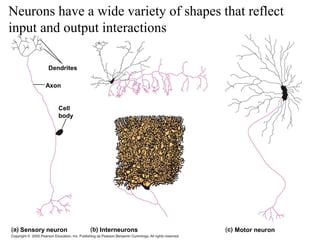
• Most neurons have dendrites, highly branched
extensions that receive signals from other neurons
• The axon is typically a much longer extension that
transmits signals to other cells at synapses
• Many axons are covered with a myelin sheath
LE 48-5
Dendrites
Cell body
Nucleus
Axon hillock Axon
Signal
direction
Presynaptic cell
Myelin sheath
Synaptic
terminals
Synapse
Postsynaptic cell
Dendrites
Cell
body
Axon
InterneuronsSensory neuron Motor neuron
Neurons have a wide variety of shapes that reflect
input and output interactions
Copyright © 2005 Pearson Education, Inc. publishing as Benjamin Cummings
Supporting Cells (Glia)
• Glia are essential for structural integrity of the
nervous system and for functioning of neurons
• Types of glia: astrocytes, radial glia,
oligodendrocytes, and Schwann cells
In the CNS,
astrocytes provide
structural support
for neurons and
regulate
extracellular
concentrations of
ions and
neurotransmitters
LE 48-8
Axon Nodes of
Ranvier
Schwann
cell
Myelin sheath
Nucleus of
Schwann cell
Schwann
cell
Nodes of Ranvier
Layers of myelin
Axon
0.1 µm
Oligodendrocytes (in the CNS) and Schwann cells (in the
PNS) form the myelin sheaths around axons of many
vertebrate neurons
Copyright © 2005 Pearson Education, Inc. publishing as Benjamin Cummings
Myelination in the central and peripheral nervous
systems
Copyright © 2005 Pearson Education, Inc. publishing as Benjamin Cummings
Dorsal view of the human brain showing the progression of myelination
(“white matter”) over the cortical surface during adolescence
Copyright © 2005 Pearson Education, Inc. publishing as Benjamin Cummings
Concept 48.2: Ion pumps and ion channels
maintain the resting potential of a neuron
• Across its plasma membrane, every cell has a
voltage called a membrane potential
• The cell’s inside is negative relative to the outside
• Membrane potential of a cell can be measured
• Oligodendrocytes (in the CNS) and Schwann cells
(in the PNS) form the myelin sheaths around
axons of many vertebrate neurons
Microelectrode
Reference
electrode
Voltage
recorder
–70 mV
Copyright © 2005 Pearson Education, Inc. publishing as Benjamin Cummings
The Resting Potential
• Resting potential is the membrane potential of a
neuron that is not transmitting signals
• Resting potential depends on ionic gradients
across the plasma membrane
Copyright © 2005 Pearson Education, Inc. publishing as Benjamin Cummings
• Concentration of Na+
is higher in the extracellular
fluid than in the cytosol
• The opposite is true for K+
• By modeling a neuron with an artificial membrane,
we can better understand resting potential
LE 48-10
CYTOSOL EXTRACELLULAR
FLUID
[Na+
]
15 mM
[K+
]
150 mM
[A–
]
100 mM
[Na+
]
150 mM
[K+
]
5 mM
[Cl–
]
120 mM
[Cl–
]
10 mM
Plasma
membrane
LE 48-11
150 mM
KCl
Inner
chamber
Outer
chamber
–92 mV
Potassium
channel
Membrane selectively permeable to K+
Membrane selectively permeable to Na+
5 mM
KCl
Artificial
membrane
K+
Cl–
150 mM
NaCl
Inner
chamber
Outer
chamber
+62 mV
Sodium
channel
15 mM
NaCl
Na+
Cl–
Copyright © 2005 Pearson Education, Inc. publishing as Benjamin Cummings
• A neuron that is not transmitting signals contains
many open K+
channels and fewer open Na+
channels in its plasma membrane
• Diffusion of K+
and Na+
leads to a separation of
charges across the membrane, producing the
resting potential
Copyright © 2005 Pearson Education, Inc. publishing as Benjamin Cummings
Gated Ion Channels
• Gated ion channels open or close in response to
one of three stimuli:
– Stretch-gated ion channels open when the
membrane is mechanically deformed
– Ligand-gated ion channels open or close when
a specific chemical binds to the channel
– Voltage-gated ion channels respond to a
change in membrane potential
Hyperpolarizations
Graded potential hyperpolarizations Graded potential depolarizations
5
Time (msec)
Resting
potential
43210
Threshold
–100
–50
0
Membranepotential(mV)
Stimuli
+50
Depolarizations
5
Time (msec)
Resting
potential
43210
Threshold
–100
–50
0
Membranepotential(mV)
Stimuli
+50
Action potential
5
Time (msec)
Resting
potential
43210
Threshold
–100
–50
0
Membranepotential(mV)
Stronger depolarizing stimulus
+50
Action
potential
6
If a cell has gated ion channels, its membrane potential may change
in response to stimuli that open or close those channels
Some stimuli trigger a hyperpolarization, an increase in magnitude
of the membrane potential
Other stimuli trigger a depolarization, a reduction in the magnitude of
the membrane potential
Copyright © 2005 Pearson Education, Inc. publishing as Benjamin Cummings
• Hyperpolarization and depolarization are called
graded potentials
• The magnitude of the change in membrane
potential varies with the strength of the stimulus
Copyright © 2005 Pearson Education, Inc. publishing as Benjamin Cummings
Production of Action Potentials
• Depolarizations are usually graded only up to a
certain membrane voltage, called the threshold
• A stimulus strong enough to produce
depolarization that reaches the threshold triggers
a response called an action potential
• An action potential is a brief all-or-none
depolarization of a neuron’s plasma membrane
• It carries information along axons
Copyright © 2005 Pearson Education, Inc. publishing as Benjamin Cummings
• Voltage-gated Na+
and K+
channels are involved in
producing an action potential
• When a stimulus depolarizes the membrane, Na+
channels
open, allowing Na+
to diffuse into the cell
• As the action potential subsides, K+
channels open, and K+
flows out of the cell
• During the refractory period after an action potential, a
second action potential cannot be initiated
Action Potential
Resting potential
Threshold
Membranepotential
(mV)
Action
potential
Time
–100
–50
+50
0
Potassium
channel
Extracellular fluid
Plasma membrane
Na+
Resting state
Inactivation
gate
Activation
gates
Sodium
channel K+
Cytosol
Na+
Depolarization
K+
Na+
Na+
Rising phase of the action potential
K+
Na+
Na+
Falling phase of the action potential
K+
Na+
Na+
Undershoot
K+
Na+
An action potential is generated as Na+
flows inward
across the membrane at one location.
Na+
Action
potential
Axon
Na+
Action
potentialK+
The depolarization of the action potential spreads to the
neighboring region of the membrane, re-initiating the
action potential there. To the left of this region, the
membrane is repolarizing as K+
flows outward.
K+
Na+
Action
potentialK+
The depolarization-repolarization process is repeated in the
next region of the membrane. In this way, local currents of
ions across the plasma membrane cause the action
potential to be propagated along the length of the axon.
K+
Conduction of Action Potentials
•An action potential can travel
long distances by regenerating
itself along the axon
•At the site where the action
potential is generated, usually the
axon hillock, an electrical current
depolarizes the neighboring
region of the axon membrane
Copyright © 2005 Pearson Education, Inc. publishing as Benjamin Cummings
Conduction Speed
• The speed of an action potential increases with
the axon’s diameter
• In vertebrates, axons are myelinated, also causing
an action potential’s speed to increase
• Action potentials in myelinated axons jump
between the nodes of Ranvier in a process called
saltatory conduction
LE 48-15
Cell body
Schwann cell
Depolarized region
(node of Ranvier)
Myelin
sheath
Axon
Na+ and K+ channels are concentrated at the
nodes to initiate a series of action potentials
Copyright © 2005 Pearson Education, Inc. publishing as Benjamin Cummings
Concept 48.4: Neurons communicate with other
cells at synapses
• In an electrical synapse, current flows directly from
one cell to another via a gap junction
• The vast majority of synapses are chemical
synapses
• In a chemical synapse, a presynaptic neuron
releases chemical neurotransmitters stored in the
synaptic terminal
LE 48-16
Postsynaptic
neuron
Synaptic
terminals
of pre-
synaptic
neurons
5µm
LE 48-17
Postsynaptic cellPresynaptic
cell
Synaptic vesicles
containing
neurotransmitter
Presynaptic
membrane
Voltage-gated
Ca2+
channel
Ca2+
Postsynaptic
membrane
Postsynaptic
membrane
Neuro-
transmitter
Ligand-
gated
ion channel
Na+
K+
Ligand-gated
ion channels
Synaptic cleft
When an action potential reaches a terminal, the final result
is release of neurotransmitters into the synaptic cleft
•Direct synaptic transmission involves binding of neurotransmitters to
ligand-gated ion channels
Copyright © 2005 Pearson Education, Inc. publishing as Benjamin Cummings
• Postsynaptic potentials fall into two categories:
– Excitatory postsynaptic potentials (EPSPs)
– Inhibitory postsynaptic potentials (IPSPs)
• After release, the neurotransmitter diffuses out of
the synaptic cleft
• It may be taken up by surrounding cells and
degraded by enzymes
Copyright © 2005 Pearson Education, Inc. publishing as Benjamin Cummings
Summation of Postsynaptic Potentials
• Unlike action potentials, postsynaptic potentials
are graded and do not regenerate
• Most neurons have many synapses on their
dendrites and cell body
• A single EPSP is usually too small to trigger an
action potential in a postsynaptic neuron
Postsynaptic
neuron
Terminal branch
of presynaptic
neuron
E1
E1
Axon
hillock
E1
E2
E1
I
Action
potential
E1E1 + E2
Spatial summation
of EPSP and IPSP
Spatial summation
I E1 + I
Action
potential
E1
Temporal summation
E1
Threshold of axon of
postsynaptic neuron
E1
Subthreshold, no
summation
E1
Resting
potential
Membranepotential(mV)
–70
0
•If two EPSPs are produced in rapid succession, an effect called
temporal summation occurs
•In spatial summation, EPSPs produced nearly simultaneously by
different synapses on the same postsynaptic neuron add together
•Through summation, an IPSP can counter the effect of an EPSP
Copyright © 2005 Pearson Education, Inc. publishing as Benjamin Cummings
Indirect Synaptic Transmission
• In indirect synaptic transmission, a
neurotransmitter binds to a receptor that is not
part of an ion channel
• This binding activates a signal transduction
pathway involving a second messenger in the
postsynaptic cell
• Effects of indirect synaptic transmission have a
slower onset but last longer
Copyright © 2005 Pearson Education, Inc. publishing as Benjamin Cummings
Neurotransmitters
• The same neurotransmitter can produce different effects in
different types of cells
Copyright © 2005 Pearson Education, Inc. publishing as Benjamin Cummings
Acetylcholine
• Acetylcholine is a common neurotransmitter in
vertebrates and invertebrates
• It can be inhibitory or excitatory
Copyright © 2005 Pearson Education, Inc. publishing as Benjamin Cummings
Biogenic Amines
• Biogenic amines include epinephrine,
norepinephrine, dopamine, and serotonin
• They are active in the CNS and PNS
Copyright © 2005 Pearson Education, Inc. publishing as Benjamin Cummings
Amino Acids and Peptides
• Four amino acids are known to function as
neurotransmitters in the CNS
• Several neuropeptides, relatively short chains of
amino acids, also function as neurotransmitters
Copyright © 2005 Pearson Education, Inc. publishing as Benjamin Cummings
Gases
• Gases such as nitric oxide and carbon monoxide
are local regulators in the PNS

Chapter 48: Nuerons

  • 1.
    Copyright © 2005Pearson Education, Inc. publishing as Benjamin Cummings Overview: Command and Control Center • The human brain contains about 100 billion nerve cells, or neurons • Each neuron may communicate with thousands of other neurons • Functional magnetic resonance imaging is a technology that can reconstruct a three-dimensional map of brain activity • Brain imaging and other methods reveal that groups of neurons function in specialized circuits dedicated to different tasks
  • 2.
    Copyright © 2005Pearson Education, Inc. publishing as Benjamin Cummings Brainbow mouse section of brain http://www.conncad.com/gallery/brainbow.html
  • 3.
    Copyright © 2005Pearson Education, Inc. publishing as Benjamin Cummings Concept 48.1: Nervous systems consist of circuits of neurons and supporting cells • All animals except sponges have a nervous system • What distinguishes nervous systems of different animal groups is how neurons are organized into circuits
  • 4.
    Nerve net Hydra (cnidarian) Radial nerve Nerve ring Seastar (echinoderm) The simplest animals with nervous systems, the cnidarians, have neurons arranged in nerve nets Sea stars have a nerve net in each arm connected by radial nerves to a central nerve ring
  • 5.
    Brain Ganglia Squid (mollusc) Brain Salamander (chordate) Spinal cord (dorsal nerve cord) Sensory ganglion •Nervoussystems in molluscs correlate with lifestyles •Sessile molluscs have simple systems, whereas more complex molluscs have more sophisticated systems
  • 6.
    LE 48-3 Sensor Sensory input Motoroutput Integration Effector Peripheral nervous system (PNS) Central nervous system (CNS) In vertebrates, the central nervous system consists of a brain and dorsal spinal cord The PNS connects to the CNS Nervous systems process information in three stages: sensory input, integration, and motor output
  • 7.
    Copyright © 2005Pearson Education, Inc. publishing as Benjamin Cummings • Sensory neurons transmit information from sensors that detect external stimuli and internal conditions • Sensory information is sent to the CNS, where interneurons integrate the information • Motor output leaves the CNS via motor neurons, which communicate with effector cells • The three stages of information processing are illustrated in the knee-jerk reflex
  • 8.
    LE 48-4 Quadriceps muscle Cell bodyof sensory neuron in dorsal root ganglion Sensory neuron Spinal cord (cross section) White matter Hamstring muscle Gray matter Motor neuron Interneuron
  • 9.
    Copyright © 2005Pearson Education, Inc. publishing as Benjamin Cummings Neuron Structure • Most of a neuron’s organelles are in the cell body • Most neurons have dendrites, highly branched extensions that receive signals from other neurons • The axon is typically a much longer extension that transmits signals to other cells at synapses • Many axons are covered with a myelin sheath
  • 10.
    LE 48-5 Dendrites Cell body Nucleus Axonhillock Axon Signal direction Presynaptic cell Myelin sheath Synaptic terminals Synapse Postsynaptic cell
  • 11.
    Dendrites Cell body Axon InterneuronsSensory neuron Motorneuron Neurons have a wide variety of shapes that reflect input and output interactions
  • 12.
    Copyright © 2005Pearson Education, Inc. publishing as Benjamin Cummings Supporting Cells (Glia) • Glia are essential for structural integrity of the nervous system and for functioning of neurons • Types of glia: astrocytes, radial glia, oligodendrocytes, and Schwann cells
  • 13.
    In the CNS, astrocytesprovide structural support for neurons and regulate extracellular concentrations of ions and neurotransmitters
  • 14.
    LE 48-8 Axon Nodesof Ranvier Schwann cell Myelin sheath Nucleus of Schwann cell Schwann cell Nodes of Ranvier Layers of myelin Axon 0.1 µm Oligodendrocytes (in the CNS) and Schwann cells (in the PNS) form the myelin sheaths around axons of many vertebrate neurons
  • 15.
    Copyright © 2005Pearson Education, Inc. publishing as Benjamin Cummings Myelination in the central and peripheral nervous systems
  • 16.
    Copyright © 2005Pearson Education, Inc. publishing as Benjamin Cummings Dorsal view of the human brain showing the progression of myelination (“white matter”) over the cortical surface during adolescence
  • 17.
    Copyright © 2005Pearson Education, Inc. publishing as Benjamin Cummings Concept 48.2: Ion pumps and ion channels maintain the resting potential of a neuron • Across its plasma membrane, every cell has a voltage called a membrane potential • The cell’s inside is negative relative to the outside • Membrane potential of a cell can be measured • Oligodendrocytes (in the CNS) and Schwann cells (in the PNS) form the myelin sheaths around axons of many vertebrate neurons
  • 18.
  • 19.
    Copyright © 2005Pearson Education, Inc. publishing as Benjamin Cummings The Resting Potential • Resting potential is the membrane potential of a neuron that is not transmitting signals • Resting potential depends on ionic gradients across the plasma membrane
  • 20.
    Copyright © 2005Pearson Education, Inc. publishing as Benjamin Cummings • Concentration of Na+ is higher in the extracellular fluid than in the cytosol • The opposite is true for K+ • By modeling a neuron with an artificial membrane, we can better understand resting potential
  • 21.
    LE 48-10 CYTOSOL EXTRACELLULAR FLUID [Na+ ] 15mM [K+ ] 150 mM [A– ] 100 mM [Na+ ] 150 mM [K+ ] 5 mM [Cl– ] 120 mM [Cl– ] 10 mM Plasma membrane
  • 22.
    LE 48-11 150 mM KCl Inner chamber Outer chamber –92mV Potassium channel Membrane selectively permeable to K+ Membrane selectively permeable to Na+ 5 mM KCl Artificial membrane K+ Cl– 150 mM NaCl Inner chamber Outer chamber +62 mV Sodium channel 15 mM NaCl Na+ Cl–
  • 23.
    Copyright © 2005Pearson Education, Inc. publishing as Benjamin Cummings • A neuron that is not transmitting signals contains many open K+ channels and fewer open Na+ channels in its plasma membrane • Diffusion of K+ and Na+ leads to a separation of charges across the membrane, producing the resting potential
  • 24.
    Copyright © 2005Pearson Education, Inc. publishing as Benjamin Cummings Gated Ion Channels • Gated ion channels open or close in response to one of three stimuli: – Stretch-gated ion channels open when the membrane is mechanically deformed – Ligand-gated ion channels open or close when a specific chemical binds to the channel – Voltage-gated ion channels respond to a change in membrane potential
  • 25.
    Hyperpolarizations Graded potential hyperpolarizationsGraded potential depolarizations 5 Time (msec) Resting potential 43210 Threshold –100 –50 0 Membranepotential(mV) Stimuli +50 Depolarizations 5 Time (msec) Resting potential 43210 Threshold –100 –50 0 Membranepotential(mV) Stimuli +50 Action potential 5 Time (msec) Resting potential 43210 Threshold –100 –50 0 Membranepotential(mV) Stronger depolarizing stimulus +50 Action potential 6 If a cell has gated ion channels, its membrane potential may change in response to stimuli that open or close those channels Some stimuli trigger a hyperpolarization, an increase in magnitude of the membrane potential Other stimuli trigger a depolarization, a reduction in the magnitude of the membrane potential
  • 26.
    Copyright © 2005Pearson Education, Inc. publishing as Benjamin Cummings • Hyperpolarization and depolarization are called graded potentials • The magnitude of the change in membrane potential varies with the strength of the stimulus
  • 27.
    Copyright © 2005Pearson Education, Inc. publishing as Benjamin Cummings Production of Action Potentials • Depolarizations are usually graded only up to a certain membrane voltage, called the threshold • A stimulus strong enough to produce depolarization that reaches the threshold triggers a response called an action potential • An action potential is a brief all-or-none depolarization of a neuron’s plasma membrane • It carries information along axons
  • 28.
    Copyright © 2005Pearson Education, Inc. publishing as Benjamin Cummings • Voltage-gated Na+ and K+ channels are involved in producing an action potential • When a stimulus depolarizes the membrane, Na+ channels open, allowing Na+ to diffuse into the cell • As the action potential subsides, K+ channels open, and K+ flows out of the cell • During the refractory period after an action potential, a second action potential cannot be initiated Action Potential
  • 29.
    Resting potential Threshold Membranepotential (mV) Action potential Time –100 –50 +50 0 Potassium channel Extracellular fluid Plasmamembrane Na+ Resting state Inactivation gate Activation gates Sodium channel K+ Cytosol Na+ Depolarization K+ Na+ Na+ Rising phase of the action potential K+ Na+ Na+ Falling phase of the action potential K+ Na+ Na+ Undershoot K+ Na+
  • 30.
    An action potentialis generated as Na+ flows inward across the membrane at one location. Na+ Action potential Axon Na+ Action potentialK+ The depolarization of the action potential spreads to the neighboring region of the membrane, re-initiating the action potential there. To the left of this region, the membrane is repolarizing as K+ flows outward. K+ Na+ Action potentialK+ The depolarization-repolarization process is repeated in the next region of the membrane. In this way, local currents of ions across the plasma membrane cause the action potential to be propagated along the length of the axon. K+ Conduction of Action Potentials •An action potential can travel long distances by regenerating itself along the axon •At the site where the action potential is generated, usually the axon hillock, an electrical current depolarizes the neighboring region of the axon membrane
  • 31.
    Copyright © 2005Pearson Education, Inc. publishing as Benjamin Cummings Conduction Speed • The speed of an action potential increases with the axon’s diameter • In vertebrates, axons are myelinated, also causing an action potential’s speed to increase • Action potentials in myelinated axons jump between the nodes of Ranvier in a process called saltatory conduction
  • 32.
    LE 48-15 Cell body Schwanncell Depolarized region (node of Ranvier) Myelin sheath Axon Na+ and K+ channels are concentrated at the nodes to initiate a series of action potentials
  • 33.
    Copyright © 2005Pearson Education, Inc. publishing as Benjamin Cummings Concept 48.4: Neurons communicate with other cells at synapses • In an electrical synapse, current flows directly from one cell to another via a gap junction • The vast majority of synapses are chemical synapses • In a chemical synapse, a presynaptic neuron releases chemical neurotransmitters stored in the synaptic terminal
  • 34.
  • 35.
    LE 48-17 Postsynaptic cellPresynaptic cell Synapticvesicles containing neurotransmitter Presynaptic membrane Voltage-gated Ca2+ channel Ca2+ Postsynaptic membrane Postsynaptic membrane Neuro- transmitter Ligand- gated ion channel Na+ K+ Ligand-gated ion channels Synaptic cleft When an action potential reaches a terminal, the final result is release of neurotransmitters into the synaptic cleft •Direct synaptic transmission involves binding of neurotransmitters to ligand-gated ion channels
  • 36.
    Copyright © 2005Pearson Education, Inc. publishing as Benjamin Cummings • Postsynaptic potentials fall into two categories: – Excitatory postsynaptic potentials (EPSPs) – Inhibitory postsynaptic potentials (IPSPs) • After release, the neurotransmitter diffuses out of the synaptic cleft • It may be taken up by surrounding cells and degraded by enzymes
  • 37.
    Copyright © 2005Pearson Education, Inc. publishing as Benjamin Cummings Summation of Postsynaptic Potentials • Unlike action potentials, postsynaptic potentials are graded and do not regenerate • Most neurons have many synapses on their dendrites and cell body • A single EPSP is usually too small to trigger an action potential in a postsynaptic neuron
  • 38.
    Postsynaptic neuron Terminal branch of presynaptic neuron E1 E1 Axon hillock E1 E2 E1 I Action potential E1E1+ E2 Spatial summation of EPSP and IPSP Spatial summation I E1 + I Action potential E1 Temporal summation E1 Threshold of axon of postsynaptic neuron E1 Subthreshold, no summation E1 Resting potential Membranepotential(mV) –70 0 •If two EPSPs are produced in rapid succession, an effect called temporal summation occurs •In spatial summation, EPSPs produced nearly simultaneously by different synapses on the same postsynaptic neuron add together •Through summation, an IPSP can counter the effect of an EPSP
  • 39.
    Copyright © 2005Pearson Education, Inc. publishing as Benjamin Cummings Indirect Synaptic Transmission • In indirect synaptic transmission, a neurotransmitter binds to a receptor that is not part of an ion channel • This binding activates a signal transduction pathway involving a second messenger in the postsynaptic cell • Effects of indirect synaptic transmission have a slower onset but last longer
  • 40.
    Copyright © 2005Pearson Education, Inc. publishing as Benjamin Cummings Neurotransmitters • The same neurotransmitter can produce different effects in different types of cells
  • 41.
    Copyright © 2005Pearson Education, Inc. publishing as Benjamin Cummings Acetylcholine • Acetylcholine is a common neurotransmitter in vertebrates and invertebrates • It can be inhibitory or excitatory
  • 42.
    Copyright © 2005Pearson Education, Inc. publishing as Benjamin Cummings Biogenic Amines • Biogenic amines include epinephrine, norepinephrine, dopamine, and serotonin • They are active in the CNS and PNS
  • 43.
    Copyright © 2005Pearson Education, Inc. publishing as Benjamin Cummings Amino Acids and Peptides • Four amino acids are known to function as neurotransmitters in the CNS • Several neuropeptides, relatively short chains of amino acids, also function as neurotransmitters
  • 44.
    Copyright © 2005Pearson Education, Inc. publishing as Benjamin Cummings Gases • Gases such as nitric oxide and carbon monoxide are local regulators in the PNS

Editor's Notes

  • #2 Each brain cell is called a neuron.
  • #3 The team constructed Brainbow using a two-step process: first, a specific genetic construct was generated that could be recombined in multiple arrangements to produce one of either three or four colors based on the particular fluorescent proteins (XFPs) being implemented.[2] Next, multiple copies of the same transgenic construct were inserted into the genome of the target species, resulting in the random expression of different XFP ratios and subsequently causing different cells to exhibit a variety of colorful hues.[2] Now we can label individual neurons
  • #4 Basics
  • #5 Just know there are different organizations of nervous systems. No need to memorize
  • #6 Clusters of nervous systems are referred to as ganglia
  • #7 Information Processed Sensory neurons receive sensory stimuli, touch, or taste Integrated in the central nervous system Comes out as an output (motor neuron)
  • #8 Sensory Neurons Interneurons Motor Neurons
  • #10 Region between two neurons is called the synapse
  • #11 Receptors are at the end of dendrites Presynaptic sends the signal Postsynaptic receives the signal
  • #12 Neurons have different shapes and sizes. Structure correlates to function
  • #13 Astrocytes and radial glia provide structure. Astrocytes brings neurons back to resting states Oligodendrocytes and Schwann cells are myelin sheets producing cells
  • #14 The extracellular matrix is regulated by supporting cells.
  • #17 DevBio9e-Fig-09-28-0.jpg
  • #18 Pretend there is a stimulus and write what happens at every step in the nerve cell. From signal to response in a muscle When there is a charge difference there is potential.
  • #20 Resting potential When it is not transmitting signal
  • #21 Sodium is higher outside than inside the cell Potassium is higher inside the cell
  • #24 A neuron that’s not signaling has open potassium channels but very few open potassium channels
  • #25 The ion channels in the membrane of a cell can be opened in response to being stretched, ligand, or voltage (gated).
  • #26 Stimuli can open and close those channels. Hyperpolarization increases the difference
  • #27 Graded potentials: they are not going to hit the action potential because they don’t pass the action potential
  • #28 Need frequent or intense signals to activate action potential
  • #29 Voltage-Gated: a certain change in membrane potential causes the sodium or potassium channels to close
  • #30 1. The sodium and potassium channels are closed 2. Voltage gated channels open 3. If action potential is meet the neuron fires 4. Causes potassium channels to open releasing the positive charges 5. Potassium overshoots