

Extremophiles
Life on edge
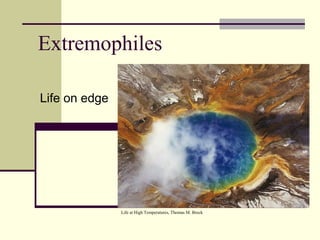
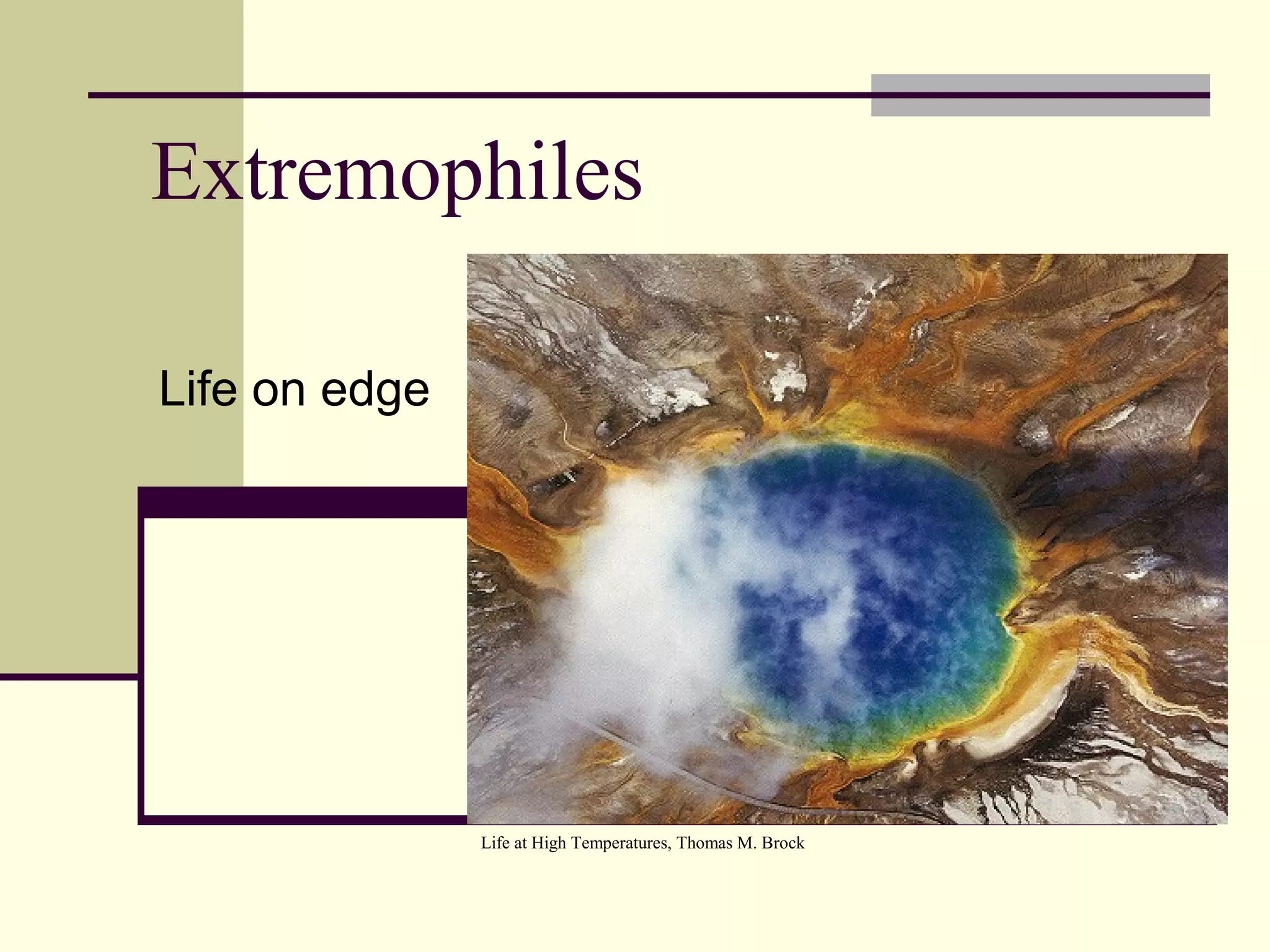
Life at High Temperatures, Thomas M. Brock
Extremophiles
Images from NASA, http://pds.jpl.nasa.gov/planets/
Extraterrestrial microbial
life-does it exist?
Lecture Aims
 What are Extremophiles- an introduction
 Strategies for growth & survival
 Biotechnology
Introduction to Extremophiles
 What are Extremophiles
 Live where nothing else can
 How do they survive?
 Extremozymes (more details later)
 Why are they are interesting?
 Extremes fascinate us
 Life on other planets
 Life at boiling temperatures
 Practical applications are interesting
 Interdisciplinary lessons
 Genetic Prospecting
Extremophile
 Definition - Lover of extremities
 History
 First suspected in 1950’s
 Extensively studied since 1970’s
 Temperature extremes
 Boiling or freezing, 1000
C to -10
C
 Chemical extremes
 Vinegar or ammonia (<5 pH or >9 pH)
 Highly saline, up to x10 sea water
 How we sterilize & preserve foods today
Extreme Temperatures
 Thermophiles - High temperature
 Thermal vents and hot springs
 May go hand in hand with chemical extremes
 Psychrophiles - Low temperature
 Arctic and Antarctic
 1/2 of earth’s surface is oceans between 1-40
C
 Deep sea –10
C to 40
C
 Most rely on photosynthesis
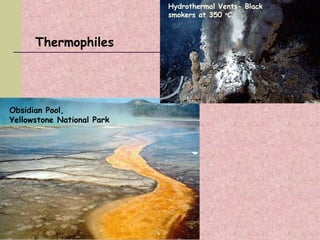
Thermophiles
Hydrothermal Vents- Black
smokers at 350 o
C
Obsidian Pool,
Yellowstone National Park
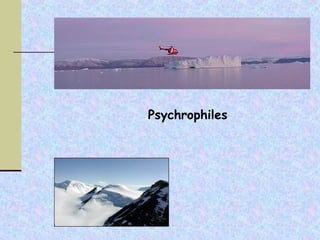
Psychrophiles
Chemical Extremes
 Acidophiles - Acidic
 Again some thermal vents & hot springs
 Alkaliphiles - Alkaline
 Soda lakes in Africa and Western U.S.
 Halophiles - Highly saline
 Natural salt lakes and manmade pools
 Sometimes occurs with extreme alkalinity
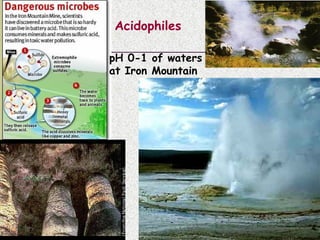
Acidophiles
pH 0-1 of waters
at Iron Mountain
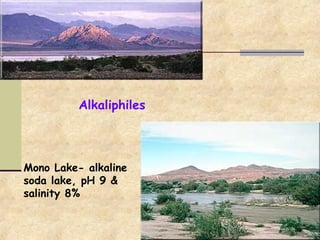
Alkaliphiles
Mono Lake- alkaline
soda lake, pH 9 &
salinity 8%
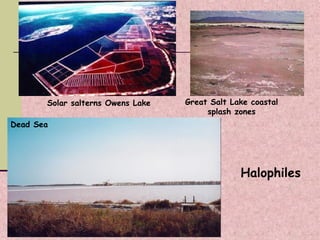
Halophiles
Dead Sea
Great Salt Lake coastal
splash zones
Solar salterns Owens Lake
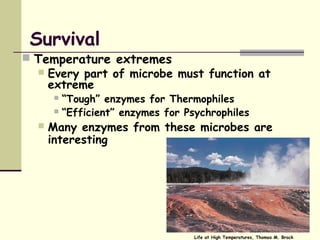
Survival
 Temperature extremes
 Every part of microbe must function at
extreme
 “Tough” enzymes for Thermophiles
 “Efficient” enzymes for Psychrophiles
 Many enzymes from these microbes are
interesting
Life at High Temperatures, Thomas M. Brock
Survival
 Chemical extremes
 Interior of cell is “normal”
 Exterior protects the cell

Acidophiles and Alkaliphiles sometimes excrete
protective substances and enzymes
 Acidophiles often lack cell wall
 Some moderate halophiles have high concs of a
solute inside to avoid “pickling”
 Some enzymes from these microbes are interesting
What are enzymes?
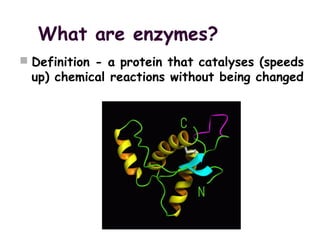
 Definition - a protein that catalyses (speeds
up) chemical reactions without being changed
What are enzymes?
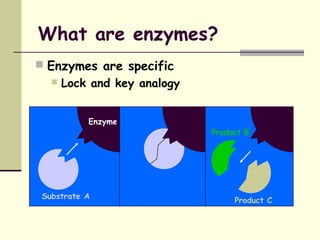
 Enzymes are specific
 Lock and key analogy
Enzyme
Substrate A
Product B
Product C
What are enzymes?
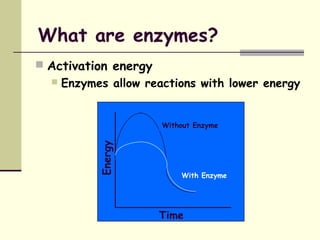
 Activation energy
 Enzymes allow reactions with lower energy
Energy
Time
Without Enzyme
With Enzyme
What are enzymes?
 Enzymes are just a protein
 They can be destroyed by
 Heat, acid, base
 They can be inhibited by
 Cold, salt
 Heat an egg white or add vinegar to milk
 Protein is a major component of both-
denatures
Practical Applications
 Extremozymes
 Enzyme from Extremophile
 Industry & Medicine
 What if you want an enzyme to work
 In a hot factory?
 Tank of cold solution?
 Acidic pond?
 Sewage (ammonia)?
 Highly saline solution?
One solution
 Pay a genetic engineer to design a “super”
enzymes...
 Heat resistant enzymes
 Survive low temperatures
 Able to resist acid, alkali and/or salt
 This could take years and lots of money
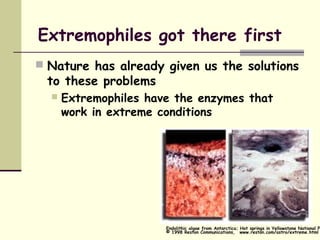
Extremophiles got there first
 Nature has already given us the solutions
to these problems
 Extremophiles have the enzymes that
work in extreme conditions
Endolithic algae from Antarctica; Hot springs in Yellowstone National Pa
© 1998 Reston Communications, www.reston.com/astro/extreme.html
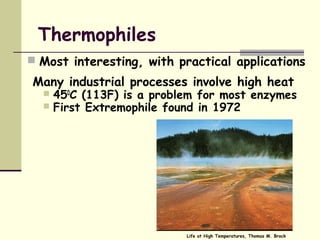
Thermophiles
 Most interesting, with practical applications
Many industrial processes involve high heat
 450
C (113F) is a problem for most enzymes
 First Extremophile found in 1972
Life at High Temperatures, Thomas M. Brock
PCR - Polymerase
Chain Reaction
 Allows amplification of small sample of DNA
using high temperature process
 Technique is about 10 years old
 DNA fingerprints - samples from crime scene
 Genetic Screening - swab from the mouth
 Medical Diagnosis - a few virus particles
from blood
 Thermus aquaticus or Taq
Life at High Temperatures, Thomas M. Brock
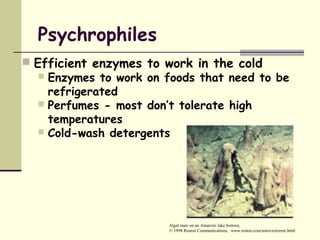
Psychrophiles
 Efficient enzymes to work in the cold
 Enzymes to work on foods that need to be
refrigerated
 Perfumes - most don’t tolerate high
temperatures
 Cold-wash detergents
Algal mats on an Antarctic lake bottom,
© 1998 Reston Communications, www.reston.com/astro/extreme.html
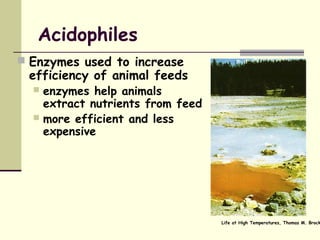
Acidophiles
 Enzymes used to increase
efficiency of animal feeds
 enzymes help animals
extract nutrients from feed
 more efficient and less
expensive
Life at High Temperatures, Thomas M. Brock
Alkaliphiles
 “Stonewashed” pants
 Alkaliphilic enzymes soften fabric and
release some of the dyes, giving worn look &
feel
 Detergents
 Enzymes dissolve proteins or fats
 Detergents do not inhibit alkaliphilic
enzymes
Halophiles
 What is a halophile?
 Diversity of Halophilic Organisms
 Adptation Strategies
 Osmoregulation-“Compatible Solute” Strategy
 “Salt-in” Strategy
 Interesting Facts and Applications
What is a halophile?
 Halophile = “salt loving; can grow in higher salt
concentrations
 Based on optimal saline environments halophilic
organisms can be grouped into three categories:
 extreme halophiles,
 moderate halophiles, and
 slightly halophilic or halotolerant organisms
 Some extreme halophiles can live in solutions of
25 % salt; seawater = 2% salt
Diversity of Halophilic Organisms
 Halophiles are a broad group &t can be
found in all three domains of life.
 Found in salt marshes, subterranean salt
deposits, dry soils, salted meats,
hypersaline seas, and salt evaporation
ponds.
Unusual Habitats
 A Pseudomonas species lives on a desert
plant in the Negev Desert- the plant
leaves secretes salt through salt glands.
 A Bacillus species is found in the nasal
cavities of desert iguanas- iguanas nasal
cavities have salt glands which secrete
KCl brine during osmotic stress.
Osmoregulation
 Halophiles maintain an internal osmotic
potential that equals their external
environment.
 Osmosis is the process in which water
moves from an area of high concentration
to an area of low concentration.
Osmoregulation
 In order for cells to maintain their water
they must have an osmotic potential equal to
their external environment.
 As salinity increases in the environment its
osmotic potential decreases.
 If you placed a non halophilic microbe in a
solution with a high amount of dissolved salts
the cell’s water will move into the solution
causing the cell to plasmolyze.
Osmoregulation
 Halophiles have adapted to life at high
salinity in many different ways.
 Structural modification of external cell
walls- posses negatively charged proteins
on the outside which bind to positively
charged sodium ions in their external
environments & stabilizes the cell wall
break down.
“Compatible Solute” Strategy
 Cells maintain low concentrations of salt in their
cytoplasm by balancing osmotic potential with
organic, compatible solutes.
 They do this by the synthesis or uptake of
compatible solutes- glycerol, sugars and their
derivatives, amino acids and their derivatives &
quaternary amines such as glycine betaine.
 Energetically synthesizing solutes is an expensive
process.
 Autotrophs use between 30 to 90 molecules of ATP to
synthesize one molecule of compatible solute.
 Heterotrophs use between 23 to 79 ATP.
“Salt-in” Strategy
 Cells can have internal concentrations that
are osmotically equivalent to their external
environment.
 This “salt-in” strategy is primarily used by
aerobic, extremely halophilic archaea and
anaerobic bacteria.
 They maintain osmotically equivalent
internal concentrations by accumulating
high concentrations of potassium chloride.
“Salt-in” Strategy
 Potassium ions enter the cell passively via
a uniporter. Sodium ions are pumped out.
Chloride enters the cell against the
membrane potential via cotransport with
sodium ions.
 For every three molecules of potassium
chloride accumulated, two ATP are
hydrolyzed making this strategy more
energy efficient than the “compatible
solute” strategy.
“Salt-in” Strategy
 To use this strategy all enzymes and
structural cell components must be
adapted to high salt concentrations to
ensure proper cell function.
Halobacterium: an extreme halophile
 Halobacterium are members of domain
archaea.
 Widely researched for their extreme
halophilism and unique structure.
 Require salt concentrations between 15% to
saturation to live.
 Use the “salt-in” strategy.
 Produce ATP by respiration or by
bacteriorhodopsin.
Halobacterium
 May also have halorhodopsin that pumps
chloride into the cell instead of pumping
protons out.
 The Red Sea was named after
halobacterium that turns the water red
during massive blooms.
Facts
 The term “red herring” comes from the
foul smell of salted meats that were
spoiled by halobacterium.
 There have been considerable problems
with halophiles colonizing leather during
the salt curing process.
Applications
 The extraction of carotene from carotene
rich halobacteria and halophilic algae that
can then be used as food additives or as
food-coloring agents.
 The use of halophilic organisms in the
fermentation of soy sauce and Thai fish
sauce.
Applications
 Other possible applications being explored:
 Increasing crude oil extraction (MEOR)
 Genetically engineering halophilic enzymes
encoding DNA into crops to allow for salt
tolerance
 Treatment of waste water (petroleum)
Conclusions
 Halophiles are salt tolerant organisms.
 They are widespread and found in all three
domains.
 The “salt-in” strategy uses less energy but
requires intracellular adaptations. Only a
few prokaryotes use it.
 All other halophiles use the “compatible
solute” strategy that is energy expensive but
does not require special adaptations.
Genetic prospecting
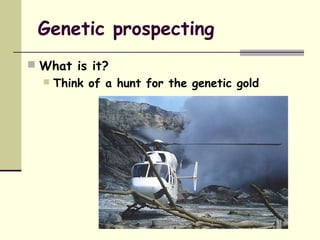
 What is it?
 Think of a hunt for the genetic gold
Summary
 Now you know something about Extremophiles
 Where they live & how they survive
 They are interesting because
 They have enzymes that work in unusual
conditions
 The practical applications are interesting

4.5 Extremeophiles

  • 1.
    Extremophiles Life on edge Lifeat High Temperatures, Thomas M. Brock
  • 2.
    Extremophiles Images from NASA,http://pds.jpl.nasa.gov/planets/ Extraterrestrial microbial life-does it exist?
  • 3.
    Lecture Aims  Whatare Extremophiles- an introduction  Strategies for growth & survival  Biotechnology
  • 4.
    Introduction to Extremophiles What are Extremophiles  Live where nothing else can  How do they survive?  Extremozymes (more details later)  Why are they are interesting?  Extremes fascinate us  Life on other planets  Life at boiling temperatures  Practical applications are interesting  Interdisciplinary lessons  Genetic Prospecting
  • 5.
    Extremophile  Definition -Lover of extremities  History  First suspected in 1950’s  Extensively studied since 1970’s  Temperature extremes  Boiling or freezing, 1000 C to -10 C  Chemical extremes  Vinegar or ammonia (<5 pH or >9 pH)  Highly saline, up to x10 sea water  How we sterilize & preserve foods today
  • 6.
    Extreme Temperatures  Thermophiles- High temperature  Thermal vents and hot springs  May go hand in hand with chemical extremes  Psychrophiles - Low temperature  Arctic and Antarctic  1/2 of earth’s surface is oceans between 1-40 C  Deep sea –10 C to 40 C  Most rely on photosynthesis
  • 7.
    Thermophiles Hydrothermal Vents- Black smokersat 350 o C Obsidian Pool, Yellowstone National Park
  • 8.
  • 9.
    Chemical Extremes  Acidophiles- Acidic  Again some thermal vents & hot springs  Alkaliphiles - Alkaline  Soda lakes in Africa and Western U.S.  Halophiles - Highly saline  Natural salt lakes and manmade pools  Sometimes occurs with extreme alkalinity
  • 10.
    Acidophiles pH 0-1 ofwaters at Iron Mountain
  • 11.
    Alkaliphiles Mono Lake- alkaline sodalake, pH 9 & salinity 8%
  • 12.
    Halophiles Dead Sea Great SaltLake coastal splash zones Solar salterns Owens Lake
  • 13.
    Survival  Temperature extremes Every part of microbe must function at extreme  “Tough” enzymes for Thermophiles  “Efficient” enzymes for Psychrophiles  Many enzymes from these microbes are interesting Life at High Temperatures, Thomas M. Brock
  • 14.
    Survival  Chemical extremes Interior of cell is “normal”  Exterior protects the cell  Acidophiles and Alkaliphiles sometimes excrete protective substances and enzymes  Acidophiles often lack cell wall  Some moderate halophiles have high concs of a solute inside to avoid “pickling”  Some enzymes from these microbes are interesting
  • 15.
    What are enzymes? Definition - a protein that catalyses (speeds up) chemical reactions without being changed
  • 16.
    What are enzymes? Enzymes are specific  Lock and key analogy Enzyme Substrate A Product B Product C
  • 17.
    What are enzymes? Activation energy  Enzymes allow reactions with lower energy Energy Time Without Enzyme With Enzyme
  • 18.
    What are enzymes? Enzymes are just a protein  They can be destroyed by  Heat, acid, base  They can be inhibited by  Cold, salt  Heat an egg white or add vinegar to milk  Protein is a major component of both- denatures
  • 19.
    Practical Applications  Extremozymes Enzyme from Extremophile  Industry & Medicine  What if you want an enzyme to work  In a hot factory?  Tank of cold solution?  Acidic pond?  Sewage (ammonia)?  Highly saline solution?
  • 20.
    One solution  Paya genetic engineer to design a “super” enzymes...  Heat resistant enzymes  Survive low temperatures  Able to resist acid, alkali and/or salt  This could take years and lots of money
  • 21.
    Extremophiles got therefirst  Nature has already given us the solutions to these problems  Extremophiles have the enzymes that work in extreme conditions Endolithic algae from Antarctica; Hot springs in Yellowstone National Pa © 1998 Reston Communications, www.reston.com/astro/extreme.html
  • 22.
    Thermophiles  Most interesting,with practical applications Many industrial processes involve high heat  450 C (113F) is a problem for most enzymes  First Extremophile found in 1972 Life at High Temperatures, Thomas M. Brock
  • 23.
    PCR - Polymerase ChainReaction  Allows amplification of small sample of DNA using high temperature process  Technique is about 10 years old  DNA fingerprints - samples from crime scene  Genetic Screening - swab from the mouth  Medical Diagnosis - a few virus particles from blood  Thermus aquaticus or Taq Life at High Temperatures, Thomas M. Brock
  • 24.
    Psychrophiles  Efficient enzymesto work in the cold  Enzymes to work on foods that need to be refrigerated  Perfumes - most don’t tolerate high temperatures  Cold-wash detergents Algal mats on an Antarctic lake bottom, © 1998 Reston Communications, www.reston.com/astro/extreme.html
  • 25.
    Acidophiles  Enzymes usedto increase efficiency of animal feeds  enzymes help animals extract nutrients from feed  more efficient and less expensive Life at High Temperatures, Thomas M. Brock
  • 26.
    Alkaliphiles  “Stonewashed” pants Alkaliphilic enzymes soften fabric and release some of the dyes, giving worn look & feel  Detergents  Enzymes dissolve proteins or fats  Detergents do not inhibit alkaliphilic enzymes
  • 27.
    Halophiles  What isa halophile?  Diversity of Halophilic Organisms  Adptation Strategies  Osmoregulation-“Compatible Solute” Strategy  “Salt-in” Strategy  Interesting Facts and Applications
  • 28.
    What is ahalophile?  Halophile = “salt loving; can grow in higher salt concentrations  Based on optimal saline environments halophilic organisms can be grouped into three categories:  extreme halophiles,  moderate halophiles, and  slightly halophilic or halotolerant organisms  Some extreme halophiles can live in solutions of 25 % salt; seawater = 2% salt
  • 29.
    Diversity of HalophilicOrganisms  Halophiles are a broad group &t can be found in all three domains of life.  Found in salt marshes, subterranean salt deposits, dry soils, salted meats, hypersaline seas, and salt evaporation ponds.
  • 30.
    Unusual Habitats  APseudomonas species lives on a desert plant in the Negev Desert- the plant leaves secretes salt through salt glands.  A Bacillus species is found in the nasal cavities of desert iguanas- iguanas nasal cavities have salt glands which secrete KCl brine during osmotic stress.
  • 31.
    Osmoregulation  Halophiles maintainan internal osmotic potential that equals their external environment.  Osmosis is the process in which water moves from an area of high concentration to an area of low concentration.
  • 32.
    Osmoregulation  In orderfor cells to maintain their water they must have an osmotic potential equal to their external environment.  As salinity increases in the environment its osmotic potential decreases.  If you placed a non halophilic microbe in a solution with a high amount of dissolved salts the cell’s water will move into the solution causing the cell to plasmolyze.
  • 33.
    Osmoregulation  Halophiles haveadapted to life at high salinity in many different ways.  Structural modification of external cell walls- posses negatively charged proteins on the outside which bind to positively charged sodium ions in their external environments & stabilizes the cell wall break down.
  • 34.
    “Compatible Solute” Strategy Cells maintain low concentrations of salt in their cytoplasm by balancing osmotic potential with organic, compatible solutes.  They do this by the synthesis or uptake of compatible solutes- glycerol, sugars and their derivatives, amino acids and their derivatives & quaternary amines such as glycine betaine.  Energetically synthesizing solutes is an expensive process.  Autotrophs use between 30 to 90 molecules of ATP to synthesize one molecule of compatible solute.  Heterotrophs use between 23 to 79 ATP.
  • 35.
    “Salt-in” Strategy  Cellscan have internal concentrations that are osmotically equivalent to their external environment.  This “salt-in” strategy is primarily used by aerobic, extremely halophilic archaea and anaerobic bacteria.  They maintain osmotically equivalent internal concentrations by accumulating high concentrations of potassium chloride.
  • 36.
    “Salt-in” Strategy  Potassiumions enter the cell passively via a uniporter. Sodium ions are pumped out. Chloride enters the cell against the membrane potential via cotransport with sodium ions.  For every three molecules of potassium chloride accumulated, two ATP are hydrolyzed making this strategy more energy efficient than the “compatible solute” strategy.
  • 37.
    “Salt-in” Strategy  Touse this strategy all enzymes and structural cell components must be adapted to high salt concentrations to ensure proper cell function.
  • 38.
    Halobacterium: an extremehalophile  Halobacterium are members of domain archaea.  Widely researched for their extreme halophilism and unique structure.  Require salt concentrations between 15% to saturation to live.  Use the “salt-in” strategy.  Produce ATP by respiration or by bacteriorhodopsin.
  • 39.
    Halobacterium  May alsohave halorhodopsin that pumps chloride into the cell instead of pumping protons out.  The Red Sea was named after halobacterium that turns the water red during massive blooms.
  • 40.
    Facts  The term“red herring” comes from the foul smell of salted meats that were spoiled by halobacterium.  There have been considerable problems with halophiles colonizing leather during the salt curing process.
  • 41.
    Applications  The extractionof carotene from carotene rich halobacteria and halophilic algae that can then be used as food additives or as food-coloring agents.  The use of halophilic organisms in the fermentation of soy sauce and Thai fish sauce.
  • 42.
    Applications  Other possibleapplications being explored:  Increasing crude oil extraction (MEOR)  Genetically engineering halophilic enzymes encoding DNA into crops to allow for salt tolerance  Treatment of waste water (petroleum)
  • 43.
    Conclusions  Halophiles aresalt tolerant organisms.  They are widespread and found in all three domains.  The “salt-in” strategy uses less energy but requires intracellular adaptations. Only a few prokaryotes use it.  All other halophiles use the “compatible solute” strategy that is energy expensive but does not require special adaptations.
  • 44.
    Genetic prospecting  Whatis it?  Think of a hunt for the genetic gold
  • 45.
    Summary  Now youknow something about Extremophiles  Where they live & how they survive  They are interesting because  They have enzymes that work in unusual conditions  The practical applications are interesting

Editor's Notes

  • #4 Info on me, in NZ on volcanic hot springs and than here on subsurface GAB ***Any Questions, go ahead and ask ** 1) You need to understand them before you can teach 2) A great deal of Info on web sites &amp; new text books due to interest in astrobiology &amp; who we are etc 3) These are fascinating creatures and I enjoyed putting presentation together
  • #5 2) Review of enzymes, then extremozymes Why is this the second talk??? A natural lead in to BioTech/Computing 3) - Interesting to scientists, and are interesting to us too. - Life on other planets - DNA fingerprinting, stonewashed jeans, and oil extraction - Interdisciplinary lessons
  • #7 Who lives in the temperature extremes? Photosynthesis???
  • #10 Can see that there is some overlap Thermophile/Acidophile and Halophile/Alkaliphile White Sands???
  • #15 Different from temperature Halophiles - Osmosis 3) Because interior tends to be normal...
  • #19 Wrapping up review of enzymes, they have limitations Remember definition, a protein that catalyses chemical reactions without being changed
  • #20 Remember last slide on enzymes, each of these situations destroy or inhibit an enzyme
  • #21 2) leads to genetic prospecting, but first
  • #27 Here is a wild application that caught my eye… Enzyme needs to work in soapy (alkaline) solution