

INTRODUCTION
TO
EXTREMOPHILES
(part 1)
Made by: Snehal K. Salunkhe
(3rd semester, BBT-2-16036)
1. THERMOPHILES
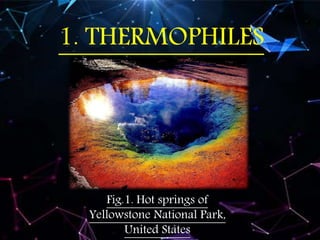
Fig.1. Hot springs of
Yellowstone National Park,
United States
INTRODUCTION
A Thermophile is an organism. a type of extremophile that
thrives at relatively high temperatures, between 40°C to 140°C.
Many Thermophiles are Archaea. Thermophilic Eubacteria are
suggested to have been among the earliest bacteria.
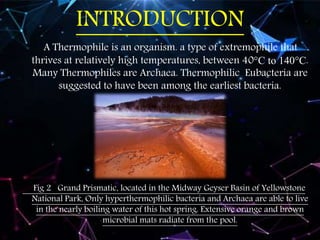
Fig 2 Grand Prismatic, located in the Midway Geyser Basin of Yellowstone
National Park, Only hyperthermophilic bacteria and Archaea are able to live
in the nearly boiling water of this hot spring. Extensive orange and brown
microbial mats radiate from the pool.
IMPORTANCE
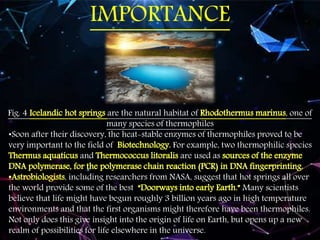
Fig. 4 are the natural habitat of , one of
many species of thermophiles
•Soon after their discovery, the heat-stable enzymes of thermophiles proved to be
very important to the field of For example, two thermophilic species
and are used as
, including researchers from NASA, suggest that hot springs all over
the world provide some of the best Many scientists
believe that life might have begun roughly 3 billion years ago in high temperature
environments and that the first organisms might therefore have been thermophiles.
Not only does this give insight into the origin of life on Earth, but opens up a new
realm of possibilities for life elsewhere in the universe.
• In 1966, Thomas Brock made the remarkable discovery that microorganisms were
growing in the boiling hot springs of Yellowstone National Park. Since Brock's
discovery, thermopiles have been discovered in geothermal features all over the world
including areas in Iceland, Kamchatka, New Zealand, Italy, Mt. Lassen, and other
locations. While boiling hot springs are far beyond the comfort zone of humans and
other animals, life, especially prokaryotic life, is able to adapt to environments that
would prove fatal to most other life forms.
• Regardless of varying environmental conditions, the ability of Thermophiles to thrive
in extremely hot environments lies in extremozymes,
The amino acids of these extremozymes have special
tricks to retain their twisted and folded 3D structures in high heat, where other
enzymes would unfold and no longer work.
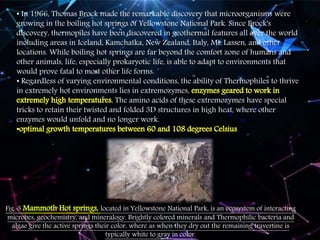
Fig. 3 located in Yellowstone National Park, is an ecosystem of interacting
microbes, geochemistry, and mineralogy. Brightly colored minerals and Thermophilic bacteria and
algae give the active springs their color, where as when they dry out the remaining travertine is
typically white to gray in color.
2. PSYCHROPHILES
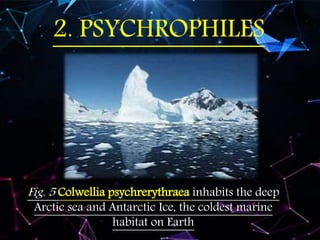
Fig. 5 Colwellia psychrerythraea inhabits the deep
Arctic sea and Antarctic Ice, the coldest marine
habitat on Earth
INTRODUCTION
Psychrophiles or cryophiles are extremophilic organisms that are
capable of growth and reproduction in cold temperatures, ranging
from −20 °Cto +10 °C.
Many such organisms are bacteria, but Psychrophiles also include
eukaryotes such as lichens , snow algae, fungi, and wingless
midges.
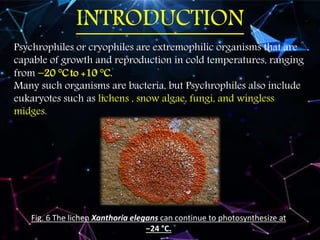
Fig. 6 The lichen Xanthoria elegans can continue to photosynthesize at
−24 °C.
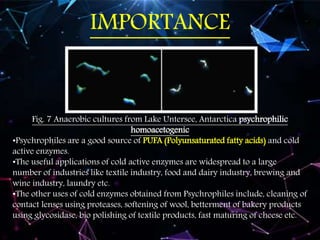
Fig. 7 Anaerobic cultures from Lake Untersee, Antarctica psychrophilic
homoacetogenic
•Psychrophiles are a good source of PUFA (Polyunsaturated fatty acids) and cold
active enzymes.
•The useful applications of cold active enzymes are widespread to a large
number of industries like textile industry, food and dairy industry, brewing and
wine industry, laundry etc.
•The other uses of cold enzymes obtained from Psychrophiles include, cleaning of
contact lenses using proteases, softening of wool, betterment of bakery products
using glycosidase, bio polishing of textile products, fast maturing of cheese etc.
IMPORTANCE
•So far, more than 100 varieties of psychrophilic bacteria have been isolated
from the deep sea.
•Psychrophilic bacteria are truly adapted for life at cold temperatures. The
enzymes of the bacteria are structurally unstable and fail to operate properly
even at room (or ambient) temperature.
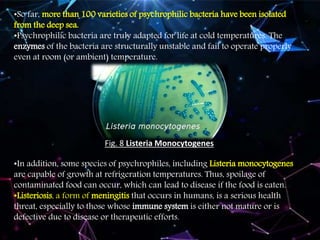
Fig. 8 Listeria Monocytogenes
•In addition, some species of psychrophiles, including Listeria monocytogenes
are capable of growth at refrigeration temperatures. Thus, spoilage of
contaminated food can occur, which can lead to disease if the food is eaten.
•Listeriosis, a form of meningitis that occurs in humans, is a serious health
threat, especially to those whose immune system is either not mature or is
defective due to disease or therapeutic efforts.
3. HALOPHILES
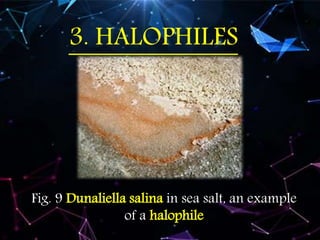
Fig. 9 Dunaliella salina in sea salt, an example
of a halophile
INTRODUCTION
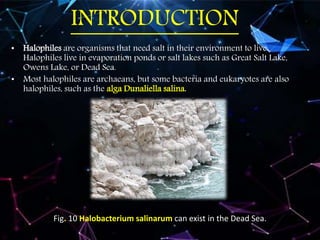
• Halophiles are organisms that need salt in their environment to live.
Halophiles live in evaporation ponds or salt lakes such as Great Salt Lake,
Owens Lake, or Dead Sea.
• Most halophiles are archaeans, but some bacteria and eukaryotes are also
halophiles, such as the alga Dunaliella salina.
Fig. 10 Halobacterium salinarum can exist in the Dead Sea.
IMPORTANCE
•Halophiles play an important part in the fermentation of some foods. For instance,
halophiles ferment soy and fish sauces. Halophiles also ferment salted fish.
•halophiles have been shown to remove phenol (a poisonous chemical) from their
environments. This could lead to future use in cleaning up oil spills.
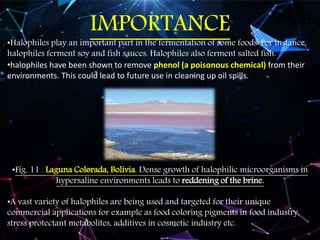
•Fig. 11 . Laguna Colorada, Bolivia. Dense growth of halophilic microorganisms in
hypersaline environments leads to reddening of the brine.
•A vast variety of halophiles are being used and targeted for their unique
commercial applications for example as food coloring pigments in food industry,
stress protectant metabolites, additives in cosmetic industry etc.
•Halobacterium salinarum produces an integral membrane protein,
bacteriorhodopsin, which is being used as holographic storage material in computer
memory and processing units.
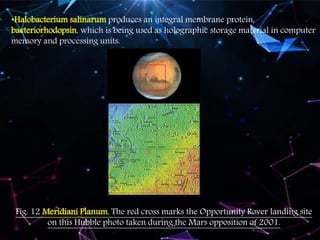
Fig. 12 Meridiani Planum, The red cross marks the Opportunity Rover landing site
on this Hubble photo taken during the Mars opposition of 2001.
•Great Salt Lake has high sodium chloride concentrations as well as a significant
amount of sulfate. The same could be said for the evaporates discovered on the
Meridiani Planum plains of Mars, a hypothesized salt lake.
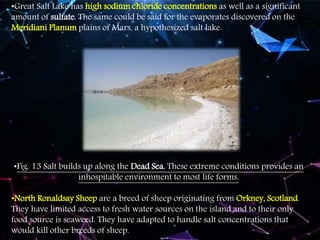
•Fig. 13 Salt builds up along the Dead Sea. These extreme conditions provides an
inhospitable environment to most life forms.
•North Ronaldsay Sheep are a breed of sheep originating from Orkney, Scotland.
They have limited access to fresh water sources on the island and to their only
food source is seaweed. They have adapted to handle salt concentrations that
would kill other breeds of sheep.
Introduction to Extremophiles (part 1)

Introduction to Extremophiles (part 1)

  • 1.
    INTRODUCTION TO EXTREMOPHILES (part 1) Made by:Snehal K. Salunkhe (3rd semester, BBT-2-16036)
  • 2.
    1. THERMOPHILES Fig.1. Hotsprings of Yellowstone National Park, United States
  • 3.
    INTRODUCTION A Thermophile isan organism. a type of extremophile that thrives at relatively high temperatures, between 40°C to 140°C. Many Thermophiles are Archaea. Thermophilic Eubacteria are suggested to have been among the earliest bacteria. Fig 2 Grand Prismatic, located in the Midway Geyser Basin of Yellowstone National Park, Only hyperthermophilic bacteria and Archaea are able to live in the nearly boiling water of this hot spring. Extensive orange and brown microbial mats radiate from the pool.
  • 4.
    IMPORTANCE Fig. 4 arethe natural habitat of , one of many species of thermophiles •Soon after their discovery, the heat-stable enzymes of thermophiles proved to be very important to the field of For example, two thermophilic species and are used as , including researchers from NASA, suggest that hot springs all over the world provide some of the best Many scientists believe that life might have begun roughly 3 billion years ago in high temperature environments and that the first organisms might therefore have been thermophiles. Not only does this give insight into the origin of life on Earth, but opens up a new realm of possibilities for life elsewhere in the universe.
  • 5.
    • In 1966,Thomas Brock made the remarkable discovery that microorganisms were growing in the boiling hot springs of Yellowstone National Park. Since Brock's discovery, thermopiles have been discovered in geothermal features all over the world including areas in Iceland, Kamchatka, New Zealand, Italy, Mt. Lassen, and other locations. While boiling hot springs are far beyond the comfort zone of humans and other animals, life, especially prokaryotic life, is able to adapt to environments that would prove fatal to most other life forms. • Regardless of varying environmental conditions, the ability of Thermophiles to thrive in extremely hot environments lies in extremozymes, The amino acids of these extremozymes have special tricks to retain their twisted and folded 3D structures in high heat, where other enzymes would unfold and no longer work. Fig. 3 located in Yellowstone National Park, is an ecosystem of interacting microbes, geochemistry, and mineralogy. Brightly colored minerals and Thermophilic bacteria and algae give the active springs their color, where as when they dry out the remaining travertine is typically white to gray in color.
  • 6.
    2. PSYCHROPHILES Fig. 5Colwellia psychrerythraea inhabits the deep Arctic sea and Antarctic Ice, the coldest marine habitat on Earth
  • 7.
    INTRODUCTION Psychrophiles or cryophilesare extremophilic organisms that are capable of growth and reproduction in cold temperatures, ranging from −20 °Cto +10 °C. Many such organisms are bacteria, but Psychrophiles also include eukaryotes such as lichens , snow algae, fungi, and wingless midges. Fig. 6 The lichen Xanthoria elegans can continue to photosynthesize at −24 °C.
  • 8.
    Fig. 7 Anaerobiccultures from Lake Untersee, Antarctica psychrophilic homoacetogenic •Psychrophiles are a good source of PUFA (Polyunsaturated fatty acids) and cold active enzymes. •The useful applications of cold active enzymes are widespread to a large number of industries like textile industry, food and dairy industry, brewing and wine industry, laundry etc. •The other uses of cold enzymes obtained from Psychrophiles include, cleaning of contact lenses using proteases, softening of wool, betterment of bakery products using glycosidase, bio polishing of textile products, fast maturing of cheese etc. IMPORTANCE
  • 9.
    •So far, morethan 100 varieties of psychrophilic bacteria have been isolated from the deep sea. •Psychrophilic bacteria are truly adapted for life at cold temperatures. The enzymes of the bacteria are structurally unstable and fail to operate properly even at room (or ambient) temperature. Fig. 8 Listeria Monocytogenes •In addition, some species of psychrophiles, including Listeria monocytogenes are capable of growth at refrigeration temperatures. Thus, spoilage of contaminated food can occur, which can lead to disease if the food is eaten. •Listeriosis, a form of meningitis that occurs in humans, is a serious health threat, especially to those whose immune system is either not mature or is defective due to disease or therapeutic efforts.
  • 10.
    3. HALOPHILES Fig. 9Dunaliella salina in sea salt, an example of a halophile
  • 11.
    INTRODUCTION • Halophiles areorganisms that need salt in their environment to live. Halophiles live in evaporation ponds or salt lakes such as Great Salt Lake, Owens Lake, or Dead Sea. • Most halophiles are archaeans, but some bacteria and eukaryotes are also halophiles, such as the alga Dunaliella salina. Fig. 10 Halobacterium salinarum can exist in the Dead Sea.
  • 12.
    IMPORTANCE •Halophiles play animportant part in the fermentation of some foods. For instance, halophiles ferment soy and fish sauces. Halophiles also ferment salted fish. •halophiles have been shown to remove phenol (a poisonous chemical) from their environments. This could lead to future use in cleaning up oil spills. •Fig. 11 . Laguna Colorada, Bolivia. Dense growth of halophilic microorganisms in hypersaline environments leads to reddening of the brine. •A vast variety of halophiles are being used and targeted for their unique commercial applications for example as food coloring pigments in food industry, stress protectant metabolites, additives in cosmetic industry etc.
  • 13.
    •Halobacterium salinarum producesan integral membrane protein, bacteriorhodopsin, which is being used as holographic storage material in computer memory and processing units. Fig. 12 Meridiani Planum, The red cross marks the Opportunity Rover landing site on this Hubble photo taken during the Mars opposition of 2001.
  • 14.
    •Great Salt Lakehas high sodium chloride concentrations as well as a significant amount of sulfate. The same could be said for the evaporates discovered on the Meridiani Planum plains of Mars, a hypothesized salt lake. •Fig. 13 Salt builds up along the Dead Sea. These extreme conditions provides an inhospitable environment to most life forms. •North Ronaldsay Sheep are a breed of sheep originating from Orkney, Scotland. They have limited access to fresh water sources on the island and to their only food source is seaweed. They have adapted to handle salt concentrations that would kill other breeds of sheep.