EXTREMOPHILES
Rounak Choudhary
M.Sc. (Gold Medalist), UGC-NET & ICAR-ASRB NET Environmental Science, DCB Ornithology, PGD Industrial Safety, Health and Environment
What are extremophiles?
• Organisms that live in and have adapted to
extreme conditions of pH, temperature, or
salinity.
• Studies have shown that bacteria and archaea
live in extremely hot environments (hot
springs and deep-sea hydrothermal vents), up
to 121◦ C (hyperthermophiles) and in very
cold temperatures in the permafrost, down to
−20◦ C (psychrophiles).
• They can live in very salty environments such as
salterns and the Dead Sea (halophiles), and in
very acidic and alkaline environments, such as
acid mine drainage and playa lakes (acidophiles
or alkaliphiles).
• They can also live in environments previously
thought to be devoid of life, such as the extreme
habitat of the Atacama Desert and on the
surfaces of rocks, such as the cave formations and
petroglyphs.
Nanoarchaeum equitans: A Dwarf,
Thermophilic Archaeon.
• During investigations of submarine vents, Huber et al. (2002)
discovered a close association between a new species of
Ignicoccus and a dwarf archaeon that they named
Nanoarchaeum equitans.
• This discovery represents one of the attempts to propose a new
phylum within the Archaea, which Huber et al. (2002) named
the Nanoarchaeota (“the dwarf archaea”). Nanoar chaeum
equitans can be cultured only as a coculture with Ignicoccus and
appears to require a “direct cell–cell contact,” which points to
our inability to always achieve pure microbial cultures. Other
interesting facets of this dwarf archaeon include its thermophilic
lifestyle, as it grows at 70–98◦ C, and its tiny genome size of 0.5
megabases (Mb), making it one of the first possible symbiotic,
dwarf thermophilic archaea to be discovered.
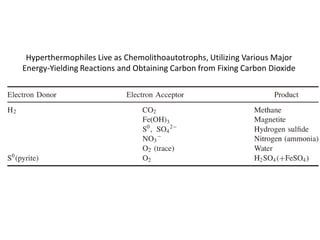
Hyperthermophiles Live as Chemolithoautotrophs, Utilizing Various Major
Energy-Yielding Reactions and Obtaining Carbon from Fixing Carbon Dioxide
• Species Ferroplasma acidiphilum, often found
associated with acidic sulfide ores, and cultured
and described from a pyrite-leaching bioreactor.
• Ferroplasma is most prevalent where there is
abundant ferrous iron, heavy met als, and very
acidic but stable conditions; it is often more
prevalent in these conditions than are previously
documented iron-oxidizing bacteria, such as
Acidithiobacillus spp. and Leptospirillum spp.
• The key to archaeal survival in very acidic conditions is their
ability to maintain very low proton permeabilities, due to
their tetraether lipids. Ferroplasma accomplishes this, even
though it lacks a cell wall, with a new kind of tetraether
lipid, a caldarchaetidylglycerol tetralipid with an isoprenoid
core (Golyshina and Timmis 2005). Genomic analyses
suggest that Ferroplasma spp. cycle iron and metabolize
carbon and reveal the presence of several genes for
resistance to various heavy metals. Research is also
demonstrating that Ferroplasma spp. may be important in
biomining, giving them an important biotech nology
potential. By studying Ferroplasma, we can better
understand how extremophiles are able to exist in what
seem to us to be very hostile conditions.
Methanogens
• Known for many years, but previously included
with the bacteria in the Monera kingdom until
Carl Woese proposed the Domain Archaea,
methanogens now reside within the
Euryarchaeota. Methanogens are the moderates
of the archaea, living at moderate pH,
temperature, and salinity, in contrast to many
other archaea. They are significant for their
production of large amounts of methane, which
they produce under anaerobic conditions.
• Methanogens are very strict anaerobes, due in part to
the sensitivity to oxygen of the enzymes involved in
methanogenesis. Because of their lack of tolerance to
oxygen, they’re found in anoxic sediments, anaerobic
digestors, and animal guts. In these environments, if
sulfate is present, sulfate-reducing bacteria will
outcompete the methanogens for hydrogen. Their
metabolism has been well characterized, and we know
that almost all methanogens can utilize hydrogen to
reduce carbon dioxide, while some methanogens can
utilize formate as the electron donor and fewer
methanogens can use alcohols. A few other
methanogens utilize C1 compounds containing methyl
or acetate. The production of methane provides
substantial energy for the organisms Methanogens
often live syntrophically with other bacteria, such as
fatty-acid-oxidizing bacteria.
• Methane, the product of methanogenesis, can be
observed in swamps. Several micro bial diversity
classes at Woods Hole Marine Biological Laboratory
have participated in a field trip to the local swamp,
where they used wooden dowels to release methane
from the swamp sediments. After capturing the
methane in corked funnels, students carefully uncorked
the funnels and lit the escaping methane to reproduce
the experiment by Alessandro Volta (1745–1827) with
marsh gas in the 1790s. Volta used his results to create
gas lanterns to provide light. Today, methane is a major
greenhouse gas, and atmospheric isotopic studies
estimate that approximately 74% of the methane
produced is produced by microorganisms (Whitman et
al. 2006)
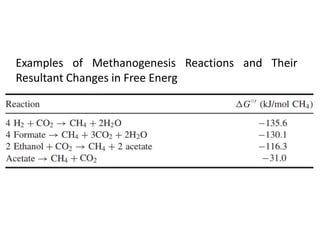
Examples of Methanogenesis Reactions and Their
Resultant Changes in Free Energ
Halophilic Archaea
• The order Halobacteriales, within the Euryarchaeota, encompasses
the halophilic organisms found in hypersaline (salt concentrations
>150–200 g/L) envi ronments. If you’ve flown into San Francisco,
CA, USA you have probably noticed the pinkish red-orange salt
ponds on the edge of the bay.
• The color comes from the carotenoids in the cell membranes. Other
habitats in which halophilic archaea are found include salt lakes,
such as the Dead Sea, salt playas, salt formations, foods preserved
in salty brines, and hides preserved with salt. How the halophiles
tolerate such high salt conditions has been the focus of much study,
which has revealed that they main tain high concentrations of ions
such as potassium and chloride within their cells. The high
intracellular ionic concentration has led to adaptations in their
enzymes to allow them to function properly at these salt
concentrations, which, in turn, has made them obligate dwellers in
salty environments. Halophilic archaea require molar
concentrations of sodium ions and the availability of magnesium
and calcium in their environment.
• One fascinating feature of many species within
the Halobacteriales is the presence of retinal
pigments, bacteriorhodopsin, which pumps
protons out of the cell, and halorhodopsin, which
pumps chloride ions into the cell. These pumps
are fueled by solar energy. Halophilic archaea can
sometimes come in interesting shapes, such as
the Walsby square “bacterium” (Walsby 1980),
which maintain their buoyancy in water through
gas-filled vacuoles.
Adaptations in acidophiles
• Acid resistance of acidophiles is the result of long-term co-evolution
and natural selection of acidophiles and their natural habitats, and
formed a relatively optimal acid-resistance network in acidophiles.
The acid tolerance network of acidophiles could be classified into
active and passive mechanisms. The active mechanisms mainly
include the proton efflux and consumption systems, generation of
reversed transmembrane electrical potential, and adjustment of cell
membrane composition; the passive mechanisms mainly include
the DNA and protein repair systems, chemotaxis and cell motility,
and quorum sensing system. The maintenance of pH homeostasis is
a cell-wide physiological process that adopt differently adjustment
strategies, deployment modules, and integration network
depending on the cell’s own potential and its habitat environments.
However, acidophiles exhibit obvious strategies and modules
similarities on acid resistance because of the long-term evolution.
• Generally, acidophilic archaea and bacteria
mainly include members of
phylum Euryarchaeota, Crenarchaeota, Proteo
bacteria, Acidobacteria, Nitrospira, Firmicutes,
Actinobacteria and Aquificae such
as Ferroplasma, Acidiplasma, Sulfolobus, Acidi
anus, Acidiphilum, Acidithiobacillus, Acidihalo
bacter, Ferrovum, Acidiferrobacter, Acidobacte
rium, Leptospirillum, Sulfobacillus, Acidibacillu
s, Acidimicrobium, and Hydrogenobaculum
Active support of acidophiles pH
homeostasis
• Microorganisms tend to maintain a high proton motive
force (PMF) and a near-neutral pH in cytoplasm. The
transmembrane electrical potential (Δψ) and
transmembrane pH gradient (ΔpH) could vary as a function
of the external pH. The immediately available energy
source for acidophilic cell is this pre-existing
transmembrane proton gradient, due to the external
environments are frequently in the pH range of 1.0–3.0,
while the typical pH of cytoplasms are close to 6.5 (that is,
the differential proton concentrations of 4–6 orders of
magnitude). The ΔpH across the membrane is a major part
of the PMF, and the ΔpH is linked to cellular bioenergetics.
Acidophiles, such as Acidithiobacillus
ferrooxidans and Acidithiobacillus caldus, are capable of
using the ΔpH to generate a large quantity of ATP .
Passive strategies for acidophiles living
• When the cells are attacked or stressed by higher
concentrations of protons, the passive mechanisms of pH
homeostasis would support the active mechanism. If
protons penetrate the acidophilic cell membrane, a range
of intracellular repair systems would help to repair the
damage of macromolecules.
• The DNA and protein repair systems play a central role in
coping with acid stress of cells. Because DNA carries genetic
information of cell life and protein plays an important role
in the physiological activities of cells, DNA or protein
damage caused by protons would bring irreversible harm to
cells. When the cells are exposed to a high concentration of
proton environments or protons influx into the cells, a great
number of DNA repair proteins and chaperones (such as
Dps, GrpE, MolR, and DnaK protein) would repair the
damaged DNA and protein.
Adaptive Mechanisms of Extreme
Alkaliphiles
• Extreme alkaliphiles, like extremophiles in general,
possess numerous structural, metabolic, physiological,
and bioenergetic adaptations that enable them to
function well under their particular “extreme”
condition or, in the case of poly-extremophiles, under
several extreme conditions at once . If they are
facultative extremophiles, many of the adaptations are
present even under non-extreme growth conditions.
That is, the adaptations to the extreme condition are
“hard-wired” although their expression may increase
further when the bacteria confront the extreme
condition(s).
• The constitutive hard-wiring is presumed to be a
mechanism that anticipates the need to survive
and grow upon a sudden shift to the extreme
condition(s). Here, we will summarize a number
of different adaptations of alkaliphiles that
support their ability to grow optimally at pH
values well above 9.0. Some of these species or
strains are obligate alkaliphiles that exhibit little
or no growth at pH values closer to neutral.
Other, facultative alkaliphiles, grow in a range
from pH 7.5 to 11.
• The facultative alkaliphiles exhibit trade-offs
of the type predicted by the ‘‘no free lunch’’
principle defined above. They have a
remarkable capacity for growth at pH values
much higher than the outer limit of pH 8.5–
9.0 for growth of typical neutralophilic
bacteria. Facultative alkaliphiles also transition
almost seamlessly through a sudden shift from
near neutral pH to extremely alkaline pH.
• Each alkaliphile strain that has been examined in some
detail displays multiple adaptations that address
specific aspects of the challenge of growth at very high
pH. For example, they have multiple types of strategies
and apparently redundant transporters or enzymes to
achieve alkaline pH homeostasis.
• Genetically tractable strains are almost entirely
unavailable for most extreme alkaliphile types,
including extreme Gram-negative alkaliphiles and poly-
extremophiles that are alkaliphilic as well as
thermophilic and/or halophilic.
Adaptive Mechanisms of Extreme
Barophiles
• Barophiles are defined as organisms which grow
optimally or preferentially at pressures greater than
atmospheric pressure.
• Deep-sea microorganisms that grow only under
elevated hydrostatic pressure are called barophilic (also
called piezophilic) and barotolerant ones grow at 1
atmospheric as well as at elevated hydrostatic
pressure. These organisms are either psychrophilic
(coldloving) or psychrotolerant (cold-tolerant),
thermophilic and thermotolerant around hydrothermal
vents. In this review the focus is on the cold –tolerant
piezophiles.
• The extremophiles are native to their respective
environment and therefore, should one look for
any adaptation strategies in the form of genes or
proteins per se in these? They may be novel from
the point of mesophilic organisms and that is not
unexpected. Therefore, most of the studies
regarding understanding of pressure effects have
come from moderately barophilic or barotolerant
microorganisms. The effect of pressure on cell
membrane, protein and gene expression are
studied in detail in some of these
microorganisms.
• Cold temperatures and high pressures decrease membrane
fluidity and affect a number of membrane-associated
processes including ion and nutrient flux and DNA
replication (Bartlett, 1992). A barotolerant strain of
Alteromonas isolated from 4033 m in the Izu-Ogasawara
Trench, Japan showed an increase in the proportion of
unsaturated fatty acid composition in membrane fraction
with increased pressure during its growth indicating its
possible involvement in maintaining the fluidity of the cell
membrane (Kamimura et al., 1993). The membrane
phospholipids of two barophilic bacteria DB21MT-2 and
DB21MT-5, isolated from sediments from Mariana Trench
at 11,000 m showed wide distribution of polyunsaturated
fatty acids, suggesting that adaptation of the barophiles to
low temperature and high hydrostatic pressure influenzed
the synthesis of phospholipids containing polyunsaturated
fatty acids (Fang et al., 2000).
• Hydrostatic pressure also influences the abundance of
cell surface proteins in bacteria adapted to low or high
pressures. The moderately barophilic deep-sea
bacterium Photobacterium SS9 was reported to
regulate the abundance of several outer membrane
proteins (omp) in response to hydrostatic pressure (Chi
and Bartlett, 1993). One outer membrane protein
ompH was induced 10-100-fold in SS9 cells grown at 28
MPa. These authors suggested that ompH probably
acts as a non-specific porin protein involving in uptake
of substrates larger than 400 daltons. Mutants that
lacked ompH gene were however not pressure-
sensitive suggesting that ompH is required for high
pressure growth under other physiological conditions
present in the deep-sea such as low nutrient conditions
or it may be one of the multiple proteins facilitating
growth at high pressure (Chi and Bartlett, 1993).

EXTREMOPHILES.pdf

  • 1.
    EXTREMOPHILES Rounak Choudhary M.Sc. (GoldMedalist), UGC-NET & ICAR-ASRB NET Environmental Science, DCB Ornithology, PGD Industrial Safety, Health and Environment
  • 2.
    What are extremophiles? •Organisms that live in and have adapted to extreme conditions of pH, temperature, or salinity. • Studies have shown that bacteria and archaea live in extremely hot environments (hot springs and deep-sea hydrothermal vents), up to 121◦ C (hyperthermophiles) and in very cold temperatures in the permafrost, down to −20◦ C (psychrophiles).
  • 3.
    • They canlive in very salty environments such as salterns and the Dead Sea (halophiles), and in very acidic and alkaline environments, such as acid mine drainage and playa lakes (acidophiles or alkaliphiles). • They can also live in environments previously thought to be devoid of life, such as the extreme habitat of the Atacama Desert and on the surfaces of rocks, such as the cave formations and petroglyphs.
  • 4.
    Nanoarchaeum equitans: ADwarf, Thermophilic Archaeon. • During investigations of submarine vents, Huber et al. (2002) discovered a close association between a new species of Ignicoccus and a dwarf archaeon that they named Nanoarchaeum equitans. • This discovery represents one of the attempts to propose a new phylum within the Archaea, which Huber et al. (2002) named the Nanoarchaeota (“the dwarf archaea”). Nanoar chaeum equitans can be cultured only as a coculture with Ignicoccus and appears to require a “direct cell–cell contact,” which points to our inability to always achieve pure microbial cultures. Other interesting facets of this dwarf archaeon include its thermophilic lifestyle, as it grows at 70–98◦ C, and its tiny genome size of 0.5 megabases (Mb), making it one of the first possible symbiotic, dwarf thermophilic archaea to be discovered.
  • 5.
    Hyperthermophiles Live asChemolithoautotrophs, Utilizing Various Major Energy-Yielding Reactions and Obtaining Carbon from Fixing Carbon Dioxide
  • 6.
    • Species Ferroplasmaacidiphilum, often found associated with acidic sulfide ores, and cultured and described from a pyrite-leaching bioreactor. • Ferroplasma is most prevalent where there is abundant ferrous iron, heavy met als, and very acidic but stable conditions; it is often more prevalent in these conditions than are previously documented iron-oxidizing bacteria, such as Acidithiobacillus spp. and Leptospirillum spp.
  • 7.
    • The keyto archaeal survival in very acidic conditions is their ability to maintain very low proton permeabilities, due to their tetraether lipids. Ferroplasma accomplishes this, even though it lacks a cell wall, with a new kind of tetraether lipid, a caldarchaetidylglycerol tetralipid with an isoprenoid core (Golyshina and Timmis 2005). Genomic analyses suggest that Ferroplasma spp. cycle iron and metabolize carbon and reveal the presence of several genes for resistance to various heavy metals. Research is also demonstrating that Ferroplasma spp. may be important in biomining, giving them an important biotech nology potential. By studying Ferroplasma, we can better understand how extremophiles are able to exist in what seem to us to be very hostile conditions.
  • 8.
    Methanogens • Known formany years, but previously included with the bacteria in the Monera kingdom until Carl Woese proposed the Domain Archaea, methanogens now reside within the Euryarchaeota. Methanogens are the moderates of the archaea, living at moderate pH, temperature, and salinity, in contrast to many other archaea. They are significant for their production of large amounts of methane, which they produce under anaerobic conditions.
  • 9.
    • Methanogens arevery strict anaerobes, due in part to the sensitivity to oxygen of the enzymes involved in methanogenesis. Because of their lack of tolerance to oxygen, they’re found in anoxic sediments, anaerobic digestors, and animal guts. In these environments, if sulfate is present, sulfate-reducing bacteria will outcompete the methanogens for hydrogen. Their metabolism has been well characterized, and we know that almost all methanogens can utilize hydrogen to reduce carbon dioxide, while some methanogens can utilize formate as the electron donor and fewer methanogens can use alcohols. A few other methanogens utilize C1 compounds containing methyl or acetate. The production of methane provides substantial energy for the organisms Methanogens often live syntrophically with other bacteria, such as fatty-acid-oxidizing bacteria.
  • 10.
    • Methane, theproduct of methanogenesis, can be observed in swamps. Several micro bial diversity classes at Woods Hole Marine Biological Laboratory have participated in a field trip to the local swamp, where they used wooden dowels to release methane from the swamp sediments. After capturing the methane in corked funnels, students carefully uncorked the funnels and lit the escaping methane to reproduce the experiment by Alessandro Volta (1745–1827) with marsh gas in the 1790s. Volta used his results to create gas lanterns to provide light. Today, methane is a major greenhouse gas, and atmospheric isotopic studies estimate that approximately 74% of the methane produced is produced by microorganisms (Whitman et al. 2006)
  • 11.
    Examples of MethanogenesisReactions and Their Resultant Changes in Free Energ
  • 12.
    Halophilic Archaea • Theorder Halobacteriales, within the Euryarchaeota, encompasses the halophilic organisms found in hypersaline (salt concentrations >150–200 g/L) envi ronments. If you’ve flown into San Francisco, CA, USA you have probably noticed the pinkish red-orange salt ponds on the edge of the bay. • The color comes from the carotenoids in the cell membranes. Other habitats in which halophilic archaea are found include salt lakes, such as the Dead Sea, salt playas, salt formations, foods preserved in salty brines, and hides preserved with salt. How the halophiles tolerate such high salt conditions has been the focus of much study, which has revealed that they main tain high concentrations of ions such as potassium and chloride within their cells. The high intracellular ionic concentration has led to adaptations in their enzymes to allow them to function properly at these salt concentrations, which, in turn, has made them obligate dwellers in salty environments. Halophilic archaea require molar concentrations of sodium ions and the availability of magnesium and calcium in their environment.
  • 13.
    • One fascinatingfeature of many species within the Halobacteriales is the presence of retinal pigments, bacteriorhodopsin, which pumps protons out of the cell, and halorhodopsin, which pumps chloride ions into the cell. These pumps are fueled by solar energy. Halophilic archaea can sometimes come in interesting shapes, such as the Walsby square “bacterium” (Walsby 1980), which maintain their buoyancy in water through gas-filled vacuoles.
  • 14.
    Adaptations in acidophiles •Acid resistance of acidophiles is the result of long-term co-evolution and natural selection of acidophiles and their natural habitats, and formed a relatively optimal acid-resistance network in acidophiles. The acid tolerance network of acidophiles could be classified into active and passive mechanisms. The active mechanisms mainly include the proton efflux and consumption systems, generation of reversed transmembrane electrical potential, and adjustment of cell membrane composition; the passive mechanisms mainly include the DNA and protein repair systems, chemotaxis and cell motility, and quorum sensing system. The maintenance of pH homeostasis is a cell-wide physiological process that adopt differently adjustment strategies, deployment modules, and integration network depending on the cell’s own potential and its habitat environments. However, acidophiles exhibit obvious strategies and modules similarities on acid resistance because of the long-term evolution.
  • 15.
    • Generally, acidophilicarchaea and bacteria mainly include members of phylum Euryarchaeota, Crenarchaeota, Proteo bacteria, Acidobacteria, Nitrospira, Firmicutes, Actinobacteria and Aquificae such as Ferroplasma, Acidiplasma, Sulfolobus, Acidi anus, Acidiphilum, Acidithiobacillus, Acidihalo bacter, Ferrovum, Acidiferrobacter, Acidobacte rium, Leptospirillum, Sulfobacillus, Acidibacillu s, Acidimicrobium, and Hydrogenobaculum
  • 16.
    Active support ofacidophiles pH homeostasis • Microorganisms tend to maintain a high proton motive force (PMF) and a near-neutral pH in cytoplasm. The transmembrane electrical potential (Δψ) and transmembrane pH gradient (ΔpH) could vary as a function of the external pH. The immediately available energy source for acidophilic cell is this pre-existing transmembrane proton gradient, due to the external environments are frequently in the pH range of 1.0–3.0, while the typical pH of cytoplasms are close to 6.5 (that is, the differential proton concentrations of 4–6 orders of magnitude). The ΔpH across the membrane is a major part of the PMF, and the ΔpH is linked to cellular bioenergetics. Acidophiles, such as Acidithiobacillus ferrooxidans and Acidithiobacillus caldus, are capable of using the ΔpH to generate a large quantity of ATP .
  • 17.
    Passive strategies foracidophiles living • When the cells are attacked or stressed by higher concentrations of protons, the passive mechanisms of pH homeostasis would support the active mechanism. If protons penetrate the acidophilic cell membrane, a range of intracellular repair systems would help to repair the damage of macromolecules. • The DNA and protein repair systems play a central role in coping with acid stress of cells. Because DNA carries genetic information of cell life and protein plays an important role in the physiological activities of cells, DNA or protein damage caused by protons would bring irreversible harm to cells. When the cells are exposed to a high concentration of proton environments or protons influx into the cells, a great number of DNA repair proteins and chaperones (such as Dps, GrpE, MolR, and DnaK protein) would repair the damaged DNA and protein.
  • 18.
    Adaptive Mechanisms ofExtreme Alkaliphiles • Extreme alkaliphiles, like extremophiles in general, possess numerous structural, metabolic, physiological, and bioenergetic adaptations that enable them to function well under their particular “extreme” condition or, in the case of poly-extremophiles, under several extreme conditions at once . If they are facultative extremophiles, many of the adaptations are present even under non-extreme growth conditions. That is, the adaptations to the extreme condition are “hard-wired” although their expression may increase further when the bacteria confront the extreme condition(s).
  • 19.
    • The constitutivehard-wiring is presumed to be a mechanism that anticipates the need to survive and grow upon a sudden shift to the extreme condition(s). Here, we will summarize a number of different adaptations of alkaliphiles that support their ability to grow optimally at pH values well above 9.0. Some of these species or strains are obligate alkaliphiles that exhibit little or no growth at pH values closer to neutral. Other, facultative alkaliphiles, grow in a range from pH 7.5 to 11.
  • 20.
    • The facultativealkaliphiles exhibit trade-offs of the type predicted by the ‘‘no free lunch’’ principle defined above. They have a remarkable capacity for growth at pH values much higher than the outer limit of pH 8.5– 9.0 for growth of typical neutralophilic bacteria. Facultative alkaliphiles also transition almost seamlessly through a sudden shift from near neutral pH to extremely alkaline pH.
  • 21.
    • Each alkaliphilestrain that has been examined in some detail displays multiple adaptations that address specific aspects of the challenge of growth at very high pH. For example, they have multiple types of strategies and apparently redundant transporters or enzymes to achieve alkaline pH homeostasis. • Genetically tractable strains are almost entirely unavailable for most extreme alkaliphile types, including extreme Gram-negative alkaliphiles and poly- extremophiles that are alkaliphilic as well as thermophilic and/or halophilic.
  • 22.
    Adaptive Mechanisms ofExtreme Barophiles • Barophiles are defined as organisms which grow optimally or preferentially at pressures greater than atmospheric pressure. • Deep-sea microorganisms that grow only under elevated hydrostatic pressure are called barophilic (also called piezophilic) and barotolerant ones grow at 1 atmospheric as well as at elevated hydrostatic pressure. These organisms are either psychrophilic (coldloving) or psychrotolerant (cold-tolerant), thermophilic and thermotolerant around hydrothermal vents. In this review the focus is on the cold –tolerant piezophiles.
  • 23.
    • The extremophilesare native to their respective environment and therefore, should one look for any adaptation strategies in the form of genes or proteins per se in these? They may be novel from the point of mesophilic organisms and that is not unexpected. Therefore, most of the studies regarding understanding of pressure effects have come from moderately barophilic or barotolerant microorganisms. The effect of pressure on cell membrane, protein and gene expression are studied in detail in some of these microorganisms.
  • 24.
    • Cold temperaturesand high pressures decrease membrane fluidity and affect a number of membrane-associated processes including ion and nutrient flux and DNA replication (Bartlett, 1992). A barotolerant strain of Alteromonas isolated from 4033 m in the Izu-Ogasawara Trench, Japan showed an increase in the proportion of unsaturated fatty acid composition in membrane fraction with increased pressure during its growth indicating its possible involvement in maintaining the fluidity of the cell membrane (Kamimura et al., 1993). The membrane phospholipids of two barophilic bacteria DB21MT-2 and DB21MT-5, isolated from sediments from Mariana Trench at 11,000 m showed wide distribution of polyunsaturated fatty acids, suggesting that adaptation of the barophiles to low temperature and high hydrostatic pressure influenzed the synthesis of phospholipids containing polyunsaturated fatty acids (Fang et al., 2000).
  • 25.
    • Hydrostatic pressurealso influences the abundance of cell surface proteins in bacteria adapted to low or high pressures. The moderately barophilic deep-sea bacterium Photobacterium SS9 was reported to regulate the abundance of several outer membrane proteins (omp) in response to hydrostatic pressure (Chi and Bartlett, 1993). One outer membrane protein ompH was induced 10-100-fold in SS9 cells grown at 28 MPa. These authors suggested that ompH probably acts as a non-specific porin protein involving in uptake of substrates larger than 400 daltons. Mutants that lacked ompH gene were however not pressure- sensitive suggesting that ompH is required for high pressure growth under other physiological conditions present in the deep-sea such as low nutrient conditions or it may be one of the multiple proteins facilitating growth at high pressure (Chi and Bartlett, 1993).