



4 Things That Leaders Do4 Things That Leaders Do
Dr. John JacksonDr. John Jackson
William Jessup UniversityWilliam Jessup University
jjackson@jessup.edujjackson@jessup.edu
4 Things That Leaders Do4 Things That Leaders Do
1.1. Cast VisionCast Vision
2.2. Create EnvironmentsCreate Environments
3.3. Develop SystemsDevelop Systems
4.4. Equip LeadersEquip Leaders
#1
Cast Vision
Leaders develop a sense of aLeaders develop a sense of a
preferable future.preferable future.
Vision casting requires aVision casting requires a
passionate pursuit of thepassionate pursuit of the
possible even in the midst ofpossible even in the midst of
the mind-numbing reality ofthe mind-numbing reality of
the present.the present.
Leaders learn to speak inLeaders learn to speak in
short sentences that SINGshort sentences that SING
rather than in paragraphsrather than in paragraphs
that SNORE.that SNORE.
Leaders must paint pictures,Leaders must paint pictures,
call forth emotions, andcall forth emotions, and
challenge people to riskchallenge people to risk
#2#2
CreateCreate
EnvironmentsEnvironments
Create environments toCreate environments to
Grow sales,Grow sales,
Grow devoted customers,Grow devoted customers,
Grow your people.Grow your people.
We live in an EXPERIENCEWe live in an EXPERIENCE
economy…..economy…..
Starbucks is not, in the end,Starbucks is not, in the end,
selling coffee!selling coffee!
Neither is Barnes & NobleNeither is Barnes & Noble
selling books!selling books!
#3
Develop
Systems
-INPUT-INPUT
-THROUGHPUT-THROUGHPUT
-OUTPUT-OUTPUT
manufacturing modelmanufacturing model
Begin with the end in mind…what do youBegin with the end in mind…what do you
want to produce?want to produce?
Systems produce…Systems produce…
#4
Equip Leaders
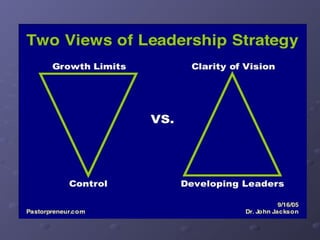
MULTIPLYMULTIPLY
versusversus
ADDINGADDING
Pinpoint HIGH CAPACITYPinpoint HIGH CAPACITY
leadersleaders
VISION DRIVENVISION DRIVEN
releasing requires personalreleasing requires personal
security…security…
Equipping Leaders: How?Equipping Leaders: How?
Life on LifeLife on Life
TrainingTraining
BenchmarkingBenchmarking
Leadership DevelopmentLeadership Development
Shared ExperiencesShared Experiences
Focus, Alignment, Reach:Focus, Alignment, Reach:
Shaping Your Vision as a LeaderShaping Your Vision as a Leader
Focus:Focus: Deciding what you must be greatDeciding what you must be great
at and being ruthless aboutat and being ruthless about
accomplishing it…thisaccomplishing it…this “one” thing I do“one” thing I do
Alignment: Strategic PlanningAlignment: Strategic Planning
and Vision Developmentand Vision Development
““Organizing is what you do before you doOrganizing is what you do before you do
something, so that when you do it, it’ssomething, so that when you do it, it’s
not all mixed up.”not all mixed up.”
Christopher Robin, in Winnie the PoohChristopher Robin, in Winnie the Pooh
REACHREACH
BENCHMARKINGBENCHMARKING
SHARING EXPERIENCESSHARING EXPERIENCES
LEADERSHIP DEVELOPMENTLEADERSHIP DEVELOPMENT
TRAININGTRAINING
MULTIPLY YOUR IMPACTMULTIPLY YOUR IMPACT
SYNERGYSYNERGY
Insuring that all the parts are workingInsuring that all the parts are working
together to multiply energy. Effectivetogether to multiply energy. Effective
leaders always multiply energy byleaders always multiply energy by
multiplying themselves, and the energymultiplying themselves, and the energy
between others to produce net gainsbetween others to produce net gains
beyond simple addition.beyond simple addition.
““Leadership is the capacity to translateLeadership is the capacity to translate
vision into reality” (Warren Bennis)vision into reality” (Warren Bennis)
““Leaders are visionaries with a poorlyLeaders are visionaries with a poorly
developed sense of fear and no concept ofdeveloped sense of fear and no concept of
the odds against them” (Dr. Robert Jarvik,the odds against them” (Dr. Robert Jarvik,
inventor of the Jarvik-7 artificial heart)inventor of the Jarvik-7 artificial heart)
““If your actions inspire others to dreamIf your actions inspire others to dream
more, learn more, do more, and becomemore, learn more, do more, and become
more, you are a leader” (John Quincymore, you are a leader” (John Quincy
Adams)Adams)
““The first responsibility of a leader is to defineThe first responsibility of a leader is to define
reality. The last is to say thank you. Inreality. The last is to say thank you. In
between, the leader is a servant” (Max Depree)between, the leader is a servant” (Max Depree)
‘‘The pessimist complains about the wind. TheThe pessimist complains about the wind. The
optimist expects it to change. The leaderoptimist expects it to change. The leader
adjusts the sails” (John Maxwell)adjusts the sails” (John Maxwell)
““If you want to know the temperature of yourIf you want to know the temperature of your
organization, put a thermometer in the leader’sorganization, put a thermometer in the leader’s
mouth” (Rick Warren)mouth” (Rick Warren)
Lessons Learned From theLessons Learned From the
80/20 Principle80/20 Principle
1. Activity does not equal1. Activity does not equal
accomplishmentaccomplishment
2. Work smarter, not harder2. Work smarter, not harder
3. Organize or agonize3. Organize or agonize
4. Evaluate or stagnate4. Evaluate or stagnate
5. Schedule your priorities5. Schedule your priorities
6. Reacting is not leading6. Reacting is not leading
7. Say no to little things7. Say no to little things
Write Down Your Top 20%Write Down Your Top 20%
Think back to the 80/20 Rule.Think back to the 80/20 Rule.
Remember: activity does not equalRemember: activity does not equal
accomplishment.accomplishment.
Answer the following questions based onAnswer the following questions based on
your own leadership strengths andyour own leadership strengths and
priorities:priorities:
Who are the top 20% influential people intoWho are the top 20% influential people into
whom you should pour your life?whom you should pour your life?
What activities result in the greatest amountWhat activities result in the greatest amount
of fruit for you as a leader?of fruit for you as a leader?
Which of your leadership roles produce theWhich of your leadership roles produce the
deepest amount of personal fulfillment?deepest amount of personal fulfillment?
Who are the potential leaders around youWho are the potential leaders around you
that you can equip for leadership?that you can equip for leadership?
What are other priorities you should pursueWhat are other priorities you should pursue
as you endeavor to lead people?as you endeavor to lead people?

4 things leaders do..

  • 1.
    4 Things ThatLeaders Do4 Things That Leaders Do Dr. John JacksonDr. John Jackson William Jessup UniversityWilliam Jessup University jjackson@jessup.edujjackson@jessup.edu
  • 3.
    4 Things ThatLeaders Do4 Things That Leaders Do 1.1. Cast VisionCast Vision 2.2. Create EnvironmentsCreate Environments 3.3. Develop SystemsDevelop Systems 4.4. Equip LeadersEquip Leaders
  • 4.
  • 5.
    Leaders develop asense of aLeaders develop a sense of a preferable future.preferable future. Vision casting requires aVision casting requires a passionate pursuit of thepassionate pursuit of the possible even in the midst ofpossible even in the midst of the mind-numbing reality ofthe mind-numbing reality of the present.the present.
  • 6.
    Leaders learn tospeak inLeaders learn to speak in short sentences that SINGshort sentences that SING rather than in paragraphsrather than in paragraphs that SNORE.that SNORE. Leaders must paint pictures,Leaders must paint pictures, call forth emotions, andcall forth emotions, and challenge people to riskchallenge people to risk
  • 7.
  • 8.
    Create environments toCreateenvironments to Grow sales,Grow sales, Grow devoted customers,Grow devoted customers, Grow your people.Grow your people.
  • 9.
    We live inan EXPERIENCEWe live in an EXPERIENCE economy…..economy….. Starbucks is not, in the end,Starbucks is not, in the end, selling coffee!selling coffee! Neither is Barnes & NobleNeither is Barnes & Noble selling books!selling books!
  • 10.
  • 11.
    -INPUT-INPUT -THROUGHPUT-THROUGHPUT -OUTPUT-OUTPUT manufacturing modelmanufacturing model Beginwith the end in mind…what do youBegin with the end in mind…what do you want to produce?want to produce? Systems produce…Systems produce…
  • 12.
  • 13.
  • 14.
    Pinpoint HIGH CAPACITYPinpointHIGH CAPACITY leadersleaders VISION DRIVENVISION DRIVEN releasing requires personalreleasing requires personal security…security…
  • 15.
    Equipping Leaders: How?EquippingLeaders: How? Life on LifeLife on Life TrainingTraining BenchmarkingBenchmarking Leadership DevelopmentLeadership Development Shared ExperiencesShared Experiences
  • 17.
    Focus, Alignment, Reach:Focus,Alignment, Reach: Shaping Your Vision as a LeaderShaping Your Vision as a Leader Focus:Focus: Deciding what you must be greatDeciding what you must be great at and being ruthless aboutat and being ruthless about accomplishing it…thisaccomplishing it…this “one” thing I do“one” thing I do
  • 18.
    Alignment: Strategic PlanningAlignment:Strategic Planning and Vision Developmentand Vision Development ““Organizing is what you do before you doOrganizing is what you do before you do something, so that when you do it, it’ssomething, so that when you do it, it’s not all mixed up.”not all mixed up.” Christopher Robin, in Winnie the PoohChristopher Robin, in Winnie the Pooh
  • 19.
    REACHREACH BENCHMARKINGBENCHMARKING SHARING EXPERIENCESSHARING EXPERIENCES LEADERSHIPDEVELOPMENTLEADERSHIP DEVELOPMENT TRAININGTRAINING MULTIPLY YOUR IMPACTMULTIPLY YOUR IMPACT
  • 20.
    SYNERGYSYNERGY Insuring that allthe parts are workingInsuring that all the parts are working together to multiply energy. Effectivetogether to multiply energy. Effective leaders always multiply energy byleaders always multiply energy by multiplying themselves, and the energymultiplying themselves, and the energy between others to produce net gainsbetween others to produce net gains beyond simple addition.beyond simple addition.
  • 21.
    ““Leadership is thecapacity to translateLeadership is the capacity to translate vision into reality” (Warren Bennis)vision into reality” (Warren Bennis) ““Leaders are visionaries with a poorlyLeaders are visionaries with a poorly developed sense of fear and no concept ofdeveloped sense of fear and no concept of the odds against them” (Dr. Robert Jarvik,the odds against them” (Dr. Robert Jarvik, inventor of the Jarvik-7 artificial heart)inventor of the Jarvik-7 artificial heart) ““If your actions inspire others to dreamIf your actions inspire others to dream more, learn more, do more, and becomemore, learn more, do more, and become more, you are a leader” (John Quincymore, you are a leader” (John Quincy Adams)Adams)
  • 22.
    ““The first responsibilityof a leader is to defineThe first responsibility of a leader is to define reality. The last is to say thank you. Inreality. The last is to say thank you. In between, the leader is a servant” (Max Depree)between, the leader is a servant” (Max Depree) ‘‘The pessimist complains about the wind. TheThe pessimist complains about the wind. The optimist expects it to change. The leaderoptimist expects it to change. The leader adjusts the sails” (John Maxwell)adjusts the sails” (John Maxwell) ““If you want to know the temperature of yourIf you want to know the temperature of your organization, put a thermometer in the leader’sorganization, put a thermometer in the leader’s mouth” (Rick Warren)mouth” (Rick Warren)
  • 23.
    Lessons Learned FromtheLessons Learned From the 80/20 Principle80/20 Principle 1. Activity does not equal1. Activity does not equal accomplishmentaccomplishment 2. Work smarter, not harder2. Work smarter, not harder 3. Organize or agonize3. Organize or agonize 4. Evaluate or stagnate4. Evaluate or stagnate
  • 24.
    5. Schedule yourpriorities5. Schedule your priorities 6. Reacting is not leading6. Reacting is not leading 7. Say no to little things7. Say no to little things
  • 25.
    Write Down YourTop 20%Write Down Your Top 20% Think back to the 80/20 Rule.Think back to the 80/20 Rule. Remember: activity does not equalRemember: activity does not equal accomplishment.accomplishment. Answer the following questions based onAnswer the following questions based on your own leadership strengths andyour own leadership strengths and priorities:priorities:
  • 26.
    Who are thetop 20% influential people intoWho are the top 20% influential people into whom you should pour your life?whom you should pour your life? What activities result in the greatest amountWhat activities result in the greatest amount of fruit for you as a leader?of fruit for you as a leader? Which of your leadership roles produce theWhich of your leadership roles produce the deepest amount of personal fulfillment?deepest amount of personal fulfillment? Who are the potential leaders around youWho are the potential leaders around you that you can equip for leadership?that you can equip for leadership? What are other priorities you should pursueWhat are other priorities you should pursue as you endeavor to lead people?as you endeavor to lead people?