


Leadership Stew MadeLeadership Stew Made
Just for You!Just for You!
ABCW Mentor PastorsABCW Mentor Pastors
© Dr. John Jackson, 2006© Dr. John Jackson, 2006
Who you Are as a LeaderWho you Are as a Leader
is theis the
Most Important Thing…Most Important Thing…
When Leadership Is Pure . . .When Leadership Is Pure . . .
It always starts with a need.It always starts with a need.
That need sparks passionThat need sparks passion
within a person.within a person.
That person acts in responseThat person acts in response
to the need.to the need.
This action moves others to cooperate.This action moves others to cooperate.
Proven Practices forProven Practices for
Getting Things Done . .Getting Things Done . .
What gets talked about gets done.What gets talked about gets done.
What gets trained for gets done.What gets trained for gets done.
What gets measured gets done.What gets measured gets done.
What gets budgeted gets done.What gets budgeted gets done.
What gets confronted gets done.What gets confronted gets done.
What gets rewarded gets done.What gets rewarded gets done.
Leadership functions on the basis ofLeadership functions on the basis of
TRUST.TRUST.
Integrity has high influence VALUE.Integrity has high influence VALUE.
Our tendency is to work harder on ourOur tendency is to work harder on our
IMAGE than on our integrity.IMAGE than on our integrity.
Integrity means LIVING the truth myself,Integrity means LIVING the truth myself,
before leading others.before leading others.
A charismatic personality may drawA charismatic personality may draw
people, but only INTEGRITY will keeppeople, but only INTEGRITY will keep
them.them.
Integrity is a VICTORY, not a gift.Integrity is a VICTORY, not a gift.
You will only BECOME what you areYou will only BECOME what you are
becoming – right now.becoming – right now.
Leaders are to live by a higherLeaders are to live by a higher
STANDARD than followers.STANDARD than followers.
4 Things Leaders4 Things Leaders
Do….Do….
#1#1
Cast VisionCast Vision
Leaders develop a sense of aLeaders develop a sense of a
preferable future.preferable future.
Vision casting requires aVision casting requires a
passionate pursuit of thepassionate pursuit of the
possible even in the midstpossible even in the midst
of the mind-numbing realityof the mind-numbing reality
of the present.of the present.
Leaders learn to speak inLeaders learn to speak in
short sentences that SINGshort sentences that SING
rather than in paragraphsrather than in paragraphs
that SNORE.that SNORE.
Leaders must paint pictures,Leaders must paint pictures,
call forth emotions, andcall forth emotions, and
challenge people to riskchallenge people to risk
#2#2
CreateCreate
EnvironmentsEnvironments
Create environments toCreate environments to
reach unchurched,reach unchurched,
grow disciples,grow disciples,
develop leaders.develop leaders.
We live in an EXPERIENCEWe live in an EXPERIENCE
economy…..economy…..
Starbucks is not, in theStarbucks is not, in the
end, selling coffee!end, selling coffee!
Neither is Barnes & NobleNeither is Barnes & Noble
selling books!selling books!
#3
Develop
Systems
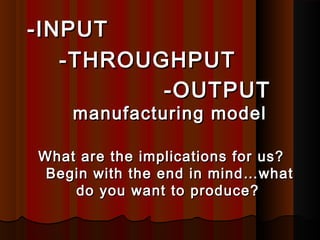
-INPUT-INPUT
-THROUGHPUT-THROUGHPUT
-OUTPUT-OUTPUT
manufacturing modelmanufacturing model
What are the implications for us?What are the implications for us?
Begin with the end in mind…whatBegin with the end in mind…what
do you want to produce?do you want to produce?
#4
Equip Leaders
MULTIPLYMULTIPLY
versusversus
ADDINGADDING
Pinpoint HIGH CAPACITYPinpoint HIGH CAPACITY
leadersleaders
VISION DRIVENVISION DRIVEN
releasing ministryreleasing ministry
requires personalrequires personal
security…security…
Jesus Valued theJesus Valued the
MarketplaceMarketplace
Of the 52 parables Jesus told, 45Of the 52 parables Jesus told, 45
had a workplace contexthad a workplace context
Different forms of the word “work”Different forms of the word “work”
are mentioned more than 800 timesare mentioned more than 800 times
in the Biblein the Bible
Of the 132 public appearances ofOf the 132 public appearances of
Jesus, 122 were in the workplaceJesus, 122 were in the workplace
Of the 40 miracles in Acts, 39 wereOf the 40 miracles in Acts, 39 were
in the workplacein the workplace (Os Hillman, International Coalition of(Os Hillman, International Coalition of
Workplace Ministries)Workplace Ministries)
GROWTH BARRIERS…..GROWTH BARRIERS…..
The barrier ofThe barrier of VISIONVISION --
A breakthrough ofA breakthrough of CLARITYCLARITY
The barrier ofThe barrier of LEADERSHIPLEADERSHIP ––
A breakthrough ofA breakthrough of CERTAINTYCERTAINTY
The barrier ofThe barrier of TEAMTEAM ––
A breakthrough ofA breakthrough of UNITYUNITY
The barrier ofThe barrier of COMMUNITYCOMMUNITY ––
A breakthrough ofA breakthrough of CONNECTIONCONNECTION
The barrier ofThe barrier of PRESENTATIONPRESENTATION ––
A breakthrough ofA breakthrough of EXCELLENCEEXCELLENCE
The barrier ofThe barrier of FOLLOW-THROUGHFOLLOW-THROUGH
––
A breakthrough ofA breakthrough of
FAITHFULNESSFAITHFULNESS
““Churches that are effectiveChurches that are effective
reaching people for Christ seereaching people for Christ see
the needs of the unchurched,the needs of the unchurched,
establish ministries that allowestablish ministries that allow
the church to be present in thethe church to be present in the
community, and have a processcommunity, and have a process
by which they are able to drawby which they are able to draw
these unchurched people intothese unchurched people into
the safety of Christ and a localthe safety of Christ and a local
church”church”
(Mcintosh & Martin,(Mcintosh & Martin, Finding Them, Keeping ThemFinding Them, Keeping Them, 22)., 22).
200 barrier key200 barrier key
factors:factors:
contagious desire to growcontagious desire to grow
identify growth acceleratorsidentify growth accelerators
shepherd to ranchershepherd to rancher
deal with small churchdeal with small church
mentality-focus outward!mentality-focus outward!
offer leadership and layoffer leadership and lay
ministry trainingministry training
Five Behaviors of SheepFive Behaviors of Sheep
Herders:Herders:
Personally do all the caringPersonally do all the caring
Attempt to meet allAttempt to meet all
expectationsexpectations
Work to the limit of time/energyWork to the limit of time/energy
Keep work close to themselvesKeep work close to themselves
Base perspective on presentBase perspective on present
conditionsconditions
Five Behaviors of SheepFive Behaviors of Sheep
Ranchers:Ranchers:
Concerned for high qualityConcerned for high quality
pastoral carepastoral care
Set expectationsSet expectations
Perceive the churchPerceive the church
organizationallyorganizationally
Delegate and involve othersDelegate and involve others
Develop leadership andDevelop leadership and
management skillsmanagement skills
200-400 key factors200-400 key factors
 Self –identity –Self –identity –
Who are we - What we used to beWho are we - What we used to be
 Leadership crisisLeadership crisis
 Multiple servicesMultiple services
 Power issuesPower issues
 Staff, ProgrammingStaff, Programming
 Staff led model,Staff led model,
pastor to leader vs. managerpastor to leader vs. manager
 Align resources to visionAlign resources to vision
 Restructure for successRestructure for success
400-700 key factors400-700 key factors
 Awkward size churchAwkward size church
 Vision directed values enhanced.Vision directed values enhanced.
 Release ministry rather than retain itRelease ministry rather than retain it
 Pastor as leader or stagnatePastor as leader or stagnate
 Elevate the thinking of the pastorElevate the thinking of the pastor
 Hire exceptional staffHire exceptional staff
 Create multiple entry pointsCreate multiple entry points
 Provide assimilation and discipleshipProvide assimilation and discipleship
via small groups/classesvia small groups/classes
800+800+
Presentation ExcellencePresentation Excellence
Communication is KeyCommunication is Key
Excellence, Simplicity, SynergyExcellence, Simplicity, Synergy
Moving from each levelMoving from each level
contains three keys:contains three keys:
Excellence,Excellence,
Productivity,Productivity,
New LeadershipNew Leadership
A pastorpreneurA pastorpreneur
is a pastoral innovator,is a pastoral innovator,
a creative dreamer who isa creative dreamer who is
willing to take great riskswilling to take great risks
in church ministryin church ministry
with the hope of greatwith the hope of great
gain for Christ and hisgain for Christ and his
kingdom.kingdom.
Calling is not about theCalling is not about the
size of a church,size of a church,
the scope of a ministry,the scope of a ministry,
or the bottom line of aor the bottom line of a
business—business—
it is about the heart ofit is about the heart of
God.God.
FAR=FAR=
FFocus,ocus,
AAlignment,lignment,
RReacheach
Focus:Focus:
Shaping Your Vision forShaping Your Vision for
MinistryMinistry
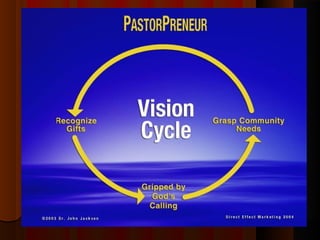
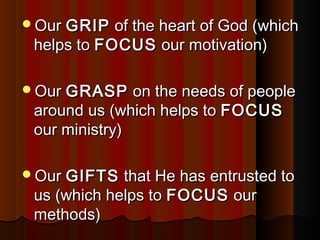
OurOur GRIPGRIP of the heart of God (whichof the heart of God (which
helps tohelps to FOCUSFOCUS our motivation)our motivation)
OurOur GRASPGRASP on the needs of peopleon the needs of people
around us (which helps toaround us (which helps to FOCUSFOCUS
our ministry)our ministry)
OurOur GIFTSGIFTS that He has entrusted tothat He has entrusted to
us (which helps tous (which helps to FOCUSFOCUS ourour
methods)methods)
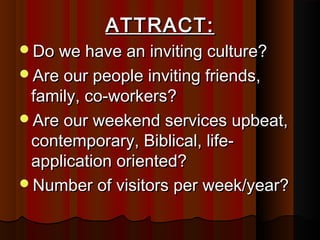
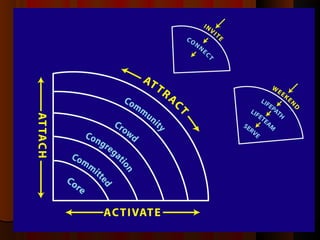
ATTRACT:ATTRACT:
Do we have an inviting culture?Do we have an inviting culture?
Are our people inviting friends,Are our people inviting friends,
family, co-workers?family, co-workers?
Are our weekend services upbeat,Are our weekend services upbeat,
contemporary, Biblical, life-contemporary, Biblical, life-
application oriented?application oriented?
Number of visitors per week/year?Number of visitors per week/year?
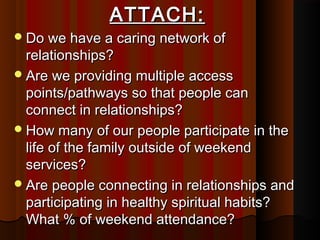
ATTACH:ATTACH:
Do we have a caring network ofDo we have a caring network of
relationships?relationships?
Are we providing multiple accessAre we providing multiple access
points/pathways so that people canpoints/pathways so that people can
connect in relationships?connect in relationships?
How many of our people participate in theHow many of our people participate in the
life of the family outside of weekendlife of the family outside of weekend
services?services?
Are people connecting in relationships andAre people connecting in relationships and
participating in healthy spiritual habits?participating in healthy spiritual habits?
What % of weekend attendance?What % of weekend attendance?
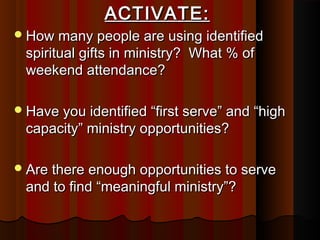
ACTIVATE:ACTIVATE:
How many people are using identifiedHow many people are using identified
spiritual gifts in ministry? What % ofspiritual gifts in ministry? What % of
weekend attendance?weekend attendance?
Have you identified “first serve” and “highHave you identified “first serve” and “high
capacity” ministry opportunities?capacity” ministry opportunities?
Are there enough opportunities to serveAre there enough opportunities to serve
and to find “meaningful ministry”?and to find “meaningful ministry”?
Alignment:Alignment:
Strategic Planning & VisionStrategic Planning & Vision
DevelopmentDevelopment
Reach:Reach:
Building Your Team Near & FarBuilding Your Team Near & Far
RELEASINGRELEASING ministry to othersministry to others
RESOURCINGRESOURCING others forothers for
ministryministry
REJOICINGREJOICING in the ministryin the ministry
success of team memberssuccess of team members
““From [Christ] the whole body, joined and heldFrom [Christ] the whole body, joined and held
together by every supporting ligament, grows andtogether by every supporting ligament, grows and
builds itself up in love, as each part does its work”builds itself up in love, as each part does its work”
(Eph 4:16)(Eph 4:16)
10 Keys to Great Leadership10 Keys to Great Leadership
By GE's Jeff ImmeltBy GE's Jeff Immelt
((From:From: Issue 81Issue 81 || April 2004, Page 96April 2004, Page 96 By:By: Fast CompanyFast Company ))
1. Personal Responsibility.1. Personal Responsibility.
2. Simplify Constantly.2. Simplify Constantly.
3. Understand Breadth, Depth, and Context.3. Understand Breadth, Depth, and Context.
4. The importance of alignment and time4. The importance of alignment and time
management.management.
5. Leaders learn constantly and also have to5. Leaders learn constantly and also have to
learn how to teach.learn how to teach.
6. Stay true to your own style.6. Stay true to your own style.
7. Manage by setting boundaries with freedom in7. Manage by setting boundaries with freedom in
the middle.the middle.
8. Stay disciplined and detailed.8. Stay disciplined and detailed.
9. Leave a few things unsaid.9. Leave a few things unsaid.
10. Like people.10. Like people.
Questions for Closing….Questions for Closing….
1. In the last 30 days did you hear1. In the last 30 days did you hear
church members talk about yourchurch members talk about your
church’s vision?church’s vision?
2. Is your church’s identity2. Is your church’s identity
unquestionably contagious?unquestionably contagious?
3. Does your mission roll off your3. Does your mission roll off your
tongue with clarity and heartfelttongue with clarity and heartfelt
conviction?conviction?
4. Does your staff embrace the value4. Does your staff embrace the value
of values?of values?
5. Have you planned an activity in the5. Have you planned an activity in the
next three months that will help younext three months that will help you
see God’s future for your church?see God’s future for your church?
6. Does the staff enthusiastically agree6. Does the staff enthusiastically agree
about how to accomplish the church’sabout how to accomplish the church’s
mission?mission?
7. Do you have a process on paper that7. Do you have a process on paper that
shows how your church will developshows how your church will develop
leaders?leaders?
8. Does all church communication8. Does all church communication
reflect and reinforce your vision?reflect and reinforce your vision?
9. Is there crystal clarity about the next9. Is there crystal clarity about the next
ministry to launch and staff role to fill?ministry to launch and staff role to fill?
10. Have you identified a person to10. Have you identified a person to
help you develop as a senior leader?help you develop as a senior leader?
((From Auxano, a church consulting groupFrom Auxano, a church consulting group))
9 Questions from Andy9 Questions from Andy
StanleyStanley
Environment Questions…Environment Questions…
-Is the context appealing?-Is the context appealing?
-Is the presentation engaging?-Is the presentation engaging?
-Is the content helpful?-Is the content helpful?
Organizational Questions…Organizational Questions…
-Which gauges should we be-Which gauges should we be
watching?watching?
-Where are we “manufacturing”-Where are we “manufacturing”
energy?energy?
Staffing Questions…Staffing Questions…
-Who needs to be sitting at the table?-Who needs to be sitting at the table?
-Who is not keeping up?-Who is not keeping up?
Professional Questions…Professional Questions…
-Where do I make the greatest-Where do I make the greatest
contribution to the organization?contribution to the organization?
-What should I quit doing?-What should I quit doing?

Leadership Stew

  • 1.
    Leadership Stew MadeLeadershipStew Made Just for You!Just for You! ABCW Mentor PastorsABCW Mentor Pastors © Dr. John Jackson, 2006© Dr. John Jackson, 2006
  • 2.
    Who you Areas a LeaderWho you Are as a Leader is theis the Most Important Thing…Most Important Thing…
  • 3.
    When Leadership IsPure . . .When Leadership Is Pure . . . It always starts with a need.It always starts with a need. That need sparks passionThat need sparks passion within a person.within a person. That person acts in responseThat person acts in response to the need.to the need. This action moves others to cooperate.This action moves others to cooperate.
  • 4.
    Proven Practices forProvenPractices for Getting Things Done . .Getting Things Done . . What gets talked about gets done.What gets talked about gets done. What gets trained for gets done.What gets trained for gets done. What gets measured gets done.What gets measured gets done. What gets budgeted gets done.What gets budgeted gets done. What gets confronted gets done.What gets confronted gets done. What gets rewarded gets done.What gets rewarded gets done.
  • 5.
    Leadership functions onthe basis ofLeadership functions on the basis of TRUST.TRUST. Integrity has high influence VALUE.Integrity has high influence VALUE. Our tendency is to work harder on ourOur tendency is to work harder on our IMAGE than on our integrity.IMAGE than on our integrity. Integrity means LIVING the truth myself,Integrity means LIVING the truth myself, before leading others.before leading others.
  • 6.
    A charismatic personalitymay drawA charismatic personality may draw people, but only INTEGRITY will keeppeople, but only INTEGRITY will keep them.them. Integrity is a VICTORY, not a gift.Integrity is a VICTORY, not a gift. You will only BECOME what you areYou will only BECOME what you are becoming – right now.becoming – right now. Leaders are to live by a higherLeaders are to live by a higher STANDARD than followers.STANDARD than followers.
  • 7.
    4 Things Leaders4Things Leaders Do….Do….
  • 8.
  • 9.
    Leaders develop asense of aLeaders develop a sense of a preferable future.preferable future. Vision casting requires aVision casting requires a passionate pursuit of thepassionate pursuit of the possible even in the midstpossible even in the midst of the mind-numbing realityof the mind-numbing reality of the present.of the present.
  • 10.
    Leaders learn tospeak inLeaders learn to speak in short sentences that SINGshort sentences that SING rather than in paragraphsrather than in paragraphs that SNORE.that SNORE. Leaders must paint pictures,Leaders must paint pictures, call forth emotions, andcall forth emotions, and challenge people to riskchallenge people to risk
  • 11.
  • 12.
    Create environments toCreateenvironments to reach unchurched,reach unchurched, grow disciples,grow disciples, develop leaders.develop leaders.
  • 13.
    We live inan EXPERIENCEWe live in an EXPERIENCE economy…..economy….. Starbucks is not, in theStarbucks is not, in the end, selling coffee!end, selling coffee! Neither is Barnes & NobleNeither is Barnes & Noble selling books!selling books!
  • 14.
  • 15.
    -INPUT-INPUT -THROUGHPUT-THROUGHPUT -OUTPUT-OUTPUT manufacturing modelmanufacturing model Whatare the implications for us?What are the implications for us? Begin with the end in mind…whatBegin with the end in mind…what do you want to produce?do you want to produce?
  • 16.
  • 17.
  • 18.
    Pinpoint HIGH CAPACITYPinpointHIGH CAPACITY leadersleaders VISION DRIVENVISION DRIVEN releasing ministryreleasing ministry requires personalrequires personal security…security…
  • 19.
    Jesus Valued theJesusValued the MarketplaceMarketplace Of the 52 parables Jesus told, 45Of the 52 parables Jesus told, 45 had a workplace contexthad a workplace context Different forms of the word “work”Different forms of the word “work” are mentioned more than 800 timesare mentioned more than 800 times in the Biblein the Bible Of the 132 public appearances ofOf the 132 public appearances of Jesus, 122 were in the workplaceJesus, 122 were in the workplace Of the 40 miracles in Acts, 39 wereOf the 40 miracles in Acts, 39 were in the workplacein the workplace (Os Hillman, International Coalition of(Os Hillman, International Coalition of Workplace Ministries)Workplace Ministries)
  • 20.
    GROWTH BARRIERS…..GROWTH BARRIERS….. Thebarrier ofThe barrier of VISIONVISION -- A breakthrough ofA breakthrough of CLARITYCLARITY The barrier ofThe barrier of LEADERSHIPLEADERSHIP –– A breakthrough ofA breakthrough of CERTAINTYCERTAINTY The barrier ofThe barrier of TEAMTEAM –– A breakthrough ofA breakthrough of UNITYUNITY
  • 21.
    The barrier ofThebarrier of COMMUNITYCOMMUNITY –– A breakthrough ofA breakthrough of CONNECTIONCONNECTION The barrier ofThe barrier of PRESENTATIONPRESENTATION –– A breakthrough ofA breakthrough of EXCELLENCEEXCELLENCE The barrier ofThe barrier of FOLLOW-THROUGHFOLLOW-THROUGH –– A breakthrough ofA breakthrough of FAITHFULNESSFAITHFULNESS
  • 22.
    ““Churches that areeffectiveChurches that are effective reaching people for Christ seereaching people for Christ see the needs of the unchurched,the needs of the unchurched, establish ministries that allowestablish ministries that allow the church to be present in thethe church to be present in the community, and have a processcommunity, and have a process by which they are able to drawby which they are able to draw these unchurched people intothese unchurched people into the safety of Christ and a localthe safety of Christ and a local church”church” (Mcintosh & Martin,(Mcintosh & Martin, Finding Them, Keeping ThemFinding Them, Keeping Them, 22)., 22).
  • 23.
    200 barrier key200barrier key factors:factors: contagious desire to growcontagious desire to grow identify growth acceleratorsidentify growth accelerators shepherd to ranchershepherd to rancher deal with small churchdeal with small church mentality-focus outward!mentality-focus outward! offer leadership and layoffer leadership and lay ministry trainingministry training
  • 24.
    Five Behaviors ofSheepFive Behaviors of Sheep Herders:Herders: Personally do all the caringPersonally do all the caring Attempt to meet allAttempt to meet all expectationsexpectations Work to the limit of time/energyWork to the limit of time/energy Keep work close to themselvesKeep work close to themselves Base perspective on presentBase perspective on present conditionsconditions
  • 25.
    Five Behaviors ofSheepFive Behaviors of Sheep Ranchers:Ranchers: Concerned for high qualityConcerned for high quality pastoral carepastoral care Set expectationsSet expectations Perceive the churchPerceive the church organizationallyorganizationally Delegate and involve othersDelegate and involve others Develop leadership andDevelop leadership and management skillsmanagement skills
  • 26.
    200-400 key factors200-400key factors  Self –identity –Self –identity – Who are we - What we used to beWho are we - What we used to be  Leadership crisisLeadership crisis  Multiple servicesMultiple services  Power issuesPower issues  Staff, ProgrammingStaff, Programming  Staff led model,Staff led model, pastor to leader vs. managerpastor to leader vs. manager  Align resources to visionAlign resources to vision  Restructure for successRestructure for success
  • 27.
    400-700 key factors400-700key factors  Awkward size churchAwkward size church  Vision directed values enhanced.Vision directed values enhanced.  Release ministry rather than retain itRelease ministry rather than retain it  Pastor as leader or stagnatePastor as leader or stagnate  Elevate the thinking of the pastorElevate the thinking of the pastor  Hire exceptional staffHire exceptional staff  Create multiple entry pointsCreate multiple entry points  Provide assimilation and discipleshipProvide assimilation and discipleship via small groups/classesvia small groups/classes
  • 28.
    800+800+ Presentation ExcellencePresentation Excellence Communicationis KeyCommunication is Key Excellence, Simplicity, SynergyExcellence, Simplicity, Synergy
  • 29.
    Moving from eachlevelMoving from each level contains three keys:contains three keys: Excellence,Excellence, Productivity,Productivity, New LeadershipNew Leadership
  • 30.
    A pastorpreneurA pastorpreneur isa pastoral innovator,is a pastoral innovator, a creative dreamer who isa creative dreamer who is willing to take great riskswilling to take great risks in church ministryin church ministry with the hope of greatwith the hope of great gain for Christ and hisgain for Christ and his kingdom.kingdom.
  • 31.
    Calling is notabout theCalling is not about the size of a church,size of a church, the scope of a ministry,the scope of a ministry, or the bottom line of aor the bottom line of a business—business— it is about the heart ofit is about the heart of God.God.
  • 32.
  • 33.
    Focus:Focus: Shaping Your VisionforShaping Your Vision for MinistryMinistry
  • 35.
    OurOur GRIPGRIP ofthe heart of God (whichof the heart of God (which helps tohelps to FOCUSFOCUS our motivation)our motivation) OurOur GRASPGRASP on the needs of peopleon the needs of people around us (which helps toaround us (which helps to FOCUSFOCUS our ministry)our ministry) OurOur GIFTSGIFTS that He has entrusted tothat He has entrusted to us (which helps tous (which helps to FOCUSFOCUS ourour methods)methods)
  • 36.
    ATTRACT:ATTRACT: Do we havean inviting culture?Do we have an inviting culture? Are our people inviting friends,Are our people inviting friends, family, co-workers?family, co-workers? Are our weekend services upbeat,Are our weekend services upbeat, contemporary, Biblical, life-contemporary, Biblical, life- application oriented?application oriented? Number of visitors per week/year?Number of visitors per week/year?
  • 37.
    ATTACH:ATTACH: Do we havea caring network ofDo we have a caring network of relationships?relationships? Are we providing multiple accessAre we providing multiple access points/pathways so that people canpoints/pathways so that people can connect in relationships?connect in relationships? How many of our people participate in theHow many of our people participate in the life of the family outside of weekendlife of the family outside of weekend services?services? Are people connecting in relationships andAre people connecting in relationships and participating in healthy spiritual habits?participating in healthy spiritual habits? What % of weekend attendance?What % of weekend attendance?
  • 38.
    ACTIVATE:ACTIVATE: How many peopleare using identifiedHow many people are using identified spiritual gifts in ministry? What % ofspiritual gifts in ministry? What % of weekend attendance?weekend attendance? Have you identified “first serve” and “highHave you identified “first serve” and “high capacity” ministry opportunities?capacity” ministry opportunities? Are there enough opportunities to serveAre there enough opportunities to serve and to find “meaningful ministry”?and to find “meaningful ministry”?
  • 39.
    Alignment:Alignment: Strategic Planning &VisionStrategic Planning & Vision DevelopmentDevelopment
  • 41.
    Reach:Reach: Building Your TeamNear & FarBuilding Your Team Near & Far
  • 42.
    RELEASINGRELEASING ministry toothersministry to others RESOURCINGRESOURCING others forothers for ministryministry REJOICINGREJOICING in the ministryin the ministry success of team memberssuccess of team members ““From [Christ] the whole body, joined and heldFrom [Christ] the whole body, joined and held together by every supporting ligament, grows andtogether by every supporting ligament, grows and builds itself up in love, as each part does its work”builds itself up in love, as each part does its work” (Eph 4:16)(Eph 4:16)
  • 43.
    10 Keys toGreat Leadership10 Keys to Great Leadership By GE's Jeff ImmeltBy GE's Jeff Immelt ((From:From: Issue 81Issue 81 || April 2004, Page 96April 2004, Page 96 By:By: Fast CompanyFast Company )) 1. Personal Responsibility.1. Personal Responsibility. 2. Simplify Constantly.2. Simplify Constantly. 3. Understand Breadth, Depth, and Context.3. Understand Breadth, Depth, and Context. 4. The importance of alignment and time4. The importance of alignment and time management.management.
  • 44.
    5. Leaders learnconstantly and also have to5. Leaders learn constantly and also have to learn how to teach.learn how to teach. 6. Stay true to your own style.6. Stay true to your own style. 7. Manage by setting boundaries with freedom in7. Manage by setting boundaries with freedom in the middle.the middle. 8. Stay disciplined and detailed.8. Stay disciplined and detailed. 9. Leave a few things unsaid.9. Leave a few things unsaid. 10. Like people.10. Like people.
  • 45.
  • 46.
    1. In thelast 30 days did you hear1. In the last 30 days did you hear church members talk about yourchurch members talk about your church’s vision?church’s vision? 2. Is your church’s identity2. Is your church’s identity unquestionably contagious?unquestionably contagious? 3. Does your mission roll off your3. Does your mission roll off your tongue with clarity and heartfelttongue with clarity and heartfelt conviction?conviction? 4. Does your staff embrace the value4. Does your staff embrace the value of values?of values?
  • 47.
    5. Have youplanned an activity in the5. Have you planned an activity in the next three months that will help younext three months that will help you see God’s future for your church?see God’s future for your church? 6. Does the staff enthusiastically agree6. Does the staff enthusiastically agree about how to accomplish the church’sabout how to accomplish the church’s mission?mission? 7. Do you have a process on paper that7. Do you have a process on paper that shows how your church will developshows how your church will develop leaders?leaders?
  • 48.
    8. Does allchurch communication8. Does all church communication reflect and reinforce your vision?reflect and reinforce your vision? 9. Is there crystal clarity about the next9. Is there crystal clarity about the next ministry to launch and staff role to fill?ministry to launch and staff role to fill? 10. Have you identified a person to10. Have you identified a person to help you develop as a senior leader?help you develop as a senior leader? ((From Auxano, a church consulting groupFrom Auxano, a church consulting group))
  • 49.
    9 Questions fromAndy9 Questions from Andy StanleyStanley Environment Questions…Environment Questions… -Is the context appealing?-Is the context appealing? -Is the presentation engaging?-Is the presentation engaging? -Is the content helpful?-Is the content helpful?
  • 50.
    Organizational Questions…Organizational Questions… -Whichgauges should we be-Which gauges should we be watching?watching? -Where are we “manufacturing”-Where are we “manufacturing” energy?energy?
  • 51.
    Staffing Questions…Staffing Questions… -Whoneeds to be sitting at the table?-Who needs to be sitting at the table? -Who is not keeping up?-Who is not keeping up?
  • 52.
    Professional Questions…Professional Questions… -Wheredo I make the greatest-Where do I make the greatest contribution to the organization?contribution to the organization? -What should I quit doing?-What should I quit doing?