

Leadership Required forLeadership Required for
TransformationTransformation
Florida Church of GodFlorida Church of God
© Dr. John Jackson 2007© Dr. John Jackson 2007
“So then, just as you received
Christ Jesus as Lord,
continue to live in Him,
rooted and built up in Him,
strengthened in the faith as you
were taught,
and overflowing with
thankfulness.”
(Colossians 2:6-7)
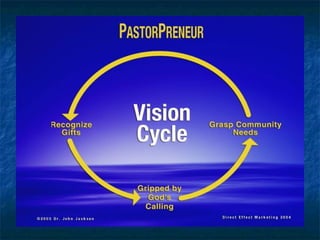
A pastorpreneur
is a pastoral innovator,
a creative dreamer who is
willing to take great risks in
church ministry
with the hope of great gain
for Christ and His kingdom.
High Impact ChurchesHigh Impact Churches break throughbreak through
spiritual, social, and leadershipspiritual, social, and leadership
barriers to establish new churches,barriers to establish new churches,
new ministries, and reach largenew ministries, and reach large
numbers of new people for Christ.numbers of new people for Christ.
High Impact ChurchesHigh Impact Churches confront theconfront the
law of inertia and the reality of humanlaw of inertia and the reality of human
lethargy with a passionate purposefullethargy with a passionate purposeful
pursuit of God’s plan for evangelismpursuit of God’s plan for evangelism
in their area.in their area.
You teach what you know.You teach what you know.
You reproduce who you are.You reproduce who you are.
4 Things That4 Things That
Leaders DoLeaders Do
#1#1
Cast VisionCast Vision
 Leaders develop a sense of aLeaders develop a sense of a
preferable future.preferable future.
 Vision casting requires aVision casting requires a
passionate pursuit of thepassionate pursuit of the
possible even in the midst ofpossible even in the midst of
the mind-numbing reality of thethe mind-numbing reality of the
present.present.
 Leaders learn to speak in shortLeaders learn to speak in short
sentences that SING rather thansentences that SING rather than
in paragraphs that SNORE.in paragraphs that SNORE.
 Leaders must paint pictures,Leaders must paint pictures,
call forth emotions, andcall forth emotions, and
challenge people to riskchallenge people to risk
#2#2
CreateCreate
EnvironmentsEnvironments
Create environments toCreate environments to
reach unchurched,reach unchurched,
grow disciples,grow disciples,
develop leaders.develop leaders.
We live in an EXPERIENCEWe live in an EXPERIENCE
economy…..economy…..
Starbucks is not, in the end,Starbucks is not, in the end,
selling coffee!selling coffee!
Neither is Barnes & Noble sellingNeither is Barnes & Noble selling
books!books!
#3#3
DevelopDevelop
SystemsSystems
 -INPUT-INPUT
 -THROUGHPUT-THROUGHPUT
 -OUTPUT-OUTPUT manufacturing modelmanufacturing model
Begin with the end in mind…what do youBegin with the end in mind…what do you
want to produce?want to produce?
#4#4
Equip LeadersEquip Leaders
MULTIPLYMULTIPLY
versusversus
ADDINGADDING
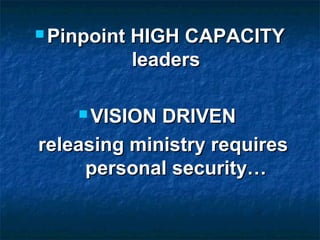
 Pinpoint HIGH CAPACITYPinpoint HIGH CAPACITY
leadersleaders
 VISION DRIVENVISION DRIVEN
releasing ministry requiresreleasing ministry requires
personal security…personal security…
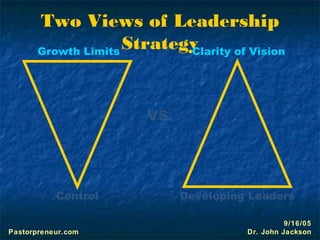
Two Views of Leadership
Strategy
9/16/05
Dr. John Jackson
VS.
Clarity of Vision
Developing Leaders
Growth Limits
Control
Pastorpreneur.com
Equipping Leaders: How?Equipping Leaders: How?
 Life on LifeLife on Life
 TrainingTraining
 BenchmarkingBenchmarking
 Leadership DevelopmentLeadership Development
 Shared ExperiencesShared Experiences
I Thessalonians 2:19-20I Thessalonians 2:19-20
George HunterGeorge Hunter (Reaching the(Reaching the
Unchurched)Unchurched) & George Barna& George Barna ((
www.barna.orgwww.barna.org))
 Built on needs of people in local contextBuilt on needs of people in local context
 Focused on the unchurchedFocused on the unchurched
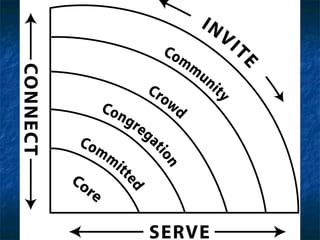
 Multiple entry points into the churchMultiple entry points into the church
 System of segmentation and sequencingSystem of segmentation and sequencing
for spiritual growthfor spiritual growth
 Leadership is the most important role ofLeadership is the most important role of
the Senior Pastorthe Senior Pastor
 High expectations of membership andHigh expectations of membership and
preaching involves a call to actionpreaching involves a call to action
 Leadership is developed from withinLeadership is developed from within
 Many specialized ministries in addition toMany specialized ministries in addition to
the basicsthe basics
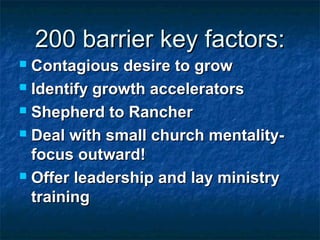
200 barrier key factors:200 barrier key factors:
 Contagious desire to growContagious desire to grow
 Identify growth acceleratorsIdentify growth accelerators
 Shepherd to RancherShepherd to Rancher
 Deal with small church mentality-Deal with small church mentality-
focus outward!focus outward!
 Offer leadership and lay ministryOffer leadership and lay ministry
trainingtraining
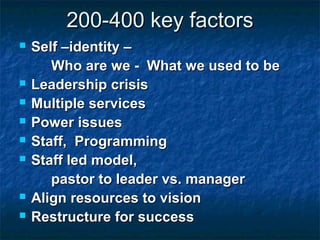
200-400 key factors200-400 key factors
 Self –identity –Self –identity –
Who are we - What we used to beWho are we - What we used to be
 Leadership crisisLeadership crisis
 Multiple servicesMultiple services
 Power issuesPower issues
 Staff, ProgrammingStaff, Programming
 Staff led model,Staff led model,
pastor to leader vs. managerpastor to leader vs. manager
 Align resources to visionAlign resources to vision
 Restructure for successRestructure for success
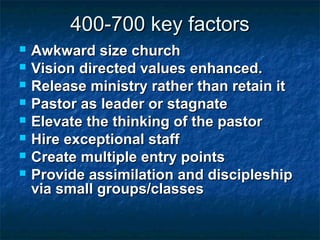
400-700 key factors400-700 key factors
 Awkward size churchAwkward size church
 Vision directed values enhanced.Vision directed values enhanced.
 Release ministry rather than retain itRelease ministry rather than retain it
 Pastor as leader or stagnatePastor as leader or stagnate
 Elevate the thinking of the pastorElevate the thinking of the pastor
 Hire exceptional staffHire exceptional staff
 Create multiple entry pointsCreate multiple entry points
 Provide assimilation and discipleshipProvide assimilation and discipleship
via small groups/classesvia small groups/classes
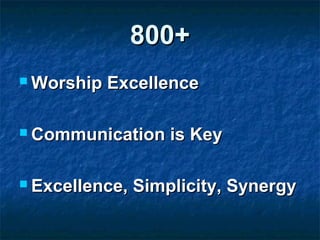
800+800+
 Worship ExcellenceWorship Excellence
 Communication is KeyCommunication is Key
 Excellence, Simplicity, SynergyExcellence, Simplicity, Synergy
Moving from each levelMoving from each level
contains three keys:contains three keys:
Excellence,Excellence,
Productivity,Productivity,
New LeadershipNew Leadership
My Favorite Tom PetersMy Favorite Tom Peters
SlidesSlides
““Management has a lot to doManagement has a lot to do
with answers.with answers.
Leadership is a function of questions.Leadership is a function of questions.
And the first question for a leaderAnd the first question for a leader
always is:always is:
‘‘WhoWho dodo wewe iintendntend toto bebe?’?’
Not ‘What are we going to do?’Not ‘What are we going to do?’
butbut
‘Who do we intend to be?’”‘Who do we intend to be?’”
—Max Du Pree, Herman Miller—Max Du Pree, Herman Miller
The greatest dangerThe greatest danger
for most of us is notfor most of us is not
that our aim is too highthat our aim is too high
and we miss it,and we miss it,
but that it isbut that it is
too lowtoo low
and we reach it.and we reach it.
--MichelangeloMichelangelo
““Never doubt that a small groupNever doubt that a small group
of committed peopleof committed people
can change the world.can change the world.
Indeed it is the only thingIndeed it is the only thing
that ever has.”that ever has.”
-Margaret Mead-Margaret Mead
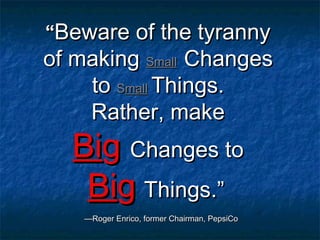
““Beware of the tyrannyBeware of the tyranny
of makingof making SmallSmall ChangesChanges
toto SSmallmall Things.Things.
Rather, makeRather, make
BiBigg Changes toChanges to
BiBigg Things.”Things.”
—Roger Enrico, former Chairman, PepsiCo—Roger Enrico, former Chairman, PepsiCo
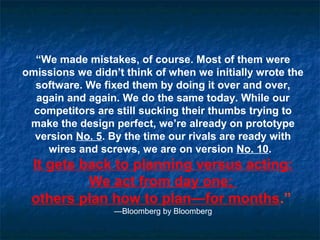
“We made mistakes, of course. Most of them were
omissions we didn’t think of when we initially wrote the
software. We fixed them by doing it over and over,
again and again. We do the same today. While our
competitors are still sucking their thumbs trying to
make the design perfect, we’re already on prototype
version No. 5. By the time our rivals are ready with
wires and screws, we are on version No. 10.
It gets back to planning versus acting:
We act from day one;
others plan how to plan—for months.”
—Bloomberg by Bloomberg

Transformational Leadership

  • 1.
    Leadership Required forLeadershipRequired for TransformationTransformation Florida Church of GodFlorida Church of God © Dr. John Jackson 2007© Dr. John Jackson 2007
  • 3.
    “So then, justas you received Christ Jesus as Lord, continue to live in Him, rooted and built up in Him, strengthened in the faith as you were taught, and overflowing with thankfulness.” (Colossians 2:6-7)
  • 4.
    A pastorpreneur is apastoral innovator, a creative dreamer who is willing to take great risks in church ministry with the hope of great gain for Christ and His kingdom.
  • 6.
    High Impact ChurchesHighImpact Churches break throughbreak through spiritual, social, and leadershipspiritual, social, and leadership barriers to establish new churches,barriers to establish new churches, new ministries, and reach largenew ministries, and reach large numbers of new people for Christ.numbers of new people for Christ. High Impact ChurchesHigh Impact Churches confront theconfront the law of inertia and the reality of humanlaw of inertia and the reality of human lethargy with a passionate purposefullethargy with a passionate purposeful pursuit of God’s plan for evangelismpursuit of God’s plan for evangelism in their area.in their area.
  • 7.
    You teach whatyou know.You teach what you know. You reproduce who you are.You reproduce who you are.
  • 8.
    4 Things That4Things That Leaders DoLeaders Do
  • 9.
  • 10.
     Leaders developa sense of aLeaders develop a sense of a preferable future.preferable future.  Vision casting requires aVision casting requires a passionate pursuit of thepassionate pursuit of the possible even in the midst ofpossible even in the midst of the mind-numbing reality of thethe mind-numbing reality of the present.present.
  • 11.
     Leaders learnto speak in shortLeaders learn to speak in short sentences that SING rather thansentences that SING rather than in paragraphs that SNORE.in paragraphs that SNORE.  Leaders must paint pictures,Leaders must paint pictures, call forth emotions, andcall forth emotions, and challenge people to riskchallenge people to risk
  • 12.
  • 13.
    Create environments toCreateenvironments to reach unchurched,reach unchurched, grow disciples,grow disciples, develop leaders.develop leaders.
  • 14.
    We live inan EXPERIENCEWe live in an EXPERIENCE economy…..economy….. Starbucks is not, in the end,Starbucks is not, in the end, selling coffee!selling coffee! Neither is Barnes & Noble sellingNeither is Barnes & Noble selling books!books!
  • 15.
  • 16.
     -INPUT-INPUT  -THROUGHPUT-THROUGHPUT -OUTPUT-OUTPUT manufacturing modelmanufacturing model Begin with the end in mind…what do youBegin with the end in mind…what do you want to produce?want to produce?
  • 19.
  • 20.
  • 21.
     Pinpoint HIGHCAPACITYPinpoint HIGH CAPACITY leadersleaders  VISION DRIVENVISION DRIVEN releasing ministry requiresreleasing ministry requires personal security…personal security…
  • 22.
    Two Views ofLeadership Strategy 9/16/05 Dr. John Jackson VS. Clarity of Vision Developing Leaders Growth Limits Control Pastorpreneur.com
  • 23.
    Equipping Leaders: How?EquippingLeaders: How?  Life on LifeLife on Life  TrainingTraining  BenchmarkingBenchmarking  Leadership DevelopmentLeadership Development  Shared ExperiencesShared Experiences I Thessalonians 2:19-20I Thessalonians 2:19-20
  • 24.
    George HunterGeorge Hunter(Reaching the(Reaching the Unchurched)Unchurched) & George Barna& George Barna (( www.barna.orgwww.barna.org))  Built on needs of people in local contextBuilt on needs of people in local context  Focused on the unchurchedFocused on the unchurched  Multiple entry points into the churchMultiple entry points into the church  System of segmentation and sequencingSystem of segmentation and sequencing for spiritual growthfor spiritual growth  Leadership is the most important role ofLeadership is the most important role of the Senior Pastorthe Senior Pastor
  • 25.
     High expectationsof membership andHigh expectations of membership and preaching involves a call to actionpreaching involves a call to action  Leadership is developed from withinLeadership is developed from within  Many specialized ministries in addition toMany specialized ministries in addition to the basicsthe basics
  • 26.
    200 barrier keyfactors:200 barrier key factors:  Contagious desire to growContagious desire to grow  Identify growth acceleratorsIdentify growth accelerators  Shepherd to RancherShepherd to Rancher  Deal with small church mentality-Deal with small church mentality- focus outward!focus outward!  Offer leadership and lay ministryOffer leadership and lay ministry trainingtraining
  • 27.
    200-400 key factors200-400key factors  Self –identity –Self –identity – Who are we - What we used to beWho are we - What we used to be  Leadership crisisLeadership crisis  Multiple servicesMultiple services  Power issuesPower issues  Staff, ProgrammingStaff, Programming  Staff led model,Staff led model, pastor to leader vs. managerpastor to leader vs. manager  Align resources to visionAlign resources to vision  Restructure for successRestructure for success
  • 28.
    400-700 key factors400-700key factors  Awkward size churchAwkward size church  Vision directed values enhanced.Vision directed values enhanced.  Release ministry rather than retain itRelease ministry rather than retain it  Pastor as leader or stagnatePastor as leader or stagnate  Elevate the thinking of the pastorElevate the thinking of the pastor  Hire exceptional staffHire exceptional staff  Create multiple entry pointsCreate multiple entry points  Provide assimilation and discipleshipProvide assimilation and discipleship via small groups/classesvia small groups/classes
  • 29.
    800+800+  Worship ExcellenceWorshipExcellence  Communication is KeyCommunication is Key  Excellence, Simplicity, SynergyExcellence, Simplicity, Synergy
  • 30.
    Moving from eachlevelMoving from each level contains three keys:contains three keys: Excellence,Excellence, Productivity,Productivity, New LeadershipNew Leadership
  • 31.
    My Favorite TomPetersMy Favorite Tom Peters SlidesSlides
  • 32.
    ““Management has alot to doManagement has a lot to do with answers.with answers. Leadership is a function of questions.Leadership is a function of questions. And the first question for a leaderAnd the first question for a leader always is:always is: ‘‘WhoWho dodo wewe iintendntend toto bebe?’?’ Not ‘What are we going to do?’Not ‘What are we going to do?’ butbut ‘Who do we intend to be?’”‘Who do we intend to be?’” —Max Du Pree, Herman Miller—Max Du Pree, Herman Miller
  • 33.
    The greatest dangerThegreatest danger for most of us is notfor most of us is not that our aim is too highthat our aim is too high and we miss it,and we miss it, but that it isbut that it is too lowtoo low and we reach it.and we reach it. --MichelangeloMichelangelo
  • 34.
    ““Never doubt thata small groupNever doubt that a small group of committed peopleof committed people can change the world.can change the world. Indeed it is the only thingIndeed it is the only thing that ever has.”that ever has.” -Margaret Mead-Margaret Mead
  • 35.
    ““Beware of thetyrannyBeware of the tyranny of makingof making SmallSmall ChangesChanges toto SSmallmall Things.Things. Rather, makeRather, make BiBigg Changes toChanges to BiBigg Things.”Things.” —Roger Enrico, former Chairman, PepsiCo—Roger Enrico, former Chairman, PepsiCo
  • 36.
    “We made mistakes,of course. Most of them were omissions we didn’t think of when we initially wrote the software. We fixed them by doing it over and over, again and again. We do the same today. While our competitors are still sucking their thumbs trying to make the design perfect, we’re already on prototype version No. 5. By the time our rivals are ready with wires and screws, we are on version No. 10. It gets back to planning versus acting: We act from day one; others plan how to plan—for months.” —Bloomberg by Bloomberg