


EMPLOYEE
ENGAGEMENT
IS IT A POSSIBILITY OR A PIPE
DREAM?
Cindy Gordon CPA, CA (Canada License only) CPCC
Culture Shock Coaching, LLC
© 2014 Culture Shock Coaching, LLC
What Engagement is Not
 Happiness – engaged employees are
considered happy at work, however happy
employees are not necessarily engaged
 Satisfaction – a satisfied employee may show
up at work without a complaint but they won’t
likely go the extra distance for the company
What is Engagement?
The emotional commitment an employee has
to their organization and its goals resulting
in the use of discretionary effort
Organizations with high employee
engagement experience
 65% greater share-price
 26% less employee turnover
 100% more unsolicited employment
applications
 20% less absenteeism
 15% greater employee productivity
 Up to 30% greater customer satisfaction levels
(2013 survey by the Queen's School of Business - Centre for Business
Venturing (QCVB) and Aon Hewitt)
WHAT’S IN IT FOR ME?
W I I F M
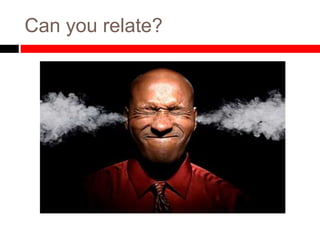
Can you relate?
Putting a dollar value on the impact of
engagement on productivity
The Financial Impact
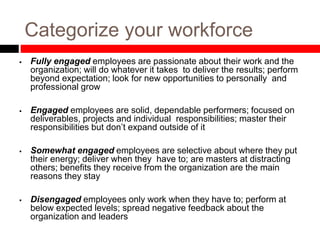
Categorize your workforce
 Fully engaged employees are passionate about their work and the
organization; will do whatever it takes to deliver the results; perform
beyond expectation; look for new opportunities to personally and
professional grow
 Engaged employees are solid, dependable performers; focused on
deliverables, projects and individual responsibilities; master their
responsibilities but don’t expand outside of it
 Somewhat engaged employees are selective about where they put
their energy; deliver when they have to; are masters at distracting
others; benefits they receive from the organization are the main
reasons they stay
 Disengaged employees only work when they have to; perform at
below expected levels; spread negative feedback about the
organization and leaders
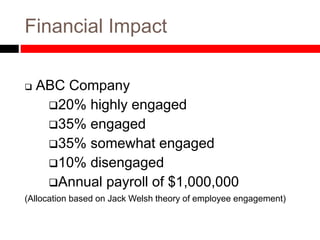
Financial Impact
 ABC Company
20% highly engaged
35% engaged
35% somewhat engaged
10% disengaged
Annual payroll of $1,000,000
(Allocation based on Jack Welsh theory of employee engagement)
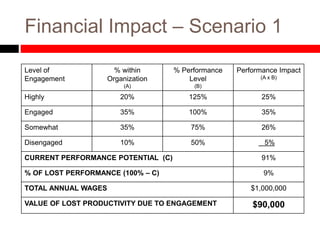
Financial Impact – Scenario 1
Level of
Engagement
% within
Organization
(A)
% Performance
Level
(B)
Performance Impact
(A x B)
Highly 20% 125% 25%
Engaged 35% 100% 35%
Somewhat 35% 75% 26%
Disengaged 10% 50% 5%
CURRENT PERFORMANCE POTENTIAL (C) 91%
% OF LOST PERFORMANCE (100% – C) 9%
TOTAL ANNUAL WAGES $1,000,000
VALUE OF LOST PRODUCTIVITY DUE TO ENGAGEMENT $90,000
Implementing Employee
Engagement Strategies
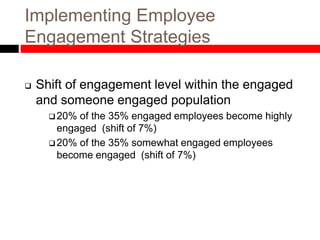
 Shift of engagement level within the engaged
and someone engaged population
 20% of the 35% engaged employees become highly
engaged (shift of 7%)
 20% of the 35% somewhat engaged employees
become engaged (shift of 7%)
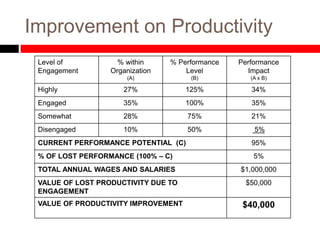
Improvement on Productivity
Level of
Engagement
% within
Organization
(A)
% Performance
Level
(B)
Performance
Impact
(A x B)
Highly 27% 125% 34%
Engaged 35% 100% 35%
Somewhat 28% 75% 21%
Disengaged 10% 50% 5%
CURRENT PERFORMANCE POTENTIAL (C) 95%
% OF LOST PERFORMANCE (100% – C) 5%
TOTAL ANNUAL WAGES AND SALARIES $1,000,000
VALUE OF LOST PRODUCTIVITY DUE TO
ENGAGEMENT
$50,000
VALUE OF PRODUCTIVITY IMPROVEMENT $40,000
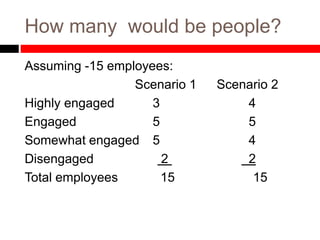
How many would be people?
Assuming -15 employees:
Scenario 1 Scenario 2
Highly engaged 3 4
Engaged 5 5
Somewhat engaged 5 4
Disengaged 2 2
Total employees 15 15
Creating a high engagement environment
How To….
Corporate culture
 Corporate culture represents the behaviors
and beliefs of what the company stands for
 The perceptions of the employees about
culture will impact their level of engagement
 “You can be the architect of your culture or you
can be the victim of it” – Len Gaby, Sleep America
Key Components of
Engagement
 Processes - Do the processes in your
organization enable your employees to
effectively get their work done easily?
 Tools - Does each employee have the
tools available to allow them to get their
job done in an efficient manner?
 People - How well do we know our people
and what motivates them?
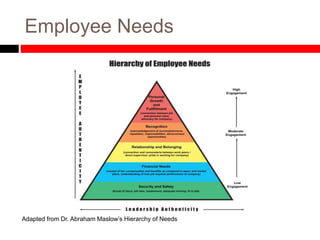
Employee Needs
Adapted from Dr. Abraham Maslow’s Hierarchy of Needs
Security and Safety
 Emotional – trust, threat of job loss, passive
aggressive behavior, immoral or illegal activity
 Physical – physical abuse, threat of injury,
limited access to premises by stranger
Financial Security
 Salary – wages are perceived as fair in
relation to responsibilities, peers and market
 Benefits – are benefits provided relevant to the
employee
Relationship and Belonging
 People don’t leave companies, they leave
bosses
 Relationships with peers vs direct boss vs
senior leader
 Type of communication – does the employee
feel heard and how does boss react to their
feedback?
Recognition
 Verbal and material recognition that shows
a direct acknowledgement of a person
 Organizations with sophisticated recognition
practices are 12 times more likely to have strong
business outcomes. (Bersin by Deloitte, The State of
Employee Recognition, 2012)
 When companies spend 1% or more of payroll on
recognition, 85% see a positive impact on
engagement.
(SHRM/Globoforce Employee Recognition Survey, 2012)
Personal Growth and Fulfillment
 Understanding the “WHY” of the business
http://www.ted.com/talks/simon_sinek_how_great_leaders_inspire_acti
on
 Requires the codification and consistent
modelling of a conscious corporate culture
(mission, values, behaviors)
Employee Engagement
Strategies
 Create strategies based on employee needs
 Don’t focus on one size fits all
 Create strategies that align with your intended
corporate culture
Take-Aways?
EMPLOYEE ENGAGEMENT
IS POSSIBLE!

Employee engagement - Possibility or Pipe Dream

  • 1.
    EMPLOYEE ENGAGEMENT IS IT APOSSIBILITY OR A PIPE DREAM? Cindy Gordon CPA, CA (Canada License only) CPCC Culture Shock Coaching, LLC © 2014 Culture Shock Coaching, LLC
  • 2.
    What Engagement isNot  Happiness – engaged employees are considered happy at work, however happy employees are not necessarily engaged  Satisfaction – a satisfied employee may show up at work without a complaint but they won’t likely go the extra distance for the company
  • 3.
    What is Engagement? Theemotional commitment an employee has to their organization and its goals resulting in the use of discretionary effort
  • 4.
    Organizations with highemployee engagement experience  65% greater share-price  26% less employee turnover  100% more unsolicited employment applications  20% less absenteeism  15% greater employee productivity  Up to 30% greater customer satisfaction levels (2013 survey by the Queen's School of Business - Centre for Business Venturing (QCVB) and Aon Hewitt)
  • 5.
    WHAT’S IN ITFOR ME? W I I F M
  • 6.
  • 7.
    Putting a dollarvalue on the impact of engagement on productivity The Financial Impact
  • 8.
    Categorize your workforce Fully engaged employees are passionate about their work and the organization; will do whatever it takes to deliver the results; perform beyond expectation; look for new opportunities to personally and professional grow  Engaged employees are solid, dependable performers; focused on deliverables, projects and individual responsibilities; master their responsibilities but don’t expand outside of it  Somewhat engaged employees are selective about where they put their energy; deliver when they have to; are masters at distracting others; benefits they receive from the organization are the main reasons they stay  Disengaged employees only work when they have to; perform at below expected levels; spread negative feedback about the organization and leaders
  • 9.
    Financial Impact  ABCCompany 20% highly engaged 35% engaged 35% somewhat engaged 10% disengaged Annual payroll of $1,000,000 (Allocation based on Jack Welsh theory of employee engagement)
  • 10.
    Financial Impact –Scenario 1 Level of Engagement % within Organization (A) % Performance Level (B) Performance Impact (A x B) Highly 20% 125% 25% Engaged 35% 100% 35% Somewhat 35% 75% 26% Disengaged 10% 50% 5% CURRENT PERFORMANCE POTENTIAL (C) 91% % OF LOST PERFORMANCE (100% – C) 9% TOTAL ANNUAL WAGES $1,000,000 VALUE OF LOST PRODUCTIVITY DUE TO ENGAGEMENT $90,000
  • 11.
    Implementing Employee Engagement Strategies Shift of engagement level within the engaged and someone engaged population  20% of the 35% engaged employees become highly engaged (shift of 7%)  20% of the 35% somewhat engaged employees become engaged (shift of 7%)
  • 12.
    Improvement on Productivity Levelof Engagement % within Organization (A) % Performance Level (B) Performance Impact (A x B) Highly 27% 125% 34% Engaged 35% 100% 35% Somewhat 28% 75% 21% Disengaged 10% 50% 5% CURRENT PERFORMANCE POTENTIAL (C) 95% % OF LOST PERFORMANCE (100% – C) 5% TOTAL ANNUAL WAGES AND SALARIES $1,000,000 VALUE OF LOST PRODUCTIVITY DUE TO ENGAGEMENT $50,000 VALUE OF PRODUCTIVITY IMPROVEMENT $40,000
  • 13.
    How many wouldbe people? Assuming -15 employees: Scenario 1 Scenario 2 Highly engaged 3 4 Engaged 5 5 Somewhat engaged 5 4 Disengaged 2 2 Total employees 15 15
  • 14.
    Creating a highengagement environment How To….
  • 15.
    Corporate culture  Corporateculture represents the behaviors and beliefs of what the company stands for  The perceptions of the employees about culture will impact their level of engagement  “You can be the architect of your culture or you can be the victim of it” – Len Gaby, Sleep America
  • 16.
    Key Components of Engagement Processes - Do the processes in your organization enable your employees to effectively get their work done easily?  Tools - Does each employee have the tools available to allow them to get their job done in an efficient manner?  People - How well do we know our people and what motivates them?
  • 17.
    Employee Needs Adapted fromDr. Abraham Maslow’s Hierarchy of Needs
  • 18.
    Security and Safety Emotional – trust, threat of job loss, passive aggressive behavior, immoral or illegal activity  Physical – physical abuse, threat of injury, limited access to premises by stranger
  • 19.
    Financial Security  Salary– wages are perceived as fair in relation to responsibilities, peers and market  Benefits – are benefits provided relevant to the employee
  • 20.
    Relationship and Belonging People don’t leave companies, they leave bosses  Relationships with peers vs direct boss vs senior leader  Type of communication – does the employee feel heard and how does boss react to their feedback?
  • 21.
    Recognition  Verbal andmaterial recognition that shows a direct acknowledgement of a person  Organizations with sophisticated recognition practices are 12 times more likely to have strong business outcomes. (Bersin by Deloitte, The State of Employee Recognition, 2012)  When companies spend 1% or more of payroll on recognition, 85% see a positive impact on engagement. (SHRM/Globoforce Employee Recognition Survey, 2012)
  • 22.
    Personal Growth andFulfillment  Understanding the “WHY” of the business http://www.ted.com/talks/simon_sinek_how_great_leaders_inspire_acti on  Requires the codification and consistent modelling of a conscious corporate culture (mission, values, behaviors)
  • 23.
    Employee Engagement Strategies  Createstrategies based on employee needs  Don’t focus on one size fits all  Create strategies that align with your intended corporate culture
  • 24.
  • 25.

Editor's Notes

  • #19 Quickly run through each category and then do exercises