“The Importance of
Leadership Development”
By
Dr. Rose Y. Brew
Leadership Webinar:
“Become the best
self-leader you can be”
Objectives:
• Define Leadership
• Differentiate a Leader and a Manager
• Learn the Importance of Leadership Development
• Understand the 7 Principles of Leadership Development
Leadership, what does it
means to you?
What does leadership mean to you?
• This topic came up at a previous meeting that I attended. It was
interesting to see how many people believed leadership could
be taught. When I asked my coworkers the same question, I got
some extremely intriguing responses: "Sometimes people get
the terms leader and manager mixed up or mistake them for
the same thing, but I believe a leader is someone who:
• 1) Has a vision
• 2) Gets others to see that vision
• 3) Can build the belief that things can be done
differently/better
• 4) Can spot opportunities that others can’t see
• 5) Can build a team and help that team rally around a
• Leadership has nothing to do with
seniority or one’s position in the
hierarchy of a company.
• Leadership has nothing to do with titles.
• Leadership has nothing to do with
personal attributes.
• Leadership isn’t management.
What is
Leadership?
to define leadership. Let’s start with
what leadership is not…
Leadership
Peter Drucker: "The only definition of a leader is
someone who has followers.“
Warren Bennis: "Leadership is the capacity to
translate vision into reality.”
Bill Gates: "As we look ahead into the next century,
leaders will be those who empower others.“
John Maxwell: "Leadership is influence - nothing
more, nothing less.“
So, what is Leadership?
DEFINITION: Leadership
IS A PROCESS OF SOCIAL INFLUENCE,
WHICH MAXIMIZES THE EFFORTS OF
OTHERS, TOWARDS THE
ACHIEVEMENT OF A GOAL.
IT ENCOMPASSES THE ABILITY OF AN
INDIVIDUAL, GROUP OR ORGANIZATION TO
“LEAD”, INFLUENCE OR GUIDE OTHER
INDIVIDUALS, TEAMS, OR ENTIRE
ORGANIZATION.
Notice key
elements
of this
definition:
• Leadership stems from social influence, not
authority or power
• Leadership requires others, and that implies
they don’t need to be “direct reports”
• No mention of personality traits, attributes,
or even a title; there are many styles, many
paths, to effective leadership
• It includes a goal, not influence with no
intended outcome
Lastly, there is the inclusion of “maximizes
the efforts”. Most of my work is in the area of
employee engagement, and engaged
employees give discretionary effort.
Developing Leadership Skills is critical in an
Ever-Changing Workplace
• Leadership development is critical in order to maintain
this dynamism and keep businesses relevant and profitable.
• Leadership development is a key activity for many
corporate HR departments. However, only two out of five
businesses believe they are developing leaders in a way that
benefits the business.
• Even with such a large focus on leadership development in
business, only half of 734 millennials in a survey conducted
by Harvard7 believed their company’s leadership
development were aligned with its business needs.
(https://www.getsmarter.com/about-us)
• Leadership development give people important
leadership skills and attributes they need to be an
effective leader, such as communication skills, motivation
and inspiration, as well as better decision-making skills and
accountability.
#1 PRINCIPLE ONE
Leaders exist at ALL LEVELS
In your Organisations………
….. NOT JUST AT THE TOP
#1 PRINCIPLE ONE
Leaders exist at ALL LEVELS
In your Organisations….
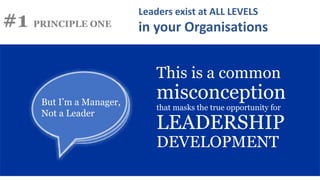
This is a common
misconception
that masks the true opportunity for
LEADERSHIP
DEVELOPMENT
#1 PRINCIPLE ONE
Leaders exist at ALL LEVELS
in your Organisations
But I’m a Manager,
Not a Leader
#1 PRINCIPLE ONE
Leaders exist at ALL LEVELS
In your Organisations
#1 PRINCIPLE ONE
Leaders exist at ALL LEVELS
In your Organisations
the most successful leaders
MANAGE
and the most successful managers
LEAD
the two go hand and hand
….and should be developed as one
Where possible
#1 PRINCIPLE ONE
Leaders exist at ALL LEVELS
In your Organisations
Leadership develop activities are relevant for
leading and managing in various contexts:
Managing
YOURSELF
#1 PRINCIPLE ONE
Leaders exist at ALL LEVELS
In your Organisations
Leadership develop activities are relevant for
leading and managing in various contexts:
Leading and Managing
OTHERS
#1 PRINCIPLE ONE
Leaders exist at ALL LEVELS
In your Organisations
Leadership develop activities are relevant for
leading and managing in various contexts:
Leading and Managing
MULTIPLE TEAMS
#1 PRINCIPLE ONE
Leaders exist at ALL LEVELS
In your Organisations
Leadership develop activities are relevant for
leading and managing in various contexts:
Leading and Managing
THE ORGANISATION
as a whole
#2 PRINCIPLE TWO
Leadership development is
CONTEXTUAL
#2 PRINCIPLE TWO
There is no
approach
ONE SIZE FITS ALL
Leadership development is
CONTEXTUAL
#2 PRINCIPLE TWO
ONE SIZE
Leadership development is
CONTEXTUAL
FITSone
No
#2 PRINCIPLE TWO
All those involved in developing your leaders
By this we mean:
TRULY KNOW YOUR ORGANISATION
Leadership development is
CONTEXTUAL
 Your culture
 Your strategy
 Your people
 Your journey so far
#2 PRINCIPLE TWO
In addition, your developing leaders need a FIRM understanding
of
Leadership development is
CONTEXTUAL
Why now?
How I will be
supported What’s expected
of me?
Why are we doing this
development?
#2 PRINCIPLE TWO
It is important to show them the
POTENTIAL BENEFITS
Leadership development is
CONTEXTUAL
Of the development for their own
day-day leadership role
#2 PRINCIPLE TWO
BY BELIEVING
Leadership development is
CONTEXTUAL
In its value, they will develop the right
mindset and attitude to make it work
And see the benefits for themselves,
their team and their organisation
#3 PRINCIPLE THREE
Visible and active senior
leadership support is crucial
#3 PRINCIPLE THREE
Senior leader
Visible and active senior
leadership support is crucial
need to actively and visibly
ENGAGE
in their people learning
#3 PRINCIPLE THREE
ways senior leader can
Visible and active senior
leadership support is crucial
engage with the programme
4• Partner with the learning provider when designing the
process
• Personalize the communication that kicks all the
initiative
• Put people development on the agenda at board level.
#3 PRINCIPLE THREE
senior leader
need to
Visible and active senior
leadership support is crucial
their learn is
going through
and to ROLE MODEL
what
‘GOOD’
looks like
#3 PRINCIPLE THREE
Tips for senior leaders:
Visible and active senior
leadership support is crucial
 Ensure you are equipped with knowledge about
the programme through Senior Team Briefings
and Taster Sessions.
 Conduct pre and post-module meetings to show
support and accelerate application
#4 PRINCIPLE FOUR
Strategic
alignment
is
critical
#4 PRINCIPLE FOUR
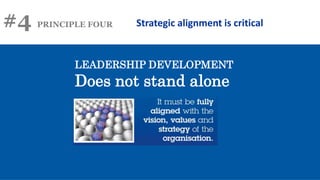
LEADERSHIP DEVELOPMENT
Does not stand alone
Strategic alignment is critical
#4 PRINCIPLE FOUR
The FIRST question to ask is
Strategic alignment is critical
What is the
overall strategy?
Then you can define
the expectations of
LEADERSHIP
TEAM
#4 PRINCIPLE FOUR Strategic alignment is critical
WHEN YOUR LEADER
DEMONSTRATE
those strategic
values
IN THEIR BEHAVIOUR, YOU
ARE
heading in the right
direction
#4 PRINCIPLE FOUR Strategic alignment is critical
WHEN YOUR LEADER
DEMONSTRATE
those strategic
values
IN THEIR BEHAVIOUR, YOU
ARE
heading in the right
direction
#4 PRINCIPLE FOUR Strategic alignment is critical
Your leader will be helping
Individual and team objectives
feed seamlessly into wider
S T R A T E G Y
#5 PRINCIPLE FIVE
Leadership needs to focus
on great conversation
#5 PRINCIPLE FIVE
Leadership needs to focus on
great conversations
This is not the time to
lead from behind a closed do or
YOU NEED TO BUILD
TRUST
COLLA
B &
RATION
#5 PRINCIPLE FIVE
Leadership needs to focus on
great conversations
Get out there
Be open,
Be honest,
Be courageous
in the conversation
you
hold across the business.
#5 PRINCIPLE FIVE
Leadership needs to focus on
great conversations
#5 PRINCIPLE FIVE
Leadership needs to focus on
great conversations
 Build on the strengths of people and
“CATCH THEM DOING THINGS RIGHT”
 Give and receive feedback
AND LISTEN
 Deal assertively and proactively with
UNDERPERFORMANCE
 Identify and develop
TALENT
 Help other to
LEARN AND GROW
 Coach and role model to
INSPIRE PERFORMANCE
#6 PRINCIPLE SIX
Leadership can be
learnt
#6 PRINCIPLE SIX
Leadership can be
learnt
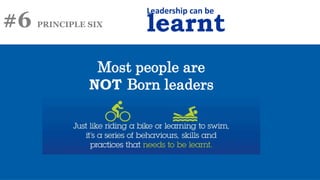
Most people are
NOT Born leaders
#6 PRINCIPLE SIX
Leadership can be
learnt
If you are serious about
Achieving your strategy
and Developing your people
You need to
INVEST IN YOUR LEADERS.
#6 PRINCIPLE SIX
Leadership can be
learnt
They will, in turn,
Show that leadership
Development can make
a visible difference to
YOUR BUSINESS.
#6 PRINCIPLE SIX
Leadership can be
learnt
How can you
Help leaders
TO LEARN?
#6 PRINCIPLE SIX
Leadership can be
learnt
 Make the leadership development contextual
bespoke and grounded in reality.
 Base it around real-life situations supported by a
practical toolkit.
 Set work-based assignments that drive key
performance indicators (KPIs).
 Task leaders to role-model the behaviour you need-
and to coach and mentor the next level through.
#7 PRINCIPLE SEVEN
Leadership can be
measured
#7 PRINCIPLE SEVEN Leadership can be measured
People often talk about
RETURN ON INVESTMENT
and create complex
numerical system + equations
#7 PRINCIPLE SEVEN Leadership can be measured
this can be important
But we believe a
RETURN ON EXPECTATION
is just a relevant
#7 PRINCIPLE SEVEN Leadership can be measured
START WITH THE
END IN MIND
You should set your
EXPECTATION
before any leadership
development even begins….
#7 PRINCIPLE SEVEN Leadership can be measured
THANK YOU
www.jsbonline.com/leadership
www.slidehshare.com
https://www.getsmarter.com/about-us
References:

Leadership Development_Rose_Brew.pptx

  • 1.
    “The Importance of LeadershipDevelopment” By Dr. Rose Y. Brew Leadership Webinar: “Become the best self-leader you can be”
  • 2.
    Objectives: • Define Leadership •Differentiate a Leader and a Manager • Learn the Importance of Leadership Development • Understand the 7 Principles of Leadership Development
  • 3.
    Leadership, what doesit means to you?
  • 4.
    What does leadershipmean to you? • This topic came up at a previous meeting that I attended. It was interesting to see how many people believed leadership could be taught. When I asked my coworkers the same question, I got some extremely intriguing responses: "Sometimes people get the terms leader and manager mixed up or mistake them for the same thing, but I believe a leader is someone who: • 1) Has a vision • 2) Gets others to see that vision • 3) Can build the belief that things can be done differently/better • 4) Can spot opportunities that others can’t see • 5) Can build a team and help that team rally around a
  • 5.
    • Leadership hasnothing to do with seniority or one’s position in the hierarchy of a company. • Leadership has nothing to do with titles. • Leadership has nothing to do with personal attributes. • Leadership isn’t management. What is Leadership? to define leadership. Let’s start with what leadership is not…
  • 6.
    Leadership Peter Drucker: "Theonly definition of a leader is someone who has followers.“ Warren Bennis: "Leadership is the capacity to translate vision into reality.” Bill Gates: "As we look ahead into the next century, leaders will be those who empower others.“ John Maxwell: "Leadership is influence - nothing more, nothing less.“ So, what is Leadership?
  • 7.
    DEFINITION: Leadership IS APROCESS OF SOCIAL INFLUENCE, WHICH MAXIMIZES THE EFFORTS OF OTHERS, TOWARDS THE ACHIEVEMENT OF A GOAL. IT ENCOMPASSES THE ABILITY OF AN INDIVIDUAL, GROUP OR ORGANIZATION TO “LEAD”, INFLUENCE OR GUIDE OTHER INDIVIDUALS, TEAMS, OR ENTIRE ORGANIZATION.
  • 8.
    Notice key elements of this definition: •Leadership stems from social influence, not authority or power • Leadership requires others, and that implies they don’t need to be “direct reports” • No mention of personality traits, attributes, or even a title; there are many styles, many paths, to effective leadership • It includes a goal, not influence with no intended outcome Lastly, there is the inclusion of “maximizes the efforts”. Most of my work is in the area of employee engagement, and engaged employees give discretionary effort.
  • 9.
    Developing Leadership Skillsis critical in an Ever-Changing Workplace • Leadership development is critical in order to maintain this dynamism and keep businesses relevant and profitable. • Leadership development is a key activity for many corporate HR departments. However, only two out of five businesses believe they are developing leaders in a way that benefits the business. • Even with such a large focus on leadership development in business, only half of 734 millennials in a survey conducted by Harvard7 believed their company’s leadership development were aligned with its business needs. (https://www.getsmarter.com/about-us) • Leadership development give people important leadership skills and attributes they need to be an effective leader, such as communication skills, motivation and inspiration, as well as better decision-making skills and accountability.
  • 11.
    #1 PRINCIPLE ONE Leadersexist at ALL LEVELS In your Organisations………
  • 12.
    ….. NOT JUSTAT THE TOP #1 PRINCIPLE ONE Leaders exist at ALL LEVELS In your Organisations….
  • 13.
    This is acommon misconception that masks the true opportunity for LEADERSHIP DEVELOPMENT #1 PRINCIPLE ONE Leaders exist at ALL LEVELS in your Organisations But I’m a Manager, Not a Leader
  • 14.
    #1 PRINCIPLE ONE Leadersexist at ALL LEVELS In your Organisations
  • 15.
    #1 PRINCIPLE ONE Leadersexist at ALL LEVELS In your Organisations the most successful leaders MANAGE and the most successful managers LEAD the two go hand and hand ….and should be developed as one Where possible
  • 16.
    #1 PRINCIPLE ONE Leadersexist at ALL LEVELS In your Organisations Leadership develop activities are relevant for leading and managing in various contexts: Managing YOURSELF
  • 17.
    #1 PRINCIPLE ONE Leadersexist at ALL LEVELS In your Organisations Leadership develop activities are relevant for leading and managing in various contexts: Leading and Managing OTHERS
  • 18.
    #1 PRINCIPLE ONE Leadersexist at ALL LEVELS In your Organisations Leadership develop activities are relevant for leading and managing in various contexts: Leading and Managing MULTIPLE TEAMS
  • 19.
    #1 PRINCIPLE ONE Leadersexist at ALL LEVELS In your Organisations Leadership develop activities are relevant for leading and managing in various contexts: Leading and Managing THE ORGANISATION as a whole
  • 20.
    #2 PRINCIPLE TWO Leadershipdevelopment is CONTEXTUAL
  • 21.
    #2 PRINCIPLE TWO Thereis no approach ONE SIZE FITS ALL Leadership development is CONTEXTUAL
  • 22.
    #2 PRINCIPLE TWO ONESIZE Leadership development is CONTEXTUAL FITSone No
  • 23.
    #2 PRINCIPLE TWO Allthose involved in developing your leaders By this we mean: TRULY KNOW YOUR ORGANISATION Leadership development is CONTEXTUAL  Your culture  Your strategy  Your people  Your journey so far
  • 24.
    #2 PRINCIPLE TWO Inaddition, your developing leaders need a FIRM understanding of Leadership development is CONTEXTUAL Why now? How I will be supported What’s expected of me? Why are we doing this development?
  • 25.
    #2 PRINCIPLE TWO Itis important to show them the POTENTIAL BENEFITS Leadership development is CONTEXTUAL Of the development for their own day-day leadership role
  • 26.
    #2 PRINCIPLE TWO BYBELIEVING Leadership development is CONTEXTUAL In its value, they will develop the right mindset and attitude to make it work And see the benefits for themselves, their team and their organisation
  • 27.
    #3 PRINCIPLE THREE Visibleand active senior leadership support is crucial
  • 28.
    #3 PRINCIPLE THREE Seniorleader Visible and active senior leadership support is crucial need to actively and visibly ENGAGE in their people learning
  • 29.
    #3 PRINCIPLE THREE wayssenior leader can Visible and active senior leadership support is crucial engage with the programme 4• Partner with the learning provider when designing the process • Personalize the communication that kicks all the initiative • Put people development on the agenda at board level.
  • 30.
    #3 PRINCIPLE THREE seniorleader need to Visible and active senior leadership support is crucial their learn is going through and to ROLE MODEL what ‘GOOD’ looks like
  • 31.
    #3 PRINCIPLE THREE Tipsfor senior leaders: Visible and active senior leadership support is crucial  Ensure you are equipped with knowledge about the programme through Senior Team Briefings and Taster Sessions.  Conduct pre and post-module meetings to show support and accelerate application
  • 32.
  • 33.
    #4 PRINCIPLE FOUR LEADERSHIPDEVELOPMENT Does not stand alone Strategic alignment is critical
  • 34.
    #4 PRINCIPLE FOUR TheFIRST question to ask is Strategic alignment is critical What is the overall strategy? Then you can define the expectations of LEADERSHIP TEAM
  • 35.
    #4 PRINCIPLE FOURStrategic alignment is critical WHEN YOUR LEADER DEMONSTRATE those strategic values IN THEIR BEHAVIOUR, YOU ARE heading in the right direction
  • 36.
    #4 PRINCIPLE FOURStrategic alignment is critical WHEN YOUR LEADER DEMONSTRATE those strategic values IN THEIR BEHAVIOUR, YOU ARE heading in the right direction
  • 37.
    #4 PRINCIPLE FOURStrategic alignment is critical Your leader will be helping Individual and team objectives feed seamlessly into wider S T R A T E G Y
  • 38.
    #5 PRINCIPLE FIVE Leadershipneeds to focus on great conversation
  • 39.
    #5 PRINCIPLE FIVE Leadershipneeds to focus on great conversations This is not the time to lead from behind a closed do or YOU NEED TO BUILD TRUST COLLA B & RATION
  • 40.
    #5 PRINCIPLE FIVE Leadershipneeds to focus on great conversations Get out there Be open, Be honest, Be courageous in the conversation you hold across the business.
  • 41.
    #5 PRINCIPLE FIVE Leadershipneeds to focus on great conversations
  • 42.
    #5 PRINCIPLE FIVE Leadershipneeds to focus on great conversations  Build on the strengths of people and “CATCH THEM DOING THINGS RIGHT”  Give and receive feedback AND LISTEN  Deal assertively and proactively with UNDERPERFORMANCE  Identify and develop TALENT  Help other to LEARN AND GROW  Coach and role model to INSPIRE PERFORMANCE
  • 43.
  • 44.
    #6 PRINCIPLE SIX Leadershipcan be learnt Most people are NOT Born leaders
  • 45.
    #6 PRINCIPLE SIX Leadershipcan be learnt If you are serious about Achieving your strategy and Developing your people You need to INVEST IN YOUR LEADERS.
  • 46.
    #6 PRINCIPLE SIX Leadershipcan be learnt They will, in turn, Show that leadership Development can make a visible difference to YOUR BUSINESS.
  • 47.
    #6 PRINCIPLE SIX Leadershipcan be learnt How can you Help leaders TO LEARN?
  • 48.
    #6 PRINCIPLE SIX Leadershipcan be learnt  Make the leadership development contextual bespoke and grounded in reality.  Base it around real-life situations supported by a practical toolkit.  Set work-based assignments that drive key performance indicators (KPIs).  Task leaders to role-model the behaviour you need- and to coach and mentor the next level through.
  • 49.
  • 50.
    #7 PRINCIPLE SEVENLeadership can be measured People often talk about RETURN ON INVESTMENT and create complex numerical system + equations
  • 51.
    #7 PRINCIPLE SEVENLeadership can be measured this can be important But we believe a RETURN ON EXPECTATION is just a relevant
  • 52.
    #7 PRINCIPLE SEVENLeadership can be measured START WITH THE END IN MIND You should set your EXPECTATION before any leadership development even begins….
  • 53.
    #7 PRINCIPLE SEVENLeadership can be measured
  • 54.
    #7 PRINCIPLE SEVENLeadership can be measured
  • 55.
    #7 PRINCIPLE SEVENLeadership can be measured
  • 56.
    #7 PRINCIPLE SEVENLeadership can be measured
  • 57.
  • 58.