Stephen Covey’s The 7 Habits of Highly Effective People Powerful Lessons in Personal Change Presentation By : Tejas Jani Mrugesh Solanki Mahendra Patel
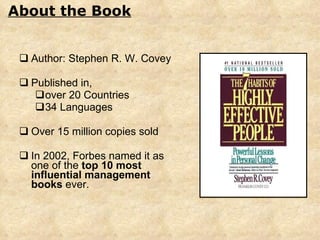
Author: Stephen R. W. Covey Published in,  over 20 Countries  34 Languages Over 15 million copies sold In 2002, Forbes named it as one of the  top 10 most influential management books  ever.  About the Book
Born:  October 24, 1932 at Salt Lake City, Utah Holds  MBA from Harvard and a doctorate from Brigham Young University Occupation:  Author, professional speaker, consultant, management-expert Stephen Covey's Online Community.  http://www.stephencovey.com/goal/ The site is a mash up of online courses, goal management and social networking.  Is cofounder and vice chairman of FranklinCovey, the leading global professional services firm with offices in 123 countries.  Its mission is to empower people and organizations to increase their performance capability through understanding and living principle-centered leadership.  He is also founder of The Institute for Principle Centered Leadership, a non-profit research group dedicated to transforming education and improving the quality of community life. About the Author
Everyday Greatness: Inspiration for a Meaningful Life  The 7 Habits of Highly Effective Marriage  Leadership - Great Leaders, Great Teams, Great Results: Library Edition  Untitled Stephen R. Covey Collection  Leadership - Great Leaders, Great Teams, Great Results  Speaking of Success: World Class Experts Share Their Secret  The 4 Disciplines of Execution  First Things First  Stephen R. Covey Leadership: Great Leaders, Great Teams and Great Results  Focus: Achieving Your Highest Priorities  Life by Choice: Stephen Covey's Insights from Reader's Digest's Most Inspirational Stories  Lead Or Get Off The Pot!: The Seven Secrets Of A Self-made Leader  Living The 7 Habits  The 7 Habits Family Collection: Leadership Where It Matters Most  Principle-Centered Leadership  And many more as author and co-author Other Titles by the Author
Paradigms and Principles :  Basic foundation for the creation of the habits.  Private Victory :  3 steps to teach a person how to move out of a state of dependence and beyond a state of independence.  Public Victory :  3 steps that lead to interdependence by showing  how to align one's needs and desires with those of other  people and create effective relationships. Renewal :  Sharpen the Saw to begin a process of  self-improvement . Sections of Book
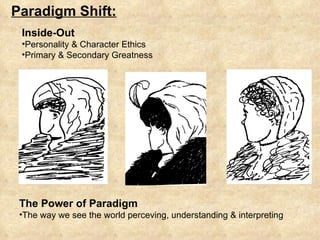
Paradigm Shift: Inside-Out Personality & Character Ethics Primary & Secondary Greatness The Power of Paradigm The way we see the world perceving, understanding & interpreting
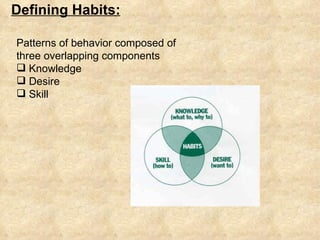
Defining Habits: Patterns of behavior composed of three overlapping components Knowledge Desire Skill
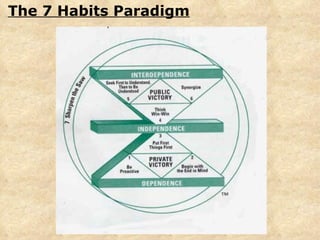
The 7 Habits Paradigm
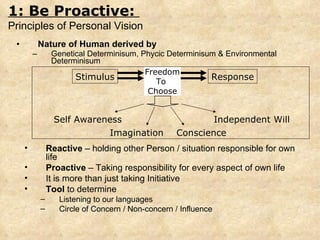
Nature of Human derived by   Genetical Determinisum, Phycic Determinisum & Environmental Determinisum 1: Be Proactive:  Principles of Personal Vision  Reactive  – holding other Person / situation responsible for own life Proactive  – Taking responsibility for every aspect of own life It is more than just taking Initiative Tool  to determine Listening to our languages Circle of Concern / Non-concern / Influence Freedom  To  Choose Stimulus Response Self Awareness Imagination Conscience Independent Will
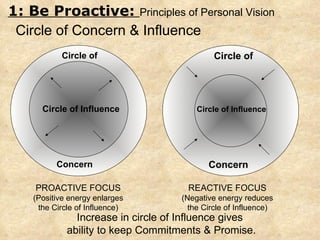
Circle of Influence Circle of Concern Circle of Influence Circle of Concern REACTIVE FOCUS (Negative energy reduces the Circle of Influence) PROACTIVE FOCUS (Positive energy enlarges the Circle of Influence) Circle of Concern & Influence Increase in circle of Influence gives  ability to keep Commitments & Promise. 1: Be Proactive:  Principles of Personal Vision
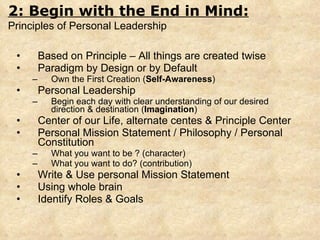
Based on Principle – All things are created twise Paradigm by Design or by Default Own the First Creation ( Self-Awareness ) Personal Leadership Begin each day with clear understanding of our desired direction & destination ( Imagination ) Center of our Life, alternate centes & Principle Center Personal Mission Statement / Philosophy / Personal Constitution What you want to be ? (character) What you want to do? (contribution) Write & Use personal Mission Statement Using whole brain Identify Roles & Goals 2: Begin with the End in Mind: Principles of Personal Leadership
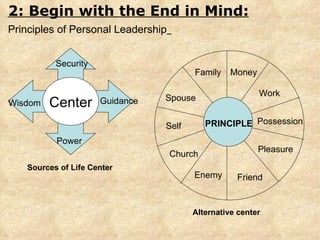
2: Begin with the End in Mind: Principles of Personal Leadership   PRINCIPLE Self Spouse Family Money Work Possession Pleasure Friend Enemy Church Alternative center Center Power Guidance Wisdom Security Sources of Life Center
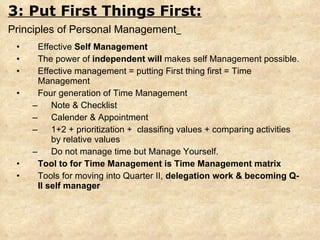
Effective  Self Management The power of  independent will  makes self Management possible. Effective management = putting First thing first = Time Management Four generation of Time Management Note & Checklist Calender & Appointment 1+2 + prioritization +  classifing values + comparing activities by relative values Do not manage time but Manage Yourself. Tool to for Time Management is Time Management matrix Tools for moving into Quarter II,  delegation work & becoming Q-II self manager 3: Put First Things First: Principles of Personal Management
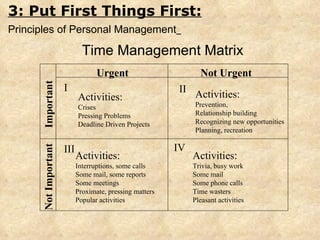
Time Management Matrix Not Important Important Urgent Not Urgent I II III IV Activities: Crises Pressing Problems Deadline Driven Projects Activities: Interruptions, some calls Some mail, some reports Some meetings Proximate, pressing matters Popular activities Activities: Prevention, Relationship building Recognizing new opportunities Planning, recreation Activities: Trivia, busy work Some mail Some phone calls Time wasters Pleasant activities 3: Put First Things First: Principles of Personal Management
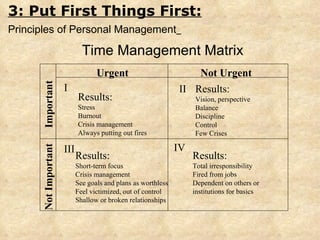
Not Important Important Urgent Not Urgent I II III IV Results: Stress Burnout Crisis management Always putting out fires Results: Short-term focus Crisis management See goals and plans as worthless Feel victimized, out of control Shallow or broken relationships Results: Vision, perspective Balance Discipline Control Few Crises Results: Total irresponsibility Fired from jobs Dependent on others or  institutions for basics 3: Put First Things First: Principles of Personal Management   Time Management Matrix
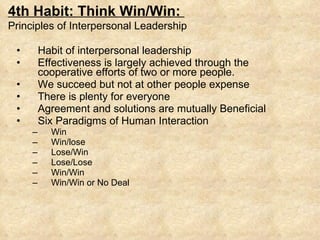
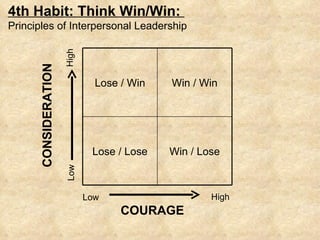
Habit of interpersonal leadership Effectiveness is largely achieved through the cooperative efforts of two or more people. We succeed but not at other people expense There is plenty for everyone Agreement and solutions are mutually Beneficial Six Paradigms of Human Interaction Win Win/lose Lose/Win Lose/Lose Win/Win Win/Win or No Deal 4th Habit: Think Win/Win:  Principles of Interpersonal Leadership
4th Habit: Think Win/Win:  Principles of Interpersonal Leadership Low High Low High COURAGE CONSIDERATION Win / Lose Lose / Lose Win / Win Lose / Win
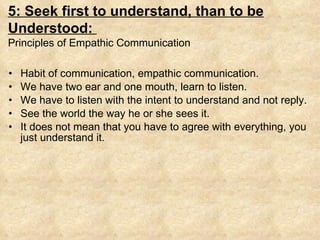
Habit of communication, empathic communication. We have two ear and one mouth, learn to listen. We have to listen with the intent to understand and not reply. See the world the way he or she sees it. It does not mean that you have to agree with everything, you just understand it. 5: Seek first to understand, than to be Understood:  Principles of Empathic Communication
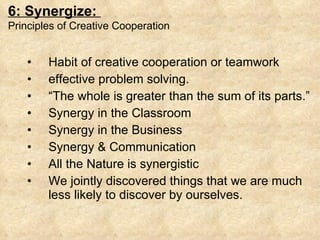
Habit of creative cooperation or teamwork effective problem solving.  “ The whole is greater than the sum of its parts.”  Synergy in the Classroom Synergy in the Business Synergy & Communication All the Nature is synergistic We jointly discovered things that we are much less likely to discover by ourselves. 6: Synergize:  Principles of Creative Cooperation
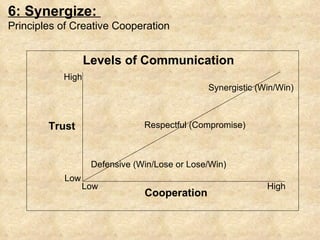
Levels of Communication Low Cooperation High Low High Trust Defensive (Win/Lose or Lose/Win) Respectful (Compromise) Synergistic (Win/Win) 6: Synergize:  Principles of Creative Cooperation
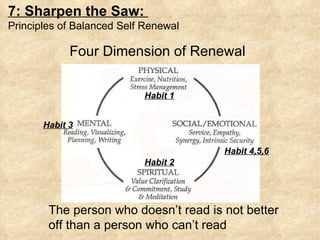
The person who doesn’t read is not better off than a person who can’t read Four Dimension of Renewal 7: Sharpen the Saw:  Principles of Balanced Self Renewal Habit 3 Habit 1 Habit 4,5,6 Habit 2
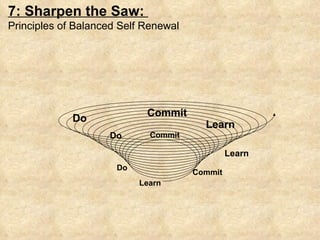
Learn Do Commit Do Do Learn Learn Commit Commit 7: Sharpen the Saw:  Principles of Balanced Self Renewal
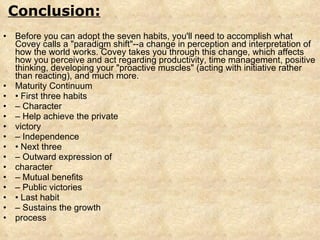
Before you can adopt the seven habits, you'll need to accomplish what Covey calls a "paradigm shift"--a change in perception and interpretation of how the world works. Covey takes you through this change, which affects how you perceive and act regarding productivity, time management, positive thinking, developing your "proactive muscles" (acting with initiative rather than reacting), and much more.  Maturity Continuum •  First three habits –  Character –  Help achieve the private victory –  Independence •  Next three –  Outward expression of character –  Mutual benefits –  Public victories •  Last habit –  Sustains the growth process Conclusion:
Lets start with  Paradigm Shift

7 Habits

  • 1.
    Stephen Covey’s The7 Habits of Highly Effective People Powerful Lessons in Personal Change Presentation By : Tejas Jani Mrugesh Solanki Mahendra Patel
  • 2.
    Author: Stephen R.W. Covey Published in, over 20 Countries 34 Languages Over 15 million copies sold In 2002, Forbes named it as one of the top 10 most influential management books ever. About the Book
  • 3.
    Born: October24, 1932 at Salt Lake City, Utah Holds MBA from Harvard and a doctorate from Brigham Young University Occupation: Author, professional speaker, consultant, management-expert Stephen Covey's Online Community. http://www.stephencovey.com/goal/ The site is a mash up of online courses, goal management and social networking. Is cofounder and vice chairman of FranklinCovey, the leading global professional services firm with offices in 123 countries. Its mission is to empower people and organizations to increase their performance capability through understanding and living principle-centered leadership. He is also founder of The Institute for Principle Centered Leadership, a non-profit research group dedicated to transforming education and improving the quality of community life. About the Author
  • 4.
    Everyday Greatness: Inspirationfor a Meaningful Life The 7 Habits of Highly Effective Marriage Leadership - Great Leaders, Great Teams, Great Results: Library Edition Untitled Stephen R. Covey Collection Leadership - Great Leaders, Great Teams, Great Results Speaking of Success: World Class Experts Share Their Secret The 4 Disciplines of Execution First Things First Stephen R. Covey Leadership: Great Leaders, Great Teams and Great Results Focus: Achieving Your Highest Priorities Life by Choice: Stephen Covey's Insights from Reader's Digest's Most Inspirational Stories Lead Or Get Off The Pot!: The Seven Secrets Of A Self-made Leader Living The 7 Habits The 7 Habits Family Collection: Leadership Where It Matters Most Principle-Centered Leadership And many more as author and co-author Other Titles by the Author
  • 5.
    Paradigms and Principles: Basic foundation for the creation of the habits. Private Victory : 3 steps to teach a person how to move out of a state of dependence and beyond a state of independence. Public Victory : 3 steps that lead to interdependence by showing how to align one's needs and desires with those of other people and create effective relationships. Renewal : Sharpen the Saw to begin a process of self-improvement . Sections of Book
  • 6.
    Paradigm Shift: Inside-OutPersonality & Character Ethics Primary & Secondary Greatness The Power of Paradigm The way we see the world perceving, understanding & interpreting
  • 7.
    Defining Habits: Patternsof behavior composed of three overlapping components Knowledge Desire Skill
  • 8.
    The 7 HabitsParadigm
  • 9.
    Nature of Humanderived by Genetical Determinisum, Phycic Determinisum & Environmental Determinisum 1: Be Proactive: Principles of Personal Vision Reactive – holding other Person / situation responsible for own life Proactive – Taking responsibility for every aspect of own life It is more than just taking Initiative Tool to determine Listening to our languages Circle of Concern / Non-concern / Influence Freedom To Choose Stimulus Response Self Awareness Imagination Conscience Independent Will
  • 10.
    Circle of InfluenceCircle of Concern Circle of Influence Circle of Concern REACTIVE FOCUS (Negative energy reduces the Circle of Influence) PROACTIVE FOCUS (Positive energy enlarges the Circle of Influence) Circle of Concern & Influence Increase in circle of Influence gives ability to keep Commitments & Promise. 1: Be Proactive: Principles of Personal Vision
  • 11.
    Based on Principle– All things are created twise Paradigm by Design or by Default Own the First Creation ( Self-Awareness ) Personal Leadership Begin each day with clear understanding of our desired direction & destination ( Imagination ) Center of our Life, alternate centes & Principle Center Personal Mission Statement / Philosophy / Personal Constitution What you want to be ? (character) What you want to do? (contribution) Write & Use personal Mission Statement Using whole brain Identify Roles & Goals 2: Begin with the End in Mind: Principles of Personal Leadership
  • 12.
    2: Begin withthe End in Mind: Principles of Personal Leadership PRINCIPLE Self Spouse Family Money Work Possession Pleasure Friend Enemy Church Alternative center Center Power Guidance Wisdom Security Sources of Life Center
  • 13.
    Effective SelfManagement The power of independent will makes self Management possible. Effective management = putting First thing first = Time Management Four generation of Time Management Note & Checklist Calender & Appointment 1+2 + prioritization + classifing values + comparing activities by relative values Do not manage time but Manage Yourself. Tool to for Time Management is Time Management matrix Tools for moving into Quarter II, delegation work & becoming Q-II self manager 3: Put First Things First: Principles of Personal Management
  • 14.
    Time Management MatrixNot Important Important Urgent Not Urgent I II III IV Activities: Crises Pressing Problems Deadline Driven Projects Activities: Interruptions, some calls Some mail, some reports Some meetings Proximate, pressing matters Popular activities Activities: Prevention, Relationship building Recognizing new opportunities Planning, recreation Activities: Trivia, busy work Some mail Some phone calls Time wasters Pleasant activities 3: Put First Things First: Principles of Personal Management
  • 15.
    Not Important ImportantUrgent Not Urgent I II III IV Results: Stress Burnout Crisis management Always putting out fires Results: Short-term focus Crisis management See goals and plans as worthless Feel victimized, out of control Shallow or broken relationships Results: Vision, perspective Balance Discipline Control Few Crises Results: Total irresponsibility Fired from jobs Dependent on others or institutions for basics 3: Put First Things First: Principles of Personal Management Time Management Matrix
  • 16.
    Habit of interpersonalleadership Effectiveness is largely achieved through the cooperative efforts of two or more people. We succeed but not at other people expense There is plenty for everyone Agreement and solutions are mutually Beneficial Six Paradigms of Human Interaction Win Win/lose Lose/Win Lose/Lose Win/Win Win/Win or No Deal 4th Habit: Think Win/Win: Principles of Interpersonal Leadership
  • 17.
    4th Habit: ThinkWin/Win: Principles of Interpersonal Leadership Low High Low High COURAGE CONSIDERATION Win / Lose Lose / Lose Win / Win Lose / Win
  • 18.
    Habit of communication,empathic communication. We have two ear and one mouth, learn to listen. We have to listen with the intent to understand and not reply. See the world the way he or she sees it. It does not mean that you have to agree with everything, you just understand it. 5: Seek first to understand, than to be Understood: Principles of Empathic Communication
  • 19.
    Habit of creativecooperation or teamwork effective problem solving. “ The whole is greater than the sum of its parts.” Synergy in the Classroom Synergy in the Business Synergy & Communication All the Nature is synergistic We jointly discovered things that we are much less likely to discover by ourselves. 6: Synergize: Principles of Creative Cooperation
  • 20.
    Levels of CommunicationLow Cooperation High Low High Trust Defensive (Win/Lose or Lose/Win) Respectful (Compromise) Synergistic (Win/Win) 6: Synergize: Principles of Creative Cooperation
  • 21.
    The person whodoesn’t read is not better off than a person who can’t read Four Dimension of Renewal 7: Sharpen the Saw: Principles of Balanced Self Renewal Habit 3 Habit 1 Habit 4,5,6 Habit 2
  • 22.
    Learn Do CommitDo Do Learn Learn Commit Commit 7: Sharpen the Saw: Principles of Balanced Self Renewal
  • 23.
    Before you canadopt the seven habits, you'll need to accomplish what Covey calls a "paradigm shift"--a change in perception and interpretation of how the world works. Covey takes you through this change, which affects how you perceive and act regarding productivity, time management, positive thinking, developing your "proactive muscles" (acting with initiative rather than reacting), and much more. Maturity Continuum • First three habits – Character – Help achieve the private victory – Independence • Next three – Outward expression of character – Mutual benefits – Public victories • Last habit – Sustains the growth process Conclusion:
  • 24.
    Lets start with Paradigm Shift