Overcoming GrowthOvercoming Growth
BarriersBarriers
Thriving Churches ConferenceThriving Churches Conference
© Dr. John Jackson, 2007© Dr. John Jackson, 2007
Quotes that make you think…Quotes that make you think…
““If churches only improve what theyIf churches only improve what they
have been doing, they will die.have been doing, they will die.
Bureaucracies and traditionalBureaucracies and traditional
practices are the major cause of thepractices are the major cause of the
decline of most denominations indecline of most denominations in
North America.”North America.”
(William Easum,(William Easum, Dancing with Dinosaurs,Dancing with Dinosaurs, p. 13-14,p. 13-14, www.easumbandy.comwww.easumbandy.com))
““I know that I am generalizing and thatI know that I am generalizing and that
what I am saying cannot be said of everywhat I am saying cannot be said of every
church. Nevertheless, generalizationschurch. Nevertheless, generalizations
do disclose general truths, and it is notdo disclose general truths, and it is not
too much to say that the church of ourtoo much to say that the church of our
time and our place is largely inwardlytime and our place is largely inwardly
focused. It has lost sight of the worldfocused. It has lost sight of the world
outside its walls. Which is to say, theoutside its walls. Which is to say, the
church has also lost sight of the God whochurch has also lost sight of the God who
works in and loves the world. And that isworks in and loves the world. And that is
a genuine tragedy.”a genuine tragedy.”
((Walt KallestadWalt Kallestad Turning Your Church Inside OutTurning Your Church Inside Out))
PastorPreneur LeadershipPastorPreneur Leadership
 Genuine calling is a powerful antidote toGenuine calling is a powerful antidote to
the drive to prove ourselves, thethe drive to prove ourselves, the
emptiness of boredom oremptiness of boredom or
discouragement, and thediscouragement, and the
meaninglessness of superficial, scatteredmeaninglessness of superficial, scattered
activities.activities.
 Calling is not about the size of a church,Calling is not about the size of a church,
the scope of a ministry, or the bottomthe scope of a ministry, or the bottom
line of a business—it is about the heartline of a business—it is about the heart
of God.of God.
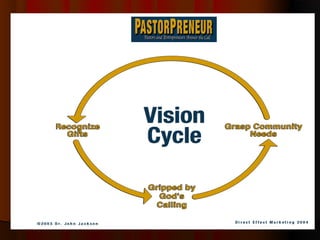
OurOur GRIPGRIP of the heart of God (whichof the heart of God (which
helps tohelps to FOCUSFOCUS our motivation)our motivation)
OurOur GRASPGRASP on the needs of peopleon the needs of people
around us (which helps toaround us (which helps to FOCUSFOCUS ourour
ministry)ministry)
OurOur GIFTSGIFTS that He has entrusted to usthat He has entrusted to us
(which helps to(which helps to FOCUSFOCUS our methods)our methods)
High Impact Churches break throughHigh Impact Churches break through
spiritual, social, and leadershipspiritual, social, and leadership
barriers to establish new churches,barriers to establish new churches,
new ministries, and reach largenew ministries, and reach large
numbers of new people for Christ.numbers of new people for Christ.
High Impact churches confront theHigh Impact churches confront the
law of inertia and the reality oflaw of inertia and the reality of
human lethargy with a passionatehuman lethargy with a passionate
purposeful pursuit of God’s plan forpurposeful pursuit of God’s plan for
evangelism in their area.evangelism in their area.
George Hunter (Reaching the Unchurched)George Hunter (Reaching the Unchurched)
& George Barna (& George Barna (www.barna.orgwww.barna.org))
 Built on needs of people in local contextBuilt on needs of people in local context
 Focused on the unchurchedFocused on the unchurched
 Multiple entry points into the churchMultiple entry points into the church
 System of segmentation and sequencingSystem of segmentation and sequencing
for spiritual growthfor spiritual growth
 Leadership is the most important role ofLeadership is the most important role of
the Senior Pastorthe Senior Pastor
 High expectations of membership andHigh expectations of membership and
preaching involves a call to actionpreaching involves a call to action
 Leadership is developed from withinLeadership is developed from within
 Many specialized ministries in addition toMany specialized ministries in addition to
the basicsthe basics
““Churches that are effective reachingChurches that are effective reaching
people for Christ see the needs ofpeople for Christ see the needs of
the unchurched, establish ministriesthe unchurched, establish ministries
that allow the church to be presentthat allow the church to be present
in the community, and have ain the community, and have a
process by which they are able toprocess by which they are able to
draw these unchurched people intodraw these unchurched people into
the safety of Christ and a localthe safety of Christ and a local
church”church”
(Mcintosh & Martin,(Mcintosh & Martin, Finding Them, Keeping ThemFinding Them, Keeping Them, 22)., 22).
GROWTH BARRIERS…..GROWTH BARRIERS…..
The barrier ofThe barrier of VISIONVISION --
A breakthrough ofA breakthrough of CLARITYCLARITY
The barrier ofThe barrier of LEADERSHIPLEADERSHIP ––
A breakthrough ofA breakthrough of CERTAINTYCERTAINTY
The barrier ofThe barrier of TEAMTEAM ––
A breakthrough ofA breakthrough of UNITYUNITY
The barrier ofThe barrier of COMMUNITYCOMMUNITY ––
A breakthrough ofA breakthrough of CONNECTIONCONNECTION
The barrier ofThe barrier of PRESENTATIONPRESENTATION ––
A breakthrough ofA breakthrough of EXCELLENCEEXCELLENCE
The barrier ofThe barrier of FOLLOW-THROUGHFOLLOW-THROUGH
A breakthrough ofA breakthrough of
FAITHFULNESSFAITHFULNESS
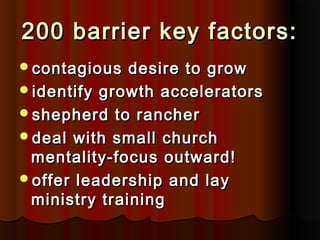
200 barrier key factors:200 barrier key factors:
contagious desire to growcontagious desire to grow
identify growth acceleratorsidentify growth accelerators
shepherd to ranchershepherd to rancher
deal with small churchdeal with small church
mentality-focus outward!mentality-focus outward!
offer leadership and layoffer leadership and lay
ministry trainingministry training
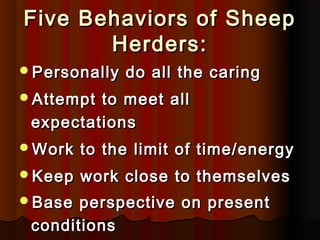
Five Behaviors of SheepFive Behaviors of Sheep
Herders:Herders:
Personally do all the caringPersonally do all the caring
Attempt to meet allAttempt to meet all
expectationsexpectations
Work to the limit of time/energyWork to the limit of time/energy
Keep work close to themselvesKeep work close to themselves
Base perspective on presentBase perspective on present
conditionsconditions
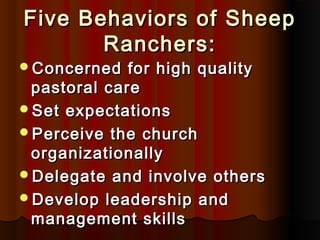
Five Behaviors of SheepFive Behaviors of Sheep
Ranchers:Ranchers:
Concerned for high qualityConcerned for high quality
pastoral carepastoral care
Set expectationsSet expectations
Perceive the churchPerceive the church
organizationallyorganizationally
Delegate and involve othersDelegate and involve others
Develop leadership andDevelop leadership and
management skillsmanagement skills
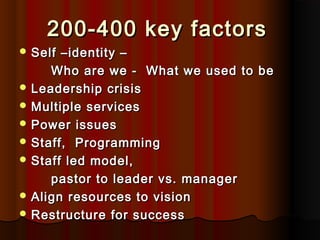
200-400 key factors200-400 key factors
 Self –identity –Self –identity –
Who are we - What we used to beWho are we - What we used to be
 Leadership crisisLeadership crisis
 Multiple servicesMultiple services
 Power issuesPower issues
 Staff, ProgrammingStaff, Programming
 Staff led model,Staff led model,
pastor to leader vs. managerpastor to leader vs. manager
 Align resources to visionAlign resources to vision
 Restructure for successRestructure for success
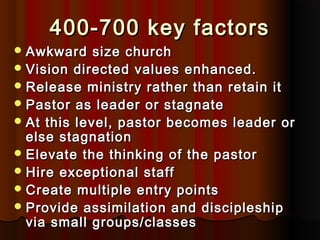
400-700 key factors400-700 key factors
 Awkward size churchAwkward size church
 Vision directed values enhanced.Vision directed values enhanced.
 Release ministry rather than retain itRelease ministry rather than retain it
 Pastor as leader or stagnatePastor as leader or stagnate
 At this level, pastor becomes leader orAt this level, pastor becomes leader or
else stagnationelse stagnation
 Elevate the thinking of the pastorElevate the thinking of the pastor
 Hire exceptional staffHire exceptional staff
 Create multiple entry pointsCreate multiple entry points
 Provide assimilation and discipleshipProvide assimilation and discipleship
via small groups/classesvia small groups/classes
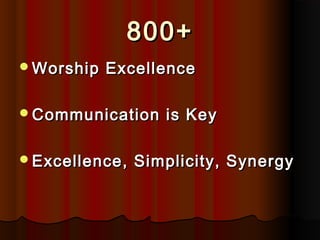
800+800+
Worship ExcellenceWorship Excellence
Communication is KeyCommunication is Key
Excellence, Simplicity, SynergyExcellence, Simplicity, Synergy
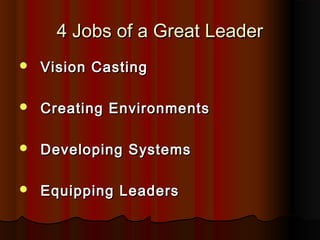
4 Jobs of a Great Leader4 Jobs of a Great Leader
 Vision CastingVision Casting
 Creating EnvironmentsCreating Environments
 Developing SystemsDeveloping Systems
 Equipping LeadersEquipping Leaders
Thriving Churches Growth Barriers

Thriving Churches Growth Barriers

  • 1.
    Overcoming GrowthOvercoming Growth BarriersBarriers ThrivingChurches ConferenceThriving Churches Conference © Dr. John Jackson, 2007© Dr. John Jackson, 2007
  • 2.
    Quotes that makeyou think…Quotes that make you think… ““If churches only improve what theyIf churches only improve what they have been doing, they will die.have been doing, they will die. Bureaucracies and traditionalBureaucracies and traditional practices are the major cause of thepractices are the major cause of the decline of most denominations indecline of most denominations in North America.”North America.” (William Easum,(William Easum, Dancing with Dinosaurs,Dancing with Dinosaurs, p. 13-14,p. 13-14, www.easumbandy.comwww.easumbandy.com))
  • 3.
    ““I know thatI am generalizing and thatI know that I am generalizing and that what I am saying cannot be said of everywhat I am saying cannot be said of every church. Nevertheless, generalizationschurch. Nevertheless, generalizations do disclose general truths, and it is notdo disclose general truths, and it is not too much to say that the church of ourtoo much to say that the church of our time and our place is largely inwardlytime and our place is largely inwardly focused. It has lost sight of the worldfocused. It has lost sight of the world outside its walls. Which is to say, theoutside its walls. Which is to say, the church has also lost sight of the God whochurch has also lost sight of the God who works in and loves the world. And that isworks in and loves the world. And that is a genuine tragedy.”a genuine tragedy.” ((Walt KallestadWalt Kallestad Turning Your Church Inside OutTurning Your Church Inside Out))
  • 4.
    PastorPreneur LeadershipPastorPreneur Leadership Genuine calling is a powerful antidote toGenuine calling is a powerful antidote to the drive to prove ourselves, thethe drive to prove ourselves, the emptiness of boredom oremptiness of boredom or discouragement, and thediscouragement, and the meaninglessness of superficial, scatteredmeaninglessness of superficial, scattered activities.activities.  Calling is not about the size of a church,Calling is not about the size of a church, the scope of a ministry, or the bottomthe scope of a ministry, or the bottom line of a business—it is about the heartline of a business—it is about the heart of God.of God.
  • 6.
    OurOur GRIPGRIP ofthe heart of God (whichof the heart of God (which helps tohelps to FOCUSFOCUS our motivation)our motivation) OurOur GRASPGRASP on the needs of peopleon the needs of people around us (which helps toaround us (which helps to FOCUSFOCUS ourour ministry)ministry) OurOur GIFTSGIFTS that He has entrusted to usthat He has entrusted to us (which helps to(which helps to FOCUSFOCUS our methods)our methods)
  • 7.
    High Impact Churchesbreak throughHigh Impact Churches break through spiritual, social, and leadershipspiritual, social, and leadership barriers to establish new churches,barriers to establish new churches, new ministries, and reach largenew ministries, and reach large numbers of new people for Christ.numbers of new people for Christ. High Impact churches confront theHigh Impact churches confront the law of inertia and the reality oflaw of inertia and the reality of human lethargy with a passionatehuman lethargy with a passionate purposeful pursuit of God’s plan forpurposeful pursuit of God’s plan for evangelism in their area.evangelism in their area.
  • 8.
    George Hunter (Reachingthe Unchurched)George Hunter (Reaching the Unchurched) & George Barna (& George Barna (www.barna.orgwww.barna.org))  Built on needs of people in local contextBuilt on needs of people in local context  Focused on the unchurchedFocused on the unchurched  Multiple entry points into the churchMultiple entry points into the church  System of segmentation and sequencingSystem of segmentation and sequencing for spiritual growthfor spiritual growth  Leadership is the most important role ofLeadership is the most important role of the Senior Pastorthe Senior Pastor
  • 9.
     High expectationsof membership andHigh expectations of membership and preaching involves a call to actionpreaching involves a call to action  Leadership is developed from withinLeadership is developed from within  Many specialized ministries in addition toMany specialized ministries in addition to the basicsthe basics
  • 10.
    ““Churches that areeffective reachingChurches that are effective reaching people for Christ see the needs ofpeople for Christ see the needs of the unchurched, establish ministriesthe unchurched, establish ministries that allow the church to be presentthat allow the church to be present in the community, and have ain the community, and have a process by which they are able toprocess by which they are able to draw these unchurched people intodraw these unchurched people into the safety of Christ and a localthe safety of Christ and a local church”church” (Mcintosh & Martin,(Mcintosh & Martin, Finding Them, Keeping ThemFinding Them, Keeping Them, 22)., 22).
  • 11.
    GROWTH BARRIERS…..GROWTH BARRIERS….. Thebarrier ofThe barrier of VISIONVISION -- A breakthrough ofA breakthrough of CLARITYCLARITY The barrier ofThe barrier of LEADERSHIPLEADERSHIP –– A breakthrough ofA breakthrough of CERTAINTYCERTAINTY The barrier ofThe barrier of TEAMTEAM –– A breakthrough ofA breakthrough of UNITYUNITY
  • 12.
    The barrier ofThebarrier of COMMUNITYCOMMUNITY –– A breakthrough ofA breakthrough of CONNECTIONCONNECTION The barrier ofThe barrier of PRESENTATIONPRESENTATION –– A breakthrough ofA breakthrough of EXCELLENCEEXCELLENCE The barrier ofThe barrier of FOLLOW-THROUGHFOLLOW-THROUGH A breakthrough ofA breakthrough of FAITHFULNESSFAITHFULNESS
  • 13.
    200 barrier keyfactors:200 barrier key factors: contagious desire to growcontagious desire to grow identify growth acceleratorsidentify growth accelerators shepherd to ranchershepherd to rancher deal with small churchdeal with small church mentality-focus outward!mentality-focus outward! offer leadership and layoffer leadership and lay ministry trainingministry training
  • 14.
    Five Behaviors ofSheepFive Behaviors of Sheep Herders:Herders: Personally do all the caringPersonally do all the caring Attempt to meet allAttempt to meet all expectationsexpectations Work to the limit of time/energyWork to the limit of time/energy Keep work close to themselvesKeep work close to themselves Base perspective on presentBase perspective on present conditionsconditions
  • 15.
    Five Behaviors ofSheepFive Behaviors of Sheep Ranchers:Ranchers: Concerned for high qualityConcerned for high quality pastoral carepastoral care Set expectationsSet expectations Perceive the churchPerceive the church organizationallyorganizationally Delegate and involve othersDelegate and involve others Develop leadership andDevelop leadership and management skillsmanagement skills
  • 16.
    200-400 key factors200-400key factors  Self –identity –Self –identity – Who are we - What we used to beWho are we - What we used to be  Leadership crisisLeadership crisis  Multiple servicesMultiple services  Power issuesPower issues  Staff, ProgrammingStaff, Programming  Staff led model,Staff led model, pastor to leader vs. managerpastor to leader vs. manager  Align resources to visionAlign resources to vision  Restructure for successRestructure for success
  • 17.
    400-700 key factors400-700key factors  Awkward size churchAwkward size church  Vision directed values enhanced.Vision directed values enhanced.  Release ministry rather than retain itRelease ministry rather than retain it  Pastor as leader or stagnatePastor as leader or stagnate  At this level, pastor becomes leader orAt this level, pastor becomes leader or else stagnationelse stagnation  Elevate the thinking of the pastorElevate the thinking of the pastor  Hire exceptional staffHire exceptional staff  Create multiple entry pointsCreate multiple entry points  Provide assimilation and discipleshipProvide assimilation and discipleship via small groups/classesvia small groups/classes
  • 18.
    800+800+ Worship ExcellenceWorship Excellence Communicationis KeyCommunication is Key Excellence, Simplicity, SynergyExcellence, Simplicity, Synergy
  • 19.
    4 Jobs ofa Great Leader4 Jobs of a Great Leader  Vision CastingVision Casting  Creating EnvironmentsCreating Environments  Developing SystemsDeveloping Systems  Equipping LeadersEquipping Leaders