FMA 1967 & The
Regulations
ACT 139
THE ACT (1/2)
 Provide control of factories related to
safety, health & welfare of persons at
work, and any matters related to
registration & inspection of machinery
 Specify dangerous occurrence, types of
serious bodily injury & industrial diseases.
 Specify powers of Inspectors, obstruction
and offences
THE ACT (2/2)
 Specify requirement for machinery – steam
boilers, unfired pressure vessels, gas cylinders,
transmission machinery, hoisting machines &
etc.
 Specify duties of persons employed and
occupier, person in charge & certificate of
competency.
 Instruct al machinery to have written approval,
valid certificate of fitness & periodically
inspection by Inspector
OBJECTIVES
 Control of factories operations with
respect to safety, health and welfare of
persons.
 Registration & inspection of machinery
APPLICATION
 OSHA 1994 supersedes the FMA 1967 in the
event of any conflict
 FMA 1967 applies to mainly factories &
construction sites
 FMA & OSHA – enabling act (give power to
minister to gazette detail regulations)
 Contain some general provision on safety,
health and welfare.
 FMA – limited to manufacturing industry, mining,
quarrying & construction
 No detail provisions on specific matters – detail
provision are stipulated under the regulations.
Arrangement
 Part 1 – Preliminary
 Part 2 – Safety, health and welfare
 Part 3 – Persons-in-charge & certificates of
competency
 Part 4 – Notification of accidents, dangerous
occurrence & dangerous diseases
 Part 5 – Notice of occupation of factory &
registration & use of machinery
 Part 6 - General
PART 1 - PRELIMINARY
 Definition of Factory
Premises & its boundaries
Within the premises there is manual labor
doing process of making, altering, repairing
ornamenting, finishing, cleaning, washing,
breaking, demolishing, constructing, fitting,
adjusting.
The process must be for trading any business
PART 2 – SAFETY, HEALTH &
WELFARE
 Key points:
Premises must be designed with safe access
to work areas, material & goods must be
safely stacked (S.10)
Machinery must be properly constructed &
dangerous parts must be fenced (S.14,15,16)
Employees must not misuse safety & health
equipment (S.20)
Employees must not to endanger himself or
other person
PART 2 – SAFETY, HEALTH &
WELFARE
 Premises must be kept clean with
adequate space, ventilation, lighting &
toilets (S.22)
 Persons must be supplied with adequate
facilities for clothing, storage, drinking,
water, first aid & washing facilities (S.25)
 Employees must be trained on safety of
machinery (S.26)
PART 3: PERSONS-IN-CHARGE &
CERTIFICATES OF COMPETENCY
 Machinery operators must be adequately
trained or under the supervision of a
trained person (S.26)
 Young persons (<16) must not operate
machinery (S.28)
PART 4: NOTIFICATION OF ACCIDENTS,
DANGEROUS OCCURRENCE &
DANGEROUS DISEASE
 The occupier must notify the nearest
Inspector of accidents & diseases include:
Loss of life
Injury to a person who loses more than 4 days
work loss injury time – LTI)
Serious damage to machinery or other
property (S.31)
Inspectors may investigate accidents &
dangerous occurrence & hold inquiries on
more serious cases (S.33)
PART 5: NOTICE OF OCCUPATION OF
FACTORY & REGISTRATION & USE OF
MACHINERY
 Notify DOSH within 3 months of the intended
start date (S.34)
 Building operations must be notified if last more
than 6 weeks (S.35)
 Changes to the use of factory or machinery must
be notified to DOSH
 Fills standard form with (a) layout plan of factory,
(b) list of manufactured products, (c) list of
machines to be used, (d) list of chemicals, toxic
or flammable substance, (e) detail flow chart of
work process
PART 6 - GENERAL
 General penalty RM 2000
 Certain sections with penalty RM5000
(S.51)
REGULATIONS
 FMA (Certificate of Competency Examination)
Regulations 1970 (Revised 1988)
 FMA (Electrical Passenger & Goods Lifts)
Regulations 1970
 FMA (Fencing of Machinery & Safety)
Regulations 1970 (Revised 1988)
 FMA (Notification, Certificate of Fitness &
Inspection) Regulations, 1970
 FMA (Person-in-Charge) Regulations, 1970
(Revised 1988)
REGULATIONS
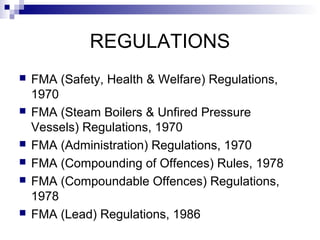
 FMA (Safety, Health & Welfare) Regulations,
1970
 FMA (Steam Boilers & Unfired Pressure
Vessels) Regulations, 1970
 FMA (Administration) Regulations, 1970
 FMA (Compounding of Offences) Rules, 1978
 FMA (Compoundable Offences) Regulations,
1978
 FMA (Lead) Regulations, 1986
REGULATIONS
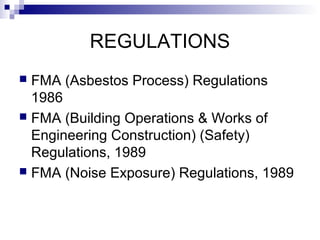
 FMA (Asbestos Process) Regulations
1986
 FMA (Building Operations & Works of
Engineering Construction) (Safety)
Regulations, 1989
 FMA (Noise Exposure) Regulations, 1989
REGULATIONS
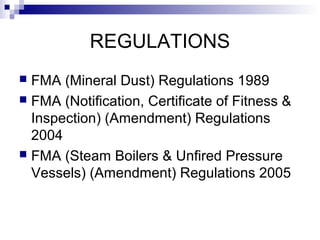
 FMA (Mineral Dust) Regulations 1989
 FMA (Notification, Certificate of Fitness &
Inspection) (Amendment) Regulations
2004
 FMA (Steam Boilers & Unfired Pressure
Vessels) (Amendment) Regulations 2005
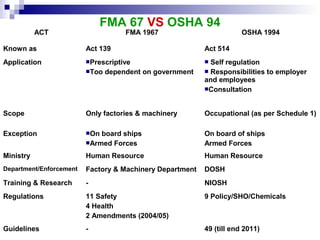
FMA 67 VS OSHA 94
ACT FMA 1967 OSHA 1994
Known as Act 139 Act 514
Application Prescriptive
Too dependent on government
 Self regulation
 Responsibilities to employer
and employees
Consultation
Scope Only factories & machinery Occupational (as per Schedule 1)
Exception On board ships
Armed Forces
On board of ships
Armed Forces
Ministry Human Resource Human Resource
Department/Enforcement Factory & Machinery Department DOSH
Training & Research - NIOSH
Regulations 11 Safety
4 Health
2 Amendments (2004/05)
9 Policy/SHO/Chemicals
Guidelines - 49 (till end 2011)
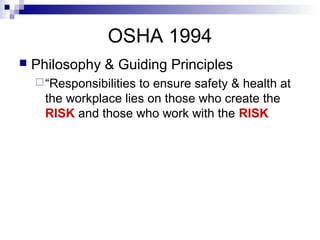
OSHA 1994
 Philosophy & Guiding Principles
“Responsibilities to ensure safety & health at
the workplace lies on those who create the
RISK and those who work with the RISK
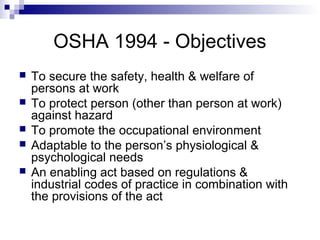
OSHA 1994 - Objectives
 To secure the safety, health & welfare of
persons at work
 To protect person (other than person at work)
against hazard
 To promote the occupational environment
 Adaptable to the person’s physiological &
psychological needs
 An enabling act based on regulations &
industrial codes of practice in combination with
the provisions of the act
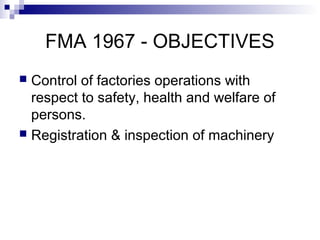
FMA 1967 - OBJECTIVES
 Control of factories operations with
respect to safety, health and welfare of
persons.
 Registration & inspection of machinery
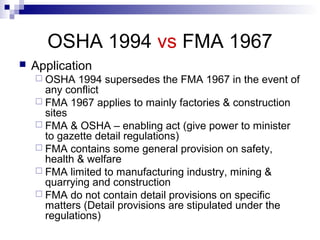
OSHA 1994 vs FMA 1967
 Application
 OSHA 1994 supersedes the FMA 1967 in the event of
any conflict
 FMA 1967 applies to mainly factories & construction
sites
 FMA & OSHA – enabling act (give power to minister
to gazette detail regulations)
 FMA contains some general provision on safety,
health & welfare
 FMA limited to manufacturing industry, mining &
quarrying and construction
 FMA do not contain detail provisions on specific
matters (Detail provisions are stipulated under the
regulations)

Fma 1967 & the regulations

  • 1.
    FMA 1967 &The Regulations ACT 139
  • 2.
    THE ACT (1/2) Provide control of factories related to safety, health & welfare of persons at work, and any matters related to registration & inspection of machinery  Specify dangerous occurrence, types of serious bodily injury & industrial diseases.  Specify powers of Inspectors, obstruction and offences
  • 3.
    THE ACT (2/2) Specify requirement for machinery – steam boilers, unfired pressure vessels, gas cylinders, transmission machinery, hoisting machines & etc.  Specify duties of persons employed and occupier, person in charge & certificate of competency.  Instruct al machinery to have written approval, valid certificate of fitness & periodically inspection by Inspector
  • 4.
    OBJECTIVES  Control offactories operations with respect to safety, health and welfare of persons.  Registration & inspection of machinery
  • 5.
    APPLICATION  OSHA 1994supersedes the FMA 1967 in the event of any conflict  FMA 1967 applies to mainly factories & construction sites  FMA & OSHA – enabling act (give power to minister to gazette detail regulations)  Contain some general provision on safety, health and welfare.  FMA – limited to manufacturing industry, mining, quarrying & construction  No detail provisions on specific matters – detail provision are stipulated under the regulations.
  • 6.
    Arrangement  Part 1– Preliminary  Part 2 – Safety, health and welfare  Part 3 – Persons-in-charge & certificates of competency  Part 4 – Notification of accidents, dangerous occurrence & dangerous diseases  Part 5 – Notice of occupation of factory & registration & use of machinery  Part 6 - General
  • 7.
    PART 1 -PRELIMINARY  Definition of Factory Premises & its boundaries Within the premises there is manual labor doing process of making, altering, repairing ornamenting, finishing, cleaning, washing, breaking, demolishing, constructing, fitting, adjusting. The process must be for trading any business
  • 8.
    PART 2 –SAFETY, HEALTH & WELFARE  Key points: Premises must be designed with safe access to work areas, material & goods must be safely stacked (S.10) Machinery must be properly constructed & dangerous parts must be fenced (S.14,15,16) Employees must not misuse safety & health equipment (S.20) Employees must not to endanger himself or other person
  • 9.
    PART 2 –SAFETY, HEALTH & WELFARE  Premises must be kept clean with adequate space, ventilation, lighting & toilets (S.22)  Persons must be supplied with adequate facilities for clothing, storage, drinking, water, first aid & washing facilities (S.25)  Employees must be trained on safety of machinery (S.26)
  • 10.
    PART 3: PERSONS-IN-CHARGE& CERTIFICATES OF COMPETENCY  Machinery operators must be adequately trained or under the supervision of a trained person (S.26)  Young persons (<16) must not operate machinery (S.28)
  • 11.
    PART 4: NOTIFICATIONOF ACCIDENTS, DANGEROUS OCCURRENCE & DANGEROUS DISEASE  The occupier must notify the nearest Inspector of accidents & diseases include: Loss of life Injury to a person who loses more than 4 days work loss injury time – LTI) Serious damage to machinery or other property (S.31) Inspectors may investigate accidents & dangerous occurrence & hold inquiries on more serious cases (S.33)
  • 12.
    PART 5: NOTICEOF OCCUPATION OF FACTORY & REGISTRATION & USE OF MACHINERY  Notify DOSH within 3 months of the intended start date (S.34)  Building operations must be notified if last more than 6 weeks (S.35)  Changes to the use of factory or machinery must be notified to DOSH  Fills standard form with (a) layout plan of factory, (b) list of manufactured products, (c) list of machines to be used, (d) list of chemicals, toxic or flammable substance, (e) detail flow chart of work process
  • 13.
    PART 6 -GENERAL  General penalty RM 2000  Certain sections with penalty RM5000 (S.51)
  • 14.
    REGULATIONS  FMA (Certificateof Competency Examination) Regulations 1970 (Revised 1988)  FMA (Electrical Passenger & Goods Lifts) Regulations 1970  FMA (Fencing of Machinery & Safety) Regulations 1970 (Revised 1988)  FMA (Notification, Certificate of Fitness & Inspection) Regulations, 1970  FMA (Person-in-Charge) Regulations, 1970 (Revised 1988)
  • 15.
    REGULATIONS  FMA (Safety,Health & Welfare) Regulations, 1970  FMA (Steam Boilers & Unfired Pressure Vessels) Regulations, 1970  FMA (Administration) Regulations, 1970  FMA (Compounding of Offences) Rules, 1978  FMA (Compoundable Offences) Regulations, 1978  FMA (Lead) Regulations, 1986
  • 16.
    REGULATIONS  FMA (AsbestosProcess) Regulations 1986  FMA (Building Operations & Works of Engineering Construction) (Safety) Regulations, 1989  FMA (Noise Exposure) Regulations, 1989
  • 17.
    REGULATIONS  FMA (MineralDust) Regulations 1989  FMA (Notification, Certificate of Fitness & Inspection) (Amendment) Regulations 2004  FMA (Steam Boilers & Unfired Pressure Vessels) (Amendment) Regulations 2005
  • 18.
    FMA 67 VSOSHA 94 ACT FMA 1967 OSHA 1994 Known as Act 139 Act 514 Application Prescriptive Too dependent on government  Self regulation  Responsibilities to employer and employees Consultation Scope Only factories & machinery Occupational (as per Schedule 1) Exception On board ships Armed Forces On board of ships Armed Forces Ministry Human Resource Human Resource Department/Enforcement Factory & Machinery Department DOSH Training & Research - NIOSH Regulations 11 Safety 4 Health 2 Amendments (2004/05) 9 Policy/SHO/Chemicals Guidelines - 49 (till end 2011)
  • 19.
    OSHA 1994  Philosophy& Guiding Principles “Responsibilities to ensure safety & health at the workplace lies on those who create the RISK and those who work with the RISK
  • 20.
    OSHA 1994 -Objectives  To secure the safety, health & welfare of persons at work  To protect person (other than person at work) against hazard  To promote the occupational environment  Adaptable to the person’s physiological & psychological needs  An enabling act based on regulations & industrial codes of practice in combination with the provisions of the act
  • 21.
    FMA 1967 -OBJECTIVES  Control of factories operations with respect to safety, health and welfare of persons.  Registration & inspection of machinery
  • 22.
    OSHA 1994 vsFMA 1967  Application  OSHA 1994 supersedes the FMA 1967 in the event of any conflict  FMA 1967 applies to mainly factories & construction sites  FMA & OSHA – enabling act (give power to minister to gazette detail regulations)  FMA contains some general provision on safety, health & welfare  FMA limited to manufacturing industry, mining & quarrying and construction  FMA do not contain detail provisions on specific matters (Detail provisions are stipulated under the regulations)