Occupational Exposure
Limits (OEL)
Ahmed-Refat AG Refat
www.slideshare.net/ahmedrefat 1
How many chemicals are in use
today?
• No one, not even the Environmental
Protection Agency (EPA), knows how many
chemicals are in use today.
• EPA has more than 85,000 chemicals listed on
its inventory of substances that fall under the
Toxic Substances Control Act (TSCA).
• https://cen.acs.org/articles/95/i9/chemicals-
use-today.html
www.slideshare.net/ahmedrefat 2
• CAS substance collection,
CAS REGISTRYSM contains :
• 144 million organic and inorganic
substances disclosed in literature since
the early 1800s .
• 67 million protein and
nucleic acid sequences
• Updated daily
• https://www.cas.org/about/cas-content
www.slideshare.net/ahmedrefat 3
OELs
www.slideshare.net/ahmedrefat 4
Occupational Exposure Limit (OEL)
• In general, the occupational
exposure limit (OEL) represents
the maximum airborne
concentration of a toxic
substance to which a worker can
be exposed over a period of time
without suffering any harmful
consequences.
https://www.ccohs.ca/oshanswers/hsprograms/occ_hygiene/occ_exposure_limits.html
www.slideshare.net/ahmedrefat 5
Occupational Exposure Limit (OEL)
• These limits are set out by many
professional organizations around
the world.
• They are established based on the
chemical properties of the
substance, experimental studies on
animals and humans, toxicological
and epidemiological data.
https://www.ccohs.ca/oshanswers/hsprograms/occ_hygiene/occ_exposure_limits.htm
l www.slideshare.net/ahmedrefat 6
Occupational Exposure Limit (OEL)
• Different organizations may use different
terminology for the OEL.
• For example, the ACGIH term for OEL is
"Threshold Limit Value" (TLV)® while the
NIOSH term is "recommended exposure
limits" (REL).
• The OELs developed by the professional
organizations are guidelines. Only the values
adopted and prescribed by the legislation are
enforceable.
https://www.ccohs.ca/oshanswers/hsprograms/occ_hygiene/occ_exposure_limits.html
www.slideshare.net/ahmedrefat 7
What are TWA, PEL and REL?
1.USA
OSHA
www.slideshare.net/ahmedrefat 8
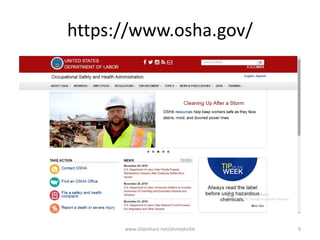
https://www.osha.gov/
www.slideshare.net/ahmedrefat 9
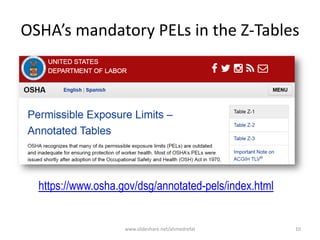
OSHA’s mandatory PELs in the Z-Tables
https://www.osha.gov/dsg/annotated-pels/index.html
www.slideshare.net/ahmedrefat 10
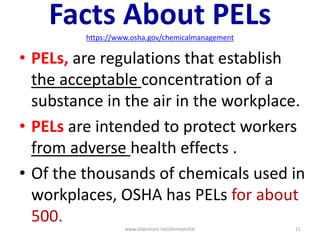
Facts About PELshttps://www.osha.gov/chemicalmanagement
• PELs, are regulations that establish
the acceptable concentration of a
substance in the air in the workplace.
• PELs are intended to protect workers
from adverse health effects .
• Of the thousands of chemicals used in
workplaces, OSHA has PELs for about
500.
www.slideshare.net/ahmedrefat 11
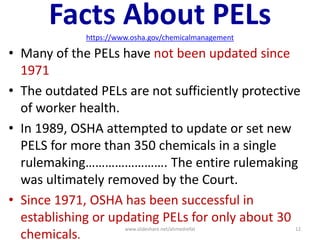
Facts About PELshttps://www.osha.gov/chemicalmanagement
• Many of the PELs have not been updated since
1971
• The outdated PELs are not sufficiently protective
of worker health.
• In 1989, OSHA attempted to update or set new
PELS for more than 350 chemicals in a single
rulemaking……………………. The entire rulemaking
was ultimately removed by the Court.
• Since 1971, OSHA has been successful in
establishing or updating PELs for only about 30
chemicals.
www.slideshare.net/ahmedrefat 12
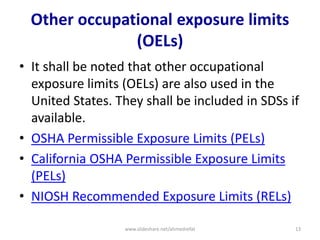
Other occupational exposure limits
(OELs)
• It shall be noted that other occupational
exposure limits (OELs) are also used in the
United States. They shall be included in SDSs if
available.
• OSHA Permissible Exposure Limits (PELs)
• California OSHA Permissible Exposure Limits
(PELs)
• NIOSH Recommended Exposure Limits (RELs)
www.slideshare.net/ahmedrefat 13
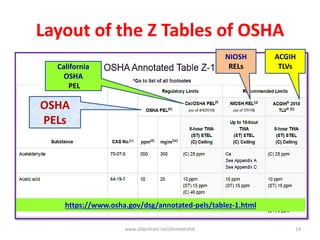
Layout of the Z Tables of OSHA
ACGIH
TLVs
NIOSH
RELsCalifornia
OSHA
PEL
OSHA
PELs
https://www.osha.gov/dsg/annotated-pels/tablez-1.html
www.slideshare.net/ahmedrefat 14
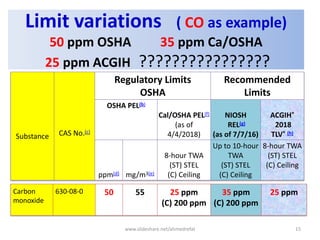
Limit variations ( CO as example)
50 ppm OSHA 35 ppm Ca/OSHA
25 ppm ACGIH ????????????????
Carbon
monoxide
630-08-0 50 55 25 ppm
(C) 200 ppm
35 ppm
(C) 200 ppm
25 ppm
Substance CAS No.(c)
Regulatory Limits
OSHA
Recommended
Limits
OSHA PEL(b)
Cal/OSHA PEL(f)
(as of
4/4/2018)
NIOSH
REL(g)
(as of 7/7/16)
ACGIH®
2018
TLV® (h)
ppm(d) mg/m3(e)
8-hour TWA
(ST) STEL
(C) Ceiling
Up to 10-hour
TWA
(ST) STEL
(C) Ceiling
8-hour TWA
(ST) STEL
(C) Ceiling
www.slideshare.net/ahmedrefat 15
What are TWA, PEL and REL?
1.USA
NOISH
www.slideshare.net/ahmedrefat 16
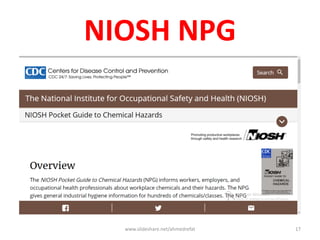
NIOSH NPG
www.slideshare.net/ahmedrefat 17
NIOSH Pocket Guide to Chemical
Hazards (NPG)
• The “NPG” gives general industrial hygiene
information for hundreds of chemicals/classes.
• The NPG presents key data for chemicals .
• NIOSH offers four versions of the NPG:
– print,
– online,
– PDF, and
– mobile web app.
https://www.cdc.gov/niosh/npg/default.html
www.slideshare.net/ahmedrefat 18
What are TWA, PEL and REL?
1.USA
ACGIH
www.slideshare.net/ahmedrefat 19
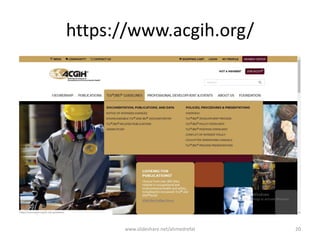
https://www.acgih.org/
www.slideshare.net/ahmedrefat 20
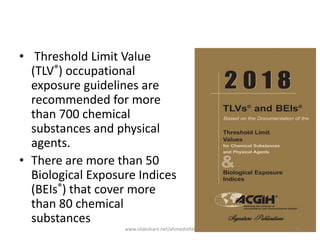
• Threshold Limit Value
(TLV®) occupational
exposure guidelines are
recommended for more
than 700 chemical
substances and physical
agents.
• There are more than 50
Biological Exposure Indices
(BEIs®) that cover more
than 80 chemical
substances
www.slideshare.net/ahmedrefat 21
TLVs & BEIs
• Threshold Limit Values (TLVs®)
• Biological Exposure Indices
(BEIs®) are determinations
made by a voluntary body of
independent knowledgeable
individuals.
www.slideshare.net/ahmedrefat 22
TLVs & BEIs
• TLVs of the ACGIH represent the
opinion of the scientific community
that has reviewed the data described
in the Documentation, that exposure
at or below the level of the TLV® or
BEI® does not create an unreasonable
risk of disease or injury.
www.slideshare.net/ahmedrefat 23
TLVs & BEIs
• TLVs® and BEIs® are not standards.
• They are guidelines designed for use
by industrial hygienists in making
decisions regarding safe levels of
exposure to various chemical
substances and physical agents found
in the workplace.
www.slideshare.net/ahmedrefat 24
TLVs & BEIs
• TLVs® and BEIs® are health-
based values established by
committees that review
existing published and peer-
reviewed literature in various
scientific disciplines
www.slideshare.net/ahmedrefat 25
TLVs® and BEIs®
are based solely on health
factors,
there is no consideration
given to economic or
technical feasibility.www.slideshare.net/ahmedrefat 26
What are TWA, PEL and REL?
2.EC
www.slideshare.net/ahmedrefat 27
‫األوزوبي‬ ‫اإلتحبد‬
•‫توجٌهات‬ ‫أربعة‬ ً‫األوروب‬ ‫اإلتحاد‬ ‫أصدر‬Directives
(‫عام‬ ‫من‬1991ً‫حت‬2009)‫التعرضات‬ ‫قٌم‬ ً‫عل‬ ‫شملت‬
ً‫اجمال‬ ‫لعدد‬ ‫بها‬ ‫الموصى‬ ‫المهنٌة‬123‫كٌماوٌة‬ ‫مادة‬.
•‫بها‬ ‫الموصى‬ ‫القٌم‬ ‫وسمٌت‬«ً‫المهن‬ ‫التعرض‬ ‫حدود‬OELs
ً‫االوروب‬ ‫لالتحاد‬-EU Community Occupational
Exposure Limits (OELs)»
‫بها‬ ‫الخاصة‬ ‫الوطنٌة‬ ‫القٌم‬ ‫تضع‬ ‫بؤن‬ ‫باالتحاد‬ ‫دولة‬ ‫لكل‬ ‫الحرٌة‬ ‫ترك‬ ‫مع‬
ً‫المهن‬ ‫التعرض‬ ‫لحدود‬.
www.slideshare.net/ahmedrefat 28
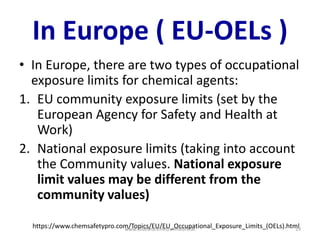
In Europe ( EU-OELs )
• In Europe, there are two types of occupational
exposure limits for chemical agents:
1. EU community exposure limits (set by the
European Agency for Safety and Health at
Work)
2. National exposure limits (taking into account
the Community values. National exposure
limit values may be different from the
community values)
https://www.chemsafetypro.com/Topics/EU/EU_Occupational_Exposure_Limits_(OELs).htmlwww.slideshare.net/ahmedrefat 29
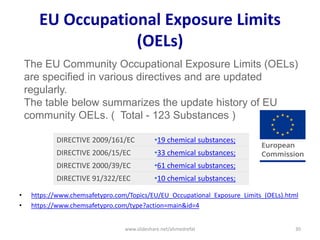
EU Occupational Exposure Limits
(OELs)
• https://www.chemsafetypro.com/Topics/EU/EU_Occupational_Exposure_Limits_(OELs).html
• https://www.chemsafetypro.com/type?action=main&id=4
DIRECTIVE 2009/161/EC •19 chemical substances;
DIRECTIVE 2006/15/EC •33 chemical substances;
DIRECTIVE 2000/39/EC •61 chemical substances;
DIRECTIVE 91/322/EEC •10 chemical substances;
The EU Community Occupational Exposure Limits (OELs)
are specified in various directives and are updated
regularly.
The table below summarizes the update history of EU
community OELs. ( Total - 123 Substances )
www.slideshare.net/ahmedrefat 30
• COMMISSION DIRECTIVE
2000/39/EC
• of 8 June 2000
• establishing a first list of
indicative occupational
exposure limit values in
implementation of Council
Directive 98/24/EC on the
protection of the health and
safety of workers from the
risks related to chemical
agents at work
www.slideshare.net/ahmedrefat 31
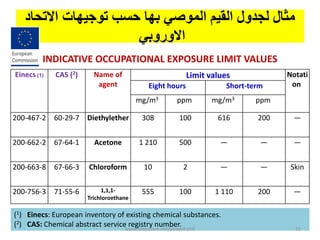
‫االتحبد‬ ‫تىجيهبث‬ ‫حسب‬ ‫بهب‬ ‫انمىصي‬ ‫انقيم‬ ‫نجدول‬ ‫مثبل‬
‫االوزوبي‬
Einecs (1) CAS (2) Name of
agent
Limit values Notati
onEight hours Short-term
mg/m3 ppm mg/m3 ppm
200-467-2 60-29-7 Diethylether 308 100 616 200 —
200-662-2 67-64-1 Acetone 1 210 500 — — —
200-663-8 67-66-3 Chloroform 10 2 — — Skin
200-756-3 71-55-6 1,1,1-
Trichloroethane
555 100 1 110 200 —
INDICATIVE OCCUPATIONAL EXPOSURE LIMIT VALUES
(1) Einecs: European inventory of existing chemical substances.
(2) CAS: Chemical abstract service registry number.www.slideshare.net/ahmedrefat 32
What are TWA, PEL and REL?
3.Egypt
‫البٌئة‬ ‫وزارة‬
www.slideshare.net/ahmedrefat 33
‫انبيئت‬ ‫قبوىن‬
‫زقم‬ ‫قبوىن‬4‫نسىت‬1994
‫بإصداز‬‫زقم‬ ‫ببنقبوىن‬ ‫وانمعدل‬ ‫انبيئت‬ ‫شأن‬ ‫في‬ ‫قبوىن‬9‫نسىت‬2009
www.slideshare.net/ahmedrefat 34
‫انبيئت‬ ‫نقبوىن‬ ‫انتىفيريت‬ ‫انالئحت‬
‫قرار‬
‫رقم‬ ‫الوزراء‬ ‫مجلس‬ ‫رئٌس‬338‫لسنة‬1995
‫البٌئة‬ ‫لقانون‬ ‫التنفٌذٌة‬ ‫الالئحة‬ ‫بإصدار‬
‫رقم‬ ‫بالقانون‬ ‫الصادر‬4‫لسنة‬1994
http://www.egyptera.org/Downloads/Laws/a-enviroment_law.pdf
www.slideshare.net/ahmedrefat 35
‫انتىفيريت‬ ‫انالئحت‬ ‫مالحق‬‫نهقبوىن‬
•-1‫لبعض‬ ‫والمواصفات‬ ‫المعاٌٌر‬‫فى‬ ‫تصرٌفها‬ ‫عند‬ ‫المواد‬‫البٌئة‬‫البحرٌة‬.
•-2‫تخضع‬ ‫التى‬ ‫المنشآت‬‫البٌئى‬ ‫للتقٌٌم‬.
•-3‫نموذج‬‫سجل‬‫البٌئة‬ ‫على‬ ‫المنشؤة‬ ‫نشاط‬ ‫تؤثٌر‬(‫البٌئٌة‬ ‫الحالة‬ ‫سجل‬)
•-4ً‫الط‬‫إمساكها‬ ‫أو‬ ‫قتلها‬ ‫أو‬ ‫صٌدها‬ ‫المحظور‬ ‫البرٌة‬ ‫والحٌوانات‬ ‫ور‬.
•-5‫لملوثات‬ ‫القصوى‬ ‫الحدود‬‫الخارجى‬ ‫الهواء‬
•-6‫فى‬ ‫الهواء‬ ‫لملوثات‬ ‫بها‬ ‫المسموح‬ ‫الحدود‬‫اإلنبعاثات‬
•-7‫بها‬ ‫المسموح‬ ‫الحدود‬‫الصوت‬ ‫لشدة‬‫له‬ ‫اآلمن‬ ‫العرض‬ ‫ومدة‬.
•-8‫الهواء‬ ‫لملوثات‬ ‫القصوى‬ ‫الحدود‬‫أماكن‬ ‫داخل‬
‫العمل‬‫كل‬ ‫لنوعٌة‬ ‫وفقا‬‫صناعة‬.
•-9‫درجتى‬ ‫من‬ ‫لكل‬ ‫األدنى‬ ‫والحد‬ ‫األقصى‬ ‫الحد‬‫والرطوبة‬ ‫الحرارة‬‫ومدة‬
‫لها‬ ‫التعرض‬‫الوقاٌة‬ ‫ووسائل‬‫منها‬.
www.slideshare.net/ahmedrefat 36
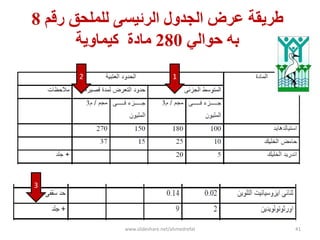
‫زقم‬ ‫انمهحق‬(8)
‫كم‬ ‫نىىعيت‬ ‫وفقب‬ ‫انعمم‬ ‫أمبكه‬ ‫داخم‬ ‫انهىاء‬ ‫نمهىثبث‬ ‫انقصىي‬ ‫انحدود‬‫صىبعت‬
‫عمودٌن‬ ً‫عل‬ ‫الجدول‬ ‫ٌحتوي‬
•‫االول‬ ‫العمود‬:‫المادة‬ ‫اسم‬(ً‫لحوال‬ ‫سرد‬280‫مادة‬)
•ً‫الثان‬ ‫العمود‬:‫قٌم‬‫العتبٌة‬ ‫الحدود‬‫أعمدة‬ ‫ثالث‬ ‫إلى‬ ‫تقسٌمه‬ ‫وتم‬
‫فرعٌة‬:
•ً‫الجزئ‬ ‫المتوسط‬
•‫قصٌرة‬ ‫لفترة‬ ‫التعرض‬ ‫حدود‬
•‫مالحظات‬(‫الجلد‬ ‫و‬ ً‫السقف‬ ‫الحد‬ ‫بها‬ ‫وضع‬)
www.slideshare.net/ahmedrefat 37
‫زقم‬ ‫انمهحق‬(8)
‫كم‬ ‫نىىعيت‬ ‫وفقب‬ ‫انعمم‬ ‫أمبكه‬ ‫داخم‬ ‫انهىاء‬ ‫نمهىثبث‬ ‫انقصىي‬ ‫انحدود‬‫صىبعت‬
‫العتبٌة‬ ‫الحدود‬
‫الحدود‬‫التى‬ ‫الهواء‬ ‫فى‬ ‫الكٌمٌائٌة‬ ‫المواد‬ ‫تركٌزات‬ ‫هى‬ ‫العتبٌة‬
‫حدوث‬ ‫دون‬ ‫ٌوم‬ ‫بعد‬ ‫ٌوما‬ ‫العاملون‬ ‫لها‬ ‫ٌتعرض‬ ‫أن‬ ‫ٌمكن‬
‫أنواع‬ ‫ثالث‬ ‫إلى‬ ‫وتنقسم‬ ‫صحٌة‬ ‫أضرار‬:
.1‫الحدود‬‫العتبٌة‬-8‫ساعات‬.
.2‫الحدود‬‫العتبٌة‬–15‫دقٌقة‬.
.3‫الحد‬‫السقفى‬
www.slideshare.net/ahmedrefat 38
‫العتبٌة‬ ‫الحدود‬
•1.‫الحدود‬‫العتبٌة‬-‫المتوسط‬‫الزمنى‬:‫وهى‬‫لٌوم‬ ‫الزمنى‬ ‫المتوسط‬
‫عادى‬ ‫عمل‬(8‫ساعات‬)‫العامل‬ ‫لها‬ ‫ٌتعرض‬ ‫أن‬ ‫ٌمكن‬ ‫والتى‬5‫أٌام‬‫فى‬
‫األسبوع‬‫صحٌة‬ ‫أضرار‬ ‫حدوث‬ ‫دون‬ ‫عمله‬ ‫فترة‬ ‫طوال‬.
•2.‫العتبٌة‬ ‫الحدود‬-‫قصٌرة‬ ‫لفترة‬ ‫التعرض‬ ‫حدود‬(‫العتبٌة‬ ‫الحدود‬
15‫دقٌقة‬)‫تركٌز‬‫الملوث‬‫بإستمرار‬ ‫العاملون‬ ‫لها‬ ‫ٌتعرض‬ ‫أن‬ ‫ٌمكن‬ ‫التى‬
‫قصٌرة‬ ‫لفترة‬.‫مدة‬15‫فترة‬ ‫خالل‬ ‫حال‬ ‫بؤى‬ ‫تجاوزها‬ ‫ٌجوز‬ ‫ال‬ ‫والتى‬ ‫دقٌقة‬
‫من‬ ‫أكثر‬ ‫ذلك‬ ‫ٌتكرر‬ ‫أن‬ ‫وال‬ ‫العمل‬4‫أن‬ ‫وٌجب‬ ‫الواحد‬ ‫الٌوم‬ ‫فى‬ ‫مرات‬
‫ٌلٌه‬ ‫والذى‬ ‫قصٌر‬ ‫تعرض‬ ‫كل‬ ‫بٌن‬ ‫الفترة‬ ‫تكون‬60‫األقل‬ ‫على‬ ‫دقٌقة‬.
•3.‫ا‬‫السقفى‬ ‫لحد‬:‫هو‬‫الذي‬ ‫الحد‬‫وعندما‬ ‫للحظة‬ ‫ولو‬ ‫تجاوزه‬ ‫ٌجوز‬ ‫ال‬
‫توضع‬ ‫التعرض‬ ‫زٌادة‬ ً‫ف‬ ‫عامال‬ ‫الجلد‬ ‫طرٌق‬ ‫عن‬ ‫االمتصاص‬ ‫ٌكون‬‫إشارة‬
(+‫جلد‬)‫العتبى‬ ‫الحد‬ ‫أمام‬.
www.slideshare.net/ahmedrefat 39
‫زقم‬ ‫انمهحق‬ ‫مكىوبث‬8
: :‫يهي‬ ‫مب‬ ‫انيه‬ ‫مضبفب‬ ً‫انسئيس‬ ‫انجدول‬
•‫للتعرض‬ ‫العتبٌة‬ ‫الحدود‬‫لآلتربة‬‫المعدنٌة‬(‫معادالت‬ ‫و‬ ‫سرد‬)
•‫العتبٌة‬ ‫الحدود‬‫المضاٌقة‬ ‫تسبب‬ ‫التى‬ ‫لؤلتربة‬‫فقط‬(‫سرد‬)
•‫العتبٌة‬ ‫الحدود‬‫المسرطنة‬ ‫للمواد‬‫والتى‬‫أنها‬ ‫فى‬ ‫ٌشتبه‬
‫مسرطنة‬(‫جدول‬-27‫مادة‬)
•‫مواد‬‫عتبٌة‬ ‫حدود‬ ‫لها‬ ‫ولٌس‬ ‫سرطانى‬ ‫تأثٌر‬ ‫ذات‬‫ال‬ ‫معروفة‬
‫أو‬ ‫بمالمستها‬ ‫للعاملٌن‬ ‫ٌسمح‬‫بأى‬ ‫له‬ ‫التعرض‬‫طرٌقة‬(‫سرد‬)
•‫مواد‬‫صناعٌة‬ ‫عملٌات‬ ‫أو‬‫مسرطنة‬ ‫أنها‬ ً‫ف‬ ‫ٌشتبه‬(‫سرد‬)
•‫ا‬‫لتهوٌة‬‫أماكن‬ ً‫ف‬‫العمل‬
www.slideshare.net/ahmedrefat 40
‫زقم‬ ‫نهمهحق‬ ً‫انسئيس‬ ‫انجدول‬ ‫عسض‬ ‫طسيقت‬8
‫حىاني‬ ‫به‬280‫كيمبويت‬ ‫مبدة‬
12
3
www.slideshare.net/ahmedrefat 41
What are TWA, PEL and REL?
3.Egypt
‫العاملة‬ ‫القوى‬ ‫وزارة‬
www.slideshare.net/ahmedrefat 42
‫انعمم‬ ‫قبوىن‬
‫ا‬‫بالجرٌدة‬ ‫المنشور‬
‫الرسمٌة‬‫العدد‬14‫مكرر‬‫بتارٌخ‬7/4/2003
www.slideshare.net/ahmedrefat 43
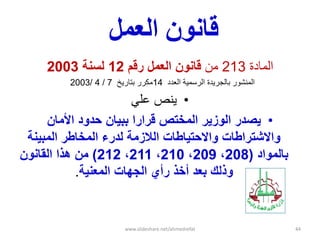
‫انعمم‬ ‫قبوىن‬
‫ا‬‫لمادة‬213‫من‬‫رقم‬ ‫العمل‬ ‫قانون‬12‫لسنة‬2003
‫بالجرٌدة‬ ‫المنشور‬‫الرسمٌة‬‫العدد‬14‫مكرر‬‫بتارٌخ‬7/4/2003
•ً‫عل‬ ‫ٌنص‬
•‫األمان‬ ‫حدود‬ ‫ببٌان‬ ‫قرارا‬ ‫المختص‬ ‫الوزٌر‬ ‫ٌصدر‬
‫المبٌنة‬ ‫المخاطر‬ ‫لدرء‬ ‫الالزمة‬ ‫واالحتٌاطات‬ ‫واالشتراطات‬
‫بالمواد‬(208،209،210،211،212)‫القانون‬ ‫هذا‬ ‫من‬
‫المعنٌة‬ ‫الجهات‬ ‫رأي‬ ‫أخذ‬ ‫بعد‬ ‫وذلك‬.
www.slideshare.net/ahmedrefat 44
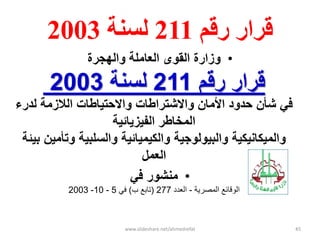
‫زقم‬ ‫قساز‬211‫نسىت‬2003
•‫والهجرة‬ ‫العاملة‬ ‫القوى‬ ‫وزارة‬
‫رقم‬ ‫قرار‬211‫لسنة‬2003
‫لدرء‬ ‫الالزمة‬ ‫واالحتٌاطات‬ ‫واالشتراطات‬ ‫األمان‬ ‫حدود‬ ‫شأن‬ ً‫ف‬
‫الفٌزٌائٌة‬ ‫المخاطر‬
‫بٌئة‬ ‫وتأمٌن‬ ‫والسلبٌة‬ ‫والكٌمٌائٌة‬ ‫والبٌولوجٌة‬ ‫والمٌكانٌكٌة‬
‫العمل‬
•ً‫ف‬ ‫منشور‬
‫المصرٌة‬ ‫الوقائع‬-‫العدد‬277(‫ب‬ ‫تابع‬)ً‫ف‬5-10-2003
www.slideshare.net/ahmedrefat 45
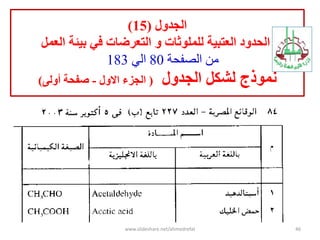
‫انجدول‬(15)
‫انعمم‬ ‫بيئت‬ ‫في‬ ‫انتعسضبث‬ ‫و‬ ‫نهمهىثبث‬ ‫انعتبيت‬ ‫انحدود‬
‫الصفحة‬ ‫من‬80‫الي‬183
‫انجدول‬ ‫نشكم‬ ‫ومىذج‬(‫االول‬ ‫انجزء‬-ً‫أون‬ ‫صفحت‬)
www.slideshare.net/ahmedrefat 46
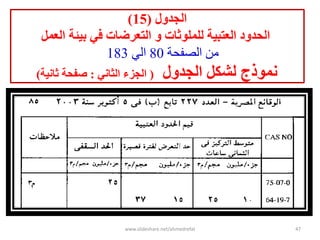
‫انجدول‬(15)
‫انعمم‬ ‫بيئت‬ ‫في‬ ‫انتعسضبث‬ ‫و‬ ‫نهمهىثبث‬ ‫انعتبيت‬ ‫انحدود‬
‫الصفحة‬ ‫من‬80‫الي‬183
‫انجدول‬ ‫نشكم‬ ‫ومىذج‬(‫انجزء‬‫انثبوي‬:‫صفحت‬‫ثبويت‬)
www.slideshare.net/ahmedrefat 47
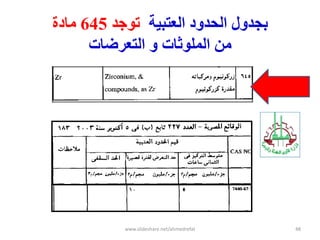
‫بجدول‬‫انعتبيت‬ ‫انحدود‬‫تىجد‬645‫مبدة‬
‫انمهىثبث‬ ‫مه‬‫و‬‫انتعسضبث‬
www.slideshare.net/ahmedrefat 48
Remember!
A legal limit or guideline
(OEL) should never be
viewed as a line
between "safe" and
"unsafe".
www.slideshare.net/ahmedrefat 49
Remember!
The best approach is to always keep exposures or the
risk of a hazard as low as possible.
• As an example, carcinogens are not usually defined
by an exposure limit. With many carcinogens, it is
difficult to say for certainty that if exposure is below
a set point, the agent is not likely to cause harm. For
this reason, for carcinogens and other specific agents
(such as allergens), the "As Low as Reasonably
Practicable" (ALARA) principle should be applied.
ALARA, in practical terms, means that exposure
should be eliminated or reduced as much as
possible.
https://www.ccohs.ca/oshanswers/hsprograms/occ_hygiene/occ_exposure_limits.html
www.slideshare.net/ahmedrefat 50
Adopted limits are not sufficiently
protective of worker health
• Industrial experience, new developments in
technology, and scientific data clearly indicate
that in many instances these adopted limits
are not sufficiently protective of worker
health.
• Many large industrial organizations have felt
obligated to supplement the existing OSHA
PELs with their own internal corporate
guidelines.
www.slideshare.net/ahmedrefat 51
Adopted limits are not sufficiently
protective of worker health
• OSHA’s Hazard Communication standard
(1910. 1200 Appendix D) requires that safety
data sheets list not only the relevant OSHA
PEL but also the ACGIH® TLV® and any other
exposure limit used or recommended by the
chemical manufacturer, importer, or employer
preparing the safety data sheet.
www.slideshare.net/ahmedrefat 52
Adopted (PELs) of OSHA are not
sufficient to protective worker’s health
• To provide employers, workers, and other
interested parties with a list of alternate
occupational exposure limits that may serve to
better protect workers, OSHA has annotated
the existing Z-Tables with other selected
occupational exposure limits. OSHA has
chosen to present a side-by-side table with
the Cal/OSHA PELs, the NIOSH Recommended
Exposure Limits (RELs) and the ACGIH® TLVs®s.
www.slideshare.net/ahmedrefat 53

Occupational exposure-limits

  • 1.
    Occupational Exposure Limits (OEL) Ahmed-RefatAG Refat www.slideshare.net/ahmedrefat 1
  • 2.
    How many chemicalsare in use today? • No one, not even the Environmental Protection Agency (EPA), knows how many chemicals are in use today. • EPA has more than 85,000 chemicals listed on its inventory of substances that fall under the Toxic Substances Control Act (TSCA). • https://cen.acs.org/articles/95/i9/chemicals- use-today.html www.slideshare.net/ahmedrefat 2
  • 3.
    • CAS substancecollection, CAS REGISTRYSM contains : • 144 million organic and inorganic substances disclosed in literature since the early 1800s . • 67 million protein and nucleic acid sequences • Updated daily • https://www.cas.org/about/cas-content www.slideshare.net/ahmedrefat 3
  • 4.
  • 5.
    Occupational Exposure Limit(OEL) • In general, the occupational exposure limit (OEL) represents the maximum airborne concentration of a toxic substance to which a worker can be exposed over a period of time without suffering any harmful consequences. https://www.ccohs.ca/oshanswers/hsprograms/occ_hygiene/occ_exposure_limits.html www.slideshare.net/ahmedrefat 5
  • 6.
    Occupational Exposure Limit(OEL) • These limits are set out by many professional organizations around the world. • They are established based on the chemical properties of the substance, experimental studies on animals and humans, toxicological and epidemiological data. https://www.ccohs.ca/oshanswers/hsprograms/occ_hygiene/occ_exposure_limits.htm l www.slideshare.net/ahmedrefat 6
  • 7.
    Occupational Exposure Limit(OEL) • Different organizations may use different terminology for the OEL. • For example, the ACGIH term for OEL is "Threshold Limit Value" (TLV)® while the NIOSH term is "recommended exposure limits" (REL). • The OELs developed by the professional organizations are guidelines. Only the values adopted and prescribed by the legislation are enforceable. https://www.ccohs.ca/oshanswers/hsprograms/occ_hygiene/occ_exposure_limits.html www.slideshare.net/ahmedrefat 7
  • 8.
    What are TWA,PEL and REL? 1.USA OSHA www.slideshare.net/ahmedrefat 8
  • 9.
  • 10.
    OSHA’s mandatory PELsin the Z-Tables https://www.osha.gov/dsg/annotated-pels/index.html www.slideshare.net/ahmedrefat 10
  • 11.
    Facts About PELshttps://www.osha.gov/chemicalmanagement •PELs, are regulations that establish the acceptable concentration of a substance in the air in the workplace. • PELs are intended to protect workers from adverse health effects . • Of the thousands of chemicals used in workplaces, OSHA has PELs for about 500. www.slideshare.net/ahmedrefat 11
  • 12.
    Facts About PELshttps://www.osha.gov/chemicalmanagement •Many of the PELs have not been updated since 1971 • The outdated PELs are not sufficiently protective of worker health. • In 1989, OSHA attempted to update or set new PELS for more than 350 chemicals in a single rulemaking……………………. The entire rulemaking was ultimately removed by the Court. • Since 1971, OSHA has been successful in establishing or updating PELs for only about 30 chemicals. www.slideshare.net/ahmedrefat 12
  • 13.
    Other occupational exposurelimits (OELs) • It shall be noted that other occupational exposure limits (OELs) are also used in the United States. They shall be included in SDSs if available. • OSHA Permissible Exposure Limits (PELs) • California OSHA Permissible Exposure Limits (PELs) • NIOSH Recommended Exposure Limits (RELs) www.slideshare.net/ahmedrefat 13
  • 14.
    Layout of theZ Tables of OSHA ACGIH TLVs NIOSH RELsCalifornia OSHA PEL OSHA PELs https://www.osha.gov/dsg/annotated-pels/tablez-1.html www.slideshare.net/ahmedrefat 14
  • 15.
    Limit variations (CO as example) 50 ppm OSHA 35 ppm Ca/OSHA 25 ppm ACGIH ???????????????? Carbon monoxide 630-08-0 50 55 25 ppm (C) 200 ppm 35 ppm (C) 200 ppm 25 ppm Substance CAS No.(c) Regulatory Limits OSHA Recommended Limits OSHA PEL(b) Cal/OSHA PEL(f) (as of 4/4/2018) NIOSH REL(g) (as of 7/7/16) ACGIH® 2018 TLV® (h) ppm(d) mg/m3(e) 8-hour TWA (ST) STEL (C) Ceiling Up to 10-hour TWA (ST) STEL (C) Ceiling 8-hour TWA (ST) STEL (C) Ceiling www.slideshare.net/ahmedrefat 15
  • 16.
    What are TWA,PEL and REL? 1.USA NOISH www.slideshare.net/ahmedrefat 16
  • 17.
  • 18.
    NIOSH Pocket Guideto Chemical Hazards (NPG) • The “NPG” gives general industrial hygiene information for hundreds of chemicals/classes. • The NPG presents key data for chemicals . • NIOSH offers four versions of the NPG: – print, – online, – PDF, and – mobile web app. https://www.cdc.gov/niosh/npg/default.html www.slideshare.net/ahmedrefat 18
  • 19.
    What are TWA,PEL and REL? 1.USA ACGIH www.slideshare.net/ahmedrefat 19
  • 20.
  • 21.
    • Threshold LimitValue (TLV®) occupational exposure guidelines are recommended for more than 700 chemical substances and physical agents. • There are more than 50 Biological Exposure Indices (BEIs®) that cover more than 80 chemical substances www.slideshare.net/ahmedrefat 21
  • 22.
    TLVs & BEIs •Threshold Limit Values (TLVs®) • Biological Exposure Indices (BEIs®) are determinations made by a voluntary body of independent knowledgeable individuals. www.slideshare.net/ahmedrefat 22
  • 23.
    TLVs & BEIs •TLVs of the ACGIH represent the opinion of the scientific community that has reviewed the data described in the Documentation, that exposure at or below the level of the TLV® or BEI® does not create an unreasonable risk of disease or injury. www.slideshare.net/ahmedrefat 23
  • 24.
    TLVs & BEIs •TLVs® and BEIs® are not standards. • They are guidelines designed for use by industrial hygienists in making decisions regarding safe levels of exposure to various chemical substances and physical agents found in the workplace. www.slideshare.net/ahmedrefat 24
  • 25.
    TLVs & BEIs •TLVs® and BEIs® are health- based values established by committees that review existing published and peer- reviewed literature in various scientific disciplines www.slideshare.net/ahmedrefat 25
  • 26.
    TLVs® and BEIs® arebased solely on health factors, there is no consideration given to economic or technical feasibility.www.slideshare.net/ahmedrefat 26
  • 27.
    What are TWA,PEL and REL? 2.EC www.slideshare.net/ahmedrefat 27
  • 28.
    ‫األوزوبي‬ ‫اإلتحبد‬ •‫توجٌهات‬ ‫أربعة‬ً‫األوروب‬ ‫اإلتحاد‬ ‫أصدر‬Directives (‫عام‬ ‫من‬1991ً‫حت‬2009)‫التعرضات‬ ‫قٌم‬ ً‫عل‬ ‫شملت‬ ً‫اجمال‬ ‫لعدد‬ ‫بها‬ ‫الموصى‬ ‫المهنٌة‬123‫كٌماوٌة‬ ‫مادة‬. •‫بها‬ ‫الموصى‬ ‫القٌم‬ ‫وسمٌت‬«ً‫المهن‬ ‫التعرض‬ ‫حدود‬OELs ً‫االوروب‬ ‫لالتحاد‬-EU Community Occupational Exposure Limits (OELs)» ‫بها‬ ‫الخاصة‬ ‫الوطنٌة‬ ‫القٌم‬ ‫تضع‬ ‫بؤن‬ ‫باالتحاد‬ ‫دولة‬ ‫لكل‬ ‫الحرٌة‬ ‫ترك‬ ‫مع‬ ً‫المهن‬ ‫التعرض‬ ‫لحدود‬. www.slideshare.net/ahmedrefat 28
  • 29.
    In Europe (EU-OELs ) • In Europe, there are two types of occupational exposure limits for chemical agents: 1. EU community exposure limits (set by the European Agency for Safety and Health at Work) 2. National exposure limits (taking into account the Community values. National exposure limit values may be different from the community values) https://www.chemsafetypro.com/Topics/EU/EU_Occupational_Exposure_Limits_(OELs).htmlwww.slideshare.net/ahmedrefat 29
  • 30.
    EU Occupational ExposureLimits (OELs) • https://www.chemsafetypro.com/Topics/EU/EU_Occupational_Exposure_Limits_(OELs).html • https://www.chemsafetypro.com/type?action=main&id=4 DIRECTIVE 2009/161/EC •19 chemical substances; DIRECTIVE 2006/15/EC •33 chemical substances; DIRECTIVE 2000/39/EC •61 chemical substances; DIRECTIVE 91/322/EEC •10 chemical substances; The EU Community Occupational Exposure Limits (OELs) are specified in various directives and are updated regularly. The table below summarizes the update history of EU community OELs. ( Total - 123 Substances ) www.slideshare.net/ahmedrefat 30
  • 31.
    • COMMISSION DIRECTIVE 2000/39/EC •of 8 June 2000 • establishing a first list of indicative occupational exposure limit values in implementation of Council Directive 98/24/EC on the protection of the health and safety of workers from the risks related to chemical agents at work www.slideshare.net/ahmedrefat 31
  • 32.
    ‫االتحبد‬ ‫تىجيهبث‬ ‫حسب‬‫بهب‬ ‫انمىصي‬ ‫انقيم‬ ‫نجدول‬ ‫مثبل‬ ‫االوزوبي‬ Einecs (1) CAS (2) Name of agent Limit values Notati onEight hours Short-term mg/m3 ppm mg/m3 ppm 200-467-2 60-29-7 Diethylether 308 100 616 200 — 200-662-2 67-64-1 Acetone 1 210 500 — — — 200-663-8 67-66-3 Chloroform 10 2 — — Skin 200-756-3 71-55-6 1,1,1- Trichloroethane 555 100 1 110 200 — INDICATIVE OCCUPATIONAL EXPOSURE LIMIT VALUES (1) Einecs: European inventory of existing chemical substances. (2) CAS: Chemical abstract service registry number.www.slideshare.net/ahmedrefat 32
  • 33.
    What are TWA,PEL and REL? 3.Egypt ‫البٌئة‬ ‫وزارة‬ www.slideshare.net/ahmedrefat 33
  • 34.
    ‫انبيئت‬ ‫قبوىن‬ ‫زقم‬ ‫قبوىن‬4‫نسىت‬1994 ‫بإصداز‬‫زقم‬‫ببنقبوىن‬ ‫وانمعدل‬ ‫انبيئت‬ ‫شأن‬ ‫في‬ ‫قبوىن‬9‫نسىت‬2009 www.slideshare.net/ahmedrefat 34
  • 35.
    ‫انبيئت‬ ‫نقبوىن‬ ‫انتىفيريت‬‫انالئحت‬ ‫قرار‬ ‫رقم‬ ‫الوزراء‬ ‫مجلس‬ ‫رئٌس‬338‫لسنة‬1995 ‫البٌئة‬ ‫لقانون‬ ‫التنفٌذٌة‬ ‫الالئحة‬ ‫بإصدار‬ ‫رقم‬ ‫بالقانون‬ ‫الصادر‬4‫لسنة‬1994 http://www.egyptera.org/Downloads/Laws/a-enviroment_law.pdf www.slideshare.net/ahmedrefat 35
  • 36.
    ‫انتىفيريت‬ ‫انالئحت‬ ‫مالحق‬‫نهقبوىن‬ •-1‫لبعض‬‫والمواصفات‬ ‫المعاٌٌر‬‫فى‬ ‫تصرٌفها‬ ‫عند‬ ‫المواد‬‫البٌئة‬‫البحرٌة‬. •-2‫تخضع‬ ‫التى‬ ‫المنشآت‬‫البٌئى‬ ‫للتقٌٌم‬. •-3‫نموذج‬‫سجل‬‫البٌئة‬ ‫على‬ ‫المنشؤة‬ ‫نشاط‬ ‫تؤثٌر‬(‫البٌئٌة‬ ‫الحالة‬ ‫سجل‬) •-4ً‫الط‬‫إمساكها‬ ‫أو‬ ‫قتلها‬ ‫أو‬ ‫صٌدها‬ ‫المحظور‬ ‫البرٌة‬ ‫والحٌوانات‬ ‫ور‬. •-5‫لملوثات‬ ‫القصوى‬ ‫الحدود‬‫الخارجى‬ ‫الهواء‬ •-6‫فى‬ ‫الهواء‬ ‫لملوثات‬ ‫بها‬ ‫المسموح‬ ‫الحدود‬‫اإلنبعاثات‬ •-7‫بها‬ ‫المسموح‬ ‫الحدود‬‫الصوت‬ ‫لشدة‬‫له‬ ‫اآلمن‬ ‫العرض‬ ‫ومدة‬. •-8‫الهواء‬ ‫لملوثات‬ ‫القصوى‬ ‫الحدود‬‫أماكن‬ ‫داخل‬ ‫العمل‬‫كل‬ ‫لنوعٌة‬ ‫وفقا‬‫صناعة‬. •-9‫درجتى‬ ‫من‬ ‫لكل‬ ‫األدنى‬ ‫والحد‬ ‫األقصى‬ ‫الحد‬‫والرطوبة‬ ‫الحرارة‬‫ومدة‬ ‫لها‬ ‫التعرض‬‫الوقاٌة‬ ‫ووسائل‬‫منها‬. www.slideshare.net/ahmedrefat 36
  • 37.
    ‫زقم‬ ‫انمهحق‬(8) ‫كم‬ ‫نىىعيت‬‫وفقب‬ ‫انعمم‬ ‫أمبكه‬ ‫داخم‬ ‫انهىاء‬ ‫نمهىثبث‬ ‫انقصىي‬ ‫انحدود‬‫صىبعت‬ ‫عمودٌن‬ ً‫عل‬ ‫الجدول‬ ‫ٌحتوي‬ •‫االول‬ ‫العمود‬:‫المادة‬ ‫اسم‬(ً‫لحوال‬ ‫سرد‬280‫مادة‬) •ً‫الثان‬ ‫العمود‬:‫قٌم‬‫العتبٌة‬ ‫الحدود‬‫أعمدة‬ ‫ثالث‬ ‫إلى‬ ‫تقسٌمه‬ ‫وتم‬ ‫فرعٌة‬: •ً‫الجزئ‬ ‫المتوسط‬ •‫قصٌرة‬ ‫لفترة‬ ‫التعرض‬ ‫حدود‬ •‫مالحظات‬(‫الجلد‬ ‫و‬ ً‫السقف‬ ‫الحد‬ ‫بها‬ ‫وضع‬) www.slideshare.net/ahmedrefat 37
  • 38.
    ‫زقم‬ ‫انمهحق‬(8) ‫كم‬ ‫نىىعيت‬‫وفقب‬ ‫انعمم‬ ‫أمبكه‬ ‫داخم‬ ‫انهىاء‬ ‫نمهىثبث‬ ‫انقصىي‬ ‫انحدود‬‫صىبعت‬ ‫العتبٌة‬ ‫الحدود‬ ‫الحدود‬‫التى‬ ‫الهواء‬ ‫فى‬ ‫الكٌمٌائٌة‬ ‫المواد‬ ‫تركٌزات‬ ‫هى‬ ‫العتبٌة‬ ‫حدوث‬ ‫دون‬ ‫ٌوم‬ ‫بعد‬ ‫ٌوما‬ ‫العاملون‬ ‫لها‬ ‫ٌتعرض‬ ‫أن‬ ‫ٌمكن‬ ‫أنواع‬ ‫ثالث‬ ‫إلى‬ ‫وتنقسم‬ ‫صحٌة‬ ‫أضرار‬: .1‫الحدود‬‫العتبٌة‬-8‫ساعات‬. .2‫الحدود‬‫العتبٌة‬–15‫دقٌقة‬. .3‫الحد‬‫السقفى‬ www.slideshare.net/ahmedrefat 38
  • 39.
    ‫العتبٌة‬ ‫الحدود‬ •1.‫الحدود‬‫العتبٌة‬-‫المتوسط‬‫الزمنى‬:‫وهى‬‫لٌوم‬ ‫الزمنى‬‫المتوسط‬ ‫عادى‬ ‫عمل‬(8‫ساعات‬)‫العامل‬ ‫لها‬ ‫ٌتعرض‬ ‫أن‬ ‫ٌمكن‬ ‫والتى‬5‫أٌام‬‫فى‬ ‫األسبوع‬‫صحٌة‬ ‫أضرار‬ ‫حدوث‬ ‫دون‬ ‫عمله‬ ‫فترة‬ ‫طوال‬. •2.‫العتبٌة‬ ‫الحدود‬-‫قصٌرة‬ ‫لفترة‬ ‫التعرض‬ ‫حدود‬(‫العتبٌة‬ ‫الحدود‬ 15‫دقٌقة‬)‫تركٌز‬‫الملوث‬‫بإستمرار‬ ‫العاملون‬ ‫لها‬ ‫ٌتعرض‬ ‫أن‬ ‫ٌمكن‬ ‫التى‬ ‫قصٌرة‬ ‫لفترة‬.‫مدة‬15‫فترة‬ ‫خالل‬ ‫حال‬ ‫بؤى‬ ‫تجاوزها‬ ‫ٌجوز‬ ‫ال‬ ‫والتى‬ ‫دقٌقة‬ ‫من‬ ‫أكثر‬ ‫ذلك‬ ‫ٌتكرر‬ ‫أن‬ ‫وال‬ ‫العمل‬4‫أن‬ ‫وٌجب‬ ‫الواحد‬ ‫الٌوم‬ ‫فى‬ ‫مرات‬ ‫ٌلٌه‬ ‫والذى‬ ‫قصٌر‬ ‫تعرض‬ ‫كل‬ ‫بٌن‬ ‫الفترة‬ ‫تكون‬60‫األقل‬ ‫على‬ ‫دقٌقة‬. •3.‫ا‬‫السقفى‬ ‫لحد‬:‫هو‬‫الذي‬ ‫الحد‬‫وعندما‬ ‫للحظة‬ ‫ولو‬ ‫تجاوزه‬ ‫ٌجوز‬ ‫ال‬ ‫توضع‬ ‫التعرض‬ ‫زٌادة‬ ً‫ف‬ ‫عامال‬ ‫الجلد‬ ‫طرٌق‬ ‫عن‬ ‫االمتصاص‬ ‫ٌكون‬‫إشارة‬ (+‫جلد‬)‫العتبى‬ ‫الحد‬ ‫أمام‬. www.slideshare.net/ahmedrefat 39
  • 40.
    ‫زقم‬ ‫انمهحق‬ ‫مكىوبث‬8 ::‫يهي‬ ‫مب‬ ‫انيه‬ ‫مضبفب‬ ً‫انسئيس‬ ‫انجدول‬ •‫للتعرض‬ ‫العتبٌة‬ ‫الحدود‬‫لآلتربة‬‫المعدنٌة‬(‫معادالت‬ ‫و‬ ‫سرد‬) •‫العتبٌة‬ ‫الحدود‬‫المضاٌقة‬ ‫تسبب‬ ‫التى‬ ‫لؤلتربة‬‫فقط‬(‫سرد‬) •‫العتبٌة‬ ‫الحدود‬‫المسرطنة‬ ‫للمواد‬‫والتى‬‫أنها‬ ‫فى‬ ‫ٌشتبه‬ ‫مسرطنة‬(‫جدول‬-27‫مادة‬) •‫مواد‬‫عتبٌة‬ ‫حدود‬ ‫لها‬ ‫ولٌس‬ ‫سرطانى‬ ‫تأثٌر‬ ‫ذات‬‫ال‬ ‫معروفة‬ ‫أو‬ ‫بمالمستها‬ ‫للعاملٌن‬ ‫ٌسمح‬‫بأى‬ ‫له‬ ‫التعرض‬‫طرٌقة‬(‫سرد‬) •‫مواد‬‫صناعٌة‬ ‫عملٌات‬ ‫أو‬‫مسرطنة‬ ‫أنها‬ ً‫ف‬ ‫ٌشتبه‬(‫سرد‬) •‫ا‬‫لتهوٌة‬‫أماكن‬ ً‫ف‬‫العمل‬ www.slideshare.net/ahmedrefat 40
  • 41.
    ‫زقم‬ ‫نهمهحق‬ ً‫انسئيس‬‫انجدول‬ ‫عسض‬ ‫طسيقت‬8 ‫حىاني‬ ‫به‬280‫كيمبويت‬ ‫مبدة‬ 12 3 www.slideshare.net/ahmedrefat 41
  • 42.
    What are TWA,PEL and REL? 3.Egypt ‫العاملة‬ ‫القوى‬ ‫وزارة‬ www.slideshare.net/ahmedrefat 42
  • 43.
  • 44.
    ‫انعمم‬ ‫قبوىن‬ ‫ا‬‫لمادة‬213‫من‬‫رقم‬ ‫العمل‬‫قانون‬12‫لسنة‬2003 ‫بالجرٌدة‬ ‫المنشور‬‫الرسمٌة‬‫العدد‬14‫مكرر‬‫بتارٌخ‬7/4/2003 •ً‫عل‬ ‫ٌنص‬ •‫األمان‬ ‫حدود‬ ‫ببٌان‬ ‫قرارا‬ ‫المختص‬ ‫الوزٌر‬ ‫ٌصدر‬ ‫المبٌنة‬ ‫المخاطر‬ ‫لدرء‬ ‫الالزمة‬ ‫واالحتٌاطات‬ ‫واالشتراطات‬ ‫بالمواد‬(208،209،210،211،212)‫القانون‬ ‫هذا‬ ‫من‬ ‫المعنٌة‬ ‫الجهات‬ ‫رأي‬ ‫أخذ‬ ‫بعد‬ ‫وذلك‬. www.slideshare.net/ahmedrefat 44
  • 45.
    ‫زقم‬ ‫قساز‬211‫نسىت‬2003 •‫والهجرة‬ ‫العاملة‬‫القوى‬ ‫وزارة‬ ‫رقم‬ ‫قرار‬211‫لسنة‬2003 ‫لدرء‬ ‫الالزمة‬ ‫واالحتٌاطات‬ ‫واالشتراطات‬ ‫األمان‬ ‫حدود‬ ‫شأن‬ ً‫ف‬ ‫الفٌزٌائٌة‬ ‫المخاطر‬ ‫بٌئة‬ ‫وتأمٌن‬ ‫والسلبٌة‬ ‫والكٌمٌائٌة‬ ‫والبٌولوجٌة‬ ‫والمٌكانٌكٌة‬ ‫العمل‬ •ً‫ف‬ ‫منشور‬ ‫المصرٌة‬ ‫الوقائع‬-‫العدد‬277(‫ب‬ ‫تابع‬)ً‫ف‬5-10-2003 www.slideshare.net/ahmedrefat 45
  • 46.
    ‫انجدول‬(15) ‫انعمم‬ ‫بيئت‬ ‫في‬‫انتعسضبث‬ ‫و‬ ‫نهمهىثبث‬ ‫انعتبيت‬ ‫انحدود‬ ‫الصفحة‬ ‫من‬80‫الي‬183 ‫انجدول‬ ‫نشكم‬ ‫ومىذج‬(‫االول‬ ‫انجزء‬-ً‫أون‬ ‫صفحت‬) www.slideshare.net/ahmedrefat 46
  • 47.
    ‫انجدول‬(15) ‫انعمم‬ ‫بيئت‬ ‫في‬‫انتعسضبث‬ ‫و‬ ‫نهمهىثبث‬ ‫انعتبيت‬ ‫انحدود‬ ‫الصفحة‬ ‫من‬80‫الي‬183 ‫انجدول‬ ‫نشكم‬ ‫ومىذج‬(‫انجزء‬‫انثبوي‬:‫صفحت‬‫ثبويت‬) www.slideshare.net/ahmedrefat 47
  • 48.
  • 49.
    Remember! A legal limitor guideline (OEL) should never be viewed as a line between "safe" and "unsafe". www.slideshare.net/ahmedrefat 49
  • 50.
    Remember! The best approachis to always keep exposures or the risk of a hazard as low as possible. • As an example, carcinogens are not usually defined by an exposure limit. With many carcinogens, it is difficult to say for certainty that if exposure is below a set point, the agent is not likely to cause harm. For this reason, for carcinogens and other specific agents (such as allergens), the "As Low as Reasonably Practicable" (ALARA) principle should be applied. ALARA, in practical terms, means that exposure should be eliminated or reduced as much as possible. https://www.ccohs.ca/oshanswers/hsprograms/occ_hygiene/occ_exposure_limits.html www.slideshare.net/ahmedrefat 50
  • 51.
    Adopted limits arenot sufficiently protective of worker health • Industrial experience, new developments in technology, and scientific data clearly indicate that in many instances these adopted limits are not sufficiently protective of worker health. • Many large industrial organizations have felt obligated to supplement the existing OSHA PELs with their own internal corporate guidelines. www.slideshare.net/ahmedrefat 51
  • 52.
    Adopted limits arenot sufficiently protective of worker health • OSHA’s Hazard Communication standard (1910. 1200 Appendix D) requires that safety data sheets list not only the relevant OSHA PEL but also the ACGIH® TLV® and any other exposure limit used or recommended by the chemical manufacturer, importer, or employer preparing the safety data sheet. www.slideshare.net/ahmedrefat 52
  • 53.
    Adopted (PELs) ofOSHA are not sufficient to protective worker’s health • To provide employers, workers, and other interested parties with a list of alternate occupational exposure limits that may serve to better protect workers, OSHA has annotated the existing Z-Tables with other selected occupational exposure limits. OSHA has chosen to present a side-by-side table with the Cal/OSHA PELs, the NIOSH Recommended Exposure Limits (RELs) and the ACGIH® TLVs®s. www.slideshare.net/ahmedrefat 53