3D
OBJECT REPRESENTATIONS
1
THREE DIMENSIONAL CONCEPTS
 We can rotate an object about an axis with any spatial
orientation in three-dimensional space.
 Two-dimensional rotations, on the other hand, are always
around an axis that is perpendicular to the xy-plane.
 Viewing transformations in three dimensions are much
more complicated because we have many more
parameters to select when specifying how a three-
dimensional scene is to be mapped to a display device.
2
THREE DIMENSIONAL OBJECT REPRESENTATIONS
 Graphics scenes contain many different kinds of objects like
Trees, flowers, glass, rock, water etc.
 There is not any single method that we can use to describe objects that
will include all characteristics of these different materials.
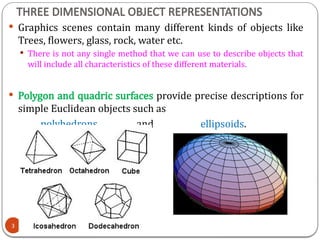
 Polygon and quadric surfaces provide precise descriptions for
simple Euclidean objects such as
polyhedrons and ellipsoids.
3
THREE DIMENSIONAL OBJECT REPRESENTATIONS…
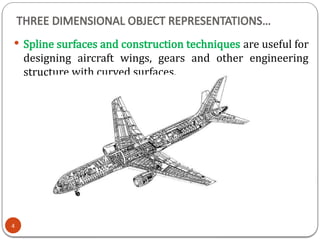
 Spline surfaces and construction techniques are useful for
designing aircraft wings, gears and other engineering
structure with curved surfaces.
4
THREE DIMENSIONAL OBJECT REPRESENTATIONS…
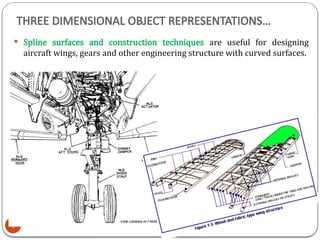
 Spline surfaces and construction techniques are useful for designing
aircraft wings, gears and other engineering structure with curved surfaces.
5
THREE DIMENSIONAL OBJECT REPRESENTATIONS…
 Procedural methods such as fractal constructions and
particle systems allow us to give accurate representations
for clouds, clumps of grass and other natural objects.
 Physically based modeling methods using systems of
interacting forces can be used to describe the non-rigid
behavior of a piece of cloth or a glob of jell.
6
THREE DIMENSIONAL OBJECT REPRESENTATIONS…
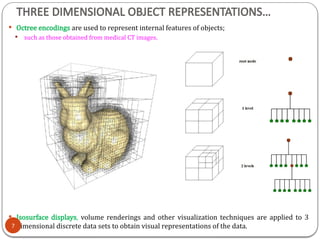
 Octree encodings are used to represent internal features of objects;
 such as those obtained from medical CT images.
 Isosurface displays, volume renderings and other visualization techniques are applied to 3
dimensional discrete data sets to obtain visual representations of the data.
7
1. POLYGON SURFACES
 Polygon surfaces provide precise descriptions for simple Euclidean
objects such as polyhedrons and ellipsoids.
 A three dimensional graphics object can be represented by a set of
surface polygons.
 Many graphic systems store a 3 dimensional object as a set of
surface polygons.
 This simplifies and speeds up the surface rendering and display of
objects.
 In this representation, the surfaces are described with linear
equations.
 The polygonal representation of a polyhedron precisely defines the
surface features of an object.
8
1. POLYGON SURFACES…
 In this representation, the surfaces are described with linear
equations.
 The polygonal representation of a polyhedron precisely defines the
surface features of an object.
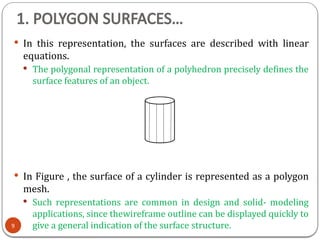
 In Figure , the surface of a cylinder is represented as a polygon
mesh.
 Such representations are common in design and solid- modeling
applications, since thewireframe outline can be displayed quickly to
give a general indication of the surface structure.
9
2. POLYGON TABLES
 We know that a polygon surface is defined by a set of vertices.
 As information for each polygon is input, the data are placed in
to tables that are used in later processing, display and
manipulation of objects in the scene.
 Polygon data tables can be organized in to 2 groups:
 geometric tables and
 attribute tables.
 Geometric data tables contain vertex coordinates and
parameters to identify the spatial orientation of the polygon
surfaces.
 Attribute information for an object includes parameters
specifying the degree of transparency of the object and its
surface reflexivity and texture characteristics.
10
2. POLYGON TABLES…
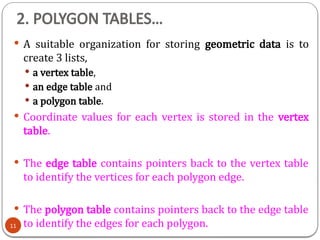
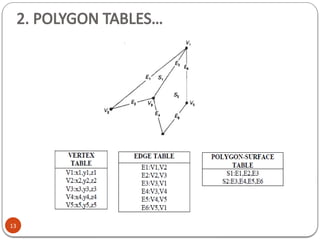
 A suitable organization for storing geometric data is to
create 3 lists,
 a vertex table,
 an edge table and
 a polygon table.
 Coordinate values for each vertex is stored in the vertex
table.
 The edge table contains pointers back to the vertex table
to identify the vertices for each polygon edge.
 The polygon table contains pointers back to the edge table
to identify the edges for each polygon.
11
2. POLYGON TABLES…
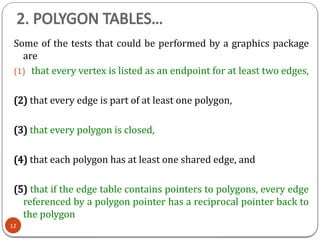
Some of the tests that could be performed by a graphics package
are
(1) that every vertex is listed as an endpoint for at least two edges,
(2) that every edge is part of at least one polygon,
(3) that every polygon is closed,
(4) that each polygon has at least one shared edge, and
(5) that if the edge table contains pointers to polygons, every edge
referenced by a polygon pointer has a reciprocal pointer back to
the polygon
12
2. POLYGON TABLES…
13
3. PLANE EQUATIONS
 When working with polygons or polygon meshes, we need to know the
equation of the plane in which the polygon lies.
 We can use the coordinates of 3 vertices to find the plane.
The plane equation is
Ax + By + Cz + D = 0
 The coefficients A, B and C define the normal to the plane [A B C].
 We can obtain the coefficients A, B, C and D by solving a set of 3 plane
equations using the coordinate values for 3 non collinear points in the plane.
 Suppose we have 3 vertices on the polygon (x1, y1, z1), (x2, y2, z2) and
(x3, y3, z3).
Ax + By + Cz + D = 0
(A/D) x1 + (B/D) y1 + (C/D) z1 = -1
(A/D) x2 + (B/D) y2 + (C/D) z2 = -1
(A/D) x3 + (B/D) y3 + (C/D) z3 = -1
14
3. PLANE EQUATIONS…
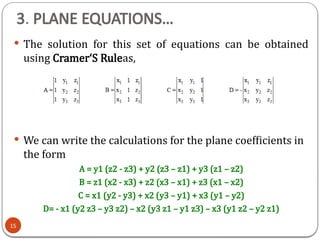
 The solution for this set of equations can be obtained
using Cramer‘S Ruleas,
 We can write the calculations for the plane coefficients in
the form
A = y1 (z2 - z3) + y2 (z3 – z1) + y3 (z1 – z2)
B = z1 (x2 - x3) + z2 (x3 – x1) + z3 (x1 – x2)
C = x1 (y2 - y3) + x2 (y3 – y1) + x3 (y1 – y2)
D= - x1 (y2 z3 – y3 z2) – x2 (y3 z1 – y1 z3) – x3 (y1 z2 – y2 z1)
15
3. PLANE EQUATIONS…
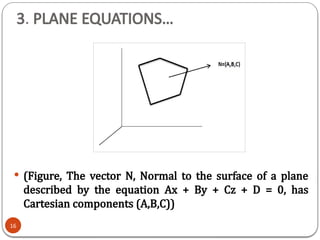
 (Figure, The vector N, Normal to the surface of a plane
described by the equation Ax + By + Cz + D = 0, has
Cartesian components (A,B,C))
16
3. PLANE EQUATIONS…
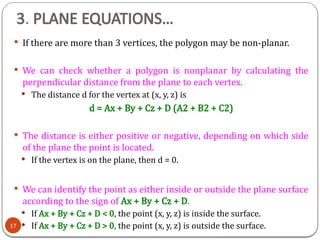
 If there are more than 3 vertices, the polygon may be non-planar.
 We can check whether a polygon is nonplanar by calculating the
perpendicular distance from the plane to each vertex.
 The distance d for the vertex at (x, y, z) is
d = Ax + By + Cz + D (A2 + B2 + C2)
 The distance is either positive or negative, depending on which side
of the plane the point is located.
 If the vertex is on the plane, then d = 0.
 We can identify the point as either inside or outside the plane surface
according to the sign of Ax + By + Cz + D.
 If Ax + By + Cz + D < 0, the point (x, y, z) is inside the surface.
 If Ax + By + Cz + D > 0, the point (x, y, z) is outside the surface.
17
4. POLYGON MESHES
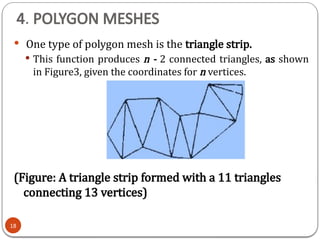
 One type of polygon mesh is the triangle strip.
 This function produces n - 2 connected triangles, as shown
in Figure3, given the coordinates for n vertices.
(Figure: A triangle strip formed with a 11 triangles
connecting 13 vertices)
18
4. POLYGON MESHES…
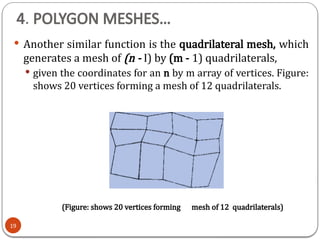
 Another similar function is the quadrilateral mesh, which
generates a mesh of (n - I) by (m - 1) quadrilaterals,
 given the coordinates for an n by m array of vertices. Figure:
shows 20 vertices forming a mesh of 12 quadrilaterals.
19
(Figure: shows 20 vertices forming mesh of 12 quadrilaterals)
4. POLYGON MESHES…
20
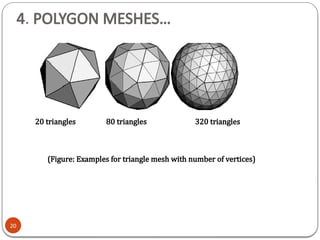
20 triangles 80 triangles 320 triangles
(Figure: Examples for triangle mesh with number of vertices)
4. POLYGON MESHES…
21
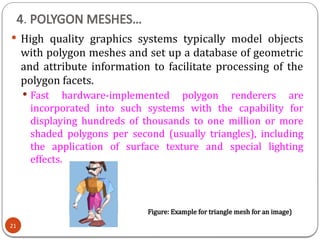
 High quality graphics systems typically model objects
with polygon meshes and set up a database of geometric
and attribute information to facilitate processing of the
polygon facets.
 Fast hardware-implemented polygon renderers are
incorporated into such systems with the capability for
displaying hundreds of thousands to one million or more
shaded polygons per second (usually triangles), including
the application of surface texture and special lighting
effects.
Figure: Example for triangle mesh for an image)
4. POLYGON MESHES…
22
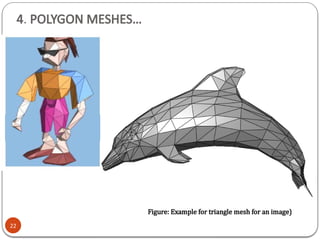
Figure: Example for triangle mesh for an image)

3D-Object Representation in Computer Graphics.pptx

  • 1.
  • 2.
    THREE DIMENSIONAL CONCEPTS We can rotate an object about an axis with any spatial orientation in three-dimensional space.  Two-dimensional rotations, on the other hand, are always around an axis that is perpendicular to the xy-plane.  Viewing transformations in three dimensions are much more complicated because we have many more parameters to select when specifying how a three- dimensional scene is to be mapped to a display device. 2
  • 3.
    THREE DIMENSIONAL OBJECTREPRESENTATIONS  Graphics scenes contain many different kinds of objects like Trees, flowers, glass, rock, water etc.  There is not any single method that we can use to describe objects that will include all characteristics of these different materials.  Polygon and quadric surfaces provide precise descriptions for simple Euclidean objects such as polyhedrons and ellipsoids. 3
  • 4.
    THREE DIMENSIONAL OBJECTREPRESENTATIONS…  Spline surfaces and construction techniques are useful for designing aircraft wings, gears and other engineering structure with curved surfaces. 4
  • 5.
    THREE DIMENSIONAL OBJECTREPRESENTATIONS…  Spline surfaces and construction techniques are useful for designing aircraft wings, gears and other engineering structure with curved surfaces. 5
  • 6.
    THREE DIMENSIONAL OBJECTREPRESENTATIONS…  Procedural methods such as fractal constructions and particle systems allow us to give accurate representations for clouds, clumps of grass and other natural objects.  Physically based modeling methods using systems of interacting forces can be used to describe the non-rigid behavior of a piece of cloth or a glob of jell. 6
  • 7.
    THREE DIMENSIONAL OBJECTREPRESENTATIONS…  Octree encodings are used to represent internal features of objects;  such as those obtained from medical CT images.  Isosurface displays, volume renderings and other visualization techniques are applied to 3 dimensional discrete data sets to obtain visual representations of the data. 7
  • 8.
    1. POLYGON SURFACES Polygon surfaces provide precise descriptions for simple Euclidean objects such as polyhedrons and ellipsoids.  A three dimensional graphics object can be represented by a set of surface polygons.  Many graphic systems store a 3 dimensional object as a set of surface polygons.  This simplifies and speeds up the surface rendering and display of objects.  In this representation, the surfaces are described with linear equations.  The polygonal representation of a polyhedron precisely defines the surface features of an object. 8
  • 9.
    1. POLYGON SURFACES… In this representation, the surfaces are described with linear equations.  The polygonal representation of a polyhedron precisely defines the surface features of an object.  In Figure , the surface of a cylinder is represented as a polygon mesh.  Such representations are common in design and solid- modeling applications, since thewireframe outline can be displayed quickly to give a general indication of the surface structure. 9
  • 10.
    2. POLYGON TABLES We know that a polygon surface is defined by a set of vertices.  As information for each polygon is input, the data are placed in to tables that are used in later processing, display and manipulation of objects in the scene.  Polygon data tables can be organized in to 2 groups:  geometric tables and  attribute tables.  Geometric data tables contain vertex coordinates and parameters to identify the spatial orientation of the polygon surfaces.  Attribute information for an object includes parameters specifying the degree of transparency of the object and its surface reflexivity and texture characteristics. 10
  • 11.
    2. POLYGON TABLES… A suitable organization for storing geometric data is to create 3 lists,  a vertex table,  an edge table and  a polygon table.  Coordinate values for each vertex is stored in the vertex table.  The edge table contains pointers back to the vertex table to identify the vertices for each polygon edge.  The polygon table contains pointers back to the edge table to identify the edges for each polygon. 11
  • 12.
    2. POLYGON TABLES… Someof the tests that could be performed by a graphics package are (1) that every vertex is listed as an endpoint for at least two edges, (2) that every edge is part of at least one polygon, (3) that every polygon is closed, (4) that each polygon has at least one shared edge, and (5) that if the edge table contains pointers to polygons, every edge referenced by a polygon pointer has a reciprocal pointer back to the polygon 12
  • 13.
  • 14.
    3. PLANE EQUATIONS When working with polygons or polygon meshes, we need to know the equation of the plane in which the polygon lies.  We can use the coordinates of 3 vertices to find the plane. The plane equation is Ax + By + Cz + D = 0  The coefficients A, B and C define the normal to the plane [A B C].  We can obtain the coefficients A, B, C and D by solving a set of 3 plane equations using the coordinate values for 3 non collinear points in the plane.  Suppose we have 3 vertices on the polygon (x1, y1, z1), (x2, y2, z2) and (x3, y3, z3). Ax + By + Cz + D = 0 (A/D) x1 + (B/D) y1 + (C/D) z1 = -1 (A/D) x2 + (B/D) y2 + (C/D) z2 = -1 (A/D) x3 + (B/D) y3 + (C/D) z3 = -1 14
  • 15.
    3. PLANE EQUATIONS… The solution for this set of equations can be obtained using Cramer‘S Ruleas,  We can write the calculations for the plane coefficients in the form A = y1 (z2 - z3) + y2 (z3 – z1) + y3 (z1 – z2) B = z1 (x2 - x3) + z2 (x3 – x1) + z3 (x1 – x2) C = x1 (y2 - y3) + x2 (y3 – y1) + x3 (y1 – y2) D= - x1 (y2 z3 – y3 z2) – x2 (y3 z1 – y1 z3) – x3 (y1 z2 – y2 z1) 15
  • 16.
    3. PLANE EQUATIONS… (Figure, The vector N, Normal to the surface of a plane described by the equation Ax + By + Cz + D = 0, has Cartesian components (A,B,C)) 16
  • 17.
    3. PLANE EQUATIONS… If there are more than 3 vertices, the polygon may be non-planar.  We can check whether a polygon is nonplanar by calculating the perpendicular distance from the plane to each vertex.  The distance d for the vertex at (x, y, z) is d = Ax + By + Cz + D (A2 + B2 + C2)  The distance is either positive or negative, depending on which side of the plane the point is located.  If the vertex is on the plane, then d = 0.  We can identify the point as either inside or outside the plane surface according to the sign of Ax + By + Cz + D.  If Ax + By + Cz + D < 0, the point (x, y, z) is inside the surface.  If Ax + By + Cz + D > 0, the point (x, y, z) is outside the surface. 17
  • 18.
    4. POLYGON MESHES One type of polygon mesh is the triangle strip.  This function produces n - 2 connected triangles, as shown in Figure3, given the coordinates for n vertices. (Figure: A triangle strip formed with a 11 triangles connecting 13 vertices) 18
  • 19.
    4. POLYGON MESHES… Another similar function is the quadrilateral mesh, which generates a mesh of (n - I) by (m - 1) quadrilaterals,  given the coordinates for an n by m array of vertices. Figure: shows 20 vertices forming a mesh of 12 quadrilaterals. 19 (Figure: shows 20 vertices forming mesh of 12 quadrilaterals)
  • 20.
    4. POLYGON MESHES… 20 20triangles 80 triangles 320 triangles (Figure: Examples for triangle mesh with number of vertices)
  • 21.
    4. POLYGON MESHES… 21 High quality graphics systems typically model objects with polygon meshes and set up a database of geometric and attribute information to facilitate processing of the polygon facets.  Fast hardware-implemented polygon renderers are incorporated into such systems with the capability for displaying hundreds of thousands to one million or more shaded polygons per second (usually triangles), including the application of surface texture and special lighting effects. Figure: Example for triangle mesh for an image)
  • 22.
    4. POLYGON MESHES… 22 Figure:Example for triangle mesh for an image)