GRAPHICAL REPRESENTATION
Michael Heron
INTRODUCTION
 In the last lecture we talked about the processes we
go through to build a 3D object.
 We focused primarily on the polymesh.
 In this lecture we are going to look at alternate
representations.
 Bezier curves
 Bezier Patches
 NURBS surfaces
 Constructive Solid Geometry
BEZIER CURVES
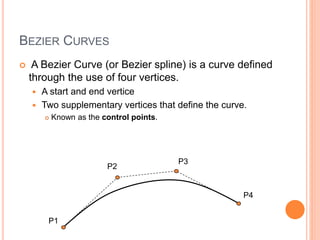
 A Bezier Curve (or Bezier spline) is a curve defined
through the use of four vertices.
 A start and end vertice
 Two supplementary vertices that define the curve.
 Known as the control points.
P1
P2
P3
P4
BEZIER CURVES
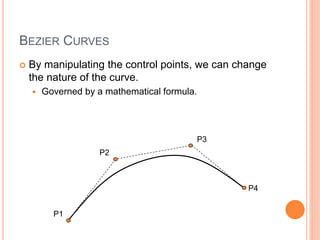
 By manipulating the control points, we can change
the nature of the curve.
 Governed by a mathematical formula.
P1
P2
P3
P4
BEZIER CURVES
 Bezier curves are used for:
 Modelling smooth curves
 In a way that cannot be done with a polymesh
 Curves appear smooth at all scales
 Font representation
 Vector/Outline fonts
 Animation
 Used to define smooth, realistic paths for movement.
BEZIER PATCHES
 Related to the idea of a Bezier curve is a Bezier
patch.
 Curves are 2D, patches are 3D
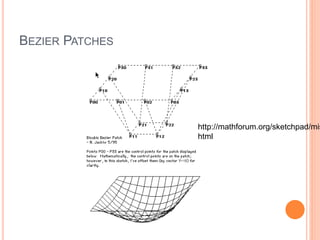
 Bezier patches are shaped nets, the appearance of
which are determined by control points.
 Control points act like gravity spots on underlying
shape.
 The define the topology of the shape through mathematical
modelling of attraction
BEZIER PATCHES
http://mathforum.org/sketchpad/mis
html
BEZIER PATCHES
 Bezier patches offer several advantages
 Integrity of representation
 Continuity across boundaries
 Awareness of neighbours
 Fluid representation
 Exact representation
 Can measure volumes and surfaces
 Economical
 A single patch can represent many polygonal equivalents.
BEZIER PATCHES
 However, they also have drawbacks.
 Simple patch has 16 control points.
 Rendering with a Bezier patch is expensive.
 Around 10 times slower than equivalent polymesh
 But this does not take into account the difference in time
requirements to model a polymesh correctly.
 Large number of perspectives required to render
properly.
NURBS
 Non-Uniform Rational B-Splines
 Yikes!
 Extension of the idea of a Bezier curve
 Defined by control points.
 Each control point has a weight
 Defines how much that control point influences the
curve.
 NURBS have knots
 Vectors that describe how the resulting curve is
influenced by the control points.
 NURBS have an order
 How closely the curve follows the lines between control
points.
CONSTRUCTIVE SOLID GEOMETRY
 Complex shapes modeled by using simple shapes.
 To these shapes we add or subtract other simple
shapes.
 Combination of shapes using boolean operators
and set theory allows for new and interesting
complex topographies.
 Unions, Intersections, etc
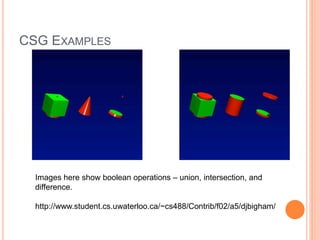
CSG EXAMPLES
Images here show boolean operations – union, intersection, and
difference.
http://www.student.cs.uwaterloo.ca/~cs488/Contrib/f02/a5/djbigham/
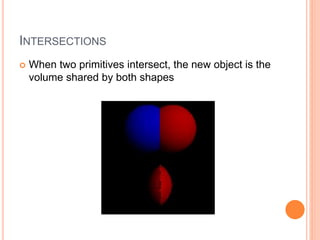
INTERSECTIONS
 When two primitives intersect, the new object is the
volume shared by both shapes
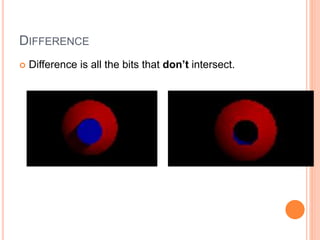
DIFFERENCE
 Difference is all the bits that don’t intersect.
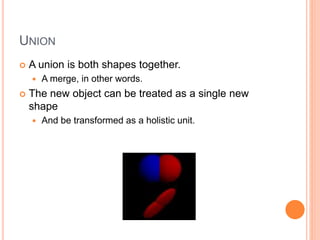
UNION
 A union is both shapes together.
 A merge, in other words.
 The new object can be treated as a single new
shape
 And be transformed as a holistic unit.
VOXEL REPRESENTATION
 Sometimes need to represent 3D space as voxels.
 3D Pixels
 3D space broken up into three dimensional arrays
of voxels.
 Each voxel labeled according to its object
occupancy.
VOXEL REPRESENTATION
 Voxel arrays are:
 Costly in terms of memory
 Entire object space must be separated down into cubic
elements
 Labelled according to object occupancy
 Space subdivision
 Frequently used in:
 Game representations of terrain
 Medical imagery
 Ray tracing
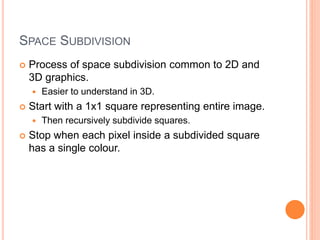
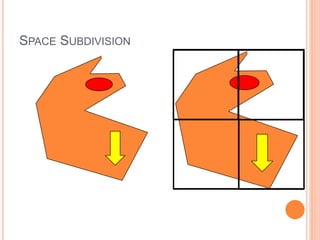
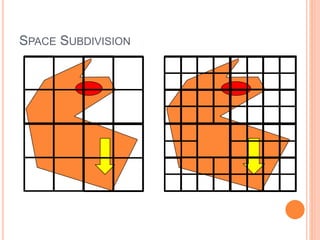
SPACE SUBDIVISION
 Process of space subdivision common to 2D and
3D graphics.
 Easier to understand in 3D.
 Start with a 1x1 square representing entire image.
 Then recursively subdivide squares.
 Stop when each pixel inside a subdivided square
has a single colour.
SPACE SUBDIVISION
SPACE SUBDIVISION
VOLUME SUBDIVISON
 Works the same way in 3D as in 2D
 We start with cubes
 Recursive subdivide cubes
 From our cube, subdivide into eight smaller cubes.
 Can represent space/volume subdivision as a tree
data structure.
 Easy to navigate and store
 Offers greater efficiency of representation.
 Advancement over simple voxel array.
SUMMARY
 Various ways to represent 3D graphics beyond
polymeshes.
 Bezier Curves
 Bezier Patches
 NURBS
 CSG
 Space Subdivision
 Each technique has its real life applications.
 The nature of the intended destination will dictate the
appropriate tool.

GRPHICS03 - Graphical Representation

  • 1.
  • 2.
    INTRODUCTION  In thelast lecture we talked about the processes we go through to build a 3D object.  We focused primarily on the polymesh.  In this lecture we are going to look at alternate representations.  Bezier curves  Bezier Patches  NURBS surfaces  Constructive Solid Geometry
  • 3.
    BEZIER CURVES  ABezier Curve (or Bezier spline) is a curve defined through the use of four vertices.  A start and end vertice  Two supplementary vertices that define the curve.  Known as the control points. P1 P2 P3 P4
  • 4.
    BEZIER CURVES  Bymanipulating the control points, we can change the nature of the curve.  Governed by a mathematical formula. P1 P2 P3 P4
  • 5.
    BEZIER CURVES  Beziercurves are used for:  Modelling smooth curves  In a way that cannot be done with a polymesh  Curves appear smooth at all scales  Font representation  Vector/Outline fonts  Animation  Used to define smooth, realistic paths for movement.
  • 6.
    BEZIER PATCHES  Relatedto the idea of a Bezier curve is a Bezier patch.  Curves are 2D, patches are 3D  Bezier patches are shaped nets, the appearance of which are determined by control points.  Control points act like gravity spots on underlying shape.  The define the topology of the shape through mathematical modelling of attraction
  • 7.
  • 8.
    BEZIER PATCHES  Bezierpatches offer several advantages  Integrity of representation  Continuity across boundaries  Awareness of neighbours  Fluid representation  Exact representation  Can measure volumes and surfaces  Economical  A single patch can represent many polygonal equivalents.
  • 9.
    BEZIER PATCHES  However,they also have drawbacks.  Simple patch has 16 control points.  Rendering with a Bezier patch is expensive.  Around 10 times slower than equivalent polymesh  But this does not take into account the difference in time requirements to model a polymesh correctly.  Large number of perspectives required to render properly.
  • 10.
    NURBS  Non-Uniform RationalB-Splines  Yikes!  Extension of the idea of a Bezier curve  Defined by control points.  Each control point has a weight  Defines how much that control point influences the curve.  NURBS have knots  Vectors that describe how the resulting curve is influenced by the control points.  NURBS have an order  How closely the curve follows the lines between control points.
  • 11.
    CONSTRUCTIVE SOLID GEOMETRY Complex shapes modeled by using simple shapes.  To these shapes we add or subtract other simple shapes.  Combination of shapes using boolean operators and set theory allows for new and interesting complex topographies.  Unions, Intersections, etc
  • 12.
    CSG EXAMPLES Images hereshow boolean operations – union, intersection, and difference. http://www.student.cs.uwaterloo.ca/~cs488/Contrib/f02/a5/djbigham/
  • 13.
    INTERSECTIONS  When twoprimitives intersect, the new object is the volume shared by both shapes
  • 14.
    DIFFERENCE  Difference isall the bits that don’t intersect.
  • 15.
    UNION  A unionis both shapes together.  A merge, in other words.  The new object can be treated as a single new shape  And be transformed as a holistic unit.
  • 16.
    VOXEL REPRESENTATION  Sometimesneed to represent 3D space as voxels.  3D Pixels  3D space broken up into three dimensional arrays of voxels.  Each voxel labeled according to its object occupancy.
  • 17.
    VOXEL REPRESENTATION  Voxelarrays are:  Costly in terms of memory  Entire object space must be separated down into cubic elements  Labelled according to object occupancy  Space subdivision  Frequently used in:  Game representations of terrain  Medical imagery  Ray tracing
  • 18.
    SPACE SUBDIVISION  Processof space subdivision common to 2D and 3D graphics.  Easier to understand in 3D.  Start with a 1x1 square representing entire image.  Then recursively subdivide squares.  Stop when each pixel inside a subdivided square has a single colour.
  • 19.
  • 20.
  • 21.
    VOLUME SUBDIVISON  Worksthe same way in 3D as in 2D  We start with cubes  Recursive subdivide cubes  From our cube, subdivide into eight smaller cubes.  Can represent space/volume subdivision as a tree data structure.  Easy to navigate and store  Offers greater efficiency of representation.  Advancement over simple voxel array.
  • 22.
    SUMMARY  Various waysto represent 3D graphics beyond polymeshes.  Bezier Curves  Bezier Patches  NURBS  CSG  Space Subdivision  Each technique has its real life applications.  The nature of the intended destination will dictate the appropriate tool.