3.5. Genetic modification and biotechnology
http://media.boingboing.net/wp-content/uploads/2012/01/pear.jpg
Miltiadis-Spyridon Kitsos
Platon IB Diploma
Genetic modification
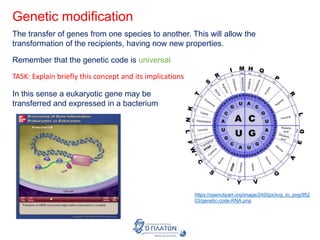
The transfer of genes from one species to another. This will allow the
transformation of the recipients, having now new properties.
https://openclipart.org/image/2400px/svg_to_png/952
03/genetic-code-RNA.png
Remember that the genetic code is universal
TASK: Explain briefly this concept and its implications
In this sense a eukaryotic gene may be
transferred and expressed in a bacterium
Applications in medicine - insulin
http://proteopedia.org/wiki/index.php/Molecular_Playgrou
nd/Insulin
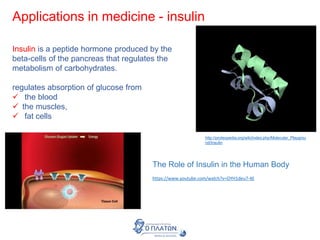
Insulin is a peptide hormone produced by the
beta-cells of the pancreas that regulates the
metabolism of carbohydrates.
regulates absorption of glucose from
 the blood
 the muscles,
 fat cells
The Role of Insulin in the Human Body
https://www.youtube.com/watch?v=OYH1deu7-4E
Applications in medicine - insulin
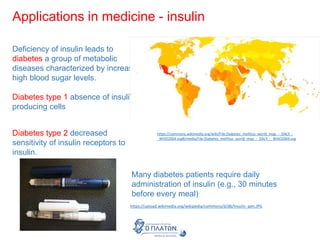
Deficiency of insulin leads to
diabetes a group of metabolic
diseases characterized by increased
high blood sugar levels.
Diabetes type 1 absence of insulin
producing cells
Diabetes type 2 decreased
sensitivity of insulin receptors to
insulin.
https://commons.wikimedia.org/wiki/File:Diabetes_mellitus_world_map_-_DALY_-
_WHO2004.svg#/media/File:Diabetes_mellitus_world_map_-_DALY_-_WHO2004.svg
Many diabetes patients require daily
administration of insulin (e.g., 30 minutes
before every meal)
https://upload.wikimedia.org/wikipedia/commons/d/d6/Insulin_pen.JPG
Applications in medicine - insulin
Isolating the required gene sequence
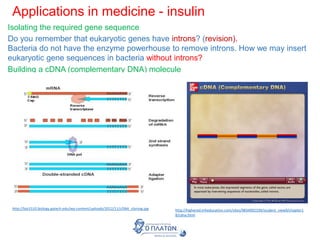
Do you remember that eukaryotic genes have introns? (revision).
Bacteria do not have the enzyme powerhouse to remove introns. How we may insert
eukaryotic gene sequences in bacteria without introns?
Building a cDNA (complementary DNA) molecule
http://bio1510.biology.gatech.edu/wp-content/uploads/2012/11/cDNA_cloning.jpg http://highered.mheducation.com/sites/9834092339/student_view0/chapter1
8/cdna.html
Applications in medicine - insulin
Isolating the required gene sequence
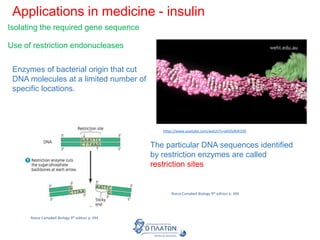
Use of restriction endonucleases
Enzymes of bacterial origin that cut
DNA molecules at a limited number of
specific locations.
The particular DNA sequences identified
by restriction enzymes are called
restriction sites
https://www.youtube.com/watch?v=aA5fyWJh5S0
Reece Campbell Biology 9th edition p. 394
Applications in medicine - insulin
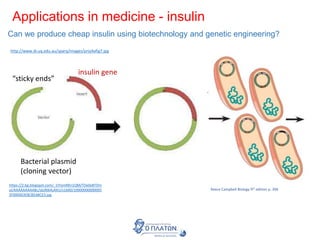
Can we produce cheap insulin using biotechnology and genetic engineering?
http://www.di.uq.edu.au/sparq/images/proj4afig7.jpg
insulin gene
Bacterial plasmid
(cloning vector)
“sticky ends”
https://2.bp.blogspot.com/_1IYomRKn1QM/TDx0eBTDm
yI/AAAAAAAAABc/sbJf664uKKU/s1600/10000000000005
2F000003E8CBEA8CE5.jpg
Reece Campbell Biology 9th edition p. 394
Applications in medicine - insulin
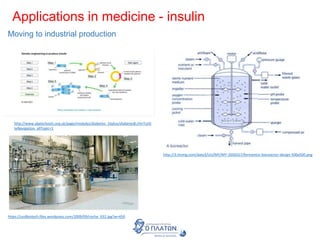
Moving to industrial production
http://www.abpischools.org.uk/page/modules/diabetes_16plus/diabetes8.cfm?coSi
teNavigation_allTopic=1
http://3.imimg.com/data3/UU/MY/MY-2056557/fermentor-bioreactor-design-500x500.png
https://ucdbiotech.files.wordpress.com/2009/09/roche_032.jpg?w=450
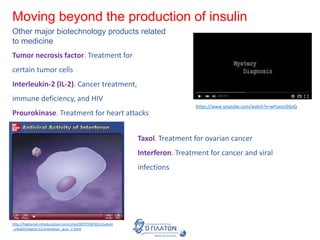
Moving beyond the production of insulin
Tumor necrosis factor. Treatment for
certain tumor cells
Interleukin-2 (IL-2). Cancer treatment,
immune deficiency, and HIV
Prourokinase. Treatment for heart attacks
Other major biotechnology products related
to medicine
https://www.youtube.com/watch?v=wYsaosI26oQ
http://highered.mheducation.com/sites/0072556781/student
_view0/chapter31/animation_quiz_2.html
Taxol. Treatment for ovarian cancer
Interferon. Treatment for cancer and viral
infections
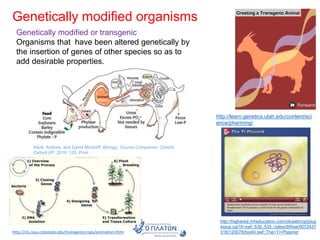
Genetically modified organisms
Genetically modified or transgenic
Organisms that have been altered genetically by
the insertion of genes of other species so as to
add desirable properties.
http://learn.genetics.utah.edu/content/sci
ence/pharming/
Allott, Andrew, and David Mindorff. Biology: Course Companion. Oxford:
Oxford UP, 2010. 125. Print.
http://cls.casa.colostate.edu/transgeniccrops/animation.html
http://highered.mheducation.com/olcweb/cgi/plug
inpop.cgi?it=swf::535::535::/sites/dl/free/0072437
316/120078/bio40.swf::The+Ti+Plasmid
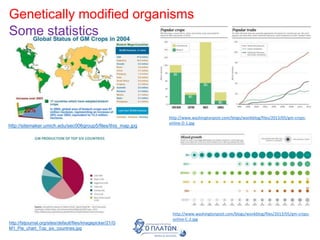
Genetically modified organisms
http://www.washingtonpost.com/blogs/wonkblog/files/2013/05/gm-crops-
online-D-1.jpg
Some statistics
http://www.washingtonpost.com/blogs/wonkblog/files/2013/05/gm-crops-
online-C-2.jpg
http://fstjournal.org/sites/default/files/imagepicker/21/G
M1_Pie_chart_Top_six_countries.jpg
http://sitemaker.umich.edu/sec006group5/files/this_map.jpg
Assessment of benefits and risks
BenefitsBenefits
Environmental
• Bt crops: less pesticides
used.
• Increased shelf-life of
fruits – decreased use
and wastage.
• Reduced need for
plowing and spraying
thus reducing fuel
consumption
Health
• Increased nutritional
value.
• No naturally-occuring
allergens or toxins.
• Edible vaccines
Agricultures
• Increased resistance
to drought, cold and
salinity may expand
cultivation range and
yield.
• Facilitate the use of
herbicides.
• Crops resistent to
viruses.
http://www.ted.com/talks/pamela_
ronald_the_case_for_engineering_
our_food?language=en
Assessment of benefits and risks
BenefitsRisks
Environmental
• Toxins may affect not
targeted organisms.
• Development of super
resistant weeds by
transfer of herbicide
resistance genes.
• Reduction in biodiversity
as food chains may be
affected.
Health
• Proteins produced by
introduced genes might
be toxic or allergic to
humans or livestock
• Development of
antibiotic resistance
genes
• Mutations not
previously assessed.
Agricultures
• Accidental
development of
higher crop density
can not be easily
controlled.
• Development of toxin-
resistant pests
(natural selection)
• No strains adapted to
local conditions may
be developed.
https://www.youtube.com/watch?t=21&v=R
QkQXyiynYs
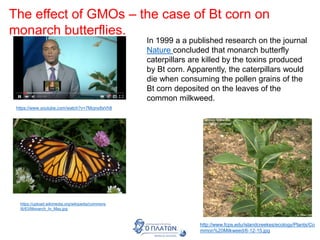
The counter argument
The effect of GMOs – the case of Bt corn on
monarch butterflies.
https://www.youtube.com/watch?v=7Mcjnx8sVh8
https://upload.wikimedia.org/wikipedia/commons
/6/63/Monarch_In_May.jpg
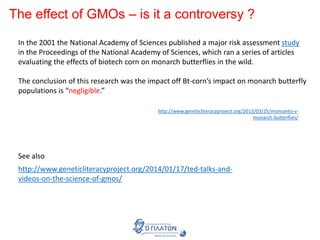
In 1999 a a published research on the journal
Nature concluded that monarch butterfly
caterpillars are killed by the toxins produced
by Bt corn. Apparently, the caterpillars would
die when consuming the pollen grains of the
Bt corn deposited on the leaves of the
common milkweed.
http://www.fcps.edu/islandcreekes/ecology/Plants/Co
mmon%20Milkweed/6-12-15.jpg
The effect of GMOs – is it a controversy ?
In the 2001 the National Academy of Sciences published a major risk assessment study
in the Proceedings of the National Academy of Sciences, which ran a series of articles
evaluating the effects of biotech corn on monarch butterflies in the wild.
The conclusion of this research was the impact off Bt-corn’s impact on monarch butterfly
populations is “negligible.”
http://www.geneticliteracyproject.org/2013/03/25/monsanto-v-
monarch-butterflies/
http://www.geneticliteracyproject.org/2014/01/17/ted-talks-and-
videos-on-the-science-of-gmos/
See also
The effect of GMOs – is it a controversy ?
In the 2001 the National Academy of Sciences published a major risk assessment study
in the Proceedings of the National Academy of Sciences, which ran a series of articles
evaluating the effects of biotech corn on monarch butterflies in the wild.
The conclusion of this research was the impact off Bt-corn’s impact on monarch butterfly
populations is “negligible.”
http://www.geneticliteracyproject.org/2013/03/25/monsanto-v-
monarch-butterflies/
http://www.geneticliteracyproject.org/2014/01/17/ted-talks-and-
videos-on-the-science-of-gmos/
See also
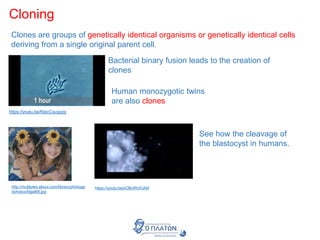
Cloning
Clones are groups of genetically identical organisms or genetically identical cells
deriving from a single original parent cell.
https://youtu.be/KIpcCyuypzg
https://youtu.be/sOBvRhXIJN4
Bacterial binary fusion leads to the creation of
clones
See how the cleavage of
the blastocyst in humans.
http://multiples.about.com/library/photoga
l/photos/blgal68.jpg
Human monozygotic twins
are also clones
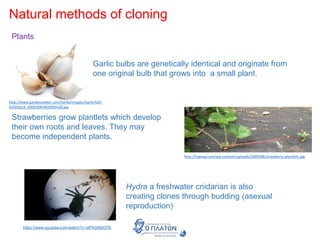
Natural methods of cloning
Plants
Garlic bulbs are genetically identical and originate from
one original bulb that grows into a small plant.
Strawberries grow plantlets which develop
their own roots and leaves. They may
become independent plants.
http://topveg.com/wp-content/uploads/2009/08/strawberry-plantlets.jpg
http://www.gardenseeker.com/herbs/images/Garlic%20-
%20iStock_000018454020XSmall.jpg
Hydra a freshwater cnidarian is also
creating clones through budding (asexual
reproduction)
https://www.youtube.com/watch?v=ztPAGISkO7E
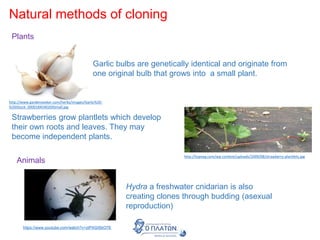
Natural methods of cloning
Plants
Garlic bulbs are genetically identical and originate from
one original bulb that grows into a small plant.
Strawberries grow plantlets which develop
their own roots and leaves. They may
become independent plants.
http://topveg.com/wp-content/uploads/2009/08/strawberry-plantlets.jpg
http://www.gardenseeker.com/herbs/images/Garlic%20-
%20iStock_000018454020XSmall.jpg
Hydra a freshwater cnidarian is also
creating clones through budding (asexual
reproduction)
https://www.youtube.com/watch?v=ztPAGISkO7E
Animals
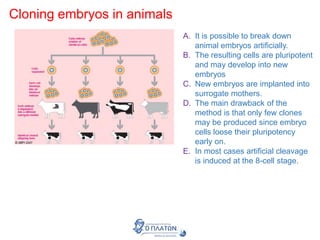
Cloning embryos in animals
A. It is possible to break down
animal embryos artificially.
B. The resulting cells are pluripotent
and may develop into new
embryos
C. New embryos are implanted into
surrogate mothers.
D. The main drawback of the
method is that only few clones
may be produced since embryo
cells loose their pluripotency
early on.
E. In most cases artificial cleavage
is induced at the 8-cell stage.
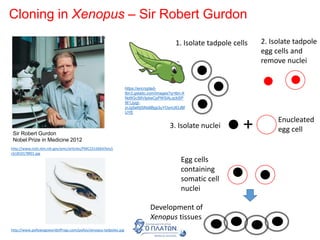
Cloning in Xenopus – Sir Robert Gurdon
http://www.ncbi.nlm.nih.gov/pmc/articles/PMC2315664/bin/j
cb1810178f01.jpg
Sir Robert Gurdon
Nobel Prize in Medicine 2012
https://encrypted-
tbn3.gstatic.com/images?q=tbn:A
Nd9GcS6VlpbeCpPWSALqcbSP
W1JuqI-
zrJg5efdjSNx6Bgs3uYOynUlOJBf
UYE
1. Isolate tadpole cells
3. Isolate nuclei
2. Isolate tadpole
egg cells and
remove nuclei
Enucleated
egg cell+
Egg cells
containing
somatic cell
nuclei
Development of
Xenopus tissues
http://www.pollywogsworldoffrogs.com/pollys/xenopus-tadpoles.jpg
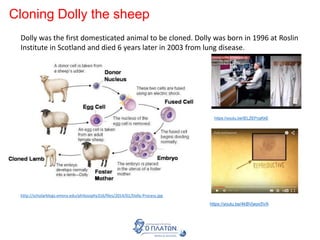
Cloning Dolly the sheep
Dolly was the first domesticated animal to be cloned. Dolly was born in 1996 at Roslin
Institute in Scotland and died 6 years later in 2003 from lung disease.
https://youtu.be/tELZEPcgKkE
http://scholarblogs.emory.edu/philosophy316/files/2014/01/Dolly-Process.jpg
https://youtu.be/4kBVjwyx5VA
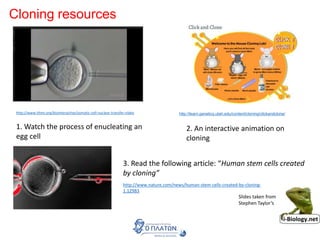
Cloning resources
http://learn.genetics.utah.edu/content/cloning/clickandclone/
1. Watch the process of enucleating an
egg cell
2. An interactive animation on
cloning
http://www.hhmi.org/biointeractive/somatic-cell-nuclear-transfer-video
3. Read the following article: “Human stem cells created
by cloning”
http://www.nature.com/news/human-stem-cells-created-by-cloning-
1.12983
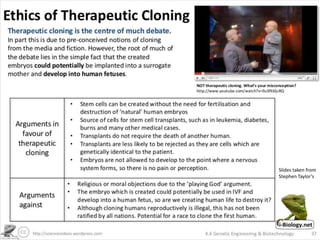
Slides taken from
Stephen Taylor’s
Slides taken from
Stephen Taylor’s
Slides taken from
Stephen Taylor’s
http://www.stepsinbiology.eu

3.5. Genetic modification and cloning

  • 1.
    3.5. Genetic modificationand biotechnology http://media.boingboing.net/wp-content/uploads/2012/01/pear.jpg Miltiadis-Spyridon Kitsos Platon IB Diploma
  • 2.
    Genetic modification The transferof genes from one species to another. This will allow the transformation of the recipients, having now new properties. https://openclipart.org/image/2400px/svg_to_png/952 03/genetic-code-RNA.png Remember that the genetic code is universal TASK: Explain briefly this concept and its implications In this sense a eukaryotic gene may be transferred and expressed in a bacterium
  • 3.
    Applications in medicine- insulin http://proteopedia.org/wiki/index.php/Molecular_Playgrou nd/Insulin Insulin is a peptide hormone produced by the beta-cells of the pancreas that regulates the metabolism of carbohydrates. regulates absorption of glucose from  the blood  the muscles,  fat cells The Role of Insulin in the Human Body https://www.youtube.com/watch?v=OYH1deu7-4E
  • 4.
    Applications in medicine- insulin Deficiency of insulin leads to diabetes a group of metabolic diseases characterized by increased high blood sugar levels. Diabetes type 1 absence of insulin producing cells Diabetes type 2 decreased sensitivity of insulin receptors to insulin. https://commons.wikimedia.org/wiki/File:Diabetes_mellitus_world_map_-_DALY_- _WHO2004.svg#/media/File:Diabetes_mellitus_world_map_-_DALY_-_WHO2004.svg Many diabetes patients require daily administration of insulin (e.g., 30 minutes before every meal) https://upload.wikimedia.org/wikipedia/commons/d/d6/Insulin_pen.JPG
  • 5.
    Applications in medicine- insulin Isolating the required gene sequence Do you remember that eukaryotic genes have introns? (revision). Bacteria do not have the enzyme powerhouse to remove introns. How we may insert eukaryotic gene sequences in bacteria without introns? Building a cDNA (complementary DNA) molecule http://bio1510.biology.gatech.edu/wp-content/uploads/2012/11/cDNA_cloning.jpg http://highered.mheducation.com/sites/9834092339/student_view0/chapter1 8/cdna.html
  • 6.
    Applications in medicine- insulin Isolating the required gene sequence Use of restriction endonucleases Enzymes of bacterial origin that cut DNA molecules at a limited number of specific locations. The particular DNA sequences identified by restriction enzymes are called restriction sites https://www.youtube.com/watch?v=aA5fyWJh5S0 Reece Campbell Biology 9th edition p. 394 Reece Campbell Biology 9th edition p. 394
  • 7.
    Applications in medicine- insulin Can we produce cheap insulin using biotechnology and genetic engineering? http://www.di.uq.edu.au/sparq/images/proj4afig7.jpg insulin gene Bacterial plasmid (cloning vector) “sticky ends” https://2.bp.blogspot.com/_1IYomRKn1QM/TDx0eBTDm yI/AAAAAAAAABc/sbJf664uKKU/s1600/10000000000005 2F000003E8CBEA8CE5.jpg Reece Campbell Biology 9th edition p. 394
  • 8.
    Applications in medicine- insulin Moving to industrial production http://www.abpischools.org.uk/page/modules/diabetes_16plus/diabetes8.cfm?coSi teNavigation_allTopic=1 http://3.imimg.com/data3/UU/MY/MY-2056557/fermentor-bioreactor-design-500x500.png https://ucdbiotech.files.wordpress.com/2009/09/roche_032.jpg?w=450
  • 9.
    Moving beyond theproduction of insulin Tumor necrosis factor. Treatment for certain tumor cells Interleukin-2 (IL-2). Cancer treatment, immune deficiency, and HIV Prourokinase. Treatment for heart attacks Other major biotechnology products related to medicine https://www.youtube.com/watch?v=wYsaosI26oQ http://highered.mheducation.com/sites/0072556781/student _view0/chapter31/animation_quiz_2.html Taxol. Treatment for ovarian cancer Interferon. Treatment for cancer and viral infections
  • 10.
    Genetically modified organisms Geneticallymodified or transgenic Organisms that have been altered genetically by the insertion of genes of other species so as to add desirable properties. http://learn.genetics.utah.edu/content/sci ence/pharming/ Allott, Andrew, and David Mindorff. Biology: Course Companion. Oxford: Oxford UP, 2010. 125. Print. http://cls.casa.colostate.edu/transgeniccrops/animation.html http://highered.mheducation.com/olcweb/cgi/plug inpop.cgi?it=swf::535::535::/sites/dl/free/0072437 316/120078/bio40.swf::The+Ti+Plasmid
  • 11.
    Genetically modified organisms http://www.washingtonpost.com/blogs/wonkblog/files/2013/05/gm-crops- online-D-1.jpg Somestatistics http://www.washingtonpost.com/blogs/wonkblog/files/2013/05/gm-crops- online-C-2.jpg http://fstjournal.org/sites/default/files/imagepicker/21/G M1_Pie_chart_Top_six_countries.jpg http://sitemaker.umich.edu/sec006group5/files/this_map.jpg
  • 12.
    Assessment of benefitsand risks BenefitsBenefits Environmental • Bt crops: less pesticides used. • Increased shelf-life of fruits – decreased use and wastage. • Reduced need for plowing and spraying thus reducing fuel consumption Health • Increased nutritional value. • No naturally-occuring allergens or toxins. • Edible vaccines Agricultures • Increased resistance to drought, cold and salinity may expand cultivation range and yield. • Facilitate the use of herbicides. • Crops resistent to viruses. http://www.ted.com/talks/pamela_ ronald_the_case_for_engineering_ our_food?language=en
  • 13.
    Assessment of benefitsand risks BenefitsRisks Environmental • Toxins may affect not targeted organisms. • Development of super resistant weeds by transfer of herbicide resistance genes. • Reduction in biodiversity as food chains may be affected. Health • Proteins produced by introduced genes might be toxic or allergic to humans or livestock • Development of antibiotic resistance genes • Mutations not previously assessed. Agricultures • Accidental development of higher crop density can not be easily controlled. • Development of toxin- resistant pests (natural selection) • No strains adapted to local conditions may be developed. https://www.youtube.com/watch?t=21&v=R QkQXyiynYs The counter argument
  • 14.
    The effect ofGMOs – the case of Bt corn on monarch butterflies. https://www.youtube.com/watch?v=7Mcjnx8sVh8 https://upload.wikimedia.org/wikipedia/commons /6/63/Monarch_In_May.jpg In 1999 a a published research on the journal Nature concluded that monarch butterfly caterpillars are killed by the toxins produced by Bt corn. Apparently, the caterpillars would die when consuming the pollen grains of the Bt corn deposited on the leaves of the common milkweed. http://www.fcps.edu/islandcreekes/ecology/Plants/Co mmon%20Milkweed/6-12-15.jpg
  • 15.
    The effect ofGMOs – is it a controversy ? In the 2001 the National Academy of Sciences published a major risk assessment study in the Proceedings of the National Academy of Sciences, which ran a series of articles evaluating the effects of biotech corn on monarch butterflies in the wild. The conclusion of this research was the impact off Bt-corn’s impact on monarch butterfly populations is “negligible.” http://www.geneticliteracyproject.org/2013/03/25/monsanto-v- monarch-butterflies/ http://www.geneticliteracyproject.org/2014/01/17/ted-talks-and- videos-on-the-science-of-gmos/ See also
  • 16.
    The effect ofGMOs – is it a controversy ? In the 2001 the National Academy of Sciences published a major risk assessment study in the Proceedings of the National Academy of Sciences, which ran a series of articles evaluating the effects of biotech corn on monarch butterflies in the wild. The conclusion of this research was the impact off Bt-corn’s impact on monarch butterfly populations is “negligible.” http://www.geneticliteracyproject.org/2013/03/25/monsanto-v- monarch-butterflies/ http://www.geneticliteracyproject.org/2014/01/17/ted-talks-and- videos-on-the-science-of-gmos/ See also
  • 17.
    Cloning Clones are groupsof genetically identical organisms or genetically identical cells deriving from a single original parent cell. https://youtu.be/KIpcCyuypzg https://youtu.be/sOBvRhXIJN4 Bacterial binary fusion leads to the creation of clones See how the cleavage of the blastocyst in humans. http://multiples.about.com/library/photoga l/photos/blgal68.jpg Human monozygotic twins are also clones
  • 18.
    Natural methods ofcloning Plants Garlic bulbs are genetically identical and originate from one original bulb that grows into a small plant. Strawberries grow plantlets which develop their own roots and leaves. They may become independent plants. http://topveg.com/wp-content/uploads/2009/08/strawberry-plantlets.jpg http://www.gardenseeker.com/herbs/images/Garlic%20- %20iStock_000018454020XSmall.jpg Hydra a freshwater cnidarian is also creating clones through budding (asexual reproduction) https://www.youtube.com/watch?v=ztPAGISkO7E
  • 19.
    Natural methods ofcloning Plants Garlic bulbs are genetically identical and originate from one original bulb that grows into a small plant. Strawberries grow plantlets which develop their own roots and leaves. They may become independent plants. http://topveg.com/wp-content/uploads/2009/08/strawberry-plantlets.jpg http://www.gardenseeker.com/herbs/images/Garlic%20- %20iStock_000018454020XSmall.jpg Hydra a freshwater cnidarian is also creating clones through budding (asexual reproduction) https://www.youtube.com/watch?v=ztPAGISkO7E Animals
  • 20.
    Cloning embryos inanimals A. It is possible to break down animal embryos artificially. B. The resulting cells are pluripotent and may develop into new embryos C. New embryos are implanted into surrogate mothers. D. The main drawback of the method is that only few clones may be produced since embryo cells loose their pluripotency early on. E. In most cases artificial cleavage is induced at the 8-cell stage.
  • 21.
    Cloning in Xenopus– Sir Robert Gurdon http://www.ncbi.nlm.nih.gov/pmc/articles/PMC2315664/bin/j cb1810178f01.jpg Sir Robert Gurdon Nobel Prize in Medicine 2012 https://encrypted- tbn3.gstatic.com/images?q=tbn:A Nd9GcS6VlpbeCpPWSALqcbSP W1JuqI- zrJg5efdjSNx6Bgs3uYOynUlOJBf UYE 1. Isolate tadpole cells 3. Isolate nuclei 2. Isolate tadpole egg cells and remove nuclei Enucleated egg cell+ Egg cells containing somatic cell nuclei Development of Xenopus tissues http://www.pollywogsworldoffrogs.com/pollys/xenopus-tadpoles.jpg
  • 22.
    Cloning Dolly thesheep Dolly was the first domesticated animal to be cloned. Dolly was born in 1996 at Roslin Institute in Scotland and died 6 years later in 2003 from lung disease. https://youtu.be/tELZEPcgKkE http://scholarblogs.emory.edu/philosophy316/files/2014/01/Dolly-Process.jpg https://youtu.be/4kBVjwyx5VA
  • 23.
    Cloning resources http://learn.genetics.utah.edu/content/cloning/clickandclone/ 1. Watchthe process of enucleating an egg cell 2. An interactive animation on cloning http://www.hhmi.org/biointeractive/somatic-cell-nuclear-transfer-video 3. Read the following article: “Human stem cells created by cloning” http://www.nature.com/news/human-stem-cells-created-by-cloning- 1.12983 Slides taken from Stephen Taylor’s
  • 24.
  • 25.
  • 26.