Topic 3 GeneticsTopic 3 Genetics
Syllabus StatementsSyllabus Statements
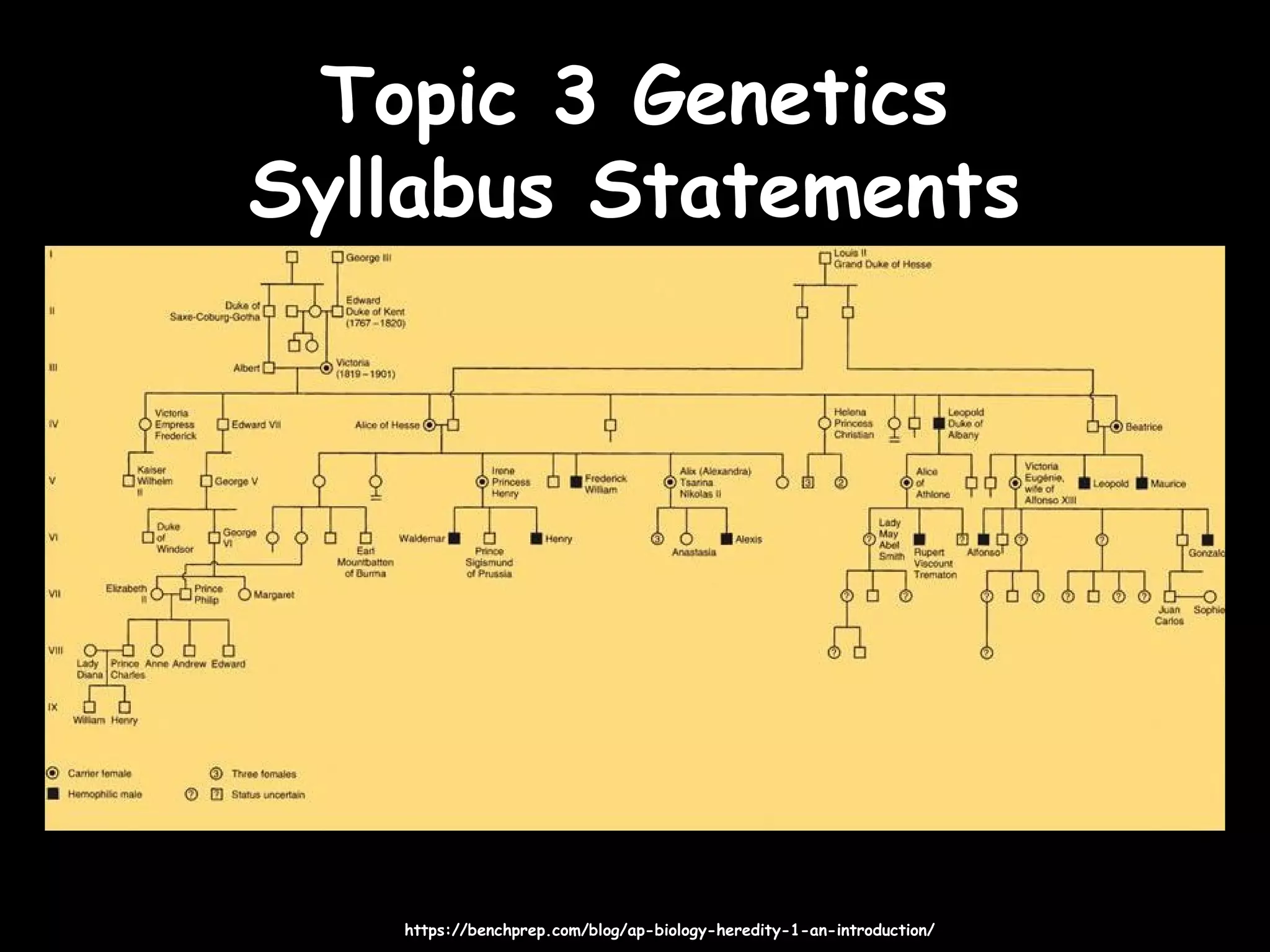
https://benchprep.com/blog/ap-biology-heredity-1-an-introduction/https://benchprep.com/blog/ap-biology-heredity-1-an-introduction/
3.1 Genes3.1 Genes
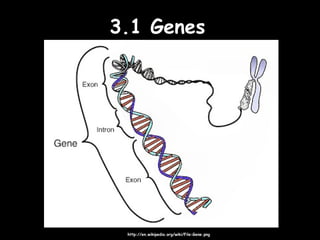
http://en.wikipedia.org/wiki/File:Gene.pnghttp://en.wikipedia.org/wiki/File:Gene.png
3.1 Genes3.1 Genes
Essential idea:
Every living organism inherits a blueprint for life from its
parents.
Nature of science:
Developments in scientific research follow improvements in
technology—gene sequencers are used for the sequencing
of genes.
3.1 Genes3.1 Genes
Understandings:
•A gene is a heritable factor that consists of a length of
DNA and influences a specific characteristic.
•A gene occupies a specific position on a chromosome.
•The various specific forms of a gene are alleles.
•Alleles differ from each other by one or only a few bases.
•New alleles are formed by mutation.
•The genome is the whole of the genetic information of an
organism.
3.1 Genes3.1 Genes
• The entire base sequence of human genes was sequenced
in the Human Genome Project.
Applications and skills:
• Application: The causes of sickle cell anemia, including a
base substitution mutation, a change to the base
sequence of mRNA transcribed from it and a change to
the sequence of a polypeptide in hemoglobin.
• Application: Comparison of the number of genes in
humans with other species.
• Skill: Use of a database to determine differences in the
base sequence of a gene in two species.
3.1 Genes3.1 Genes
Guidance:
•Students should be able to recall one specific base
substitution that causes glutamic acid to be substituted by
valine as the sixth amino acid in the hemoglobin
polypeptide.
•The number of genes in a species should not be referred
to as genome size as this term is used for the total amount
of DNA. At least one plant and one bacterium should be
included in the comparison and at least one species with
more genes and one with fewer genes than a human.
3.1 Genes3.1 Genes
• The Genbank® database can be used to search for DNA
base sequences. The cytochrome C gene sequence is
available for many different organisms and is of
particular interest because of its use in reclassifying
organisms into three domains.
• Deletions, insertions and frame shift mutations do not
need to be included.
3.1 Genes3.1 Genes
International-mindedness:
•Sequencing of the human genome shows that all humans
share the vast majority of their base sequences but also
that there are many single nucleotide polymorphisms that
contribute to human diversity.
Theory of knowledge:
•There is a link between sickle cell anemia and prevalence
of malaria. How can we know whether there is a causal link
in such cases or simply a correlation?
3.1 Genes3.1 Genes
Aims:
•Aim 7: The use of a database to compare DNA base
sequences.
•Aim 8: Ethics of patenting human genes.
3.2 Chromosomes3.2 Chromosomes
http://www.samesexprocreation.com/mmct.htmhttp://www.samesexprocreation.com/mmct.htm
3.2 Chromosomes3.2 Chromosomes
Essential idea:
Chromosomes carry genes in a linear sequence that is
shared by members of a species.
Nature of science:
Developments in research follow improvements in
techniques—autoradiography was used to establish the
length of DNA molecules in chromosomes.
3.2 Chromosomes3.2 Chromosomes
Understandings:
•Prokaryotes have one chromosome consisting of a circular
DNA molecule.
•Some prokaryotes also have plasmids but eukaryotes do
not.
•Eukaryote chromosomes are linear DNA molecules
associated with histone proteins.
•In a eukaryote species there are different chromosomes
that carry different genes.
3.2 Chromosomes3.2 Chromosomes
• Homologous chromosomes carry the same sequence of
genes but not necessarily the same alleles of those
genes.
• Diploid nuclei have pairs of homologous chromosomes.
• Haploid nuclei have one chromosome of each pair.
• The number of chromosomes is a characteristic feature
of members of a species.
• A karyogram shows the chromosomes of an organism in
homologous pairs of decreasing length.
• Sex is determined by sex chromosomes and autosomes
are chromosomes that do not determine sex.
3.2 Chromosomes3.2 Chromosomes
Applications and skills:
•Application: Cairns’ technique for measuring the length of
DNA molecules by autoradiography.
•Application: Comparison of genome size in T2 phage,
Escherichia coli, Drosophila melanogaster, Homo sapiens
and Paris japonica.
•Application: Comparison of diploid chromosome numbers of
Homo sapiens, Pan troglodytes, Canis familiaris, Oryza
sativa, Parascaris equorum.
•Application: Use of karyograms to deduce sex and
diagnose Down syndrome in humans.
3.2 Chromosomes3.2 Chromosomes
• Skill: Use of databases to identify the locus of a human
gene and its polypeptide product.
3.2 Chromosomes3.2 Chromosomes
Guidance:
•The terms karyotype and karyogram have different
meanings. Karyotype is a property of a cell—the number
and type of chromosomes present in the nucleus, not a
photograph or diagram of them.
•Genome size is the total length of DNA in an organism.
The examples of genome and chromosome number have
been selected to allow points of interest to be raised.
•The two DNA molecules formed by DNA replication prior
to cell division are considered to be sister chromatids until
the splitting of the centromere at the start of anaphase.
After this, they are individual chromosomes.
3.2 Chromosomes3.2 Chromosomes
International-mindedness:
•Sequencing of the rice genome involved cooperation
between biologists in 10 countries.
Aims:
•Aim 6: Staining root tip squashes and microscope
examination of chromosomes is recommended but not
obligatory.
•Aim 7: Use of databases to identify gene loci and protein
products of genes.
3.3 Meiosis3.3 Meiosis
http://www.rapidlearningcenter.com/biology/genetics/04-Mitosis-and-Meiosis.htmlhttp://www.rapidlearningcenter.com/biology/genetics/04-Mitosis-and-Meiosis.html
3.3 Meiosis3.3 Meiosis
Essential idea:
Alleles segregate during meiosis allowing new combinations
to be formed by the fusion of gametes.
Nature of science:
Making careful observations—meiosis was discovered by
microscope examination of dividing germ-line cells.
3.3 Meiosis3.3 Meiosis
Understandings:
•One diploid nucleus divides by meiosis to produce four
haploid nuclei.
•The halving of the chromosome number allows a sexual life
cycle with fusion of gametes.
•DNA is replicated before meiosis so that all chromosomes
consist of two sister chromatids.
•The early stages of meiosis involve pairing of homologous
chromosomes and crossing over followed by condensation.
3.3 Meiosis3.3 Meiosis
• Orientation of pairs of homologous chromosomes prior
to separation is random.
• Separation of pairs of homologous chromosomes in the
first division of meiosis halves the chromosome number.
• Crossing over and random orientation promotes genetic
variation.
• Fusion of gametes from different parents promotes
genetic variation.
3.3 Meiosis3.3 Meiosis
Applications and skills:
•Application: Non-disjunction can cause Down syndrome and
other chromosome abnormalities.
•Application: Studies showing age of parents influences
chances of nondisjunction.
•Application: Description of methods used to obtain cells
for karyotype analysis e.g. chorionic villus sampling and
amniocentesis and the associated risks.
•Skill: Drawing diagrams to show the stages of meiosis
resulting in the formation of four haploid cells.
3.3 Meiosis3.3 Meiosis
Guidance:
•Preparation of microscope slides showing meiosis is
challenging and permanent slides should be available in case
no cells in meiosis are visible in temporary mounts.
•Drawings of the stages of meiosis do not need to include
chiasmata.
•The process of chiasmata formation need not be
explained.
3.3 Meiosis3.3 Meiosis
Theory of knowledge:
•In 1922 the number of chromosomes counted in a human
cell was 48. This remained the established number for 30
years, even though a review of photographic evidence from
the time clearly showed that there were 46. For what
reasons do existing beliefs carry a certain inertia?
Utilization:
•An understanding of karyotypes has allowed diagnoses to
be made for the purposes of genetic counselling.
3.3 Meiosis3.3 Meiosis
Aims:
Aim 8: Pre-natal screening for chromosome abnormalities
gives an indication of the sex of the fetus and raises
ethical issues over selective abortion of female fetuses in
some countries.
3.4 Inheritance3.4 Inheritance
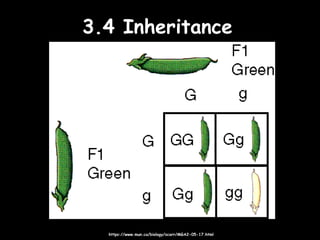
https://www.mun.ca/biology/scarr/MGA2-05-17.htmlhttps://www.mun.ca/biology/scarr/MGA2-05-17.html
3.4 Inheritance3.4 Inheritance
Essential idea:
The inheritance of genes follows patterns.
Nature of science:
Making quantitative measurements with replicates to
ensure reliability. Mendel’s genetic crosses with pea plants
generated numerical data.
3.4 Inheritance3.4 Inheritance
Understandings:
•Mendel discovered the principles of inheritance with
experiments in which large numbers of pea plants were
crossed.
•Gametes are haploid so contain only one allele of each
gene.
•The two alleles of each gene separate into different
haploid daughter nuclei during meiosis.
•Fusion of gametes results in diploid zygotes with two
alleles of each gene that may be the same allele or
different alleles.
3.4 Inheritance3.4 Inheritance
• Dominant alleles mask the effects of recessive alleles
but co-dominant alleles have joint effects.
• Many genetic diseases in humans are due to recessive
alleles of autosomal genes, although some genetic
diseases are due to dominant or co-dominant alleles.
• Some genetic diseases are sex-linked. The pattern of
inheritance is different with sex-linked genes due to
their location on sex chromosomes.
• Many genetic diseases have been identified in humans
but most are very rare.
• Radiation and mutagenic chemicals increase the mutation
rate and can cause genetic diseases and cancer.
3.4 Inheritance3.4 Inheritance
Applications and skills:
•Application: Inheritance of ABO blood groups.
•Application: Red-green colour blindness and hemophilia as
examples of sexlinked inheritance.
•Application: Inheritance of cystic fibrosis and
Huntington’s disease.
•Application: Consequences of radiation after nuclear
bombing of Hiroshima and accident at Chernobyl.
•Skill: Construction of Punnett grids for predicting the
outcomes of monohybrid genetic crosses.
3.4 Inheritance3.4 Inheritance
• Skill: Comparison of predicted and actual outcomes of
genetic crosses using real data.
• Skill: Analysis of pedigree charts to deduce the pattern
of inheritance of genetic diseases.
3.4 Inheritance3.4 Inheritance
Guidance:
•Alleles carried on X chromosomes should be shown as
superscript letters on an upper case X, such as Xh.
•The expected notation for ABO blood group alleles is:
3.4 Inheritance3.4 Inheritance
Theory of knowledge:
•Mendel’s theories were not accepted by the scientific
community for a long time. What factors would encourage
the acceptance of new ideas by the scientific community?
Aims:
•Aim 8: Social implications of diagnosis of mutations,
including the effects on the family and stigmatization.
3.5 Genetic Modification &3.5 Genetic Modification &
BiotechnologyBiotechnology
http://www.inlander.com/Bloglander/archives/2013/09/27/syringes-gas-masks-and-frankenfood-visuals-of-the-gmo-debatehttp://www.inlander.com/Bloglander/archives/2013/09/27/syringes-gas-masks-and-frankenfood-visuals-of-the-gmo-debate
3.5 Genetic Modification &3.5 Genetic Modification &
BiotechnologyBiotechnology
Essential idea:
Biologists have developed techniques for artificial
manipulation of DNA, cells and organisms.
Nature of science:
Assessing risks associated with scientific research—
scientists attempt to assess the risks associated with
genetically modified crops or livestock.
3.5 Genetic Modification &3.5 Genetic Modification &
BiotechnologyBiotechnology
Understandings:
•Gel electrophoresis is used to separate proteins or
fragments of DNA according to size.
•PCR can be used to amplify small amounts of DNA.
•DNA profiling involves comparison of DNA.
•Genetic modification is carried out by gene transfer
between species.
3.5 Genetic Modification &3.5 Genetic Modification &
BiotechnologyBiotechnology
• Clones are groups of genetically identical organisms,
derived from a single original parent cell.
• Many plant species and some animal species have natural
methods of cloning.
• Many plant species and some animal species have natural
methods of cloning.
• Animals can be cloned at the embryo stage by breaking
up the embryo into more than one group of cells.
• Methods have been developed for cloning adult animals
using differentiated cells.
3.5 Genetic Modification &3.5 Genetic Modification &
BiotechnologyBiotechnology
Applications and skills:
•Application: Use of DNA profiling in paternity and
forensic investigations.
•Application: Gene transfer to bacteria using plasmids
makes use of restriction endonucleases and DNA ligase.
•Application: Assessment of the potential risks and
benefits associated with genetic modification of crops.
•Application: Production of cloned embryos produced by
somatic-cell nuclear transfer.
3.5 Genetic Modification &3.5 Genetic Modification &
BiotechnologyBiotechnology
• Skill: Design of an experiment to assess one factor
affecting the rooting of stem-cuttings.
• Skill: Analysis of examples of DNA profiles.
• Skill: Analysis of data on risks to monarch butterflies of
Bt crops.
3.5 Genetic Modification &3.5 Genetic Modification &
BiotechnologyBiotechnology
Guidance:
•Students should be able to deduce whether or not a man
could be the father of a child from the pattern of bands
on a DNA profile.
•Dolly can be used as an example of somatic-cell transfer.
•A plant species should be chosen for rooting experiments
that forms roots readily in water or a solid medium.
3.5 Genetic Modification &3.5 Genetic Modification &
BiotechnologyBiotechnology
Theory of knowledge:
•The use of DNA for securing convictions in legal cases is
well established, yet even universally accepted theories
are overturned in the light of new evidence in science.
What criteria are necessary for assessing the reliability of
evidence?
Aims:
•Aim 6: The design of a rooting experiment should ideally
lead to the experiment actually being carried out by
students.
•Aim 8: The ethics of genetic modification could be
discussed.

3 genetics syllabus statements

  • 1.
    Topic 3 GeneticsTopic3 Genetics Syllabus StatementsSyllabus Statements https://benchprep.com/blog/ap-biology-heredity-1-an-introduction/https://benchprep.com/blog/ap-biology-heredity-1-an-introduction/
  • 2.
  • 3.
    3.1 Genes3.1 Genes Essentialidea: Every living organism inherits a blueprint for life from its parents. Nature of science: Developments in scientific research follow improvements in technology—gene sequencers are used for the sequencing of genes.
  • 4.
    3.1 Genes3.1 Genes Understandings: •Agene is a heritable factor that consists of a length of DNA and influences a specific characteristic. •A gene occupies a specific position on a chromosome. •The various specific forms of a gene are alleles. •Alleles differ from each other by one or only a few bases. •New alleles are formed by mutation. •The genome is the whole of the genetic information of an organism.
  • 5.
    3.1 Genes3.1 Genes •The entire base sequence of human genes was sequenced in the Human Genome Project. Applications and skills: • Application: The causes of sickle cell anemia, including a base substitution mutation, a change to the base sequence of mRNA transcribed from it and a change to the sequence of a polypeptide in hemoglobin. • Application: Comparison of the number of genes in humans with other species. • Skill: Use of a database to determine differences in the base sequence of a gene in two species.
  • 6.
    3.1 Genes3.1 Genes Guidance: •Studentsshould be able to recall one specific base substitution that causes glutamic acid to be substituted by valine as the sixth amino acid in the hemoglobin polypeptide. •The number of genes in a species should not be referred to as genome size as this term is used for the total amount of DNA. At least one plant and one bacterium should be included in the comparison and at least one species with more genes and one with fewer genes than a human.
  • 7.
    3.1 Genes3.1 Genes •The Genbank® database can be used to search for DNA base sequences. The cytochrome C gene sequence is available for many different organisms and is of particular interest because of its use in reclassifying organisms into three domains. • Deletions, insertions and frame shift mutations do not need to be included.
  • 8.
    3.1 Genes3.1 Genes International-mindedness: •Sequencingof the human genome shows that all humans share the vast majority of their base sequences but also that there are many single nucleotide polymorphisms that contribute to human diversity. Theory of knowledge: •There is a link between sickle cell anemia and prevalence of malaria. How can we know whether there is a causal link in such cases or simply a correlation?
  • 9.
    3.1 Genes3.1 Genes Aims: •Aim7: The use of a database to compare DNA base sequences. •Aim 8: Ethics of patenting human genes.
  • 10.
  • 11.
    3.2 Chromosomes3.2 Chromosomes Essentialidea: Chromosomes carry genes in a linear sequence that is shared by members of a species. Nature of science: Developments in research follow improvements in techniques—autoradiography was used to establish the length of DNA molecules in chromosomes.
  • 12.
    3.2 Chromosomes3.2 Chromosomes Understandings: •Prokaryoteshave one chromosome consisting of a circular DNA molecule. •Some prokaryotes also have plasmids but eukaryotes do not. •Eukaryote chromosomes are linear DNA molecules associated with histone proteins. •In a eukaryote species there are different chromosomes that carry different genes.
  • 13.
    3.2 Chromosomes3.2 Chromosomes •Homologous chromosomes carry the same sequence of genes but not necessarily the same alleles of those genes. • Diploid nuclei have pairs of homologous chromosomes. • Haploid nuclei have one chromosome of each pair. • The number of chromosomes is a characteristic feature of members of a species. • A karyogram shows the chromosomes of an organism in homologous pairs of decreasing length. • Sex is determined by sex chromosomes and autosomes are chromosomes that do not determine sex.
  • 14.
    3.2 Chromosomes3.2 Chromosomes Applicationsand skills: •Application: Cairns’ technique for measuring the length of DNA molecules by autoradiography. •Application: Comparison of genome size in T2 phage, Escherichia coli, Drosophila melanogaster, Homo sapiens and Paris japonica. •Application: Comparison of diploid chromosome numbers of Homo sapiens, Pan troglodytes, Canis familiaris, Oryza sativa, Parascaris equorum. •Application: Use of karyograms to deduce sex and diagnose Down syndrome in humans.
  • 15.
    3.2 Chromosomes3.2 Chromosomes •Skill: Use of databases to identify the locus of a human gene and its polypeptide product.
  • 16.
    3.2 Chromosomes3.2 Chromosomes Guidance: •Theterms karyotype and karyogram have different meanings. Karyotype is a property of a cell—the number and type of chromosomes present in the nucleus, not a photograph or diagram of them. •Genome size is the total length of DNA in an organism. The examples of genome and chromosome number have been selected to allow points of interest to be raised. •The two DNA molecules formed by DNA replication prior to cell division are considered to be sister chromatids until the splitting of the centromere at the start of anaphase. After this, they are individual chromosomes.
  • 17.
    3.2 Chromosomes3.2 Chromosomes International-mindedness: •Sequencingof the rice genome involved cooperation between biologists in 10 countries. Aims: •Aim 6: Staining root tip squashes and microscope examination of chromosomes is recommended but not obligatory. •Aim 7: Use of databases to identify gene loci and protein products of genes.
  • 18.
  • 19.
    3.3 Meiosis3.3 Meiosis Essentialidea: Alleles segregate during meiosis allowing new combinations to be formed by the fusion of gametes. Nature of science: Making careful observations—meiosis was discovered by microscope examination of dividing germ-line cells.
  • 20.
    3.3 Meiosis3.3 Meiosis Understandings: •Onediploid nucleus divides by meiosis to produce four haploid nuclei. •The halving of the chromosome number allows a sexual life cycle with fusion of gametes. •DNA is replicated before meiosis so that all chromosomes consist of two sister chromatids. •The early stages of meiosis involve pairing of homologous chromosomes and crossing over followed by condensation.
  • 21.
    3.3 Meiosis3.3 Meiosis •Orientation of pairs of homologous chromosomes prior to separation is random. • Separation of pairs of homologous chromosomes in the first division of meiosis halves the chromosome number. • Crossing over and random orientation promotes genetic variation. • Fusion of gametes from different parents promotes genetic variation.
  • 22.
    3.3 Meiosis3.3 Meiosis Applicationsand skills: •Application: Non-disjunction can cause Down syndrome and other chromosome abnormalities. •Application: Studies showing age of parents influences chances of nondisjunction. •Application: Description of methods used to obtain cells for karyotype analysis e.g. chorionic villus sampling and amniocentesis and the associated risks. •Skill: Drawing diagrams to show the stages of meiosis resulting in the formation of four haploid cells.
  • 23.
    3.3 Meiosis3.3 Meiosis Guidance: •Preparationof microscope slides showing meiosis is challenging and permanent slides should be available in case no cells in meiosis are visible in temporary mounts. •Drawings of the stages of meiosis do not need to include chiasmata. •The process of chiasmata formation need not be explained.
  • 24.
    3.3 Meiosis3.3 Meiosis Theoryof knowledge: •In 1922 the number of chromosomes counted in a human cell was 48. This remained the established number for 30 years, even though a review of photographic evidence from the time clearly showed that there were 46. For what reasons do existing beliefs carry a certain inertia? Utilization: •An understanding of karyotypes has allowed diagnoses to be made for the purposes of genetic counselling.
  • 25.
    3.3 Meiosis3.3 Meiosis Aims: Aim8: Pre-natal screening for chromosome abnormalities gives an indication of the sex of the fetus and raises ethical issues over selective abortion of female fetuses in some countries.
  • 26.
  • 27.
    3.4 Inheritance3.4 Inheritance Essentialidea: The inheritance of genes follows patterns. Nature of science: Making quantitative measurements with replicates to ensure reliability. Mendel’s genetic crosses with pea plants generated numerical data.
  • 28.
    3.4 Inheritance3.4 Inheritance Understandings: •Mendeldiscovered the principles of inheritance with experiments in which large numbers of pea plants were crossed. •Gametes are haploid so contain only one allele of each gene. •The two alleles of each gene separate into different haploid daughter nuclei during meiosis. •Fusion of gametes results in diploid zygotes with two alleles of each gene that may be the same allele or different alleles.
  • 29.
    3.4 Inheritance3.4 Inheritance •Dominant alleles mask the effects of recessive alleles but co-dominant alleles have joint effects. • Many genetic diseases in humans are due to recessive alleles of autosomal genes, although some genetic diseases are due to dominant or co-dominant alleles. • Some genetic diseases are sex-linked. The pattern of inheritance is different with sex-linked genes due to their location on sex chromosomes. • Many genetic diseases have been identified in humans but most are very rare. • Radiation and mutagenic chemicals increase the mutation rate and can cause genetic diseases and cancer.
  • 30.
    3.4 Inheritance3.4 Inheritance Applicationsand skills: •Application: Inheritance of ABO blood groups. •Application: Red-green colour blindness and hemophilia as examples of sexlinked inheritance. •Application: Inheritance of cystic fibrosis and Huntington’s disease. •Application: Consequences of radiation after nuclear bombing of Hiroshima and accident at Chernobyl. •Skill: Construction of Punnett grids for predicting the outcomes of monohybrid genetic crosses.
  • 31.
    3.4 Inheritance3.4 Inheritance •Skill: Comparison of predicted and actual outcomes of genetic crosses using real data. • Skill: Analysis of pedigree charts to deduce the pattern of inheritance of genetic diseases.
  • 32.
    3.4 Inheritance3.4 Inheritance Guidance: •Allelescarried on X chromosomes should be shown as superscript letters on an upper case X, such as Xh. •The expected notation for ABO blood group alleles is:
  • 33.
    3.4 Inheritance3.4 Inheritance Theoryof knowledge: •Mendel’s theories were not accepted by the scientific community for a long time. What factors would encourage the acceptance of new ideas by the scientific community? Aims: •Aim 8: Social implications of diagnosis of mutations, including the effects on the family and stigmatization.
  • 34.
    3.5 Genetic Modification&3.5 Genetic Modification & BiotechnologyBiotechnology http://www.inlander.com/Bloglander/archives/2013/09/27/syringes-gas-masks-and-frankenfood-visuals-of-the-gmo-debatehttp://www.inlander.com/Bloglander/archives/2013/09/27/syringes-gas-masks-and-frankenfood-visuals-of-the-gmo-debate
  • 35.
    3.5 Genetic Modification&3.5 Genetic Modification & BiotechnologyBiotechnology Essential idea: Biologists have developed techniques for artificial manipulation of DNA, cells and organisms. Nature of science: Assessing risks associated with scientific research— scientists attempt to assess the risks associated with genetically modified crops or livestock.
  • 36.
    3.5 Genetic Modification&3.5 Genetic Modification & BiotechnologyBiotechnology Understandings: •Gel electrophoresis is used to separate proteins or fragments of DNA according to size. •PCR can be used to amplify small amounts of DNA. •DNA profiling involves comparison of DNA. •Genetic modification is carried out by gene transfer between species.
  • 37.
    3.5 Genetic Modification&3.5 Genetic Modification & BiotechnologyBiotechnology • Clones are groups of genetically identical organisms, derived from a single original parent cell. • Many plant species and some animal species have natural methods of cloning. • Many plant species and some animal species have natural methods of cloning. • Animals can be cloned at the embryo stage by breaking up the embryo into more than one group of cells. • Methods have been developed for cloning adult animals using differentiated cells.
  • 38.
    3.5 Genetic Modification&3.5 Genetic Modification & BiotechnologyBiotechnology Applications and skills: •Application: Use of DNA profiling in paternity and forensic investigations. •Application: Gene transfer to bacteria using plasmids makes use of restriction endonucleases and DNA ligase. •Application: Assessment of the potential risks and benefits associated with genetic modification of crops. •Application: Production of cloned embryos produced by somatic-cell nuclear transfer.
  • 39.
    3.5 Genetic Modification&3.5 Genetic Modification & BiotechnologyBiotechnology • Skill: Design of an experiment to assess one factor affecting the rooting of stem-cuttings. • Skill: Analysis of examples of DNA profiles. • Skill: Analysis of data on risks to monarch butterflies of Bt crops.
  • 40.
    3.5 Genetic Modification&3.5 Genetic Modification & BiotechnologyBiotechnology Guidance: •Students should be able to deduce whether or not a man could be the father of a child from the pattern of bands on a DNA profile. •Dolly can be used as an example of somatic-cell transfer. •A plant species should be chosen for rooting experiments that forms roots readily in water or a solid medium.
  • 41.
    3.5 Genetic Modification&3.5 Genetic Modification & BiotechnologyBiotechnology Theory of knowledge: •The use of DNA for securing convictions in legal cases is well established, yet even universally accepted theories are overturned in the light of new evidence in science. What criteria are necessary for assessing the reliability of evidence? Aims: •Aim 6: The design of a rooting experiment should ideally lead to the experiment actually being carried out by students. •Aim 8: The ethics of genetic modification could be discussed.