4.3. Carbon cycling
Miltiadis-Spyridon Kitsos
Platon IB Diploma
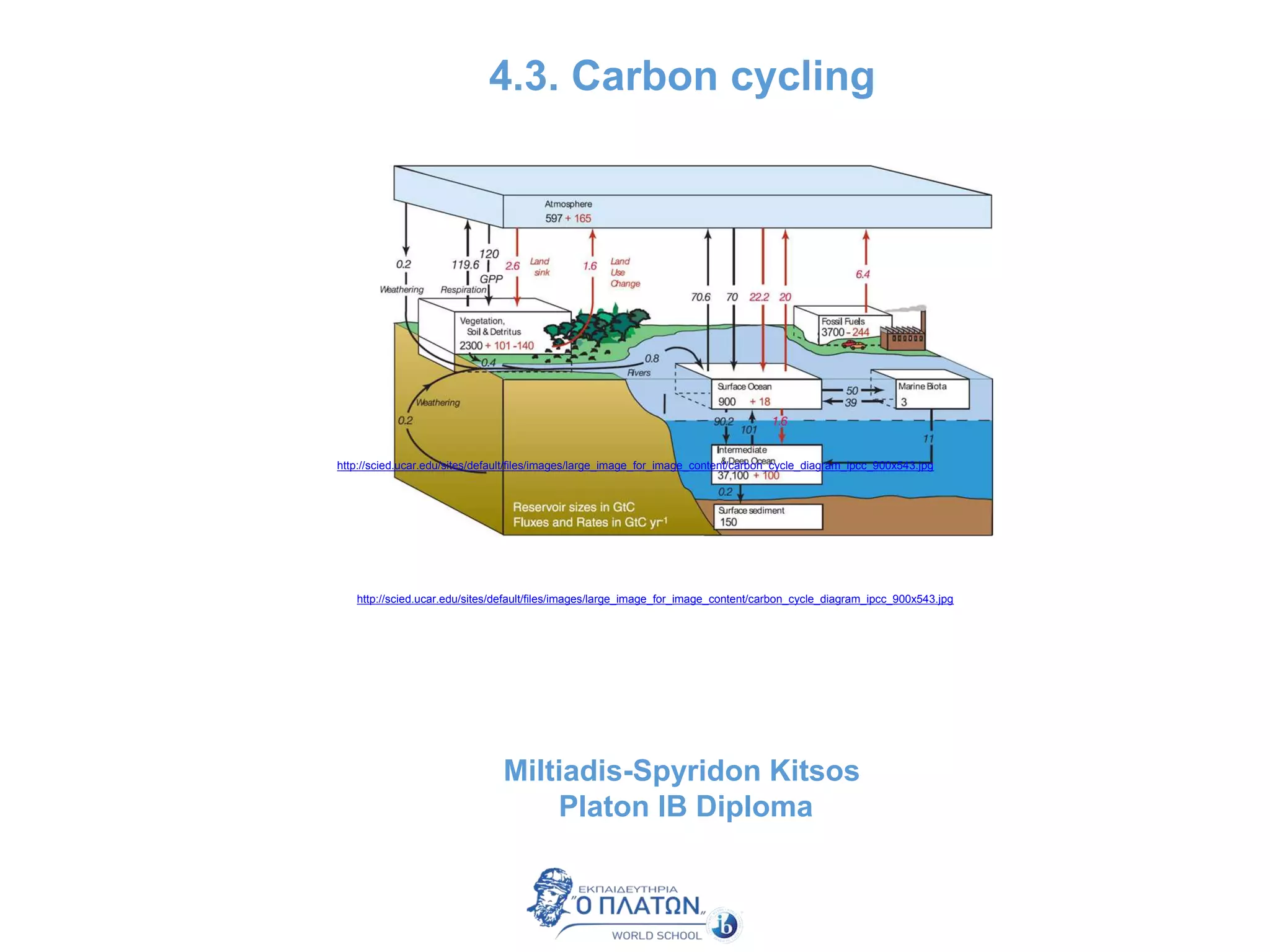
http://scied.ucar.edu/sites/default/files/images/large_image_for_image_content/carbon_cycle_diagram_ipcc_900x543.jpg
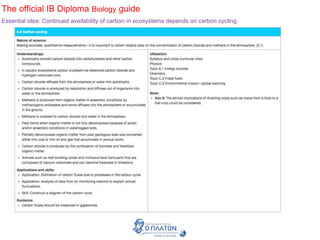
The official IB Diploma Biology guide
Essential idea: Continued availability of carbon in ecosystems depends on carbon cycling.
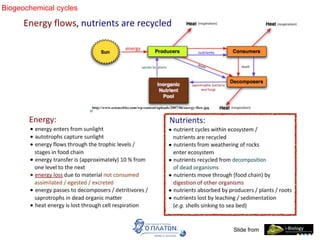
Biogeochemical cycles
Slide from
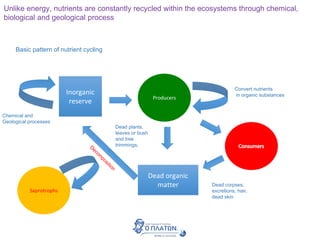
Unlike energy, nutrients are constantly recycled within the ecosystems through chemical,
biological and geological process
Inorganic
reserve
Producers
Basic pattern of nutrient cycling
Convert nutrients
in organic substances
Chemical and
Geological processes
Dead organic
matter Dead corpses,
excretions, hair,
dead skin
Dead plants,
leaves or bush
and tree
trimmings,
Saprotrophs
Biogeochemical cycles
Slide from
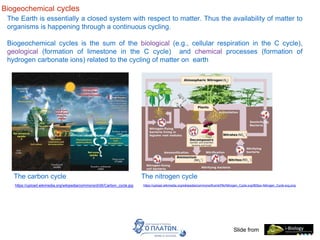
The Earth is essentially a closed system with respect to matter. Thus the availability of matter to
organisms is happening through a continuous cycling.
Biogeochemical cycles is the sum of the biological (e.g., cellular respiration in the C cycle),
geological (formation of limestone in the C cycle) and chemical processes (formation of
hydrogen carbonate ions) related to the cycling of matter on earth
The carbon cycle
https://upload.wikimedia.org/wikipedia/commons/d/d5/Carbon_cycle.jpg
The nitrogen cycle
https://upload.wikimedia.org/wikipedia/commons/thumb/f/fe/Nitrogen_Cycle.svg/800px-Nitrogen_Cycle.svg.png
Carbon input in the ecosystems - Fixation
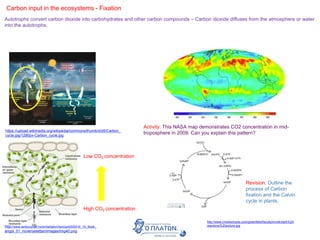
Autotrophs convert carbon dioxide into carbohydrates and other carbon compounds – Carbon dioxide diffuses from the atmosphere or water
into the autotrophs.
Revision: Outline the
process of Carbon
fixation and the Calvin
cycle in plants.
http://www.cms4schools.com/greenfield/faculty/mvolk/dark%20
reactions%20picture.jpg
https://upload.wikimedia.org/wikipedia/commons/thumb/d/d5/Carbon_
cycle.jpg/1280px-Carbon_cycle.jpg
Activity: This NASA map demonstrates CO2 concentration in mid-
troposphere in 2009. Can you explain this pattern?
http://www.tankonyvtar.hu/en/tartalom/tamop425/0010_1A_Book_
angol_01_novenyelettan/images/img40.png
Low CO2 concentration
High CO2 concentration
Carbon input in the ecosystems – Aquatic ecosystems
http://image.slidesharecdn.com/biok4-150219124749-conversion-
gate02/95/bioknowledgy-43-carbon-cycling-11-638.jpg?cb=1424350183
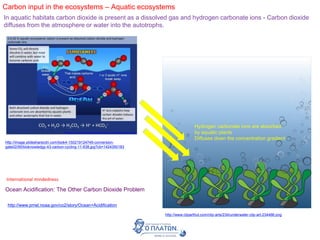
In aquatic habitats carbon dioxide is present as a dissolved gas and hydrogen carbonate ions - Carbon dioxide
diffuses from the atmosphere or water into the autotrophs.
http://www.cliparthut.com/clip-arts/234/underwater-clip-art-234466.png
International mindedness
http://www.pmel.noaa.gov/co2/story/Ocean+Acidification
Ocean Acidification: The Other Carbon Dioxide Problem
Hydrogen carbonate ions are absorbed
by aquatic plants
Diffuses down the concentration gradient
Release of CO2 - cell respiration
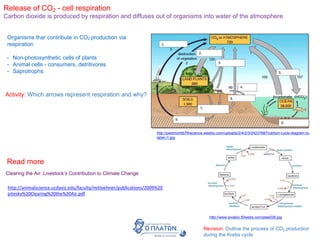
Carbon dioxide is produced by respiration and diffuses out of organisms into water of the atmosphere
Revision: Outline the process of CO2 production
during the Krebs cycle
http://www.sivabio.50webs.com/plas036.jpg
Activity: Which arrows represent respiration and why?
Clearing the Air: Livestock’s Contribution to Climate Change
Read more
http://animalscience.ucdavis.edu/faculty/mitloehner/publications/2009%20
pitesky%20Clearing%20the%20Air.pdf
http://piedmontib7thscience.weebly.com/uploads/2/4/2/3/24237687/carbon-cycle-diagram-to-
label-i1.jpg
Organisms thar contribute in CO2 production via
respiration
• Non-photosynthetic cells of plants
• Animal cells - consumers, detritivores
• Saprotrophs
Release of CO2 - cell respiration
Carbon dioxide is produced by respiration and diffuses out of organisms into water of the atmosphere
Revision: Outline the process of CO2 production
during the Krebs cycle
http://www.sivabio.50webs.com/plas036.jpg
Clearing the Air: Livestock’s Contribution to Climate Change
Read more
http://animalscience.ucdavis.edu/faculty/mitloehner/publications/2009%20pitesky%20
Clearing%20the%20Air.pdf
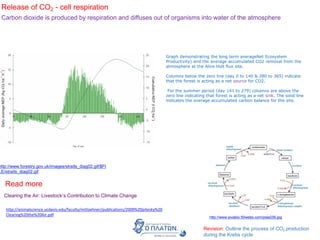
http://www.forestry.gov.uk/images/straits_diag02.gif/$FI
LE/straits_diag02.gif
Graph demonstrating the long term averageNet Ecosystem
Productivity) and the average accumulated CO2 removal from the
atmosphere at the Alice Holt flux site.
Columns below the zero line (day 0 to 140 & 280 to 365) indicate
that the forest is acting as a net source for CO2.
For the summer period (day 141 to 279) columns are above the
zero line indicating that forest is acting as a net sink. The solid line
indicates the average accumulated carbon balance for the site.
Methane and Methanogenesis
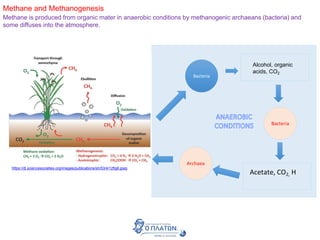
Methane is produced from organic mater in anaerobic conditions by methanogenic archaeans (bacteria) and
some diffuses into the atmosphere.
https://dl.sciencesocieties.org/images/publications/sh/53/4/12fig6.jpeg
Bacteria
Alcohol, organic
acids, CO2
Bacteria
Acetate, CO2, H
Archaea
Methane and Methanogenesis
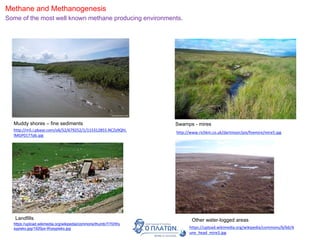
Some of the most well known methane producing environments.
http://m5.i.pbase.com/o6/52/679252/1/115312855.NCZy9Qhl.
IMGP0177pb.jpg
Muddy shores – fine sediments
http://www.richkni.co.uk/dartmoor/pix/foxmire/mire5.jpg
Swamps - mires
https://upload.wikimedia.org/wikipedia/commons/thumb/7/70/Wy
sypisko.jpg/1920px-Wysypisko.jpg
Landfills
https://upload.wikimedia.org/wikipedia/commons/b/b6/A
une_head_mire3.jpg
Other water-logged areas
Methane and Methanogenesis: Oxidation of methane
http://www.ux1.eiu.edu/~cfjps/1400/TBL01_0T2.JPG
Methane atmospheric concentration is very low in
comparison to the amount released in the
atmosphere.
Methane is oxidized to carbon dioxide and water in the atmosphere.
Methane is gradually oxidized in the atmosphere.
Hydroxyl (OH-) radicals and monatomic oxygen (0-)
play an important role.
http://media-3.web.britannica.com/eb-media/22/6022-004-
32EBE121.jpg
Methane and Methanogenesis: Oxidation of methane
Methane is oxidized to carbon dioxide and water in the atmosphere.
Methane persists in the atmosphere
for a period of 12 years.
However, atmospheric data from
Mauna Loa, Hawaii, and other
monitoring stations indicate a gradual
increase of the concentration in the
atmosphere.
Formation of Peat
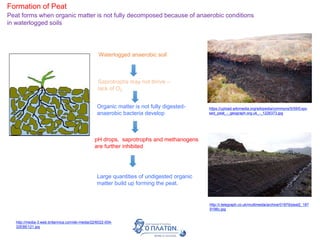
Peat forms when organic matter is not fully decomposed because of anaerobic conditions
in waterlogged soils
http://media-3.web.britannica.com/eb-media/22/6022-004-
32EBE121.jpg
https://upload.wikimedia.org/wikipedia/commons/5/59/Expo
sed_peat_-_geograph.org.uk_-_1226373.jpg
Waterlogged anaerobic soil
Saprotrophs may not thrive –
lack of O2
Organic matter is not fully digested-
anaerobic bacteria develop
pH drops, saprotrophs and methanogens
are further inhibited
http://i.telegraph.co.uk/multimedia/archive/01879/peat2_187
9196c.jpg
Large quantities of undigested organic
matter build up forming the peat.
Peat plant, Irdyn swampland,
https://upload.wikimedia.org/wikipedia/commons/thumb/6/64/Peat_plant_1%2C_2006.5.JPG/48
9px-Peat_plant_1%2C_2006.5.JPG
Peat forms when organic matter is not fully decomposed because of anaerobic conditions
in waterlogged soils
https://upload.wikimedia.org/wikipedia/commons/4/43/Peat-bog-Ireland.jpg
Peat may be used as a fuel
and is burned in old-
fashioned peat plants
Slide from
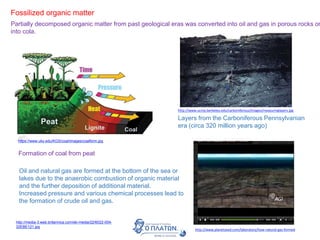
Fossilized organic matter
Partially decomposed organic matter from past geological eras was converted into oil and gas in porous rocks or
into cola.
http://media-3.web.britannica.com/eb-media/22/6022-004-
32EBE121.jpg
https://www.uky.edu/KGS/coal/images/coalform.jpg
Formation of coal from peat
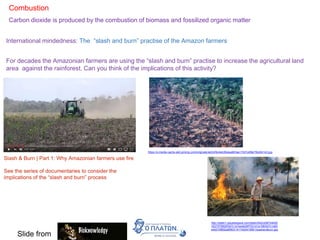
Layers from the Carboniferous Pennsylvanian
era (circa 320 million years ago)
http://www.ucmp.berkeley.edu/carboniferous/images/measuringlayers.jpg
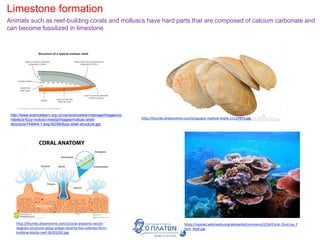
Oil and natural gas are formed at the bottom of the sea or
lakes due to the anaerobic combustion of organic material
and the further deposition of additional material.
Increased pressure and various chemical processes lead to
the formation of crude oil and gas.
http://www.planetseed.com/laboratory/how-natural-gas-formed
Combustion
Carbon dioxide is produced by the combustion of biomass and fossilized organic matter
Complete Combustion is a reaction in which organic matter is fully oxidized to CO2 and H2O (in the
presence of O2)
Fires
Naturally
occurring Human induced
http://news.psu.edu/sites/default/files/styles/threshold-992/public/forest_floor_fire.jpg
http://constantine.typepad.com/.a/6a0120a7fc3be9970b017743aa2
cbd970d-pi
http://hardenup.org/media/307462/coal_fire_station_pic.jpg
Combustion of fossil fuels
Combustion
Carbon dioxide is produced by the combustion of biomass and fossilized organic matter
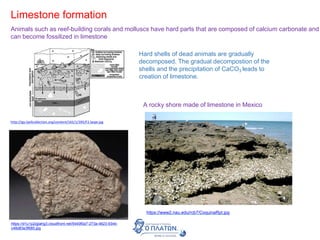
International mindedness: The “slash and burn” practise of the Amazon farmers
For decades the Amazonian farmers are using the “slash and burn” practise to increase the agricultural land
area against the rainforest. Can you think of the implications of this activity?
Slash & Burn | Part 1: Why Amazonian farmers use fire
See the series of documentaries to consider the
implications of the “slash and burn” process
https://s-media-cache-ak0.pinimg.com/originals/4e/b3/fe/4eb3fe4aa603ae17d31e99e70bd54143.jpg
http://static1.squarespace.com/static/542ce587e4b00
3527579fd2f/547c1e7ee4b00f7531d1a108/547c1e83
e4b019f892a8f903/1417420419951/slashandburn.jpg
Slide from
Limestone formation
Animals such as reef-building corals and molluscs have hard parts that are composed of calcium carbonate and
can become fossilized in limestone
http://www.sciencelearn.org.nz/var/sciencelearn/storage/images/co
ntexts/a-fizzy-rock/sci-media/images/mollusc-shell-
structure/744044-1-eng-NZ/Mollusc-shell-structure.jpg
http://thumbs.dreamstime.com/x/aquatic-mollusk-shells-11137975.jpg
http://thumbs.dreamstime.com/z/coral-anatomy-vector-
diagram-structure-polyp-polyps-tend-to-live-colonies-form-
building-blocks-reef-36203292.jpg
https://upload.wikimedia.org/wikipedia/commons/2/2e/Coral_Outcrop_F
lynn_Reef.jpg
Limestone formation
Animals such as reef-building corals and molluscs have hard parts that are composed of calcium carbonate and
can become fossilized in limestone
http://jgs.lyellcollection.org/content/165/1/395/F2.large.jpg
Hard shells of dead animals are gradually
decomposed. The gradual decompostion of the
shells and the precipitation of CaCO3 leads to
creation of limestone.
https://d1u1p2xjjiahg3.cloudfront.net/5440f0a7-273a-4823-9344-
c48d83e3f685.jpg
https://www2.nau.edu/rcb7/CoquinaRpt.jpg
A rocky shore made of limestone in Mexico
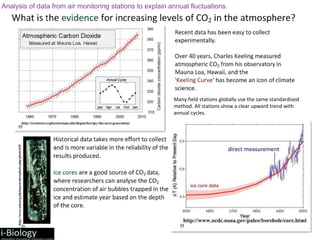
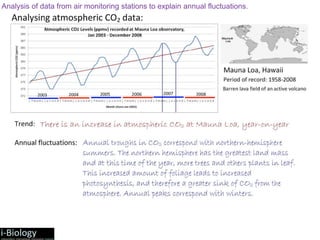
Analysis of data from air monitoring stations to explain annual fluctuations.
Many field stations globally use the same standardised
method. All stations show a clear upward trend with
annual cycles.
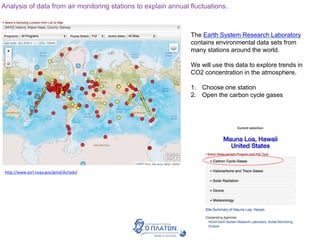
http://www.esrl.noaa.gov/gmd/dv/iadv/
The Earth System Research Laboratory
contains environmental data sets from
many stations around the world.
We will use this data to explore trends in
CO2 concentration in the atmosphere.
1. Choose one station
2. Open the carbon cycle gases
Analysis of data from air monitoring stations to explain annual fluctuations.
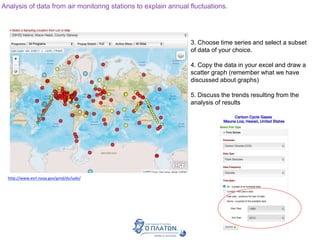
http://www.esrl.noaa.gov/gmd/dv/iadv/
3. Choose time series and select a subset
of data of your choice.
4. Copy the data in your excel and draw a
scatter graph (remember what we have
discussed about graphs)
5. Discuss the trends resulting from the
analysis of results
Analysis of data from air monitoring stations to explain annual fluctuations.
https://www.ncdc.noaa.gov/cdo/f?p=518:1:0:::APP:PROXYTOS
EARCH:7
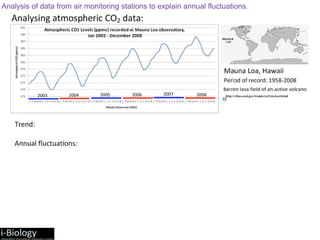
Analysis of data from air monitoring stations to explain annual fluctuations.
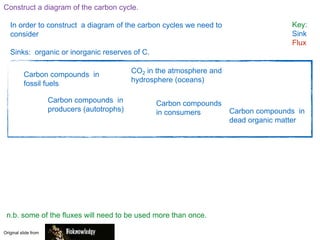
Construct a diagram of the carbon cycle.
CO2 in the atmosphere and
hydrosphere (oceans)
In order to construct a diagram of the carbon cycles we need to
consider
Sinks: organic or inorganic reserves of C.
Carbon compounds in
producers (autotrophs)
Carbon compounds
in consumers Carbon compounds in
dead organic matter
Key:
Sink
Flux
n.b. some of the fluxes will need to be used more than once.
Original slide from
Carbon compounds in
fossil fuels
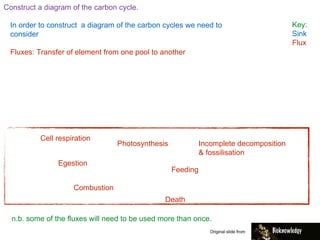
Construct a diagram of the carbon cycle.
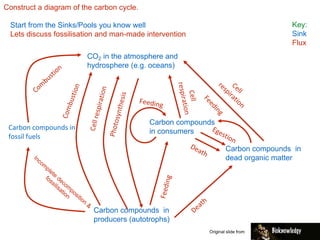
In order to construct a diagram of the carbon cycles we need to
consider
Fluxes: Transfer of element from one pool to another
Key:
Sink
Flux
n.b. some of the fluxes will need to be used more than once.
Cell respiration
Photosynthesis
Combustion
Feeding
Egestion
Death
Incomplete decomposition
& fossilisation
Original slide from
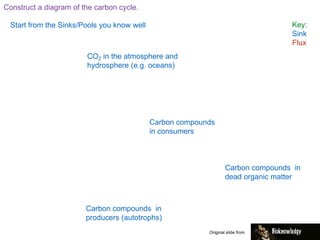
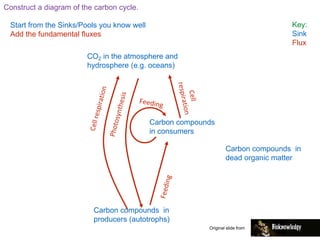
Construct a diagram of the carbon cycle.
Start from the Sinks/Pools you know well Key:
Sink
Flux
CO2 in the atmosphere and
hydrosphere (e.g. oceans)
Carbon compounds in
producers (autotrophs)
Carbon compounds
in consumers
Carbon compounds in
dead organic matter
Original slide from
Construct a diagram of the carbon cycle.
Start from the Sinks/Pools you know well
Add the fundamental fluxes
Key:
Sink
Flux
CO2 in the atmosphere and
hydrosphere (e.g. oceans)
Carbon compounds in
producers (autotrophs)
Carbon compounds
in consumers
Carbon compounds in
dead organic matter
Original slide from
Construct a diagram of the carbon cycle.
Start from the Sinks/Pools you know well
Add the fundamental fluxes
Key:
Sink
Flux
CO2 in the atmosphere and
hydrosphere (e.g. oceans)
Carbon compounds in
producers (autotrophs)
Carbon compounds
in consumers
Carbon compounds in
dead organic matter
Original slide from
Construct a diagram of the carbon cycle.
Start from the Sinks/Pools you know well
Lets discuss fossilisation and man-made intervention
Key:
Sink
Flux
CO2 in the atmosphere and
hydrosphere (e.g. oceans)
Carbon compounds in
producers (autotrophs)
Carbon compounds
in consumers
Carbon compounds in
dead organic matter
Carbon compounds in
fossil fuels
Original slide from
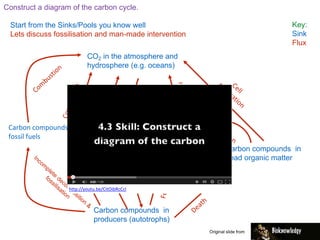
Construct a diagram of the carbon cycle.
Start from the Sinks/Pools you know well
Lets discuss fossilisation and man-made intervention
Key:
Sink
Flux
CO2 in the atmosphere and
hydrosphere (e.g. oceans)
Carbon compounds in
producers (autotrophs)
Carbon compounds
in consumers
Carbon compounds in
dead organic matter
Carbon compounds in
fossil fuels
Original slide from
http://youtu.be/CitOibRcCcI
Construct a diagram of the carbon cycle.
Start from the Sinks/Pools you know well
Lets discuss fossilisation and man-made intervention
Key:
Sink
Flux
CO2 in the atmosphere and
hydrosphere (e.g. oceans)
Carbon compounds in
producers (autotrophs)
Carbon compounds
in consumers
Carbon compounds in
dead organic matter
Carbon compounds in
fossil fuels
Original slide from
Extend your understanding:
Between which sinks would you add a flux showing volcanoes and the weathering of
rocks?
What additional sink would you add to show the role of corals and shellfish? What
additional flux would be needed?
In some environments water is unable to drain out of soils so they become
waterlogged and anaerobic. This prevents the decomposition of dead organic matter
forming peat deposits [4.3.U7]. Peat can be dried and burnt as a fuel. Suggest how
peat could be added to the carbon cycle.
Explain why fossil fuels are classified as non-renewable resources when the carbon
cycle indicates they are renewed (hint: refer to the pictorial carbon cycle).
Diffusion is a flux that moves CO2 from the atmosphere to the hydrosphere and back
again. Taken together these fluxes are largest in the cycle suggest why.
www.stepsinbiology.com

4.3 Carbon cycling

  • 1.
    4.3. Carbon cycling Miltiadis-SpyridonKitsos Platon IB Diploma http://scied.ucar.edu/sites/default/files/images/large_image_for_image_content/carbon_cycle_diagram_ipcc_900x543.jpg http://scied.ucar.edu/sites/default/files/images/large_image_for_image_content/carbon_cycle_diagram_ipcc_900x543.jpg
  • 2.
    The official IBDiploma Biology guide Essential idea: Continued availability of carbon in ecosystems depends on carbon cycling.
  • 3.
  • 4.
    Unlike energy, nutrientsare constantly recycled within the ecosystems through chemical, biological and geological process Inorganic reserve Producers Basic pattern of nutrient cycling Convert nutrients in organic substances Chemical and Geological processes Dead organic matter Dead corpses, excretions, hair, dead skin Dead plants, leaves or bush and tree trimmings, Saprotrophs
  • 5.
    Biogeochemical cycles Slide from TheEarth is essentially a closed system with respect to matter. Thus the availability of matter to organisms is happening through a continuous cycling. Biogeochemical cycles is the sum of the biological (e.g., cellular respiration in the C cycle), geological (formation of limestone in the C cycle) and chemical processes (formation of hydrogen carbonate ions) related to the cycling of matter on earth The carbon cycle https://upload.wikimedia.org/wikipedia/commons/d/d5/Carbon_cycle.jpg The nitrogen cycle https://upload.wikimedia.org/wikipedia/commons/thumb/f/fe/Nitrogen_Cycle.svg/800px-Nitrogen_Cycle.svg.png
  • 6.
    Carbon input inthe ecosystems - Fixation Autotrophs convert carbon dioxide into carbohydrates and other carbon compounds – Carbon dioxide diffuses from the atmosphere or water into the autotrophs. Revision: Outline the process of Carbon fixation and the Calvin cycle in plants. http://www.cms4schools.com/greenfield/faculty/mvolk/dark%20 reactions%20picture.jpg https://upload.wikimedia.org/wikipedia/commons/thumb/d/d5/Carbon_ cycle.jpg/1280px-Carbon_cycle.jpg Activity: This NASA map demonstrates CO2 concentration in mid- troposphere in 2009. Can you explain this pattern? http://www.tankonyvtar.hu/en/tartalom/tamop425/0010_1A_Book_ angol_01_novenyelettan/images/img40.png Low CO2 concentration High CO2 concentration
  • 7.
    Carbon input inthe ecosystems – Aquatic ecosystems http://image.slidesharecdn.com/biok4-150219124749-conversion- gate02/95/bioknowledgy-43-carbon-cycling-11-638.jpg?cb=1424350183 In aquatic habitats carbon dioxide is present as a dissolved gas and hydrogen carbonate ions - Carbon dioxide diffuses from the atmosphere or water into the autotrophs. http://www.cliparthut.com/clip-arts/234/underwater-clip-art-234466.png International mindedness http://www.pmel.noaa.gov/co2/story/Ocean+Acidification Ocean Acidification: The Other Carbon Dioxide Problem Hydrogen carbonate ions are absorbed by aquatic plants Diffuses down the concentration gradient
  • 8.
    Release of CO2- cell respiration Carbon dioxide is produced by respiration and diffuses out of organisms into water of the atmosphere Revision: Outline the process of CO2 production during the Krebs cycle http://www.sivabio.50webs.com/plas036.jpg Activity: Which arrows represent respiration and why? Clearing the Air: Livestock’s Contribution to Climate Change Read more http://animalscience.ucdavis.edu/faculty/mitloehner/publications/2009%20 pitesky%20Clearing%20the%20Air.pdf http://piedmontib7thscience.weebly.com/uploads/2/4/2/3/24237687/carbon-cycle-diagram-to- label-i1.jpg Organisms thar contribute in CO2 production via respiration • Non-photosynthetic cells of plants • Animal cells - consumers, detritivores • Saprotrophs
  • 9.
    Release of CO2- cell respiration Carbon dioxide is produced by respiration and diffuses out of organisms into water of the atmosphere Revision: Outline the process of CO2 production during the Krebs cycle http://www.sivabio.50webs.com/plas036.jpg Clearing the Air: Livestock’s Contribution to Climate Change Read more http://animalscience.ucdavis.edu/faculty/mitloehner/publications/2009%20pitesky%20 Clearing%20the%20Air.pdf http://www.forestry.gov.uk/images/straits_diag02.gif/$FI LE/straits_diag02.gif Graph demonstrating the long term averageNet Ecosystem Productivity) and the average accumulated CO2 removal from the atmosphere at the Alice Holt flux site. Columns below the zero line (day 0 to 140 & 280 to 365) indicate that the forest is acting as a net source for CO2. For the summer period (day 141 to 279) columns are above the zero line indicating that forest is acting as a net sink. The solid line indicates the average accumulated carbon balance for the site.
  • 10.
    Methane and Methanogenesis Methaneis produced from organic mater in anaerobic conditions by methanogenic archaeans (bacteria) and some diffuses into the atmosphere. https://dl.sciencesocieties.org/images/publications/sh/53/4/12fig6.jpeg Bacteria Alcohol, organic acids, CO2 Bacteria Acetate, CO2, H Archaea
  • 11.
    Methane and Methanogenesis Someof the most well known methane producing environments. http://m5.i.pbase.com/o6/52/679252/1/115312855.NCZy9Qhl. IMGP0177pb.jpg Muddy shores – fine sediments http://www.richkni.co.uk/dartmoor/pix/foxmire/mire5.jpg Swamps - mires https://upload.wikimedia.org/wikipedia/commons/thumb/7/70/Wy sypisko.jpg/1920px-Wysypisko.jpg Landfills https://upload.wikimedia.org/wikipedia/commons/b/b6/A une_head_mire3.jpg Other water-logged areas
  • 12.
    Methane and Methanogenesis:Oxidation of methane http://www.ux1.eiu.edu/~cfjps/1400/TBL01_0T2.JPG Methane atmospheric concentration is very low in comparison to the amount released in the atmosphere. Methane is oxidized to carbon dioxide and water in the atmosphere. Methane is gradually oxidized in the atmosphere. Hydroxyl (OH-) radicals and monatomic oxygen (0-) play an important role. http://media-3.web.britannica.com/eb-media/22/6022-004- 32EBE121.jpg
  • 13.
    Methane and Methanogenesis:Oxidation of methane Methane is oxidized to carbon dioxide and water in the atmosphere. Methane persists in the atmosphere for a period of 12 years. However, atmospheric data from Mauna Loa, Hawaii, and other monitoring stations indicate a gradual increase of the concentration in the atmosphere.
  • 14.
    Formation of Peat Peatforms when organic matter is not fully decomposed because of anaerobic conditions in waterlogged soils http://media-3.web.britannica.com/eb-media/22/6022-004- 32EBE121.jpg https://upload.wikimedia.org/wikipedia/commons/5/59/Expo sed_peat_-_geograph.org.uk_-_1226373.jpg Waterlogged anaerobic soil Saprotrophs may not thrive – lack of O2 Organic matter is not fully digested- anaerobic bacteria develop pH drops, saprotrophs and methanogens are further inhibited http://i.telegraph.co.uk/multimedia/archive/01879/peat2_187 9196c.jpg Large quantities of undigested organic matter build up forming the peat.
  • 15.
    Peat plant, Irdynswampland, https://upload.wikimedia.org/wikipedia/commons/thumb/6/64/Peat_plant_1%2C_2006.5.JPG/48 9px-Peat_plant_1%2C_2006.5.JPG Peat forms when organic matter is not fully decomposed because of anaerobic conditions in waterlogged soils https://upload.wikimedia.org/wikipedia/commons/4/43/Peat-bog-Ireland.jpg Peat may be used as a fuel and is burned in old- fashioned peat plants Slide from
  • 16.
    Fossilized organic matter Partiallydecomposed organic matter from past geological eras was converted into oil and gas in porous rocks or into cola. http://media-3.web.britannica.com/eb-media/22/6022-004- 32EBE121.jpg https://www.uky.edu/KGS/coal/images/coalform.jpg Formation of coal from peat Layers from the Carboniferous Pennsylvanian era (circa 320 million years ago) http://www.ucmp.berkeley.edu/carboniferous/images/measuringlayers.jpg Oil and natural gas are formed at the bottom of the sea or lakes due to the anaerobic combustion of organic material and the further deposition of additional material. Increased pressure and various chemical processes lead to the formation of crude oil and gas. http://www.planetseed.com/laboratory/how-natural-gas-formed
  • 17.
    Combustion Carbon dioxide isproduced by the combustion of biomass and fossilized organic matter Complete Combustion is a reaction in which organic matter is fully oxidized to CO2 and H2O (in the presence of O2) Fires Naturally occurring Human induced http://news.psu.edu/sites/default/files/styles/threshold-992/public/forest_floor_fire.jpg http://constantine.typepad.com/.a/6a0120a7fc3be9970b017743aa2 cbd970d-pi http://hardenup.org/media/307462/coal_fire_station_pic.jpg Combustion of fossil fuels
  • 18.
    Combustion Carbon dioxide isproduced by the combustion of biomass and fossilized organic matter International mindedness: The “slash and burn” practise of the Amazon farmers For decades the Amazonian farmers are using the “slash and burn” practise to increase the agricultural land area against the rainforest. Can you think of the implications of this activity? Slash & Burn | Part 1: Why Amazonian farmers use fire See the series of documentaries to consider the implications of the “slash and burn” process https://s-media-cache-ak0.pinimg.com/originals/4e/b3/fe/4eb3fe4aa603ae17d31e99e70bd54143.jpg http://static1.squarespace.com/static/542ce587e4b00 3527579fd2f/547c1e7ee4b00f7531d1a108/547c1e83 e4b019f892a8f903/1417420419951/slashandburn.jpg Slide from
  • 19.
    Limestone formation Animals suchas reef-building corals and molluscs have hard parts that are composed of calcium carbonate and can become fossilized in limestone http://www.sciencelearn.org.nz/var/sciencelearn/storage/images/co ntexts/a-fizzy-rock/sci-media/images/mollusc-shell- structure/744044-1-eng-NZ/Mollusc-shell-structure.jpg http://thumbs.dreamstime.com/x/aquatic-mollusk-shells-11137975.jpg http://thumbs.dreamstime.com/z/coral-anatomy-vector- diagram-structure-polyp-polyps-tend-to-live-colonies-form- building-blocks-reef-36203292.jpg https://upload.wikimedia.org/wikipedia/commons/2/2e/Coral_Outcrop_F lynn_Reef.jpg
  • 20.
    Limestone formation Animals suchas reef-building corals and molluscs have hard parts that are composed of calcium carbonate and can become fossilized in limestone http://jgs.lyellcollection.org/content/165/1/395/F2.large.jpg Hard shells of dead animals are gradually decomposed. The gradual decompostion of the shells and the precipitation of CaCO3 leads to creation of limestone. https://d1u1p2xjjiahg3.cloudfront.net/5440f0a7-273a-4823-9344- c48d83e3f685.jpg https://www2.nau.edu/rcb7/CoquinaRpt.jpg A rocky shore made of limestone in Mexico
  • 21.
    Analysis of datafrom air monitoring stations to explain annual fluctuations. Many field stations globally use the same standardised method. All stations show a clear upward trend with annual cycles.
  • 22.
    http://www.esrl.noaa.gov/gmd/dv/iadv/ The Earth SystemResearch Laboratory contains environmental data sets from many stations around the world. We will use this data to explore trends in CO2 concentration in the atmosphere. 1. Choose one station 2. Open the carbon cycle gases Analysis of data from air monitoring stations to explain annual fluctuations.
  • 23.
    http://www.esrl.noaa.gov/gmd/dv/iadv/ 3. Choose timeseries and select a subset of data of your choice. 4. Copy the data in your excel and draw a scatter graph (remember what we have discussed about graphs) 5. Discuss the trends resulting from the analysis of results Analysis of data from air monitoring stations to explain annual fluctuations.
  • 24.
    Analysis of datafrom air monitoring stations to explain annual fluctuations.
  • 25.
    Analysis of datafrom air monitoring stations to explain annual fluctuations.
  • 26.
    Analysis of datafrom air monitoring stations to explain annual fluctuations.
  • 27.
    https://www.ncdc.noaa.gov/cdo/f?p=518:1:0:::APP:PROXYTOS EARCH:7 Analysis of datafrom air monitoring stations to explain annual fluctuations.
  • 28.
    Construct a diagramof the carbon cycle. CO2 in the atmosphere and hydrosphere (oceans) In order to construct a diagram of the carbon cycles we need to consider Sinks: organic or inorganic reserves of C. Carbon compounds in producers (autotrophs) Carbon compounds in consumers Carbon compounds in dead organic matter Key: Sink Flux n.b. some of the fluxes will need to be used more than once. Original slide from Carbon compounds in fossil fuels
  • 29.
    Construct a diagramof the carbon cycle. In order to construct a diagram of the carbon cycles we need to consider Fluxes: Transfer of element from one pool to another Key: Sink Flux n.b. some of the fluxes will need to be used more than once. Cell respiration Photosynthesis Combustion Feeding Egestion Death Incomplete decomposition & fossilisation Original slide from
  • 30.
    Construct a diagramof the carbon cycle. Start from the Sinks/Pools you know well Key: Sink Flux CO2 in the atmosphere and hydrosphere (e.g. oceans) Carbon compounds in producers (autotrophs) Carbon compounds in consumers Carbon compounds in dead organic matter Original slide from
  • 31.
    Construct a diagramof the carbon cycle. Start from the Sinks/Pools you know well Add the fundamental fluxes Key: Sink Flux CO2 in the atmosphere and hydrosphere (e.g. oceans) Carbon compounds in producers (autotrophs) Carbon compounds in consumers Carbon compounds in dead organic matter Original slide from
  • 32.
    Construct a diagramof the carbon cycle. Start from the Sinks/Pools you know well Add the fundamental fluxes Key: Sink Flux CO2 in the atmosphere and hydrosphere (e.g. oceans) Carbon compounds in producers (autotrophs) Carbon compounds in consumers Carbon compounds in dead organic matter Original slide from
  • 33.
    Construct a diagramof the carbon cycle. Start from the Sinks/Pools you know well Lets discuss fossilisation and man-made intervention Key: Sink Flux CO2 in the atmosphere and hydrosphere (e.g. oceans) Carbon compounds in producers (autotrophs) Carbon compounds in consumers Carbon compounds in dead organic matter Carbon compounds in fossil fuels Original slide from
  • 34.
    Construct a diagramof the carbon cycle. Start from the Sinks/Pools you know well Lets discuss fossilisation and man-made intervention Key: Sink Flux CO2 in the atmosphere and hydrosphere (e.g. oceans) Carbon compounds in producers (autotrophs) Carbon compounds in consumers Carbon compounds in dead organic matter Carbon compounds in fossil fuels Original slide from http://youtu.be/CitOibRcCcI
  • 35.
    Construct a diagramof the carbon cycle. Start from the Sinks/Pools you know well Lets discuss fossilisation and man-made intervention Key: Sink Flux CO2 in the atmosphere and hydrosphere (e.g. oceans) Carbon compounds in producers (autotrophs) Carbon compounds in consumers Carbon compounds in dead organic matter Carbon compounds in fossil fuels Original slide from Extend your understanding: Between which sinks would you add a flux showing volcanoes and the weathering of rocks? What additional sink would you add to show the role of corals and shellfish? What additional flux would be needed? In some environments water is unable to drain out of soils so they become waterlogged and anaerobic. This prevents the decomposition of dead organic matter forming peat deposits [4.3.U7]. Peat can be dried and burnt as a fuel. Suggest how peat could be added to the carbon cycle. Explain why fossil fuels are classified as non-renewable resources when the carbon cycle indicates they are renewed (hint: refer to the pictorial carbon cycle). Diffusion is a flux that moves CO2 from the atmosphere to the hydrosphere and back again. Taken together these fluxes are largest in the cycle suggest why.
  • 36.