
Topic 4: Physical Layer
- Chapter 7: Transmission Media
Classes of Transmission Media
Conducted or guided media
 use a conductor such as a wire or a fiber
optic cable to move the signal from sender
to receiver
Wireless or unguided media
 use radio waves of different frequencies
and do not need a wire or cable conductor
to transmit signals
Design Factors
for Transmission Media
Bandwidth: All other factors remaining constant, the
greater the band-width of a signal, the higher the
data rate that can be achieved.
Transmission impairments. Limit the distance a signal
can travel.
Interference: Competing signals in overlapping
frequency bands can distort or wipe out a signal.
Number of receivers: Each attachment introduces
some attenuation and distortion, limiting distance
and/or data rate.
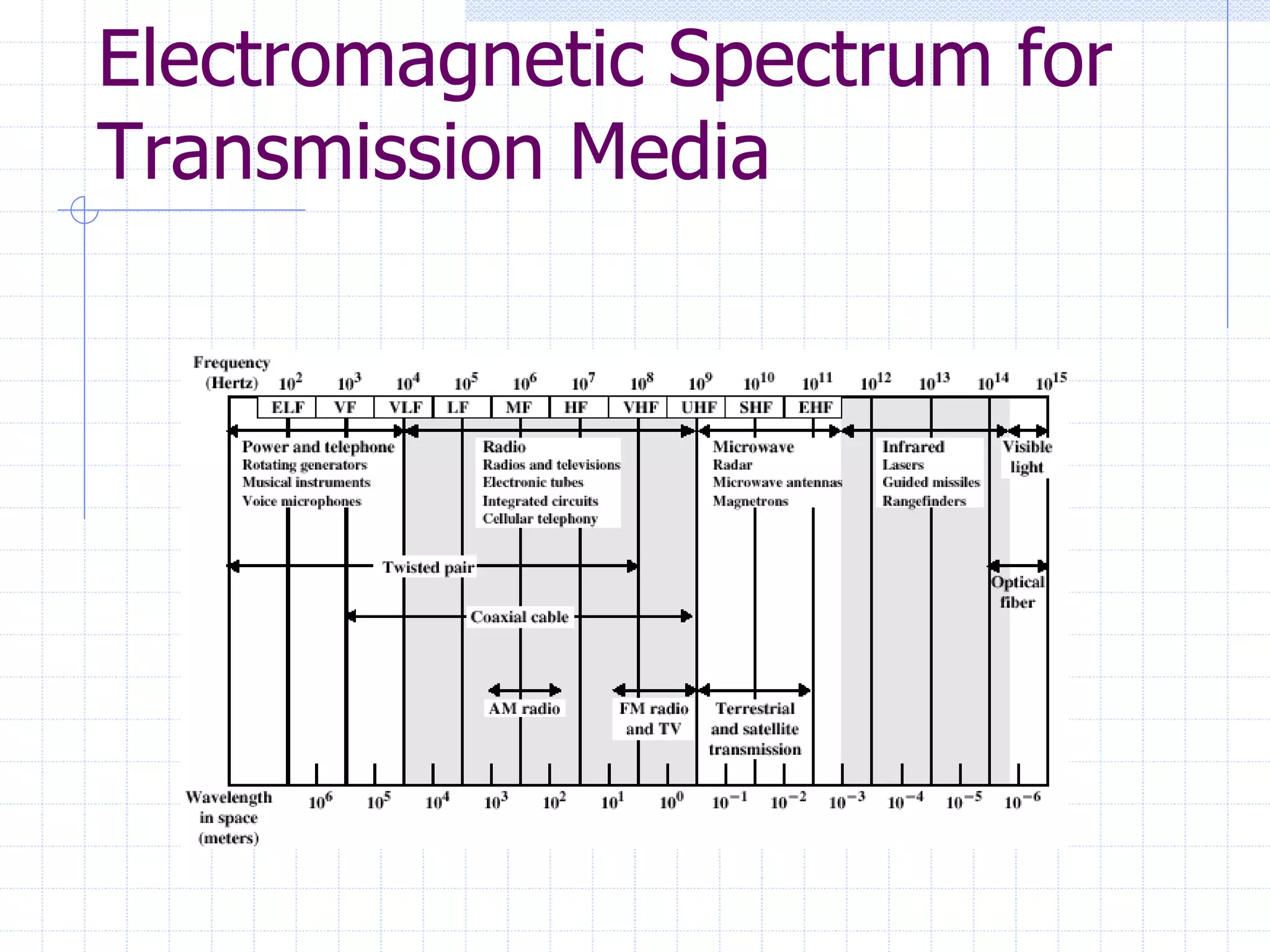
Electromagnetic Spectrum for
Transmission Media
Guided Transmission Media
Transmission capacity depends on the
distance and on whether the medium is
point-to-point or multipoint
Examples
 twisted pair wires
 coaxial cables
 optical fiber
Twisted Pair Wires
Consists of two insulated copper wires
arranged in a regular spiral pattern to
minimize the electromagnetic
interference between adjacent pairs
Often used at customer facilities and
also over distances to carry voice as
well as data communications
Low frequency transmission medium
Types of Twisted Pair
STP (shielded twisted pair)
 the pair is wrapped with metallic foil or
braid to insulate the pair from
electromagnetic interference
UTP (unshielded twisted pair)
 each wire is insulated with plastic wrap,
but the pair is encased in an outer covering
Ratings of Twisted Pair
Category 3 UTP
 data rates of up to 16mbps are achievable
Category 5 UTP
 data rates of up to 100mbps are achievable
 more tightly twisted than Category 3 cables
 more expensive, but better performance
STP
 More expensive, harder to work with
Twisted Pair Advantages
Inexpensive and readily available
Flexible and light weight
Easy to work with and install
Twisted Pair Disadvantages
Susceptibility to interference and noise
Attenuation problem
 For analog, repeaters needed every 5-6km
 For digital, repeaters needed every 2-3km
Relatively low bandwidth (3000Hz)
Coaxial Cable (or Coax)
Used for cable television, LANs,
telephony
Has an inner conductor surrounded by a
braided mesh
Both conductors share a common
center axial, hence the term “co-axial”
Coax Layers
copper or aluminum
conductor
insulating material
shield
(braided wire)
outer jacket
(polyethylene)
Coax Advantages
Higher bandwidth
 400 to 600Mhz
 up to 10,800 voice conversations
Can be tapped easily (pros and cons)
Much less susceptible to interference
than twisted pair
Coax Disadvantages
High attenuation rate makes it
expensive over long distance
Bulky
Fiber Optic Cable
Relatively new transmission medium used by
telephone companies in place of long-
distance trunk lines
Also used by private companies in
implementing local data communications
networks
Require a light source with injection laser
diode (ILD) or light-emitting diodes (LED)
plastic jacket glass or plastic
cladding
fiber core
Fiber Optic Layers
consists of three concentric sections
Fiber Optic Types
multimode step-index fiber
 the reflective walls of the fiber move the light
pulses to the receiver
multimode graded-index fiber
 acts to refract the light toward the center of the
fiber by variations in the density
single mode fiber
 the light is guided down the center of an
extremely narrow core
Fiber Optic Advantages
greater capacity (bandwidth of up to 2
Gbps)
smaller size and lighter weight
lower attenuation
immunity to environmental interference
highly secure due to tap difficulty and
lack of signal radiation
Fiber Optic Disadvantages
expensive over short distance
requires highly skilled installers
adding additional nodes is difficult
Wireless (Unguided Media)
Transmission
transmission and reception are achieved by
means of an antenna
directional
 transmitting antenna puts out focused beam
 transmitter and receiver must be aligned
omnidirectional
 signal spreads out in all directions
 can be received by many antennas
Wireless Examples
terrestrial microwave
satellite microwave
broadcast radio
infrared
Terrestrial Microwave
used for long-distance telephone service
uses radio frequency spectrum, from 2 to 40
Ghz
parabolic dish transmitter, mounted high
used by common carriers as well as private
networks
requires unobstructed line of sight between
source and receiver
curvature of the earth requires stations
(repeaters) ~30 miles apart
Satellite Microwave
Applications
Television distribution
Long-distance telephone transmission
Private business networks
Microwave Transmission
Disadvantages
line of sight requirement
expensive towers and repeaters
subject to interference such as passing
airplanes and rain
Satellite
Microwave Transmission
a microwave relay station in space
can relay signals over long distances
geostationary satellites
 remain above the equator at a height of
22,300 miles (geosynchronous orbit)
 travel around the earth in exactly the time
the earth takes to rotate
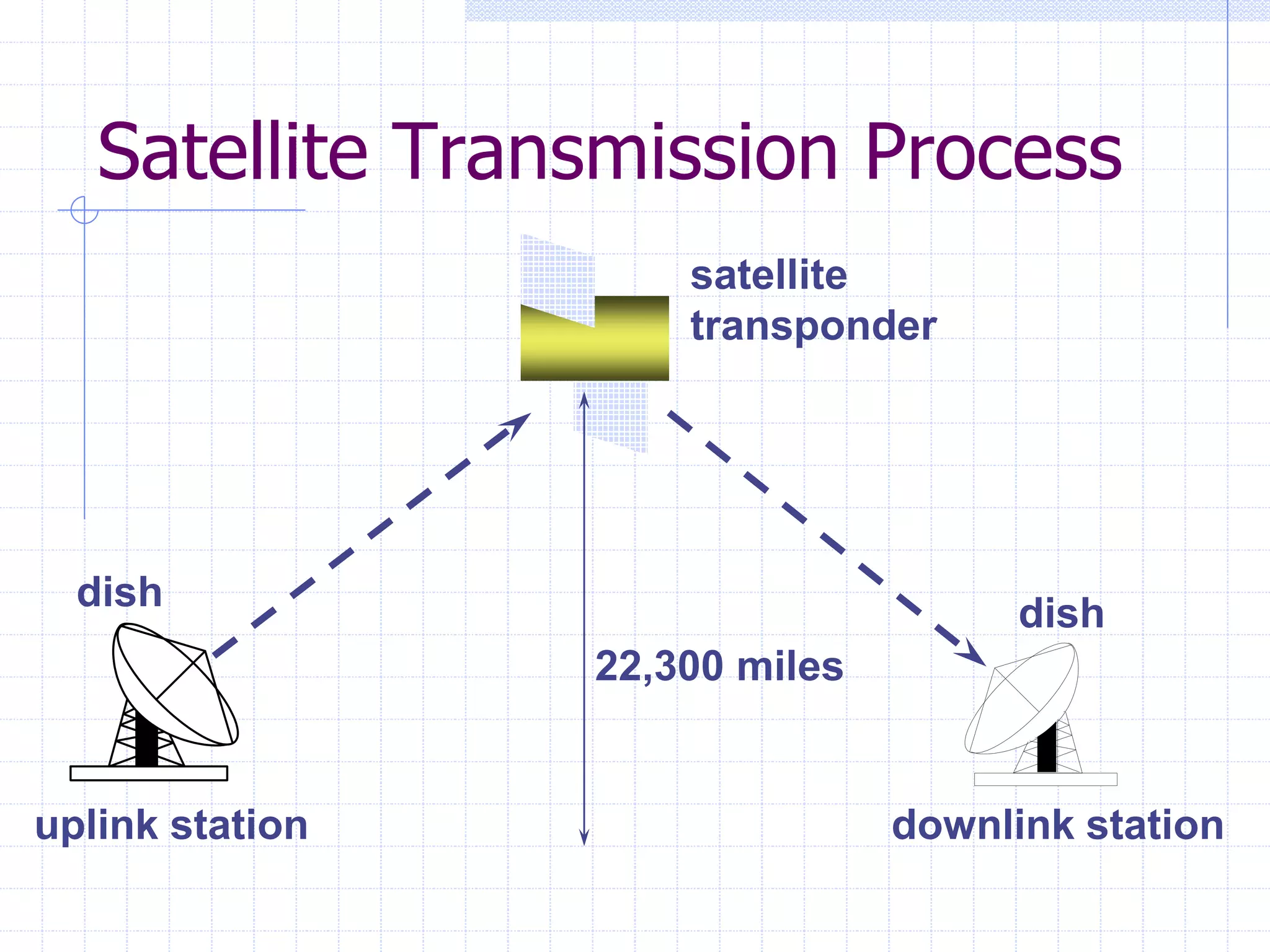
Satellite Transmission Links
earth stations communicate by sending
signals to the satellite on an uplink
the satellite then repeats those signals
on a downlink
the broadcast nature of the downlink
makes it attractive for services such as
the distribution of television
programming
dish
dish
uplink station downlink station
satellite
transponder
22,300 miles
Satellite Transmission Process
Satellite Transmission
Applications
television distribution
 a network provides programming from a
central location
 direct broadcast satellite (DBS)
long-distance telephone transmission
 high-usage international trunks
private business networks
Principal Satellite Transmission
Bands
C band: 4(downlink) - 6(uplink) GHz
 the first to be designated
Ku band: 12(downlink) -14(uplink) GHz
 rain interference is the major problem
Ka band: 19(downlink) - 29(uplink) GHz
 equipment needed to use the band is still
very expensive
Fiber vs Satellite
Radio
radio is omnidirectional and microwave
is directional
Radio is a general term often used to
encompass frequencies in the range 3
kHz to 300 GHz.
Mobile telephony occupies several
frequency bands just under 1 GHz.
Infrared
Uses transmitters/receivers
(transceivers) that modulate
noncoherent infrared light.
Transceivers must be within line of
sight of each other (directly or via
reflection ).
Unlike microwaves, infrared does not
penetrate walls.
Thank you
 Presented by Shubham SIngh

Transmission media 2

  • 1.
    Topic 4: PhysicalLayer - Chapter 7: Transmission Media
  • 2.
    Classes of TransmissionMedia Conducted or guided media  use a conductor such as a wire or a fiber optic cable to move the signal from sender to receiver Wireless or unguided media  use radio waves of different frequencies and do not need a wire or cable conductor to transmit signals
  • 3.
    Design Factors for TransmissionMedia Bandwidth: All other factors remaining constant, the greater the band-width of a signal, the higher the data rate that can be achieved. Transmission impairments. Limit the distance a signal can travel. Interference: Competing signals in overlapping frequency bands can distort or wipe out a signal. Number of receivers: Each attachment introduces some attenuation and distortion, limiting distance and/or data rate.
  • 4.
  • 5.
    Guided Transmission Media Transmissioncapacity depends on the distance and on whether the medium is point-to-point or multipoint Examples  twisted pair wires  coaxial cables  optical fiber
  • 6.
    Twisted Pair Wires Consistsof two insulated copper wires arranged in a regular spiral pattern to minimize the electromagnetic interference between adjacent pairs Often used at customer facilities and also over distances to carry voice as well as data communications Low frequency transmission medium
  • 7.
    Types of TwistedPair STP (shielded twisted pair)  the pair is wrapped with metallic foil or braid to insulate the pair from electromagnetic interference UTP (unshielded twisted pair)  each wire is insulated with plastic wrap, but the pair is encased in an outer covering
  • 8.
    Ratings of TwistedPair Category 3 UTP  data rates of up to 16mbps are achievable Category 5 UTP  data rates of up to 100mbps are achievable  more tightly twisted than Category 3 cables  more expensive, but better performance STP  More expensive, harder to work with
  • 9.
    Twisted Pair Advantages Inexpensiveand readily available Flexible and light weight Easy to work with and install
  • 10.
    Twisted Pair Disadvantages Susceptibilityto interference and noise Attenuation problem  For analog, repeaters needed every 5-6km  For digital, repeaters needed every 2-3km Relatively low bandwidth (3000Hz)
  • 11.
    Coaxial Cable (orCoax) Used for cable television, LANs, telephony Has an inner conductor surrounded by a braided mesh Both conductors share a common center axial, hence the term “co-axial”
  • 12.
    Coax Layers copper oraluminum conductor insulating material shield (braided wire) outer jacket (polyethylene)
  • 13.
    Coax Advantages Higher bandwidth 400 to 600Mhz  up to 10,800 voice conversations Can be tapped easily (pros and cons) Much less susceptible to interference than twisted pair
  • 14.
    Coax Disadvantages High attenuationrate makes it expensive over long distance Bulky
  • 15.
    Fiber Optic Cable Relativelynew transmission medium used by telephone companies in place of long- distance trunk lines Also used by private companies in implementing local data communications networks Require a light source with injection laser diode (ILD) or light-emitting diodes (LED)
  • 16.
    plastic jacket glassor plastic cladding fiber core Fiber Optic Layers consists of three concentric sections
  • 17.
    Fiber Optic Types multimodestep-index fiber  the reflective walls of the fiber move the light pulses to the receiver multimode graded-index fiber  acts to refract the light toward the center of the fiber by variations in the density single mode fiber  the light is guided down the center of an extremely narrow core
  • 18.
    Fiber Optic Advantages greatercapacity (bandwidth of up to 2 Gbps) smaller size and lighter weight lower attenuation immunity to environmental interference highly secure due to tap difficulty and lack of signal radiation
  • 19.
    Fiber Optic Disadvantages expensiveover short distance requires highly skilled installers adding additional nodes is difficult
  • 20.
    Wireless (Unguided Media) Transmission transmissionand reception are achieved by means of an antenna directional  transmitting antenna puts out focused beam  transmitter and receiver must be aligned omnidirectional  signal spreads out in all directions  can be received by many antennas
  • 21.
    Wireless Examples terrestrial microwave satellitemicrowave broadcast radio infrared
  • 22.
    Terrestrial Microwave used forlong-distance telephone service uses radio frequency spectrum, from 2 to 40 Ghz parabolic dish transmitter, mounted high used by common carriers as well as private networks requires unobstructed line of sight between source and receiver curvature of the earth requires stations (repeaters) ~30 miles apart
  • 23.
    Satellite Microwave Applications Television distribution Long-distancetelephone transmission Private business networks
  • 24.
    Microwave Transmission Disadvantages line ofsight requirement expensive towers and repeaters subject to interference such as passing airplanes and rain
  • 25.
    Satellite Microwave Transmission a microwaverelay station in space can relay signals over long distances geostationary satellites  remain above the equator at a height of 22,300 miles (geosynchronous orbit)  travel around the earth in exactly the time the earth takes to rotate
  • 26.
    Satellite Transmission Links earthstations communicate by sending signals to the satellite on an uplink the satellite then repeats those signals on a downlink the broadcast nature of the downlink makes it attractive for services such as the distribution of television programming
  • 27.
    dish dish uplink station downlinkstation satellite transponder 22,300 miles Satellite Transmission Process
  • 28.
    Satellite Transmission Applications television distribution a network provides programming from a central location  direct broadcast satellite (DBS) long-distance telephone transmission  high-usage international trunks private business networks
  • 29.
    Principal Satellite Transmission Bands Cband: 4(downlink) - 6(uplink) GHz  the first to be designated Ku band: 12(downlink) -14(uplink) GHz  rain interference is the major problem Ka band: 19(downlink) - 29(uplink) GHz  equipment needed to use the band is still very expensive
  • 30.
  • 31.
    Radio radio is omnidirectionaland microwave is directional Radio is a general term often used to encompass frequencies in the range 3 kHz to 300 GHz. Mobile telephony occupies several frequency bands just under 1 GHz.
  • 32.
    Infrared Uses transmitters/receivers (transceivers) thatmodulate noncoherent infrared light. Transceivers must be within line of sight of each other (directly or via reflection ). Unlike microwaves, infrared does not penetrate walls.
  • 33.
    Thank you  Presentedby Shubham SIngh