09/04/2016
3. Movement in & out of cells
Syllabus statements
Statements from Cambridge IGCSE Chemistry syllabus 0610 (for exams in 2016 – 2018)
3.1 Diffusion
• Define diffusion as the net movement of particles
from a region of their higher concentration to a
region of their lower concentration down a
concentration gradient, as a result of their random
movement
• Describe the importance of diffusion of gases and
solutes
• State that substances move into and out of cells by
diffusion through the cell membrane
3.1 Diffusion
• State that the energy for diffusion comes from the
kinetic energy of random movement of molecules
and ions
• Investigate the factors that influence diffusion,
limited to surface area, temperature, concentration
gradients and distance
3.2 Osmosis
• State that water diffuses through partially
permeable membranes by osmosis
• State that water moves in and out of cells by
osmosis through the cell membrane
• Define osmosis as the net movement of water
molecules from a region of higher water potential
(dilute solution) to a region of lower water
potential (concentrated solution), through a
partially permeable membrane
3.2 Osmosis
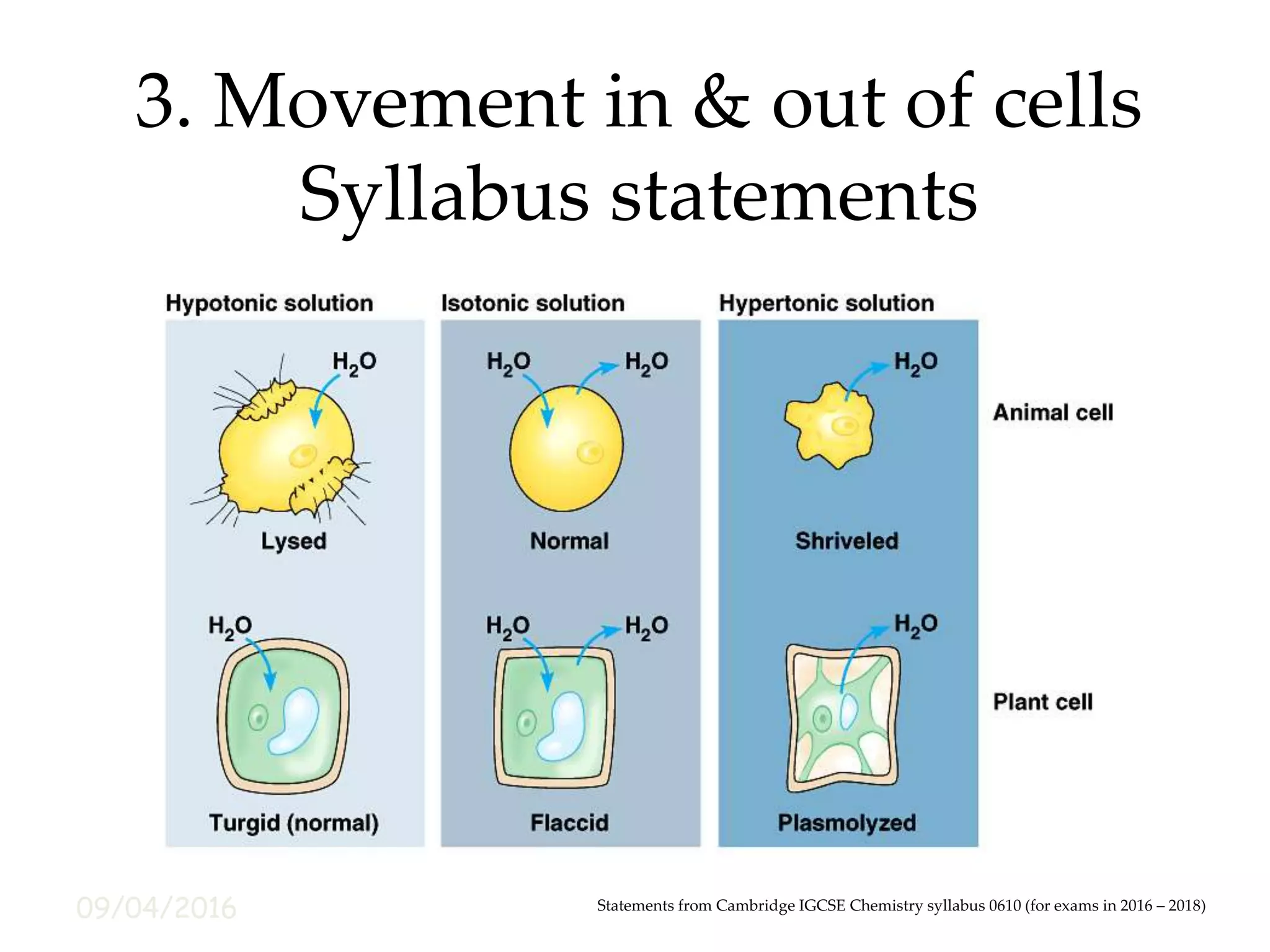
• Investigate and describe the effects on plant
tissues of immersing them in solutions of different
concentrations
• Explain the effects on plant tissues of immersing
them in solutions of different concentrations by
using the terms turgid, turgor pressure,
plasmolysis and flaccid
3.2 Osmosis
• State that plants are supported by the pressure of
water inside the cells pressing outwards on the cell
wall
• Explain how plants are supported by the turgor
pressure within cells, in terms of water pressure
acting against an inelastic cell wall
• Explain the importance of water potential and
osmosis in the uptake of water by plants
3.2 Osmosis
• Explain the importance of water potential and
osmosis on animal cells and tissues
3.3 Active Transport
• Define active transport as the movement of
particles through a cell membrane from a region of
lower concentration to a region of higher
concentration using energy from respiration
• Discuss the importance of active transport as a
process for movement across membranes:
– e.g. ion uptake by root hairs & uptake of glucose
by epithelial cells of villi & kidney tubules
• Explain how protein molecules move particles
across a membrane during active transport

3 syllabus statements

  • 1.
    09/04/2016 3. Movement in& out of cells Syllabus statements Statements from Cambridge IGCSE Chemistry syllabus 0610 (for exams in 2016 – 2018)
  • 2.
    3.1 Diffusion • Definediffusion as the net movement of particles from a region of their higher concentration to a region of their lower concentration down a concentration gradient, as a result of their random movement • Describe the importance of diffusion of gases and solutes • State that substances move into and out of cells by diffusion through the cell membrane
  • 3.
    3.1 Diffusion • Statethat the energy for diffusion comes from the kinetic energy of random movement of molecules and ions • Investigate the factors that influence diffusion, limited to surface area, temperature, concentration gradients and distance
  • 4.
    3.2 Osmosis • Statethat water diffuses through partially permeable membranes by osmosis • State that water moves in and out of cells by osmosis through the cell membrane • Define osmosis as the net movement of water molecules from a region of higher water potential (dilute solution) to a region of lower water potential (concentrated solution), through a partially permeable membrane
  • 5.
    3.2 Osmosis • Investigateand describe the effects on plant tissues of immersing them in solutions of different concentrations • Explain the effects on plant tissues of immersing them in solutions of different concentrations by using the terms turgid, turgor pressure, plasmolysis and flaccid
  • 6.
    3.2 Osmosis • Statethat plants are supported by the pressure of water inside the cells pressing outwards on the cell wall • Explain how plants are supported by the turgor pressure within cells, in terms of water pressure acting against an inelastic cell wall • Explain the importance of water potential and osmosis in the uptake of water by plants
  • 7.
    3.2 Osmosis • Explainthe importance of water potential and osmosis on animal cells and tissues
  • 8.
    3.3 Active Transport •Define active transport as the movement of particles through a cell membrane from a region of lower concentration to a region of higher concentration using energy from respiration • Discuss the importance of active transport as a process for movement across membranes: – e.g. ion uptake by root hairs & uptake of glucose by epithelial cells of villi & kidney tubules • Explain how protein molecules move particles across a membrane during active transport