PERGERAKAN BAHAN
MERENTAS MEMBRAN PLASMA
Need for movement of substances
across plasma membrane
 bahan-bahan yang diperlukan oleh sel.
 bahan-bahan yang perlu disingkirkan daripada sel.
 keperluan pergerakan bahan-bahan merentas
membran plasma.
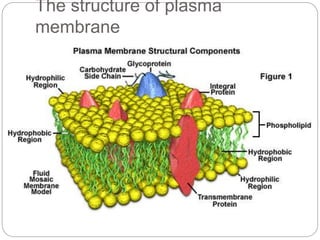
The structure of plasma
membrane
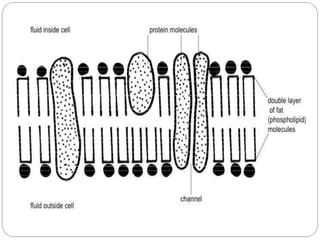
struktur membran plasma
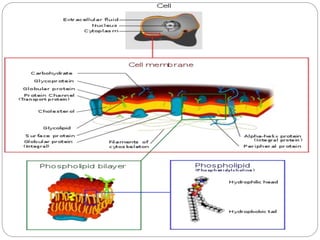
struktur membran plasma yang merangkumi
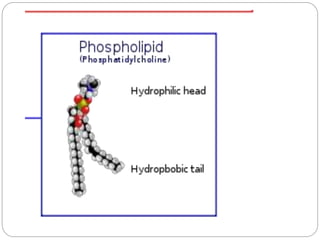
 fosfolipid dwilapisan,
 protein pembawa
 protein liang.
 Membrane is fluid because:
 Most individual proteins and phospholipids
molecule can drift laterally in the membrane.
 A membrane is pictured as mosaic because:
 It has various protein molecule embedded in the
phospholipid bilayer.
Characteristic of plasma membrane
 Composed of phospholipids and protein
 Protein are dispersed throughout and inserted into
the phospolipid
 Various types of protein that embedded in plasma
membrane
 Pore protein (channel protein) and carrier protein
 Glycoprotein – protein that attach to carbohydrate
 Arrange themselves in two layer – bilayer
 Act as barrier which isolates the two side of the
membranes.
 Contain cholesterol – to stabilize and strengthen
 Phospholipid bilayer, protein and other
comnponents form a dynamic and flexible
Selective permeable
 Also known as semi permeable
 Some substance can move across the membrane
freely while the others cannot.
 Determine by its size and polarity of the molecule.
 Substance that can move freely through plasma
membrane:
1. Lipid soluble molecules
2. Non-polar molecules
3. Small polar molecules
 Large water soluble molecule move across the
plasma membrane by the aid of carrier proteins
1. Pore proteins: allow small water soluble molecule
and ion to pass through membrane.
2. Carrier protein: have sites that bind to a specific
PASSIVE TRANSPORT
The movement of substances
across the plasma membrane
Passive transport
• Occur down concentration gradient (from higher
concentration to lower concentration of solute)
• No energy required
• Substances move across membrane through
three ways:
– Lipid bilayer
– Channel protein
– Carrier protein
• Substances can move freely without using energy
through simple diffusion and osmosis or with the
help of transport protein through facilitated
diffusion.
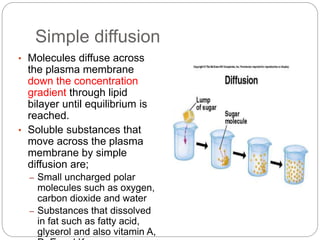
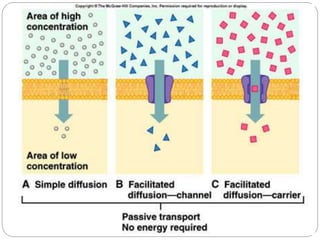
Simple diffusion
• Molecules diffuse across
the plasma membrane
down the concentration
gradient through lipid
bilayer until equilibrium is
reached.
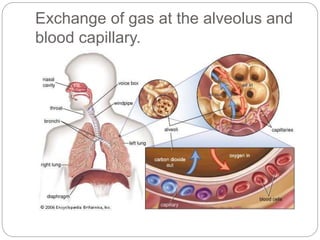
• Soluble substances that
move across the plasma
membrane by simple
diffusion are;
– Small uncharged polar
molecules such as oxygen,
carbon dioxide and water
– Substances that dissolved
in fat such as fatty acid,
glyserol and also vitamin A,
Exchange of gas at the alveolus and
blood capillary.
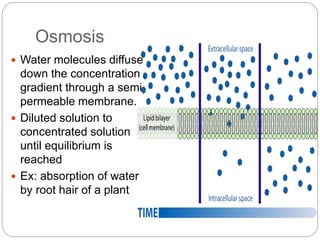
Osmosis
 Water molecules diffuse
down the concentration
gradient through a semi
permeable membrane.
 Diluted solution to
concentrated solution
until equilibrium is
reached
 Ex: absorption of water
by root hair of a plant
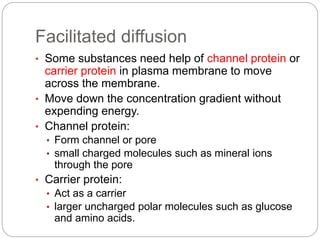
Facilitated diffusion
• Some substances need help of channel protein or
carrier protein in plasma membrane to move
across the membrane.
• Move down the concentration gradient without
expending energy.
• Channel protein:
• Form channel or pore
• small charged molecules such as mineral ions
through the pore
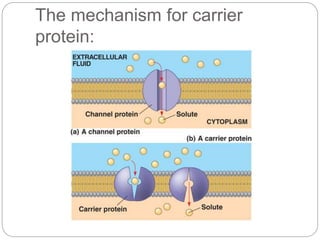
• Carrier protein:
• Act as a carrier
• larger uncharged polar molecules such as glucose
and amino acids.
 Example of facilitated diffusion are
 The transportation of glucose, amino acids and
mineral ions across the membrane of the vilus at
the ileum and also the body cells
The mechanism for carrier
protein:
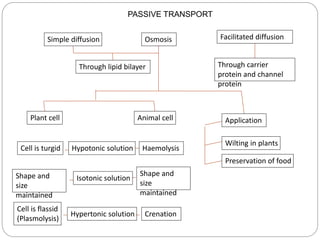
Simple diffusion Osmosis Facilitated diffusion
Through lipid bilayer Through carrier
protein and channel
protein
Plant cell Animal cell Application
Isotonic solution
Hypotonic solution
Hypertonic solution
Shape and
size
maintained
Shape and
size
maintained
HaemolysisCell is turgid
Crenation
Cell is flassid
(Plasmolysis)
Wilting in plants
Preservation of food
PASSIVE TRANSPORT
ACTIVE TRANSPORT
The movement of substances
across the plasma membrane
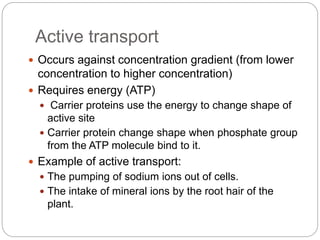
Active transport
 Occurs against concentration gradient (from lower
concentration to higher concentration)
 Requires energy (ATP)
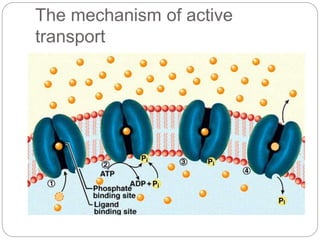
 Carrier proteins use the energy to change shape of
active site
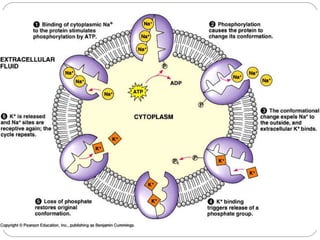
 Carrier protein change shape when phosphate group
from the ATP molecule bind to it.
 Example of active transport:
 The pumping of sodium ions out of cells.
 The intake of mineral ions by the root hair of the
plant.
The mechanism of active
transport
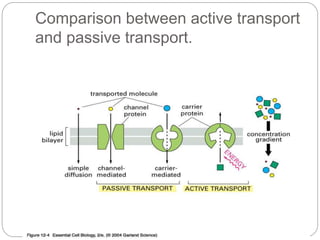
Comparison between active transport
and passive transport.
3.2 Movement of Substances
across the Plasma Membrane
 Explain what hypotonic, hypertonic and isotonic solution are
 Explain the effect of hypotonic, hypertonic and isotonic solution
on plant and animal cell
Explain plasmolysis, deplasmolysis, haemolysis, and crenation.
Explain the phenomenon of wilting in plants using examples
Explain the preservation of food using examples
Explain what hypotonic, hypertonic and isotonic
solution are
 Isotonic solution:
 A solution in which the solute concentration in the cell is equal to the
concentration of solute outside the cell
 Water diffuses into and out of the cell at equal rate
 Thus, there is no net movement of water across the plasma
membrane
 Hypotonic solution:
 A solution in which the solute concentration in the cell is lower than
the concentration of solute outside the cell
 Thus, there is a net movement of water from the outside into the cell.
 Hypertonic solution:
 A solution in which the solute concentration in the cell is higher to
the concentration of solute outside the cell
 Thus, there is a net movement of water from the inside to the outside
of the cell
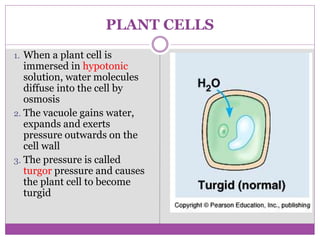
PLANT CELLS
1. When a plant cell is
immersed in hypotonic
solution, water molecules
diffuse into the cell by
osmosis
2. The vacuole gains water,
expands and exerts
pressure outwards on the
cell wall
3. The pressure is called
turgor pressure and causes
the plant cell to become
turgid
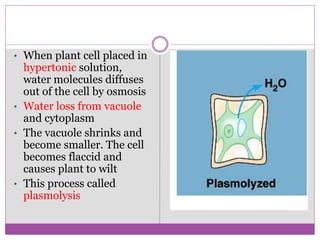
• When plant cell placed in
hypertonic solution,
water molecules diffuses
out of the cell by osmosis
• Water loss from vacuole
and cytoplasm
• The vacuole shrinks and
become smaller. The cell
becomes flaccid and
causes plant to wilt
• This process called
plasmolysis
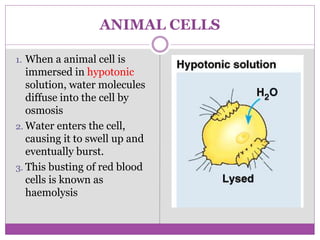
ANIMAL CELLS
1. When a animal cell is
immersed in hypotonic
solution, water molecules
diffuse into the cell by
osmosis
2. Water enters the cell,
causing it to swell up and
eventually burst.
3. This busting of red blood
cells is known as
haemolysis
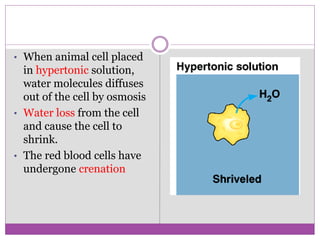
• When animal cell placed
in hypertonic solution,
water molecules diffuses
out of the cell by osmosis
• Water loss from the cell
and cause the cell to
shrink.
• The red blood cells have
undergone crenation
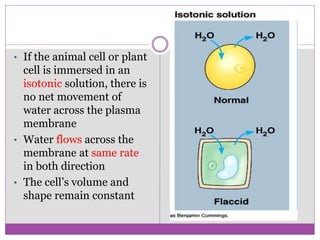
• If the animal cell or plant
cell is immersed in an
isotonic solution, there is
no net movement of
water across the plasma
membrane
• Water flows across the
membrane at same rate
in both direction
• The cell’s volume and
shape remain constant
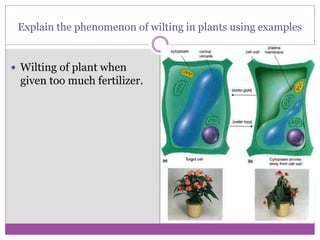
Explain the phenomenon of wilting in plants using examples
 Wilting of plant when
given too much fertilizer.
Explanation
 Fertilisers will dissolve in the soil and caused the soil
water to be hypertonic to the root cells of plant
 Water diffuse out from the root to their surrounding
by osmosis
 Plasmolysis occur and plant cell become flaccid,
cause the plant wilt.
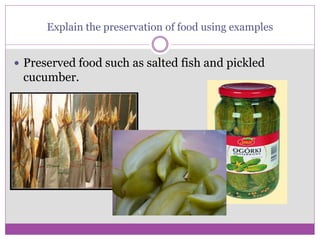
Explain the preservation of food using examples
 Preserved food such as salted fish and pickled
cucumber.
3.3 Appreciating the Movement of
Substances across the Plasma
Membrane
Explain the necessity for the movement of
substances across plasma membrane which occurs
in the continuous and controlled manner for the
survival of the cell.
 The movement of substances
across the plasma
membrane occurs in a
continuous and controlled
manner for survival of a cell.
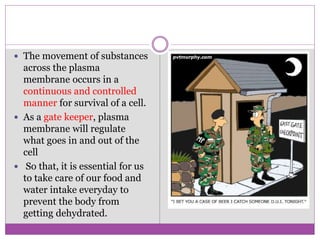
 As a gate keeper, plasma
membrane will regulate
what goes in and out of the
cell
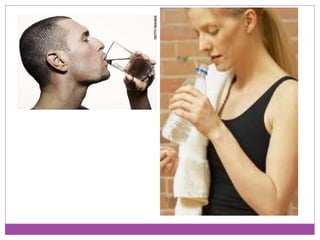
 So that, it is essential for us
to take care of our food and
water intake everyday to
prevent the body from
getting dehydrated.
Movement across the plasma membrane   copy

Movement across the plasma membrane copy

  • 1.
  • 2.
    Need for movementof substances across plasma membrane  bahan-bahan yang diperlukan oleh sel.  bahan-bahan yang perlu disingkirkan daripada sel.  keperluan pergerakan bahan-bahan merentas membran plasma.
  • 5.
    The structure ofplasma membrane
  • 6.
    struktur membran plasma strukturmembran plasma yang merangkumi  fosfolipid dwilapisan,  protein pembawa  protein liang.  Membrane is fluid because:  Most individual proteins and phospholipids molecule can drift laterally in the membrane.  A membrane is pictured as mosaic because:  It has various protein molecule embedded in the phospholipid bilayer.
  • 8.
    Characteristic of plasmamembrane  Composed of phospholipids and protein  Protein are dispersed throughout and inserted into the phospolipid  Various types of protein that embedded in plasma membrane  Pore protein (channel protein) and carrier protein  Glycoprotein – protein that attach to carbohydrate  Arrange themselves in two layer – bilayer  Act as barrier which isolates the two side of the membranes.  Contain cholesterol – to stabilize and strengthen  Phospholipid bilayer, protein and other comnponents form a dynamic and flexible
  • 9.
    Selective permeable  Alsoknown as semi permeable  Some substance can move across the membrane freely while the others cannot.  Determine by its size and polarity of the molecule.  Substance that can move freely through plasma membrane: 1. Lipid soluble molecules 2. Non-polar molecules 3. Small polar molecules  Large water soluble molecule move across the plasma membrane by the aid of carrier proteins 1. Pore proteins: allow small water soluble molecule and ion to pass through membrane. 2. Carrier protein: have sites that bind to a specific
  • 10.
    PASSIVE TRANSPORT The movementof substances across the plasma membrane
  • 11.
    Passive transport • Occurdown concentration gradient (from higher concentration to lower concentration of solute) • No energy required • Substances move across membrane through three ways: – Lipid bilayer – Channel protein – Carrier protein • Substances can move freely without using energy through simple diffusion and osmosis or with the help of transport protein through facilitated diffusion.
  • 12.
    Simple diffusion • Moleculesdiffuse across the plasma membrane down the concentration gradient through lipid bilayer until equilibrium is reached. • Soluble substances that move across the plasma membrane by simple diffusion are; – Small uncharged polar molecules such as oxygen, carbon dioxide and water – Substances that dissolved in fat such as fatty acid, glyserol and also vitamin A,
  • 13.
    Exchange of gasat the alveolus and blood capillary.
  • 14.
    Osmosis  Water moleculesdiffuse down the concentration gradient through a semi permeable membrane.  Diluted solution to concentrated solution until equilibrium is reached  Ex: absorption of water by root hair of a plant
  • 15.
    Facilitated diffusion • Somesubstances need help of channel protein or carrier protein in plasma membrane to move across the membrane. • Move down the concentration gradient without expending energy. • Channel protein: • Form channel or pore • small charged molecules such as mineral ions through the pore • Carrier protein: • Act as a carrier • larger uncharged polar molecules such as glucose and amino acids.
  • 16.
     Example offacilitated diffusion are  The transportation of glucose, amino acids and mineral ions across the membrane of the vilus at the ileum and also the body cells
  • 17.
    The mechanism forcarrier protein:
  • 19.
    Simple diffusion OsmosisFacilitated diffusion Through lipid bilayer Through carrier protein and channel protein Plant cell Animal cell Application Isotonic solution Hypotonic solution Hypertonic solution Shape and size maintained Shape and size maintained HaemolysisCell is turgid Crenation Cell is flassid (Plasmolysis) Wilting in plants Preservation of food PASSIVE TRANSPORT
  • 20.
    ACTIVE TRANSPORT The movementof substances across the plasma membrane
  • 21.
    Active transport  Occursagainst concentration gradient (from lower concentration to higher concentration)  Requires energy (ATP)  Carrier proteins use the energy to change shape of active site  Carrier protein change shape when phosphate group from the ATP molecule bind to it.  Example of active transport:  The pumping of sodium ions out of cells.  The intake of mineral ions by the root hair of the plant.
  • 22.
    The mechanism ofactive transport
  • 24.
    Comparison between activetransport and passive transport.
  • 25.
    3.2 Movement ofSubstances across the Plasma Membrane  Explain what hypotonic, hypertonic and isotonic solution are  Explain the effect of hypotonic, hypertonic and isotonic solution on plant and animal cell Explain plasmolysis, deplasmolysis, haemolysis, and crenation. Explain the phenomenon of wilting in plants using examples Explain the preservation of food using examples
  • 26.
    Explain what hypotonic,hypertonic and isotonic solution are  Isotonic solution:  A solution in which the solute concentration in the cell is equal to the concentration of solute outside the cell  Water diffuses into and out of the cell at equal rate  Thus, there is no net movement of water across the plasma membrane  Hypotonic solution:  A solution in which the solute concentration in the cell is lower than the concentration of solute outside the cell  Thus, there is a net movement of water from the outside into the cell.  Hypertonic solution:  A solution in which the solute concentration in the cell is higher to the concentration of solute outside the cell  Thus, there is a net movement of water from the inside to the outside of the cell
  • 27.
    PLANT CELLS 1. Whena plant cell is immersed in hypotonic solution, water molecules diffuse into the cell by osmosis 2. The vacuole gains water, expands and exerts pressure outwards on the cell wall 3. The pressure is called turgor pressure and causes the plant cell to become turgid
  • 28.
    • When plantcell placed in hypertonic solution, water molecules diffuses out of the cell by osmosis • Water loss from vacuole and cytoplasm • The vacuole shrinks and become smaller. The cell becomes flaccid and causes plant to wilt • This process called plasmolysis
  • 29.
    ANIMAL CELLS 1. Whena animal cell is immersed in hypotonic solution, water molecules diffuse into the cell by osmosis 2. Water enters the cell, causing it to swell up and eventually burst. 3. This busting of red blood cells is known as haemolysis
  • 30.
    • When animalcell placed in hypertonic solution, water molecules diffuses out of the cell by osmosis • Water loss from the cell and cause the cell to shrink. • The red blood cells have undergone crenation
  • 31.
    • If theanimal cell or plant cell is immersed in an isotonic solution, there is no net movement of water across the plasma membrane • Water flows across the membrane at same rate in both direction • The cell’s volume and shape remain constant
  • 32.
    Explain the phenomenonof wilting in plants using examples  Wilting of plant when given too much fertilizer.
  • 33.
    Explanation  Fertilisers willdissolve in the soil and caused the soil water to be hypertonic to the root cells of plant  Water diffuse out from the root to their surrounding by osmosis  Plasmolysis occur and plant cell become flaccid, cause the plant wilt.
  • 34.
    Explain the preservationof food using examples  Preserved food such as salted fish and pickled cucumber.
  • 35.
    3.3 Appreciating theMovement of Substances across the Plasma Membrane Explain the necessity for the movement of substances across plasma membrane which occurs in the continuous and controlled manner for the survival of the cell.
  • 36.
     The movementof substances across the plasma membrane occurs in a continuous and controlled manner for survival of a cell.  As a gate keeper, plasma membrane will regulate what goes in and out of the cell  So that, it is essential for us to take care of our food and water intake everyday to prevent the body from getting dehydrated.