Business Intelligence 101Randy ArchambaultManager Business Intelligence and ReportingPalm Beach Tan
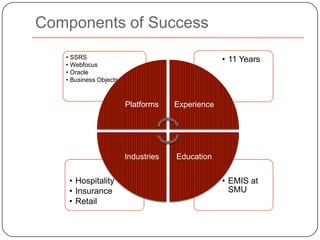
Components of Success
What is Business IntelligenceBusiness Intelligence (BI) is about getting the right information, to the right decision makers, at the right time. BI is an enterprise-wide platform that supports reporting, analysis and decision making.BI leads to: fact-based decision making“single version of the truth”Business Intelligence 101
What is Business IntelligenceMaking useful, actionable insight from stored data.Allows effective business decisions to be made. The act of using historical data to gain new information. Techniques include: multidimensional analysesmathematical projection modeling ad-hoc queries 'canned' reportingDashboardsBusiness Intelligence 101
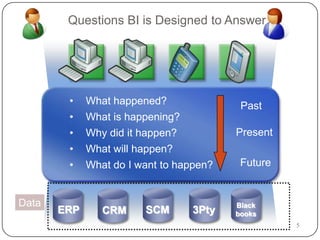
5Questions BI is Designed to AnswerWhat happened?
What is happening?
Why did it happen?
What will happen?
What do I want to happen?PastPresentFutureDataERP3PtySCMBlack booksCRM
Questions BI is Designed to AnswerA  BI solution, with the right data and features, should be able to take operational data and enable users to answer specific questions such as: Sales and marketingWhich customers should I target? What has caused the change in my pipeline? Which are my most profitable campaigns per region?Did store sales spike when we advertised in the local paper or launched an email campaign?What is the most profitable source of sales leads and how has that changed over time?
Questions BI is Designed to AnswerOperational Which vendors are best at delivering on time and on budget?– How many additional personnel do we need to add per store during the holidays?Which order processing processes are most inefficient? Financial What is the fully loaded cost of new products? What is the expected annual profit/loss based on current marketing and sales forecasts? How are forecasts trending against the annual plan?What are the current trends in cash flow, accounts payable and accounts receivable and how do they compare with plan?Overall business performance What are the most important risk factors impacting the company’s ability to meet annual profit goals? Should we expand internationally and, if so, which geographic areas should we first target?
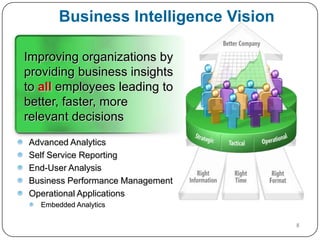
8Business Intelligence VisionImproving organizations by providing business insights to all employees leading to better, faster, more relevant decisionsAdvanced AnalyticsSelf Service ReportingEnd-User AnalysisBusiness Performance ManagementOperational Applications Embedded Analytics
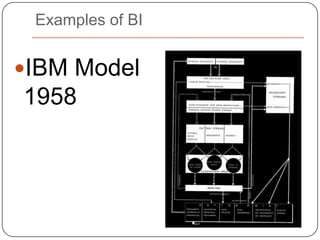
IBM Model 1958Examples of BI
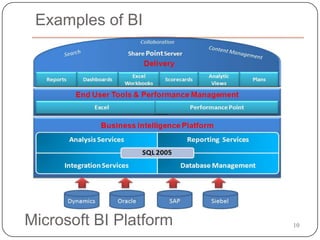
10Examples of BIMicrosoft BI Platform
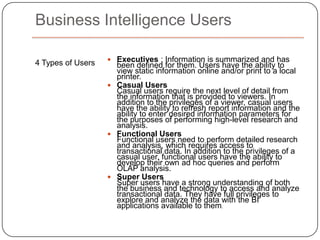
4 Types of UsersExecutives : Information is summarized and has been defined for them. Users have the ability to view static information online and/or print to a local printer.Casual UsersCasual users require the next level of detail from the information that is provided to viewers. In addition to the privileges of a viewer, casual users have the ability to refresh report information and the ability to enter desired information parameters for the purposes of performing high-level research and analysis.Functional UsersFunctional users need to perform detailed research and analysis, which requires access to transactional data. In addition to the privileges of a casual user, functional users have the ability to develop their own ad hoc queries and perform OLAP analysis.Super UsersSuper users have a strong understanding of both the business and technology to access and analyze transactional data. They have full privileges to explore and analyze the data with the BI applications available to them.Business Intelligence Users
Business Intelligence 101Garbage in Garbage OutTransform data in to actionable insight.
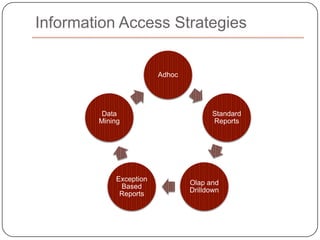
Information Access Strategies
The Five Stages of BIBI involves five stages of taking raw data and presenting it as relevant, actionable insight to users.
The 5 Stages of Business Intelligence1.The Data: defining which data will be loaded into the system and analyzed.Where all information is storedTechnology dependentMSSQL, MYSQL, Oracle, Red Brick, DB2Often an OLAP type data sourceMany rows of often summarized dataUtilize database queries to retrieve data from the source. SQL – MSSQL and MYSQLPL/SQL – Oracle
The 5 Stages of Business IntelligenceOLTP  Online Transaction processingTypically not your reporting database. Processes transactions fast for applicationExampleRetail POS systemWeb SiteOnline Transaction Processing has two key benefits: Simplicity efficiencyOLAP Online Analytical ProcessingUsed for reporting May form base of data warehouse or BI toolsNot used for transaction processing. Databases configured for OLAP use a multidimensional data model, allowing for complex analytical and ad-hoc queries with a rapid execution time
The 5 Stages of Business Intelligence2.The ETL (Extract, Transform, and Load) Engine: moving the source data to the Data Warehouse. This can be a complex step involving modifications and calculations on the data itself. If this step doesn’t work properly, the BI solution simply cannot be effective.3.Data Warehousing: connects electronic data from different operational systems so that the data can be queried and analyzed over time for business decision making.A data warehouse is an analytically oriented, integrated, time-variant, and nonvolatile collection of data that supports decision making processes Large databases that aggregate data collected from multiple sources
The 5 Stages of Business Intelligence4.Analytic Engine: analyzes multidimensional data sets found in a data warehouse to identify trends, outliers, and patterns.Data Miningis the process of extracting patterns from data. Data mining is becoming an increasingly important tool to transform this data into information. It is commonly used in a wide range of profiling practices, such as marketing, surveillance, fraud detection and scientific discovery.Data mining can be used to uncover patterns in data but is often carried out only on samples of data. The mining process will be ineffective if the samples are not a good representation of the larger body of data. Data mining cannot discover patterns that may be present in the larger body of data if those patterns are not present in the sample being "mined".
The 5 Stages of Business Intelligence5.Presentation Layer: the dashboards, reports and alerts that present findings from the analysis.Typically Technology Agnostic  The presentation layer is for the user. It does not care How? When ? Where? Why?the user accesses the Information just that it is available.
The 5 Stages of Business Intelligence5.Presentation Layer: Interactive Dashboards:A dashboard is a set of high-level reports on key metrics, typically for managers.There may be multiple reports on a single dashboard, much the same way that a car’s dashboard has multiple gauges and displays on it. With a dashboard, users can gain an at-a-glance understanding of key trends and metrics. Dashboards can be customizable to work for anyone in an organization, from a sales rep or frontline operations manager to a middle manager or senior executive.An “interactive” dashboard allows users to take those dashboard reports and filter information to more deeply analyze trends and results, or to “drill down” into deeper and more detailed analysis of the data. That is, by clicking on the particular reports or results, they can explore more detailed information to find root causes of results.
The 5 Stages of Business Intelligence5.Presentation Layer: Customizable Reports: which can present high-level findings as well as enable a user to drill down to find specific details. Most BI systems either come with report templates and/or provide the capability to create and customize reports. Alerts: notifying users to changes selected as key to meeting user goals. Alerts can be set to warn users on an imminent event, changes to data, or that new data needs to be entered into the system.
The 5 Stages of Business IntelligenceMicrostrategyCognosOracle – OBIEEMicrosoft SQL BI SuiteSAP – Business ObjectsPentaho – Open Source Alternative
Palm Beach Tan Online Reporting PortalA Retail Example
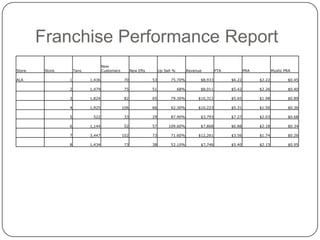
Franchise Performance Report
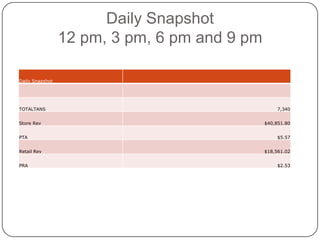
Daily Snapshot12 pm, 3 pm, 6 pm and 9 pm

Business intelligence

  • 1.
    Business Intelligence 101RandyArchambaultManager Business Intelligence and ReportingPalm Beach Tan
  • 2.
  • 3.
    What is BusinessIntelligenceBusiness Intelligence (BI) is about getting the right information, to the right decision makers, at the right time. BI is an enterprise-wide platform that supports reporting, analysis and decision making.BI leads to: fact-based decision making“single version of the truth”Business Intelligence 101
  • 4.
    What is BusinessIntelligenceMaking useful, actionable insight from stored data.Allows effective business decisions to be made. The act of using historical data to gain new information. Techniques include: multidimensional analysesmathematical projection modeling ad-hoc queries 'canned' reportingDashboardsBusiness Intelligence 101
  • 5.
    5Questions BI isDesigned to AnswerWhat happened?
  • 6.
  • 7.
    Why did ithappen?
  • 8.
  • 9.
    What do Iwant to happen?PastPresentFutureDataERP3PtySCMBlack booksCRM
  • 10.
    Questions BI isDesigned to AnswerA BI solution, with the right data and features, should be able to take operational data and enable users to answer specific questions such as: Sales and marketingWhich customers should I target? What has caused the change in my pipeline? Which are my most profitable campaigns per region?Did store sales spike when we advertised in the local paper or launched an email campaign?What is the most profitable source of sales leads and how has that changed over time?
  • 11.
    Questions BI isDesigned to AnswerOperational Which vendors are best at delivering on time and on budget?– How many additional personnel do we need to add per store during the holidays?Which order processing processes are most inefficient? Financial What is the fully loaded cost of new products? What is the expected annual profit/loss based on current marketing and sales forecasts? How are forecasts trending against the annual plan?What are the current trends in cash flow, accounts payable and accounts receivable and how do they compare with plan?Overall business performance What are the most important risk factors impacting the company’s ability to meet annual profit goals? Should we expand internationally and, if so, which geographic areas should we first target?
  • 12.
    8Business Intelligence VisionImprovingorganizations by providing business insights to all employees leading to better, faster, more relevant decisionsAdvanced AnalyticsSelf Service ReportingEnd-User AnalysisBusiness Performance ManagementOperational Applications Embedded Analytics
  • 13.
  • 14.
  • 15.
    4 Types ofUsersExecutives : Information is summarized and has been defined for them. Users have the ability to view static information online and/or print to a local printer.Casual UsersCasual users require the next level of detail from the information that is provided to viewers. In addition to the privileges of a viewer, casual users have the ability to refresh report information and the ability to enter desired information parameters for the purposes of performing high-level research and analysis.Functional UsersFunctional users need to perform detailed research and analysis, which requires access to transactional data. In addition to the privileges of a casual user, functional users have the ability to develop their own ad hoc queries and perform OLAP analysis.Super UsersSuper users have a strong understanding of both the business and technology to access and analyze transactional data. They have full privileges to explore and analyze the data with the BI applications available to them.Business Intelligence Users
  • 16.
    Business Intelligence 101Garbagein Garbage OutTransform data in to actionable insight.
  • 17.
  • 18.
    The Five Stagesof BIBI involves five stages of taking raw data and presenting it as relevant, actionable insight to users.
  • 19.
    The 5 Stagesof Business Intelligence1.The Data: defining which data will be loaded into the system and analyzed.Where all information is storedTechnology dependentMSSQL, MYSQL, Oracle, Red Brick, DB2Often an OLAP type data sourceMany rows of often summarized dataUtilize database queries to retrieve data from the source. SQL – MSSQL and MYSQLPL/SQL – Oracle
  • 20.
    The 5 Stagesof Business IntelligenceOLTP Online Transaction processingTypically not your reporting database. Processes transactions fast for applicationExampleRetail POS systemWeb SiteOnline Transaction Processing has two key benefits: Simplicity efficiencyOLAP Online Analytical ProcessingUsed for reporting May form base of data warehouse or BI toolsNot used for transaction processing. Databases configured for OLAP use a multidimensional data model, allowing for complex analytical and ad-hoc queries with a rapid execution time
  • 21.
    The 5 Stagesof Business Intelligence2.The ETL (Extract, Transform, and Load) Engine: moving the source data to the Data Warehouse. This can be a complex step involving modifications and calculations on the data itself. If this step doesn’t work properly, the BI solution simply cannot be effective.3.Data Warehousing: connects electronic data from different operational systems so that the data can be queried and analyzed over time for business decision making.A data warehouse is an analytically oriented, integrated, time-variant, and nonvolatile collection of data that supports decision making processes Large databases that aggregate data collected from multiple sources
  • 22.
    The 5 Stagesof Business Intelligence4.Analytic Engine: analyzes multidimensional data sets found in a data warehouse to identify trends, outliers, and patterns.Data Miningis the process of extracting patterns from data. Data mining is becoming an increasingly important tool to transform this data into information. It is commonly used in a wide range of profiling practices, such as marketing, surveillance, fraud detection and scientific discovery.Data mining can be used to uncover patterns in data but is often carried out only on samples of data. The mining process will be ineffective if the samples are not a good representation of the larger body of data. Data mining cannot discover patterns that may be present in the larger body of data if those patterns are not present in the sample being "mined".
  • 23.
    The 5 Stagesof Business Intelligence5.Presentation Layer: the dashboards, reports and alerts that present findings from the analysis.Typically Technology Agnostic The presentation layer is for the user. It does not care How? When ? Where? Why?the user accesses the Information just that it is available.
  • 24.
    The 5 Stagesof Business Intelligence5.Presentation Layer: Interactive Dashboards:A dashboard is a set of high-level reports on key metrics, typically for managers.There may be multiple reports on a single dashboard, much the same way that a car’s dashboard has multiple gauges and displays on it. With a dashboard, users can gain an at-a-glance understanding of key trends and metrics. Dashboards can be customizable to work for anyone in an organization, from a sales rep or frontline operations manager to a middle manager or senior executive.An “interactive” dashboard allows users to take those dashboard reports and filter information to more deeply analyze trends and results, or to “drill down” into deeper and more detailed analysis of the data. That is, by clicking on the particular reports or results, they can explore more detailed information to find root causes of results.
  • 25.
    The 5 Stagesof Business Intelligence5.Presentation Layer: Customizable Reports: which can present high-level findings as well as enable a user to drill down to find specific details. Most BI systems either come with report templates and/or provide the capability to create and customize reports. Alerts: notifying users to changes selected as key to meeting user goals. Alerts can be set to warn users on an imminent event, changes to data, or that new data needs to be entered into the system.
  • 26.
    The 5 Stagesof Business IntelligenceMicrostrategyCognosOracle – OBIEEMicrosoft SQL BI SuiteSAP – Business ObjectsPentaho – Open Source Alternative
  • 27.
    Palm Beach TanOnline Reporting PortalA Retail Example
  • 28.
  • 29.
    Daily Snapshot12 pm,3 pm, 6 pm and 9 pm