Fatigue
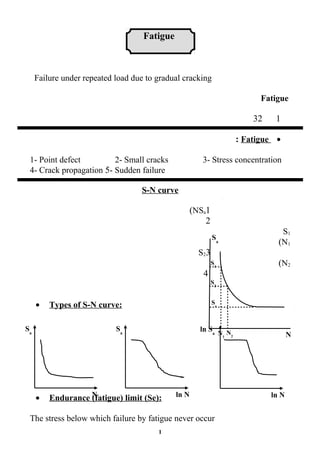
Failure under repeated load due to gradual cracking
Fatigue
123
•Fatigue:
1- Point defect 2- Small cracks 3- Stress concentration
4- Crack propagation 5- Sudden failure
S-N curve
1SaN(
2
S1
N1(
3S2
N2(
4
• Types of S-N curve:
• Endurance (fatigue) limit (Se):
The stress below which failure by fatigue never occur
1
Sa
N
S1
S2
N1
N2
Se
N
Sa
ln N
Sa
ln N
ln Sa
Most nonferrous alloys (e.g., aluminum, copper, magnesium) do not have a
fatigue limit
For these materials, the fatigue response is specified as Fatigue strength.
Fatigue strength: The stress level at which failure will occur for some
specified number of cycles.
Fatigue life: It is the number of cycles to cause failure at a specified stress
level, as taken from the S–N plot.
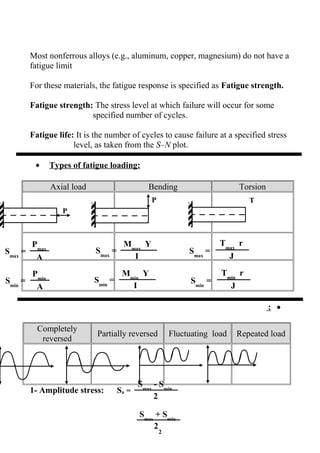
• Types of fatigue loading:
TorsionBendingAxial load
•:
Repeated loadFluctuating loadPartially reversed
Completely
reversed
1- Amplitude stress: Sa =
2
Smax
- Smin
Smax
+ Smin
2
2
P
P T
Pmax
Smax
=
A
Smax
=
Mmax
Y
I
Smax
=
Tmax
r
J
Pmin
Smin
=
A
Smin
=
Mmin
Y
I
Smin
=
Tmin
r
J
Sa
2- Mean stress : Sm =
3- Range of stresses R = Smax - Smin
For completely reversed load [Smax = - Smin & Sm = 0 & Sa = Smax = Se]
Mean stress: defined as the average of the maximum and minimum
stresses in the cycle.
Stress amplitude: is just one half of the range of stress.
Soderberg rule Goodman rule Gerber rule
More safe Less cost
• Modified Goodman diagram:
SoderbergGoodmanFatigue Design
Triangle
• Miner’s cumulative damage
theory:
Stress Number of cycles
S1
S2
S3
N1
N2
N3
n1
n2
n3
3
Sa
Se
= 1+
Sm
Su
2Sa
Se
Sm
Sy
= 1+
Sa
Se
Sm
Su
= 1+
Sy
Sa
Se
Sm
Sa
Se
Sm
Su
Sm
Su
Sa
Se
Sm
Su
Se
Sa
Sy
Sy
= 1
+ + .................
= 1
Miner’s theory of cumulative fatigue damage assumes damage
caused to specimen is independent of whether higher stress follows or
precedes the lower stress
Crack initiation9090%
S-N Curve
Crack initiationCrack propagation
• Factors affecting fatigue properties:
Type of loading
(σe)Tension = 0.85 (σe)Bending (σe)Torsion = 0.58 (σe)Bending
Temperature
4
n1
N1
n2
N2
n
NΣ
n
NΣ 1
n
NΣ 1
The increase in temperature reduce fatigue properties because of oxidation
of metals occurs
Surface finish (Roughness)
Fatigue properties
polishingSeFatigue properties
Stress concentration
holes & key way
σa
Residual stresses
residual stress
residual stressesσefatigueTensile failurefatigue
Size of specimen
For bending & torsion loading σe (decrease) as size (increase)
For axial load (no size effect )
Mean Stress
The increase in the mean stress level
leads to a decrease in fatigue life.
Kf : Fatigue strength reduction factor
Kt : Theoretical stress concentration
factor
q: Notch sensitivity factor
5
σm)Tension
σa
σm)Compression
σa
σm)Tension
σa
Kf
=
σf
σe
Kt
=
σLocal
σApplied
σe
(Without notch)
σe
(with notch)Fatigue stress-concentration factor (Kf
) =
Kt > Kf > 1
Kf
1- Severity of notch 2- Type of notch 3- Material
4- Type of loading 5- Stress level
Maximum sensitivity at q = 1 when Kf = Kt
Solved Example
σy = 300 MN/m2
σe = 200 MN/m2
Find: Mmax to avoid fatigue failure
Kt = 1.55 notch sensitivity factor (q) = 0.9
Apply Soderberg’s law
6
Se
Se
O
1
2
Smax
Smin
Sm
Sy
Su
Sy
Su
3
4
5
6
7
8
9
45°
45°
Notch sensitivity factor (q) =
Kf
– 1
Kt
– 1
50 KN50 KN
M
M
37.5 mm 25 mm
σa
=
M Y
I
M x 12.5 x 64
π(25)4= = (6.52 x 10⁻⁴
M) MN/m2
Notch sensitivity factor (q) =
Kf
– 1
Kt
– 1
0.9 =
Kf
– 1
1.55 – 1
Kf
= 1.5
σa
σe
σm
σy
= 1+
6.5201 x 4-
M
002
8.101
003
=1+ M531 =m.N 1.
P
A
01 x 05 3-
σm
= π
/4
(520.0) 2= m/NM 8.101 = 2
σu
= 40 σy
= 24 σe
= 20 F.S. = 2 (Static) F.S. = 3 (Dynamic)
1-Se1) & (2(
2-045
3-3) & (4)Su , SuSy , Sy(
4-1–3
5-1455(
6-1–31–56(
7-41–67(
8-70-4-38(
9-7–89(7–8=8–9
10-1–7–4–9–2–0–1
( ) A survey of the stresses at the critical points of machine member was
carried out and the value of the max. and min. stresses at points A, B, C
were as follows:
A B C
σmax, kg/mm2
+ 12 + 8 + 4
σmin, kg/mm2
- 8 Zero - 2
If the properties of the steel member were as follows:
Tensile strength = 40 kg/mm2
, yield strength = 24 kg/mm2
, and endurance
limit = 20 kg/mm2
. Show whether this member is safe or not if the factor of
safety = 2 for static load and = 3 for fatigue loading
7
Smax
+ Smin
2
Sm
=
Smax
- Smin
2
Sa
=
Su
= 740 Se
= 320
A B C
Smax 12 8 4
Smin -8 0 -2
2 4 1
10 4 3
Unsafe Safe Safe
( ) Plot the Goodman diagram for steel having a fatigue limit of 320 MN/m2
and
a tensile strength of 740 MN/m2
. Predict, using the diagram, whether the
following stress amplitudes are likely to lead to fatigue failure:
(a) 100 MN/m2
at mean stress of 200 MN/m2
(b) 150 MN/m2
at mean stress of 400 MN/m2
A B
Sm 200 400
Sa 100 150
Safe Safe (Critical)
8
σu
'
= σu2
= =0204
2
σ y
'
= σ y2
= =2142
2
σ e
'
= σ e2
= =7.602
3
0
2
4
6
8
10
12
14
16
18
20
0 2 4 6 8 10 12 14 16 18 20
Sm
S a
S y
'
S u
'
S y
'
S e
'
● A
● B
● C
0
100
200
300
400
500
600
700
800
0 100 200 300 400 500 600 700 800
Sm
S a
S u
S e
● A
● B
( ) The number of cycles to failure from S-N curve for certain steel is:
Stress, MN/m2
Number of cycles to failure, Cycles
350 2,000,000
380 500,000
410 125,000
If a component manufactured for this steel is subjected to 600,000 cycles at
the stress 350 MN/m2
and 150,000 cycles at the stress 380 MN/m2
. How many
cycles can the component is expected to withstand at 410 MN/m2
before
fatigue failure occurs, assuming that Miner's commulative damage theory
applies?
S (MN/m2
) n N
350 600,000 2,000,000
380 150,000 500,000
410 X 125,000
9
Su
= 420 MPa Sy
= 336 MPa Se
= 210 MPa Sm
= 126 MPa
Smax
+ Smin
2
Sm
= 126 = Smax
+ Smin
= 252
Smax
- Smin
2
Sa
= 147 = Smax
– Smin
= 294
Smax
= 273 MPa Smin
= – 21 MPa
Using Miner's commulative damage theory
( ) A part of machine is subjected to repeated load of mean stress equals to 126
MPa. Find the maximum and minimum stresses using Goodman's,
Soderberg's and Gerber's rules. The tensile strength of the material is 420
MPa, yield strength is 336 MPa and the fatigue limit is 210 MPa.
(I) Goodman's rule
(II) Soderberg's rule
10
n
NΣ = 1
n1
N1
n2
N2
= 1+ ……………
+ +
n3
N3
600,000
2,000,000
= 1+ +
150,000
500,000
X
125,000
X = 50,000 cycle
Sa
Se
Sm
Sy
= 1+
Sa
Se
Sm
Su
= 1+
Sa
126
420
= 1+ Sa
= 147 MPa
Smax
+ Smin
2
Sm
= 126 = Smax
+ Smin
= 252
Smax
- Smin
2
Sa
= 131.25 = Smax
– Smin
= 262.5
Smax
= 257.25 MPa Smin
= – 5.25 MPa
Smax
+ Smin
2
Sm
= 126 = Smax
+ Smin
= 252
Smax
- Smin
2
Sa
= 191.1 = Smax
– Smin
= 382.2
Smax
= 317.1 MPa Smin
= – 65.1 MPa
Su
= 4200 kg/cm2
Sy
= 3360 kg/cm2
Se
= 2100 kg/cm2
Sm
= 1260 kg/cm2
(III) Gerber's rule
( ) A part of machine is subjected to repeated load of mean stress equals to
1260 kg/cm2
. Find the max. and min. stresses using Gerber's, Goodman's,
and Soderberg's rules. The tensile strength of the material is 4200 kg/cm2
,
yield strength is 3360 kg/cm2
and the fatigue limit is 2100 kg/cm2
.
(I) Goodman's rule
(II) Soderberg's rule
11
Sa
126
336
= 1+ Sa
= 131.25 MPa
Sa
Se
= 1+
Sm
Su
2
Sa
126
420
= 1+ Sa
= 191.1 MPa
2
Sa
Se
Sm
Su
= 1+
Sa
1260
4200
= 1+ Sa
= 1470 kg/cm2
Smax
+ Smin
2
Sm
= 1260 = Smax
+ Smin
= 2520
Smax
- Smin
2
Sa
= 1470 = Smax
– Smin
= 2940
Smax
= 2730 kg/cm2
Smin
= – 210 kg/cm2
Sa
Se
Sm
Sy
= 1+
Sa
1260
3360
= 1+ Sa
= 1312.5 kg/cm2
Smax
+ Smin
2
Sm
= 1260 = Smax
+ Smin
= 2520
Smax
- Smin
2
Sa
= 1312.5
=
Smax
– Smin
= 2625
Smax
= 2572.5 kg/cm2
Smin
= – 52.5 kg/cm2
0
2
4
6
8
10
12
14
16
18
20
0 2 4 6 8 10 12 14 16 18 20
Sm
Sa
Sy
'
Su
'
Sy
'
Se
'
Pmax
A
Smax
=
3000
A
=
Pmin
A
Smin
=
1000
A
=
Smax
+ Smin
2
Sm
= =
3000 + 1000
2A
=
2000
A
Smax
- Smin
2
Sa
= =
3000 – 1000
2A
=
1000
A
At safe point Sm
= 8 = 2000/A A = 250 cm2
Safe line
Safe point
A = π/4(D)2
= 250 D = 17.8 cm
Slope of line = Sa
/ Sm
= ½
Smax
+ Smin
2
Sm
= 1260 = Smax
+ Smin
= 2520
Smax
- Smin
2
Sa
= 1911 = Smax
– Smin
= 3822
Smax
= 3171 kg/cm2
Smin
= – 651 kg/cm2
Su
= 40 kg/mm2
Sy
= 24 kg/mm2
Se
= 18 kg/mm2
F.S. = 2
Pmax
= 3000 kg Pmin
= 1000 kg
(III) Gerber's rule
( ) A part of machine is subjected to repeated load change from +3 to +1 tons.
Find the cross section area of this part using modified Goodman diagram.
The factor of safety = 2, the tensile strength of the material = 40 kg/mm2
,
yield strength = 24 kg/mm2
and the fatigue limit = 18 kg/mm2
.Find also the
cross section area of the part using Soderberg's rule.
(II) Modified Goodman diagram
12
Sa
Se
= 1+
Sm
Su
2
Sa
1260
4200
= 1+ Sa
= 1911 kg/cm2
2
Su
'
= S
u2
= =0204
2
S y
'
= S
y2
= =2142
2
S e
'
= S
e2
= =981
2
(II) Soderberg's rule
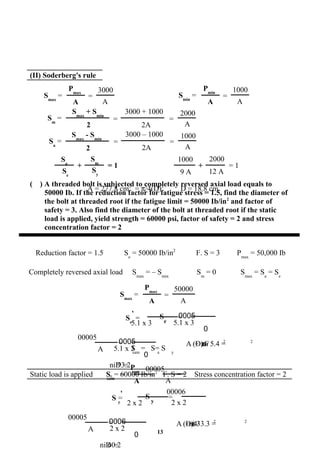
( ) A threaded bolt is subjected to completely reversed axial load equals to
50000 Ib. If the reduction factor for fatigue stress = 1.5, find the diameter of
the bolt at threaded root if the fatigue limit = 50000 Ib/in2
and factor of
safety = 3. Also find the diameter of the bolt at threaded root if the static
load is applied, yield strength = 60000 psi, factor of safety = 2 and stress
concentration factor = 2
Static load is applied Se = 60000 Ib/in2
F. S = 2 Stress concentration factor = 2
13
A = 277.8 cm2
= π/4(D)2
D = 18.8 cm
Pmax
A
Smax
=
3000
A
=
Pmin
A
Smin
=
1000
A
=
Smax
+ Smin
2
Sm
= =
3000 + 1000
2A
=
2000
A
Smax
- Smin
2
Sa
= =
3000 – 1000
2A
=
1000
A
Sa
Se
Sm
Sy
= 1+
1000
9 A
2000
12 A
= 1+
Reduction factor = 1.5 Se
= 50000 Ib/in2
F. S = 3 Pmax
= 50,000 Ib
Completely reversed axial load Smax
= – Smin
Sm
= 0 Smax
= Sa
= Se
Pmax
A
Smax
=
50000
A
=
Se
'
= S
e5.1 x 3
=0005
0
5.1 x 3
00005
A
=0005
0
5.1 x 3
A = π(D)4/ 2
ni 5.4 = 2
D =ni 93.2
Sxam
= S a
= S y
Pxam
A
Sxam
=
00005
A
=
S y
'
= S
y2 x 2
=
00006
2 x 2
00005
A
=0006
0
2 x 2
A = π(D)4/ 2
ni 33.3 = 2
D =ni 60.2
( ) A circular shaft 4 inch in diameter is subjected to a completely reversed
twisting moment. The fatigue strength at N = 106
cycles for complete stress
reversal in bending is 42000 psi. Determine the twisting moment that will
produce fracture in 106
cycles. Use torsional fatigue strength equal to 0.6
times the bending fatigue strength.
14
Se
]torsion
= 0.6 Se
]Bending
= 0.6 x 42000 = 25200 Ib/in2
Completely reversed twisting moment Smax
= – Smin
Sm
= 0 Smax
= Sa
= Se
Tmax
= 316,672.5 Ib.in
Tmax
. r
J
Smax
= =
Tmax
. 2
8 π
4 in J = π
/32
D4
= π
/32
(4)4
= (8π) in4
r = D/2 = 2 in
25200 =
Tmax
. 2
8 π
Smin
= 0Pmin
= 0 Pmax
= P
Su
= 120000 psi Sy
= 90000 psi Se
= 60000 psi
For cantilever M = P L
I = 1
/12
[7(6)3
] = 126 in4
Y = h/2 = 3 in L = 12 ft = 120 in
Smax
+ Smin
2
Sm
= =
2.86 P + 0
2
= 1.43 P
Smax
- Smin
2
Sa
= =
2.86 P – 0
2
= 1.43 P
Mmax
.Y
I
Smax
= =
(Pmax
L) x 3
126
=
360 P
126
= 2.86 P
P = 25175 Ib
( ) A cantilever beam 10 ft long with a cross section 7 in wide and 6 in deep is
subjected to an end fluctuating load that varies from zero to P, the material
used has a tensile yield strength of 90000 psi, an ultimate strength of 120000
psi and a fatigue strength of 60000 psi for N = 105
cycles . Determine the
failure load P at N = 105
cycles based on the Soderberg and Goodman
relations.
-I- Soderberg rule
-I- Goodman rule
15
7 in
6 in
Sa
Se
Sm
Sy
= 1+
1.43 P
60000
= 1+
1.43 P
90000
16
P = 27972 Ib
Sa
Se
Sm
Su
= 1+
1.43 P
60000
= 1+
1.43 P

7 fatigue

  • 1.
    Fatigue Failure under repeatedload due to gradual cracking Fatigue 123 •Fatigue: 1- Point defect 2- Small cracks 3- Stress concentration 4- Crack propagation 5- Sudden failure S-N curve 1SaN( 2 S1 N1( 3S2 N2( 4 • Types of S-N curve: • Endurance (fatigue) limit (Se): The stress below which failure by fatigue never occur 1 Sa N S1 S2 N1 N2 Se N Sa ln N Sa ln N ln Sa
  • 2.
    Most nonferrous alloys(e.g., aluminum, copper, magnesium) do not have a fatigue limit For these materials, the fatigue response is specified as Fatigue strength. Fatigue strength: The stress level at which failure will occur for some specified number of cycles. Fatigue life: It is the number of cycles to cause failure at a specified stress level, as taken from the S–N plot. • Types of fatigue loading: TorsionBendingAxial load •: Repeated loadFluctuating loadPartially reversed Completely reversed 1- Amplitude stress: Sa = 2 Smax - Smin Smax + Smin 2 2 P P T Pmax Smax = A Smax = Mmax Y I Smax = Tmax r J Pmin Smin = A Smin = Mmin Y I Smin = Tmin r J
  • 3.
    Sa 2- Mean stress: Sm = 3- Range of stresses R = Smax - Smin For completely reversed load [Smax = - Smin & Sm = 0 & Sa = Smax = Se] Mean stress: defined as the average of the maximum and minimum stresses in the cycle. Stress amplitude: is just one half of the range of stress. Soderberg rule Goodman rule Gerber rule More safe Less cost • Modified Goodman diagram: SoderbergGoodmanFatigue Design Triangle • Miner’s cumulative damage theory: Stress Number of cycles S1 S2 S3 N1 N2 N3 n1 n2 n3 3 Sa Se = 1+ Sm Su 2Sa Se Sm Sy = 1+ Sa Se Sm Su = 1+ Sy Sa Se Sm Sa Se Sm Su Sm Su Sa Se Sm Su Se Sa Sy Sy
  • 4.
    = 1 + +................. = 1 Miner’s theory of cumulative fatigue damage assumes damage caused to specimen is independent of whether higher stress follows or precedes the lower stress Crack initiation9090% S-N Curve Crack initiationCrack propagation • Factors affecting fatigue properties: Type of loading (σe)Tension = 0.85 (σe)Bending (σe)Torsion = 0.58 (σe)Bending Temperature 4 n1 N1 n2 N2 n NΣ n NΣ 1 n NΣ 1
  • 5.
    The increase intemperature reduce fatigue properties because of oxidation of metals occurs Surface finish (Roughness) Fatigue properties polishingSeFatigue properties Stress concentration holes & key way σa Residual stresses residual stress residual stressesσefatigueTensile failurefatigue Size of specimen For bending & torsion loading σe (decrease) as size (increase) For axial load (no size effect ) Mean Stress The increase in the mean stress level leads to a decrease in fatigue life. Kf : Fatigue strength reduction factor Kt : Theoretical stress concentration factor q: Notch sensitivity factor 5 σm)Tension σa σm)Compression σa σm)Tension σa Kf = σf σe Kt = σLocal σApplied σe (Without notch) σe (with notch)Fatigue stress-concentration factor (Kf ) =
  • 6.
    Kt > Kf> 1 Kf 1- Severity of notch 2- Type of notch 3- Material 4- Type of loading 5- Stress level Maximum sensitivity at q = 1 when Kf = Kt Solved Example σy = 300 MN/m2 σe = 200 MN/m2 Find: Mmax to avoid fatigue failure Kt = 1.55 notch sensitivity factor (q) = 0.9 Apply Soderberg’s law 6 Se Se O 1 2 Smax Smin Sm Sy Su Sy Su 3 4 5 6 7 8 9 45° 45° Notch sensitivity factor (q) = Kf – 1 Kt – 1 50 KN50 KN M M 37.5 mm 25 mm σa = M Y I M x 12.5 x 64 π(25)4= = (6.52 x 10⁻⁴ M) MN/m2 Notch sensitivity factor (q) = Kf – 1 Kt – 1 0.9 = Kf – 1 1.55 – 1 Kf = 1.5 σa σe σm σy = 1+ 6.5201 x 4- M 002 8.101 003 =1+ M531 =m.N 1. P A 01 x 05 3- σm = π /4 (520.0) 2= m/NM 8.101 = 2
  • 7.
    σu = 40 σy =24 σe = 20 F.S. = 2 (Static) F.S. = 3 (Dynamic) 1-Se1) & (2( 2-045 3-3) & (4)Su , SuSy , Sy( 4-1–3 5-1455( 6-1–31–56( 7-41–67( 8-70-4-38( 9-7–89(7–8=8–9 10-1–7–4–9–2–0–1 ( ) A survey of the stresses at the critical points of machine member was carried out and the value of the max. and min. stresses at points A, B, C were as follows: A B C σmax, kg/mm2 + 12 + 8 + 4 σmin, kg/mm2 - 8 Zero - 2 If the properties of the steel member were as follows: Tensile strength = 40 kg/mm2 , yield strength = 24 kg/mm2 , and endurance limit = 20 kg/mm2 . Show whether this member is safe or not if the factor of safety = 2 for static load and = 3 for fatigue loading 7
  • 8.
    Smax + Smin 2 Sm = Smax - Smin 2 Sa = Su =740 Se = 320 A B C Smax 12 8 4 Smin -8 0 -2 2 4 1 10 4 3 Unsafe Safe Safe ( ) Plot the Goodman diagram for steel having a fatigue limit of 320 MN/m2 and a tensile strength of 740 MN/m2 . Predict, using the diagram, whether the following stress amplitudes are likely to lead to fatigue failure: (a) 100 MN/m2 at mean stress of 200 MN/m2 (b) 150 MN/m2 at mean stress of 400 MN/m2 A B Sm 200 400 Sa 100 150 Safe Safe (Critical) 8 σu ' = σu2 = =0204 2 σ y ' = σ y2 = =2142 2 σ e ' = σ e2 = =7.602 3 0 2 4 6 8 10 12 14 16 18 20 0 2 4 6 8 10 12 14 16 18 20 Sm S a S y ' S u ' S y ' S e ' ● A ● B ● C 0 100 200 300 400 500 600 700 800 0 100 200 300 400 500 600 700 800 Sm S a S u S e ● A ● B
  • 9.
    ( ) Thenumber of cycles to failure from S-N curve for certain steel is: Stress, MN/m2 Number of cycles to failure, Cycles 350 2,000,000 380 500,000 410 125,000 If a component manufactured for this steel is subjected to 600,000 cycles at the stress 350 MN/m2 and 150,000 cycles at the stress 380 MN/m2 . How many cycles can the component is expected to withstand at 410 MN/m2 before fatigue failure occurs, assuming that Miner's commulative damage theory applies? S (MN/m2 ) n N 350 600,000 2,000,000 380 150,000 500,000 410 X 125,000 9
  • 10.
    Su = 420 MPaSy = 336 MPa Se = 210 MPa Sm = 126 MPa Smax + Smin 2 Sm = 126 = Smax + Smin = 252 Smax - Smin 2 Sa = 147 = Smax – Smin = 294 Smax = 273 MPa Smin = – 21 MPa Using Miner's commulative damage theory ( ) A part of machine is subjected to repeated load of mean stress equals to 126 MPa. Find the maximum and minimum stresses using Goodman's, Soderberg's and Gerber's rules. The tensile strength of the material is 420 MPa, yield strength is 336 MPa and the fatigue limit is 210 MPa. (I) Goodman's rule (II) Soderberg's rule 10 n NΣ = 1 n1 N1 n2 N2 = 1+ …………… + + n3 N3 600,000 2,000,000 = 1+ + 150,000 500,000 X 125,000 X = 50,000 cycle Sa Se Sm Sy = 1+ Sa Se Sm Su = 1+ Sa 126 420 = 1+ Sa = 147 MPa
  • 11.
    Smax + Smin 2 Sm = 126= Smax + Smin = 252 Smax - Smin 2 Sa = 131.25 = Smax – Smin = 262.5 Smax = 257.25 MPa Smin = – 5.25 MPa Smax + Smin 2 Sm = 126 = Smax + Smin = 252 Smax - Smin 2 Sa = 191.1 = Smax – Smin = 382.2 Smax = 317.1 MPa Smin = – 65.1 MPa Su = 4200 kg/cm2 Sy = 3360 kg/cm2 Se = 2100 kg/cm2 Sm = 1260 kg/cm2 (III) Gerber's rule ( ) A part of machine is subjected to repeated load of mean stress equals to 1260 kg/cm2 . Find the max. and min. stresses using Gerber's, Goodman's, and Soderberg's rules. The tensile strength of the material is 4200 kg/cm2 , yield strength is 3360 kg/cm2 and the fatigue limit is 2100 kg/cm2 . (I) Goodman's rule (II) Soderberg's rule 11 Sa 126 336 = 1+ Sa = 131.25 MPa Sa Se = 1+ Sm Su 2 Sa 126 420 = 1+ Sa = 191.1 MPa 2 Sa Se Sm Su = 1+ Sa 1260 4200 = 1+ Sa = 1470 kg/cm2 Smax + Smin 2 Sm = 1260 = Smax + Smin = 2520 Smax - Smin 2 Sa = 1470 = Smax – Smin = 2940 Smax = 2730 kg/cm2 Smin = – 210 kg/cm2 Sa Se Sm Sy = 1+ Sa 1260 3360 = 1+ Sa = 1312.5 kg/cm2 Smax + Smin 2 Sm = 1260 = Smax + Smin = 2520 Smax - Smin 2 Sa = 1312.5 = Smax – Smin = 2625 Smax = 2572.5 kg/cm2 Smin = – 52.5 kg/cm2
  • 12.
    0 2 4 6 8 10 12 14 16 18 20 0 2 46 8 10 12 14 16 18 20 Sm Sa Sy ' Su ' Sy ' Se ' Pmax A Smax = 3000 A = Pmin A Smin = 1000 A = Smax + Smin 2 Sm = = 3000 + 1000 2A = 2000 A Smax - Smin 2 Sa = = 3000 – 1000 2A = 1000 A At safe point Sm = 8 = 2000/A A = 250 cm2 Safe line Safe point A = π/4(D)2 = 250 D = 17.8 cm Slope of line = Sa / Sm = ½ Smax + Smin 2 Sm = 1260 = Smax + Smin = 2520 Smax - Smin 2 Sa = 1911 = Smax – Smin = 3822 Smax = 3171 kg/cm2 Smin = – 651 kg/cm2 Su = 40 kg/mm2 Sy = 24 kg/mm2 Se = 18 kg/mm2 F.S. = 2 Pmax = 3000 kg Pmin = 1000 kg (III) Gerber's rule ( ) A part of machine is subjected to repeated load change from +3 to +1 tons. Find the cross section area of this part using modified Goodman diagram. The factor of safety = 2, the tensile strength of the material = 40 kg/mm2 , yield strength = 24 kg/mm2 and the fatigue limit = 18 kg/mm2 .Find also the cross section area of the part using Soderberg's rule. (II) Modified Goodman diagram 12 Sa Se = 1+ Sm Su 2 Sa 1260 4200 = 1+ Sa = 1911 kg/cm2 2 Su ' = S u2 = =0204 2 S y ' = S y2 = =2142 2 S e ' = S e2 = =981 2
  • 13.
    (II) Soderberg's rule () A threaded bolt is subjected to completely reversed axial load equals to 50000 Ib. If the reduction factor for fatigue stress = 1.5, find the diameter of the bolt at threaded root if the fatigue limit = 50000 Ib/in2 and factor of safety = 3. Also find the diameter of the bolt at threaded root if the static load is applied, yield strength = 60000 psi, factor of safety = 2 and stress concentration factor = 2 Static load is applied Se = 60000 Ib/in2 F. S = 2 Stress concentration factor = 2 13 A = 277.8 cm2 = π/4(D)2 D = 18.8 cm Pmax A Smax = 3000 A = Pmin A Smin = 1000 A = Smax + Smin 2 Sm = = 3000 + 1000 2A = 2000 A Smax - Smin 2 Sa = = 3000 – 1000 2A = 1000 A Sa Se Sm Sy = 1+ 1000 9 A 2000 12 A = 1+ Reduction factor = 1.5 Se = 50000 Ib/in2 F. S = 3 Pmax = 50,000 Ib Completely reversed axial load Smax = – Smin Sm = 0 Smax = Sa = Se Pmax A Smax = 50000 A = Se ' = S e5.1 x 3 =0005 0 5.1 x 3 00005 A =0005 0 5.1 x 3 A = π(D)4/ 2 ni 5.4 = 2 D =ni 93.2 Sxam = S a = S y Pxam A Sxam = 00005 A = S y ' = S y2 x 2 = 00006 2 x 2 00005 A =0006 0 2 x 2 A = π(D)4/ 2 ni 33.3 = 2 D =ni 60.2
  • 14.
    ( ) Acircular shaft 4 inch in diameter is subjected to a completely reversed twisting moment. The fatigue strength at N = 106 cycles for complete stress reversal in bending is 42000 psi. Determine the twisting moment that will produce fracture in 106 cycles. Use torsional fatigue strength equal to 0.6 times the bending fatigue strength. 14 Se ]torsion = 0.6 Se ]Bending = 0.6 x 42000 = 25200 Ib/in2 Completely reversed twisting moment Smax = – Smin Sm = 0 Smax = Sa = Se Tmax = 316,672.5 Ib.in Tmax . r J Smax = = Tmax . 2 8 π 4 in J = π /32 D4 = π /32 (4)4 = (8π) in4 r = D/2 = 2 in 25200 = Tmax . 2 8 π
  • 15.
    Smin = 0Pmin = 0Pmax = P Su = 120000 psi Sy = 90000 psi Se = 60000 psi For cantilever M = P L I = 1 /12 [7(6)3 ] = 126 in4 Y = h/2 = 3 in L = 12 ft = 120 in Smax + Smin 2 Sm = = 2.86 P + 0 2 = 1.43 P Smax - Smin 2 Sa = = 2.86 P – 0 2 = 1.43 P Mmax .Y I Smax = = (Pmax L) x 3 126 = 360 P 126 = 2.86 P P = 25175 Ib ( ) A cantilever beam 10 ft long with a cross section 7 in wide and 6 in deep is subjected to an end fluctuating load that varies from zero to P, the material used has a tensile yield strength of 90000 psi, an ultimate strength of 120000 psi and a fatigue strength of 60000 psi for N = 105 cycles . Determine the failure load P at N = 105 cycles based on the Soderberg and Goodman relations. -I- Soderberg rule -I- Goodman rule 15 7 in 6 in Sa Se Sm Sy = 1+ 1.43 P 60000 = 1+ 1.43 P 90000
  • 16.
    16 P = 27972Ib Sa Se Sm Su = 1+ 1.43 P 60000 = 1+ 1.43 P