Severe Weather:
Tornadoes and Hurricanes
Thunderstorms and Lightning
S6E4b Relate unequal heating of land
and water surfaces to form large global
wind systems and weather events
such as tornados and thunderstorms.
c Relate how moisture evaporating
from the oceans affects the weather
patterns and weather events such as
hurricanes
Task:•
• Scenario: You are a team of storm
chasers from the Weather Channel.
Your job is to educate the public
about severe weather as it is
happening. You will need a team of
researchers to do this project.
Each person will play a role, but
you will need to do the research on
the severe storm alone.
Your Task:
• Create a group product to share the
information about your storm with the
rest of the class during a “gallery
walk.”
• Products could be a song, poster,
informational flyer, brochure, 3 minute
information video, recipe card or any
other product your group comes up
with and gets approved by the
teacher
As you work think about these
questions :
•  What are the “ingredients” for your storm to form?
•  How does your storm form?
•  What are the atmospheric conditions that are
likely to occur?
•  Does your storm form during a specific season or
month(s)?
•  Is there a particular location where this storm
forms?
•  How does this storm affect the people who live
through it?
•  What are some safety tips to survive this storm?
Grab Toto!!
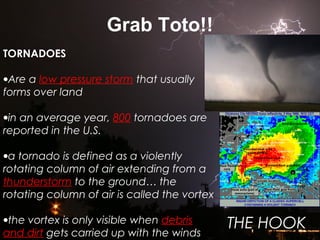
TORNADOES
•Are a low pressure storm that usually
forms over land
•in an average year, 800 tornadoes are
reported in the U.S.
•a tornado is defined as a violently
rotating column of air extending from a
thunderstorm to the ground… the
rotating column of air is called the vortex
•the vortex is only visible when debris
and dirt gets carried up with the winds
THE HOOK
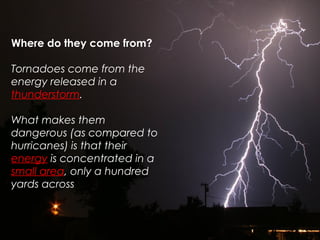
Where do they come from?
Tornadoes come from the
energy released in a
thunderstorm.
What makes them
dangerous (as compared to
hurricanes) is that their
energy is concentrated in a
small area, only a hundred
yards across
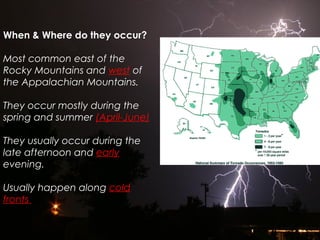
When & Where do they occur?
Most common east of the
Rocky Mountains and west of
the Appalachian Mountains.
They occur mostly during the
spring and summer (April-June)
They usually occur during the
late afternoon and early
evening.
Usually happen along cold
fronts
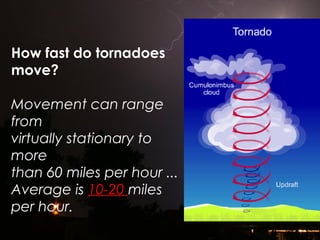
How fast do tornadoes
move?
Movement can range
from
virtually stationary to
more
than 60 miles per hour ...
Average is 10-20 miles
per hour.
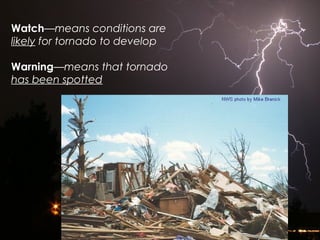
Watch—means conditions are
likely for tornado to develop
Warning—means that tornado
has been spotted
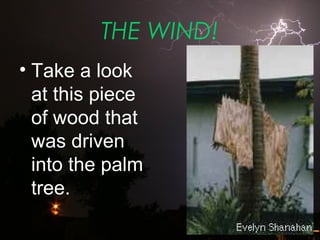
THE WIND!
• Take a look
at this piece
of wood that
was driven
into the palm
tree.
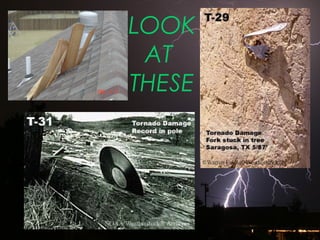
LOOK
AT
THESE
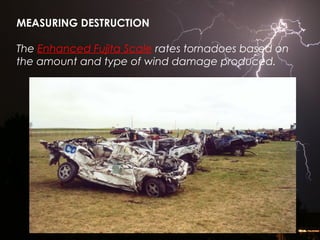
MEASURING DESTRUCTION
The Enhanced Fujita Scale rates tornadoes based on
the amount and type of wind damage produced.
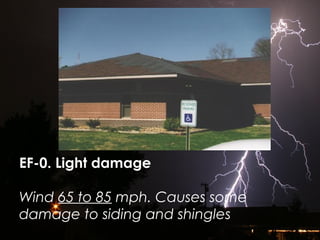
EF-0. Light damage
Wind 65 to 85 mph. Causes some
damage to siding and shingles
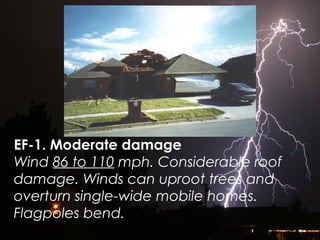
EF-1. Moderate damage
Wind 86 to 110 mph. Considerable roof
damage. Winds can uproot trees and
overturn single-wide mobile homes.
Flagpoles bend.
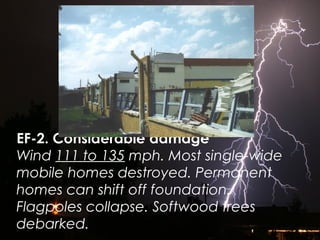
EF-2. Considerable damage
Wind 111 to 135 mph. Most single-wide
mobile homes destroyed. Permanent
homes can shift off foundation.
Flagpoles collapse. Softwood trees
debarked.
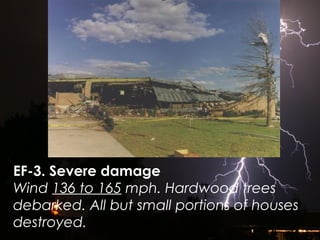
EF-3. Severe damage
Wind 136 to 165 mph. Hardwood trees
debarked. All but small portions of houses
destroyed.
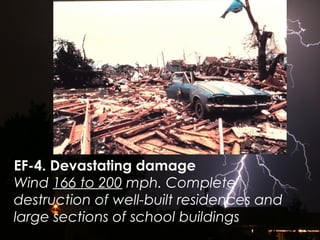
EF-4. Devastating damage
Wind 166 to 200 mph. Complete
destruction of well-built residences and
large sections of school buildings
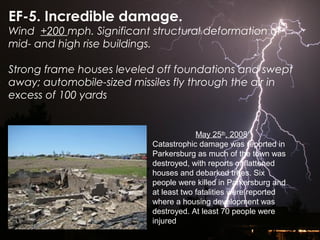
EF-5. Incredible damage.
Wind +200 mph. Significant structural deformation of
mid- and high rise buildings.
Strong frame houses leveled off foundations and swept
away; automobile-sized missiles fly through the air in
excess of 100 yards
May 25th
, 2008
Catastrophic damage was reported in
Parkersburg as much of the town was
destroyed, with reports of flattened
houses and debarked trees. Six
people were killed in Parkersburg and
at least two fatalities were reported
where a housing development was
destroyed. At least 70 people were
injured
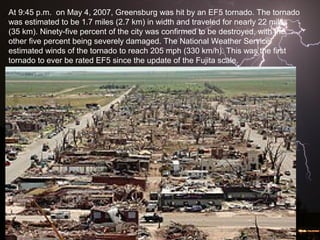
At 9:45 p.m. on May 4, 2007, Greensburg was hit by an EF5 tornado. The tornado
was estimated to be 1.7 miles (2.7 km) in width and traveled for nearly 22 miles
(35 km). Ninety-five percent of the city was confirmed to be destroyed, with the
other five percent being severely damaged. The National Weather Service
estimated winds of the tornado to reach 205 mph (330 km/h). This was the first
tornado to ever be rated EF5 since the update of the Fujita scale.
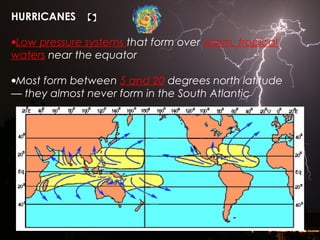
HURRICANES
•Low pressure systems that form over warm, tropical
waters near the equator
•Most form between 5 and 20 degrees north latitude
— they almost never form in the South Atlantic
They have the lowest barometric pressure
ever recorded with and storm (905 millibars
Is the lowest recorded
These huge areas of low pressure is what creates
The rapid, inward spiraling of winds
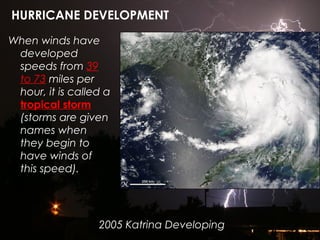
When winds have
developed
speeds from 39
to 73 miles per
hour, it is called a
tropical storm
(storms are given
names when
they begin to
have winds of
this speed).
HURRICANE DEVELOPMENT
2005 Katrina Developing
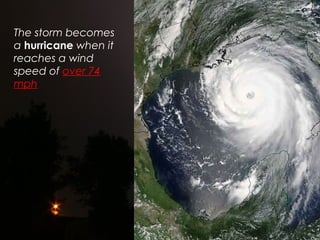
The storm becomes
a hurricane when it
reaches a wind
speed of over 74
mph
Hurricane
Formation
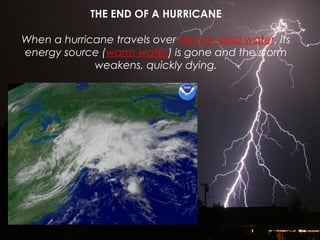
THE END OF A HURRICANE
When a hurricane travels over land or cold water, its
energy source (warm water) is gone and the storm
weakens, quickly dying.
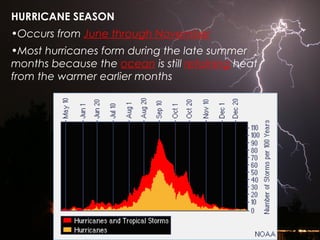
HURRICANE SEASON
•Occurs from June through November
•Most hurricanes form during the late summer
months because the ocean is still retaining heat
from the warmer earlier months
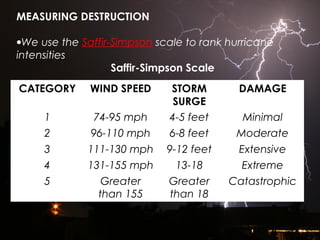
MEASURING DESTRUCTION
•We use the Saffir-Simpson scale to rank hurricane
intensities
Saffir-Simpson Scale
CATEGORY WIND SPEED STORM
SURGE
DAMAGE
1 74-95 mph 4-5 feet Minimal
2 96-110 mph 6-8 feet Moderate
3 111-130 mph 9-12 feet Extensive
4 131-155 mph 13-18 Extreme
5 Greater
than 155
Greater
than 18
Catastrophic
Video Clip on Wind Tunnel
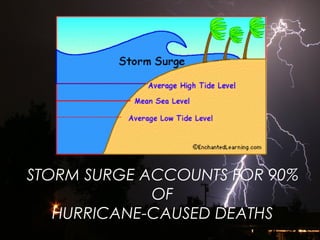
STORM SURGE ACCOUNTS FOR 90%
OF
HURRICANE-CAUSED DEATHS
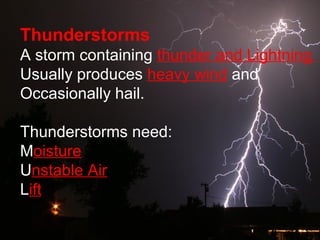
Thunderstorms
A storm containing thunder and Lightning
Usually produces heavy wind and
Occasionally hail.
Thunderstorms need:
Moisture
Unstable Air
Lift
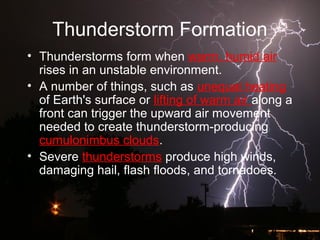
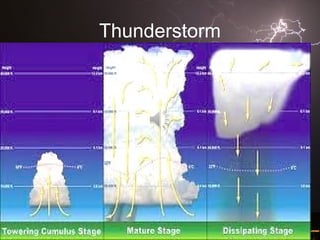
Thunderstorm Formation
• Thunderstorms form when warm, humid air
rises in an unstable environment.
• A number of things, such as unequal heating
of Earth's surface or lifting of warm air along a
front can trigger the upward air movement
needed to create thunderstorm-producing
cumulonimbus clouds.
• Severe thunderstorms produce high winds,
damaging hail, flash floods, and tornadoes.
Tornado Precautions
• Go to a basement, if you have one.
• Get in the innermost room of your house.
Avoid rooms with windows. Bathrooms
are good.
• Crouch with arms above your head.
• If outside, lie in a ditch or get under a
bridge.
• If you live in an area with a frequency of
tornadoes, listen to forecasts.
Thunderstorm
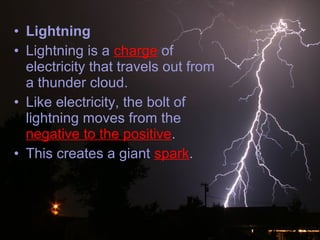
• Lightning
• Lightning is a charge of
electricity that travels out from
a thunder cloud.
• Like electricity, the bolt of
lightning moves from the
negative to the positive.
• This creates a giant spark.
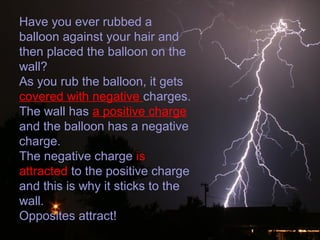
Have you ever rubbed a
balloon against your hair and
then placed the balloon on the
wall?
As you rub the balloon, it gets
covered with negative charges.
The wall has a positive charge
and the balloon has a negative
charge.
The negative charge is
attracted to the positive charge
and this is why it sticks to the
wall.
Opposites attract!
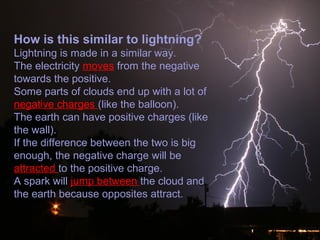
How is this similar to lightning?
Lightning is made in a similar way.
The electricity moves from the negative
towards the positive.
Some parts of clouds end up with a lot of
negative charges (like the balloon).
The earth can have positive charges (like
the wall).
If the difference between the two is big
enough, the negative charge will be
attracted to the positive charge.
A spark will jump between the cloud and
the earth because opposites attract.
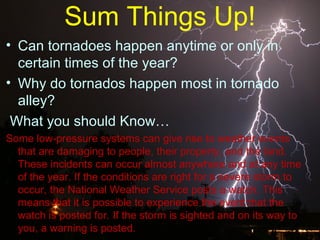
Sum Things Up!
• Can tornadoes happen anytime or only in
certain times of the year?
• Why do tornados happen most in tornado
alley?
What you should Know…
Some low pressure systems can give rise to weather events‐
that are damaging to people, their property, and the land.
These incidents can occur almost anywhere and at any time
of the year. If the conditions are right for a severe storm to
occur, the National Weather Service posts a watch. This
means that it is possible to experience the event that the
watch is posted for. If the storm is sighted and on its way to
you, a warning is posted.

3 25 2015 severe weather ppt 014[1] with notes

  • 1.
    Severe Weather: Tornadoes andHurricanes Thunderstorms and Lightning S6E4b Relate unequal heating of land and water surfaces to form large global wind systems and weather events such as tornados and thunderstorms. c Relate how moisture evaporating from the oceans affects the weather patterns and weather events such as hurricanes
  • 2.
    Task:• • Scenario: Youare a team of storm chasers from the Weather Channel. Your job is to educate the public about severe weather as it is happening. You will need a team of researchers to do this project. Each person will play a role, but you will need to do the research on the severe storm alone.
  • 3.
    Your Task: • Createa group product to share the information about your storm with the rest of the class during a “gallery walk.” • Products could be a song, poster, informational flyer, brochure, 3 minute information video, recipe card or any other product your group comes up with and gets approved by the teacher
  • 4.
    As you workthink about these questions : •  What are the “ingredients” for your storm to form? •  How does your storm form? •  What are the atmospheric conditions that are likely to occur? •  Does your storm form during a specific season or month(s)? •  Is there a particular location where this storm forms? •  How does this storm affect the people who live through it? •  What are some safety tips to survive this storm?
  • 5.
    Grab Toto!! TORNADOES •Are alow pressure storm that usually forms over land •in an average year, 800 tornadoes are reported in the U.S. •a tornado is defined as a violently rotating column of air extending from a thunderstorm to the ground… the rotating column of air is called the vortex •the vortex is only visible when debris and dirt gets carried up with the winds THE HOOK
  • 6.
    Where do theycome from? Tornadoes come from the energy released in a thunderstorm. What makes them dangerous (as compared to hurricanes) is that their energy is concentrated in a small area, only a hundred yards across
  • 7.
    When & Wheredo they occur? Most common east of the Rocky Mountains and west of the Appalachian Mountains. They occur mostly during the spring and summer (April-June) They usually occur during the late afternoon and early evening. Usually happen along cold fronts
  • 8.
    How fast dotornadoes move? Movement can range from virtually stationary to more than 60 miles per hour ... Average is 10-20 miles per hour.
  • 9.
    Watch—means conditions are likelyfor tornado to develop Warning—means that tornado has been spotted
  • 10.
    THE WIND! • Takea look at this piece of wood that was driven into the palm tree.
  • 11.
  • 12.
    MEASURING DESTRUCTION The EnhancedFujita Scale rates tornadoes based on the amount and type of wind damage produced.
  • 13.
    EF-0. Light damage Wind65 to 85 mph. Causes some damage to siding and shingles
  • 14.
    EF-1. Moderate damage Wind86 to 110 mph. Considerable roof damage. Winds can uproot trees and overturn single-wide mobile homes. Flagpoles bend.
  • 15.
    EF-2. Considerable damage Wind111 to 135 mph. Most single-wide mobile homes destroyed. Permanent homes can shift off foundation. Flagpoles collapse. Softwood trees debarked.
  • 16.
    EF-3. Severe damage Wind136 to 165 mph. Hardwood trees debarked. All but small portions of houses destroyed.
  • 17.
    EF-4. Devastating damage Wind166 to 200 mph. Complete destruction of well-built residences and large sections of school buildings
  • 18.
    EF-5. Incredible damage. Wind+200 mph. Significant structural deformation of mid- and high rise buildings. Strong frame houses leveled off foundations and swept away; automobile-sized missiles fly through the air in excess of 100 yards May 25th , 2008 Catastrophic damage was reported in Parkersburg as much of the town was destroyed, with reports of flattened houses and debarked trees. Six people were killed in Parkersburg and at least two fatalities were reported where a housing development was destroyed. At least 70 people were injured
  • 19.
    At 9:45 p.m.on May 4, 2007, Greensburg was hit by an EF5 tornado. The tornado was estimated to be 1.7 miles (2.7 km) in width and traveled for nearly 22 miles (35 km). Ninety-five percent of the city was confirmed to be destroyed, with the other five percent being severely damaged. The National Weather Service estimated winds of the tornado to reach 205 mph (330 km/h). This was the first tornado to ever be rated EF5 since the update of the Fujita scale.
  • 20.
    HURRICANES •Low pressure systemsthat form over warm, tropical waters near the equator •Most form between 5 and 20 degrees north latitude — they almost never form in the South Atlantic
  • 21.
    They have thelowest barometric pressure ever recorded with and storm (905 millibars Is the lowest recorded These huge areas of low pressure is what creates The rapid, inward spiraling of winds
  • 22.
    When winds have developed speedsfrom 39 to 73 miles per hour, it is called a tropical storm (storms are given names when they begin to have winds of this speed). HURRICANE DEVELOPMENT 2005 Katrina Developing
  • 23.
    The storm becomes ahurricane when it reaches a wind speed of over 74 mph Hurricane Formation
  • 24.
    THE END OFA HURRICANE When a hurricane travels over land or cold water, its energy source (warm water) is gone and the storm weakens, quickly dying.
  • 25.
    HURRICANE SEASON •Occurs fromJune through November •Most hurricanes form during the late summer months because the ocean is still retaining heat from the warmer earlier months
  • 26.
    MEASURING DESTRUCTION •We usethe Saffir-Simpson scale to rank hurricane intensities Saffir-Simpson Scale CATEGORY WIND SPEED STORM SURGE DAMAGE 1 74-95 mph 4-5 feet Minimal 2 96-110 mph 6-8 feet Moderate 3 111-130 mph 9-12 feet Extensive 4 131-155 mph 13-18 Extreme 5 Greater than 155 Greater than 18 Catastrophic Video Clip on Wind Tunnel
  • 27.
    STORM SURGE ACCOUNTSFOR 90% OF HURRICANE-CAUSED DEATHS
  • 28.
    Thunderstorms A storm containingthunder and Lightning Usually produces heavy wind and Occasionally hail. Thunderstorms need: Moisture Unstable Air Lift
  • 29.
    Thunderstorm Formation • Thunderstormsform when warm, humid air rises in an unstable environment. • A number of things, such as unequal heating of Earth's surface or lifting of warm air along a front can trigger the upward air movement needed to create thunderstorm-producing cumulonimbus clouds. • Severe thunderstorms produce high winds, damaging hail, flash floods, and tornadoes.
  • 30.
    Tornado Precautions • Goto a basement, if you have one. • Get in the innermost room of your house. Avoid rooms with windows. Bathrooms are good. • Crouch with arms above your head. • If outside, lie in a ditch or get under a bridge. • If you live in an area with a frequency of tornadoes, listen to forecasts.
  • 31.
  • 32.
    • Lightning • Lightningis a charge of electricity that travels out from a thunder cloud. • Like electricity, the bolt of lightning moves from the negative to the positive. • This creates a giant spark.
  • 33.
    Have you everrubbed a balloon against your hair and then placed the balloon on the wall? As you rub the balloon, it gets covered with negative charges. The wall has a positive charge and the balloon has a negative charge. The negative charge is attracted to the positive charge and this is why it sticks to the wall. Opposites attract!
  • 34.
    How is thissimilar to lightning? Lightning is made in a similar way. The electricity moves from the negative towards the positive. Some parts of clouds end up with a lot of negative charges (like the balloon). The earth can have positive charges (like the wall). If the difference between the two is big enough, the negative charge will be attracted to the positive charge. A spark will jump between the cloud and the earth because opposites attract.
  • 35.
    Sum Things Up! •Can tornadoes happen anytime or only in certain times of the year? • Why do tornados happen most in tornado alley? What you should Know… Some low pressure systems can give rise to weather events‐ that are damaging to people, their property, and the land. These incidents can occur almost anywhere and at any time of the year. If the conditions are right for a severe storm to occur, the National Weather Service posts a watch. This means that it is possible to experience the event that the watch is posted for. If the storm is sighted and on its way to you, a warning is posted.