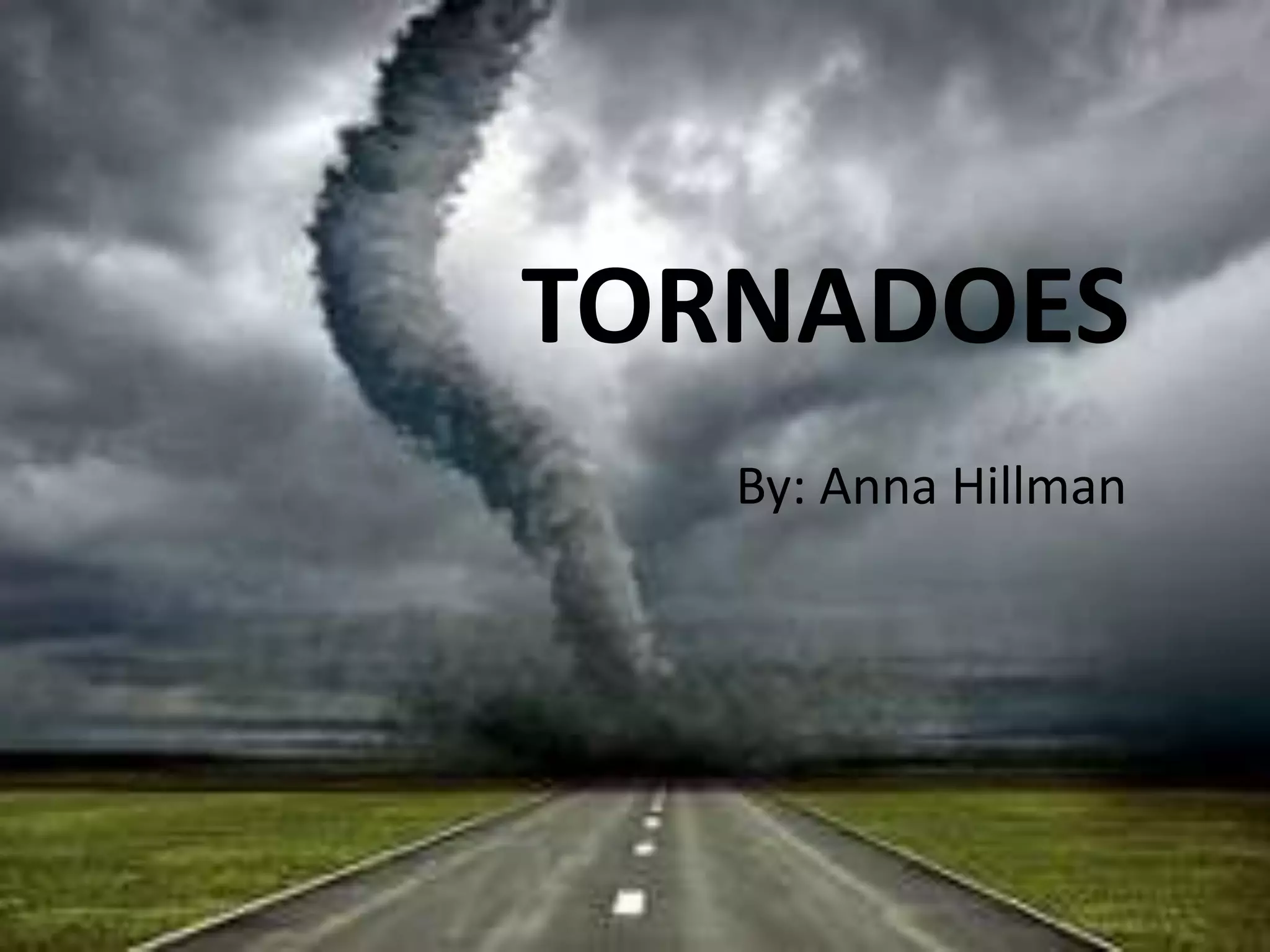
TORNADOES
By: Anna Hillman
Intro (What is a Tornado?)
A tornado is a violently rotating column of
air that is in contact with both the surface of
the earth and a cumulonimbus cloud; in some
cases, it will be the base of a cumulus cloud.
Most tornadoes have wind speeds less than
110 miles per hour, are about 250 feet
wide, and travel only a few miles before they
dissipate.
How Does a Tornado Form?
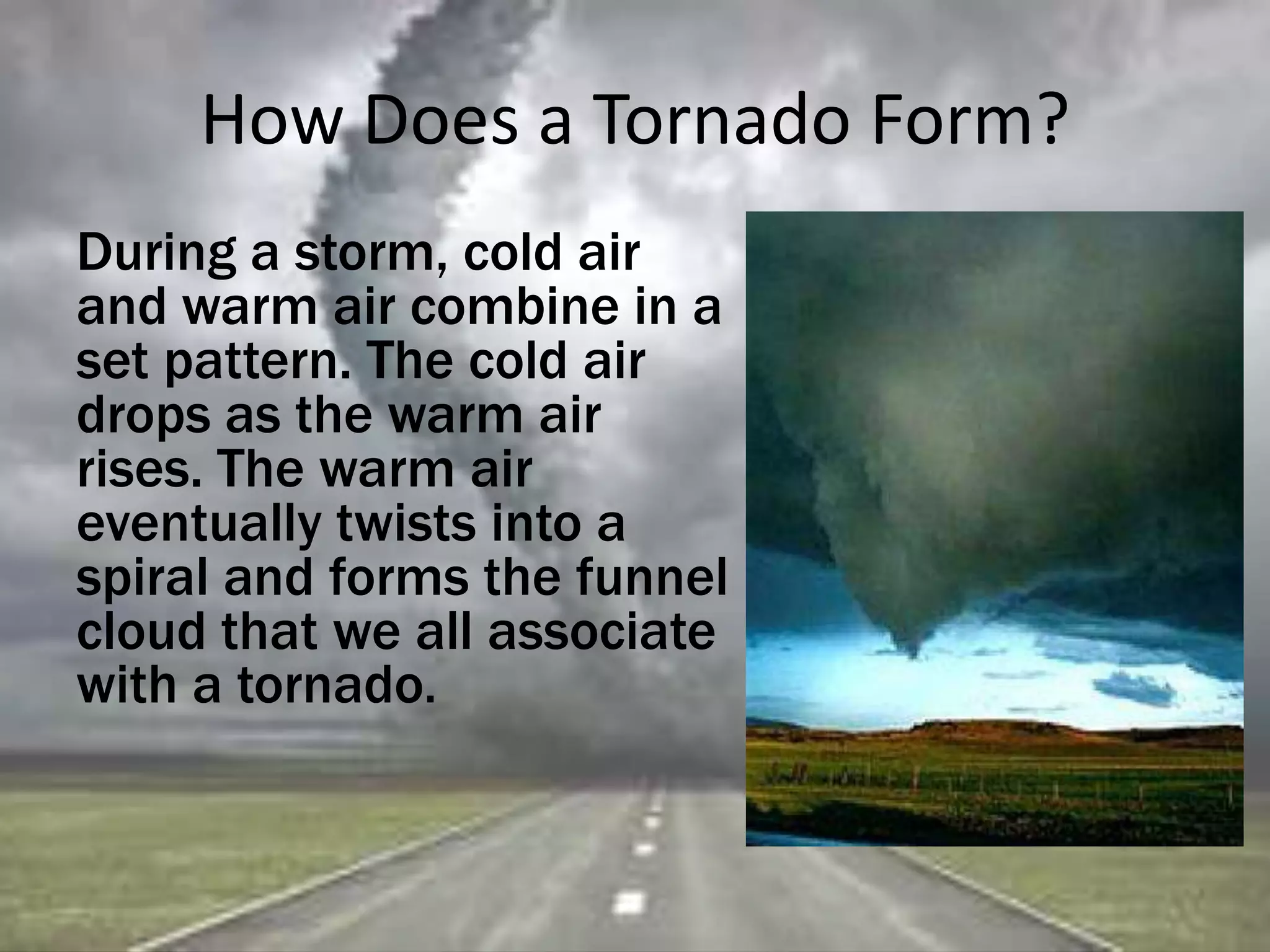
During a storm, cold air
and warm air combine in a
set pattern. The cold air
drops as the warm air
rises. The warm air
eventually twists into a
spiral and forms the funnel
cloud that we all associate
with a tornado.
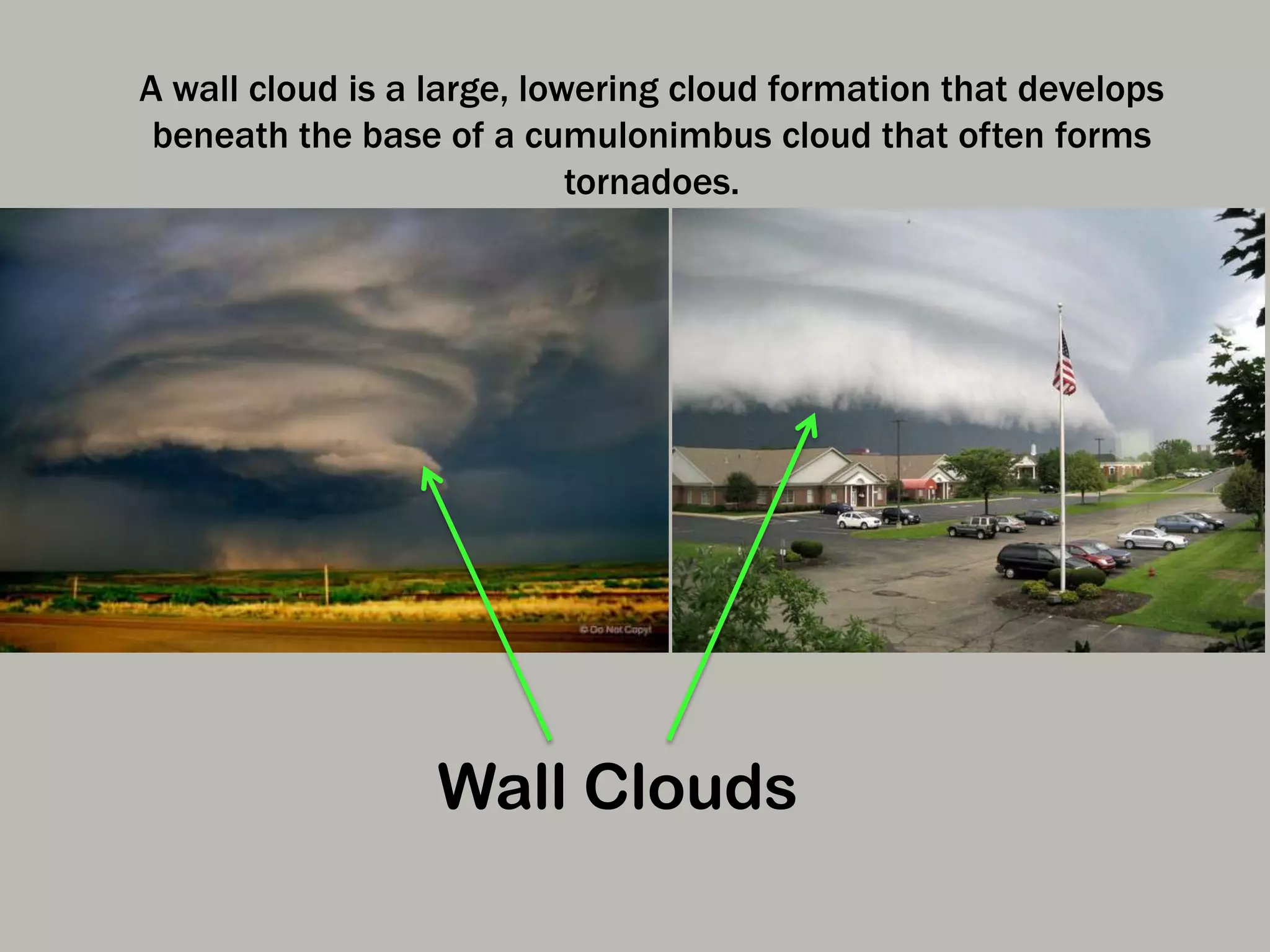
Wall Clouds
A wall cloud is a large, lowering cloud formation that develops
beneath the base of a cumulonimbus cloud that often forms
tornadoes.
Tornado Disasters
• On May 22, 1987, between 8:15 p.m. and 8:20
p.m., Saragosa, Texas, was devastated by a
violent, multiple-vortex tornado, with winds of 207-260
mph.
• On April 3-4, 1974, a super tornado
outbreak. It was the worst
tornado outbreak in U.S. history
at that time with 148 twisters
touching down in 13 states.
330 people were killed and
5,484 were injured in a
damaging path covering more
than 2,500 miles.
http://www.nap.edu/openbook.php?record_id=1766&page=60
Tornado Disasters
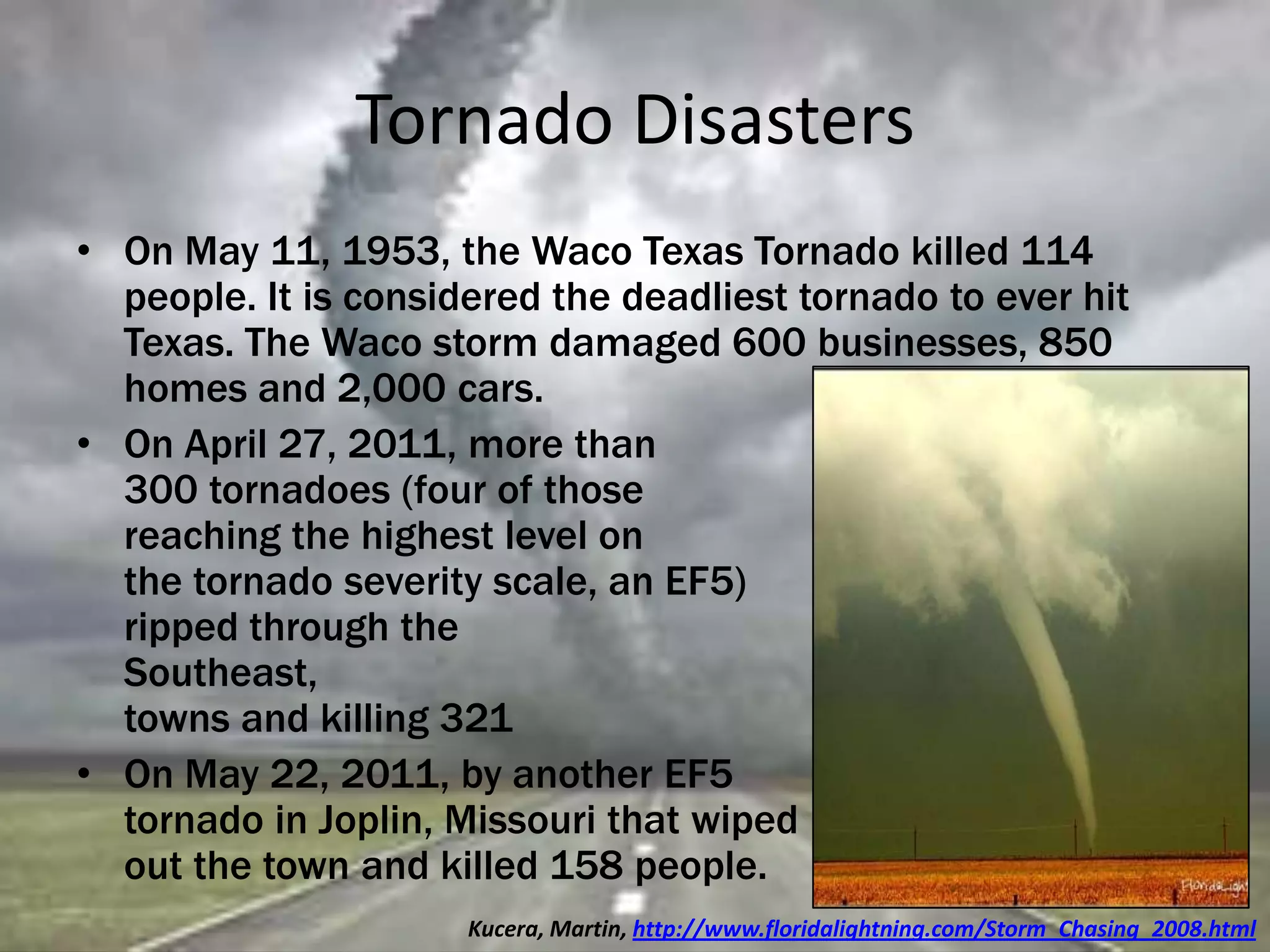
• On May 11, 1953, the Waco Texas Tornado killed 114
people. It is considered the deadliest tornado to ever hit
Texas. The Waco storm damaged 600 businesses, 850
homes and 2,000 cars.
• On April 27, 2011, more than
300 tornadoes (four of those
reaching the highest level on
the tornado severity scale, an EF5)
ripped through the
Southeast, leveling whole
towns and killing 321 people.
• On May 22, 2011, by another EF5
tornado in Joplin, Missouri that wiped
out the town and killed 158 people.
Kucera, Martin, http://www.floridalightning.com/Storm_Chasing_2008.html
Water Spouts
http://www.srh.noaa.gov/mfl/?n=waterspouts
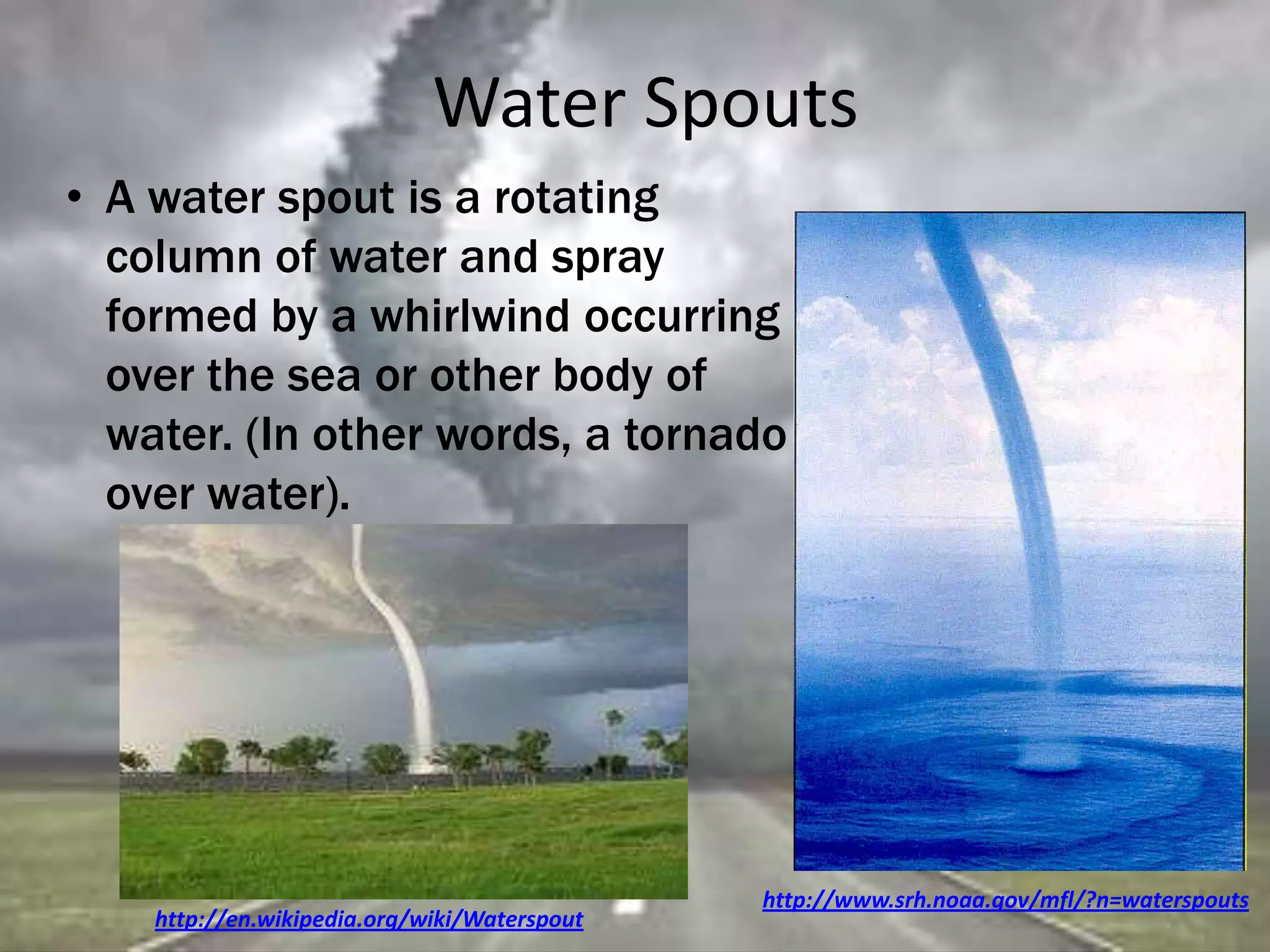
• A water spout is a rotating
column of water and spray
formed by a whirlwind occurring
over the sea or other body of
water. (In other words, a tornado
over water).
http://en.wikipedia.org/wiki/Waterspout
Tornado Alley
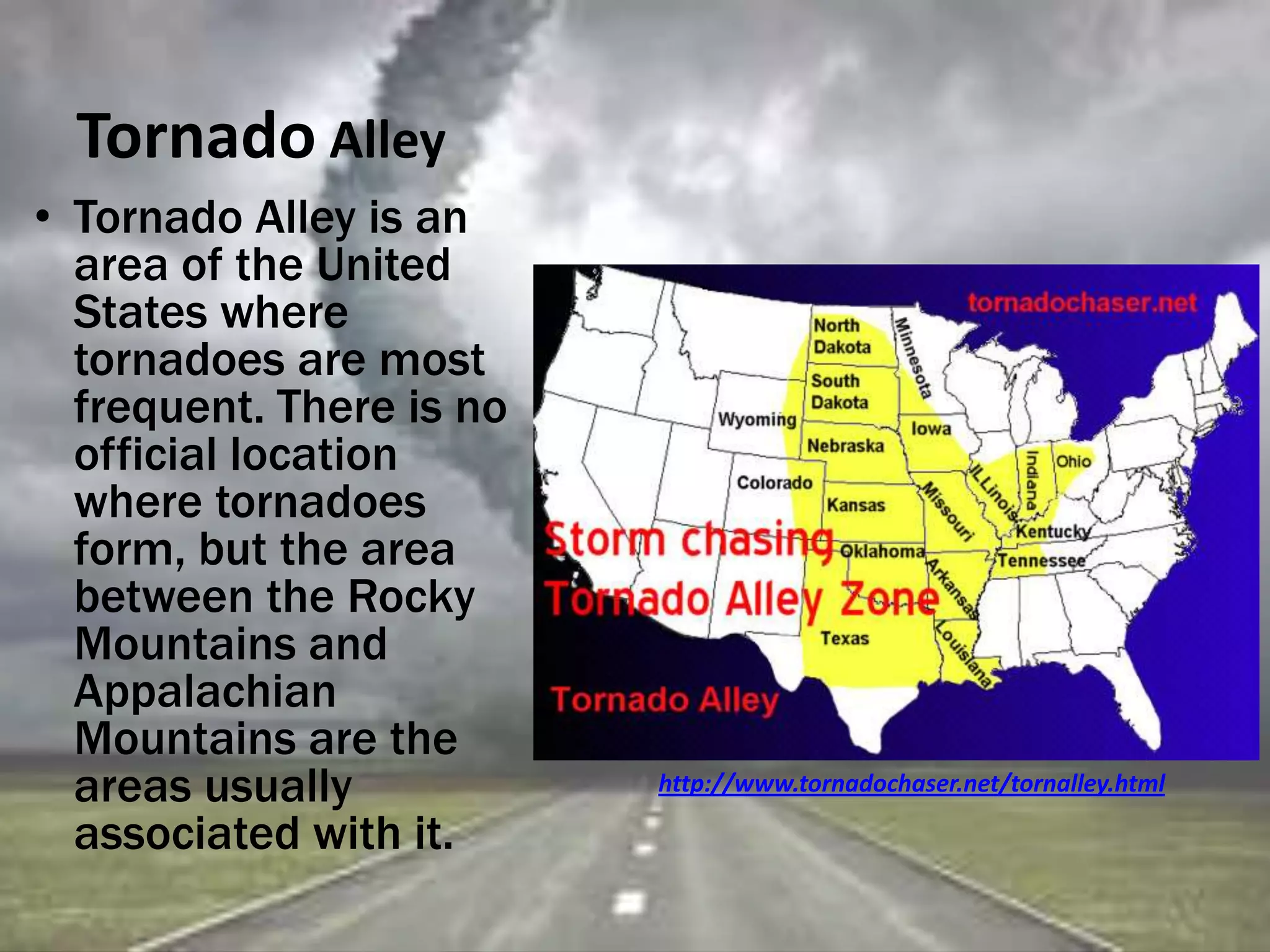
• Tornado Alley is an
area of the United
States where
tornadoes are most
frequent. There is no
official location
where tornadoes
form, but the area
between the Rocky
Mountains and
Appalachian
Mountains are the
areas usually
associated with it.
http://www.tornadochaser.net/tornalley.html
Monitoring and Predicting Tornadoes
• When predicting tornadoes, the Doppler radar will
help a lot. The radar's beam, which forces
microwaves into the precipitation and creates an
image of the wind's motion. This is too wide to
properly pinpoint the actual tornado. Therefore, the
Doppler radar can only suggest that conditions are
ripe for a tornado to present itself.
• Tornadoes send out ultra long-wave low-frequency
sounds. These noises are known as infrasound.
Infrasound detectors can signal the approach of a
tornado just minutes before it occurs.
Monitoring and Predicting Tornadoes
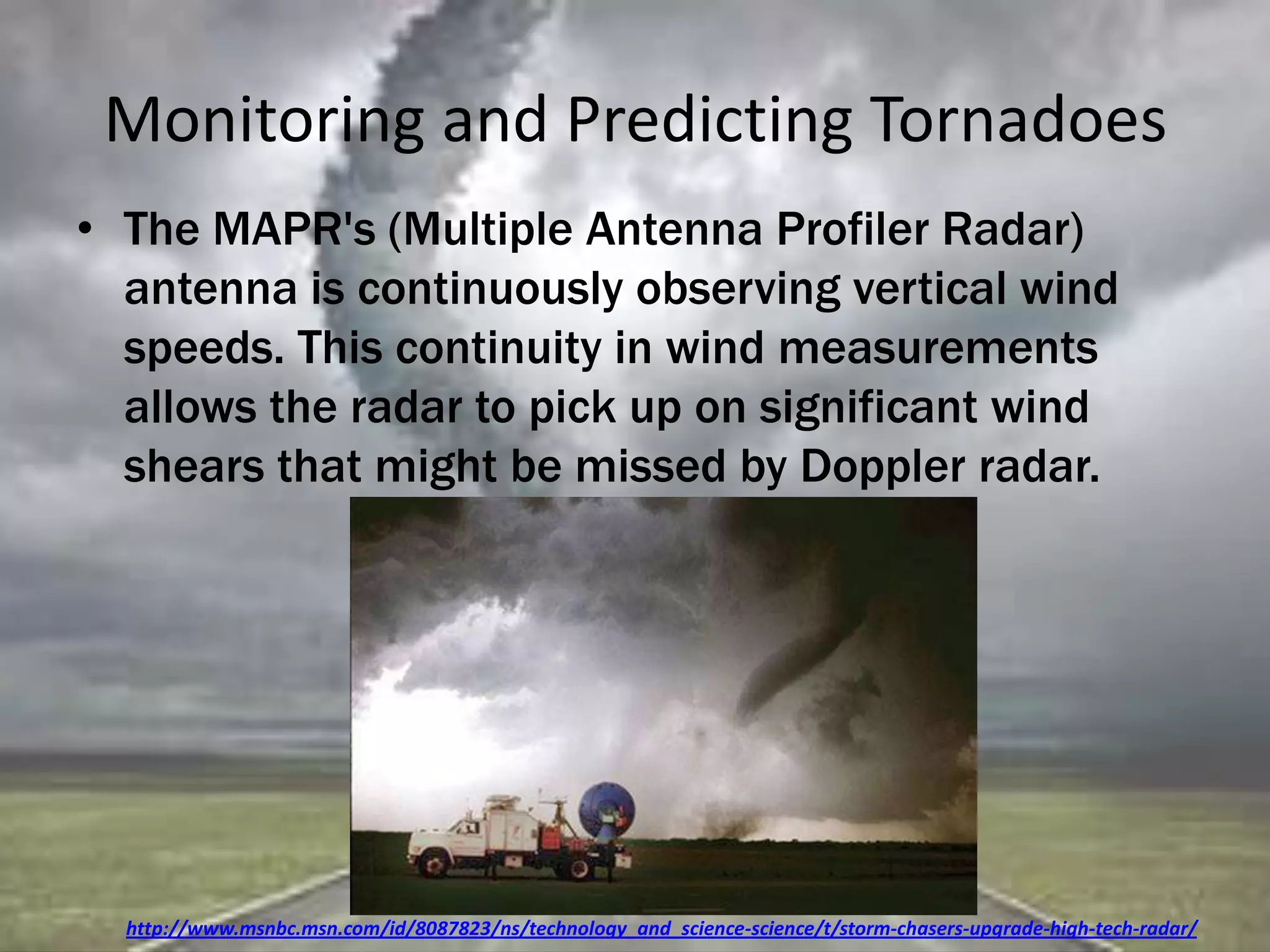
• The MAPR's (Multiple Antenna Profiler Radar)
antenna is continuously observing vertical wind
speeds. This continuity in wind measurements
allows the radar to pick up on significant wind
shears that might be missed by Doppler radar.
http://www.msnbc.msn.com/id/8087823/ns/technology_and_science-science/t/storm-chasers-upgrade-high-tech-radar/
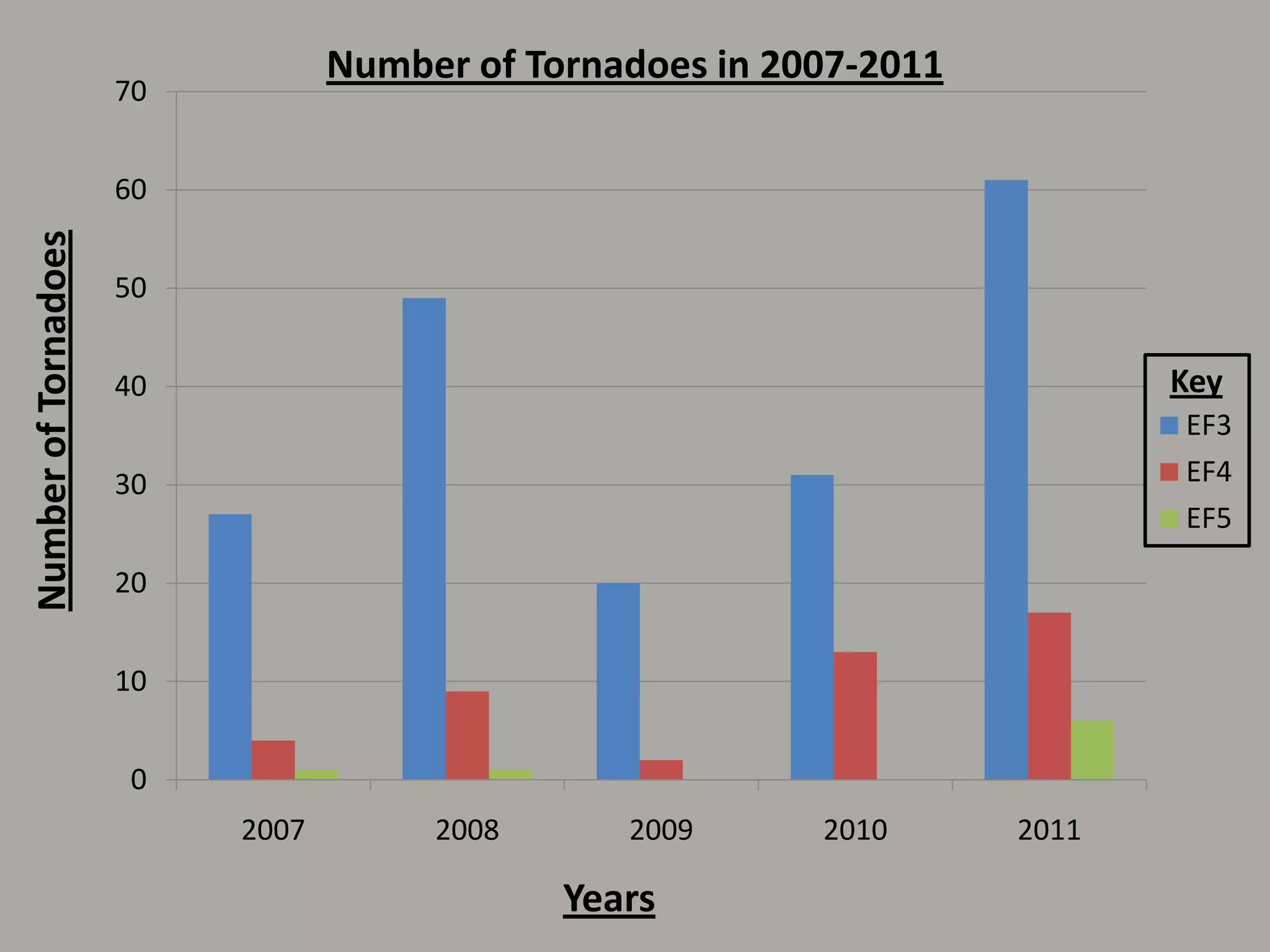
0
10
20
30
40
50
60
70
2007 2008 2009 2010 2011
EF3
EF4
EF5
Key
NumberofTornadoes
Years
Number of Tornadoes in 2007-2011
Tornado Preparation
• Make sure your car’s gas tank is full.
• Be aware of changing weather conditions, especially darkening skies, rain, and rising
wind. If you see a funnel cloud, you could have no more than five minutes to get to
shelter. (If you can actually hear the tornado, you have only a few seconds).
• Leave low areas because there might be flooding or high tides.
• Listen for tornado watch updates and news.
• If in the water or a boat, go to shore and find shelter.
• Secure all outside furniture, barbecues, toys, etc.
• Nail boards across windows and tape them over so that wind pressure doesn’t shatter
the panes.
• Secure animals (and people!)
• Learn how to perform CPR and administer first aid.
• Check water, camping, emergency, and food supplies.
• Move valuables to the side of the house away from the wind.
• Have fresh batteries available for flashlights and portable radios.
• Store water in plastic bottles, jugs, pots, pans, and bathtubs.
• Try not to stay in a mobile home or R.V.
• Be prepared to evacuate and know where to go.
Staying Safe During A Tornado
• Hide in a storm cellar if you have one. Shelters should contain blankets, bottled
water, transistor radios and first-aid supplies.
• If you are outside, try to find shelter inside a building.
• If there is no storm cellar or shelter available, crouch in the southwest corner of your
basement. If there is no basement, lie out flat on the floor under heavy furniture or a
bed. Some people have survived in bathtubs by pulling mattresses over themselves, or
under stairwells or in closets.
• Surround yourself with a thick blanket for added protection.
• If you are outside, move away from the tornado’s path at a right angle.
• Do not stay in a building with a freestanding roof, like an auditorium or gym.
• If the tornado is too close for you to find shelter, lie on the ground in a ditch.
• Stay in the lowest story of the building.
• Keep away from windows and other breakable items.
• Get away from open areas and find shelter in interior hallways, reinforced rooms, or
partitioned spaces. Get as many walls as possible between you and the storm.
• If you are outdoors in a car, stop and find shelter inside a building, or hide in a ditch or
ravine. Lie facedown and cover your head. Don’t stand! Don’t try to outrun the tornado.
• Don’t leave your shelter until you hear that the tornado has ended.
Words Cited
• MHCS Marketing Team, Tornadoes: How to avoid Fremont emergency room visits, “Memorial
Hospital, 10-24-12, http://blog.memorialhcs.org/Memorial-Hospital-
Blog/bid/41230/Tornadoes-How-to-avoid-Fremont-emergency-room-visits
• Where is Tornado Alley, “Tornado Chaser”, 10-24-
12, http://www.tornadochaser.net/tornado.html
• “The Deadliest U.S. Tornadoes”, 10-25-
12, http://www.epicdisasters.com/index.php/site/comments/the_deadliest_us_tornadoes/
• Xara, “Beautiful Tornadoes Pictures”, 10-26-12, http://www.xarj.net/2012/beautiful-
tornados-pictures/
• Wikipedia, “Tornadoes of 2011”, 10-28-
12, http://en.wikipedia.org/wiki/Tornadoes_of_2011#Events
• Wikipedia, “Tornadoes of 2010”, 10-28-12, http://en.wikipedia.org/wiki/Tornadoes_of_2010
• Wikipedia, “Tornadoes of 2009, 10-28-12, http://en.wikipedia.org/wiki/Tornadoes_of_2009
• Wikipedia, “Tornadoes of 2008, 10-28-12, http://en.wikipedia.org/wiki/Tornadoes_of_2008
• Wikipedia, “Tornadoes of 2007, 10-28-12, http://en.wikipedia.org/wiki/Tornadoes_of_2007
• The Weather Channel, “Tracking and Researching Tornadoes”, 10-28-
12, http://www.weather.com/outlook/weather-news/severe-weather/articles/tornado-
agencies-track-research_2010-03-30

Tornadoes

  • 1.
  • 2.
    Intro (What isa Tornado?) A tornado is a violently rotating column of air that is in contact with both the surface of the earth and a cumulonimbus cloud; in some cases, it will be the base of a cumulus cloud. Most tornadoes have wind speeds less than 110 miles per hour, are about 250 feet wide, and travel only a few miles before they dissipate.
  • 3.
    How Does aTornado Form? During a storm, cold air and warm air combine in a set pattern. The cold air drops as the warm air rises. The warm air eventually twists into a spiral and forms the funnel cloud that we all associate with a tornado.
  • 4.
    Wall Clouds A wallcloud is a large, lowering cloud formation that develops beneath the base of a cumulonimbus cloud that often forms tornadoes.
  • 5.
    Tornado Disasters • OnMay 22, 1987, between 8:15 p.m. and 8:20 p.m., Saragosa, Texas, was devastated by a violent, multiple-vortex tornado, with winds of 207-260 mph. • On April 3-4, 1974, a super tornado outbreak. It was the worst tornado outbreak in U.S. history at that time with 148 twisters touching down in 13 states. 330 people were killed and 5,484 were injured in a damaging path covering more than 2,500 miles. http://www.nap.edu/openbook.php?record_id=1766&page=60
  • 6.
    Tornado Disasters • OnMay 11, 1953, the Waco Texas Tornado killed 114 people. It is considered the deadliest tornado to ever hit Texas. The Waco storm damaged 600 businesses, 850 homes and 2,000 cars. • On April 27, 2011, more than 300 tornadoes (four of those reaching the highest level on the tornado severity scale, an EF5) ripped through the Southeast, leveling whole towns and killing 321 people. • On May 22, 2011, by another EF5 tornado in Joplin, Missouri that wiped out the town and killed 158 people. Kucera, Martin, http://www.floridalightning.com/Storm_Chasing_2008.html
  • 7.
    Water Spouts http://www.srh.noaa.gov/mfl/?n=waterspouts • Awater spout is a rotating column of water and spray formed by a whirlwind occurring over the sea or other body of water. (In other words, a tornado over water). http://en.wikipedia.org/wiki/Waterspout
  • 8.
    Tornado Alley • TornadoAlley is an area of the United States where tornadoes are most frequent. There is no official location where tornadoes form, but the area between the Rocky Mountains and Appalachian Mountains are the areas usually associated with it. http://www.tornadochaser.net/tornalley.html
  • 9.
    Monitoring and PredictingTornadoes • When predicting tornadoes, the Doppler radar will help a lot. The radar's beam, which forces microwaves into the precipitation and creates an image of the wind's motion. This is too wide to properly pinpoint the actual tornado. Therefore, the Doppler radar can only suggest that conditions are ripe for a tornado to present itself. • Tornadoes send out ultra long-wave low-frequency sounds. These noises are known as infrasound. Infrasound detectors can signal the approach of a tornado just minutes before it occurs.
  • 10.
    Monitoring and PredictingTornadoes • The MAPR's (Multiple Antenna Profiler Radar) antenna is continuously observing vertical wind speeds. This continuity in wind measurements allows the radar to pick up on significant wind shears that might be missed by Doppler radar. http://www.msnbc.msn.com/id/8087823/ns/technology_and_science-science/t/storm-chasers-upgrade-high-tech-radar/
  • 11.
    0 10 20 30 40 50 60 70 2007 2008 20092010 2011 EF3 EF4 EF5 Key NumberofTornadoes Years Number of Tornadoes in 2007-2011
  • 12.
    Tornado Preparation • Makesure your car’s gas tank is full. • Be aware of changing weather conditions, especially darkening skies, rain, and rising wind. If you see a funnel cloud, you could have no more than five minutes to get to shelter. (If you can actually hear the tornado, you have only a few seconds). • Leave low areas because there might be flooding or high tides. • Listen for tornado watch updates and news. • If in the water or a boat, go to shore and find shelter. • Secure all outside furniture, barbecues, toys, etc. • Nail boards across windows and tape them over so that wind pressure doesn’t shatter the panes. • Secure animals (and people!) • Learn how to perform CPR and administer first aid. • Check water, camping, emergency, and food supplies. • Move valuables to the side of the house away from the wind. • Have fresh batteries available for flashlights and portable radios. • Store water in plastic bottles, jugs, pots, pans, and bathtubs. • Try not to stay in a mobile home or R.V. • Be prepared to evacuate and know where to go.
  • 13.
    Staying Safe DuringA Tornado • Hide in a storm cellar if you have one. Shelters should contain blankets, bottled water, transistor radios and first-aid supplies. • If you are outside, try to find shelter inside a building. • If there is no storm cellar or shelter available, crouch in the southwest corner of your basement. If there is no basement, lie out flat on the floor under heavy furniture or a bed. Some people have survived in bathtubs by pulling mattresses over themselves, or under stairwells or in closets. • Surround yourself with a thick blanket for added protection. • If you are outside, move away from the tornado’s path at a right angle. • Do not stay in a building with a freestanding roof, like an auditorium or gym. • If the tornado is too close for you to find shelter, lie on the ground in a ditch. • Stay in the lowest story of the building. • Keep away from windows and other breakable items. • Get away from open areas and find shelter in interior hallways, reinforced rooms, or partitioned spaces. Get as many walls as possible between you and the storm. • If you are outdoors in a car, stop and find shelter inside a building, or hide in a ditch or ravine. Lie facedown and cover your head. Don’t stand! Don’t try to outrun the tornado. • Don’t leave your shelter until you hear that the tornado has ended.
  • 14.
    Words Cited • MHCSMarketing Team, Tornadoes: How to avoid Fremont emergency room visits, “Memorial Hospital, 10-24-12, http://blog.memorialhcs.org/Memorial-Hospital- Blog/bid/41230/Tornadoes-How-to-avoid-Fremont-emergency-room-visits • Where is Tornado Alley, “Tornado Chaser”, 10-24- 12, http://www.tornadochaser.net/tornado.html • “The Deadliest U.S. Tornadoes”, 10-25- 12, http://www.epicdisasters.com/index.php/site/comments/the_deadliest_us_tornadoes/ • Xara, “Beautiful Tornadoes Pictures”, 10-26-12, http://www.xarj.net/2012/beautiful- tornados-pictures/ • Wikipedia, “Tornadoes of 2011”, 10-28- 12, http://en.wikipedia.org/wiki/Tornadoes_of_2011#Events • Wikipedia, “Tornadoes of 2010”, 10-28-12, http://en.wikipedia.org/wiki/Tornadoes_of_2010 • Wikipedia, “Tornadoes of 2009, 10-28-12, http://en.wikipedia.org/wiki/Tornadoes_of_2009 • Wikipedia, “Tornadoes of 2008, 10-28-12, http://en.wikipedia.org/wiki/Tornadoes_of_2008 • Wikipedia, “Tornadoes of 2007, 10-28-12, http://en.wikipedia.org/wiki/Tornadoes_of_2007 • The Weather Channel, “Tracking and Researching Tornadoes”, 10-28- 12, http://www.weather.com/outlook/weather-news/severe-weather/articles/tornado- agencies-track-research_2010-03-30