UNPACKED ELEMENT DRIVING INSTRUCTION:
S6E5b:Look into the
role of minerals to
rock makeup.
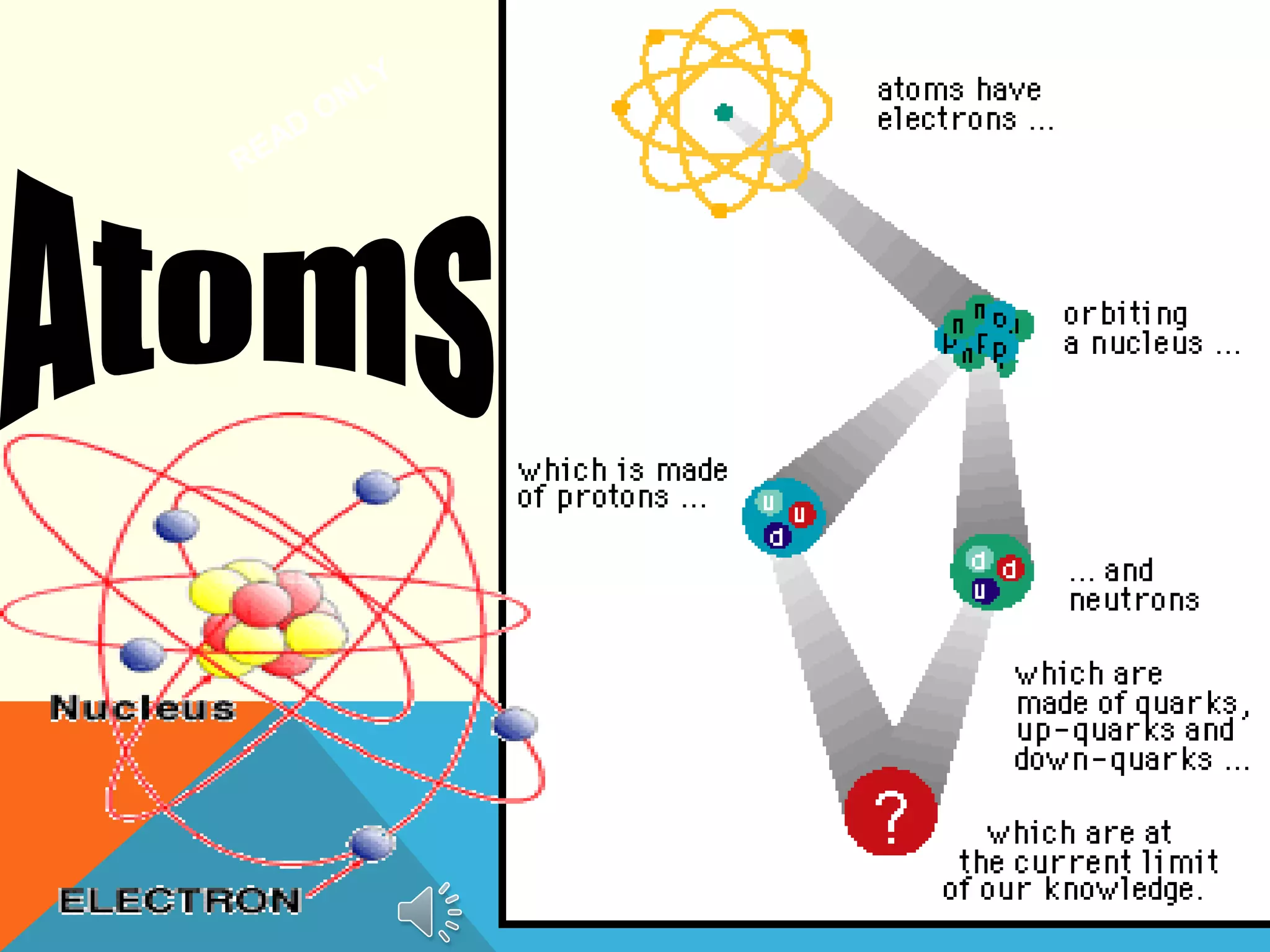
INTRODUCTION/ DIRECTIONS
Welcome Junior Geologist today
we will find out if an object is a
rock or mineral!
Your task is to gather as much
information about minerals. You
must copy the information in RED
but you are not limited to just
that (You may gather more
information as needed) that is up
LEARNING GOALS
1. Identify properties of minerals and be able to
identify certain minerals using specific tests.
2. Apply Moh’s hardness scale to identify
minerals.
Question: What methods can we use to
identify minerals?
Minerals are most often identified by
inspecting their PHYSICAL and
Chemical properties.
READ
ONLY
READ
ONLY
READ ONLY
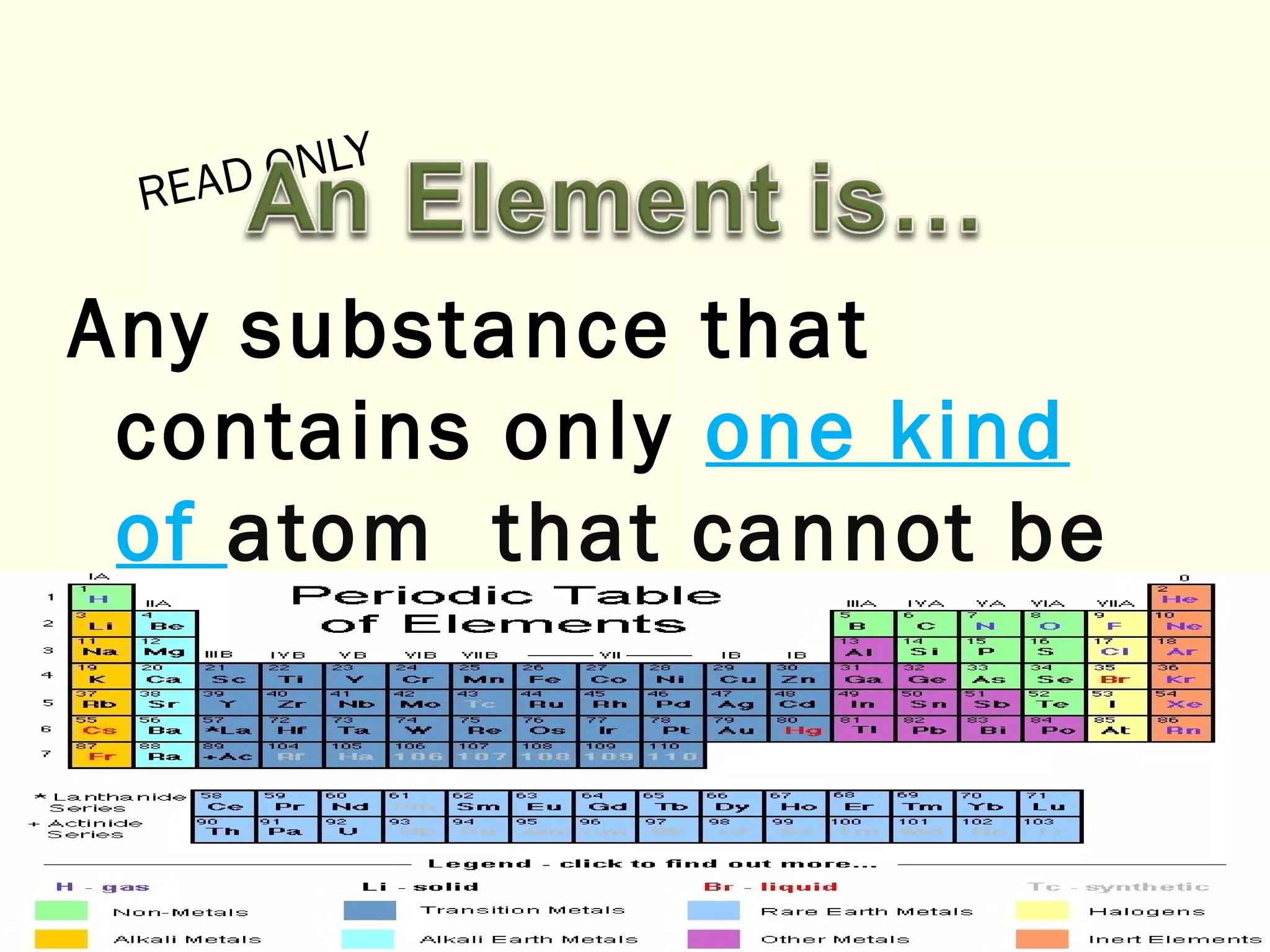
Any substance that
contains only one kind
of atom that cannot be
separated.
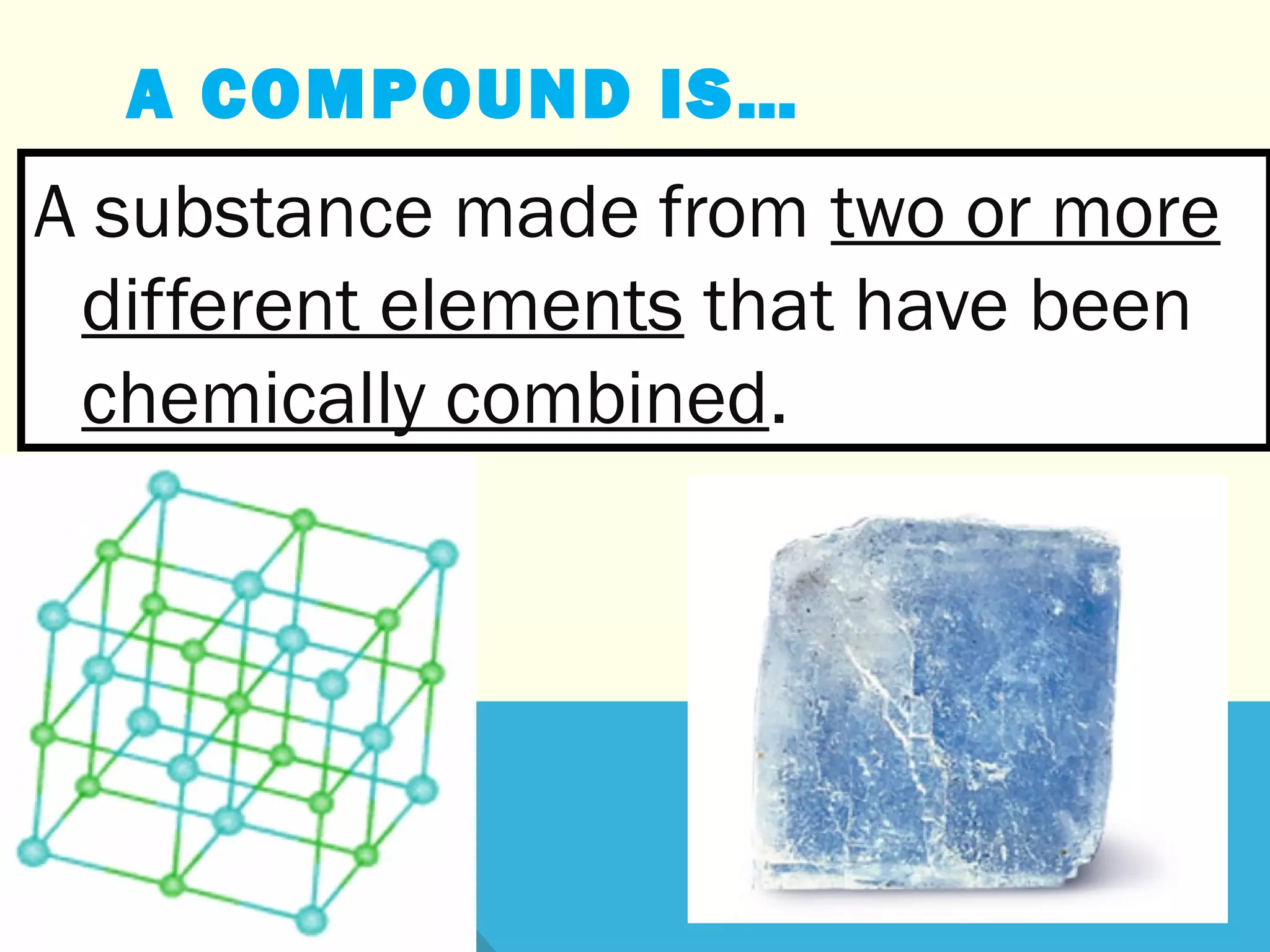
A COMPOUND IS…
A substance made from two or more
different elements that have been
chemically combined.
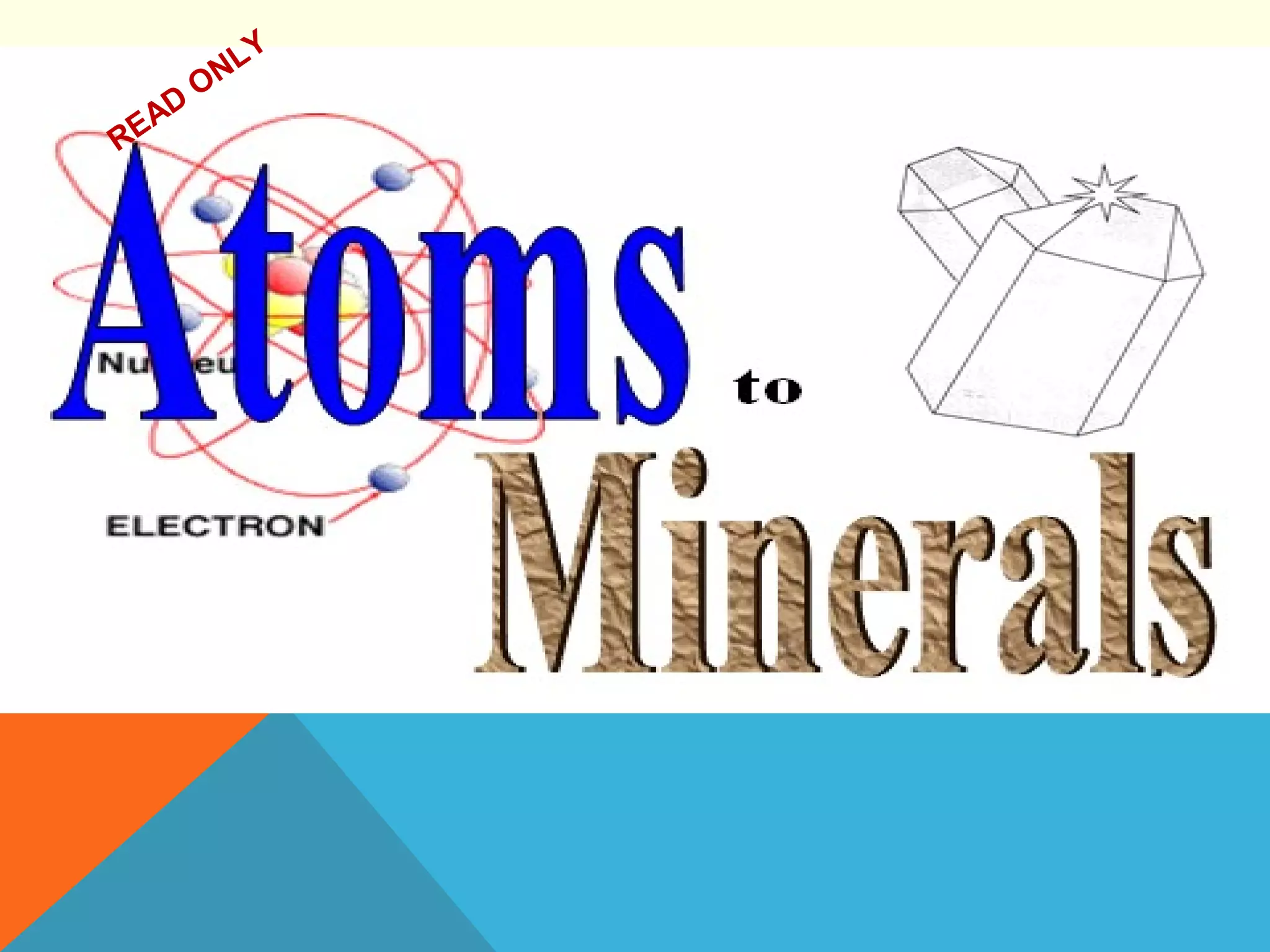
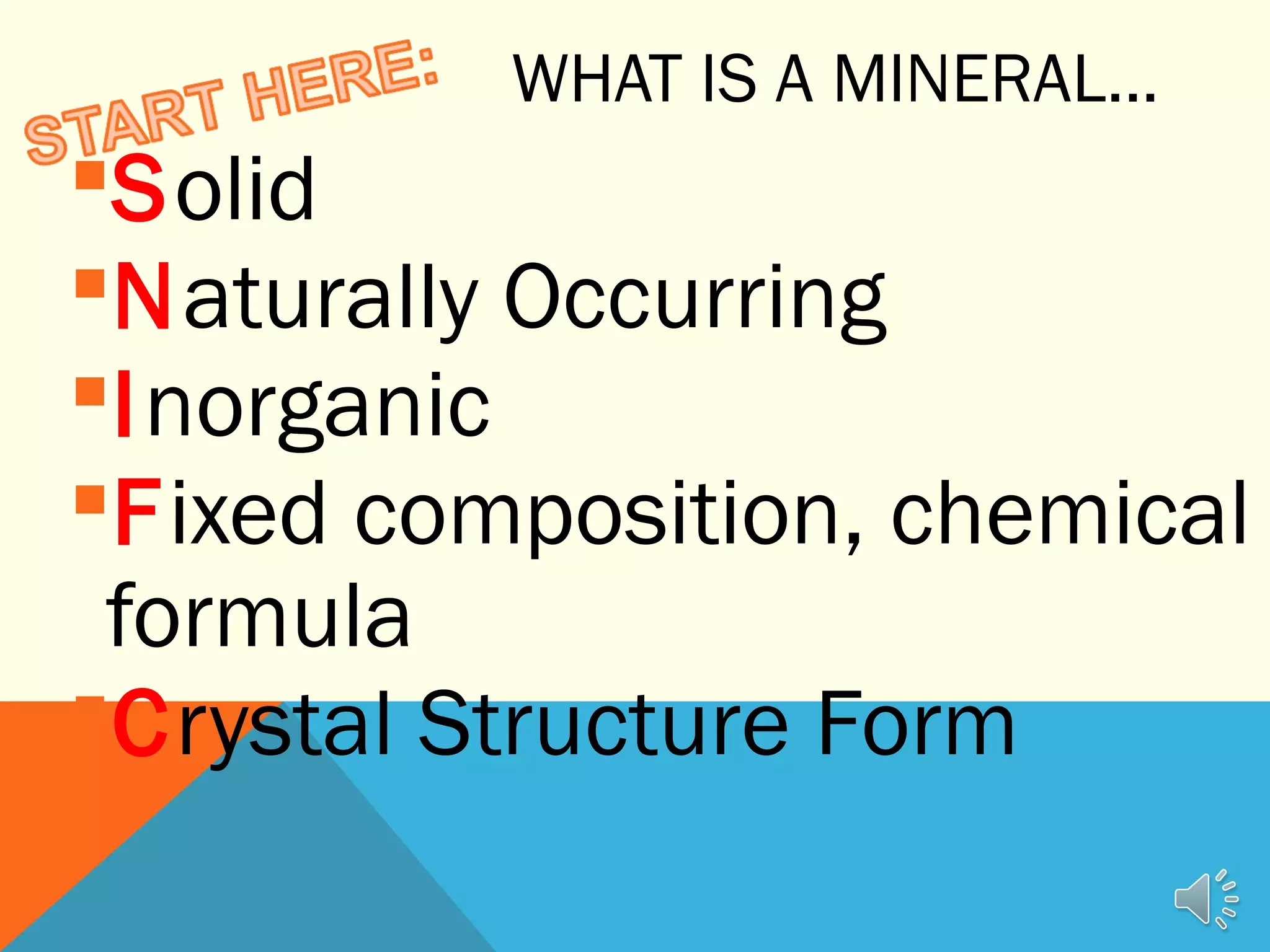
WHAT IS A MINERAL...
Solid
Naturally Occurring
Inorganic
Fixed composition, chemical
formula
Crystal Structure Form
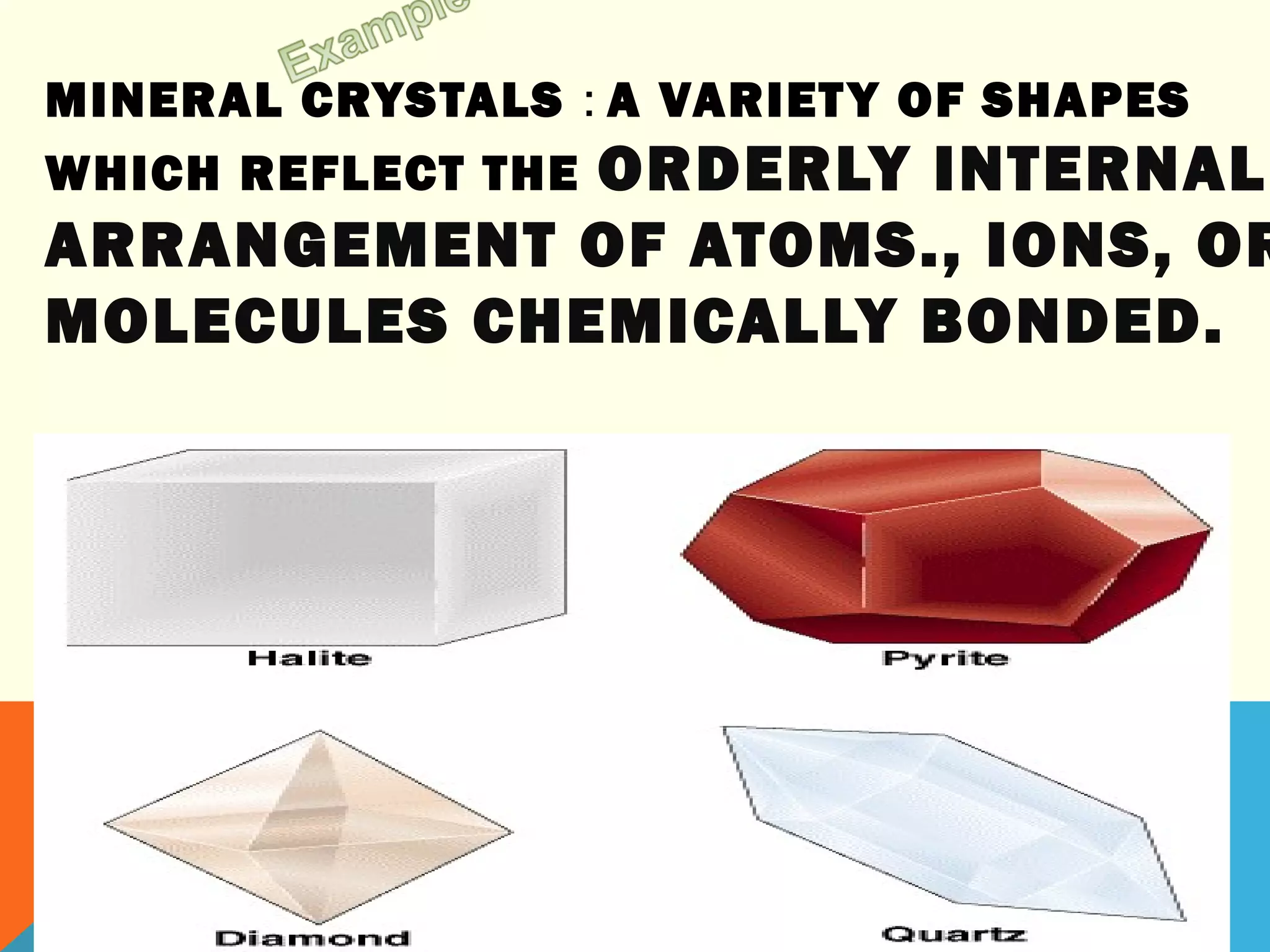
MINERAL CRYSTALS : A VARIETY OF SHAPES
WHICH REFLECT THE ORDERLY INTERNAL
ARRANGEMENT OF ATOMS., IONS, OR
MOLECULES CHEMICALLY BONDED.
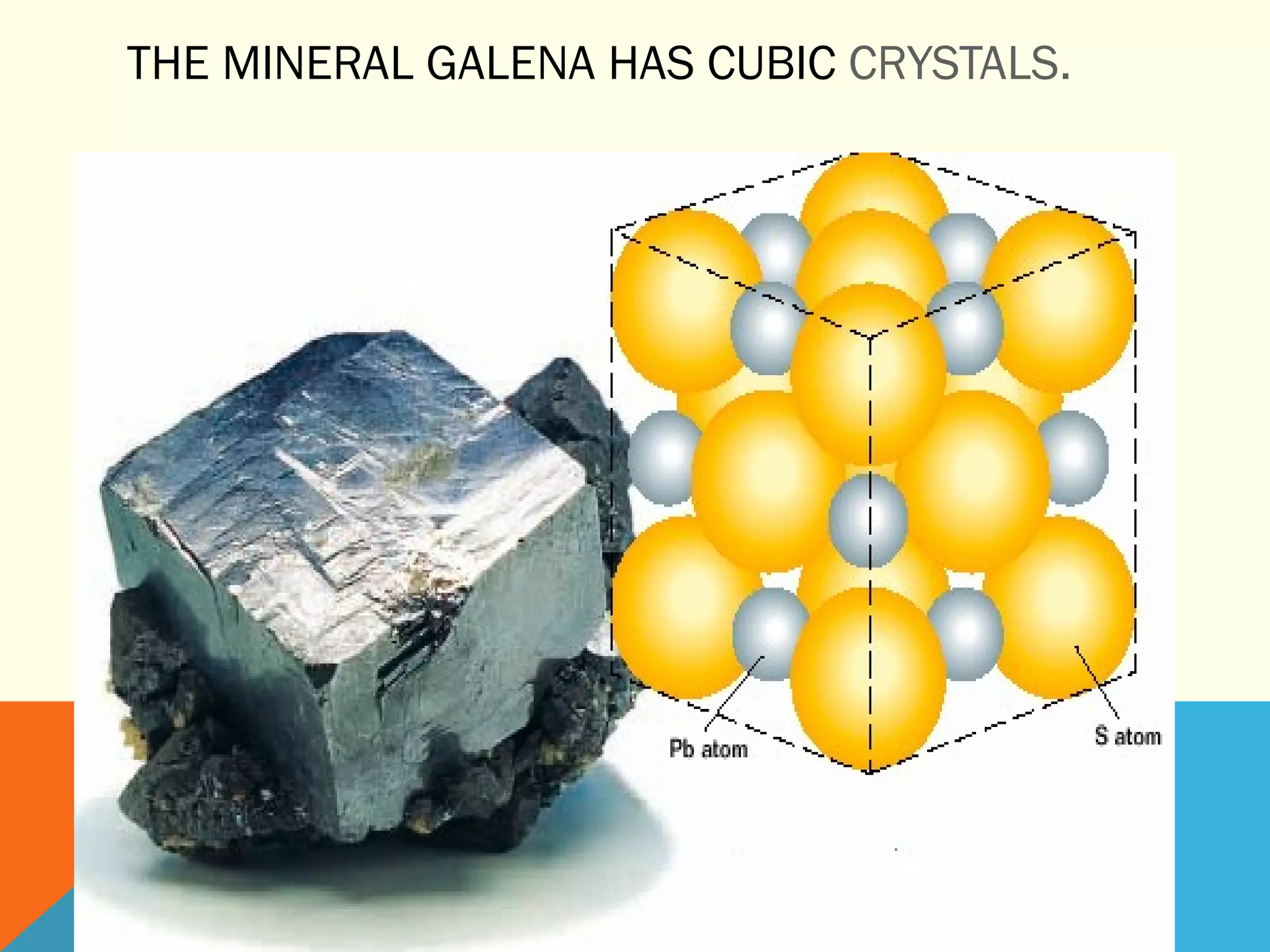
THE MINERAL GALENA HAS CUBIC CRYSTALS.
Minerals are elements or compounds that are found
naturally in rocks or soil.
All minerals share certain characteristics and have
these things in common:
• Minerals are not found as liquids or gases. They are all
solids.
• Minerals form naturally. They are not created by people.
• Minerals form an orderly, repetitive arrangement. The
atoms that minerals are made are connected to each
other in a pattern. Fluorite often forms beautiful cube-
shaped crystals.
• Each mineral has a unique chemical composition
which also means it has its own chemical formula. The
chemical formula for fluorite is CaF2 (calcium fluoride).
PROPERTIES OF
MINERALS
USE THE NEXT SLIDES TO ANSWER THE BOTTOM HALF OF THE PAPER
GEOLOGISTS USE CHARACTERISTICS TO
TELL ONE MINERAL FROM ANOTHER
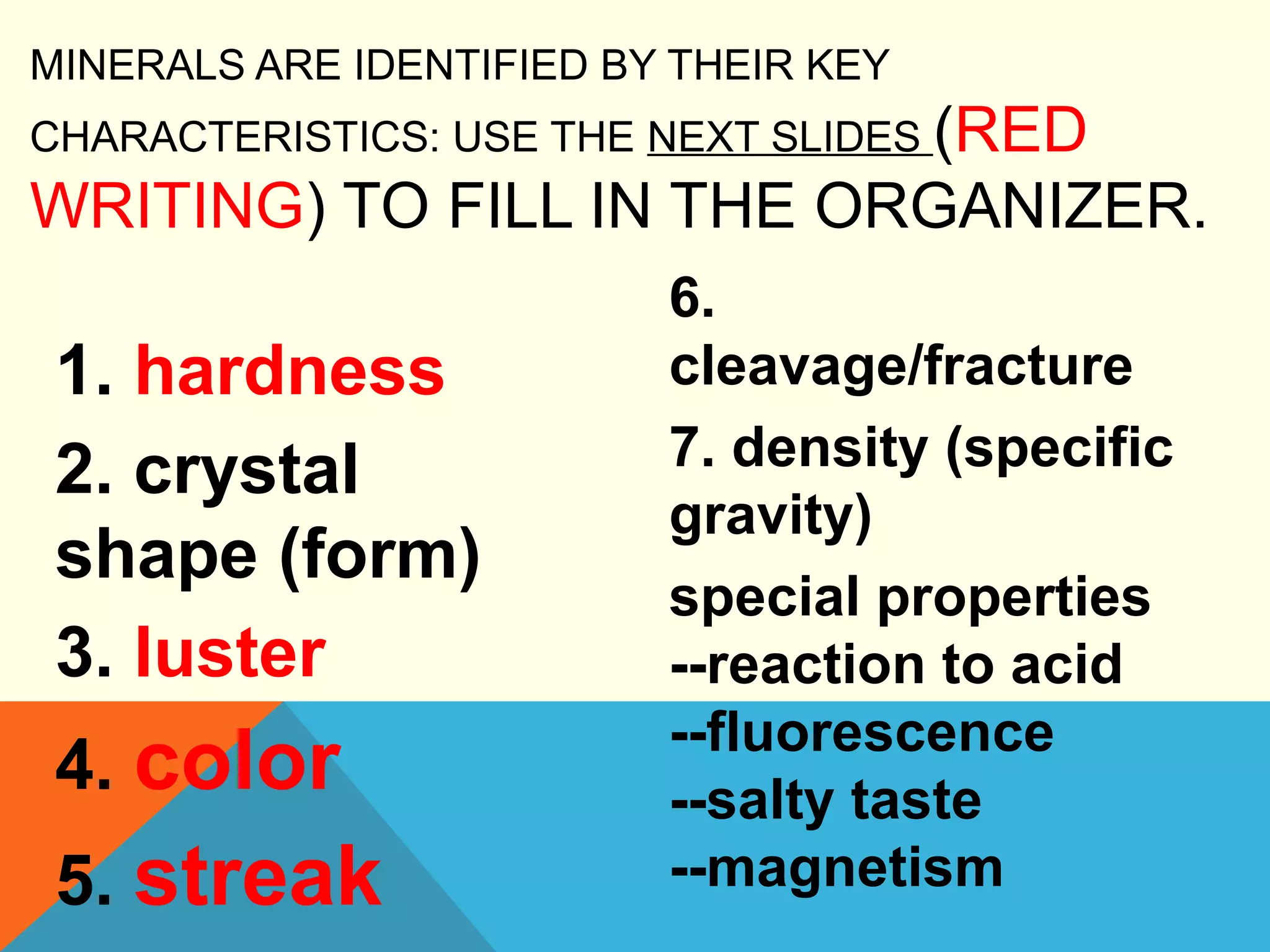
MINERALS ARE IDENTIFIED BY THEIR KEY
CHARACTERISTICS: USE THE NEXT SLIDES (RED
WRITING) TO FILL IN THE ORGANIZER.
1. hardness
2. crystal
shape (form)
3. luster
4. color
5. streak
6.
cleavage/fracture
7. density (specific
gravity)
special properties
--reaction to acid
--fluorescence
--salty taste
--magnetism
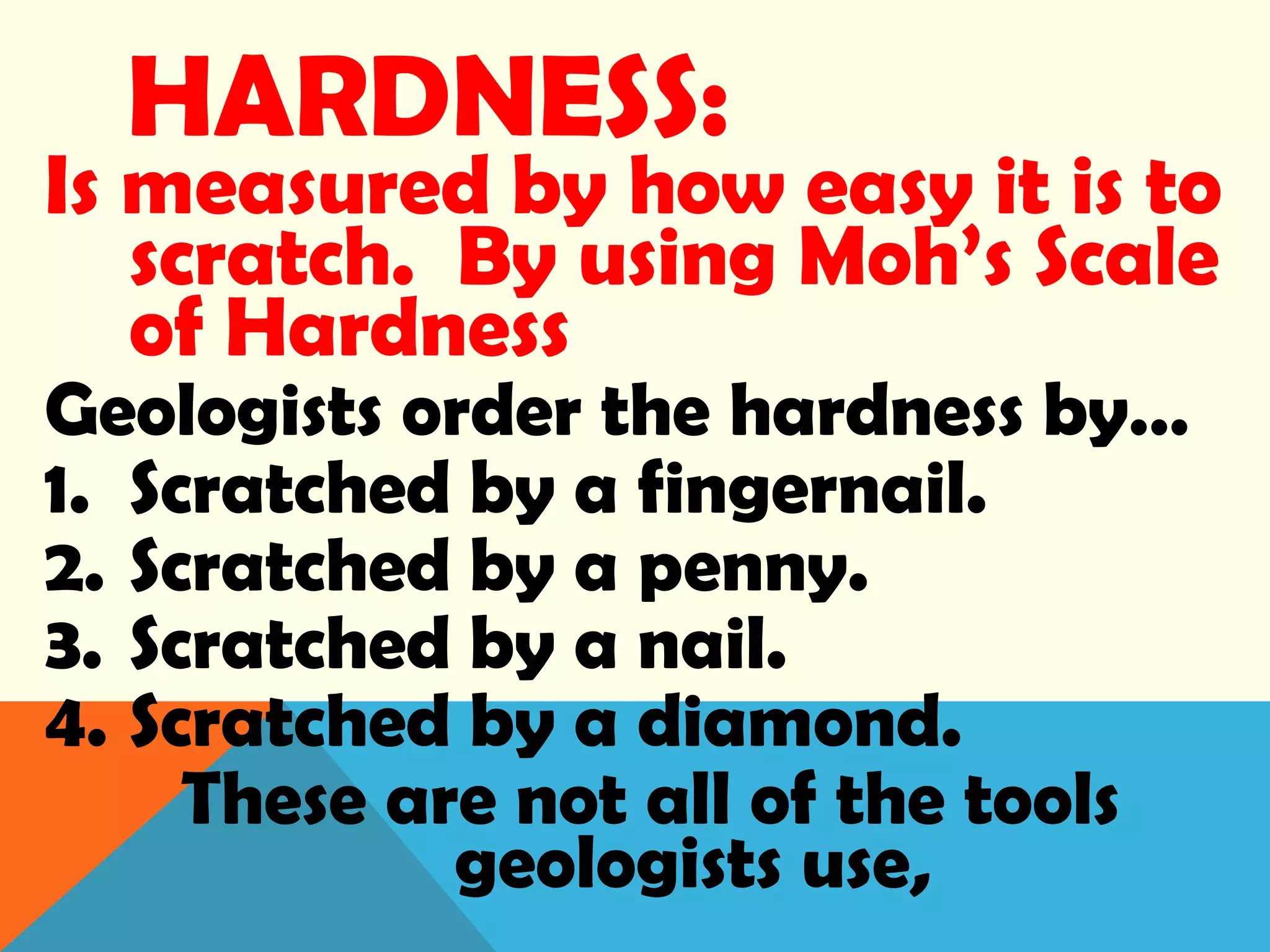
HARDNESS:
Is measured by how easy it is to
scratch. By using Moh’s Scale
of Hardness
Geologists order the hardness by…
1. Scratched by a fingernail.
2. Scratched by a penny.
3. Scratched by a nail.
4. Scratched by a diamond.
These are not all of the tools
geologists use,
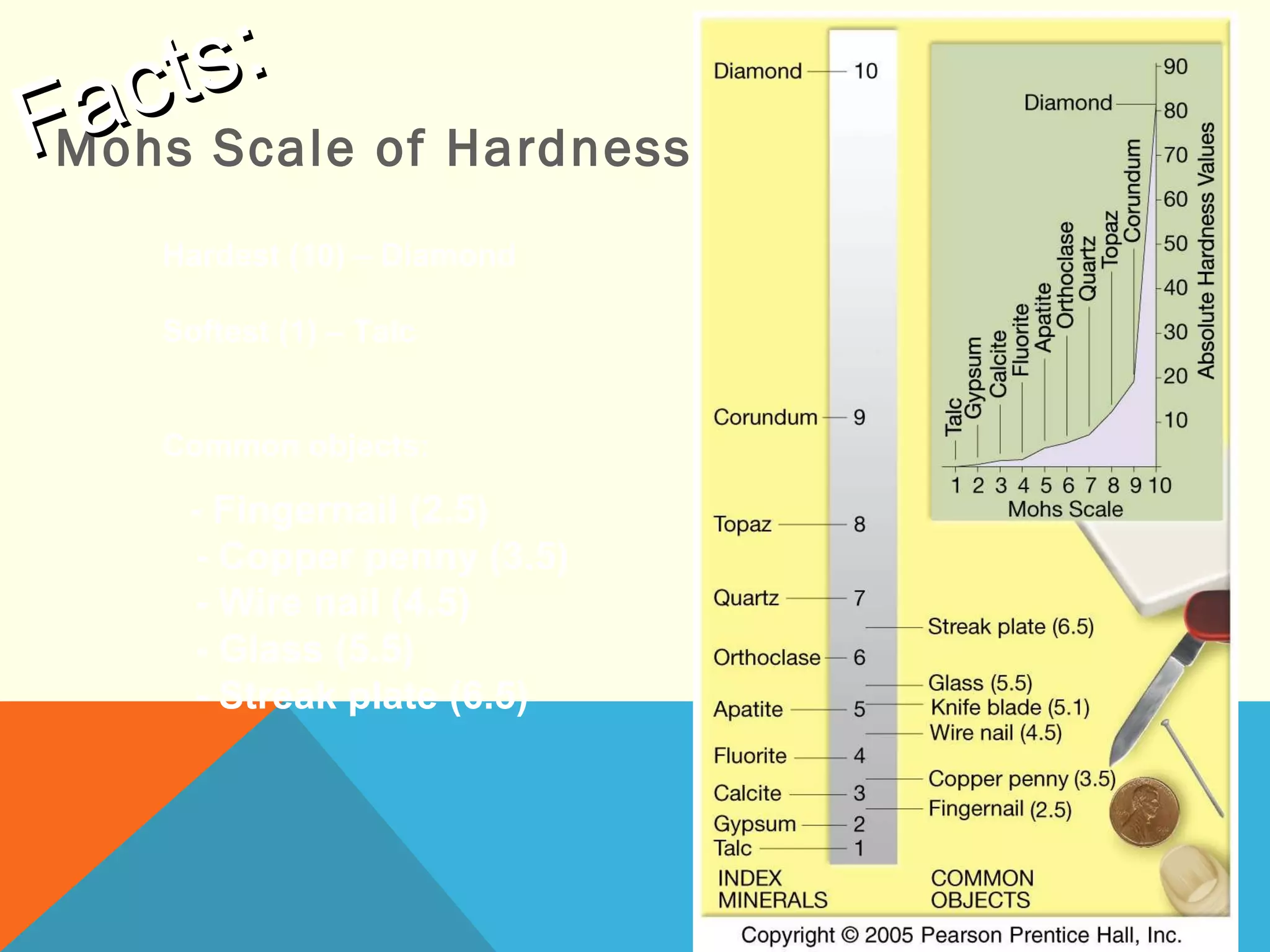
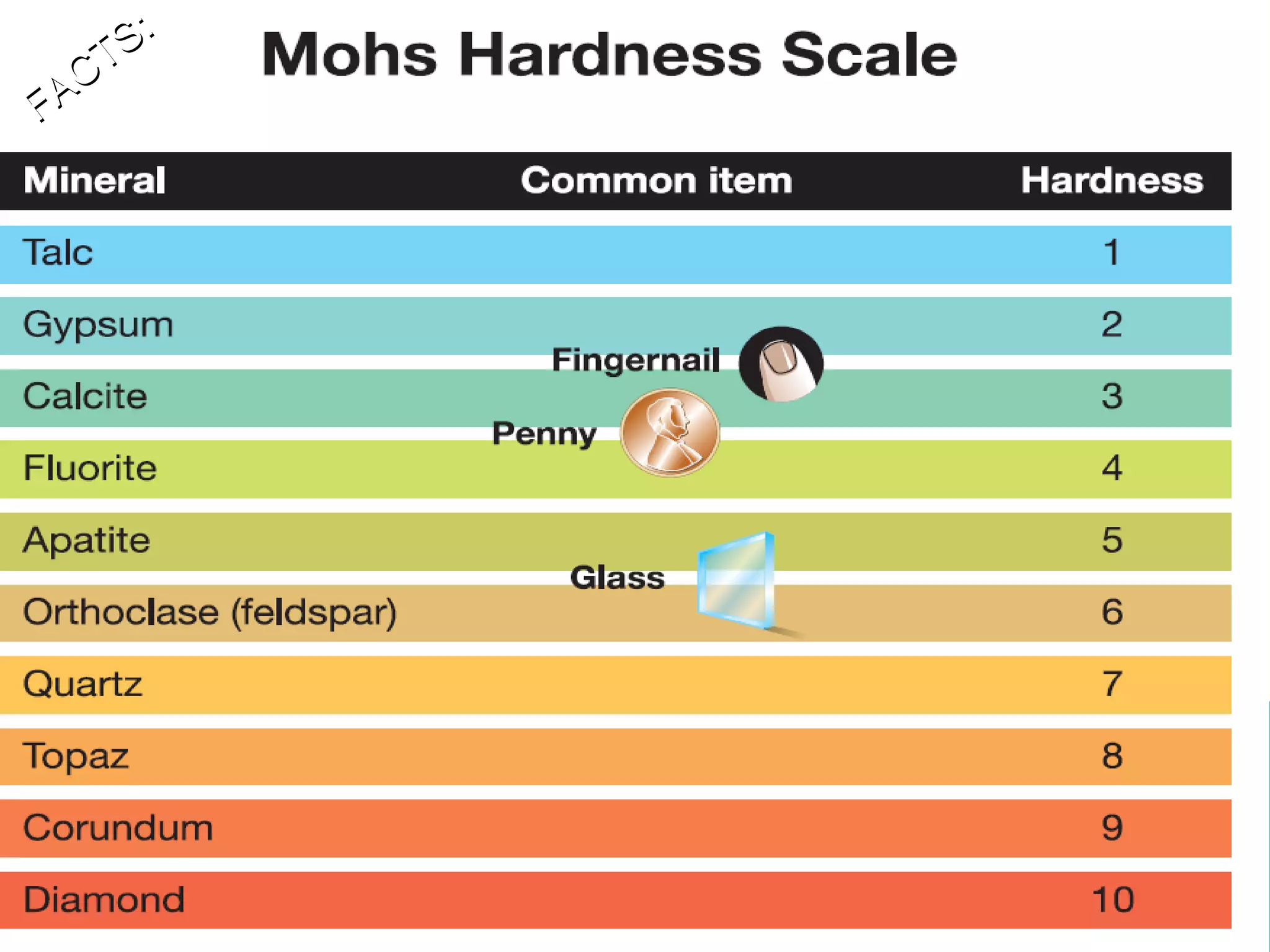
Mohs Scale of Hardness
Hardest (10) – Diamond
Softest (1) – Talc
Common objects:
- Fingernail (2.5)
- Copper penny (3.5)
- Wire nail (4.5)
- Glass (5.5)
- Streak plate (6.5)
Facts:
Facts:
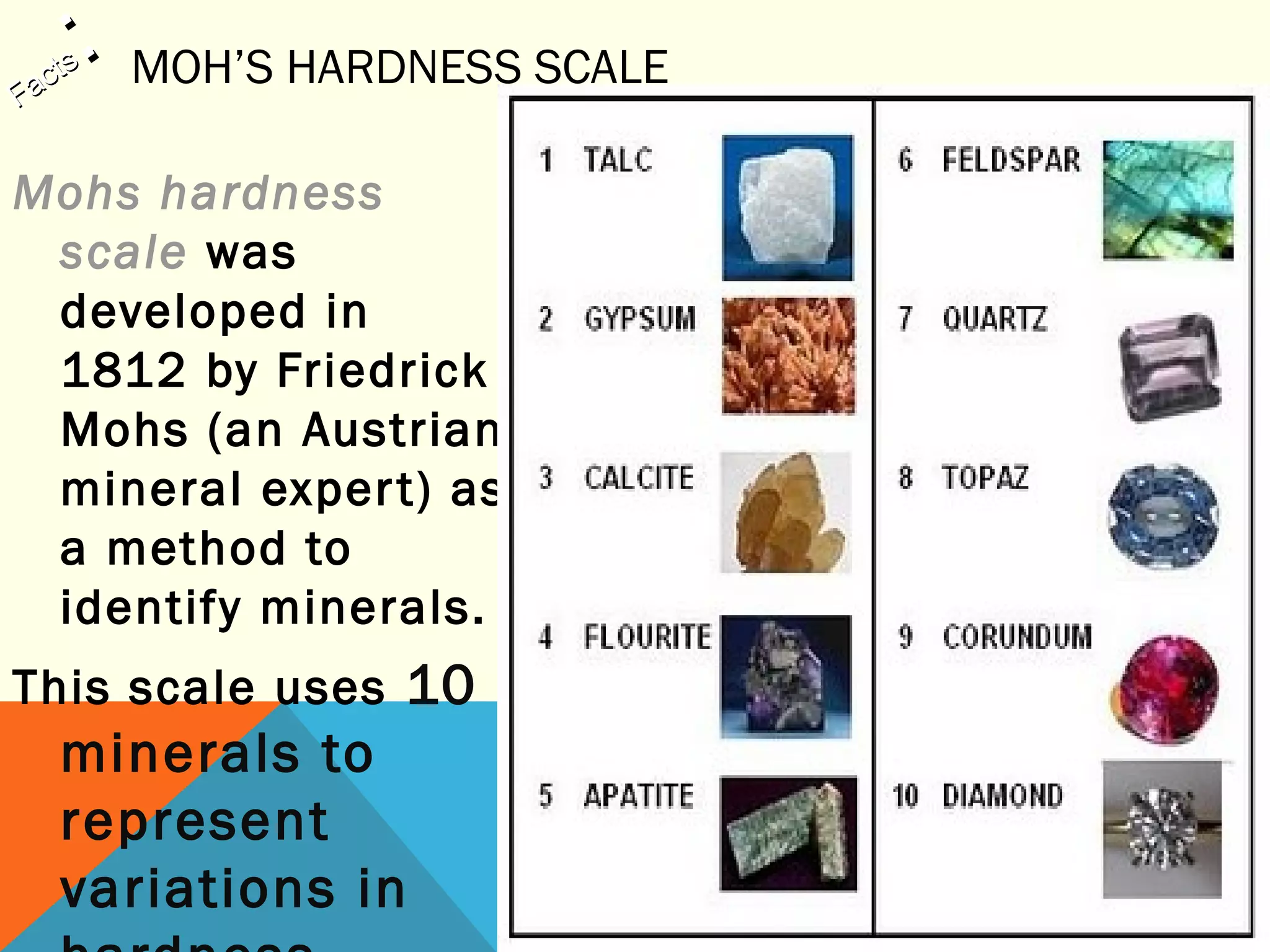
MOH’S HARDNESS SCALE
Mohs hardness
scale was
developed in
1812 by Friedrick
Mohs (an Austrian
mineral expert) as
a method to
identify minerals.
This scale uses 10
minerals to
represent
variations in
Facts
Facts::
FACTS:
FACTS:
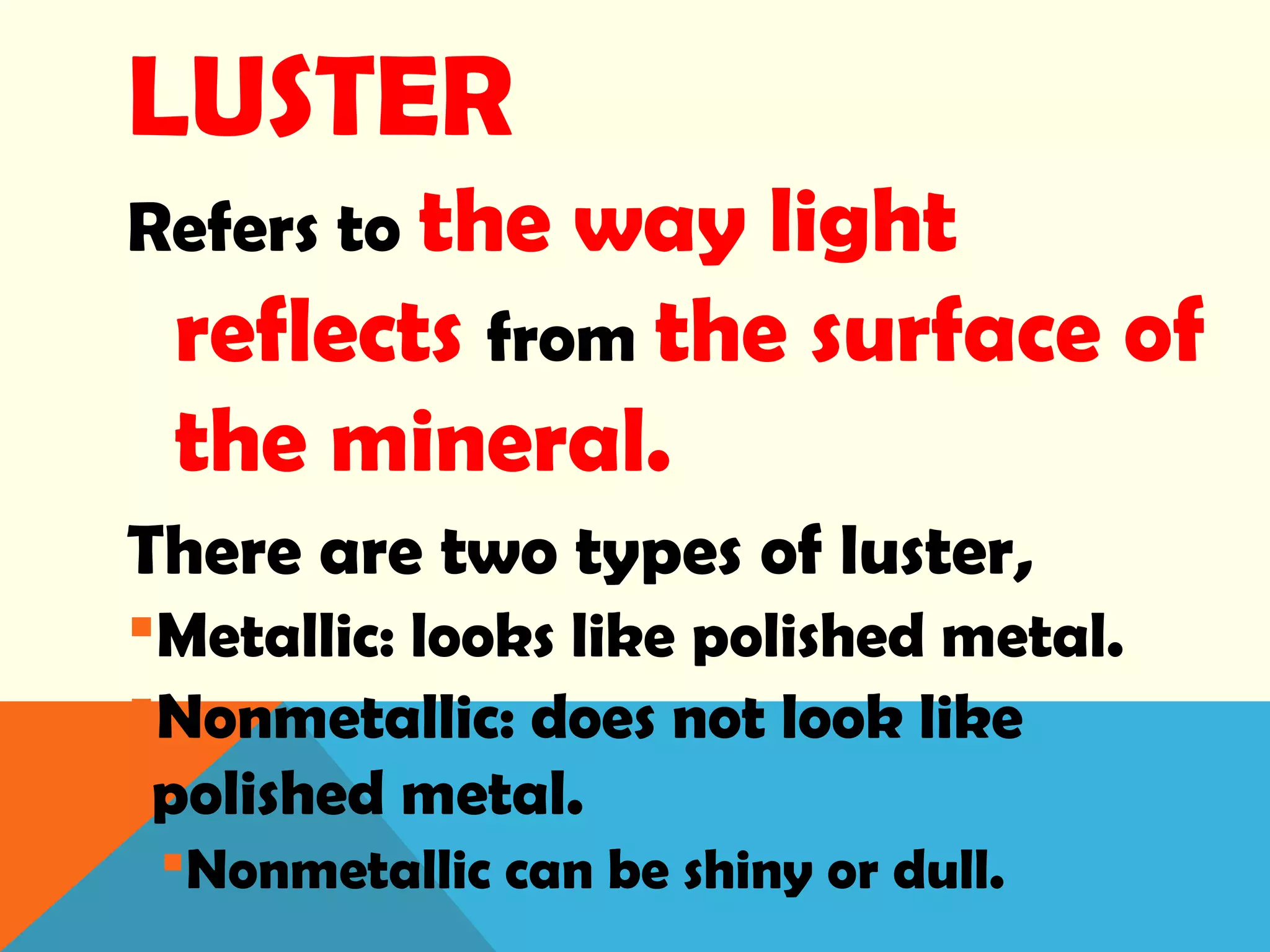
LUSTER
Refers to the way light
reflects from the surface of
the mineral.
There are two types of luster,
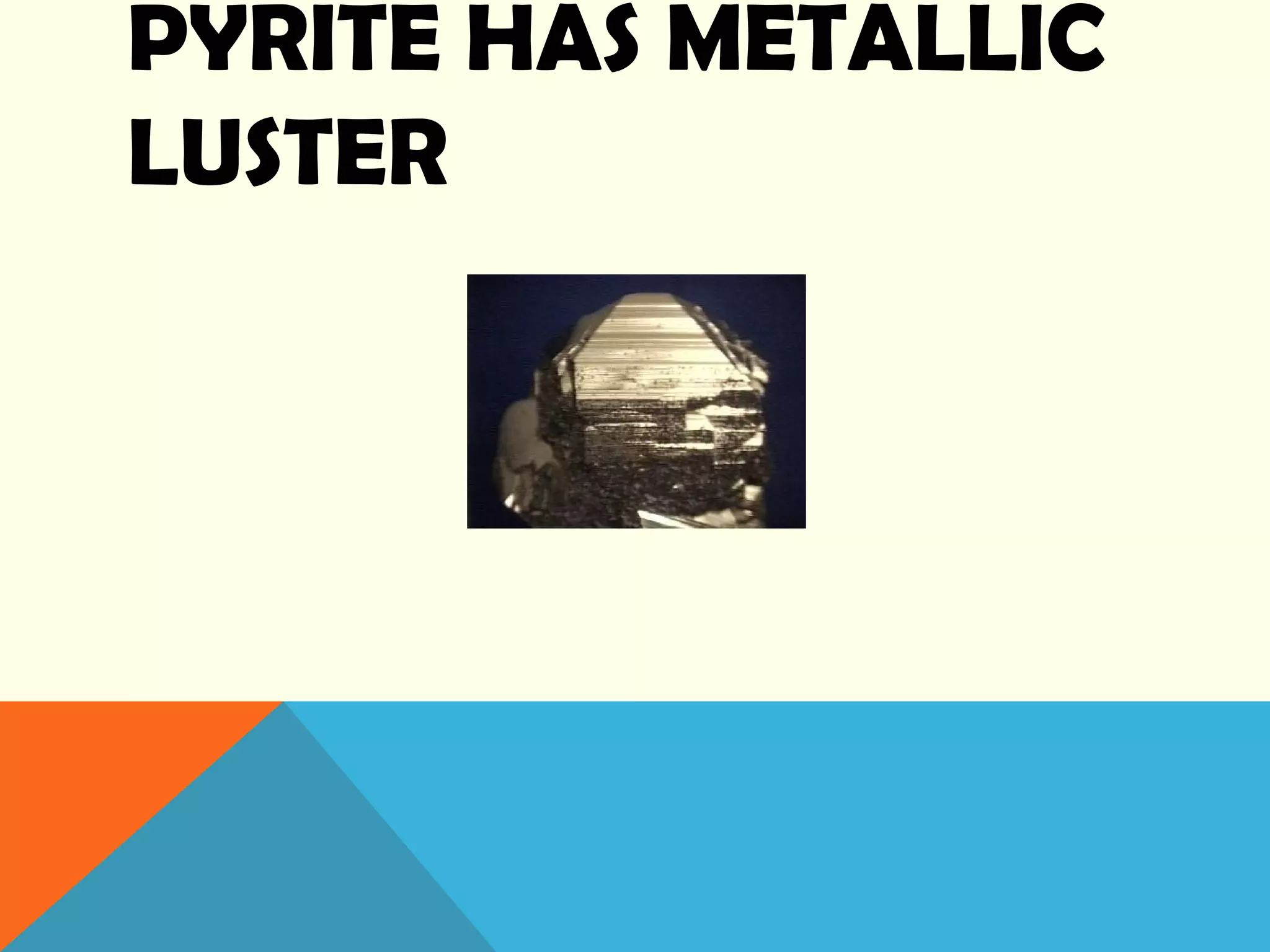
Metallic: looks like polished metal.
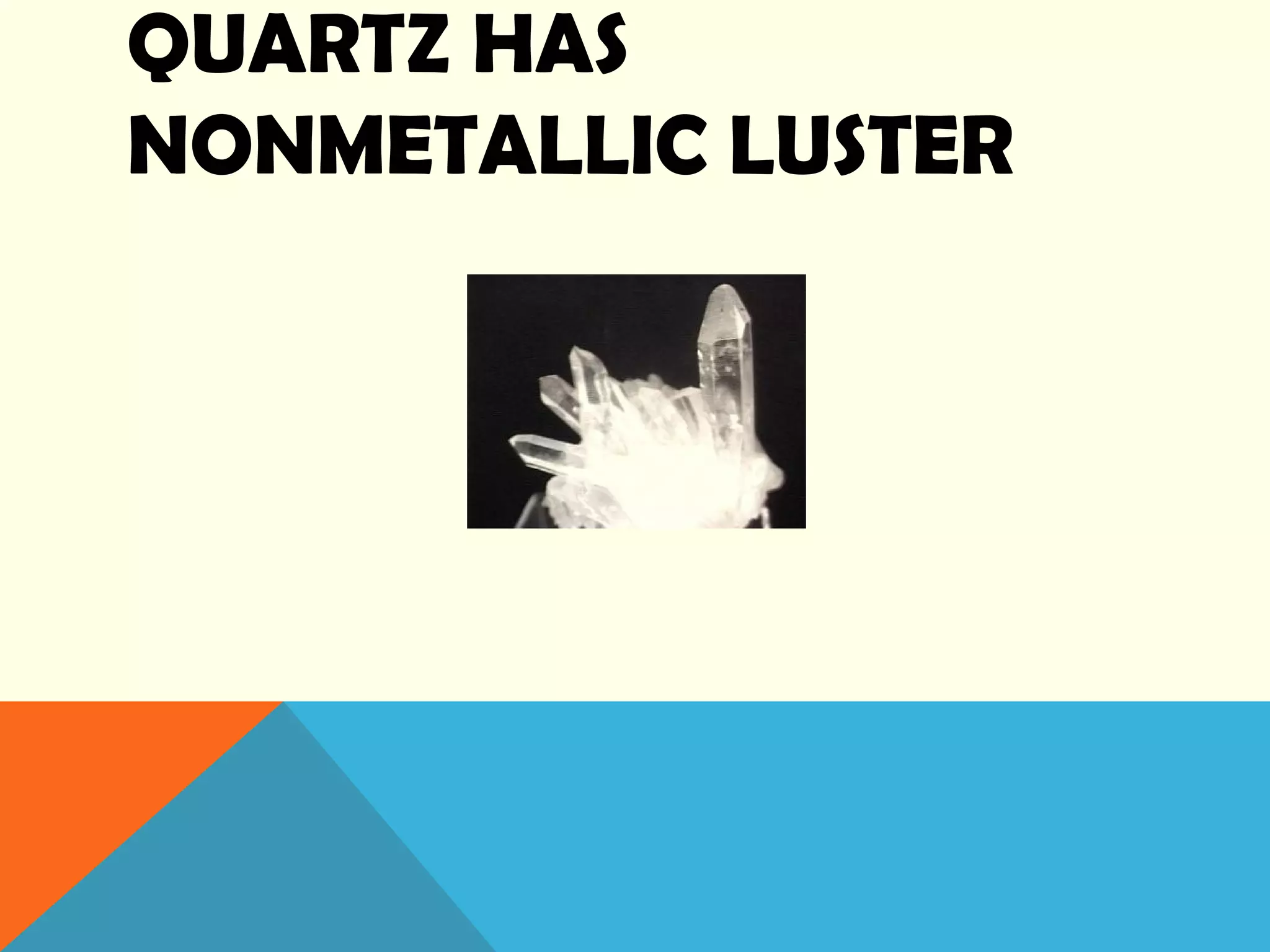
Nonmetallic: does not look like
polished metal.
Nonmetallic can be shiny or dull.
PYRITE HAS METALLIC
LUSTER
QUARTZ HAS
NONMETALLIC LUSTER
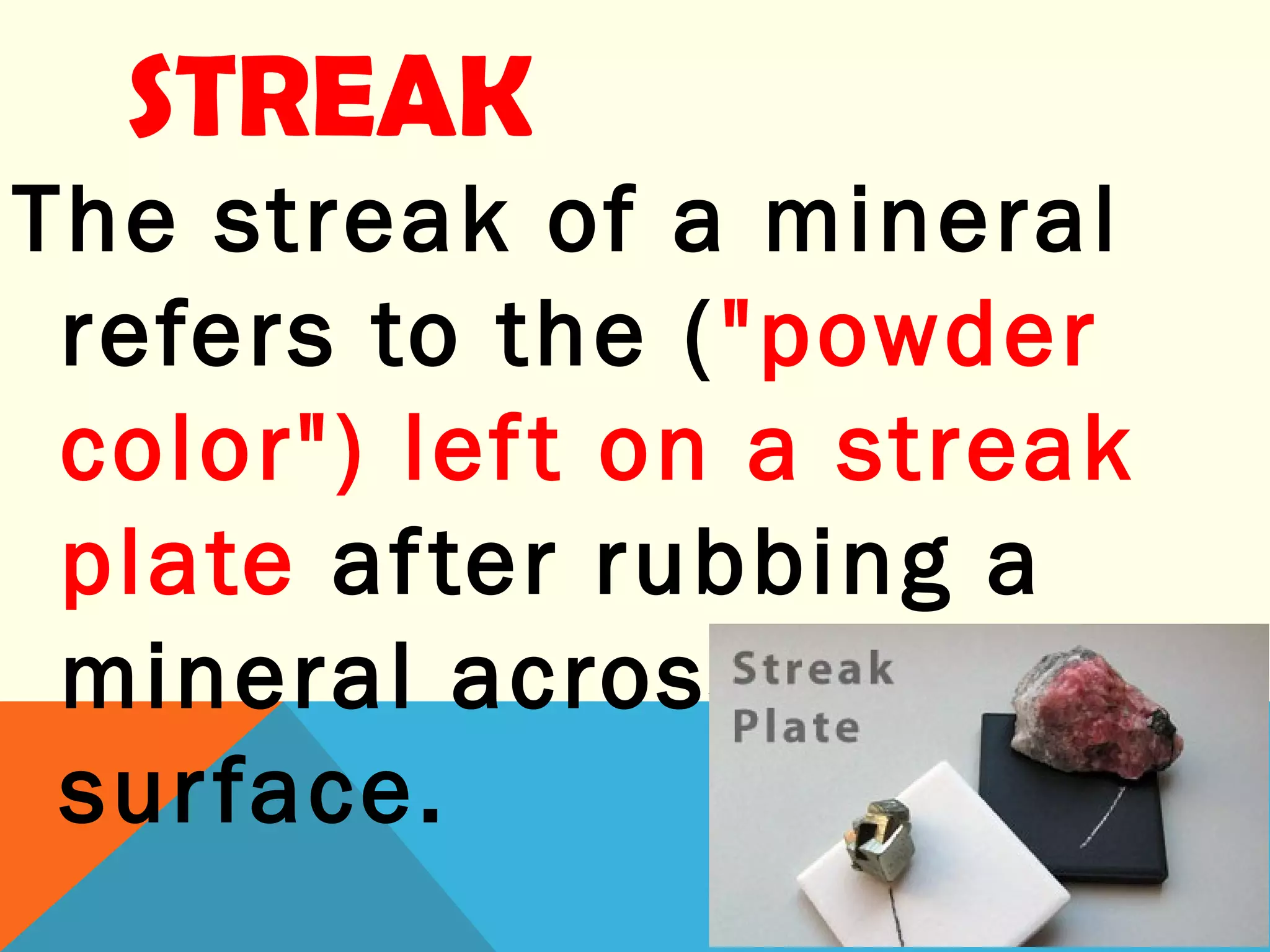
STREAK
The streak of a mineral
refers to the ("powder
color") left on a streak
plate after rubbing a
mineral across its
surface.
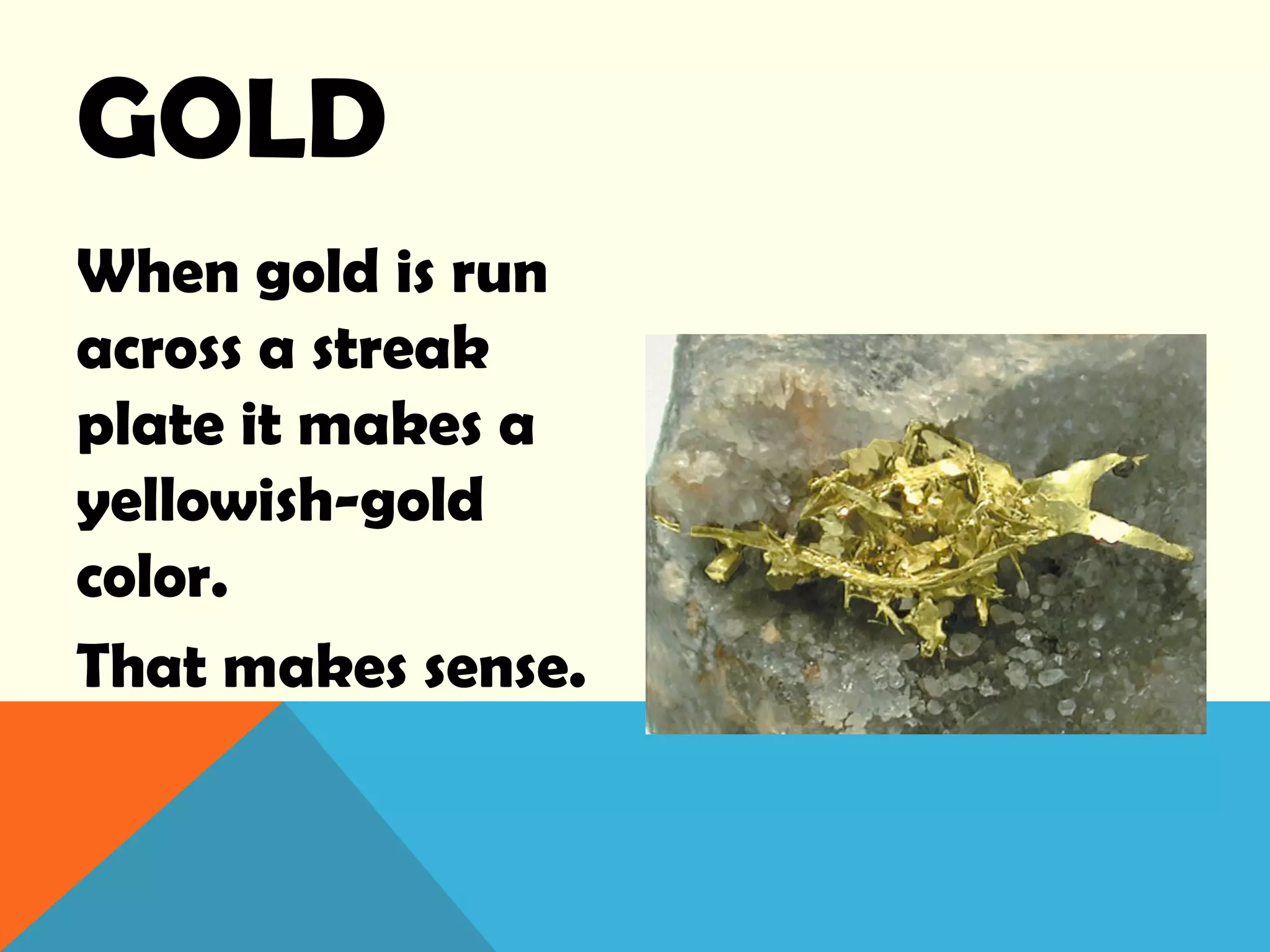
GOLD
When gold is run
across a streak
plate it makes a
yellowish-gold
color.
That makes sense.
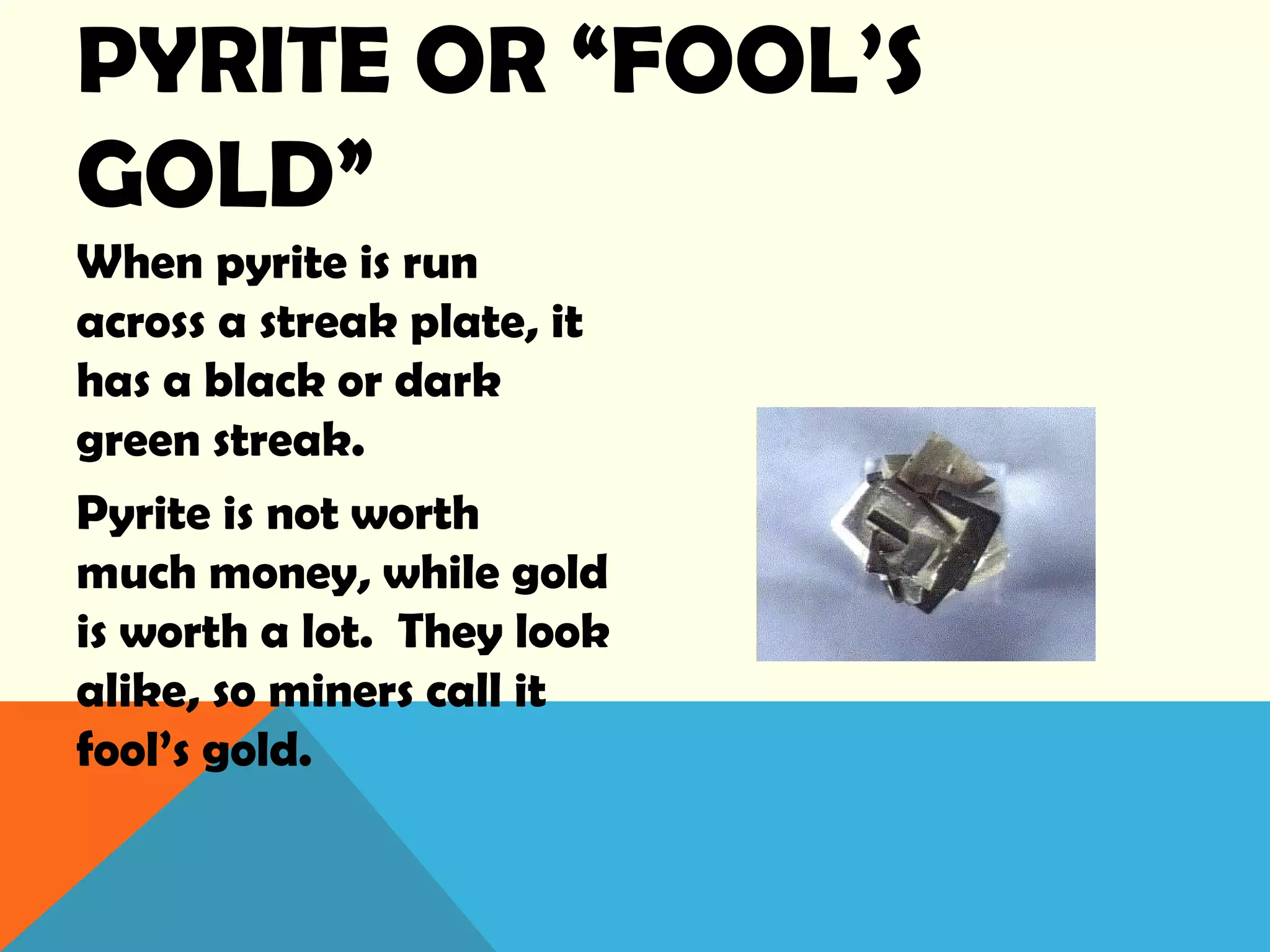
PYRITE OR “FOOL’S
GOLD”
When pyrite is run
across a streak plate, it
has a black or dark
green streak.
Pyrite is not worth
much money, while gold
is worth a lot. They look
alike, so miners call it
fool’s gold.
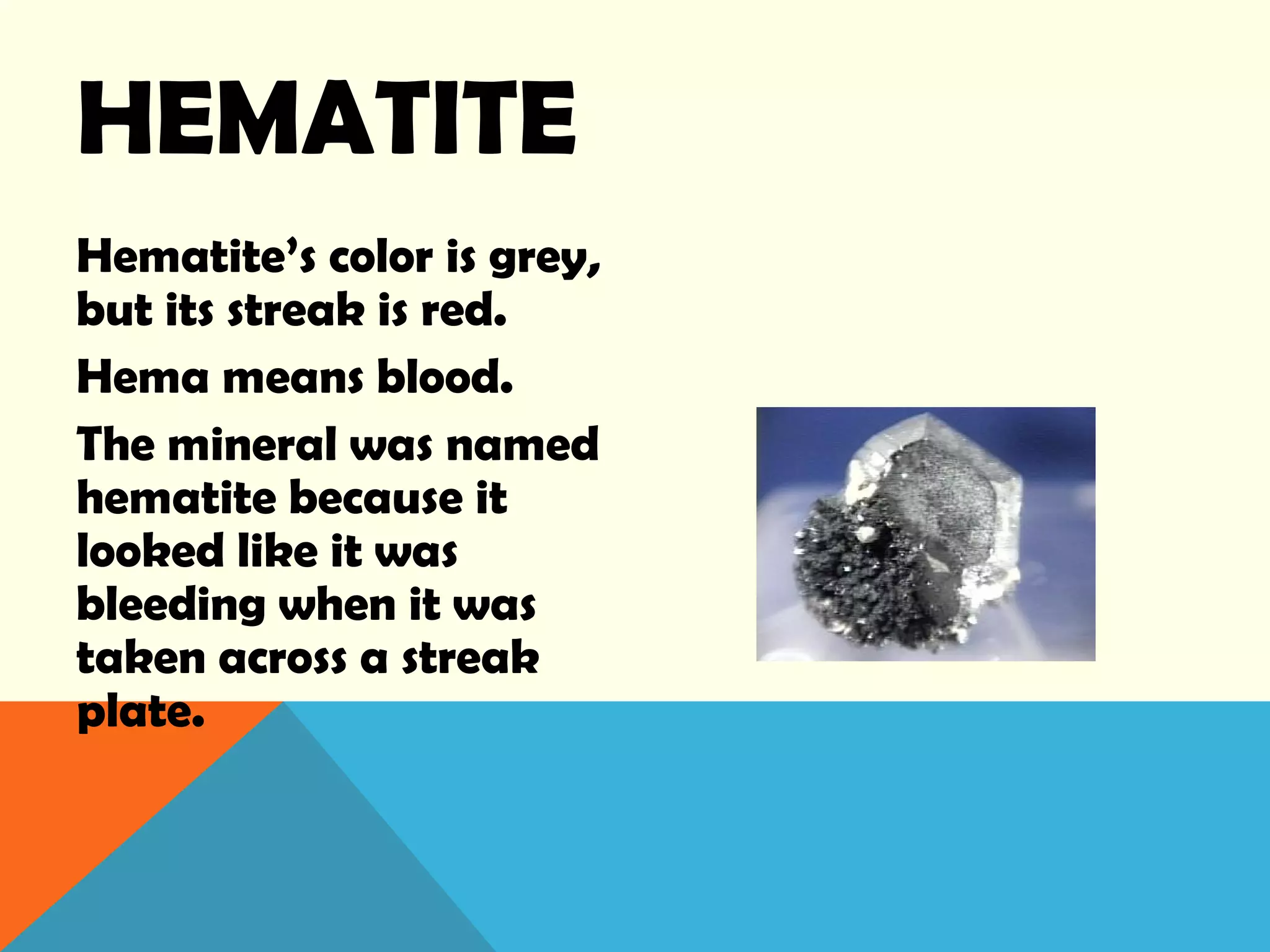
HEMATITE
Hematite’s color is grey,
but its streak is red.
Hema means blood.
The mineral was named
hematite because it
looked like it was
bleeding when it was
taken across a streak
plate.
ONE MINERAL
PROPERTY WE
WILL NOT USE…
COLOR
SEE
W
HY
ON
THE
NEXT
SLIDE
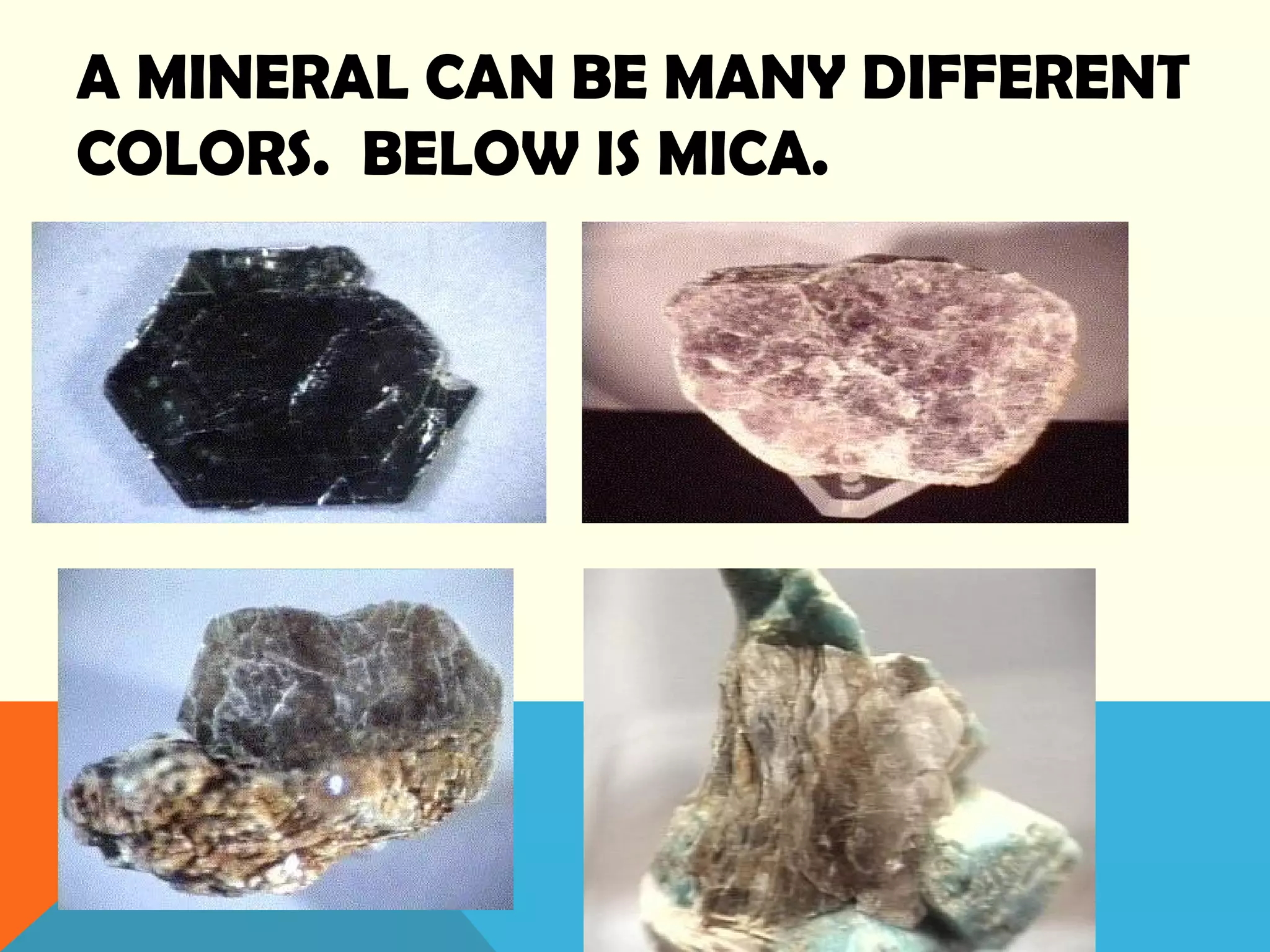
A MINERAL CAN BE MANY DIFFERENT
COLORS. BELOW IS MICA.
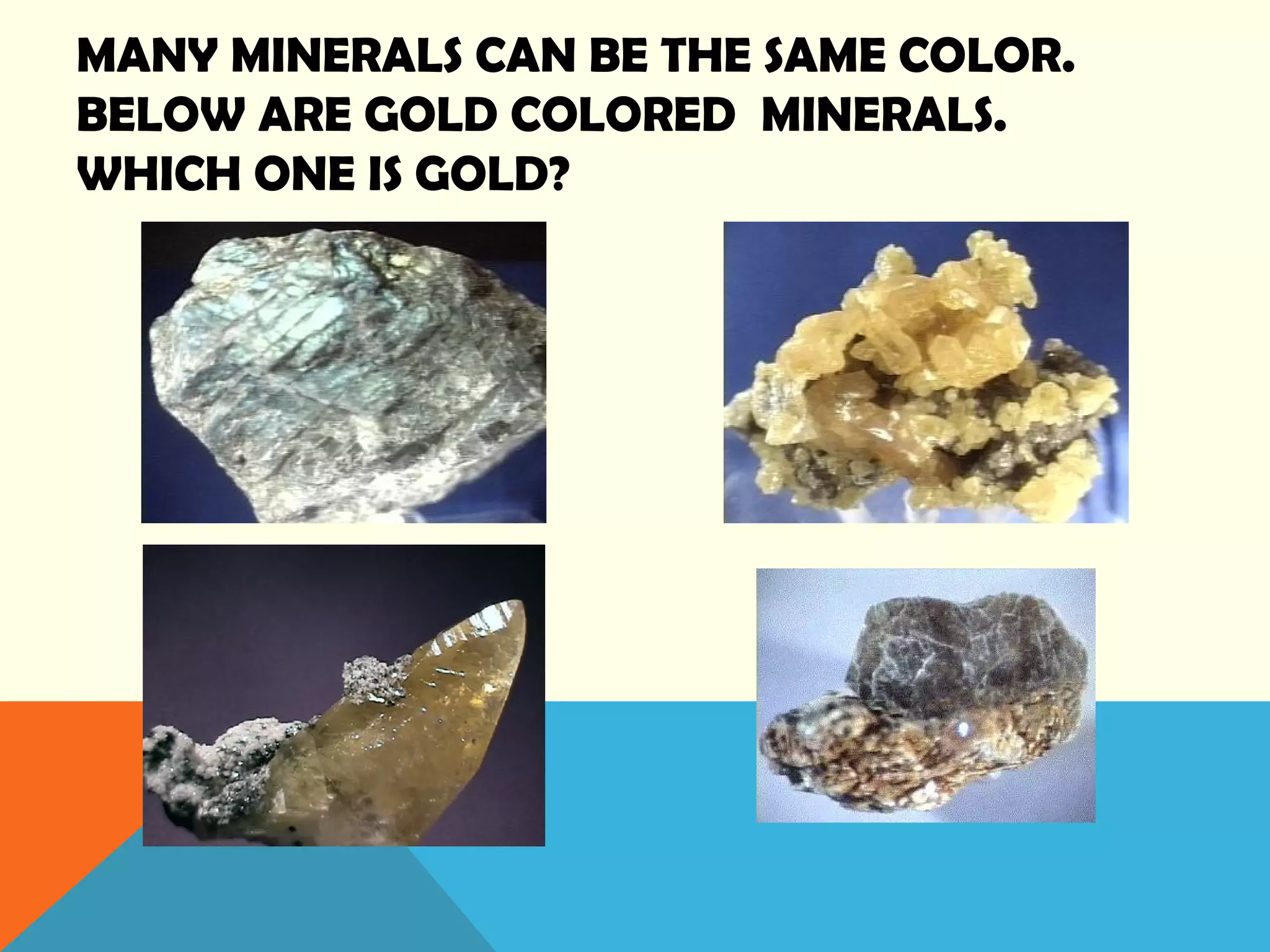
MANY MINERALS CAN BE THE SAME COLOR.
BELOW ARE GOLD COLORED MINERALS.
WHICH ONE IS GOLD?
THE
ANSW
ER…
NONE
OF
THEM
W
ERE
REAL
GOLD.
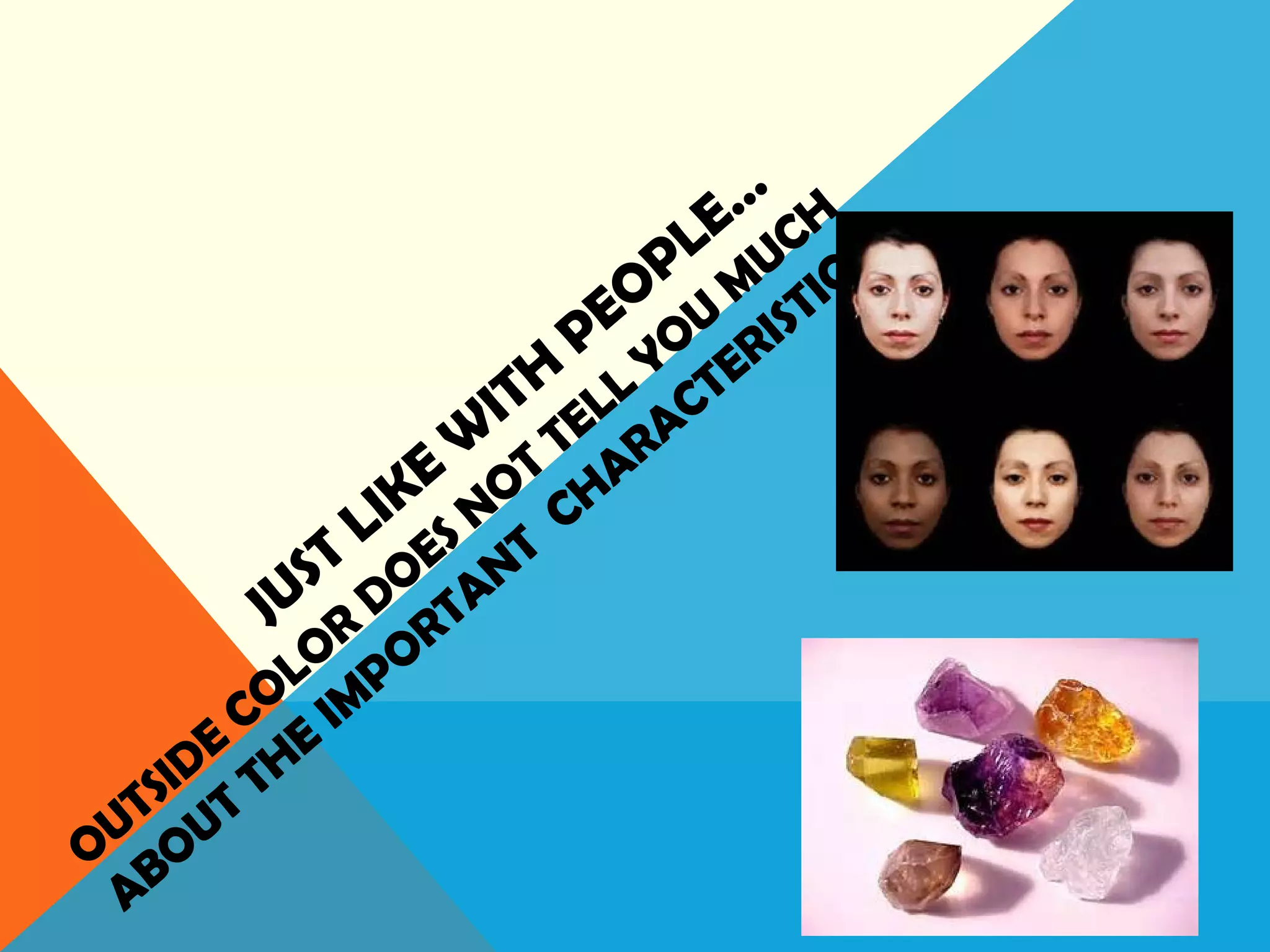
JUST
LIKE
W
ITH
PEOPLE…
OUTSIDE
COLOR
DOES NOT
TELL
YOU
M
UCH
ABOUT
THE
IM
PORTANT
CHARACTERISTICS.
COLOR
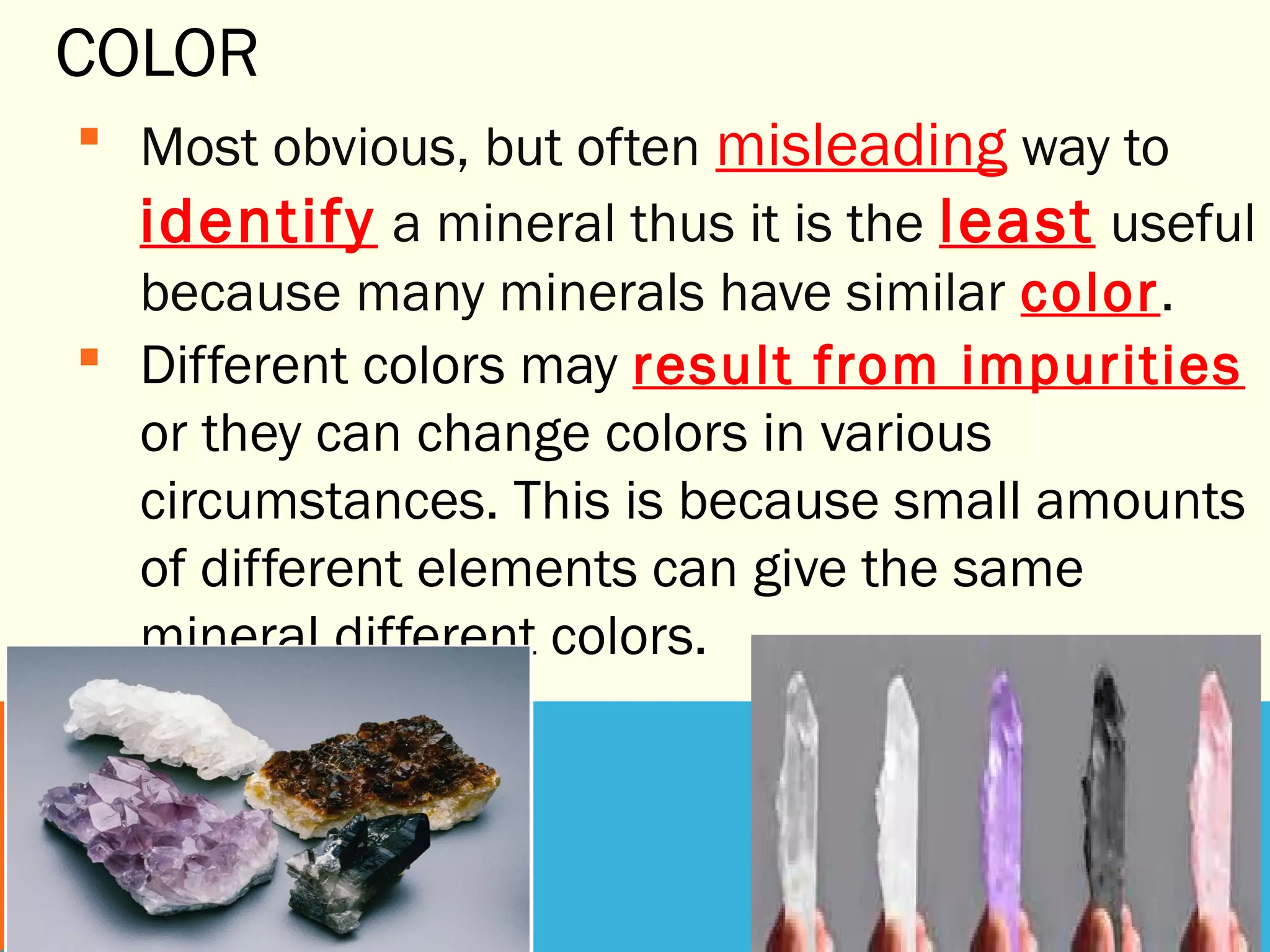
 Most obvious, but often misleading way to
identify a mineral thus it is the least useful
because many minerals have similar color.
 Different colors may result from impurities
or they can change colors in various
circumstances. This is because small amounts
of different elements can give the same
mineral different colors.
CLEAVAGE
Not all minerals have cleavage.
Some minerals split easily along a flat
surface. It’s the way some minerals
break along certain lines of
weakness in their structure.
Cleavages are described in terms of
their quality - how smoothly the
mineral breaks - and their difficulty -
how easy, or how hard, it is to
produce the cleavage.
The number of lines that are created when
a mineral is split will be the number of
GENERAL FACTS ABOUT
MINERALS
Between 2 - 3,000 have been
identified
A few are “native elements” -- made
of only one element, such as sulfur,
gold. copper, and graphite (carbon)
Most are compounds, especially the
silicate group (Si, O).
Other important groups are oxides,
carbonates, and sulfides.
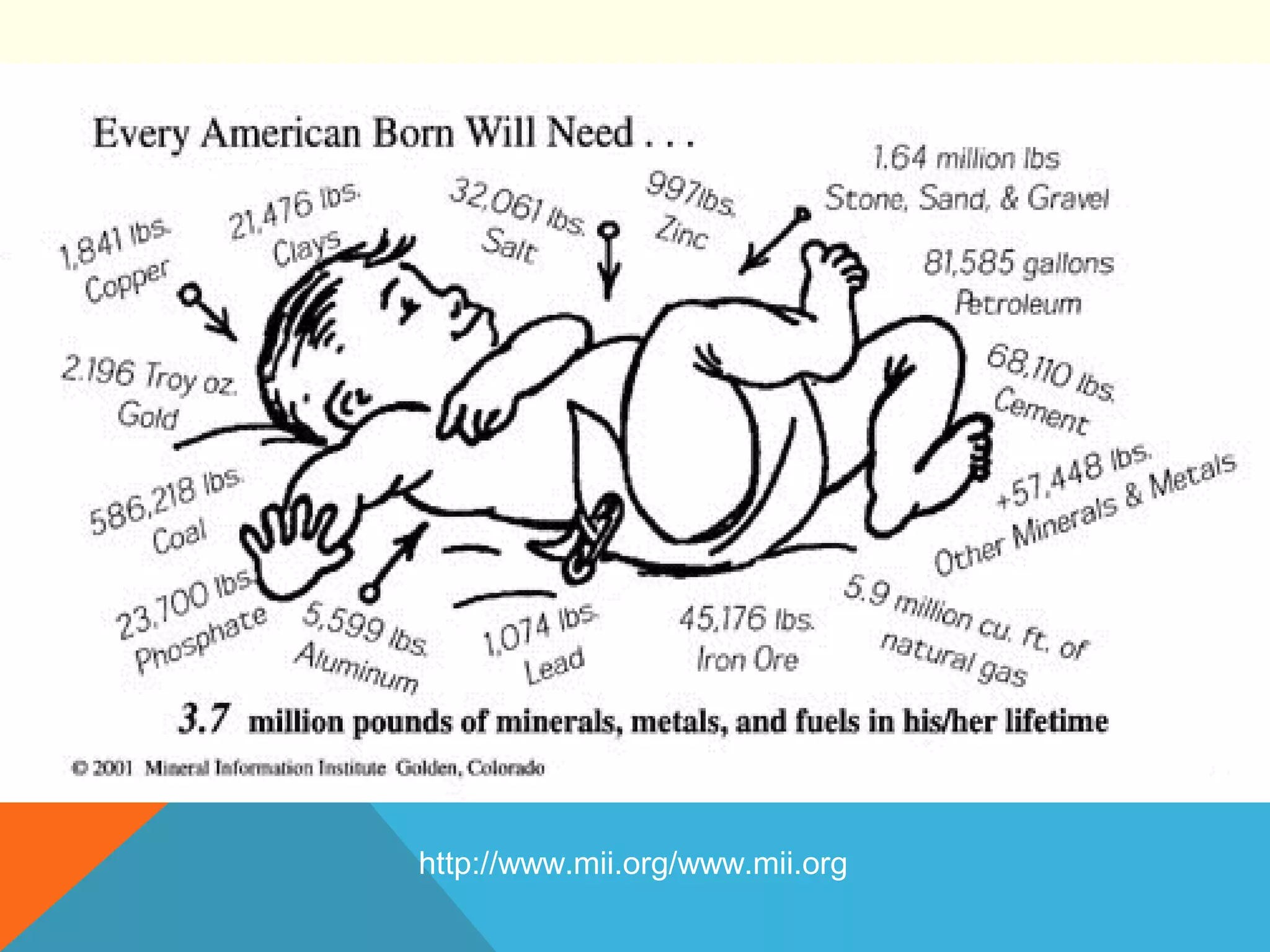
http://www.mii.org/www.mii.org
If you have time
If you have time
try the other links.
Go back to ikeepbookmarks
MINERALS and try the other links

8 12 2015 minerals defined & properties revised

  • 1.
    UNPACKED ELEMENT DRIVINGINSTRUCTION: S6E5b:Look into the role of minerals to rock makeup.
  • 2.
    INTRODUCTION/ DIRECTIONS Welcome JuniorGeologist today we will find out if an object is a rock or mineral! Your task is to gather as much information about minerals. You must copy the information in RED but you are not limited to just that (You may gather more information as needed) that is up
  • 3.
    LEARNING GOALS 1. Identifyproperties of minerals and be able to identify certain minerals using specific tests. 2. Apply Moh’s hardness scale to identify minerals. Question: What methods can we use to identify minerals? Minerals are most often identified by inspecting their PHYSICAL and Chemical properties.
  • 4.
  • 5.
  • 6.
    READ ONLY Any substancethat contains only one kind of atom that cannot be separated.
  • 7.
    A COMPOUND IS… Asubstance made from two or more different elements that have been chemically combined.
  • 8.
    WHAT IS AMINERAL... Solid Naturally Occurring Inorganic Fixed composition, chemical formula Crystal Structure Form
  • 9.
    MINERAL CRYSTALS :A VARIETY OF SHAPES WHICH REFLECT THE ORDERLY INTERNAL ARRANGEMENT OF ATOMS., IONS, OR MOLECULES CHEMICALLY BONDED.
  • 10.
    THE MINERAL GALENAHAS CUBIC CRYSTALS.
  • 11.
    Minerals are elementsor compounds that are found naturally in rocks or soil. All minerals share certain characteristics and have these things in common: • Minerals are not found as liquids or gases. They are all solids. • Minerals form naturally. They are not created by people. • Minerals form an orderly, repetitive arrangement. The atoms that minerals are made are connected to each other in a pattern. Fluorite often forms beautiful cube- shaped crystals. • Each mineral has a unique chemical composition which also means it has its own chemical formula. The chemical formula for fluorite is CaF2 (calcium fluoride).
  • 12.
    PROPERTIES OF MINERALS USE THENEXT SLIDES TO ANSWER THE BOTTOM HALF OF THE PAPER GEOLOGISTS USE CHARACTERISTICS TO TELL ONE MINERAL FROM ANOTHER
  • 13.
    MINERALS ARE IDENTIFIEDBY THEIR KEY CHARACTERISTICS: USE THE NEXT SLIDES (RED WRITING) TO FILL IN THE ORGANIZER. 1. hardness 2. crystal shape (form) 3. luster 4. color 5. streak 6. cleavage/fracture 7. density (specific gravity) special properties --reaction to acid --fluorescence --salty taste --magnetism
  • 14.
    HARDNESS: Is measured byhow easy it is to scratch. By using Moh’s Scale of Hardness Geologists order the hardness by… 1. Scratched by a fingernail. 2. Scratched by a penny. 3. Scratched by a nail. 4. Scratched by a diamond. These are not all of the tools geologists use,
  • 15.
    Mohs Scale ofHardness Hardest (10) – Diamond Softest (1) – Talc Common objects: - Fingernail (2.5) - Copper penny (3.5) - Wire nail (4.5) - Glass (5.5) - Streak plate (6.5) Facts: Facts:
  • 16.
    MOH’S HARDNESS SCALE Mohshardness scale was developed in 1812 by Friedrick Mohs (an Austrian mineral expert) as a method to identify minerals. This scale uses 10 minerals to represent variations in Facts Facts::
  • 17.
  • 18.
    LUSTER Refers to theway light reflects from the surface of the mineral. There are two types of luster, Metallic: looks like polished metal. Nonmetallic: does not look like polished metal. Nonmetallic can be shiny or dull.
  • 19.
  • 20.
  • 21.
    STREAK The streak ofa mineral refers to the ("powder color") left on a streak plate after rubbing a mineral across its surface.
  • 22.
    GOLD When gold isrun across a streak plate it makes a yellowish-gold color. That makes sense.
  • 23.
    PYRITE OR “FOOL’S GOLD” Whenpyrite is run across a streak plate, it has a black or dark green streak. Pyrite is not worth much money, while gold is worth a lot. They look alike, so miners call it fool’s gold.
  • 24.
    HEMATITE Hematite’s color isgrey, but its streak is red. Hema means blood. The mineral was named hematite because it looked like it was bleeding when it was taken across a streak plate.
  • 25.
    ONE MINERAL PROPERTY WE WILLNOT USE… COLOR SEE W HY ON THE NEXT SLIDE
  • 26.
    A MINERAL CANBE MANY DIFFERENT COLORS. BELOW IS MICA.
  • 27.
    MANY MINERALS CANBE THE SAME COLOR. BELOW ARE GOLD COLORED MINERALS. WHICH ONE IS GOLD?
  • 28.
  • 29.
  • 30.
    COLOR  Most obvious,but often misleading way to identify a mineral thus it is the least useful because many minerals have similar color.  Different colors may result from impurities or they can change colors in various circumstances. This is because small amounts of different elements can give the same mineral different colors.
  • 31.
    CLEAVAGE Not all mineralshave cleavage. Some minerals split easily along a flat surface. It’s the way some minerals break along certain lines of weakness in their structure. Cleavages are described in terms of their quality - how smoothly the mineral breaks - and their difficulty - how easy, or how hard, it is to produce the cleavage. The number of lines that are created when a mineral is split will be the number of
  • 32.
    GENERAL FACTS ABOUT MINERALS Between2 - 3,000 have been identified A few are “native elements” -- made of only one element, such as sulfur, gold. copper, and graphite (carbon) Most are compounds, especially the silicate group (Si, O). Other important groups are oxides, carbonates, and sulfides.
  • 33.
  • 34.
    If you havetime If you have time try the other links. try the other links. Go back to ikeepbookmarks Go back to ikeepbookmarks MINERALS and try the other links MINERALS and try the other links