Group Members from group 7:
Antor-157 Shoity-147 Shuvo-151
Rakib-145 Rafiul-149
Welcome to our presentation
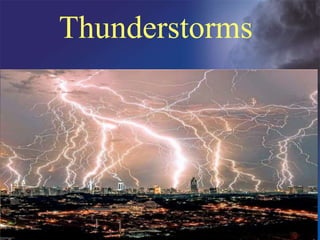
Thunderstorms
What is Thunderstorm?
• A thunderstorm is a weather condition
characterized by heavy rain and wind
accompanied by lighting, thunder, sometimes
with hail and tornados.
• According to A.N. Strahler , “A thunderstorm is
an intense local storm associated with large,
dense cumulonimbus clouds in which there are
very strong updraft of air.”
How do thunderstorms
form?
♠Condition for forming a Thunderstorm :
For a thunderstorm to form, three conditions must
exist.
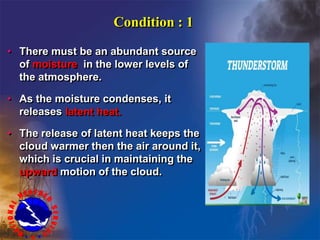
Condition : 1
• There must be an abundant source
of moisture in the lower levels of
the atmosphere.
• As the moisture condenses, it
releases latent heat.
• The release of latent heat keeps the
cloud warmer then the air around it,
which is crucial in maintaining the
upward motion of the cloud.
Condition : 2
• Some mechanism ( orographic, lifting,
temperature difference, fronts) must lift the air so
that the moisture can condense and release heat.
Condition : 3
• The portion of the atmosphere through which the
cloud grows must be unstable.
3 Stages of thunderstorm formation
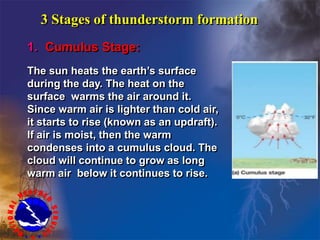
1. Cumulus Stage:
The sun heats the earth’s surface
during the day. The heat on the
surface warms the air around it.
Since warm air is lighter than cold air,
it starts to rise (known as an updraft).
If air is moist, then the warm
condenses into a cumulus cloud. The
cloud will continue to grow as long
warm air below it continues to rise.
3 Stages of thunderstorm formation
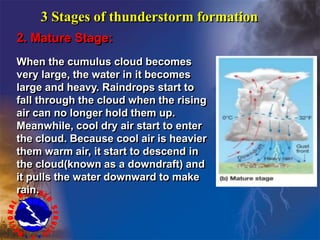
2. Mature Stage:
When the cumulus cloud becomes
very large, the water in it becomes
large and heavy. Raindrops start to
fall through the cloud when the rising
air can no longer hold them up.
Meanwhile, cool dry air start to enter
the cloud. Because cool air is heavier
them warm air, it start to descend in
the cloud(known as a downdraft) and
it pulls the water downward to make
rain.
3 Stages of thunderstorm formation
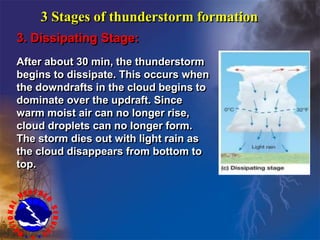
3. Dissipating Stage:
After about 30 min, the thunderstorm
begins to dissipate. This occurs when
the downdrafts in the cloud begins to
dominate over the updraft. Since
warm moist air can no longer rise,
cloud droplets can no longer form.
The storm dies out with light rain as
the cloud disappears from bottom to
top.
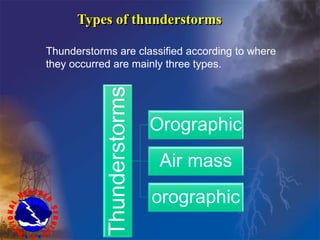
Types of thunderstorms
Thunderstorms are classified according to where
they occurred are mainly three types.
Thunderstorms Orographic
Air mass
orographic
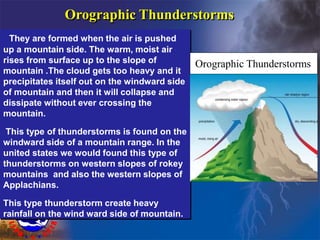
Orographic Thunderstorms
They are formed when the air is pushed
up a mountain side. The warm, moist air
rises from surface up to the slope of
mountain .The cloud gets too heavy and it
precipitates itself out on the windward side
of mountain and then it will collapse and
dissipate without ever crossing the
mountain.
This type of thunderstorms is found on the
windward side of a mountain range. In the
united states we would found this type of
thunderstorms on western slopes of rokey
mountains and also the western slopes of
Applachians.
This type thunderstorm create heavy
rainfall on the wind ward side of mountain.
Orographic Thunderstorms
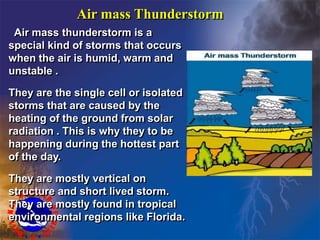
Air mass Thunderstorm
Air mass thunderstorm is a
special kind of storms that occurs
when the air is humid, warm and
unstable .
They are the single cell or isolated
storms that are caused by the
heating of the ground from solar
radiation . This is why they to be
happening during the hottest part
of the day.
They are mostly vertical on
structure and short lived storm.
They are mostly found in tropical
environmental regions like Florida.
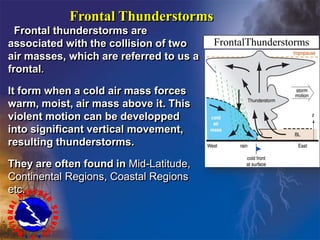
Frontal Thunderstorms
Frontal thunderstorms are
associated with the collision of two
air masses, which are referred to us a
frontal.
It form when a cold air mass forces
warm, moist, air mass above it. This
violent motion can be developped
into significant vertical movement,
resulting thunderstorms.
They are often found in Mid-Latitude,
Continental Regions, Coastal Regions
etc.
r
FrontalThunderstorms
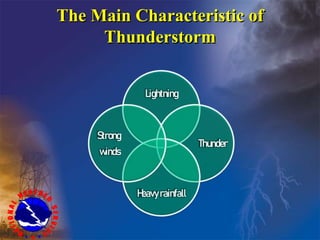
The Main Characteristic of
Thunderstorm
Lightning
Thunder
Heavyrainfall
Strong
winds
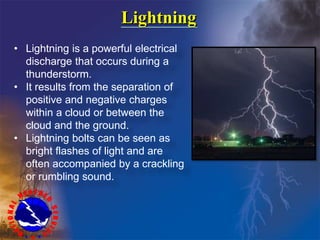
Lightning
• Lightning is a powerful electrical
discharge that occurs during a
thunderstorm.
• It results from the separation of
positive and negative charges
within a cloud or between the
cloud and the ground.
• Lightning bolts can be seen as
bright flashes of light and are
often accompanied by a crackling
or rumbling sound.
Lightning Facts
• The majority of lightning occurs within clouds…only about 20%
between cloud and ground.
• The lightning strokes heats a narrow channel to roughly 54,000
F—much hotter than the surface of the sun. Causes air to expand
explosively—producing thunder.
• Light from lightning moves at the speed of light (186,000 miles per
second), while sound of thunder only moves at 1/5 mile per
second.
• Can use the difference to determine how far the lightning stroke is
for every 5 second difference-one mile away
Thunder
Thunder is the sound produced by the rapid
expansion of air due to the intense heat
generated by lightning.It is often described
as a loud rumble or boom and can be heard
shortly after seeing the lightning flash.The
time delay between seeing the lightning and
hearing the thunder can help estimate the
distance of the storm.
Strong Winds
Thunderstorms are often
accompanied by strong gusts of wind,
which can cause branches to break,
trees to be uprooted, and debris to be
thrown around.These strong winds
can also contribute to the rapid spread
of wildfires, especially during dry
conditions.
The gusts in Ordinary thunderstorms can range from 48 to 80
kilometers per hour.
Wind gusts in Supercells can exceed 160 kilometers
per hour.
Heavy Rainfall
Thunderstorms are known for their
intense and heavy rainfall, which can
lead to flash floods and
waterlogging.The rapid accumulation of
water on the ground can result in
hazardous conditions and damage to
property and infrastructure.
Thunderstorms and the Environment
Thunderstorms play a vital role in the Earth's
atmosphere.They help transport heat,
moisture, and pollutants between the surface
and the upper atmosphere.Thunderstorms can
contribute to nitrogen fixation, which
enriches the soil with nutrients.
Positive effect of Thunderstorm
• Natural Rainfall
• Nitrogen Fixation
• lighting recharge earth’s negative charge
Natural Rainfall
Thunderstorms bring much-needed rainfall to
replenish
1.Water sources.
2.Nourish crops.
3.Support ecosystems.
Nitrogen Fixation
Nightning fixes nitrogen in the ground/soil through
electro-magnetic chemical processes.Each bolt of
lightning carries electrical energy that is powerful
enough to break the strong bonds of the nitrogen
molecule in the atmosphere.Free nitrogen atoms in
the air bond with oxygen in the air to create nitrogen
oxides, which dissolve in moisture to form nitrates
that are carried to Earth's surface by
precipitation.Lightning accounts for some naturally
occurring reactive nitrogen-worldwide each year,
lightning fixes an estimated 3-10 teragrams (Tg), the
usual measurement unit for discussing the
global nitrogen cycle.
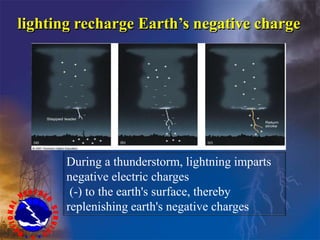
lighting recharge Earth’s negative charge
During a thunderstorm, lightning imparts
negative electric charges
(-) to the earth's surface, thereby
replenishing earth's negative charges
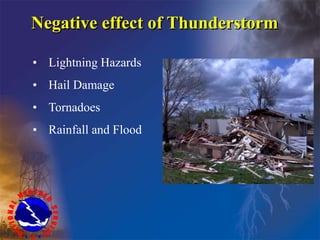
Negative effect of Thunderstorm
• Lightning Hazards
• Hail Damage
• Tornadoes
• Rainfall and Flood
Lightning Hazards
• When lightning strikes the ground or a
structure, it can cause injuries or fatalities
to people and animals in its vicinity.
• It can also start wildfires if it strikes dry
vegetation or flammable materials.
• Additionally, lightning can damage
electrical systems and electronic devices,
leading to power outages and equipment
failures.
Hail Damage
• Hail is solid precipitation in the form of balls or
lumps of ice that are created within powerful
thunderstorms with strong updrafts.
• Hailstones vary in size, from small pellets to
large golf ball sized or even larger stones.
• During severe thunderstorms, large hailstones can
cause significant damage to crops, vehicles,
roofs, windows, and other property.
• Hail damage can result in expensive repairs and
insurance claims.
Tornadoes
• Tornadoes can uproot trees, destroy
buildings, and throw debris at high
speeds, posing severe risks to people
in their path.
• Tornadoes are associated with
supercell thunderstorms, which are
large and long-lived storms with
intense rotation.
Thunderstorm Safety Tips
• Stay Informed
• Seek Shelter Indoors
• Avoid Electrical Appliances
• Avoid Windows and Doors
Pay attention to weather forecasts and
warnings issued by local authorities.Have a
weather app or a battery-powered NOAA
Weather Radio to receive updates
during power outages.
Stay Informed
Seek Shelter Indoors
If a thunderstorm is approaching, seek
shelter in a sturdy building.Avoid small,
open structures and isolated trees.
Avoid Electrical Appliances
Refrain from using electrical appliances,
including corded phones and computers,
during a thunderstorm.
Lightning can cause power surges that may
damage electronics.

Thunderstorm.ppt

  • 1.
    Group Members fromgroup 7: Antor-157 Shoity-147 Shuvo-151 Rakib-145 Rafiul-149 Welcome to our presentation
  • 2.
  • 3.
    What is Thunderstorm? •A thunderstorm is a weather condition characterized by heavy rain and wind accompanied by lighting, thunder, sometimes with hail and tornados. • According to A.N. Strahler , “A thunderstorm is an intense local storm associated with large, dense cumulonimbus clouds in which there are very strong updraft of air.”
  • 4.
    How do thunderstorms form? ♠Conditionfor forming a Thunderstorm : For a thunderstorm to form, three conditions must exist.
  • 5.
    Condition : 1 •There must be an abundant source of moisture in the lower levels of the atmosphere. • As the moisture condenses, it releases latent heat. • The release of latent heat keeps the cloud warmer then the air around it, which is crucial in maintaining the upward motion of the cloud.
  • 6.
    Condition : 2 •Some mechanism ( orographic, lifting, temperature difference, fronts) must lift the air so that the moisture can condense and release heat. Condition : 3 • The portion of the atmosphere through which the cloud grows must be unstable.
  • 7.
    3 Stages ofthunderstorm formation 1. Cumulus Stage: The sun heats the earth’s surface during the day. The heat on the surface warms the air around it. Since warm air is lighter than cold air, it starts to rise (known as an updraft). If air is moist, then the warm condenses into a cumulus cloud. The cloud will continue to grow as long warm air below it continues to rise.
  • 8.
    3 Stages ofthunderstorm formation 2. Mature Stage: When the cumulus cloud becomes very large, the water in it becomes large and heavy. Raindrops start to fall through the cloud when the rising air can no longer hold them up. Meanwhile, cool dry air start to enter the cloud. Because cool air is heavier them warm air, it start to descend in the cloud(known as a downdraft) and it pulls the water downward to make rain.
  • 9.
    3 Stages ofthunderstorm formation 3. Dissipating Stage: After about 30 min, the thunderstorm begins to dissipate. This occurs when the downdrafts in the cloud begins to dominate over the updraft. Since warm moist air can no longer rise, cloud droplets can no longer form. The storm dies out with light rain as the cloud disappears from bottom to top.
  • 10.
    Types of thunderstorms Thunderstormsare classified according to where they occurred are mainly three types. Thunderstorms Orographic Air mass orographic
  • 11.
    Orographic Thunderstorms They areformed when the air is pushed up a mountain side. The warm, moist air rises from surface up to the slope of mountain .The cloud gets too heavy and it precipitates itself out on the windward side of mountain and then it will collapse and dissipate without ever crossing the mountain. This type of thunderstorms is found on the windward side of a mountain range. In the united states we would found this type of thunderstorms on western slopes of rokey mountains and also the western slopes of Applachians. This type thunderstorm create heavy rainfall on the wind ward side of mountain. Orographic Thunderstorms
  • 12.
    Air mass Thunderstorm Airmass thunderstorm is a special kind of storms that occurs when the air is humid, warm and unstable . They are the single cell or isolated storms that are caused by the heating of the ground from solar radiation . This is why they to be happening during the hottest part of the day. They are mostly vertical on structure and short lived storm. They are mostly found in tropical environmental regions like Florida.
  • 13.
    Frontal Thunderstorms Frontal thunderstormsare associated with the collision of two air masses, which are referred to us a frontal. It form when a cold air mass forces warm, moist, air mass above it. This violent motion can be developped into significant vertical movement, resulting thunderstorms. They are often found in Mid-Latitude, Continental Regions, Coastal Regions etc. r FrontalThunderstorms
  • 14.
    The Main Characteristicof Thunderstorm Lightning Thunder Heavyrainfall Strong winds
  • 15.
    Lightning • Lightning isa powerful electrical discharge that occurs during a thunderstorm. • It results from the separation of positive and negative charges within a cloud or between the cloud and the ground. • Lightning bolts can be seen as bright flashes of light and are often accompanied by a crackling or rumbling sound.
  • 16.
    Lightning Facts • Themajority of lightning occurs within clouds…only about 20% between cloud and ground. • The lightning strokes heats a narrow channel to roughly 54,000 F—much hotter than the surface of the sun. Causes air to expand explosively—producing thunder. • Light from lightning moves at the speed of light (186,000 miles per second), while sound of thunder only moves at 1/5 mile per second. • Can use the difference to determine how far the lightning stroke is for every 5 second difference-one mile away
  • 17.
    Thunder Thunder is thesound produced by the rapid expansion of air due to the intense heat generated by lightning.It is often described as a loud rumble or boom and can be heard shortly after seeing the lightning flash.The time delay between seeing the lightning and hearing the thunder can help estimate the distance of the storm.
  • 18.
    Strong Winds Thunderstorms areoften accompanied by strong gusts of wind, which can cause branches to break, trees to be uprooted, and debris to be thrown around.These strong winds can also contribute to the rapid spread of wildfires, especially during dry conditions. The gusts in Ordinary thunderstorms can range from 48 to 80 kilometers per hour. Wind gusts in Supercells can exceed 160 kilometers per hour.
  • 19.
    Heavy Rainfall Thunderstorms areknown for their intense and heavy rainfall, which can lead to flash floods and waterlogging.The rapid accumulation of water on the ground can result in hazardous conditions and damage to property and infrastructure.
  • 20.
    Thunderstorms and theEnvironment Thunderstorms play a vital role in the Earth's atmosphere.They help transport heat, moisture, and pollutants between the surface and the upper atmosphere.Thunderstorms can contribute to nitrogen fixation, which enriches the soil with nutrients.
  • 21.
    Positive effect ofThunderstorm • Natural Rainfall • Nitrogen Fixation • lighting recharge earth’s negative charge
  • 22.
    Natural Rainfall Thunderstorms bringmuch-needed rainfall to replenish 1.Water sources. 2.Nourish crops. 3.Support ecosystems.
  • 23.
    Nitrogen Fixation Nightning fixesnitrogen in the ground/soil through electro-magnetic chemical processes.Each bolt of lightning carries electrical energy that is powerful enough to break the strong bonds of the nitrogen molecule in the atmosphere.Free nitrogen atoms in the air bond with oxygen in the air to create nitrogen oxides, which dissolve in moisture to form nitrates that are carried to Earth's surface by precipitation.Lightning accounts for some naturally occurring reactive nitrogen-worldwide each year, lightning fixes an estimated 3-10 teragrams (Tg), the usual measurement unit for discussing the global nitrogen cycle.
  • 24.
    lighting recharge Earth’snegative charge During a thunderstorm, lightning imparts negative electric charges (-) to the earth's surface, thereby replenishing earth's negative charges
  • 25.
    Negative effect ofThunderstorm • Lightning Hazards • Hail Damage • Tornadoes • Rainfall and Flood
  • 26.
    Lightning Hazards • Whenlightning strikes the ground or a structure, it can cause injuries or fatalities to people and animals in its vicinity. • It can also start wildfires if it strikes dry vegetation or flammable materials. • Additionally, lightning can damage electrical systems and electronic devices, leading to power outages and equipment failures.
  • 27.
    Hail Damage • Hailis solid precipitation in the form of balls or lumps of ice that are created within powerful thunderstorms with strong updrafts. • Hailstones vary in size, from small pellets to large golf ball sized or even larger stones. • During severe thunderstorms, large hailstones can cause significant damage to crops, vehicles, roofs, windows, and other property. • Hail damage can result in expensive repairs and insurance claims.
  • 28.
    Tornadoes • Tornadoes canuproot trees, destroy buildings, and throw debris at high speeds, posing severe risks to people in their path. • Tornadoes are associated with supercell thunderstorms, which are large and long-lived storms with intense rotation.
  • 29.
    Thunderstorm Safety Tips •Stay Informed • Seek Shelter Indoors • Avoid Electrical Appliances • Avoid Windows and Doors
  • 30.
    Pay attention toweather forecasts and warnings issued by local authorities.Have a weather app or a battery-powered NOAA Weather Radio to receive updates during power outages. Stay Informed
  • 31.
    Seek Shelter Indoors Ifa thunderstorm is approaching, seek shelter in a sturdy building.Avoid small, open structures and isolated trees.
  • 32.
    Avoid Electrical Appliances Refrainfrom using electrical appliances, including corded phones and computers, during a thunderstorm. Lightning can cause power surges that may damage electronics.