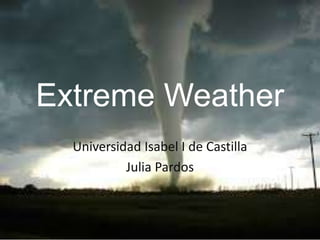
Extreme Weather
Universidad Isabel I de Castilla
Julia Pardos
LESON PLAN
- Target Group: 25 1st year
Secondary School students.
- Length: 55 minutes
- Use of English:
1.- Grammar:
Continuous forms in present and
past for explaining the processes of
phenomenon formation.
2.- Vocabulary:
Nouns:drizzle, downpour, hailstones, frost, sleet,
blizzard, thunder, mist, drought, breeze, heat wave, hot
spell, cold snap, blustery, wind, whirlwind, hurricane,
tornado, drought, below zero, lood, above zero.
Verbs: to be boiling hot, to be airless, to be muggy, to,
be chilly, to be overcast, to be freezing, to be soaked to the
skin, to snow, to hail, to pour down, to teem down, to
drizzle.
- Skills:
1.- Reading comprehension (reading
the article and summarising it)
2.-Listening comprehension
(Understanding the video, listening to
other presentations)
3.-ICT skills (selecting good/ bad
information , using visual support for
their presentations)
4.- Speaking (Presenting their
expositions)
-Motivational video:
Play a 1 minute video about the
topic. Then there is a short
exchange of opinions about the
extreme weather and the topic in
general.
(7 minutes)
Introduction of the topic:
Division of the class in five groups
of five people. Each group has to
look for real information about a
real extreme weather event and
after that expose a short report
about it to the rest of the class.
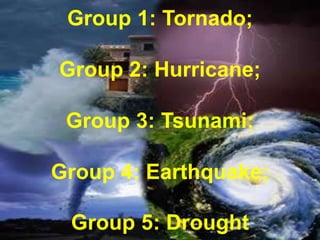
Group 1: Tornado;
Group 2: Hurricane;
Group 3: Tsunami;
Group 4: Earthquake;
Group 5: Drought
The students will go to the
school’s computer lab and they
will look the information up on
the Internet together with
supporting images or videos.
After that they will have to write
a short report about it and
present it to the rest of the class.
(20 minutes)
Each group will choose a
team leader and he/she will
present the extreme
weather example to the rest
of the class.
(10 minutes)
The students will fulfil a rubric
form where they will evaluate
their partner’s presentation and
contents. They will also add a
comment on each extreme
weather event. The groups will
distribute their rubrics to every
class mate.
(7 minutes)
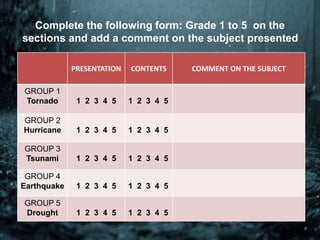
Complete the following form: Grade 1 to 5 on the
sections and add a comment on the subject presented
PRESENTATION CONTENTS COMMENT ON THE SUBJECT
GROUP 1
Tornado 1 2 3 4 5 1 2 3 4 5
GROUP 2
Hurricane 1 2 3 4 5 1 2 3 4 5
GROUP 3
Tsunami 1 2 3 4 5 1 2 3 4 5
GROUP 4
Earthquake 1 2 3 4 5 1 2 3 4 5
GROUP 5
Drought 1 2 3 4 5 1 2 3 4 5
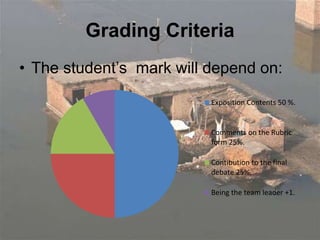
Grading Criteria
• The student’s mark will depend on:
Exposition Contents 50 %.
Comments on the Rubric
form 25%.
Contibution to the final
debate 25%.
Being the team leader +1.
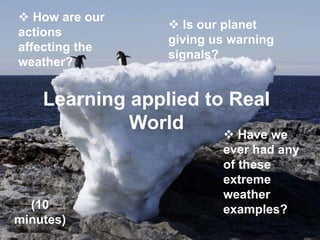
Learning applied to Real
World
 How are our
actions
affecting the
weather?
 Is our planet
giving us warning
signals?
 Have we
ever had any
of these
extreme
weather
examples?(10
minutes)
Useful links for students
 http://en.wikipedia.org/wiki/List_of_severe_weather
_phenomena
 http://www.bbc.co.uk/schools/gcsebitesize/geograp
hy/weather_climate/extreme_weather_rev1.shtml
 https://theextinctionprotocol.wordpress.com/2012/0
9/29/extreme-weather-wreaks-havoc-from-spain-to-
morocco/
 Tornadoes:
http://www.weatherwizkids.com/weather-tornado.htm
 Hurricanes: http://www.nhc.noaa.gov/
 Tsunamis:http://environment.nationalgeographic.co
m/environment/natural-disasters/tsunami-profile/
 Earthquakes:
http://earthquake.usgs.gov/earthquakes/
 Droughts:http://drought.unl.edu/DroughtBasics/Wh
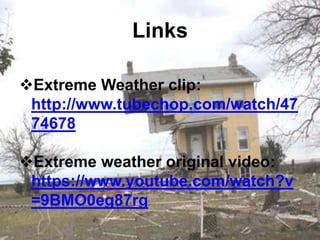
Links
Extreme Weather clip:
http://www.tubechop.com/watch/47
74678
Extreme weather original video:
https://www.youtube.com/watch?v
=9BMO0eg87rg

Extreme Weather Lesson Plan

  • 1.
    Extreme Weather Universidad IsabelI de Castilla Julia Pardos
  • 2.
    LESON PLAN - TargetGroup: 25 1st year Secondary School students. - Length: 55 minutes
  • 3.
    - Use ofEnglish: 1.- Grammar: Continuous forms in present and past for explaining the processes of phenomenon formation.
  • 4.
    2.- Vocabulary: Nouns:drizzle, downpour,hailstones, frost, sleet, blizzard, thunder, mist, drought, breeze, heat wave, hot spell, cold snap, blustery, wind, whirlwind, hurricane, tornado, drought, below zero, lood, above zero. Verbs: to be boiling hot, to be airless, to be muggy, to, be chilly, to be overcast, to be freezing, to be soaked to the skin, to snow, to hail, to pour down, to teem down, to drizzle.
  • 5.
    - Skills: 1.- Readingcomprehension (reading the article and summarising it) 2.-Listening comprehension (Understanding the video, listening to other presentations) 3.-ICT skills (selecting good/ bad information , using visual support for their presentations) 4.- Speaking (Presenting their expositions)
  • 6.
    -Motivational video: Play a1 minute video about the topic. Then there is a short exchange of opinions about the extreme weather and the topic in general. (7 minutes)
  • 7.
    Introduction of thetopic: Division of the class in five groups of five people. Each group has to look for real information about a real extreme weather event and after that expose a short report about it to the rest of the class.
  • 8.
    Group 1: Tornado; Group2: Hurricane; Group 3: Tsunami; Group 4: Earthquake; Group 5: Drought
  • 9.
    The students willgo to the school’s computer lab and they will look the information up on the Internet together with supporting images or videos. After that they will have to write a short report about it and present it to the rest of the class. (20 minutes)
  • 10.
    Each group willchoose a team leader and he/she will present the extreme weather example to the rest of the class. (10 minutes)
  • 11.
    The students willfulfil a rubric form where they will evaluate their partner’s presentation and contents. They will also add a comment on each extreme weather event. The groups will distribute their rubrics to every class mate. (7 minutes)
  • 12.
    Complete the followingform: Grade 1 to 5 on the sections and add a comment on the subject presented PRESENTATION CONTENTS COMMENT ON THE SUBJECT GROUP 1 Tornado 1 2 3 4 5 1 2 3 4 5 GROUP 2 Hurricane 1 2 3 4 5 1 2 3 4 5 GROUP 3 Tsunami 1 2 3 4 5 1 2 3 4 5 GROUP 4 Earthquake 1 2 3 4 5 1 2 3 4 5 GROUP 5 Drought 1 2 3 4 5 1 2 3 4 5
  • 13.
    Grading Criteria • Thestudent’s mark will depend on: Exposition Contents 50 %. Comments on the Rubric form 25%. Contibution to the final debate 25%. Being the team leader +1.
  • 14.
    Learning applied toReal World  How are our actions affecting the weather?  Is our planet giving us warning signals?  Have we ever had any of these extreme weather examples?(10 minutes)
  • 17.
    Useful links forstudents  http://en.wikipedia.org/wiki/List_of_severe_weather _phenomena  http://www.bbc.co.uk/schools/gcsebitesize/geograp hy/weather_climate/extreme_weather_rev1.shtml  https://theextinctionprotocol.wordpress.com/2012/0 9/29/extreme-weather-wreaks-havoc-from-spain-to- morocco/  Tornadoes: http://www.weatherwizkids.com/weather-tornado.htm  Hurricanes: http://www.nhc.noaa.gov/  Tsunamis:http://environment.nationalgeographic.co m/environment/natural-disasters/tsunami-profile/  Earthquakes: http://earthquake.usgs.gov/earthquakes/  Droughts:http://drought.unl.edu/DroughtBasics/Wh
  • 18.
    Links Extreme Weather clip: http://www.tubechop.com/watch/47 74678 Extremeweather original video: https://www.youtube.com/watch?v =9BMO0eg87rg