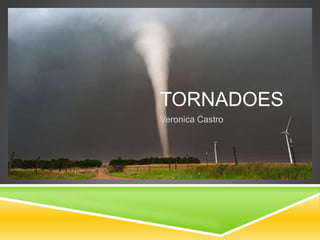
TORNADOES
Veronica Castro
WHAT IS A TORNADO?
The literal definition of a tornado is:
 “a mobile, destructive vortex of violently rotating winds
having the appearance of a funnel-shaped cloud and
advancing beneath a large storm system.”
 In other words, a tornado is a funnel shaped cloud that comes
to shape after a thunderstorm and fast winds.
What is a Tornado Cont.
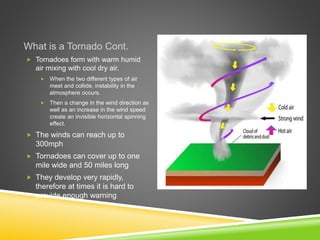
 Tornadoes form with warm humid
air mixing with cool dry air.
 When the two different types of air
meet and collide, instability in the
atmosphere occurs.
 Then a change in the wind direction as
well as an increase in the wind speed
create an invisible horizontal spinning
effect.
 The winds can reach up to
300mph
 Tornadoes can cover up to one
mile wide and 50 miles long
 They develop very rapidly,
therefore at times it is hard to
provide enough warning
HOW TO BECOME AWARE OF AN
APPROACHING TORNADO
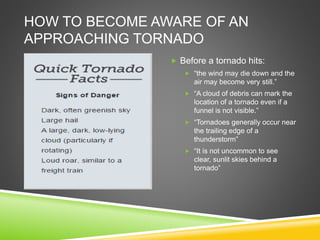
 Before a tornado hits:
 “the wind may die down and the
air may become very still.”
 “A cloud of debris can mark the
location of a tornado even if a
funnel is not visible.”
 “Tornadoes generally occur near
the trailing edge of a
thunderstorm”
 “It is not uncommon to see
clear, sunlit skies behind a
tornado”
TORNADO WARNINGS
 Because tornadoes develop
very rapidly, warnings are
often given with very little
notice
https://youtu.be/4_ZZFKjjoL0
WHEN/WHERE ARE TORNADOES MOST
LIKELY TO OCCUR?  Tornadoes can hit during any time
of the year.
 “Tornadoes occur in many parts of
the world, including Australia,
Europe, Africa, Asia, and South
America. Even New Zealand
reports about 20 tornadoes each
year”, but are most likely to hit the
center of the US (Tornado Alley)
 For the northern states, Tornadoes
usually hit around the summer
time.
 In southern states the “tornado
season” is between March and
May.
 The US central is hit with at least
500 tornadoes a year.
 The center of the US is the region
in which the air becomes unstable
(cold air clashes with warm air
which is why tornadoes are seen in
that area.)
HOW DO TORNADOES AFFECT LIFE ON
EARTH?
 Tornadoes can be extremely
destructive.
 They cause an average of
80 fatalities and 1,500
injuries in the U.S. each year.
(mostly from flying or falling
debris)
 $400 million in property
damage annually.
 Besides the fatalities,
tornadoes destroy anything
in their paths.
 Tornadoes pick up dirt and soil
as they move. They will carry all
of the dirt and debris they pick
up and eventually drop it
somewhere else.
 Depending on how strong the
tornado is, significant damage
to the Earth's structure can
occur. T
 Tornadoes also have the
strength to uproot trees and
flatten foothills if the soil is soft
enough.
 As a result of a tornado, animal
populations may have to move
somewhere else in order to
survive.
 Debris left over from the
tornado may also circulate into
the environment causing
pollution if the damage is
severe.
CAN TORNADOES BE STOPPED?
 It is believed that a “Giant
Wall” can be the solution (not
completely)
 China and the US have
similar geographic locations:
 Northern China Plain and the
Eastern China Plain is also in the
zone of mixing, similar to
Tornado Alley
 Tornadoes are a smaller threat in
China because there are three
east-west mountain ranges to
protect these plains from
tornadoes
Can Tornadoes be
Stopped?
 Because of the mountains in
China, it is believed that
building Giant walls in North
Dakota, the middle of
Oklahoma, and Texas to
Louisiana (frequent tornado
targets) and then extending
them to other tornado targets
would reduce the number of
tornadoes in the US.
 Although it sounds like a good
idea, it will not stop tornadoes
all together.
 Besides that, the project will be
very costly.
THANK YOU

Tornado presentation

  • 1.
  • 2.
    WHAT IS ATORNADO? The literal definition of a tornado is:  “a mobile, destructive vortex of violently rotating winds having the appearance of a funnel-shaped cloud and advancing beneath a large storm system.”  In other words, a tornado is a funnel shaped cloud that comes to shape after a thunderstorm and fast winds.
  • 3.
    What is aTornado Cont.  Tornadoes form with warm humid air mixing with cool dry air.  When the two different types of air meet and collide, instability in the atmosphere occurs.  Then a change in the wind direction as well as an increase in the wind speed create an invisible horizontal spinning effect.  The winds can reach up to 300mph  Tornadoes can cover up to one mile wide and 50 miles long  They develop very rapidly, therefore at times it is hard to provide enough warning
  • 4.
    HOW TO BECOMEAWARE OF AN APPROACHING TORNADO  Before a tornado hits:  “the wind may die down and the air may become very still.”  “A cloud of debris can mark the location of a tornado even if a funnel is not visible.”  “Tornadoes generally occur near the trailing edge of a thunderstorm”  “It is not uncommon to see clear, sunlit skies behind a tornado”
  • 5.
    TORNADO WARNINGS  Becausetornadoes develop very rapidly, warnings are often given with very little notice https://youtu.be/4_ZZFKjjoL0
  • 6.
    WHEN/WHERE ARE TORNADOESMOST LIKELY TO OCCUR?  Tornadoes can hit during any time of the year.  “Tornadoes occur in many parts of the world, including Australia, Europe, Africa, Asia, and South America. Even New Zealand reports about 20 tornadoes each year”, but are most likely to hit the center of the US (Tornado Alley)  For the northern states, Tornadoes usually hit around the summer time.  In southern states the “tornado season” is between March and May.  The US central is hit with at least 500 tornadoes a year.  The center of the US is the region in which the air becomes unstable (cold air clashes with warm air which is why tornadoes are seen in that area.)
  • 7.
    HOW DO TORNADOESAFFECT LIFE ON EARTH?  Tornadoes can be extremely destructive.  They cause an average of 80 fatalities and 1,500 injuries in the U.S. each year. (mostly from flying or falling debris)  $400 million in property damage annually.  Besides the fatalities, tornadoes destroy anything in their paths.  Tornadoes pick up dirt and soil as they move. They will carry all of the dirt and debris they pick up and eventually drop it somewhere else.  Depending on how strong the tornado is, significant damage to the Earth's structure can occur. T  Tornadoes also have the strength to uproot trees and flatten foothills if the soil is soft enough.  As a result of a tornado, animal populations may have to move somewhere else in order to survive.  Debris left over from the tornado may also circulate into the environment causing pollution if the damage is severe.
  • 8.
    CAN TORNADOES BESTOPPED?  It is believed that a “Giant Wall” can be the solution (not completely)  China and the US have similar geographic locations:  Northern China Plain and the Eastern China Plain is also in the zone of mixing, similar to Tornado Alley  Tornadoes are a smaller threat in China because there are three east-west mountain ranges to protect these plains from tornadoes
  • 9.
    Can Tornadoes be Stopped? Because of the mountains in China, it is believed that building Giant walls in North Dakota, the middle of Oklahoma, and Texas to Louisiana (frequent tornado targets) and then extending them to other tornado targets would reduce the number of tornadoes in the US.  Although it sounds like a good idea, it will not stop tornadoes all together.  Besides that, the project will be very costly.
  • 10.

Editor's Notes

  • #3 ***Will show the wind changing directions in video***