THUNDERSTORM AND
LIGHTNING
Department of
Disaster Science and Management
Faculty of
Earth and Environmental Sciences
University of Dhaka
July 2014
Course No. : DSMHT-203
Course name: Climatic Hazards & Climate Change
Submitted to
Taslima Imam
Meteorologist
Submitted by-
Mirza Shihab Uddin Antor FH -001
Md.Raisul Islam Shamrat SH-008
S.M Mahmudul Islam Tamal FH-020
Muhammad Abu Sayed SH-023
Md. Syadur Rahman SH-027
Sarker Md. Nokibul Hasan SH-030
Thunderstorm
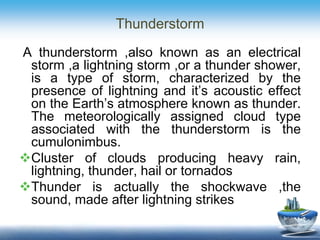
A thunderstorm ,also known as an electrical
storm ,a lightning storm ,or a thunder shower,
is a type of storm, characterized by the
presence of lightning and it’s acoustic effect
on the Earth’s atmosphere known as thunder.
The meteorologically assigned cloud type
associated with the thunderstorm is the
cumulonimbus.
Cluster of clouds producing heavy rain,
lightning, thunder, hail or tornados
Thunder is actually the shockwave ,the
sound, made after lightning strikes
Thunderstorm Requirements
All thunderstorm require three ingredient
for their formation:
I. Source of moisture
II. Air lifting mechanism
III. Instability.
Life cycle of a thunderstorm
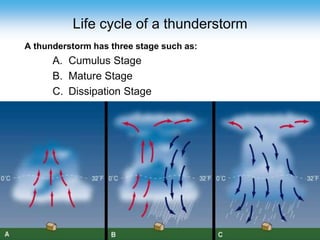
A thunderstorm has three stage such as:
A. Cumulus Stage
B. Mature Stage
C. Dissipation Stage
Cumulus Stage
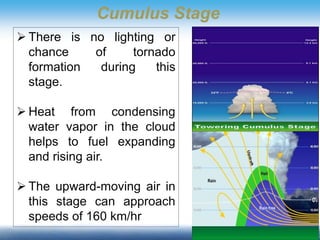
 There is no lighting or
chance of tornado
formation during this
stage.
 Heat from condensing
water vapor in the cloud
helps to fuel expanding
and rising air.
 The upward-moving air in
this stage can approach
speeds of 160 km/hr
Mature Stage
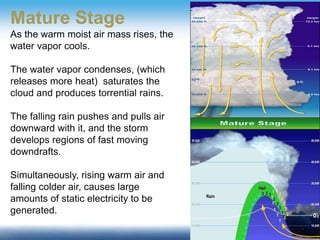
As the warm moist air mass rises, the
water vapor cools.
The water vapor condenses, (which
releases more heat) saturates the
cloud and produces torrential rains.
The falling rain pushes and pulls air
downward with it, and the storm
develops regions of fast moving
downdrafts.
Simultaneously, rising warm air and
falling colder air, causes large
amounts of static electricity to be
generated.
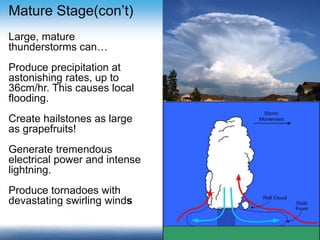
Mature Stage(con’t)
Large, mature
thunderstorms can…
Produce precipitation at
astonishing rates, up to
36cm/hr. This causes local
flooding.
Create hailstones as large
as grapefruits!
Generate tremendous
electrical power and intense
lightning.
Produce tornadoes with
devastating swirling winds
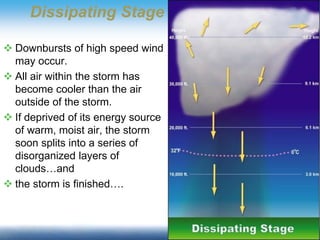
Dissipating Stage
 Downbursts of high speed wind
may occur.
 All air within the storm has
become cooler than the air
outside of the storm.
 If deprived of its energy source
of warm, moist air, the storm
soon splits into a series of
disorganized layers of
clouds…and
 the storm is finished….
Types of Thunderstorm
There are three types:
1. Composed of cells
 Ordinary - short lived and small
 Super – large ,last for hours
2. Single cell
3. Multi cell
Lightning
 Lightning is a dazzling bluish white light produce by
clouds. It is usually accompanied by thunder.
 Lightning a Gigantic Electrical Spark Traveling
between Cloud to Cloud or Cloud to Earth Containing
an average charge of 30 to 50 lakhs Volts and a
current of 30 Kilo amperes with a speed of 220 km
per hour.
 Till 1752, nobody knew about the cause of lightning.
It was Benjamin Franklin who prove that lightning is
cause by static electric charges in the cloud.
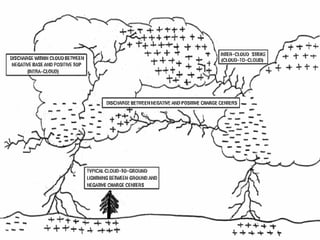
 When the clouds fill up with electric charges the
positive charges or protons from at the top of the
cloud and negative charges from at the bottom ,it
causes lightning .
How does lightning occur?
There have been many theories of occurring
lightning :
Polarization Mechanism Theory: As ice falls
through the Earth’s atmosphere , they
become electrically polarized.
Electrostatic Induction Theory: Two opposing
charges get separated. The electricity gets
stored in the middle of a cumulonimbus
cloud. There the electricity collides with rain.
The Discharge Theory: Electricity is made
when there’s enough positive & negative
energy together .
Types of Lightning
 Intra-cloud lightning: Lightning happening inside a cloud.
 Cloud to Ground Lightning: Lightning that hits the Earth from
a cloud.
 Bead Lightning: A brighter version of cloud to ground
lightning.
 Cloud to Cloud Lightning: Lightning that goes from one cloud
to another.(RARE)
 Ball Lightning: Lightning that comes in the shape of a ball in a
thunderstorm
Lightning Facts
Globally 44,000 thunderstorms/day and 100
lightning strokes /sec
Duration of one stroke of lightning, 1/5 th of
second.
Strike the Earth 50 to 100 times per second.
Voltages 1,00,000 kV and peak current 30 kA.
Total energy released 40 GJ.
Temperatures rises 50,000 degrees Celsius
Lightning can travel at speeds of 300,000 m/sec
Lightning heats nearby air to about 10,000 °C.
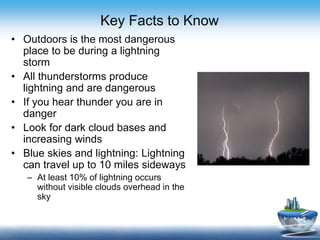
Key Facts to Know
• Outdoors is the most dangerous
place to be during a lightning
storm
• All thunderstorms produce
lightning and are dangerous
• If you hear thunder you are in
danger
• Look for dark cloud bases and
increasing winds
• Blue skies and lightning: Lightning
can travel up to 10 miles sideways
– At least 10% of lightning occurs
without visible clouds overhead in the
sky
Indoor Safety Rules
• Three main ways lightning enters a structure
– A direct strike
– Through wires or pipes that extend outside the structure
– Through the ground
• Lightning Safety tips for Inside the Home
– Avoid contact with corded phones
• Leading cause of indoor lightning injuries
– Avoid contact with electrical equipment or cords
– Avoid contact with plumbing
• Do not take a bath, shower, or wash dishes
– Stay away from windows and doors, and stay off porches
Outdoor Safety Rules
If you are outdoors when a thunderstorm threatens go as
quickly as you can to a safe shelter
• What constitutes as a safe shelter
– Safe buildings are buildings that are fully enclosed with
a roof, walls, and floor.
• They are considered safe because they have wiring and
plumbing
– Safe vehicles are those with hard tops.
• Make sure all doors are closed and windows rolled up and do
not touch any metal surfaces
– Large Boats with Cabins
• Best policy is if you are on the water and a storm is approaching
is to get out of the water
Outdoor Safety Rules
The question begs to be asked: What do if
there is no safe shelter nearby to go to.
• Move away from tall trees
• Keep away from metal objects and fences
• If you are in a group spread out with at least
15 ft between you so that there is someone
to assist the struck victim.
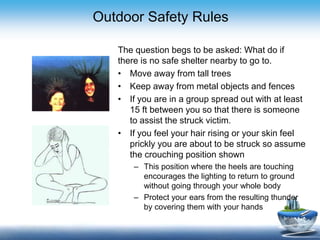
• If you feel your hair rising or your skin feel
prickly you are about to be struck so assume
the crouching position shown
– This position where the heels are touching
encourages the lighting to return to ground
without going through your whole body
– Protect your ears from the resulting thunder
by covering them with your hands
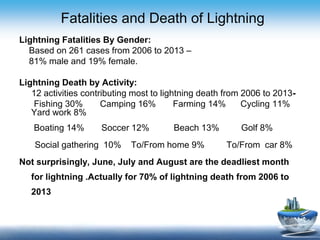
Fatalities and Death of Lightning
Lightning Fatalities By Gender:
Based on 261 cases from 2006 to 2013 –
81% male and 19% female.
Lightning Death by Activity:
12 activities contributing most to lightning death from 2006 to 2013-
Fishing 30% Camping 16% Farming 14% Cycling 11%
Yard work 8%
Boating 14% Soccer 12% Beach 13% Golf 8%
Social gathering 10% To/From home 9% To/From car 8%
Not surprisingly, June, July and August are the deadliest month
for lightning .Actually for 70% of lightning death from 2006 to
2013
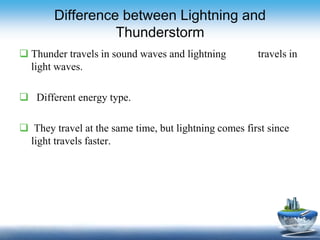
Difference between Lightning and
Thunderstorm
 Thunder travels in sound waves and lightning travels in
light waves.
 Different energy type.
 They travel at the same time, but lightning comes first since
light travels faster.
Any Question
THANK YOU ALL

Thunderstorm and lightining

  • 1.
    THUNDERSTORM AND LIGHTNING Department of DisasterScience and Management Faculty of Earth and Environmental Sciences University of Dhaka July 2014
  • 2.
    Course No. :DSMHT-203 Course name: Climatic Hazards & Climate Change Submitted to Taslima Imam Meteorologist Submitted by- Mirza Shihab Uddin Antor FH -001 Md.Raisul Islam Shamrat SH-008 S.M Mahmudul Islam Tamal FH-020 Muhammad Abu Sayed SH-023 Md. Syadur Rahman SH-027 Sarker Md. Nokibul Hasan SH-030
  • 3.
    Thunderstorm A thunderstorm ,alsoknown as an electrical storm ,a lightning storm ,or a thunder shower, is a type of storm, characterized by the presence of lightning and it’s acoustic effect on the Earth’s atmosphere known as thunder. The meteorologically assigned cloud type associated with the thunderstorm is the cumulonimbus. Cluster of clouds producing heavy rain, lightning, thunder, hail or tornados Thunder is actually the shockwave ,the sound, made after lightning strikes
  • 4.
    Thunderstorm Requirements All thunderstormrequire three ingredient for their formation: I. Source of moisture II. Air lifting mechanism III. Instability.
  • 5.
    Life cycle ofa thunderstorm A thunderstorm has three stage such as: A. Cumulus Stage B. Mature Stage C. Dissipation Stage
  • 6.
    Cumulus Stage  Thereis no lighting or chance of tornado formation during this stage.  Heat from condensing water vapor in the cloud helps to fuel expanding and rising air.  The upward-moving air in this stage can approach speeds of 160 km/hr
  • 7.
    Mature Stage As thewarm moist air mass rises, the water vapor cools. The water vapor condenses, (which releases more heat) saturates the cloud and produces torrential rains. The falling rain pushes and pulls air downward with it, and the storm develops regions of fast moving downdrafts. Simultaneously, rising warm air and falling colder air, causes large amounts of static electricity to be generated.
  • 8.
    Mature Stage(con’t) Large, mature thunderstormscan… Produce precipitation at astonishing rates, up to 36cm/hr. This causes local flooding. Create hailstones as large as grapefruits! Generate tremendous electrical power and intense lightning. Produce tornadoes with devastating swirling winds
  • 9.
    Dissipating Stage  Downburstsof high speed wind may occur.  All air within the storm has become cooler than the air outside of the storm.  If deprived of its energy source of warm, moist air, the storm soon splits into a series of disorganized layers of clouds…and  the storm is finished….
  • 10.
    Types of Thunderstorm Thereare three types: 1. Composed of cells  Ordinary - short lived and small  Super – large ,last for hours 2. Single cell 3. Multi cell
  • 11.
    Lightning  Lightning isa dazzling bluish white light produce by clouds. It is usually accompanied by thunder.  Lightning a Gigantic Electrical Spark Traveling between Cloud to Cloud or Cloud to Earth Containing an average charge of 30 to 50 lakhs Volts and a current of 30 Kilo amperes with a speed of 220 km per hour.  Till 1752, nobody knew about the cause of lightning. It was Benjamin Franklin who prove that lightning is cause by static electric charges in the cloud.  When the clouds fill up with electric charges the positive charges or protons from at the top of the cloud and negative charges from at the bottom ,it causes lightning .
  • 12.
    How does lightningoccur? There have been many theories of occurring lightning : Polarization Mechanism Theory: As ice falls through the Earth’s atmosphere , they become electrically polarized. Electrostatic Induction Theory: Two opposing charges get separated. The electricity gets stored in the middle of a cumulonimbus cloud. There the electricity collides with rain. The Discharge Theory: Electricity is made when there’s enough positive & negative energy together .
  • 14.
    Types of Lightning Intra-cloud lightning: Lightning happening inside a cloud.  Cloud to Ground Lightning: Lightning that hits the Earth from a cloud.  Bead Lightning: A brighter version of cloud to ground lightning.  Cloud to Cloud Lightning: Lightning that goes from one cloud to another.(RARE)  Ball Lightning: Lightning that comes in the shape of a ball in a thunderstorm
  • 15.
    Lightning Facts Globally 44,000thunderstorms/day and 100 lightning strokes /sec Duration of one stroke of lightning, 1/5 th of second. Strike the Earth 50 to 100 times per second. Voltages 1,00,000 kV and peak current 30 kA. Total energy released 40 GJ. Temperatures rises 50,000 degrees Celsius Lightning can travel at speeds of 300,000 m/sec Lightning heats nearby air to about 10,000 °C.
  • 16.
    Key Facts toKnow • Outdoors is the most dangerous place to be during a lightning storm • All thunderstorms produce lightning and are dangerous • If you hear thunder you are in danger • Look for dark cloud bases and increasing winds • Blue skies and lightning: Lightning can travel up to 10 miles sideways – At least 10% of lightning occurs without visible clouds overhead in the sky
  • 17.
    Indoor Safety Rules •Three main ways lightning enters a structure – A direct strike – Through wires or pipes that extend outside the structure – Through the ground • Lightning Safety tips for Inside the Home – Avoid contact with corded phones • Leading cause of indoor lightning injuries – Avoid contact with electrical equipment or cords – Avoid contact with plumbing • Do not take a bath, shower, or wash dishes – Stay away from windows and doors, and stay off porches
  • 18.
    Outdoor Safety Rules Ifyou are outdoors when a thunderstorm threatens go as quickly as you can to a safe shelter • What constitutes as a safe shelter – Safe buildings are buildings that are fully enclosed with a roof, walls, and floor. • They are considered safe because they have wiring and plumbing – Safe vehicles are those with hard tops. • Make sure all doors are closed and windows rolled up and do not touch any metal surfaces – Large Boats with Cabins • Best policy is if you are on the water and a storm is approaching is to get out of the water
  • 19.
    Outdoor Safety Rules Thequestion begs to be asked: What do if there is no safe shelter nearby to go to. • Move away from tall trees • Keep away from metal objects and fences • If you are in a group spread out with at least 15 ft between you so that there is someone to assist the struck victim. • If you feel your hair rising or your skin feel prickly you are about to be struck so assume the crouching position shown – This position where the heels are touching encourages the lighting to return to ground without going through your whole body – Protect your ears from the resulting thunder by covering them with your hands
  • 20.
    Fatalities and Deathof Lightning Lightning Fatalities By Gender: Based on 261 cases from 2006 to 2013 – 81% male and 19% female. Lightning Death by Activity: 12 activities contributing most to lightning death from 2006 to 2013- Fishing 30% Camping 16% Farming 14% Cycling 11% Yard work 8% Boating 14% Soccer 12% Beach 13% Golf 8% Social gathering 10% To/From home 9% To/From car 8% Not surprisingly, June, July and August are the deadliest month for lightning .Actually for 70% of lightning death from 2006 to 2013
  • 21.
    Difference between Lightningand Thunderstorm  Thunder travels in sound waves and lightning travels in light waves.  Different energy type.  They travel at the same time, but lightning comes first since light travels faster.
  • 22.