

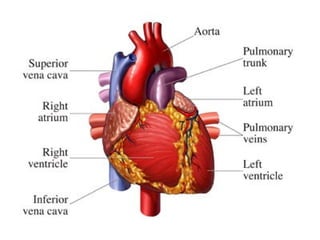


































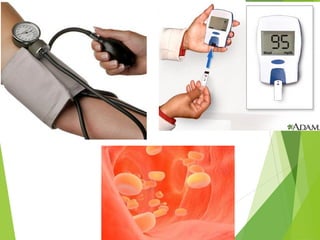
























































































HEART FACTS
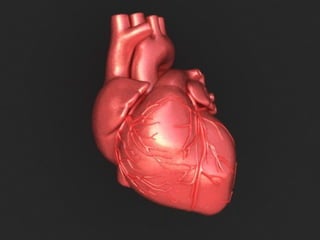
 The average adult heart beats
 72 times a minute;
 100,000 times a day;
 3,600,000 times a year;
 and 2.5 billion times during a lifetime.
HEART FACTS
 Though weighing only 11 ounces on average,
 a healthy heart pumps
 2,000 gallons of blood through
 60,000 miles of blood vessels
 each day.
HEART FACTS
 5% of blood supplies the heart,
 15-20% goes to the brain and central nervous system,
 and 22% goes to the kidneys.
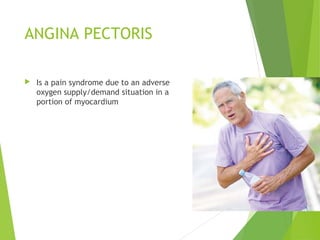
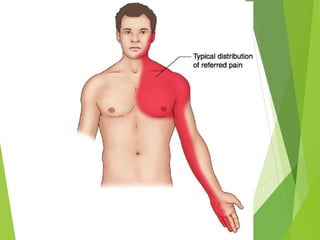
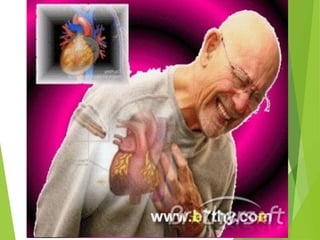
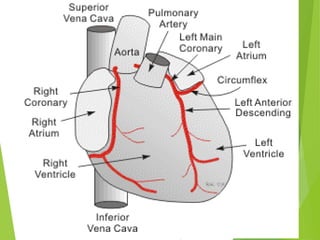
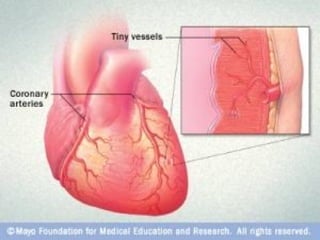
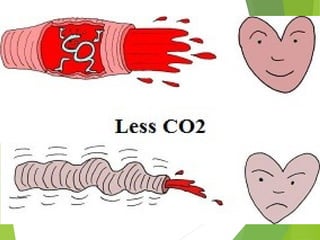
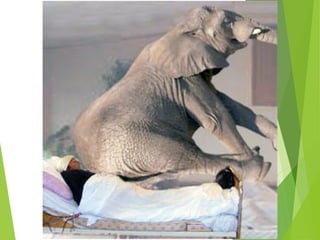
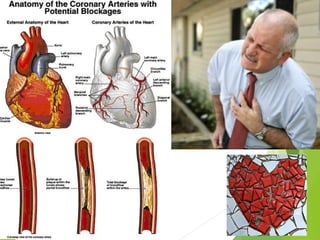
ANGINA PECTORIS
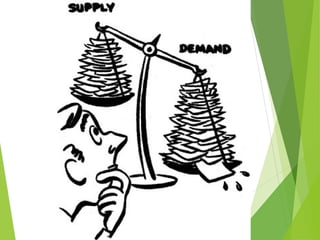
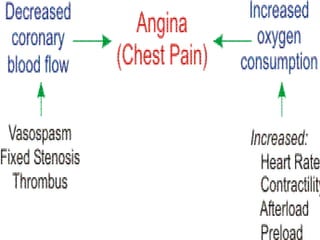
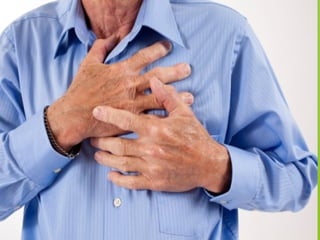
 Is a pain syndrome due to an adverse
oxygen supply/demand situation in a
portion of myocardium
ANTIANGINAL DRUGS
DR. V.SATHYANARAYANAN M.D
PROFESSOR OF PHARMACOLOGY
SRM MCH & RC
CHENNAI, INDIA
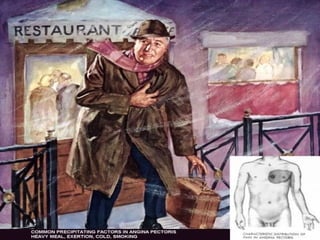
TYPES OF ANGINA
Classical angina
common form
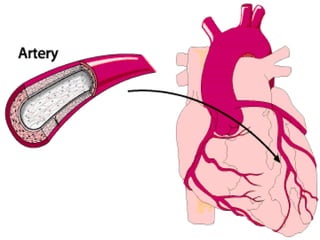
due to fixed coronary obstruction
Ischemic pain is felt
Subside when the increased energy demand is withdrawn
attacks are provoked by
 exercise,
emotion,
 eating or
coitus
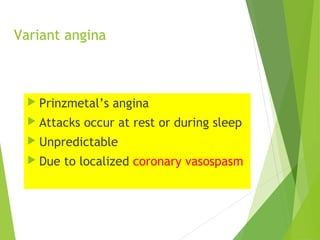
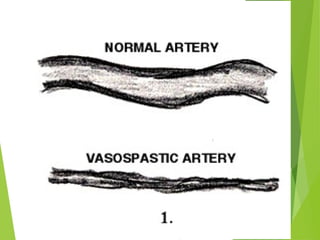
Variant angina
 Prinzmetal’s angina
 Attacks occur at rest or during sleep
 Unpredictable
 Due to localized coronary vasospasm
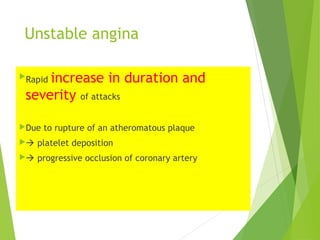
Unstable angina

Rapid increase in duration and
severity of attacks
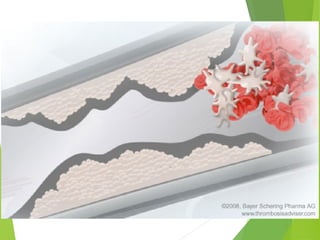
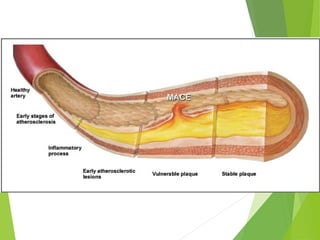
Due to rupture of an atheromatous plaque
 platelet deposition
 progressive occlusion of coronary artery
HEART FACTS
 The human heart begins to beat as
early as
four weeks after conception
HEART FACTS
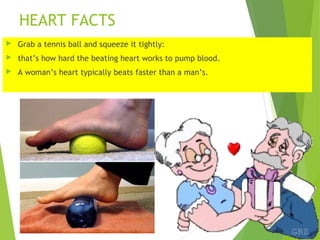
 Grab a tennis ball and squeeze it tightly:
 that’s how hard the beating heart works to pump blood.
 A woman’s heart typically beats faster than a man’s.
HEART FACTS
Every day, the heart creates enough energy to
drive a truck 20 miles.
 In a lifetime, that is equivalent to
driving to the moon and back.
HEART FACTS
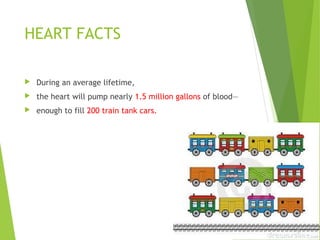
 During an average lifetime,
 the heart will pump nearly 1.5 million gallons of blood—
 enough to fill 200 train tank cars.
ANTIANGINAL DRUGS
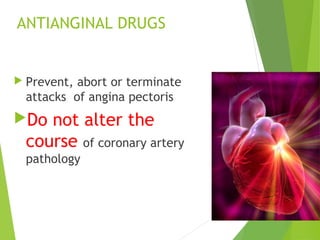
 Prevent, abort or terminate
attacks of angina pectoris
Do not alter the
course of coronary artery
pathology
CLASSIFICATION
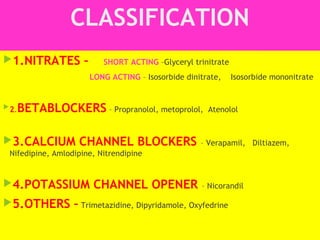
1.NITRATES – SHORT ACTING –Glyceryl trinitrate
LONG ACTING – Isosorbide dinitrate, Isosorbide mononitrate
2.BETABLOCKERS – Propranolol, metoprolol, Atenolol
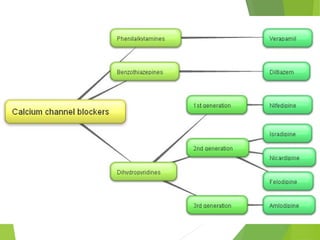
3.CALCIUM CHANNEL BLOCKERS – Verapamil, Diltiazem,
Nifedipine, Amlodipine, Nitrendipine
4.POTASSIUM CHANNEL OPENER – Nicorandil
5.OTHERS – Trimetazidine, Dipyridamole, Oxyfedrine
NITRATES- GLYCERYL TRINITRATE-
(PROTOTYPE)
 ACTIONS

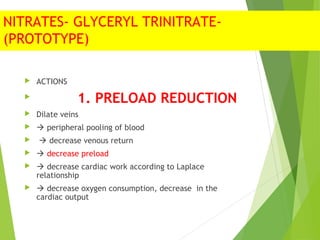
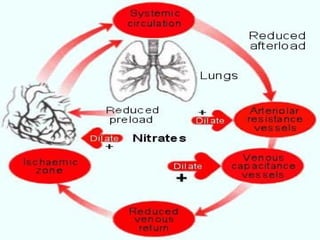
1. PRELOAD REDUCTION
 Dilate veins
  peripheral pooling of blood
  decrease venous return
  decrease preload
  decrease cardiac work according to Laplace
relationship
  decrease oxygen consumption, decrease in the
cardiac output
ACTIONS
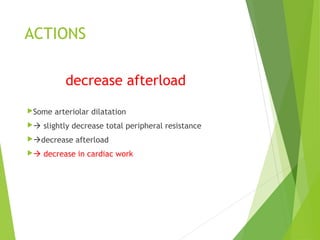
decrease afterload
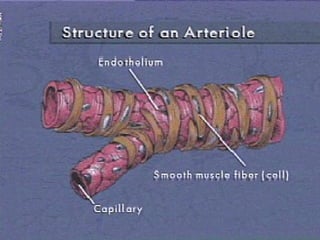
Some arteriolar dilatation
 slightly decrease total peripheral resistance
decrease afterload
 decrease in cardiac work
ACTIONS
Dilate larger coronary vessels

 increase blood flow to
ischemic areas
ACTIONS

Dilate cutaneous blood vessels  flushing

Dilate meningeal vessels  headache
 Shift blood from pulmonary circuit to systemic circuit 
decongest lungs
ACTIONS
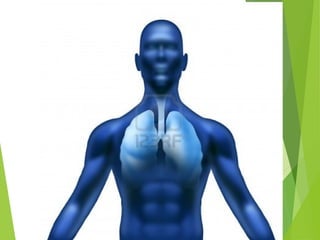
Relax bronchi
Relax biliary tract
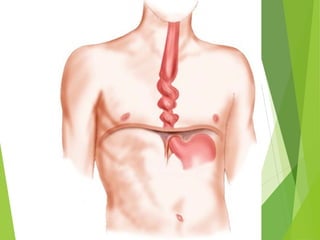
Relax esophagus
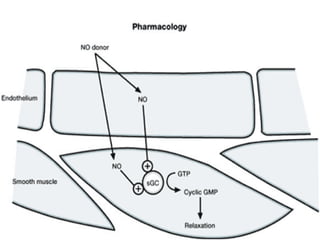
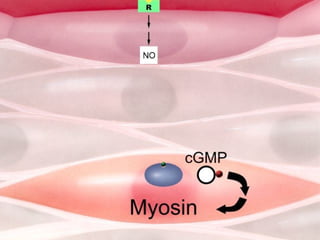
MECHANISM OF ACTION
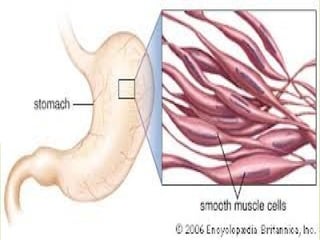
Denitrated in smooth muscle
 release Nitric Oxide
 activates cytosolic guanylyl cyclase
 increase cGMP
 dephosphorylation of MLCK
 reduced availability of active MLCK
interferes with the activation of Myosin

 fails to interact with actin  relaxation

cGMP  decrease ca entry  relaxation
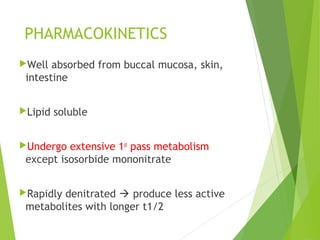
PHARMACOKINETICS
Well absorbed from buccal mucosa, skin,
intestine
Lipid soluble
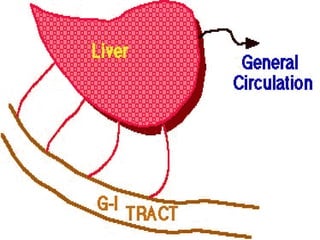
Undergo extensive 1st
pass metabolism
except isosorbide mononitrate
Rapidly denitrated  produce less active
metabolites with longer t1/2
ADR
 Headache, fullness in head
 Flushing,
 weakness
 Palpitation,
 sweating,
 dizziness, fainting
 Methemoglobinemia – a problem in severe
anemia
 Rashes – particularly with pentaerythritol
tetranitrate
TOLERANCE
 Decreased effectiveness of nitrates on repeated
administration
 Seen with GTN used orally, i.v, transdermally
 With long acting agents
 Cross tolerance also seen

Prevented by keeping nitrate free
interval everyday
DEPENDENCE
Seen after sudden withdrawal after
prolonged exposure
Myocardial infarction,
sudden deaths,
increase episodes of angina on record
Add a drug of another class
Withdrawal must be gradual
Sex and cardiovascular system
 CHANGES DURING ORGASM……
 Tachycardia  upto 180 beats/ minute
 BP  230/130 mmHg even in
normotensives
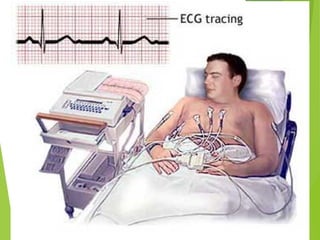
 ECG abnormalities may occur
 RESPIRATORY RATE  60 / min
 SUDDEN DEATHS
 CAUTION – older patients with CAD
INTERACTIONS
Potentiation of action by
sildenafil  severe hypotension
 MI, deaths
With other vasodilators
 additive hypotension
GLYCERYL TRINITRATE
Volatile liquid
Stored in tight glass container
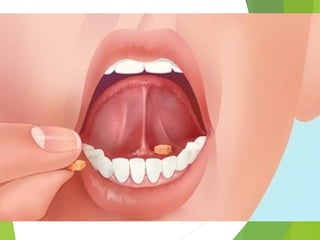
Taken sublingually terminate an anginal
attack
Acts within 1-2 minutes
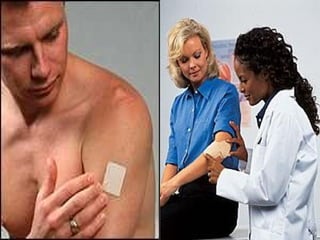
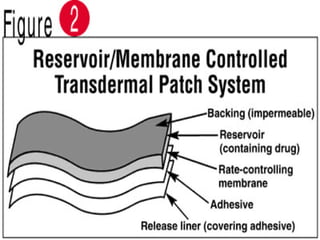
Also administered as
sublingual spray,
S.R. capsule,
transdermal patch,
i.v infusion,
transmucosal dosage form
Given as i.v infusion in unstable angina, LVF in MI, during
cardiac surgeries
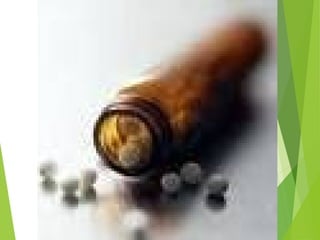
DOCTOR….. DOCTOR…..
Patient: It's been one month since my last visit
and I still feel miserable.
Doctor: Did you follow the instructions on the
medicine I gave you?
Patient: I sure did - the bottle said 'keep
tightly closed.'
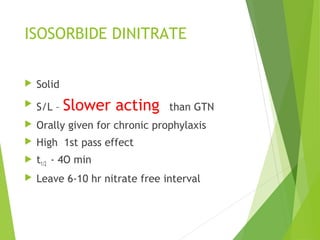
ISOSORBIDE DINITRATE
 Solid
 S/L – Slower acting than GTN
 Orally given for chronic prophylaxis
 High 1st pass effect
 t1/2 - 4O min
 Leave 6-10 hr nitrate free interval
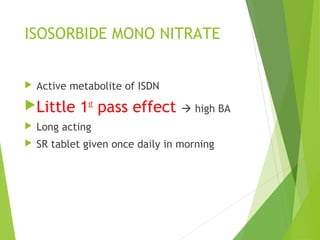
ISOSORBIDE MONO NITRATE
 Active metabolite of ISDN
Little 1st
pass effect  high BA
 Long acting
 SR tablet given once daily in morning
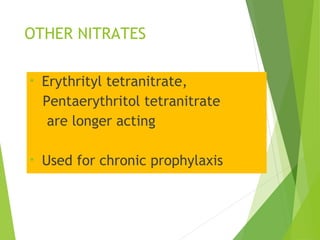
OTHER NITRATES
• Erythrityl tetranitrate,
Pentaerythritol tetranitrate
are longer acting
• Used for chronic prophylaxis
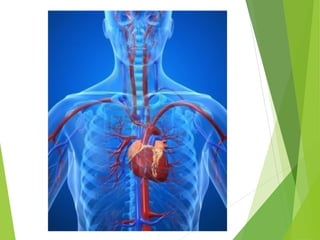
HEART FACTS
 When the body is at rest,
 it takes only 6 seconds for the blood
 to go from the heart to the lungs and back,
 only 8 seconds for it
 to go the brain and back, and
 only 16 seconds for it
 to reach the toes and travel all the way
back to the heart.
USES
 Angina pectoris –effective in classical
angina, variant angina increase exercise tolerance,
given as “as and when required” basis
 Acute coronary syndromes
 Congestive heart failure
 Acute left ventricular failure
 Myocardial infarction – of marginal benefit
 Interventional cardiac procedures
 Biliary colic
 Esophageal spasm
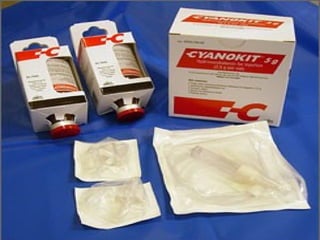
 Cyanide poisoning
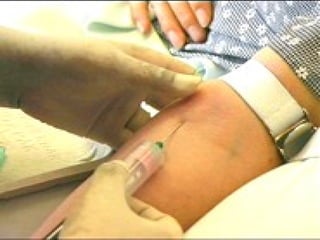
 Venipuncture
BETABLOCKERS IN ANGINA
Decrease cardiac work, oxygen consumption during
exercise, anxiety
All are Equally effective in preventing angina
Cardio selective beta blockers are preferred
To be taken on regular schedule
Dosage to be individualized
Tolerance does not develop
DO NOT DILATE CORONARY VESSELS
BETABLOCKERS IN ANGINA - CAUTION
Sudden withdrawal
precipitates angina, even MI
 beta-blockers are Contraindicated in
variant angina
SUMMARY
 Angina pectoris is a symptom of myocardial ischaemia
 Acute attack is treated with GTN 0.5mg sublingually
 Affords only symptomatic relief
 Nitrates act by reducing pre-load, afterload, dilates
coronary arteries
 Cause headache, flushing, palpitation as side effects
 Betablockers are useful in the prophylaxis
 Withdrawal of these drugs must be gradual
 Sildenafil usage during nitrates therapy may be
fatal
CALCIUM CHANNEL BLOCKERS
 Verapamil
 Nifedipine
 Diltiazem
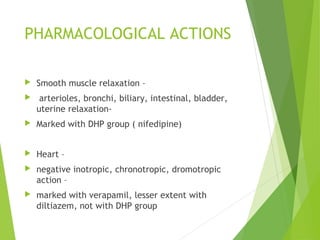
PHARMACOLOGICAL ACTIONS
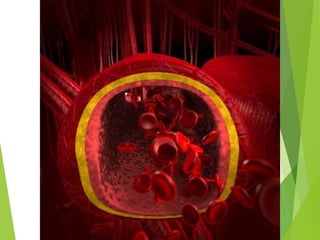
 Smooth muscle relaxation –
 arterioles, bronchi, biliary, intestinal, bladder,
uterine relaxation-
 Marked with DHP group ( nifedipine)
 Heart –
 negative inotropic, chronotropic, dromotropic
action –
 marked with verapamil, lesser extent with
diltiazem, not with DHP group
VERAPAMIL
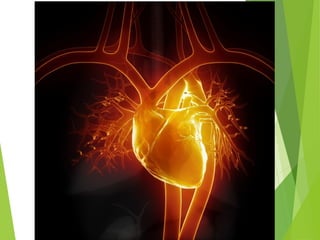
 Decreases heart rate, A-V conduction,
dilates arterioles, decreases t.p.r
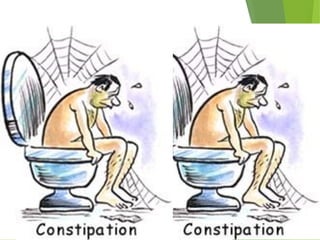
 ADR- nausea, constipation, bradycardia
 C/I – A-V block, CHF
 D/I – Should not be given with
betablockers, quinidine, increases digoxin
level
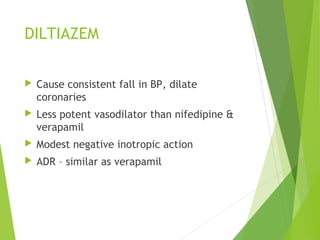
DILTIAZEM
 Cause consistent fall in BP, dilate
coronaries
 Less potent vasodilator than nifedipine &
verapamil
 Modest negative inotropic action
 ADR – similar as verapamil
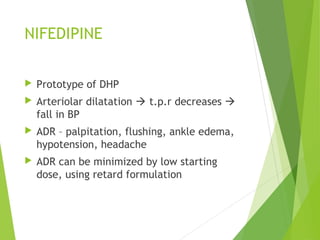
NIFEDIPINE
 Prototype of DHP
 Arteriolar dilatation  t.p.r decreases 
fall in BP
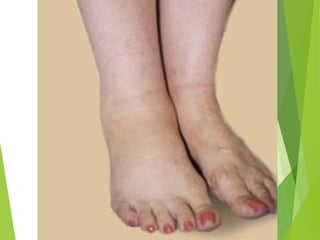
 ADR – palpitation, flushing, ankle edema,
hypotension, headache
 ADR can be minimized by low starting
dose, using retard formulation
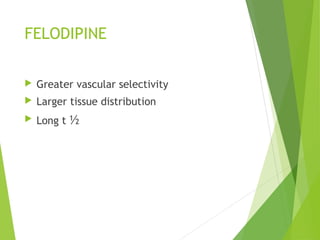
FELODIPINE
 Greater vascular selectivity
 Larger tissue distribution
 Long t ½
AMLODIPINE
 Slow oral absorption
 Devoid of vasodilator side effects like
flushing, palpitation, headache, postural
dizziness
 Long t1/2
 Diurnal fluctuation is small
 Action extends over next morning
NITRENDIPINE
 Release nitric oxide  additional
mechanism For vasodilatation
 Retard atherosclerosis
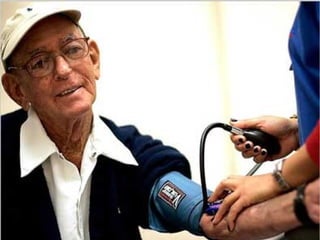
 Indicated in hypertension, angina
pectoris
LACIDIPINE
 Highly vasoselective newer DHP
 Once daily dose
 Used only in hypertension
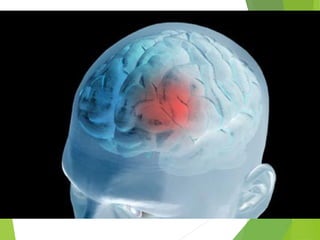
NIMODIPINE
 Short acting DHP
 Selectively relaxes cerebral blood vessels
 Used in treating neurological deficit due
to cerebral vasospasm following
subarachnoid hemorrhage
USES OF CALCIUM CHANNEL
BLOCKERS
•
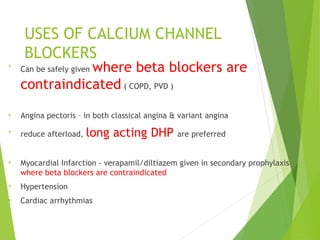
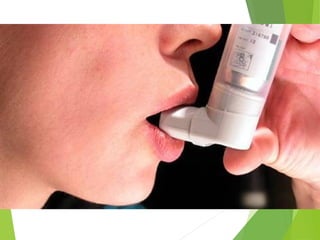
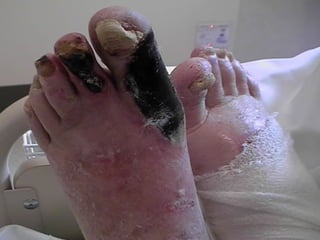
Can be safely given where beta blockers are
contraindicated ( COPD, PVD )
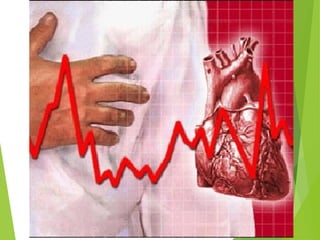
• Angina pectoris – in both classical angina & variant angina
• reduce afterload, long acting DHP are preferred
• Myocardial Infarction - verapamil/diltiazem given in secondary prophylaxis
where beta blockers are contraindicated
• Hypertension
• Cardiac arrhythmias
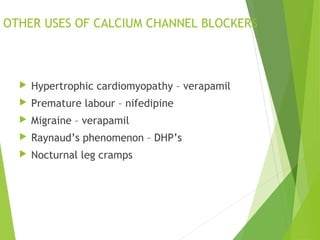
OTHER USES OF CALCIUM CHANNEL BLOCKERS
 Hypertrophic cardiomyopathy – verapamil
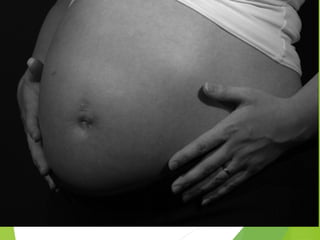
 Premature labour – nifedipine
 Migraine – verapamil
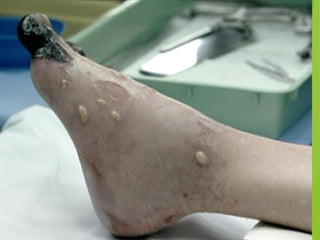
 Raynaud’s phenomenon – DHP’s
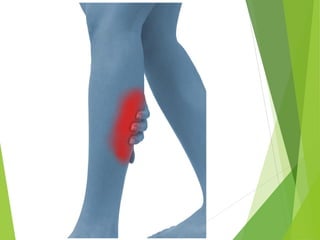
 Nocturnal leg cramps
RATIONAL DRUG COMBINATIONS
• When mono therapy fails to give relief
• Beta blockers + long-acting nitrates –
• tachycardia due to nitrates is blocked,
• ventricular dilatation, reduced coronary blood flow due to
B –blocker is blocked
• Slow acting DHP Ca channel blocker + B-blocker
• Nitrates + CCB  Valuable in severe vasospastic angina
• Nitrates + B-blocker + CCB in resistant cases
• (VERAPAMIL/DILTIAZEM should be avoided in such
combinations)
POTASSIUM CHANNEL
OPENERS
 Minoxidil, diazoxide
 Nicorandil
 Pinacidil
 cromokalim
MECHANISM OF ACTION
 Activates ATP sensitive K+ Channels
  increase outflow of K+ ions
  hyperpolarisation
  decrease Ca++ entry
  smooth muscle relaxation
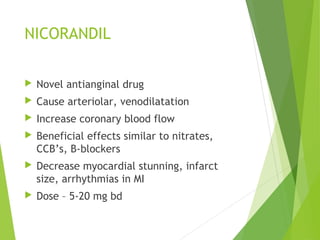
NICORANDIL
 Novel antianginal drug
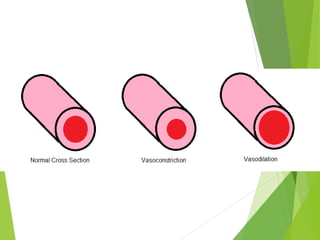
 Cause arteriolar, venodilatation
 Increase coronary blood flow
 Beneficial effects similar to nitrates,
CCB’s, B-blockers
 Decrease myocardial stunning, infarct
size, arrhythmias in MI
 Dose – 5-20 mg bd
Side effects
 headache,
 flushing,
 palpitation,
 dizziness,
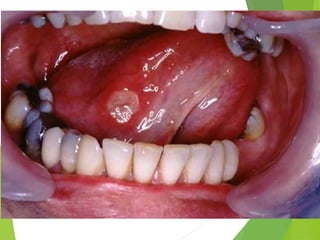
 painful apthous ulcers
POTENTIAL CLINICAL
APPLICATIONS
 Angina pectoris when tolerance is a
problem, when others are
contraindicated
 Hypertension
 CHF
 Myocardial salvage in MI
POTENTIAL CLINICAL
APPLICATIONS
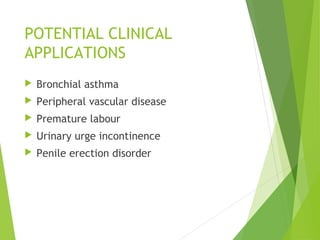
 Bronchial asthma
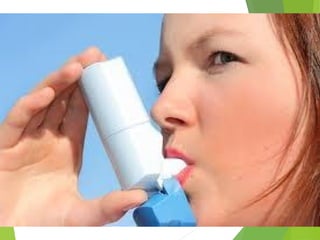
 Peripheral vascular disease
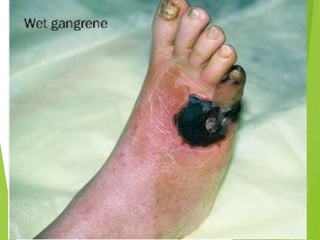
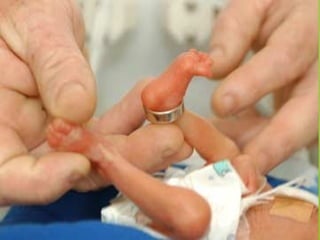
 Premature labour
 Urinary urge incontinence
 Penile erection disorder
DIPYRIDAMOLE
 Powerful coronary dilator
 Can cause coronary steal phenomenon
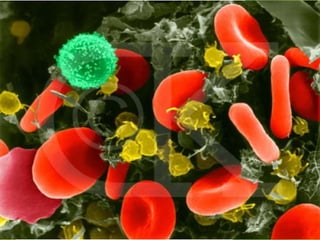
 Inhibits platelet aggregation
 Not useful as an antianginal drug
 Used in the prophylaxis in post MI, post
stroke to prevent thrombosis
TRIMETAZIDINE
 Novel antianginal drug
 Improve cellular tolerance to ischemia by
inhibiting LC3CAT
 Reduce anginal attacks in patients not
responding to other drugs
 ADR- gastric burning, dizziness, fatigue,
parkinsonism
 Useful as an add on medication to
conventional therapy in angina, post MI
RANOLAZINE
 Trimetazidine congener
 Spares fatty acid oxidation and shifts ATP
production to more O2 efficient
carbohydrate oxidation
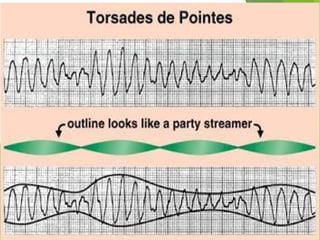
 Torsades de pointes is a risk
 Recommended only in combination
IVABRADINE
 Pure hear rate lowering antianginal drug
 Recently introduced as an alternative to betablockers
 Blocks cardiac pacemaker cell “f” channels 
decreases heart rate  decreases oxygen demand,
 prolongs diastole  improves myocardial blood flow
 increased oxygen supply
 ADR  VISUAL DISTURBANCES, headache, dizziness,
nausea
 USES  chronic stable angina pectoris alternate to
betablockers, inappropriate sinus tachycardia
DRUGS FOR PERIPHERAL
VASCULAR DISEASES
 CYCLANDELATE
 XANTHINOL NICOTINATE
 PENTOXIPHYLLINE
 CILOSTAZOLE
 CCBs
 ALPHABLOCKERS
 PGI2  severe cases with rest pain
PENTOXIPHYLLINE
 Analogue of theophylline
 Weak PDE inhibitor
 Increases blood flow in ischemic areas by
reducing whole blood viscosity,
 And by improving flexibility of RBCs
 ADR  nausea, vomiting, dyspepsia,
bloating
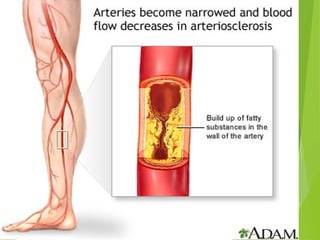
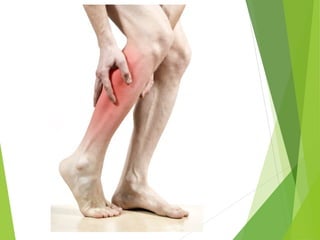
 USES  intermittent claudication, Trophic
leg ulcers, TIAs
CILOSTAZOLE
 PDE-3 inhibitor
 Increases cyclic AMP  vasodilatation, antiplatelet
aggregating activity
 More effective than pentoxiphylline for claudication
pain
 Not to be used in heart failure
 ADR  HEADACHE, nausea, dizziness, palpitation,
weakness
 USES  intermittent claudication with no rest pain or
heart failure
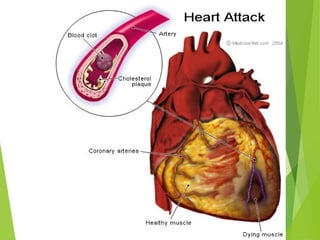
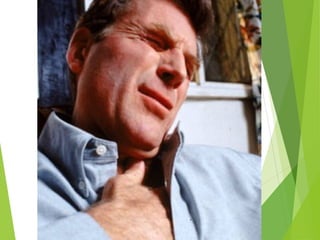
MYOCARDIAL INFARCTION
 Ischaemic necrosis of a portion of the
myocardium due to sudden occlusion of a
branch of coronary artery
 Acute thrombus is the cause
 25% die before therapy
 Has to be treated in I.C.C.U’S
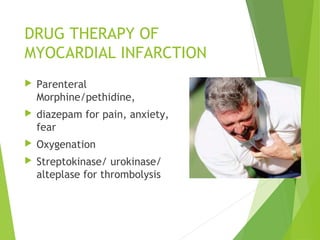
DRUG THERAPY OF
MYOCARDIAL INFARCTION
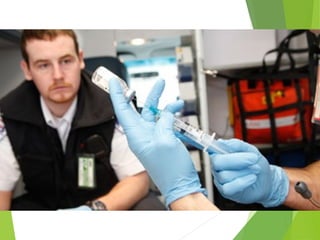
 Parenteral
Morphine/pethidine,
 diazepam for pain, anxiety,
fear
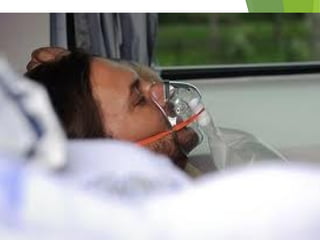
 Oxygenation
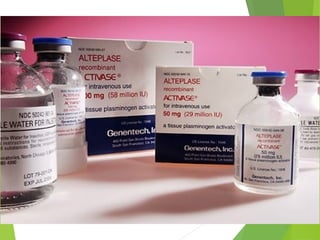
 Streptokinase/ urokinase/
alteplase for thrombolysis
DRUG THERAPY OF MYOCARDIAL INFARCTION
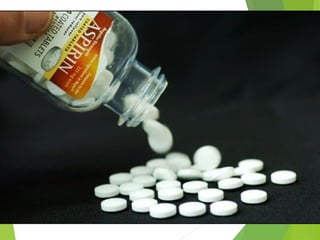
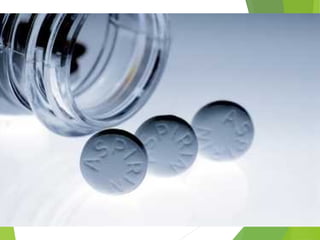
• Low dose aspirin for the
prevention of thrombi
extension
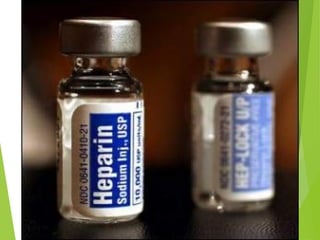
• Heparin/oral anticoagulants
to prevent DVT
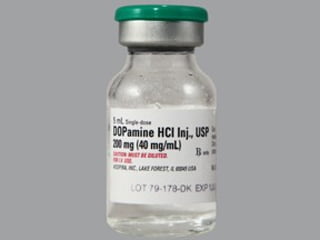
• Dopamine/ dobutamine for
increasing pumping action of
heart
DRUG THERAPY OF
MYOCARDIAL INFARCTION
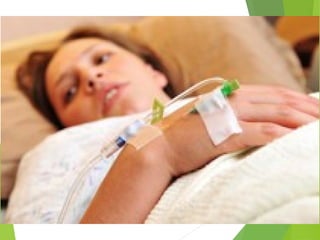
 GTN i.v/nitroprusside for vasodilatation
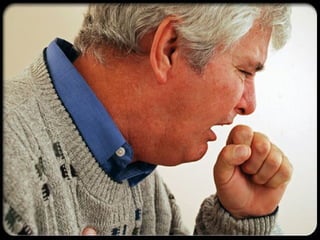
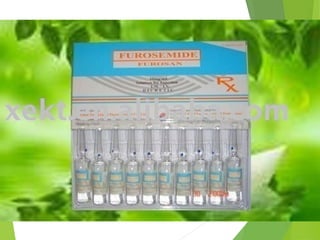
 Frusemide I.V if pulmonary edema present
 i.v beta blocker to prevent arrhythmias
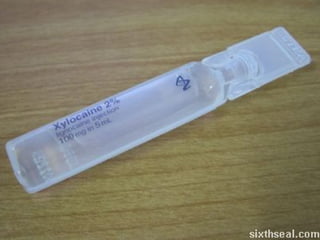
 Lidocaine/procainamide for tachyarrhythmias
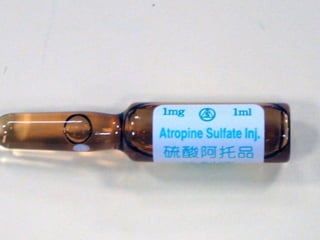
 Atropine for heart block
DRUG THERAPY OF
MYOCARDIAL INFARCTION
• Sodium bicarbonate i.v to correct acidosis
• Slow i.v infusion of saline/LMW dextran
• to maintain blood volume,
• tissue perfusion,
• Microcirculation
• ACE inhibitors/ARB’s to prevent
remodeling, CHF
PREVENTION OF FUTURE
ATTACKS
 Aspirin low dose/clopidogrel given on
long-term basis
 Betablockers to reduce
 risk of reinfarction,
 CHF,
 death
 Statins to control hyperlipidaemias
Any intelligent fool can make things
bigger, more complex, and more violent.
It takes a touch of genius -- and a lot of
courage -- to move in the opposite
direction."
Albert Einstein
THANK YOU

Antianginal drugs satya

  • 5.
    HEART FACTS  Theaverage adult heart beats  72 times a minute;  100,000 times a day;  3,600,000 times a year;  and 2.5 billion times during a lifetime.
  • 6.
    HEART FACTS  Thoughweighing only 11 ounces on average,  a healthy heart pumps  2,000 gallons of blood through  60,000 miles of blood vessels  each day.
  • 7.
    HEART FACTS  5%of blood supplies the heart,  15-20% goes to the brain and central nervous system,  and 22% goes to the kidneys.
  • 8.
    ANGINA PECTORIS  Isa pain syndrome due to an adverse oxygen supply/demand situation in a portion of myocardium
  • 11.
    ANTIANGINAL DRUGS DR. V.SATHYANARAYANANM.D PROFESSOR OF PHARMACOLOGY SRM MCH & RC CHENNAI, INDIA
  • 16.
    TYPES OF ANGINA Classicalangina common form due to fixed coronary obstruction Ischemic pain is felt Subside when the increased energy demand is withdrawn attacks are provoked by  exercise, emotion,  eating or coitus
  • 21.
    Variant angina  Prinzmetal’sangina  Attacks occur at rest or during sleep  Unpredictable  Due to localized coronary vasospasm
  • 23.
    Unstable angina  Rapid increasein duration and severity of attacks Due to rupture of an atheromatous plaque  platelet deposition  progressive occlusion of coronary artery
  • 27.
    HEART FACTS  Thehuman heart begins to beat as early as four weeks after conception
  • 28.
    HEART FACTS  Graba tennis ball and squeeze it tightly:  that’s how hard the beating heart works to pump blood.  A woman’s heart typically beats faster than a man’s.
  • 29.
    HEART FACTS Every day,the heart creates enough energy to drive a truck 20 miles.  In a lifetime, that is equivalent to driving to the moon and back.
  • 30.
    HEART FACTS  Duringan average lifetime,  the heart will pump nearly 1.5 million gallons of blood—  enough to fill 200 train tank cars.
  • 32.
    ANTIANGINAL DRUGS  Prevent,abort or terminate attacks of angina pectoris Do not alter the course of coronary artery pathology
  • 33.
    CLASSIFICATION 1.NITRATES – SHORTACTING –Glyceryl trinitrate LONG ACTING – Isosorbide dinitrate, Isosorbide mononitrate 2.BETABLOCKERS – Propranolol, metoprolol, Atenolol 3.CALCIUM CHANNEL BLOCKERS – Verapamil, Diltiazem, Nifedipine, Amlodipine, Nitrendipine 4.POTASSIUM CHANNEL OPENER – Nicorandil 5.OTHERS – Trimetazidine, Dipyridamole, Oxyfedrine
  • 34.
    NITRATES- GLYCERYL TRINITRATE- (PROTOTYPE) ACTIONS  1. PRELOAD REDUCTION  Dilate veins   peripheral pooling of blood   decrease venous return   decrease preload   decrease cardiac work according to Laplace relationship   decrease oxygen consumption, decrease in the cardiac output
  • 36.
    ACTIONS decrease afterload Some arteriolardilatation  slightly decrease total peripheral resistance decrease afterload  decrease in cardiac work
  • 39.
    ACTIONS Dilate larger coronaryvessels   increase blood flow to ischemic areas
  • 43.
    ACTIONS  Dilate cutaneous bloodvessels  flushing  Dilate meningeal vessels  headache  Shift blood from pulmonary circuit to systemic circuit  decongest lungs
  • 47.
  • 50.
    MECHANISM OF ACTION Denitratedin smooth muscle  release Nitric Oxide  activates cytosolic guanylyl cyclase  increase cGMP  dephosphorylation of MLCK  reduced availability of active MLCK interferes with the activation of Myosin   fails to interact with actin  relaxation  cGMP  decrease ca entry  relaxation
  • 54.
    PHARMACOKINETICS Well absorbed frombuccal mucosa, skin, intestine Lipid soluble Undergo extensive 1st pass metabolism except isosorbide mononitrate Rapidly denitrated  produce less active metabolites with longer t1/2
  • 57.
    ADR  Headache, fullnessin head  Flushing,  weakness  Palpitation,  sweating,  dizziness, fainting  Methemoglobinemia – a problem in severe anemia  Rashes – particularly with pentaerythritol tetranitrate
  • 65.
    TOLERANCE  Decreased effectivenessof nitrates on repeated administration  Seen with GTN used orally, i.v, transdermally  With long acting agents  Cross tolerance also seen  Prevented by keeping nitrate free interval everyday
  • 66.
    DEPENDENCE Seen after suddenwithdrawal after prolonged exposure Myocardial infarction, sudden deaths, increase episodes of angina on record Add a drug of another class Withdrawal must be gradual
  • 69.
    Sex and cardiovascularsystem  CHANGES DURING ORGASM……  Tachycardia  upto 180 beats/ minute  BP  230/130 mmHg even in normotensives  ECG abnormalities may occur  RESPIRATORY RATE  60 / min  SUDDEN DEATHS  CAUTION – older patients with CAD
  • 71.
    INTERACTIONS Potentiation of actionby sildenafil  severe hypotension  MI, deaths With other vasodilators  additive hypotension
  • 74.
    GLYCERYL TRINITRATE Volatile liquid Storedin tight glass container Taken sublingually terminate an anginal attack Acts within 1-2 minutes Also administered as sublingual spray, S.R. capsule, transdermal patch, i.v infusion, transmucosal dosage form Given as i.v infusion in unstable angina, LVF in MI, during cardiac surgeries
  • 84.
    DOCTOR….. DOCTOR….. Patient: It'sbeen one month since my last visit and I still feel miserable. Doctor: Did you follow the instructions on the medicine I gave you? Patient: I sure did - the bottle said 'keep tightly closed.'
  • 85.
    ISOSORBIDE DINITRATE  Solid S/L – Slower acting than GTN  Orally given for chronic prophylaxis  High 1st pass effect  t1/2 - 4O min  Leave 6-10 hr nitrate free interval
  • 86.
    ISOSORBIDE MONO NITRATE Active metabolite of ISDN Little 1st pass effect  high BA  Long acting  SR tablet given once daily in morning
  • 87.
    OTHER NITRATES • Erythrityltetranitrate, Pentaerythritol tetranitrate are longer acting • Used for chronic prophylaxis
  • 89.
    HEART FACTS  Whenthe body is at rest,  it takes only 6 seconds for the blood  to go from the heart to the lungs and back,  only 8 seconds for it  to go the brain and back, and  only 16 seconds for it  to reach the toes and travel all the way back to the heart.
  • 102.
    USES  Angina pectoris–effective in classical angina, variant angina increase exercise tolerance, given as “as and when required” basis  Acute coronary syndromes  Congestive heart failure  Acute left ventricular failure  Myocardial infarction – of marginal benefit  Interventional cardiac procedures  Biliary colic  Esophageal spasm  Cyanide poisoning  Venipuncture
  • 114.
    BETABLOCKERS IN ANGINA Decreasecardiac work, oxygen consumption during exercise, anxiety All are Equally effective in preventing angina Cardio selective beta blockers are preferred To be taken on regular schedule Dosage to be individualized Tolerance does not develop DO NOT DILATE CORONARY VESSELS
  • 118.
    BETABLOCKERS IN ANGINA- CAUTION Sudden withdrawal precipitates angina, even MI  beta-blockers are Contraindicated in variant angina
  • 126.
    SUMMARY  Angina pectorisis a symptom of myocardial ischaemia  Acute attack is treated with GTN 0.5mg sublingually  Affords only symptomatic relief  Nitrates act by reducing pre-load, afterload, dilates coronary arteries  Cause headache, flushing, palpitation as side effects  Betablockers are useful in the prophylaxis  Withdrawal of these drugs must be gradual  Sildenafil usage during nitrates therapy may be fatal
  • 129.
    CALCIUM CHANNEL BLOCKERS Verapamil  Nifedipine  Diltiazem
  • 131.
    PHARMACOLOGICAL ACTIONS  Smoothmuscle relaxation –  arterioles, bronchi, biliary, intestinal, bladder, uterine relaxation-  Marked with DHP group ( nifedipine)  Heart –  negative inotropic, chronotropic, dromotropic action –  marked with verapamil, lesser extent with diltiazem, not with DHP group
  • 134.
    VERAPAMIL  Decreases heartrate, A-V conduction, dilates arterioles, decreases t.p.r  ADR- nausea, constipation, bradycardia  C/I – A-V block, CHF  D/I – Should not be given with betablockers, quinidine, increases digoxin level
  • 141.
    DILTIAZEM  Cause consistentfall in BP, dilate coronaries  Less potent vasodilator than nifedipine & verapamil  Modest negative inotropic action  ADR – similar as verapamil
  • 145.
    NIFEDIPINE  Prototype ofDHP  Arteriolar dilatation  t.p.r decreases  fall in BP  ADR – palpitation, flushing, ankle edema, hypotension, headache  ADR can be minimized by low starting dose, using retard formulation
  • 151.
    FELODIPINE  Greater vascularselectivity  Larger tissue distribution  Long t ½
  • 152.
    AMLODIPINE  Slow oralabsorption  Devoid of vasodilator side effects like flushing, palpitation, headache, postural dizziness  Long t1/2  Diurnal fluctuation is small  Action extends over next morning
  • 159.
    NITRENDIPINE  Release nitricoxide  additional mechanism For vasodilatation  Retard atherosclerosis  Indicated in hypertension, angina pectoris
  • 162.
    LACIDIPINE  Highly vasoselectivenewer DHP  Once daily dose  Used only in hypertension
  • 164.
    NIMODIPINE  Short actingDHP  Selectively relaxes cerebral blood vessels  Used in treating neurological deficit due to cerebral vasospasm following subarachnoid hemorrhage
  • 168.
    USES OF CALCIUMCHANNEL BLOCKERS • Can be safely given where beta blockers are contraindicated ( COPD, PVD ) • Angina pectoris – in both classical angina & variant angina • reduce afterload, long acting DHP are preferred • Myocardial Infarction - verapamil/diltiazem given in secondary prophylaxis where beta blockers are contraindicated • Hypertension • Cardiac arrhythmias
  • 176.
    OTHER USES OFCALCIUM CHANNEL BLOCKERS  Hypertrophic cardiomyopathy – verapamil  Premature labour – nifedipine  Migraine – verapamil  Raynaud’s phenomenon – DHP’s  Nocturnal leg cramps
  • 184.
    RATIONAL DRUG COMBINATIONS •When mono therapy fails to give relief • Beta blockers + long-acting nitrates – • tachycardia due to nitrates is blocked, • ventricular dilatation, reduced coronary blood flow due to B –blocker is blocked • Slow acting DHP Ca channel blocker + B-blocker • Nitrates + CCB  Valuable in severe vasospastic angina • Nitrates + B-blocker + CCB in resistant cases • (VERAPAMIL/DILTIAZEM should be avoided in such combinations)
  • 187.
    POTASSIUM CHANNEL OPENERS  Minoxidil,diazoxide  Nicorandil  Pinacidil  cromokalim
  • 188.
    MECHANISM OF ACTION Activates ATP sensitive K+ Channels   increase outflow of K+ ions   hyperpolarisation   decrease Ca++ entry   smooth muscle relaxation
  • 190.
    NICORANDIL  Novel antianginaldrug  Cause arteriolar, venodilatation  Increase coronary blood flow  Beneficial effects similar to nitrates, CCB’s, B-blockers  Decrease myocardial stunning, infarct size, arrhythmias in MI  Dose – 5-20 mg bd
  • 194.
    Side effects  headache, flushing,  palpitation,  dizziness,  painful apthous ulcers
  • 201.
    POTENTIAL CLINICAL APPLICATIONS  Anginapectoris when tolerance is a problem, when others are contraindicated  Hypertension  CHF  Myocardial salvage in MI
  • 206.
    POTENTIAL CLINICAL APPLICATIONS  Bronchialasthma  Peripheral vascular disease  Premature labour  Urinary urge incontinence  Penile erection disorder
  • 212.
    DIPYRIDAMOLE  Powerful coronarydilator  Can cause coronary steal phenomenon  Inhibits platelet aggregation  Not useful as an antianginal drug  Used in the prophylaxis in post MI, post stroke to prevent thrombosis
  • 217.
    TRIMETAZIDINE  Novel antianginaldrug  Improve cellular tolerance to ischemia by inhibiting LC3CAT  Reduce anginal attacks in patients not responding to other drugs  ADR- gastric burning, dizziness, fatigue, parkinsonism  Useful as an add on medication to conventional therapy in angina, post MI
  • 219.
    RANOLAZINE  Trimetazidine congener Spares fatty acid oxidation and shifts ATP production to more O2 efficient carbohydrate oxidation  Torsades de pointes is a risk  Recommended only in combination
  • 221.
    IVABRADINE  Pure hearrate lowering antianginal drug  Recently introduced as an alternative to betablockers  Blocks cardiac pacemaker cell “f” channels  decreases heart rate  decreases oxygen demand,  prolongs diastole  improves myocardial blood flow  increased oxygen supply  ADR  VISUAL DISTURBANCES, headache, dizziness, nausea  USES  chronic stable angina pectoris alternate to betablockers, inappropriate sinus tachycardia
  • 223.
    DRUGS FOR PERIPHERAL VASCULARDISEASES  CYCLANDELATE  XANTHINOL NICOTINATE  PENTOXIPHYLLINE  CILOSTAZOLE  CCBs  ALPHABLOCKERS  PGI2  severe cases with rest pain
  • 224.
    PENTOXIPHYLLINE  Analogue oftheophylline  Weak PDE inhibitor  Increases blood flow in ischemic areas by reducing whole blood viscosity,  And by improving flexibility of RBCs  ADR  nausea, vomiting, dyspepsia, bloating  USES  intermittent claudication, Trophic leg ulcers, TIAs
  • 227.
    CILOSTAZOLE  PDE-3 inhibitor Increases cyclic AMP  vasodilatation, antiplatelet aggregating activity  More effective than pentoxiphylline for claudication pain  Not to be used in heart failure  ADR  HEADACHE, nausea, dizziness, palpitation, weakness  USES  intermittent claudication with no rest pain or heart failure
  • 230.
    MYOCARDIAL INFARCTION  Ischaemicnecrosis of a portion of the myocardium due to sudden occlusion of a branch of coronary artery  Acute thrombus is the cause  25% die before therapy  Has to be treated in I.C.C.U’S
  • 241.
    DRUG THERAPY OF MYOCARDIALINFARCTION  Parenteral Morphine/pethidine,  diazepam for pain, anxiety, fear  Oxygenation  Streptokinase/ urokinase/ alteplase for thrombolysis
  • 249.
    DRUG THERAPY OFMYOCARDIAL INFARCTION • Low dose aspirin for the prevention of thrombi extension • Heparin/oral anticoagulants to prevent DVT • Dopamine/ dobutamine for increasing pumping action of heart
  • 253.
    DRUG THERAPY OF MYOCARDIALINFARCTION  GTN i.v/nitroprusside for vasodilatation  Frusemide I.V if pulmonary edema present  i.v beta blocker to prevent arrhythmias  Lidocaine/procainamide for tachyarrhythmias  Atropine for heart block
  • 263.
    DRUG THERAPY OF MYOCARDIALINFARCTION • Sodium bicarbonate i.v to correct acidosis • Slow i.v infusion of saline/LMW dextran • to maintain blood volume, • tissue perfusion, • Microcirculation • ACE inhibitors/ARB’s to prevent remodeling, CHF
  • 268.
    PREVENTION OF FUTURE ATTACKS Aspirin low dose/clopidogrel given on long-term basis  Betablockers to reduce  risk of reinfarction,  CHF,  death  Statins to control hyperlipidaemias
  • 297.
    Any intelligent foolcan make things bigger, more complex, and more violent. It takes a touch of genius -- and a lot of courage -- to move in the opposite direction." Albert Einstein
  • 300.