KEY


                               GENERAL CHEMISTRY-I (1411)
                                        S.I. # 22

1. In what two ways can an object possess energy? How do these two ways differ
from one another?
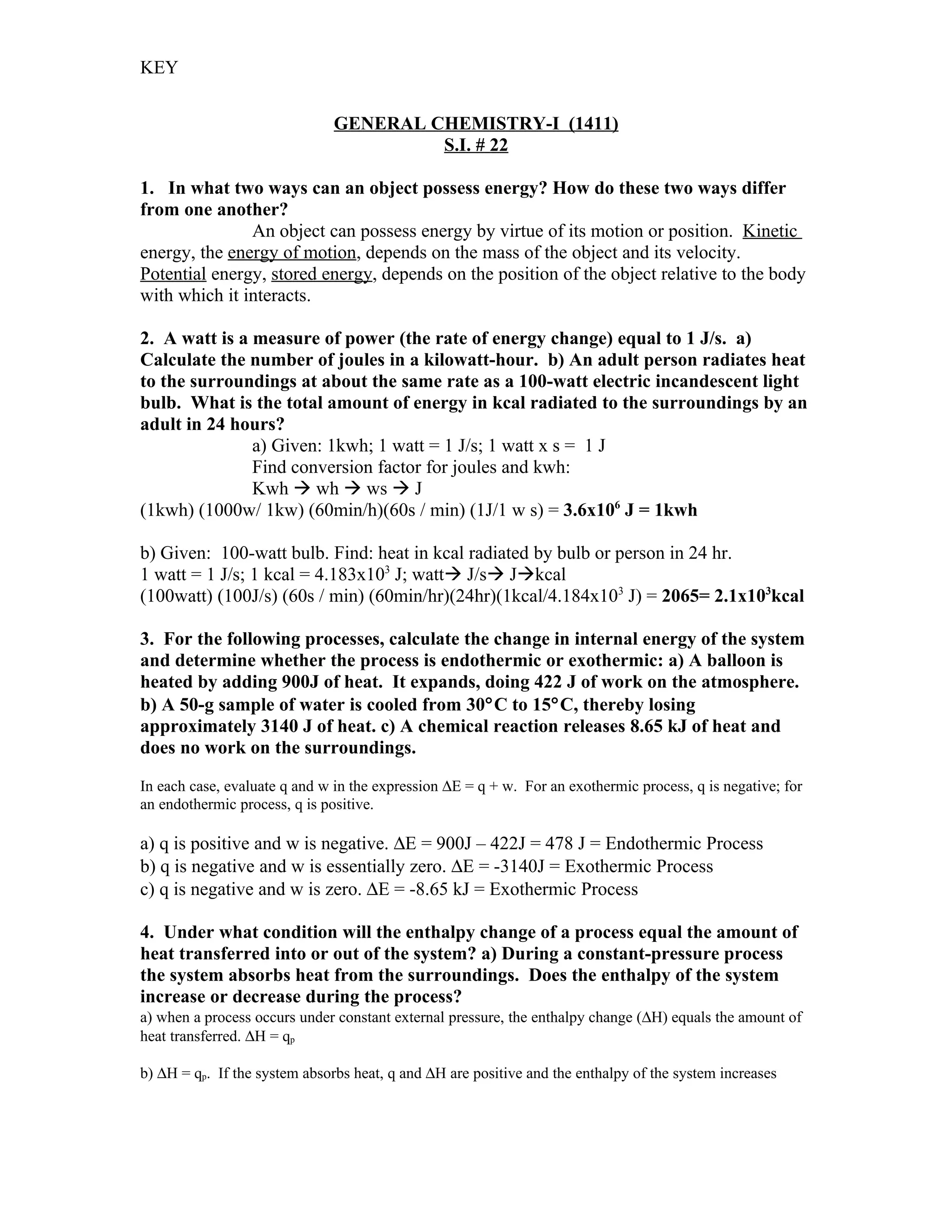
               An object can possess energy by virtue of its motion or position. Kinetic
energy, the energy of motion, depends on the mass of the object and its velocity.
Potential energy, stored energy, depends on the position of the object relative to the body
with which it interacts.

2. A watt is a measure of power (the rate of energy change) equal to 1 J/s. a)
Calculate the number of joules in a kilowatt-hour. b) An adult person radiates heat
to the surroundings at about the same rate as a 100-watt electric incandescent light
bulb. What is the total amount of energy in kcal radiated to the surroundings by an
adult in 24 hours?
               a) Given: 1kwh; 1 watt = 1 J/s; 1 watt x s = 1 J
               Find conversion factor for joules and kwh:
               Kwh  wh  ws  J
(1kwh) (1000w/ 1kw) (60min/h)(60s / min) (1J/1 w s) = 3.6x10⁶ J = 1kwh

b) Given: 100-watt bulb. Find: heat in kcal radiated by bulb or person in 24 hr.
1 watt = 1 J/s; 1 kcal = 4.183x10³ J; watt J/s Jkcal
(100watt) (100J/s) (60s / min) (60min/hr)(24hr)(1kcal/4.184x103 J) = 2065= 2.1x10³kcal

3. For the following processes, calculate the change in internal energy of the system
and determine whether the process is endothermic or exothermic: a) A balloon is
heated by adding 900J of heat. It expands, doing 422 J of work on the atmosphere.
b) A 50-g sample of water is cooled from 30°C to 15°C, thereby losing
approximately 3140 J of heat. c) A chemical reaction releases 8.65 kJ of heat and
does no work on the surroundings.

In each case, evaluate q and w in the expression ∆E = q + w. For an exothermic process, q is negative; for
an endothermic process, q is positive.

a) q is positive and w is negative. ∆E = 900J – 422J = 478 J = Endothermic Process
b) q is negative and w is essentially zero. ∆E = -3140J = Exothermic Process
c) q is negative and w is zero. ∆E = -8.65 kJ = Exothermic Process

4. Under what condition will the enthalpy change of a process equal the amount of
heat transferred into or out of the system? a) During a constant-pressure process
the system absorbs heat from the surroundings. Does the enthalpy of the system
increase or decrease during the process?
a) when a process occurs under constant external pressure, the enthalpy change (∆H) equals the amount of
heat transferred. ∆H = qp

b) ∆H = qp. If the system absorbs heat, q and ∆H are positive and the enthalpy of the system increases
KEY


5. When solutions containing silver ions and chloride ions are mixed, silver chloride
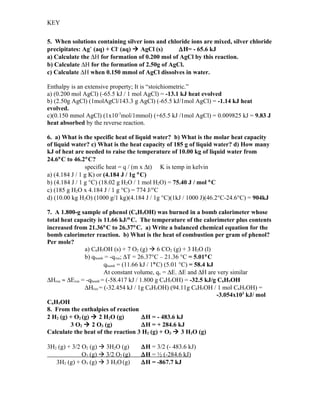
precipitates: Ag+ (aq) + Cl- (aq)  AgCl (s)     ∆H= - 65.6 kJ
a) Calculate the ∆H for formation of 0.200 mol of AgCl by this reaction.
b) Calculate ∆H for the formation of 2.50g of AgCl.
c) Calculate ∆H when 0.150 mmol of AgCl dissolves in water.

Enthalpy is an extensive property; It is “stoichiometric.”
a) (0.200 mol AgCl) (-65.5 kJ / 1 mol AgCl) = -13.1 kJ heat evolved
b) (2.50g AgCl) (1molAgCl/143.3 g AgCl) (-65.5 kJ/1mol AgCl) = -1.14 kJ heat
evolved.
c)(0.150 mmol AgCl) (1x10⁻³mol/1mmol) (+65.5 kJ /1mol AgCl) = 0.009825 kJ = 9.83 J
heat absorbed by the reverse reaction.

6. a) What is the specific heat of liquid water? b) What is the molar heat capacity
of liquid water? c) What is the heat capacity of 185 g of liquid water? d) How many
kJ of heat are needed to raise the temperature of 10.00 kg of liquid water from
24.6°C to 46.2°C?
                specific heat = q / (m x ∆t) K is temp in kelvin
a) (4.184 J / 1 g K) or (4.184 J / 1g °C)
b) (4.184 J / 1 g °C) (18.02 g H2O / 1 mol H2O) = 75.40 J / mol °C
c) (185 g H2O x 4.184 J / 1 g °C) = 774 J/°C
d) (10.00 kg H2O) (1000 g/1 kg)(4.184 J / 1g °C)(1kJ / 1000 J)(46.2°C-24.6°C) = 904kJ

7. A 1.800-g sample of phenol (C6H5OH) was burned in a bomb calorimeter whose
total heat capacity is 11.66 kJ/°C. The temperature of the calorimeter plus contents
increased from 21.36°C to 26.37°C. a) Write a balanced chemical equation for the
bomb calorimeter reaction. b) What is the heat of combustion per gram of phenol?
Per mole?
               a) C6H5OH (s) + 7 O2 (g)  6 CO2 (g) + 3 H2O (l)
               b) qbomb = -qrxn; ∆T = 26.37°C – 21.36 °C = 5.01°C
                        qbomb = (11.66 kJ / 1°C) (5.01 °C) = 58.4 kJ
                        At constant volume, qv = ∆E. ∆E and ∆H are very similar
∆Hrxn ≈ ∆Erxn = -qbomb = (-58.417 kJ / 1.800 g C6H5OH) = -32.5 kJ/g C6H5OH
               ∆Hrxn = (-32.454 kJ / 1g C6H5OH) (94.11g C6H5OH / 1 mol C6H5OH) =
                                                                     -3.054x10³ kJ/ mol
C6H5OH
8. From the enthalpies of reaction
2 H2 (g) + O2 (g)  2 H2O (g)           ∆H = - 483.6 kJ
         3 O2  2 O3 (g)                ∆H = + 284.6 kJ
Calculate the heat of the reaction 3 H2 (g) + O3  3 H2O (g)

3H2 (g) + 3/2 O2 (g)  3H2O (g)     ∆H = 3/2 (- 483.6 kJ)
              O3 (g)  3/2 O2 (g)   ∆ H = ½ (-284.6 kJ)
   3H2 (g) + O3 (g)  3 H2O (g)     ∆H = -867.7 kJ

#22 Key

  • 1.
    KEY GENERAL CHEMISTRY-I (1411) S.I. # 22 1. In what two ways can an object possess energy? How do these two ways differ from one another? An object can possess energy by virtue of its motion or position. Kinetic energy, the energy of motion, depends on the mass of the object and its velocity. Potential energy, stored energy, depends on the position of the object relative to the body with which it interacts. 2. A watt is a measure of power (the rate of energy change) equal to 1 J/s. a) Calculate the number of joules in a kilowatt-hour. b) An adult person radiates heat to the surroundings at about the same rate as a 100-watt electric incandescent light bulb. What is the total amount of energy in kcal radiated to the surroundings by an adult in 24 hours? a) Given: 1kwh; 1 watt = 1 J/s; 1 watt x s = 1 J Find conversion factor for joules and kwh: Kwh  wh  ws  J (1kwh) (1000w/ 1kw) (60min/h)(60s / min) (1J/1 w s) = 3.6x10⁶ J = 1kwh b) Given: 100-watt bulb. Find: heat in kcal radiated by bulb or person in 24 hr. 1 watt = 1 J/s; 1 kcal = 4.183x10³ J; watt J/s Jkcal (100watt) (100J/s) (60s / min) (60min/hr)(24hr)(1kcal/4.184x103 J) = 2065= 2.1x10³kcal 3. For the following processes, calculate the change in internal energy of the system and determine whether the process is endothermic or exothermic: a) A balloon is heated by adding 900J of heat. It expands, doing 422 J of work on the atmosphere. b) A 50-g sample of water is cooled from 30°C to 15°C, thereby losing approximately 3140 J of heat. c) A chemical reaction releases 8.65 kJ of heat and does no work on the surroundings. In each case, evaluate q and w in the expression ∆E = q + w. For an exothermic process, q is negative; for an endothermic process, q is positive. a) q is positive and w is negative. ∆E = 900J – 422J = 478 J = Endothermic Process b) q is negative and w is essentially zero. ∆E = -3140J = Exothermic Process c) q is negative and w is zero. ∆E = -8.65 kJ = Exothermic Process 4. Under what condition will the enthalpy change of a process equal the amount of heat transferred into or out of the system? a) During a constant-pressure process the system absorbs heat from the surroundings. Does the enthalpy of the system increase or decrease during the process? a) when a process occurs under constant external pressure, the enthalpy change (∆H) equals the amount of heat transferred. ∆H = qp b) ∆H = qp. If the system absorbs heat, q and ∆H are positive and the enthalpy of the system increases
  • 2.
    KEY 5. When solutionscontaining silver ions and chloride ions are mixed, silver chloride precipitates: Ag+ (aq) + Cl- (aq)  AgCl (s) ∆H= - 65.6 kJ a) Calculate the ∆H for formation of 0.200 mol of AgCl by this reaction. b) Calculate ∆H for the formation of 2.50g of AgCl. c) Calculate ∆H when 0.150 mmol of AgCl dissolves in water. Enthalpy is an extensive property; It is “stoichiometric.” a) (0.200 mol AgCl) (-65.5 kJ / 1 mol AgCl) = -13.1 kJ heat evolved b) (2.50g AgCl) (1molAgCl/143.3 g AgCl) (-65.5 kJ/1mol AgCl) = -1.14 kJ heat evolved. c)(0.150 mmol AgCl) (1x10⁻³mol/1mmol) (+65.5 kJ /1mol AgCl) = 0.009825 kJ = 9.83 J heat absorbed by the reverse reaction. 6. a) What is the specific heat of liquid water? b) What is the molar heat capacity of liquid water? c) What is the heat capacity of 185 g of liquid water? d) How many kJ of heat are needed to raise the temperature of 10.00 kg of liquid water from 24.6°C to 46.2°C? specific heat = q / (m x ∆t) K is temp in kelvin a) (4.184 J / 1 g K) or (4.184 J / 1g °C) b) (4.184 J / 1 g °C) (18.02 g H2O / 1 mol H2O) = 75.40 J / mol °C c) (185 g H2O x 4.184 J / 1 g °C) = 774 J/°C d) (10.00 kg H2O) (1000 g/1 kg)(4.184 J / 1g °C)(1kJ / 1000 J)(46.2°C-24.6°C) = 904kJ 7. A 1.800-g sample of phenol (C6H5OH) was burned in a bomb calorimeter whose total heat capacity is 11.66 kJ/°C. The temperature of the calorimeter plus contents increased from 21.36°C to 26.37°C. a) Write a balanced chemical equation for the bomb calorimeter reaction. b) What is the heat of combustion per gram of phenol? Per mole? a) C6H5OH (s) + 7 O2 (g)  6 CO2 (g) + 3 H2O (l) b) qbomb = -qrxn; ∆T = 26.37°C – 21.36 °C = 5.01°C qbomb = (11.66 kJ / 1°C) (5.01 °C) = 58.4 kJ At constant volume, qv = ∆E. ∆E and ∆H are very similar ∆Hrxn ≈ ∆Erxn = -qbomb = (-58.417 kJ / 1.800 g C6H5OH) = -32.5 kJ/g C6H5OH ∆Hrxn = (-32.454 kJ / 1g C6H5OH) (94.11g C6H5OH / 1 mol C6H5OH) = -3.054x10³ kJ/ mol C6H5OH 8. From the enthalpies of reaction 2 H2 (g) + O2 (g)  2 H2O (g) ∆H = - 483.6 kJ 3 O2  2 O3 (g) ∆H = + 284.6 kJ Calculate the heat of the reaction 3 H2 (g) + O3  3 H2O (g) 3H2 (g) + 3/2 O2 (g)  3H2O (g) ∆H = 3/2 (- 483.6 kJ) O3 (g)  3/2 O2 (g) ∆ H = ½ (-284.6 kJ) 3H2 (g) + O3 (g)  3 H2O (g) ∆H = -867.7 kJ