KEY


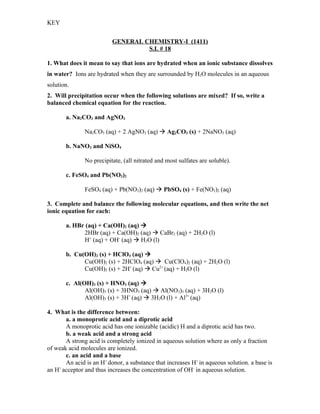
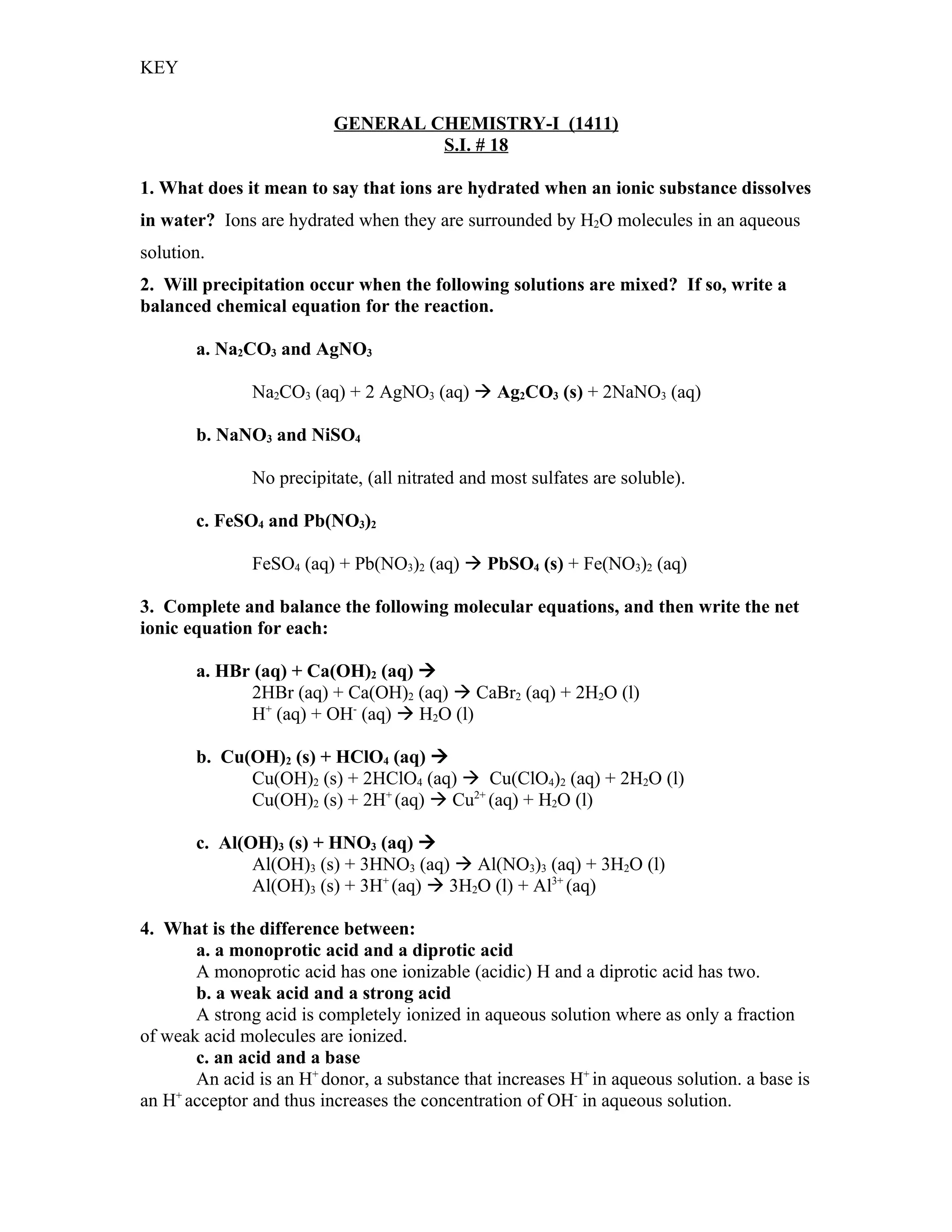
                          GENERAL CHEMISTRY-I (1411)
                                   S.I. # 18

1. What does it mean to say that ions are hydrated when an ionic substance dissolves
in water? Ions are hydrated when they are surrounded by H2O molecules in an aqueous
solution.
2. Will precipitation occur when the following solutions are mixed? If so, write a
balanced chemical equation for the reaction.

       a. Na2CO3 and AgNO3

               Na2CO3 (aq) + 2 AgNO3 (aq)  Ag2CO3 (s) + 2NaNO3 (aq)

       b. NaNO3 and NiSO4

               No precipitate, (all nitrated and most sulfates are soluble).

       c. FeSO4 and Pb(NO3)2

               FeSO4 (aq) + Pb(NO3)2 (aq)  PbSO4 (s) + Fe(NO3)2 (aq)

3. Complete and balance the following molecular equations, and then write the net
ionic equation for each:

       a. HBr (aq) + Ca(OH)2 (aq) 
             2HBr (aq) + Ca(OH)2 (aq)  CaBr2 (aq) + 2H2O (l)
             H+ (aq) + OH- (aq)  H2O (l)

       b. Cu(OH)2 (s) + HClO4 (aq) 
             Cu(OH)2 (s) + 2HClO4 (aq)  Cu(ClO4)2 (aq) + 2H2O (l)
             Cu(OH)2 (s) + 2H+ (aq)  Cu2+ (aq) + H2O (l)

       c. Al(OH)3 (s) + HNO3 (aq) 
              Al(OH)3 (s) + 3HNO3 (aq)  Al(NO3)3 (aq) + 3H2O (l)
              Al(OH)3 (s) + 3H+ (aq)  3H2O (l) + Al3+ (aq)

4. What is the difference between:
       a. a monoprotic acid and a diprotic acid
       A monoprotic acid has one ionizable (acidic) H and a diprotic acid has two.
       b. a weak acid and a strong acid
       A strong acid is completely ionized in aqueous solution where as only a fraction
of weak acid molecules are ionized.
       c. an acid and a base
       An acid is an H+ donor, a substance that increases H+ in aqueous solution. a base is
an H acceptor and thus increases the concentration of OH- in aqueous solution.
    +
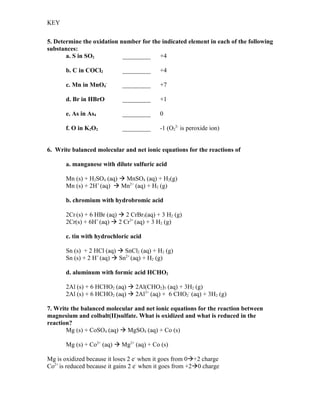
KEY


5. Determine the oxidation number for the indicated element in each of the following
substances:
       a. S in SO2          _________    +4

       b. C in COCl2         _________     +4

       c. Mn in MnO4-        _________     +7

       d. Br in HBrO         _________     +1

       e. As in As4          _________     0

       f. O in K2O2          _________     -1 (O22- is peroxide ion)


6. Write balanced molecular and net ionic equations for the reactions of

       a. manganese with dilute sulfuric acid

       Mn (s) + H2SO4 (aq)  MnSO4 (aq) + H2(g)
       Mn (s) + 2H+ (aq)  Mn2+ (aq) + H2 (g)

       b. chromium with hydrobromic acid

       2Cr (s) + 6 HBr (aq)  2 CrBr3(aq) + 3 H2 (g)
       2Cr(s) + 6H+ (aq)  2 Cr3+ (aq) + 3 H2 (g)

       c. tin with hydrochloric acid

       Sn (s) + 2 HCl (aq)  SnCl2 (aq) + H2 (g)
       Sn (s) + 2 H+ (aq)  Sn2+ (aq) + H2 (g)

       d. aluminum with formic acid HCHO2

       2Al (s) + 6 HCHO2 (aq)  2Al(CHO2)3 (aq) + 3H2 (g)
       2Al (s) + 6 HCHO2 (aq)  2Al3+ (aq) + 6 CHO2- (aq) + 3H2 (g)

7. Write the balanced molecular and net ionic equations for the reaction between
magnesium and colbalt(II)sulfate. What is oxidized and what is reduced in the
reaction?
       Mg (s) + CoSO4 (aq)  MgSO4 (aq) + Co (s)

       Mg (s) + Co2+ (aq)  Mg2+ (aq) + Co (s)

Mg is oxidized because it loses 2 e- when it goes from 0+2 charge
Co2+ is reduced because it gains 2 e- when it goes from +20 charge

#18 Key

  • 1.
    KEY GENERAL CHEMISTRY-I (1411) S.I. # 18 1. What does it mean to say that ions are hydrated when an ionic substance dissolves in water? Ions are hydrated when they are surrounded by H2O molecules in an aqueous solution. 2. Will precipitation occur when the following solutions are mixed? If so, write a balanced chemical equation for the reaction. a. Na2CO3 and AgNO3 Na2CO3 (aq) + 2 AgNO3 (aq)  Ag2CO3 (s) + 2NaNO3 (aq) b. NaNO3 and NiSO4 No precipitate, (all nitrated and most sulfates are soluble). c. FeSO4 and Pb(NO3)2 FeSO4 (aq) + Pb(NO3)2 (aq)  PbSO4 (s) + Fe(NO3)2 (aq) 3. Complete and balance the following molecular equations, and then write the net ionic equation for each: a. HBr (aq) + Ca(OH)2 (aq)  2HBr (aq) + Ca(OH)2 (aq)  CaBr2 (aq) + 2H2O (l) H+ (aq) + OH- (aq)  H2O (l) b. Cu(OH)2 (s) + HClO4 (aq)  Cu(OH)2 (s) + 2HClO4 (aq)  Cu(ClO4)2 (aq) + 2H2O (l) Cu(OH)2 (s) + 2H+ (aq)  Cu2+ (aq) + H2O (l) c. Al(OH)3 (s) + HNO3 (aq)  Al(OH)3 (s) + 3HNO3 (aq)  Al(NO3)3 (aq) + 3H2O (l) Al(OH)3 (s) + 3H+ (aq)  3H2O (l) + Al3+ (aq) 4. What is the difference between: a. a monoprotic acid and a diprotic acid A monoprotic acid has one ionizable (acidic) H and a diprotic acid has two. b. a weak acid and a strong acid A strong acid is completely ionized in aqueous solution where as only a fraction of weak acid molecules are ionized. c. an acid and a base An acid is an H+ donor, a substance that increases H+ in aqueous solution. a base is an H acceptor and thus increases the concentration of OH- in aqueous solution. +
  • 2.
    KEY 5. Determine theoxidation number for the indicated element in each of the following substances: a. S in SO2 _________ +4 b. C in COCl2 _________ +4 c. Mn in MnO4- _________ +7 d. Br in HBrO _________ +1 e. As in As4 _________ 0 f. O in K2O2 _________ -1 (O22- is peroxide ion) 6. Write balanced molecular and net ionic equations for the reactions of a. manganese with dilute sulfuric acid Mn (s) + H2SO4 (aq)  MnSO4 (aq) + H2(g) Mn (s) + 2H+ (aq)  Mn2+ (aq) + H2 (g) b. chromium with hydrobromic acid 2Cr (s) + 6 HBr (aq)  2 CrBr3(aq) + 3 H2 (g) 2Cr(s) + 6H+ (aq)  2 Cr3+ (aq) + 3 H2 (g) c. tin with hydrochloric acid Sn (s) + 2 HCl (aq)  SnCl2 (aq) + H2 (g) Sn (s) + 2 H+ (aq)  Sn2+ (aq) + H2 (g) d. aluminum with formic acid HCHO2 2Al (s) + 6 HCHO2 (aq)  2Al(CHO2)3 (aq) + 3H2 (g) 2Al (s) + 6 HCHO2 (aq)  2Al3+ (aq) + 6 CHO2- (aq) + 3H2 (g) 7. Write the balanced molecular and net ionic equations for the reaction between magnesium and colbalt(II)sulfate. What is oxidized and what is reduced in the reaction? Mg (s) + CoSO4 (aq)  MgSO4 (aq) + Co (s) Mg (s) + Co2+ (aq)  Mg2+ (aq) + Co (s) Mg is oxidized because it loses 2 e- when it goes from 0+2 charge Co2+ is reduced because it gains 2 e- when it goes from +20 charge