2-23 skepticism and perception
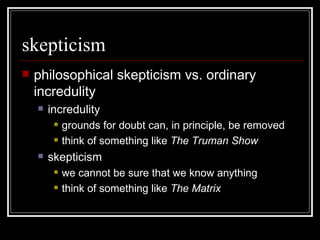
skepticism philosophical skepticism vs. ordinary incredulity incredulity grounds for doubt can, in principle, be removed think of something like  The Truman Show skepticism we cannot be sure that we know anything think of something like  The Matrix
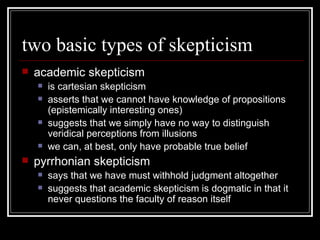
two basic types of skepticism academic skepticism is cartesian skepticism asserts that we cannot have knowledge of propositions (epistemically interesting ones) suggests that we simply have no way to distinguish veridical perceptions from illusions we can, at best, only have probable true belief pyrrhonian skepticism says that we have must withhold judgment altogether suggests that academic skepticism is dogmatic in that it never questions the faculty of reason itself
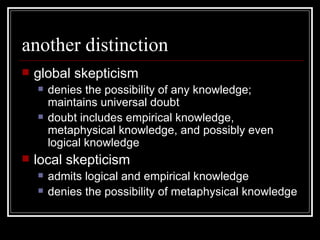
another distinction global skepticism denies the possibility of any knowledge; maintains universal doubt doubt includes empirical knowledge, metaphysical knowledge, and possibly even logical knowledge local skepticism admits logical and empirical knowledge denies the possibility of metaphysical knowledge
where skepticism lies primarily attacks the notion of justification in our concept of knowledge (justified, true belief) questions whether or not we can trust anything our senses “tell” us hume points out that we never experience the actual relation between cause and effect.  rather, we use inductive reasoning to get us to the probable, and this is merely custom or habit, and this can never get us knowledge in any strong sense.
counter-arguments we do have knowledge of external world this argument just says that we, obviously, have knowledge.  as skepticism maintains that such knowledge is not possible, skepticism is wrong.  think of moore offering evidence that he does indeed have hands by holding up his hands this line of argument is question-begging.  that is, it presumes exactly what is in question in order to reach its conclusion the skeptic is merely dogmatic hospers says that a skeptic who refuses to accept good reasons has made ‘doubt’ an empty word what is the reason for doubt in cases where we have excellent justification? we have knowledge just when we have good reasons to believe something is the case relies on a weaker version of knowledge using this, can i say that i know that i know?
perception appearance does not necessarily imply reality what is the direct object of awareness when we perceive? direct realism representationalism phenomenalism
direct realism object of perception is a physical object existing independently of our awareness of it this suggests that the qualities we experience really are in the world  in the way that we experience them often says that the concept of an object is contained in the object itself one might wonder why it is, then, that computers and infants seem to have such a difficult time making distinctions between objects
representationalism there is a source of data, the real world this data is taken in through sensory apparatus, e.g. eyes, ears, etc., and it is here that there is a sensory representation the external world is explicitly the cause of the representation, and this representation systematically reflects objects which have an independent existence in the external world an alternative version is this: this representation is then acted upon by some cognitive mechanism that applies concepts to the representation in order to make use of it the result of such a process is, predictably, that the output of the system is always quantitatively less than the input, and in this way abstraction and categories are possible; perception just is the application of some conceptual framework that acts as a filter for detecting relevant information the upshot is that, although the sensory representation is caused by the external world, we have no way of discussing what the “real” world might be like as doing such would necessarily invoke some conceptual framework, and such frameworks are always subject to change
phenomenalism physical objects are simply constructions of sense data; they do not exist independently of sense impressions scientific discourse is purely instrumental, a useful fiction in order to have some experience one need only get into the appropriate position nothing exists except sensations and the minds that perceive them

2-23

  • 1.
  • 2.
    skepticism philosophical skepticismvs. ordinary incredulity incredulity grounds for doubt can, in principle, be removed think of something like The Truman Show skepticism we cannot be sure that we know anything think of something like The Matrix
  • 3.
    two basic typesof skepticism academic skepticism is cartesian skepticism asserts that we cannot have knowledge of propositions (epistemically interesting ones) suggests that we simply have no way to distinguish veridical perceptions from illusions we can, at best, only have probable true belief pyrrhonian skepticism says that we have must withhold judgment altogether suggests that academic skepticism is dogmatic in that it never questions the faculty of reason itself
  • 4.
    another distinction globalskepticism denies the possibility of any knowledge; maintains universal doubt doubt includes empirical knowledge, metaphysical knowledge, and possibly even logical knowledge local skepticism admits logical and empirical knowledge denies the possibility of metaphysical knowledge
  • 5.
    where skepticism liesprimarily attacks the notion of justification in our concept of knowledge (justified, true belief) questions whether or not we can trust anything our senses “tell” us hume points out that we never experience the actual relation between cause and effect. rather, we use inductive reasoning to get us to the probable, and this is merely custom or habit, and this can never get us knowledge in any strong sense.
  • 6.
    counter-arguments we dohave knowledge of external world this argument just says that we, obviously, have knowledge. as skepticism maintains that such knowledge is not possible, skepticism is wrong. think of moore offering evidence that he does indeed have hands by holding up his hands this line of argument is question-begging. that is, it presumes exactly what is in question in order to reach its conclusion the skeptic is merely dogmatic hospers says that a skeptic who refuses to accept good reasons has made ‘doubt’ an empty word what is the reason for doubt in cases where we have excellent justification? we have knowledge just when we have good reasons to believe something is the case relies on a weaker version of knowledge using this, can i say that i know that i know?
  • 7.
    perception appearance doesnot necessarily imply reality what is the direct object of awareness when we perceive? direct realism representationalism phenomenalism
  • 8.
    direct realism objectof perception is a physical object existing independently of our awareness of it this suggests that the qualities we experience really are in the world in the way that we experience them often says that the concept of an object is contained in the object itself one might wonder why it is, then, that computers and infants seem to have such a difficult time making distinctions between objects
  • 9.
    representationalism there isa source of data, the real world this data is taken in through sensory apparatus, e.g. eyes, ears, etc., and it is here that there is a sensory representation the external world is explicitly the cause of the representation, and this representation systematically reflects objects which have an independent existence in the external world an alternative version is this: this representation is then acted upon by some cognitive mechanism that applies concepts to the representation in order to make use of it the result of such a process is, predictably, that the output of the system is always quantitatively less than the input, and in this way abstraction and categories are possible; perception just is the application of some conceptual framework that acts as a filter for detecting relevant information the upshot is that, although the sensory representation is caused by the external world, we have no way of discussing what the “real” world might be like as doing such would necessarily invoke some conceptual framework, and such frameworks are always subject to change
  • 10.
    phenomenalism physical objectsare simply constructions of sense data; they do not exist independently of sense impressions scientific discourse is purely instrumental, a useful fiction in order to have some experience one need only get into the appropriate position nothing exists except sensations and the minds that perceive them